Skyler Schrempp's Blog, page 2
May 15, 2022
Amber and Clay
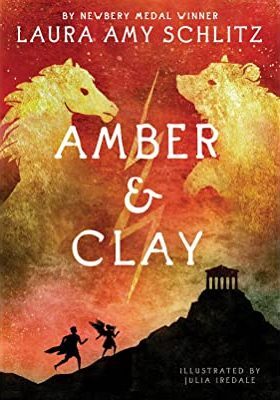
Title: Amber and Clay
Author: Laura Amy Schlitz
Setting: Ancient Greece
Recommended Age: Middle Grade
What it’s about…Amber and Clay is a part-verse, part-prose novel about two young people’s whose destinies are linked by fate and a mother’s love. Rhaskos is a Thracian slave boy who longs to draw horses. Melisto is an Athenian citizen’s daughter who wishes to run wild and free as a bear. Divided by distance and separated by the bounds of privilege, Rhaskos and Melisto know nothing of the other’s greatest dreams and deepest secrets. But the two children’s lives become intertwined when Rhaskos’s mother is sold to Melisto’s father, and their destinies are sealed when tragedy strikes. Told from multiple perspectives (including gods), Amber and Clay is an epic story of bonds broken and oaths kept.
My hot take…This book reads like it sprung from the brain a citizen of ancient Athens. Characters speak and opine with the sensibilities of another civilization which deepens the already impressive verisimilitude of Schlitz’s world. Schlitz seems to trust her audience implicitly and offers a wonderful author’s note on the time period and her choices for that extra curious reader. Multiple viewpoints provide insight and humor, whether we’re watching Rhaskos mourn the loss of his mother, or listening to Hermes make fun of everything humans hold so dear. Perhaps the most unexpected viewpoint is that of the nameless academics whose pontifications on the meaning of ancient artifacts frame the story. With each shard of pottery they pour over we’re reminded that the objects that stand the test of time only tell one iota of the story of the people who once held them.
You might like this book if you enjoy: Ghost stories, antiquities, and thunder storms.
The post Amber and Clay appeared first on Skyler Schrempp.


April 24, 2022
7 Questions with Anita Jari Kharbanda
Visit Anita’s Website, Twitter, Instagram, TikTok
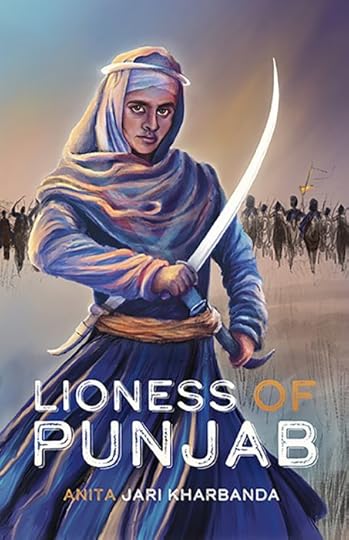
1. If you could travel back in time, (assuming there’d be no risk to yourself or changing the course of history) where and when and why would you go?I’d definitely travel to Punjab in the 1700s and meet the main character of my book, Mai Bhago. I wish I could say I’d fight beside her, but she is the battle warrior, and truly my pen is my sword. I’d love to learn about her battle strategies, and what motivates her. This discussion would have to take place after I faint when first meeting her! 
I’m fascinated by this time period because it marks the birth of Sikhism. This is my religion and Mai Bhago’s religion. During this time period India was not actually a country. It was a subcontinent with border skirmishes and invading groups. At the same time, however, it was full of vivid cultural traditions and celebrations. This was the time period before, and leading up to colonization. It is important to understand everything that led up to colonization, so we can connect with South Asia’s evolution. History is key to helping us understand why certain events happened. History also teaches us to learn from the past, and make better decisions in the future.
 3. What elements of this time period do we still see today?
We still see some of the same foods, the language and clothing. The language is Punjabi, and a staple meal includes roti, a wheat flat bread.
4. What do you think young people from this time and place could teach us today?I think they could teach us the importance of bravery and fighting for what you believe in.
5. Is there an historical tidbit that didn’t make it in the book, but is super interesting?I did not include historical details about Banda Singh, a brave soldier of the Sikhs. He avenged the tenth Guru’s murder and laid the foundation for a Sikh kingdom. The tenth Guru, Guru Gobind Singh Ji, was the final living guru of Sikhism. Sikhism is the fifth largest religion in the world, and our tenth guru named our Holy Book the final Guru, within which lay the teachings and beliefs of those before him. Banda Singh was an ascetic who lived in hermitude, and who the Guru met when living near the Godavari River. The Guru saw a special fire in Banda Singh, and charged him with avenging the men who persecuted the Guru’s Sikhs and sons. The Guru was then fatally injured, and Banda Singh went on to kill the man responsible, as well as build a Sikh Empire.
6. What’s your favorite historical fiction (any age!)I have too many to count! I love reading books about partition era India, and the Nazi era. I’ve also enjoyed stories about the Texas Dust Bowl or the Transcontinental Railroad or the California Gold Rush. Give me good writing and an interesting piece of history and I’m hooked!
7. What are you working on right now?I can’t tell you that. It’s a secret. 
The post 7 Questions with Anita Jari Kharbanda appeared first on Skyler Schrempp.
March 23, 2022
Rima’s Rebellion
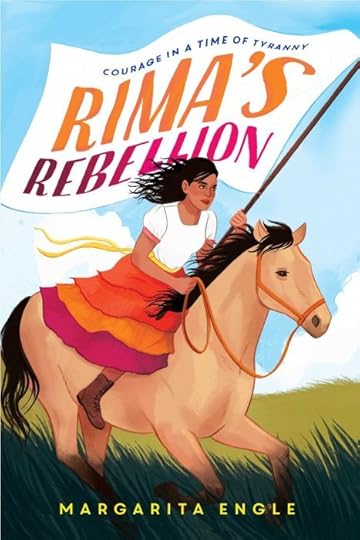
Title: Rima’s Rebellion
Author: Margarita Engle
Setting: Cuba, 1923-1936
Recommended Age: 12 and up
What it’s about…Rima’s Rebellion is a novel in verse about a young woman fighting to make an unjust world a better place for her and other girls like her. Rima comes of age in a world where femicide of adulterous women is the legal right of every husband, and children born out of wedlock are subjected to cruelty and exclusion. Rather than accept things the way they are or live in fear, Rima joins a multi-generational brood of strong women to demand a better life. Despite the fact that the powers that be want girls like Rima to simply disappear, she finds her place in the world, helping her sisters in arms, push and pull their country towards a brighter future.
My hot take…This book dives into the rich history of feminists in early 20th century Cuba. Margarita Engle has clearly researched the period in-depth and it shows. Moreover, the strong theme of feminism extends far beyond the demands of female characters to vote and overturn misogynist laws. Engle’s female characters are allies, even when divided by class, love, and opportunity. Engle’s setting (while firmly historical) is also ripe for adventure. There are daring horse chases, dramatic escapes, and even true love. Readers today will find Rima’s defiance of unjust laws and practices inspiring and hopefully will feel compelled to lean into their own beliefs about the world as it is and the world as it should be.
You might like this book if you enjoy: Riding horses (fast), radical poetry presses, and suffragettes.
The post Rima’s Rebellion appeared first on Skyler Schrempp.
March 22, 2022
7 Questions with Michael Leali

Visit Michael’s Website, Twitter, Instagram
1. If you could travel back in time, (assuming there’d be no risk to yourself or changing the course of history) where and when and why would you go?Well, if there’s no time-wimey nonsense happening and no risk to myself, I’m absolutely going back to visit the dinosaurs. Who wouldn’t want to hang with a brontosaurus? I was completely captivated by dinosaurs as a kid. They fueled so much of my imagination and sparked my interest in storytelling. From The Land Before Time series to the plastic dollar store figurines I used to make my own dino movie with my family’s camcorder, I was obsessed. Dinosaurs were magical— Who am I kidding? They still are.
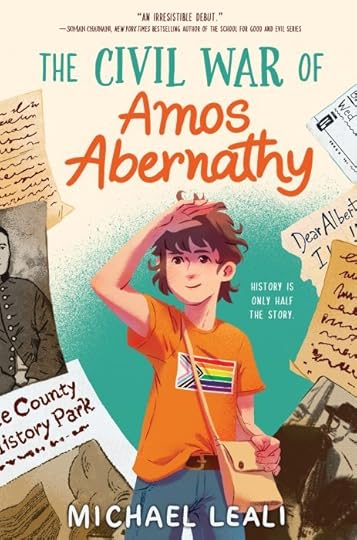 2. Your book is set today but heavily delves into the American Civil War. What fascinates you most about this time period?
I think what I’m most fascinated by is the conflict, tension, and potential that the era represents for the United States. The American Civil War, in many ways, was the beginning of the fight for the soul of our country. I am not a historian by any means, but that’s the way I see it, as someone who is still learning, growing, and coming to understand the world I live in. While the American colonies represented hope and freedom to many white people, it meant the death and destruction of so many others. In addition to the atrocious genocide of Indigenous peoples, for centuries white people enslaved Black people, building a country upon their labor and lives, benefiting from their pain and bondage. For me, the American Civil War era is a turning point in our country’s history toward something better, the first real steps we took to be truly free and equitable for all. We have come a long way since then, but we still have a very long way to go.
3. What elements of this time period are still with us today?We might not frequently use butter churns or play skittles, but we are still fighting for equality and the moral center of our country. BIPOC and LGBTQ+ communities still suffer greatly from inequities, as do many other individuals with underrepresented and historically marginalized identities. We might not go to battle as they did in the mid-1800s, but we fight on in other ways. We sign petitions, and we vote. We use words. We tell stories.
4. What kind of insights do you think kids from this time period have?This was an era that tested many peoples’ courage, across many identities and backgrounds. Young people fought and died to ensure that “equality” was not a hollow word in the United States. That persistence, determination, and bravery to stand up against your own family and friends, against bigotry and hatred—it’s powerful and not to be forgotten as a part of the history of the United States.
5. Is there an historical tidbit that didn’t make it in the book, but is super interesting?Since The Civil War of Amos Abernathy isn’t historical fiction but rather about history and set in the present day, I had to be very selective. My focus was narrow and mainly on the LGBTQ+ community during the 1800s and largely during the American Civil War. That being said, there was a minute there that I was sure I’d be able to incorporate some of the music from the era into the novel. None of it made the cut, but I do recommend giving some of the songs a listen! Here’s some of the tunes I listened to on repeat: “Wildwood Flower,” “Two Brothers,” “Hard Times,” “When Johnny Comes Marching Home,” and “Battle Cry of Freedom.”
6. What’s your favorite historical fiction (any age!)I detest choosing favorites—how does anyone pick their favorite book, even if narrowed down by genre? Alas, I’ll pick a few. Growing up my mom read many historical fiction novels to me and my siblings. I loved listening to Johnny Tremain and The Witch of Blackbird Pond. Both are still two of my favorite books. In recent years, I’ve fallen completely head over heels for titles like Julie Berry’s The Passion of Dolssa and Adam Gidwtiz’s The Inquisitor’s Tale. They are must reads!
7. What are you working on right now?I’m not sure how much I can actually say about my next book, but… it’s a contemporary fantasy middle grade that is a very loose retelling of a popular folktale that explores truth, identity, and community. This book is due to come out in 2023 from HarperCollins. I’m also working on a couple of young adult projects, and I have a picture book out on submission. I’ve also got a middle grade fantasy project that I’ve drafted, and I am very eager to continue developing it. My brain is always writing, even when my fingers aren’t at my keyboard!
The post 7 Questions with Michael Leali appeared first on Skyler Schrempp.