Christopher Tuthill's Blog, page 12
July 18, 2023
Axis & Allies & Zombies
As if World War II needed some extra violence and mayhem, Avalon Hill added zombies to their classic game. It’s for two to five players, controlling one of the same powers as the original game, with the wild card of zombies for good measure.

I’ve been playing the original version of this game for many years; I find it a fun, lengthy wargame and my 10 year old son enjoys it very much. He could see after a few games, and after playing some more recent kinds of wargames, that the combat mechanics, while involved, are fairly standard, and when he saw this version with monsters in it he wanted it badly.

We’ve played it a number of times now, and it is always fun. The story is that some sort of noxious smoke, unleashed by a Nazi archaeological dig, circulates around the globe creating zombies. The zombies can end up overtaking you before your opponent, which can be funny. You draw a zombie card before your turn, and add a zombie to a territory. You also have a chance to drive them out of your territories, but beware! If you lose, your soldiers end up zombified, which can be disastrous for your chances to win, even while being quite hilarious. You also have a chance to roll for tech advances that will help you fight the zombies, similar to your ability to advance your technology in the original game. Who doesn’t want a chainsaw tank or zombie mind control ray in their arsenal? No one, that’s who.
The pieces are high quality, and in line with what you would expect from an Axis & Allies game. It’s a worthy addition to this series. I have been thinking of picking up one of the other versions of the game, as there are now editions focused on WWI, the Pacific theater, and so on. But two games of this sort are enough for now. One of the fun things about these enormous wargames is the epic feel of them. It can sometimes take numerous sessions over several days to finish. We have a number of these types of big games in our collection, and adding to that seems unwise. The most disastrous thing that has happened while playing one of these occurred when our cat, in her nocturnal roamings, destroyed a game of War of the Ring after two solid days of play. We tried to soldier on, but the feline monster won the day.
If you like Axis and Allies, I’d rate this one 4.5 out of 5 stars. Highly recommended!


July 12, 2023
One Roll Quest!
In our family travels this summer, I brought along some quick, portable games to play with my eight and ten year old. A couple of them were real hits with the kids that we will continue to play.
One Roll Quest plays just like it sounds. There’s a big clear die with 5 tiny colored die inside. You roll it, and that roll immediately determines whether you live or die, gain fame and fortune or experience points. The inner, colored dice determine some more specific consequences for your character–i.e. Everyone gains fame and fortune, except you–you die! It’s a very fast paced and funny game that my kids and I played numerous times. We also played One Roll Chronicles, which is a book with a brief story, in which you start out drinking in a tavern (like all good adventurers) and wind up, of course, looking for fame and glory. I’d rate this one 10 out of five stars for the number of laughs we had over it. It even includes some one off jokes like ‘One roll pizza,’ in which the die roll determines what pie you’ll order and which toppings. (we ended up with pepperoni and cheese, but my daughter cheated). 

“Gelatinous” is another humorous dice game from Steve Jackson, in which each player gets 7 dice and tries to roll enough threes to create a gelatinous cube to win. Everyone can also lose and get eaten by a cube, which is a very amusing way to end this game. My kids found this one fun, as well.
We also played Catan dice, a shortened version of the game, in which all the dice have different resources on them, and you roll to create towns, cities, and roads. This was another fun and fast paced game, though it was less funny that the first two.

Finally, on a rainy day during our vacation, we played ‘Undead,’ a pocket box from Steve Jackson Games. This is a fun one, a bit more complicated than the others that will take an hour or two to complete. One player controls vampire hunters, the other is Dracula, and there is an option for a GM. It takes place in London in 1890, and is a hidden movement game that we found fun and thematically pleasing.

You can’t go wrong with any of these games. Steve Jackson Games has always done a great job with affordable, light games like these, and they keep creating great new ones all the time. I highly recommend supporting their kickstarters, or just checking out one of their many pocket or travel games if you’re looking for something to take with you on your vacation. They also make great diversions on game night with your friends.
Our trip was fun, as well. But games make everything better.
July 10, 2023
Asimov’s Foundation
I loved Isaac Asimov’s Foundation series when I first read it as a teen. It’s still one of my all time favorite science fiction series–it imprinted on me at a young age, before I had read very much, but it holds up quite well. Asimov’s later installments, in which he revisited and added to the series, were great too.
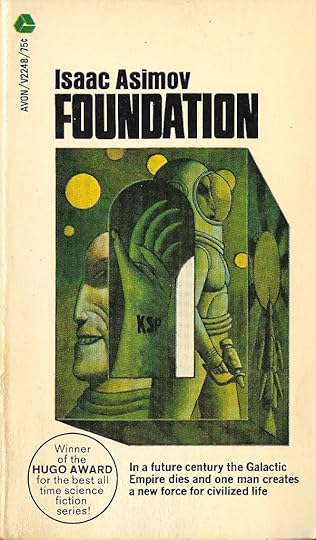
I’m not setting out to review the books right now, nor the new, slick production from Apple TV. What I will say about the show, after watching a couple episodes and then giving up, is that it must take some gargantuan ego or confidence to change such a classic work until it’s unrecognizable, and still call it Foundation. I have no idea where the show is going and didn’t care much after what I’ve watched. The production is expensive and looks cool and the actors are quite talented but the story was so different from what I read that it seemed strange to say it’s based on Asimov. Aside from the title and the most general plot setup, it wasn’t. It seems I’m in the minority, and many people love it, but that’s my opinion. I’ll probably just re-read Foundation instead.
Call me old fashioned; I don’t mind. Books don’t always need expensive adaptations. This series seemed ripe for such a show, but it wasn’t to my taste at all.
June 21, 2023
A Summer Invocation
by Walt Whitman, 1881
Thou orb aloft full dazzling,
Flooding with sheeny light the gray beach sand;
Thou sibilant near sea, with vistas far, and foam,
And tawny streaks and shades, and spreading blue;
Before I sing the rest, O sun refulgent,
My special word to thee.
Hear me, illustrious!
Thy lover me—for always I have loved thee,
Even as basking babe—then happy boy alone by some wood edge—thy
touching distant beams enough,
Or man matured, or young or old—as now to thee I launch my invocation.
(Thou canst not with thy dumbness me deceive.
I know before the fitting man all Nature yields.
Though answering not in words, the skies, trees, hear his voice—and thou,
O sun,
As for thy throes, thy perturbations, sudden breaks and shafts of flame gigantic,
I understand them—I know those flames, those perturbations well.)
Thou that with fructifying heat and light,
O’er myriad forms—o’er lands and waters, North and South,
O’er Mississippi’s endless course, o’er Texas’ grassy plains, Kanada’s woods,
O’er all the globe, that turns its face to thee, shining in space,
Thou that impartially enfoldest all—not only continents, seas,
Thou that to grapes and weeds and little wild flowers givest so liberally,
Shed, shed thyself on mine and me—mellow these lines.
Fuse thyself here—with but a fleeting ray out of thy million millions,
Strike through this chant.
Nor only launch thy subtle dazzle and thy strength for this;
Prepare the later afternoon of me myself—prepare my lengthening shadows.
Prepare my starry nights.
WALT WHITMAN

Summer, Pieter Bruegel the Elder, 1568
June 20, 2023
Yours Truly, Vlad Dracul
Writers are often rightly admonished to be professional when querying. You don’t want to make a bad impression with an editor or agent. It’s hard enough to get published without stacking the deck against yourself by getting someone’s name wrong, or (gulp) not reading the guidelines, or making other easily avoidable mistakes that will send you straight to the wastebasket, or cause you to be deleted unread.
But here is something funny, on the flip side. Let’s say you’ve written and edited and worked on something for years, and you closely read the guidelines and tailor a query to an agent or editor, and send it in. The odds are against you, of course, no matter how hard you work or how good you think your book is. You feel kinda like Sisyphus, maybe, but you keep trying anyway. Then you get back a rejection that gets your name and genre wrong, and tells you you’re wasting time querying a vampire romance with someone who doesn’t represent the stuff.
But wait, you think, my name isn’t Vlad Dracul and I haven’t written a vampire romance. So you just add this to the pile of rejections and chuckle about it and move on to the next one.
Respect is earned and it’s a two way street. You are reviewing this agency that you hope might want to represent you, at the same time they’re reading, or not reading, your stuff and forming an impression of you. Kinda like a job interview.
True story: I once interviewed at a clearly dysfunctional place, where the search committee openly argued and contradicted each other and said how much they hated their boss, right in front of me. Then they took me to lunch and while asking me what I wanted out of a career, they continued saying what a terrible place it was to work and bitterly complained at their lack of opportunities for professional growth. I politely continued with the interview, but wow, I dodged a bullet there. When I read an email from someone who has taken so little care with my stuff, I get that same feeling.
I know agents and editors are swamped, and I sympathize. But I’m pretty busy myself. Just one guy’s opinion from the querying trenches.
May 26, 2023
THE OSPREY MAN SALE
THE OSPREY MAN is just $12 right now, through June 30, with free shipping from my publisher. It’s $5.99 as an ebook, or you can contact me for a signed copy. Read the reviews here–this coming of age tale is great read for a young person in your life, or for general readers.
May 6, 2023
RökFlöte
RökFlöte, the 23rd studio album from Jethro Tull, is, to paraphrase an old maxim, a very nice sort of album for those who enjoy these sorts of albums.

Just a year removed from the long-awaited, pandemic-delayed The Zealot Gene, Ian Anderson and friends return this spring with a record full of Norse Mythology. That Anderson is still releasing new music at this stage of his career, fifty-five years after he founded the band, is an amazing feat. This new one has, as you may expect, plenty of rock, plenty of flute, plenty of dense lyrics about Odin and Thor and the creation of the world. In short, the perfect subject matter for Jethro Tull.
To my ear, RökFlöte is heavier, with more hard rock songs than The Zealot Gene, but lacks some of that album’s warmth and emotion. Given Tull’s huge catalog, and Anderson’s interest in myths and legends, it’s almost surprising that he hasn’t recorded something like this before. I particularly enjoyed the way the songs interplay with one another, each centered on a different Norse god or myth. The opening track, and the closing one, feature spoken word poetry from the Old Icelandic poetic edda, inviting the listener into the world the band is exploring. It’s well worth the trip. And, I might add, if you don’t love spoken word Old Icelandic poetry, I am not sure how I can help you, or convince you to enjoy this kind of record. I love it, but of course I do. This is my favorite band, and has been for more than thirty years. Besides, I’m a sucker for Norse Myths and dead languages–Anderson knows his audience by now. The only thing we love better than mythology are long flute solos and synth riffs. As W.H. Auden once said, in a review of Lord of the Rings: “This is a work that will either totally enthrall you or leave you stone cold, and, whichever your response, nothing and nobody will ever change it.” Over the years I have found this to be true about many of the things I enjoy, including progressive rock and epic fantasy.
I’m glad Anderson is still active and touring. I am too young to have seen the band in their legendary 70s form, having discovered them in the early 90s, when I was in college. Since then, I’ve listened to everything they’ve released, and seen as many tours as I could. I’m not about to stop now. I have tickets to see him again in November, and was so pleased to hear he has planned a 24th album for release next year.
May 1, 2023
Writing
I’ve been busy preparing a manuscript for release next year; don’t want to give away too much about it, but it will appeal to those who like comedy and spooky stories. It’ll be a great seasonal read for Halloween, and I hope to have the release coincide with that, perhaps late summer.
Think The ‘Burbs meets The Haunting of Hill House. It’s a tale as old as time: Good, Evil, and Home Improvement.
I’ve also been working on a new book, about which I will say even less, since I’m still on draft #1. But it’s humor and fantasy, mixed with some more serious elements.
My hope is that these novels will build on the audience for my first book, The Osprey Man, and appeal to an even wider audience. I learned a lot through the release of my first book, and I hope the rollouts for these forthcoming books will be even better.
By the way, if you’re reading this, but haven’t read The Osprey Man, check out the pinned post on this blog for some reviews. Readers have loved this tale of two youths creating a comic book together, and memorializing their friend. It’s just $15 through my website–contact me for a signed copy. You can also purchase through the publisher for the same price, or get the ebook for just $5.99. It’s great for general readers, or for a young person in your life who loves to read. You can also ask your local library to purchase it; that is a great way to support writers.
Happy Reading!
April 30, 2023
Kindred, by Octavia Butler
I found Kindred to be such an amazing achievement; wonderfully written, creating such a believable, harrowing world. I plan to read the rest of Butler’s novels in due course, but had to let my thoughts on this one simmer for awhile. This isn’t light beach reading or something you pick up to be distracted. It’s considered one of the monumental works of 20th century science fiction, deservedly so.

Dana, an African American writer, is transported back to the antebellum south, and this is where the horror begins. It is hard to do this book justice, but the day to day life of a slave in the American south is described in great and horrifying detail. Dana becomes the protector of young Rufus Weylin, the heir to a plantation, and she later learns that he is one of her ancestors. Dana travels back and forth between the 1820s and 1976, finding that while she has been in the past for several hours, days, or months, she has usually only been gone for comparatively short periods of time in the present.
Slaves on the Weylin plantation are brutalized, raped, and tortured, and yet Weylin’s father, Tom, their master, is considered by the slaves to be mild in comparison to other slave owners. Families are casually torn apart to pay debts, or in some cases just to prove a point. Dana’s account of these atrocities gives the reader an idea of what slave life was like, and the unimaginable horror of just surviving and enduring.
The book is set during the bicentennial, which is when it was written, and this setting is significant, given how much America was celebrating at that time. But this book is a clear reminder of our brutal, racist, genocidal past. It’s something we must reckon with, if we want to make this country more just and fair.
Kindred is a book everyone should read. It’s a landmark of American literature, a brilliantly written and researched novel and a powerful work of literature. The characters are very nuanced and have so much depth to them. The depiction of the slave community, and the brutality they were subjected to, are so moving and heartbreaking. They are faced with unthinkable choices for their survival, and Dana’s struggle to help them and eventually be liberated has echoes of historical slave narratives, as many critics have pointed out. Butler has said in interviews that she wanted “to make people feel history,“ and she succeeded brilliantly.
April 22, 2023
Contact, by Carl Sagan
“We all have a thirst for wonder. It’s a deeply human quality. Science and religion are both bound up with it. What I’m saying is, you don’t have to make stories up, you don’t have to exaggerate. There’s wonder and awe enough in the real world. Nature’s a lot better at inventing wonders than we are.”
“She had studied the universe all her life, but had overlooked its clearest message: For small creatures such as we the vastness is bearable only through love.” –Carl Sagan, Contact

Carl Sagan had a rare gift for making extremely complex subjects accessible to non-experts. Coupled with his passion for educating the public, he was truly a one of a kind renaissance man who brought the wonder of science to millions. His novel is something no one who enjoyed Cosmos, or his other popular works, should miss.
Contact is the story of how humans might one day communicate with an extra terrestrial race, made plausible by Sagan’s knowledge of science, physics, astronomy, and his talent as a writer. Ellie Arroway, the astronomer/hero of the novel, discovers a signal through a radio telescope, and sets out to decode the message with the help of scientists from around the world. Politics, religion, and mass hysteria become a volatile mix when the public gets wind of the project.
It turns out Sagan’s gifts weren’t limited to teaching and science. He was a poetic writer as well, and the novel is so well written, with such attention paid to characterization, along with scientific explanations for what the astronomers are actually doing. I was impressed with the way he melds hard science with a touching story about a somewhat lonely astronomer, and her efforts to change the world. Sagan also takes religion and politics seriously, and has empathy for those struggling with faith as a result of the discovery of life beyond earth.
In reading Sagan’s work, I get the feeling he was an optimist who loved people, who loved science, and who felt it was in our best interest for the public to be educated on matters that we too often leave to researchers and don’t understand. But he was also a realist, and hoped that we could overcome our petty nationalistic struggles for the good of all humanity. The book shows the interplay of these complex human issues: the nations of earth come together to solve the puzzling message, but soon after, they begin bickering over who will control the message, and who will get credit. The idea of non human intelligence terrifies political and religious leaders, who don’t want their power threatened, or to admit that we might just be a backward, primitive race in comparison to the extra terrestrials.
Sagan’s book brings to bear a whole world of philosophical, scientific, religious, and personal ideas, and I feel it is a must read. It might even inspire you to read more about astronomy and physics, and learn more about the SETI project. As an avid, lifelong reader of science fiction, I don’t know how I didn’t read it for all these years, but I’m so glad I picked it up. At times, I was reading the book hearing Sagan’s voice from Cosmos. His legacy is really secure. I finished it wishing he had written more science fiction. Like scientist/fiction writers such as Asimov, Clarke, or Frederick Hoyle, he might’ve had a long and distinguished career as a science fiction writer, as well.