Nanine Case's Blog, page 2
March 29, 2019
INDIA IN REFLECTION~A FINAL FAREWELL
THE RICHNESS OF THE SOUL
AND NOT THE SIZE OF THE POCKETBOOK
TRULY DEFINES A MAN'S WORTH.
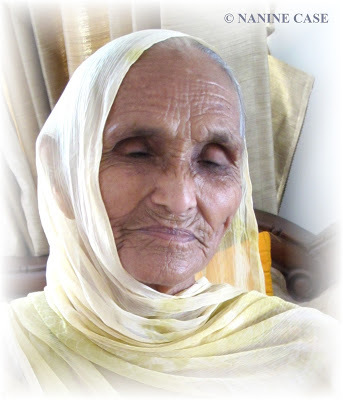
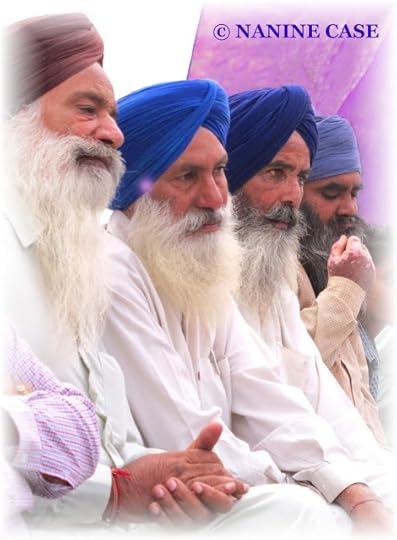
~IN THIS FINAL WRITING~ I wish to express my thanks and profound gratitude to the Indian people of all ages and walks of life.
Each and every one of you made my journey rank as one of the most UNFORGETTABLE experiences of my life.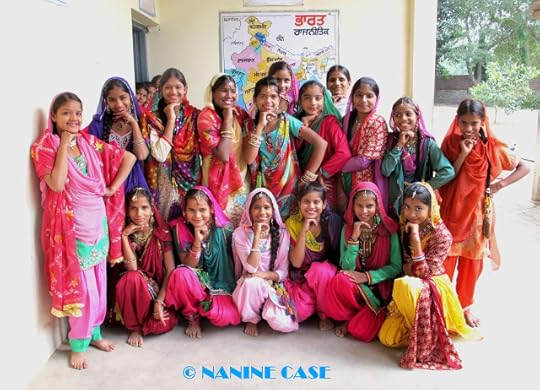
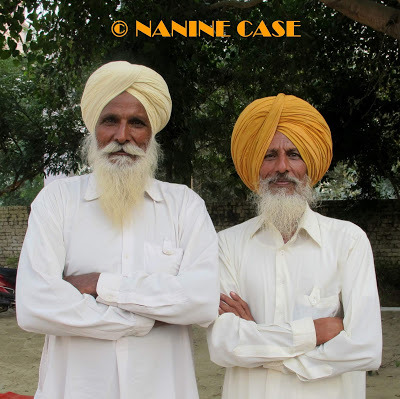
TO MY HOST AND HOSTESS for their kindness and warm hospitality.
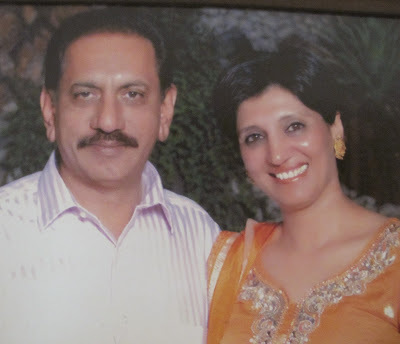
TO their friends who showered me with kindness.
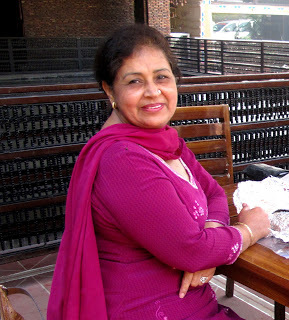
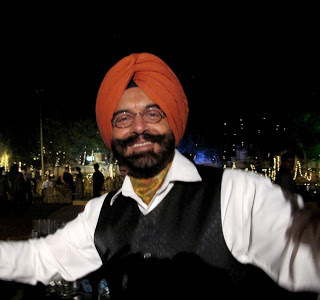
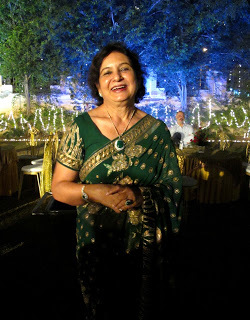
To the young male and female dancers who captivated me with their native dance.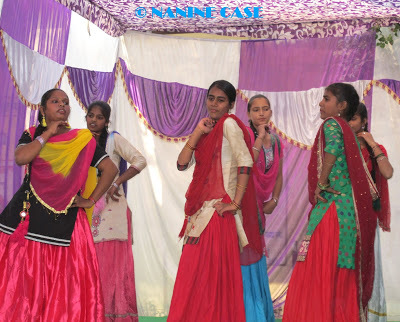
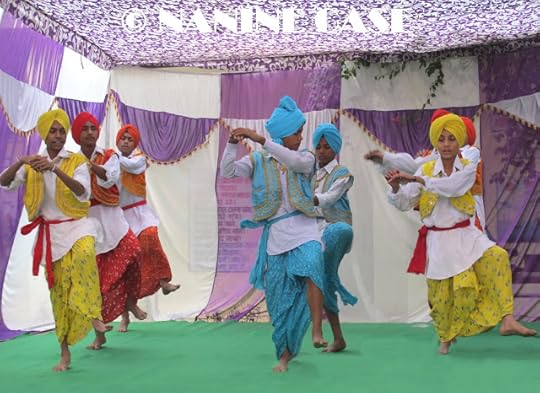
~FINALLY~ TO THE YOUNG MEN AND WOMEN dancers with whom I danced in step to the exotic Bhangra; and whom I further delighted by mixing cultures with the addition of a few steps of the Cha Cha to include in their on-stage dance performance.
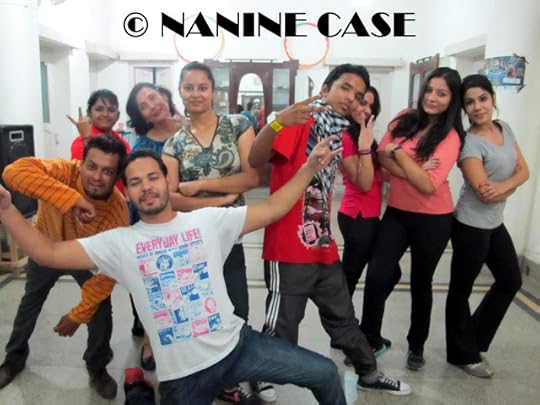
YOU ALL made me feel 20 again!
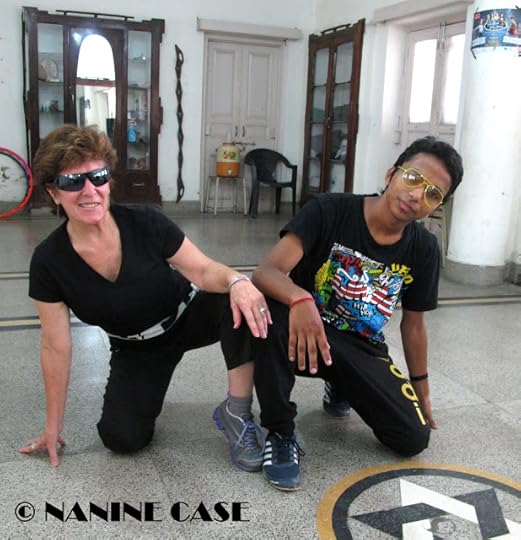
~THIS IS INDIA~
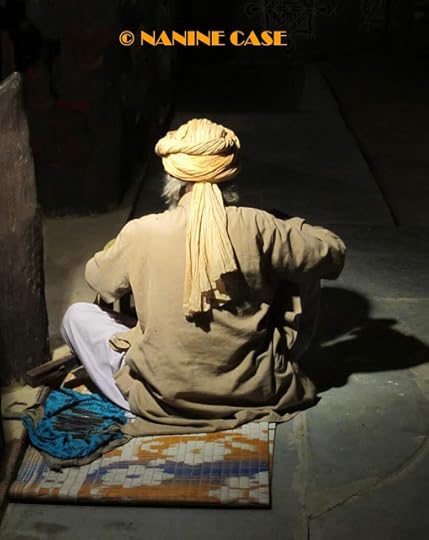
AND NOT THE SIZE OF THE POCKETBOOK
TRULY DEFINES A MAN'S WORTH.


~IN THIS FINAL WRITING~ I wish to express my thanks and profound gratitude to the Indian people of all ages and walks of life.
Each and every one of you made my journey rank as one of the most UNFORGETTABLE experiences of my life.


TO MY HOST AND HOSTESS for their kindness and warm hospitality.

TO their friends who showered me with kindness.


To the young male and female dancers who captivated me with their native dance.


~FINALLY~ TO THE YOUNG MEN AND WOMEN dancers with whom I danced in step to the exotic Bhangra; and whom I further delighted by mixing cultures with the addition of a few steps of the Cha Cha to include in their on-stage dance performance.

YOU ALL made me feel 20 again!

~THIS IS INDIA~


INDIAN IN REFLECTION~THE GOLDEN TRIANGLE
2019~INDIA IN REFLECTION~ A WILD pulse surrounded me wherever I ventured...whether from the window of my hired taxi, the seat of a bouncing rickshaw, while walking among its people, or wandering the corridors of its magnificent palaces and fortresses, my senses were on OVERLOAD, growing in proportion with each experience. By days end a meal, some much-needed quiet, and a bed were all I could manage. ~~~~~~~~~~
THIS IS INDIA

… its people
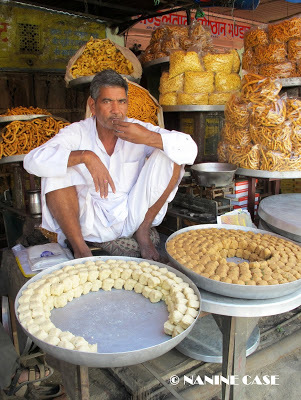
…its culture
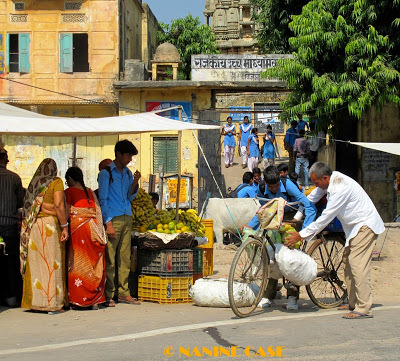
…its history.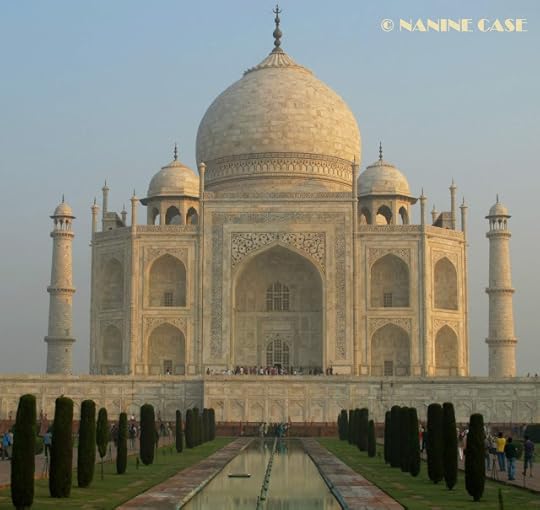
A VIBRANT COUNTRY THAT CALLED OUT TO ME THEN TO GO IN SEARCH OF ITS ANCIENT TREASURES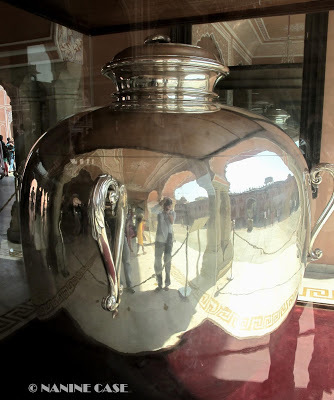
and its FASCINATING way of life.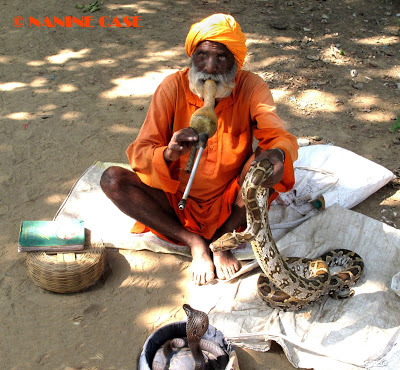 ~THE GOLDEN TRIANGLE~
ON THAT FINAL LEG OF MY INDIAN JOURNEY, I would travel from Patiala--in the north--with my hired driver, Amar Singh, across India’s Golden Triangle, a 530 KM trek, taking in New Delhi, Agra, Jaipur and all the contrasting sights in between.
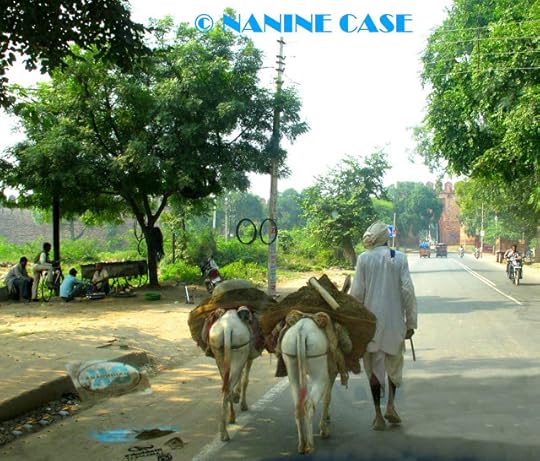
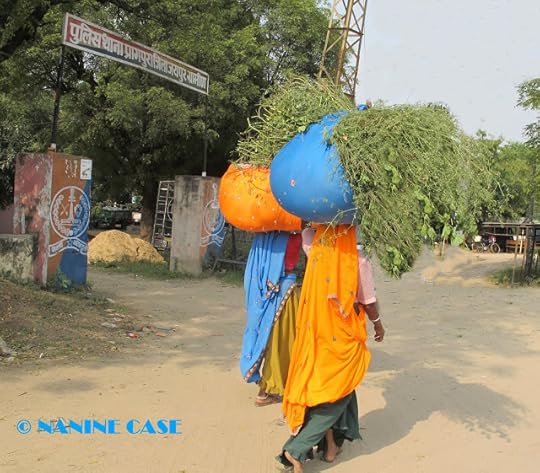
THE PHOTOS TELL THE STORY OF ALL THAT I WITNESSED. Those of village life were taken from the window of my hired car as there was no place for my driver to pull over for fear of being RUN OVER, or, meeting my end as the crumpled matter beneath an elephant’s foot!
````````````````````First stop, the colorful old city of Delhi--founded in 1639. Population ELEVEN million!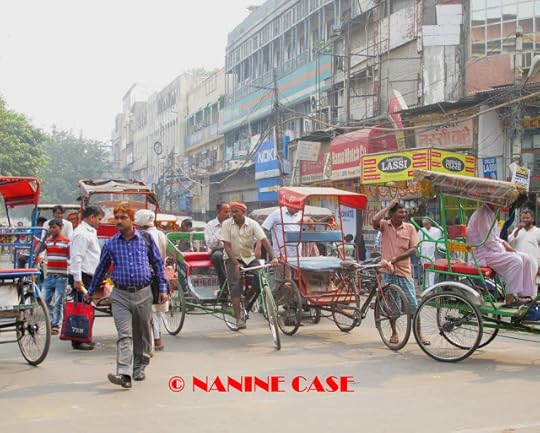
IT WAS A MAZE of narrow side streets where LIVELY vendors hocked their wares.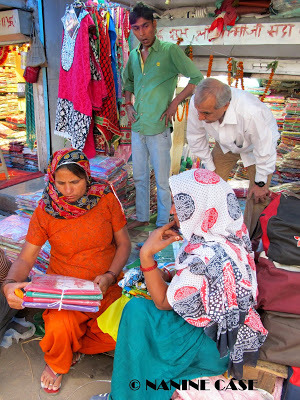 AND OFFERED SPICY bites that promised to startle the palate.
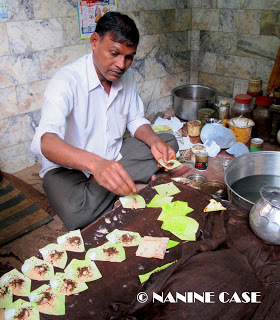
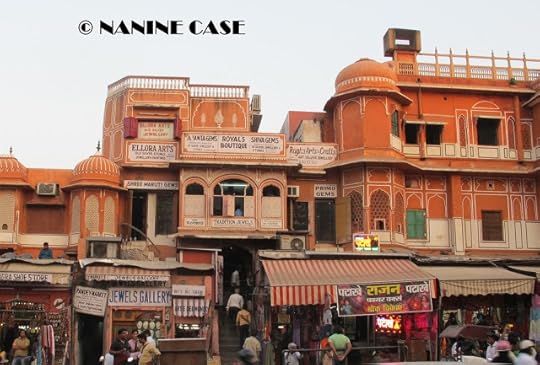
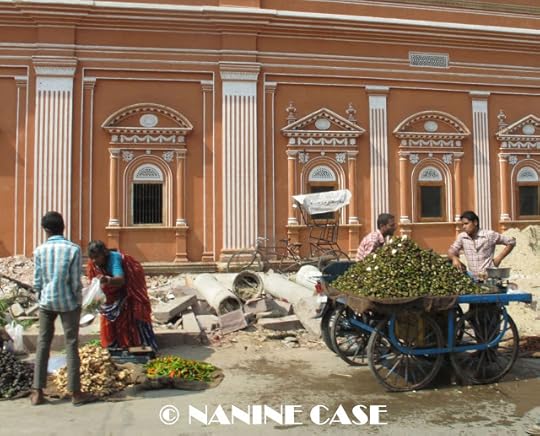
IN BETWEEN, BEAUTIFUL facades and IMPRESSIVE domes defined its long history.
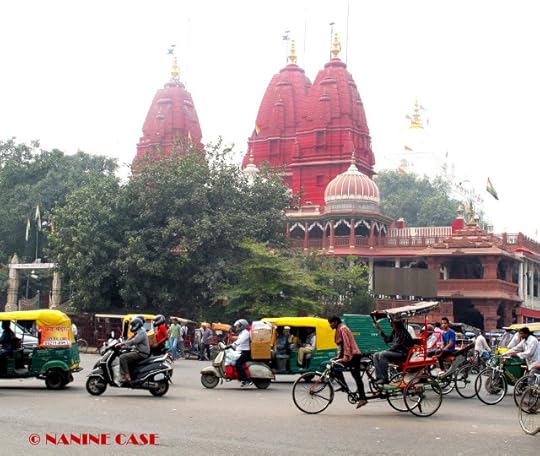
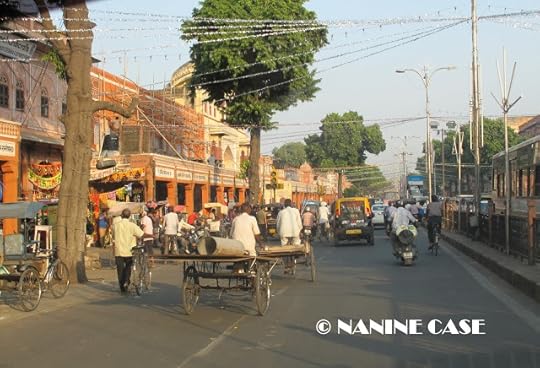
RICKSHAWS AND MOTORIZED BIKES shared the crowded streets with pedestrians and cars and oxen-drawn carts, ALL, at work claiming their small piece of the road.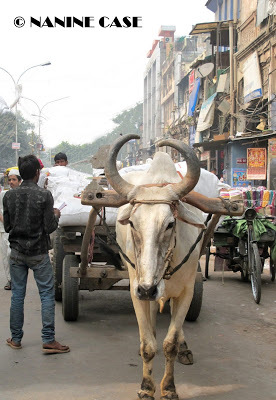
NO SPACE was left unused;
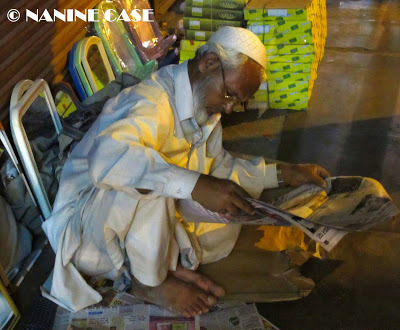
even the center median offered a poor man a place to lay down his head.
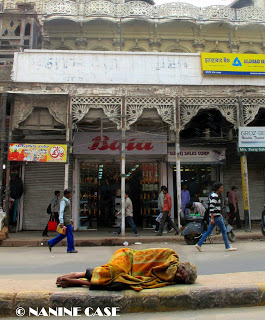 Amar Singh negotiated with a rickshaw driver for a city fare and before long I was swept up and carried off to face the unmerciful DEMANDS of Delhi’s streets.
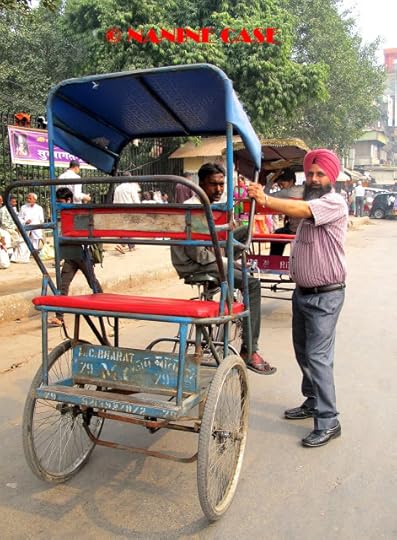
JOSTLED IN MY SEAT beside my self-appointed protector, Amar Singh, I was amazed by the skill with which our nimble driver carried his burden, his sandal-covered feet moving in a steady, quick stride as he navigated his rickshaw through the unending string of traffic.
THE ONLY ESCAPE from the madness was the RAJ GHAT, a quiet park where a memorial dedicated to, Mahatma Gandhi, allowed me a brief respite alongside those in quiet reverence to the beloved man that had once led India to independence, and inspired movements for civil rights and freedom worldwide.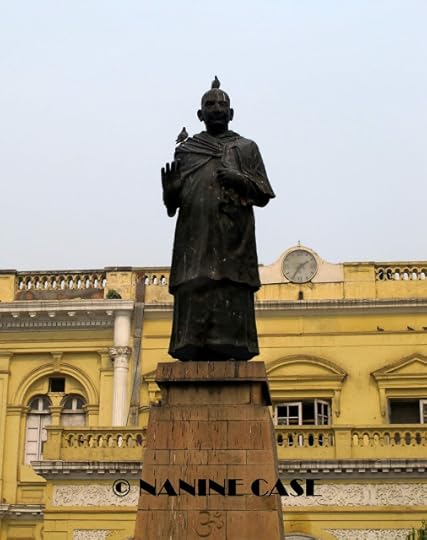
`````````````````````````LEAVING DELHI BEHIND, Amar Singh, proceeded along a four-lane, passing the New Delhi and its modern high rises strung along the highway.ARRIVING LATER at the town of FATEPUHR SIKRI in the Agra District of Uttar Pradesh, my prearranged guide waited outside the palace entrance where he would offer up--in vivid detail--India's OPULENT history.
~THE EMPEROR AKBAR'S 14thCENTURY PALACE~
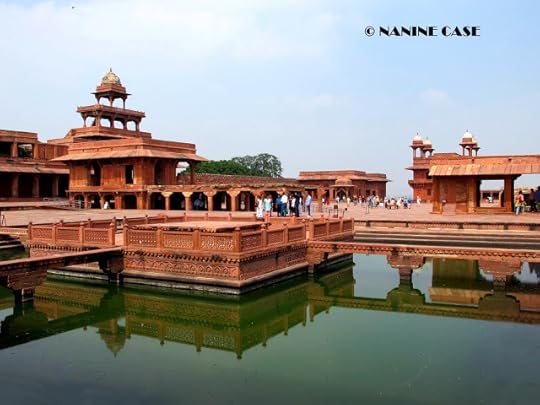
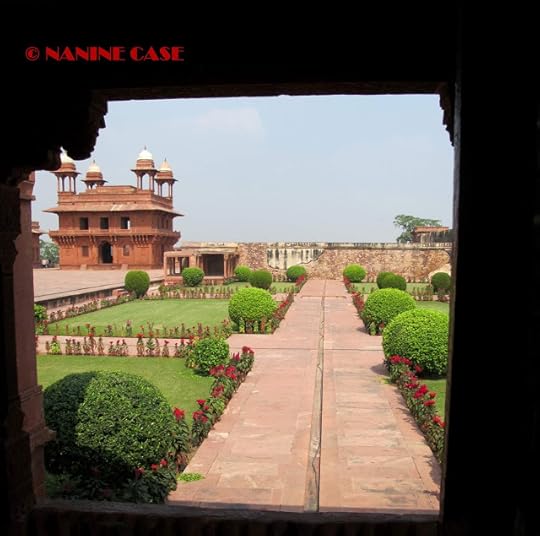
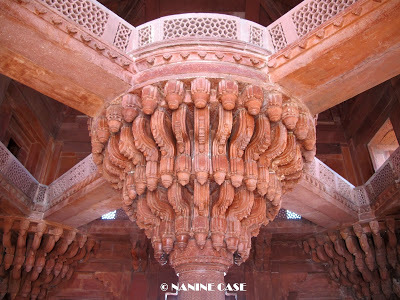
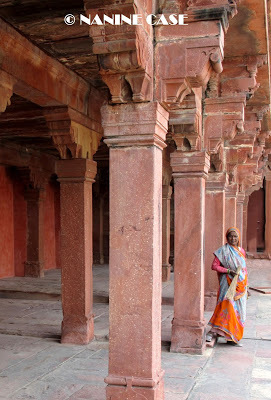
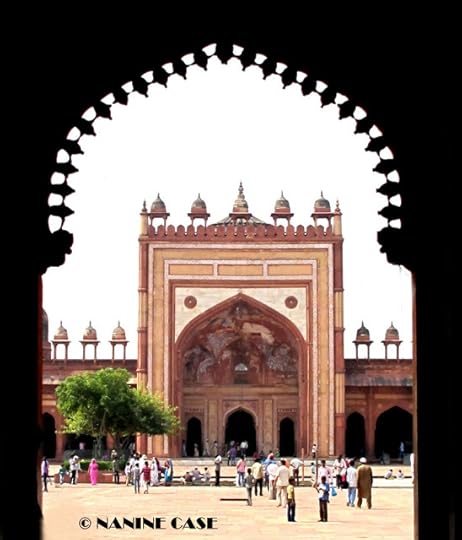
THE BULAND DARWASA ("Gate of Victory") "Crafted of red sandstone with accents of white and black marble. It was built by Akbar in 1572 to commemorate his victory over Gujarat. It is the main entrance into the palace’s quadrangle, and the HIGHEST gateway in the WORLD."
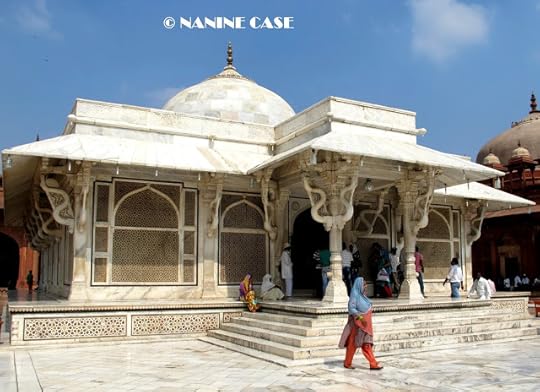
TOMB OF SHEIKL SALIM CHISHTI "Famed as one of the finest examples of Mughal architecture in India. Built during the years 1580 and 1581."
```````````````````````````````````````````
WITH THE PALACE IN OUR REAR VIEW MIRROR, Amar Singh, began our 48 km drive to the city of AGRA, traveling through small villages that provided a STARK CONTRAST to the grand palace we had left behind, and the even greater "WONDER" planned for later on.
````````````````````````````````````````````````````````````````````````````````````````````````````````````
ARRIVING IN AGRA, a city on the banks of the river Yamuna, I can still remember the honking horns and mid-morning traffic coughing out smoky exhaust while an unruffled, Amar Singh, moved at a crawl from traffic light to traffic light. Although twinges of guilt for those much less fortunate than I crept in, I relished in the comfort of his brand new taxi with its AC and tightly sealed windows that protected me while allowing me to witness it all.
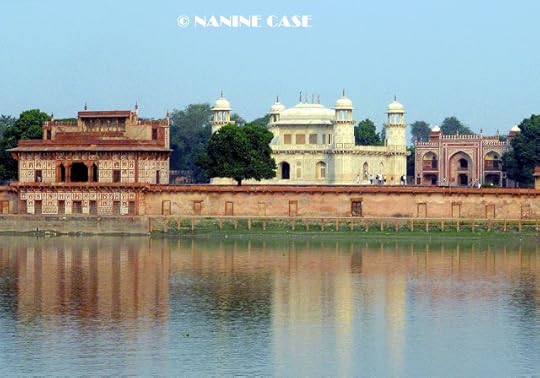
TRAVELING ALONG THE YAMUNA I felt the excitement chase down my spine as the Taj Majal, set boldly against the horizon and settling in soft reflection on the river, came into view. Majestic though it was, that image would prove to be a mere GNAT in comparison to the GIANT that would soon take my breath away.
`````````````````````````````````````````````
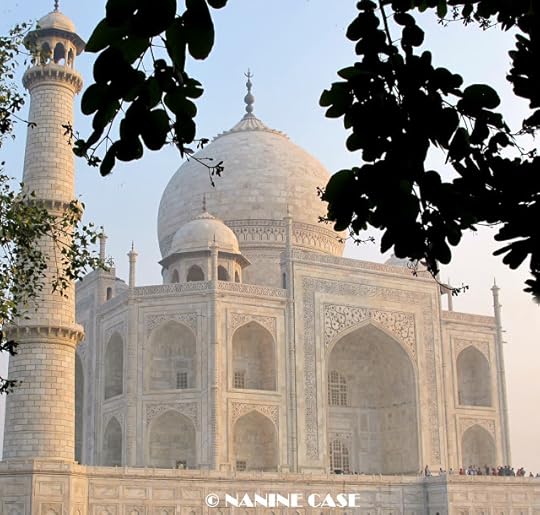
~TAJ MAJAL-1632~ ("Crown of the Palaces") ONE OF THE SEVEN WONDERS OF THE WORLD
AMAR SINGH, PHONE HAND-HELD in communication, delivered me safely to my guide (also with phone in hand) who waited at the entrance to the gait. The pleasant, male Indian man introduced himself, asked for my passport to present to security, and led me to the gate where I was about to follow suit beside others standing in silent AWE, our gaze fixed on the sprawling white marble mausoleum lit by the sun.
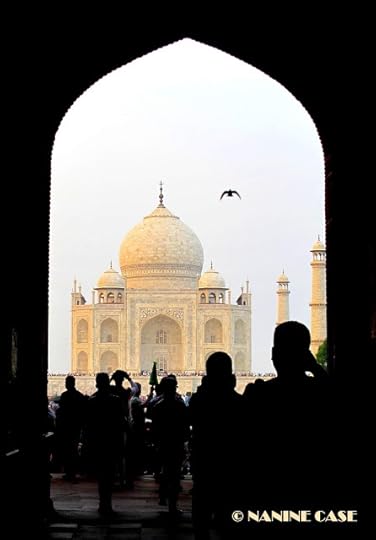 MY GUIDE began his discourse doing his best to keep up with my weaving in and out of the crowd and venturing off the beaten path to shoot photos, and with a photo at every turn, we were soon dancing in step.
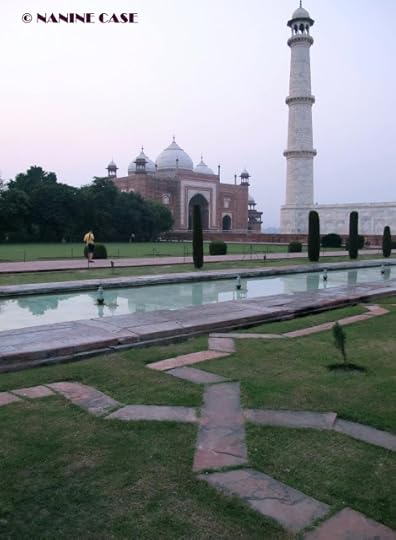
HIS TONE WAS POLITE: "Madam, the complex is set in a 300-meter square Mughal garden that's divided into four quarters." While I looked for the best angle to capture the garden, I proceeded to do the math in my head; "That's about 1,000 feet," I replied, stopping the guide mid-sentence and leaving him on pause while I moved about the raised, pastel-colored marble pathways that divided each of the garden's four quarters, squatting down to compose the next shot.
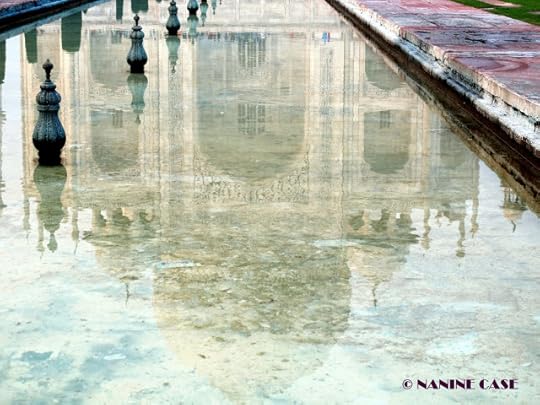
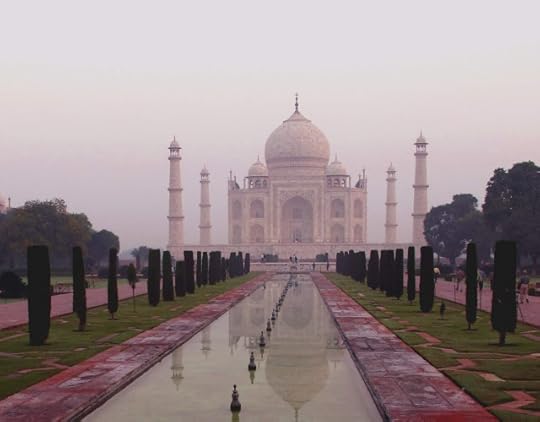
I WAS IN LUCK with the sun at the right angle, because halfway between the tomb and the gateway, smack in the center of the garden, the mausoleum smiled its reflection in the narrow pool.
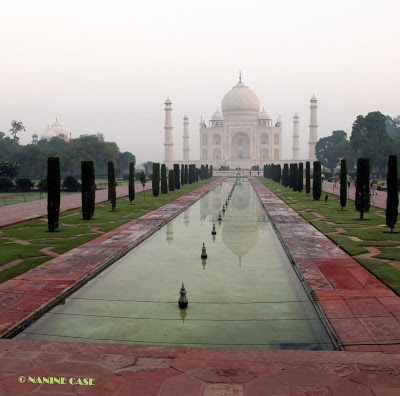
CONTINUING with his unceasing script, I felt my neck strain as I fixated on the exterior, aiming the lens while the quide talked: "Madam, notice how the decorations change with each surface.
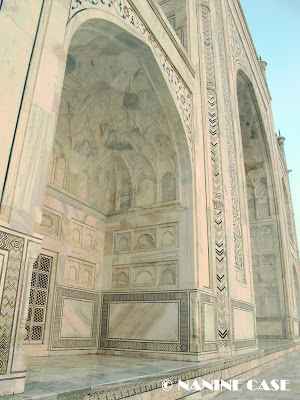
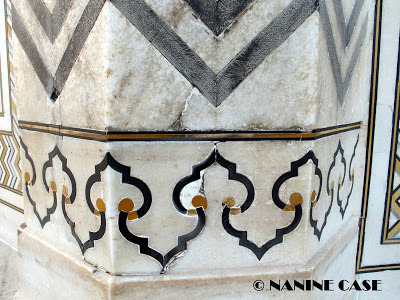
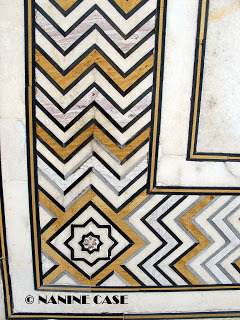
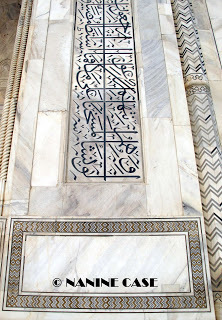
Those that you're taking photos of were created with paint, stone inlays and carvings. Some areas depict passages from the Qur'an." I paused in memory of morning chants from loud speakers flooding the city of Cairo, Egypt with sound during my trip in 1998.Doing his best to move me along at HIS pace--for I could have lingered in the shadows of the mausoleum until sunset--I gave in to his invitation to move on to the inside tomb, forcing me to leave my tour of the outside 'til the next day when I would return on my own to see the Taj Majhal change color in the RISING sun.
AS A WOMAN, I can not even begin to IMAGINE being so loved that a mausoleum--the likes of theTaj Mahal--would be built in my memory; but as my guide explained in a voice that hinted disapproval: "The Emperor, Shah Jahan, built this ostentatious display of wealth in memory of his favorite wife, Mumtaz Mahal, who SO ranked in favor over his other TWO wives that he gave little attention to his POLYGAMOUS rights!"
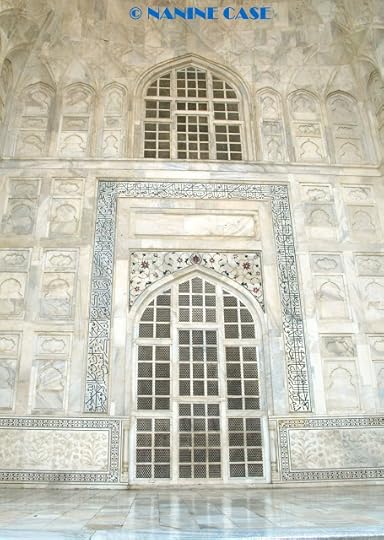
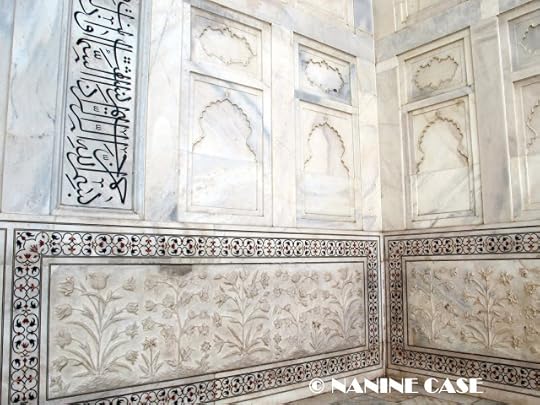
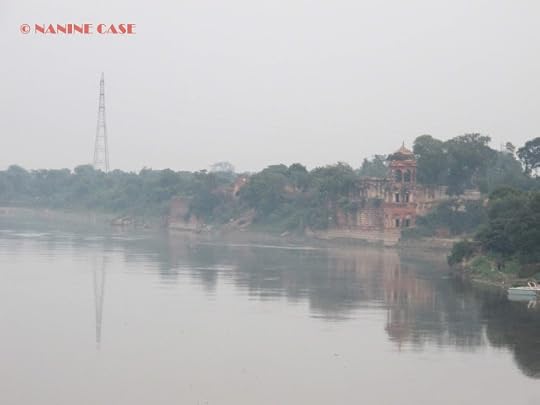
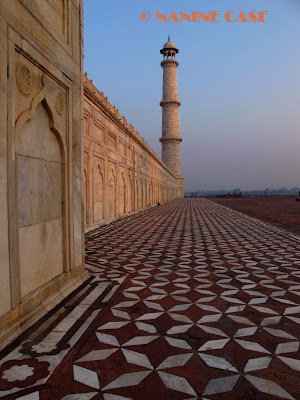
AS THE DAY DREW TO A CLOSE, I stood along the south wall to gaze one last time up the misty Yamuna River, quiet and lonely in pose. Five hundred-eighty-five years hence of the Taj Mahal's birth, I could not help but think that little had changed of the scenery other than the style of the boat resting along the bank.
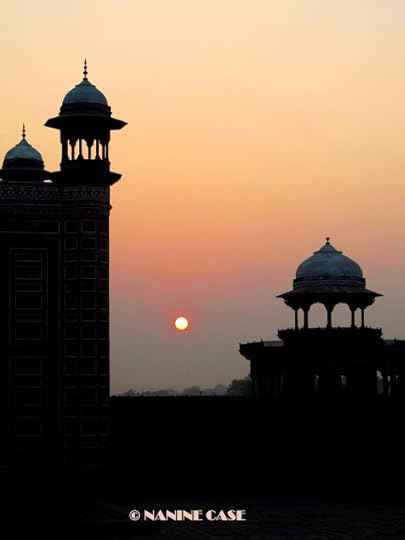
~SUNRISE~WITH THE TAJ MAHAL CAST IN SHADES OF PINK.
A SIGHT TO BEHOLD.

`````````````````````````````````````````````````````````````````````
LEAVING THE TAJ MAHAL BEHIND, WE BEGAN THE FINAL 240 km LEG OF THE GOLDEN TRIANGLE ALONG INDIA'S HIGHWAYS AND BYWAYS.
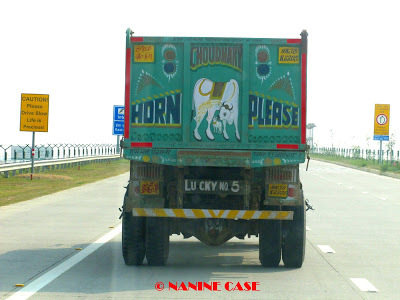
WITH A GLIMPSE OF VILLAGE LIFE ALONG THE WAY.
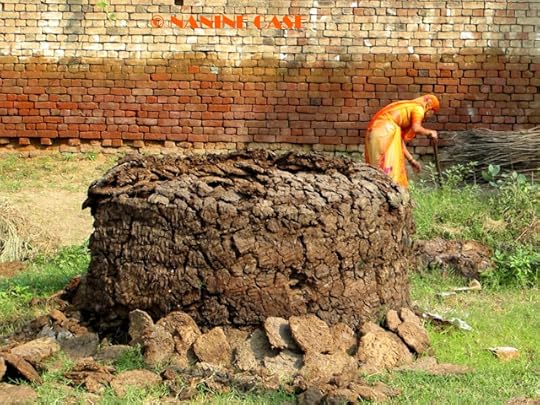 DUNG DRYING IN THE SUN FOR FUEL
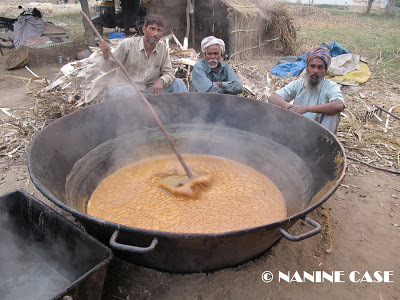 COOKED SYRUP LATER HARDENED INTO CANDY.
`````````````````````````````````````````````````
JAIPUR ("THE PINK CITY")
HOME OF AMER FORT AND THE WORKING ELEPHANTEstablished 1729
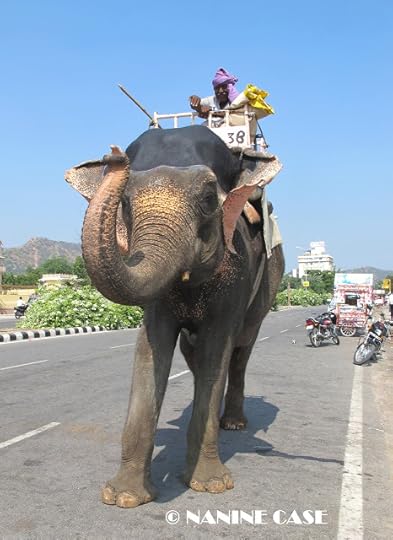
POPULATION 3.1 Million
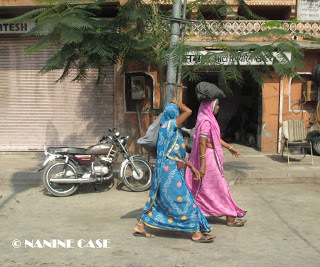
HAWA MAHAL ("Palace of Winds")LOCATED IN THE HEART OF THE CITY."Built in 1799 by Maharaja Sawai Pratap Singh. Constructed of red sandstone. 953 small windows and decorative lattice work give it the appearance of a honeycomb; since the royal ladies had to obey the strict rules of "purdah" which forbade them from appearing in public without face coverings, these small windows allowed them to observe the street scenes below without being seen."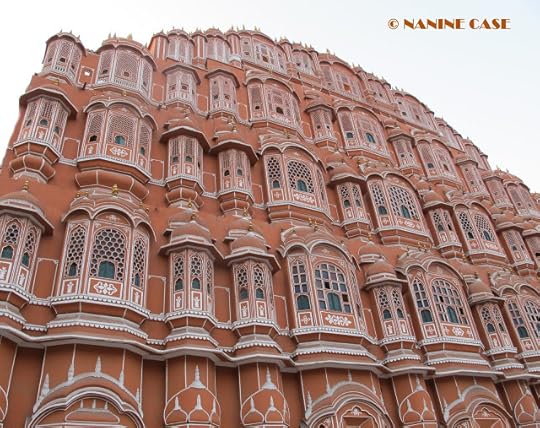
INSIDE THE PALACE
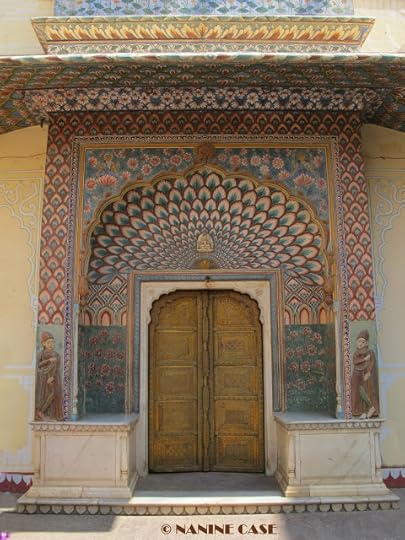
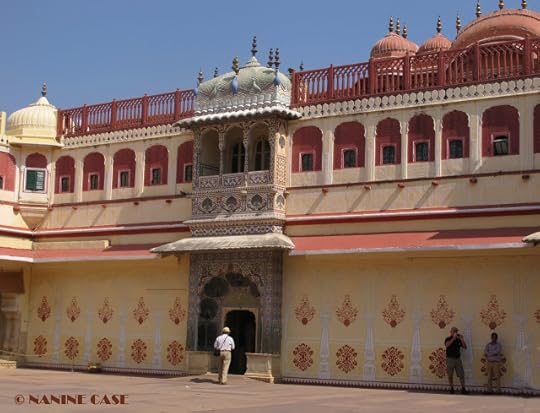
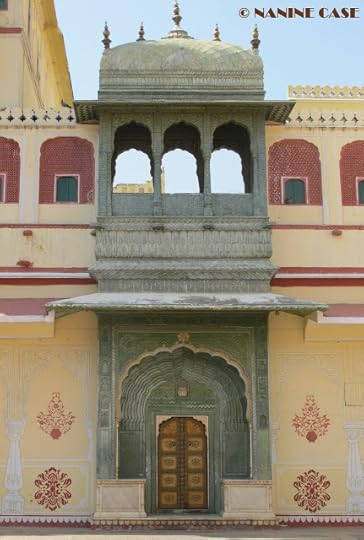
CHANDRA MAHAL BUILDINGPEACOCK GATE
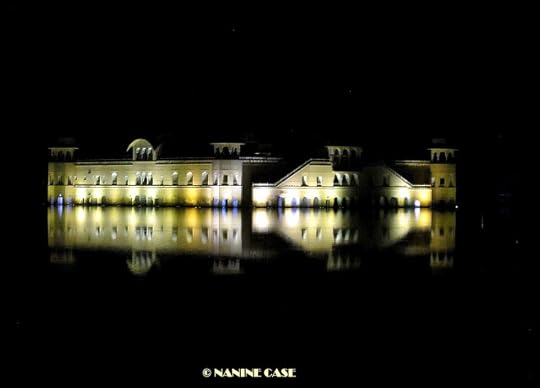
~JAL MAHAL (WATER PALACE)~
A Picturesque Centerpiece Seated in the Middle of the Sagar Lake in Jaipur City.
 JAIPUR WAS A MILD VERSION of Delhi, easily navigated, and I wanted to partake of all it had to offer, so after a drive along the main street and a visit to the Hawa Mahal Palace, Amar Singh, drove me to a park to view the Jal Mahal by day.
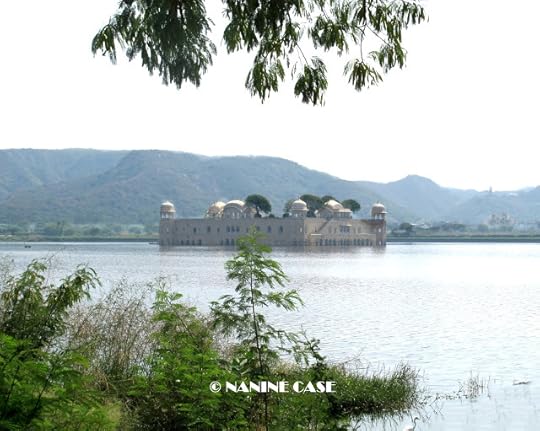
THE PALACE was a beautiful, stand along piece that appeared to be afloat on the water's surface. With my back to the park, and a dutiful Amar Singh waiting behind, I was oblivious to the children who had become aware of the white-skinned woman taking photos. When I turned, there she stood, that featured, stunning, green-eyed child of the streets. I WAS CAPTIVATED as she stared back at me, her penetrating eyes and beguiling smile reaching out to the camera lens. Caught in the moment, my once again, over-active mind flashed to the famous cover photo of the green-eyed Afghan girl taken by a National Geographic Photographer in 1984. Had it not been for the urgent calling of Amar Singh, standing by the open passenger door, I might have been tempted to linger for more shots. But I followed his urgent call, for I would have been encircled by begging children demanding equal time and money to provide for their impoverished state.~~~~~~AMAR SINGH left no stone un-turned in his ongoing effort to provide me the RICHEST experience, which meant unexpected side trips for those startling photographs.
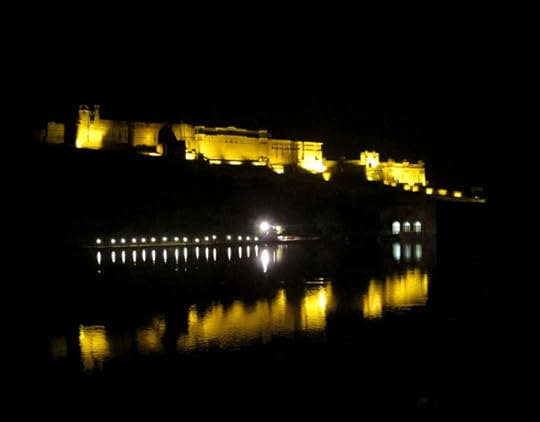
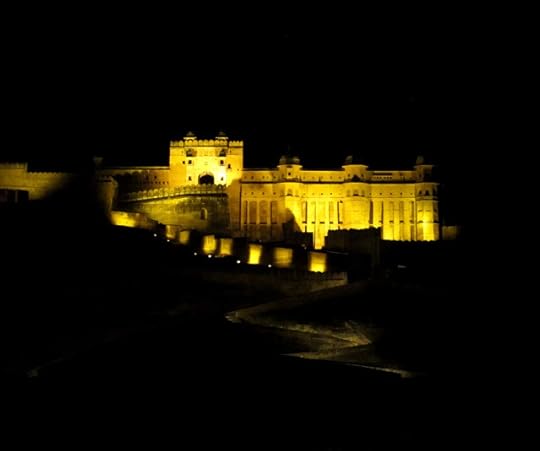
THAT NIGHT we would travel the long winding road uphill to witness the SPECTACLE of Amer Palace Fort--perched atop the hill--lit and reflected in the Maota Lake below.
~~~~~~~~~~~~~~~~~~~~~~~~~~~
AMER, THE SMALL TOWN which is home to Amer Palace was en route to the fort, and I asked Amar Singh to park the taxi and allow me a quick stroll through the village. My first preview was a calf attempting sleep on a side street with its tail curled up in pursuit of the pesky flies that clamored around its eyes, and the fresh lettuce scraps someone had deliberately placed nearby.
FARTHER ON in a square, a woman and her children lay claim to the street, her less than meager possessions strewn on the dirt beside a mattress. She peered out at me from her partially covered face and eyed me skeptically. While viewing her from behind the lens, I felt tears well up in my eyes, her state of being tearing at my heartstrings.
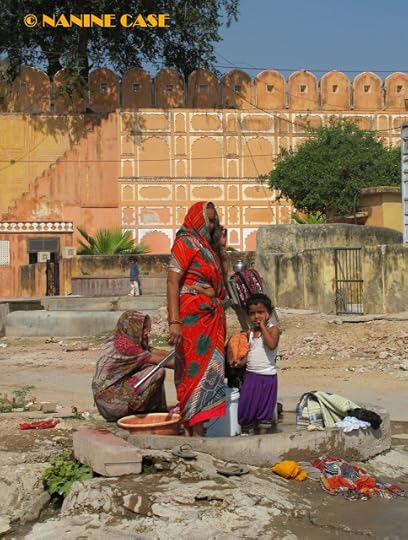
BEYOND, where life was happening at a leisurely pace, the villagers appeared unruffled by my presence.
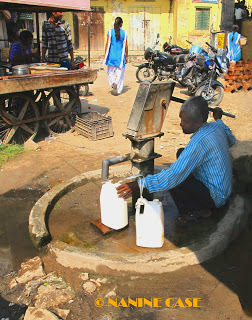
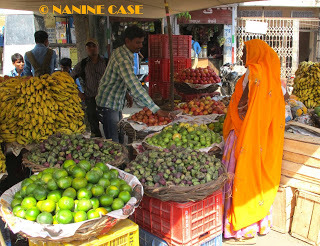
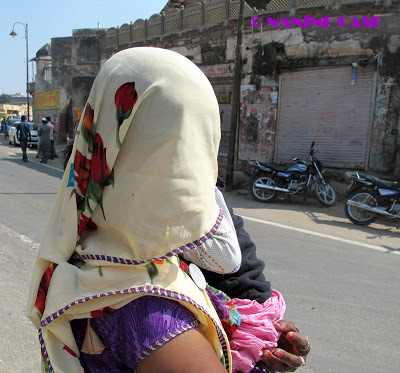
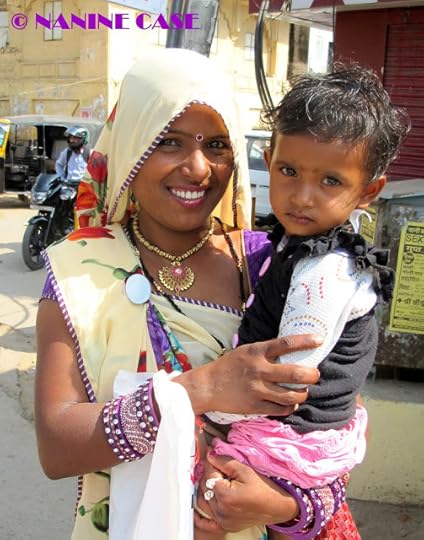
TO INCLUDE a veiled onlooker who soon revealed her privileged status, evidenced by the gold embellishments that smiled against her bronze-colored skin.
 ~~~~~~~~~~~~~~~~
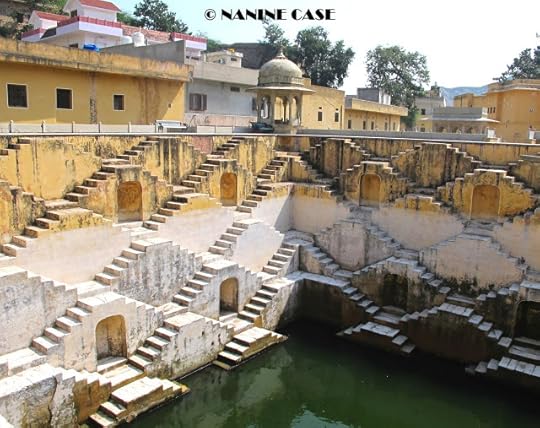
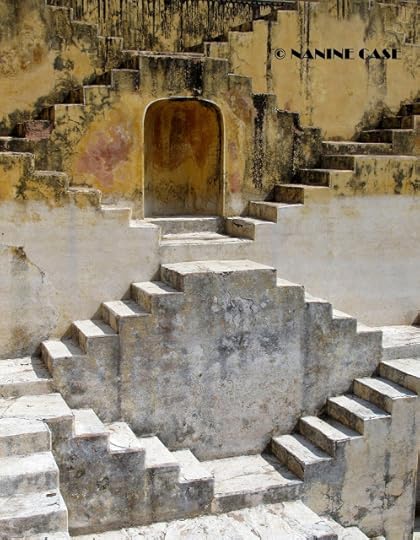
NEARBY, we stumbled upon the huge well at Kheri Gate--an architectural wonder and ingenious concept for storing and collecting water--left over from another time.
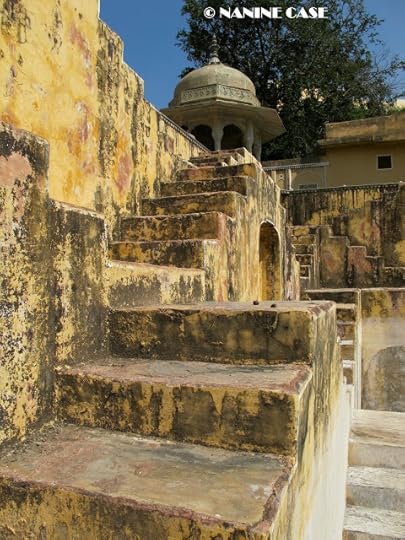
A SERIES of artistically laid out steep stair steps led down to an algae-stained, well. The absence of support rails, combined with the steep drop and slippery stairs, proved challenging, but reaching the bottom made it possible to envision the difficulty one must have faced carrying vessels of water up the steep incline.
~~~~~~~~~~~~~~
~AMER FORT AND PALACE~
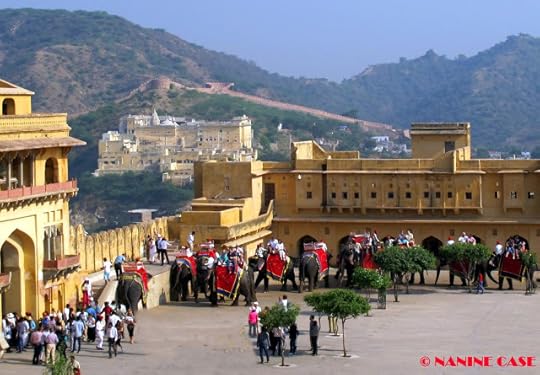
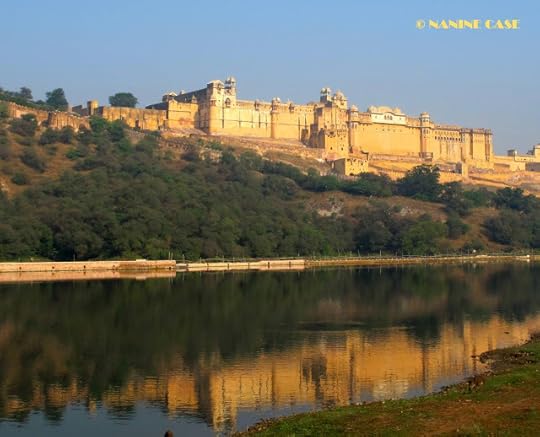 VENTURE THE LONG STEEP PATH ON THE BACK OF A COLORFULLY CLAD ELEPHANT OR WALK? THE ELEPHANT WON...HANDS DOWN!
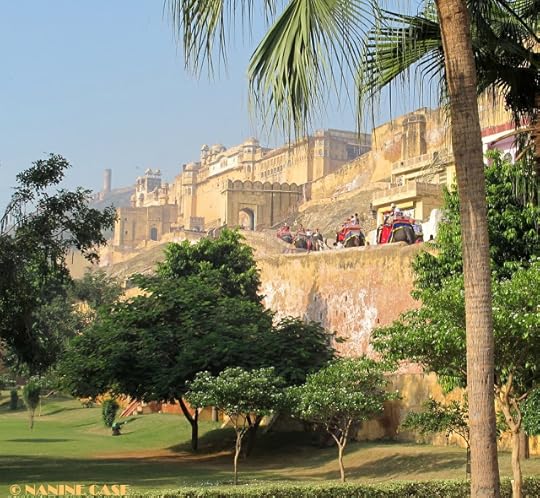
AS BEFORE, I would be met by a guide, this one best characterized as a wannabe "Casanova", and one who would prove to be very entertaining, inquisitive, and admittedly fearful of heights. He was not so entertaining, though when he insisted on taking possession of my camera while I was being hoisted up and onto the elephant's padded seat for two. A nice gesture had it not been for the fact that he turned my prized possession over to the elephant attendant , who promptly tossed the camera in the air with the now on board Casanova barely catching the projectile with his fingertips! GRRR!
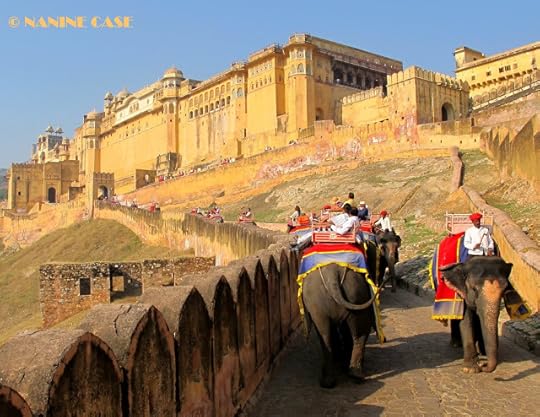 UP THE COBBLESTONE ROAD the string of regal elephants trod, elephants minus their human cargo passing us on the opposite side. Our elephant's wobbled gated caused me to rock and tilt precariously in the seat, Casanova, occasionally holding a firm but deliberate and prolonged grip on my arm.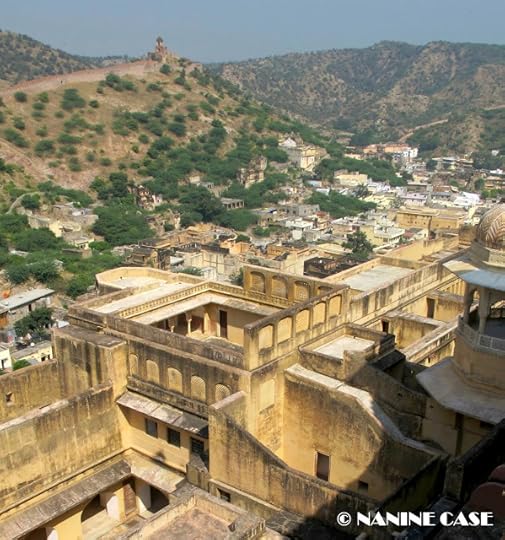
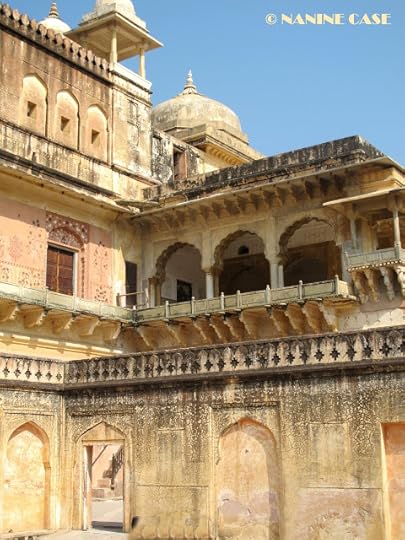
"AMER FORT and PALACE ARE made of red sandstone and marble. The Fort is known for its artistic-styled elements of large ramparts, series of gates and cobbled paths. The opulent Palace is laid out on four levels, each with a courtyard."
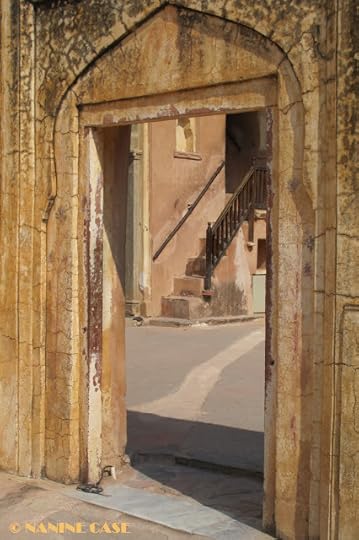
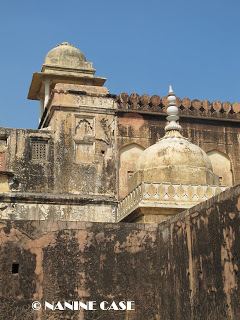
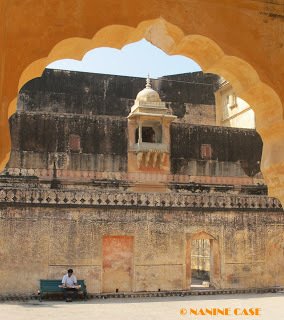
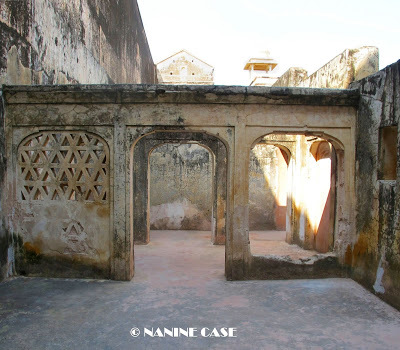
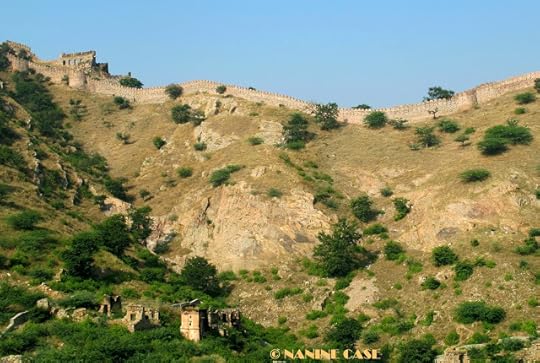
"AMER FORT--along with Jaigarh Fort--is located on the Cheel ka Teela (Hill of Eagles) of the Aravali range of hills."
 "THE PALACE and Jaigarh Fort are considered one complex as they are connected by a subterranean passage. This passage was meant as an escape route in times of war to enable the royal family members and others in the Amer Fort to shift to the more formidable Jaigarh Fort."
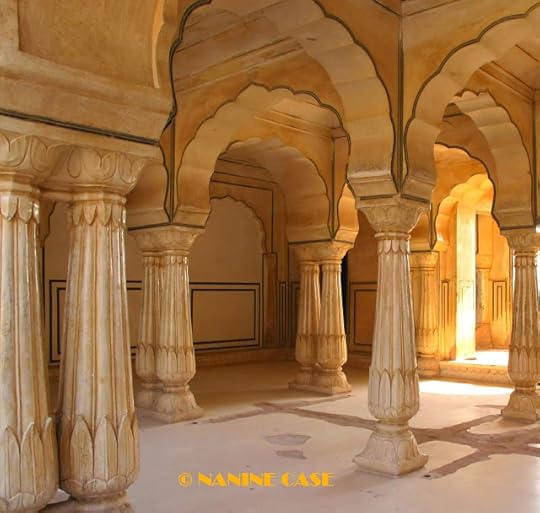
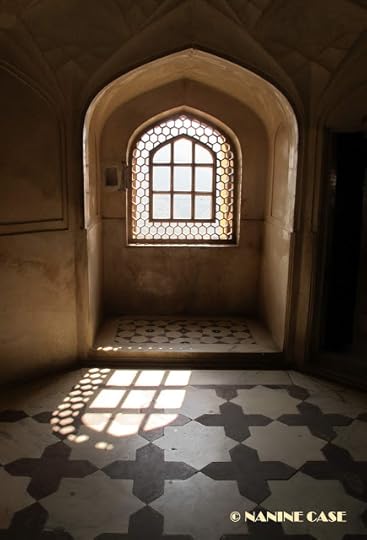
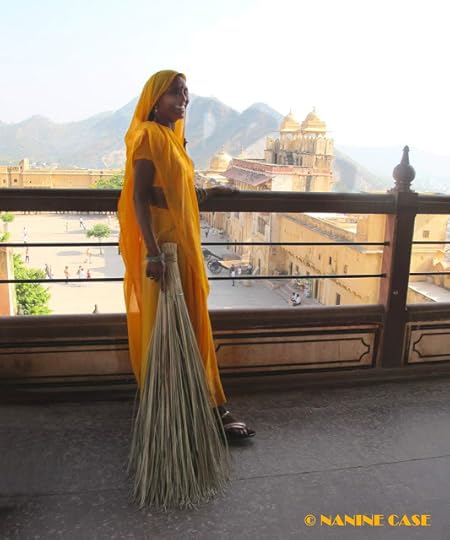
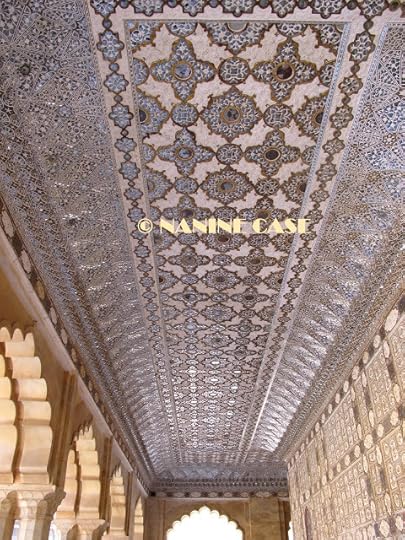
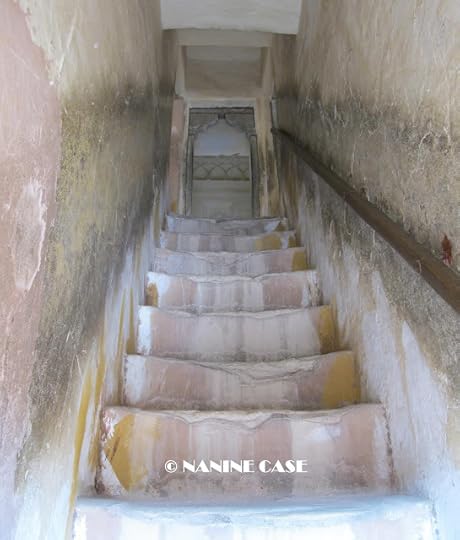
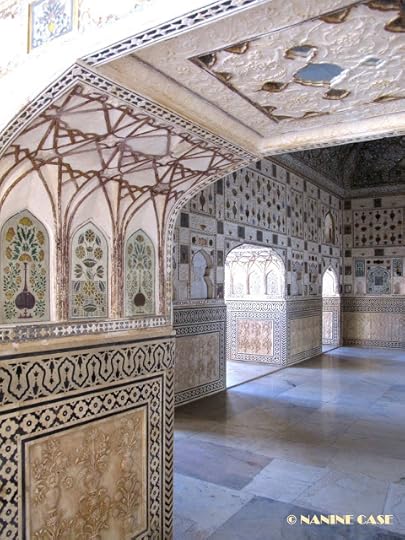
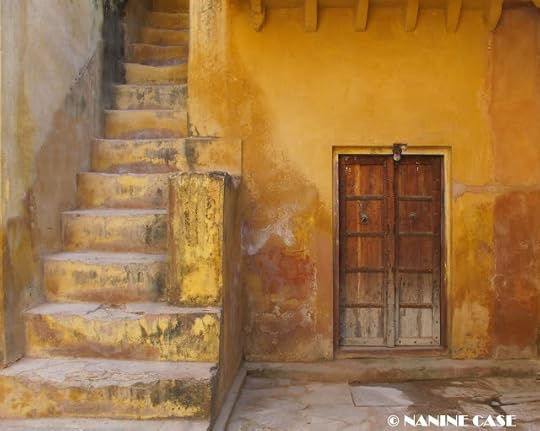
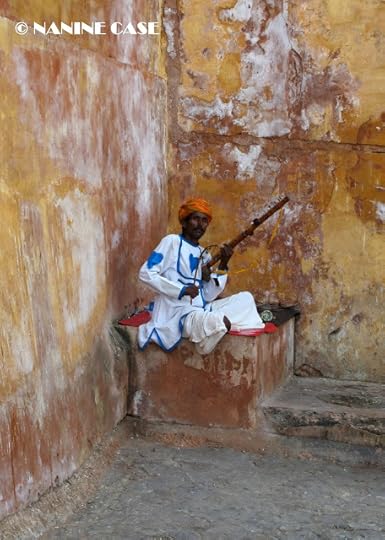
 FOR HOURS I would be stunned by mirrored ceilings, bejeweled surfaces, archways that resembled suspended crowns and age-stained sandstone that brought even the palace's empty spaces to life in unceasing swirls of color. And every so often, a common person--planted as a prop--would lend a timid smile to remind me of another life that existed beyond that atmosphere of unimaginable wealth.
~~~~~~~~~~~~~~~~~~~~~~~~~~~~~~~~~~~~~~~~~~~~~
THE LAST STOP ON THE GOLDEN TRIANGLE ROUTE~ROYAL GAITORE~
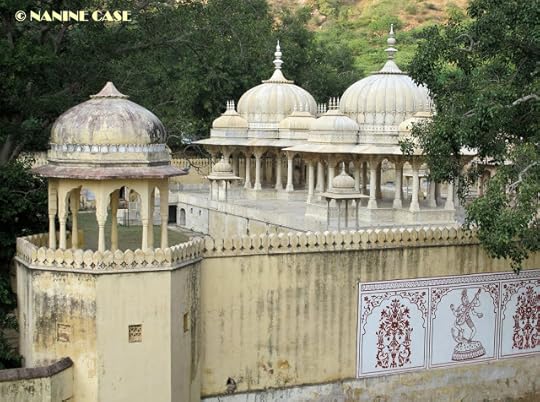
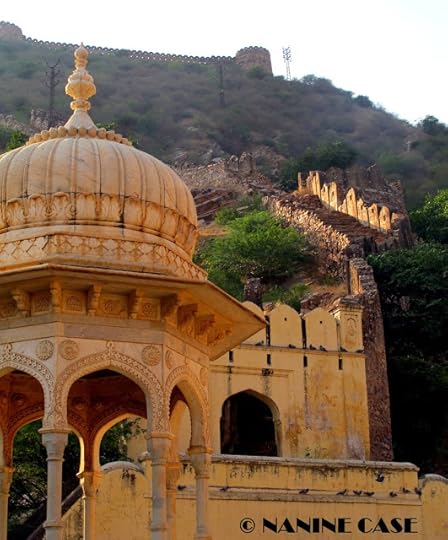
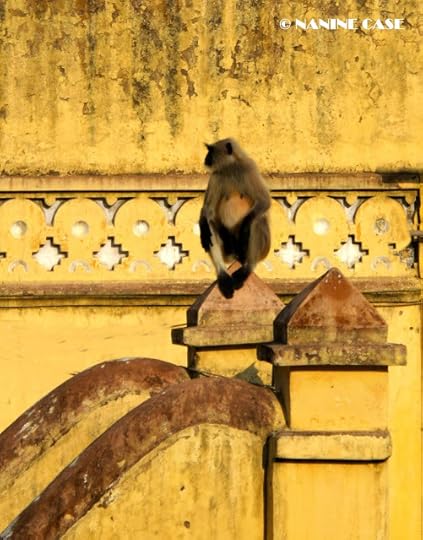
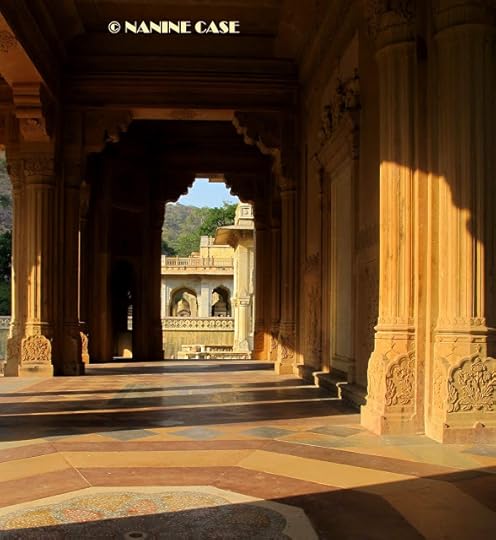
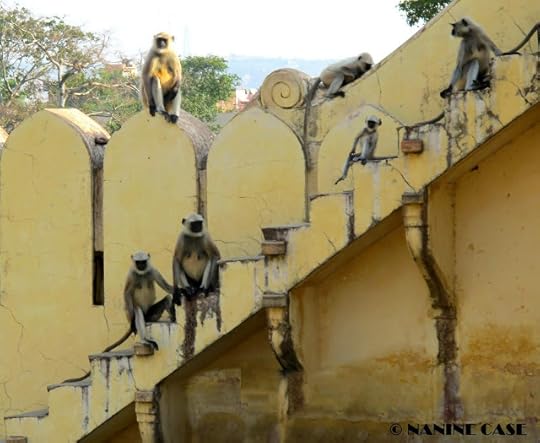
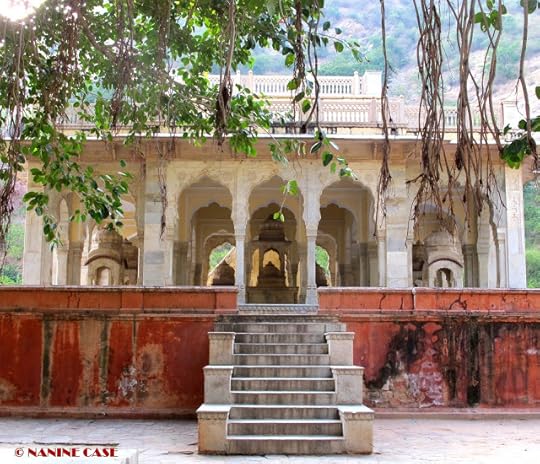
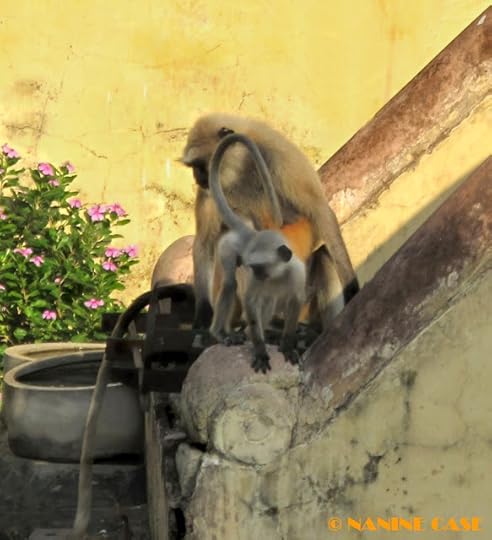
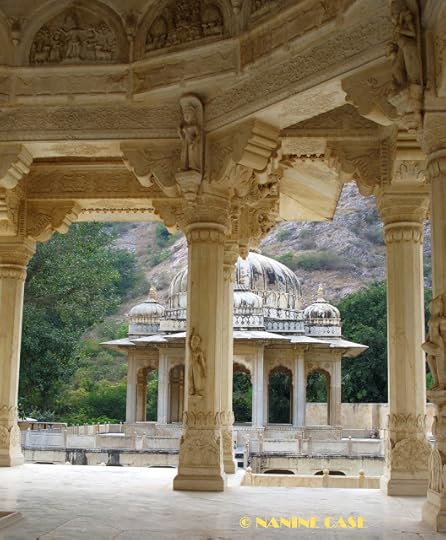
THE DAY WAS NEARING AN END causing the sun to creep along the hallways and light the Gaitore's courtyards. Aside from the monkeys who lay claim to the grounds, Amar Singh, and I were the only people present. In the absence of a guide, and Amar's lack of the English language, I would be left to imagine the faint murmurings of the ancients and listen to the background chatter of the resident monkeys perched on a wall.
~~~~~~~~~~~~~~~~~~~~~~~~~~~~~~~~~~~~~~~~~~~~~~~~~~~~~~~
WHAT A PRIVILEGE IT HAS BEENReliving...Sharing...WritingMY GOLDEN TRIANGLE ADVENTURE.
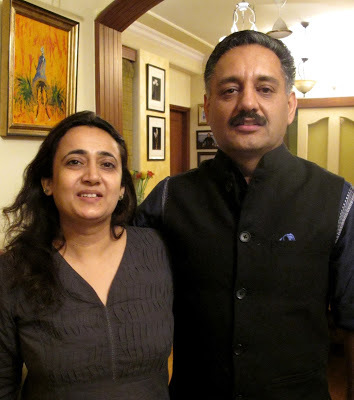
A VERY SPECIAL THANKS GOES OUT TO, Amarjeet Singh, and his gracious wife who planned the Golden Triangle trip--SPARING NO DETAILS. I will NEVER forget the fun and laughter, and how you opened your hearts and shared your home with me en route. AND OH, THE MOUTH-WATERING, HOME-COOKED, INDIAN DISHES!
AND TO MY SIKH FRIEND AND DRIVER, AMAR SINGH, who kept me safe and comfortable AT ALL TIMES. Who made me laugh. And, who, when I attempted to thank him for his efforts and apologize for keeping him waiting, said:
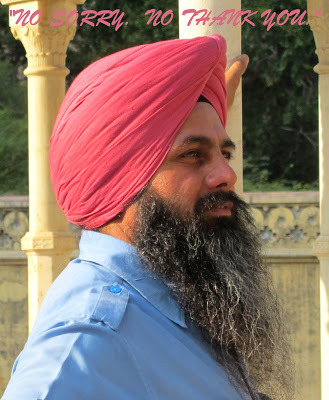
NEITHER DISTANCE NOR TIME CAN EVER GET IN THE WAY OF MEMORIES.
THIS IS INDIA
… its people

…its culture
…its history.

A VIBRANT COUNTRY THAT CALLED OUT TO ME THEN TO GO IN SEARCH OF ITS ANCIENT TREASURES
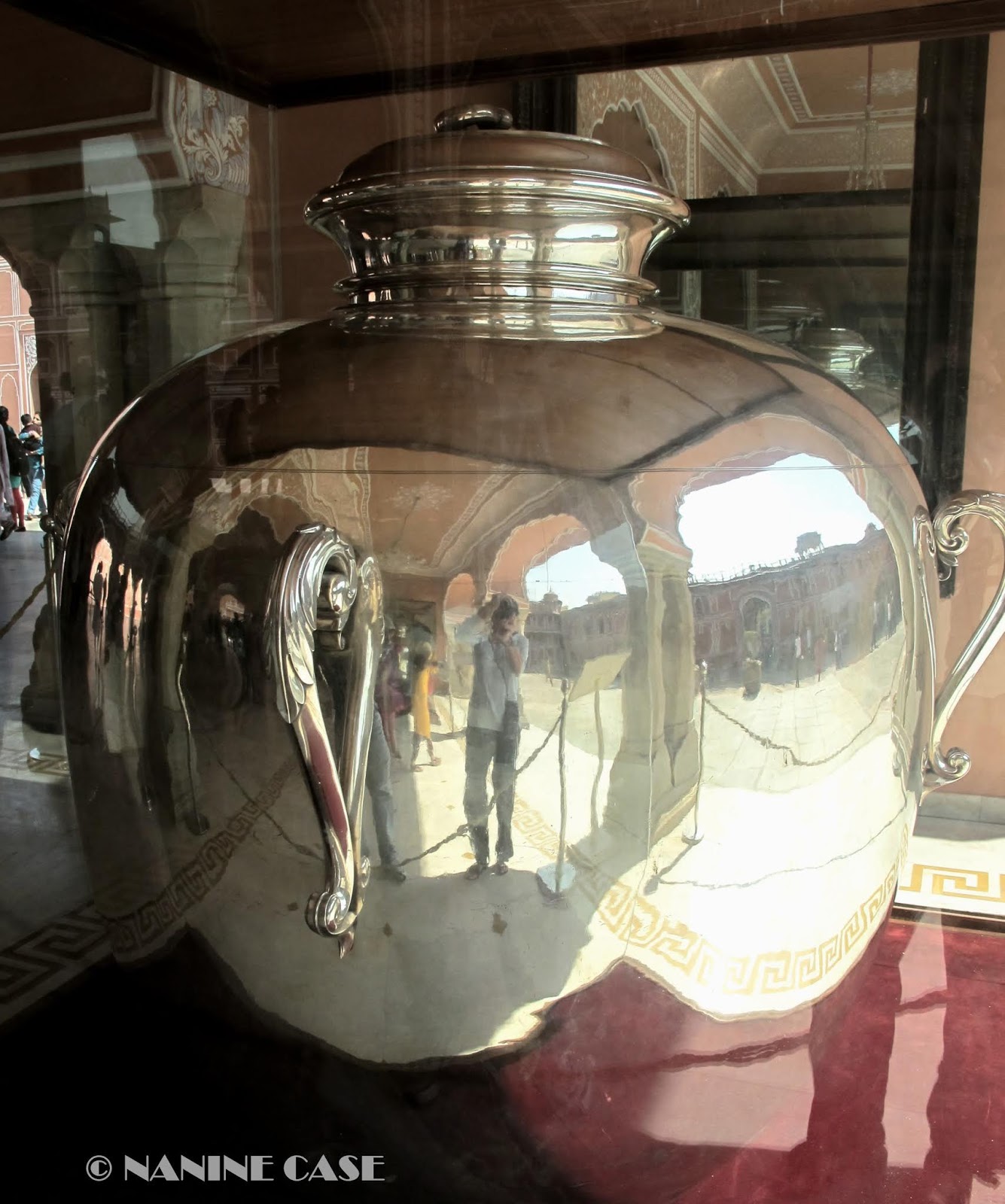
and its FASCINATING way of life.
~THE GOLDEN TRIANGLE~ON THAT FINAL LEG OF MY INDIAN JOURNEY, I would travel from Patiala--in the north--with my hired driver, Amar Singh, across India’s Golden Triangle, a 530 KM trek, taking in New Delhi, Agra, Jaipur and all the contrasting sights in between.
THE PHOTOS TELL THE STORY OF ALL THAT I WITNESSED. Those of village life were taken from the window of my hired car as there was no place for my driver to pull over for fear of being RUN OVER, or, meeting my end as the crumpled matter beneath an elephant’s foot!
````````````````````First stop, the colorful old city of Delhi--founded in 1639. Population ELEVEN million!

IT WAS A MAZE of narrow side streets where LIVELY vendors hocked their wares.
 AND OFFERED SPICY bites that promised to startle the palate.

IN BETWEEN, BEAUTIFUL facades and IMPRESSIVE domes defined its long history.
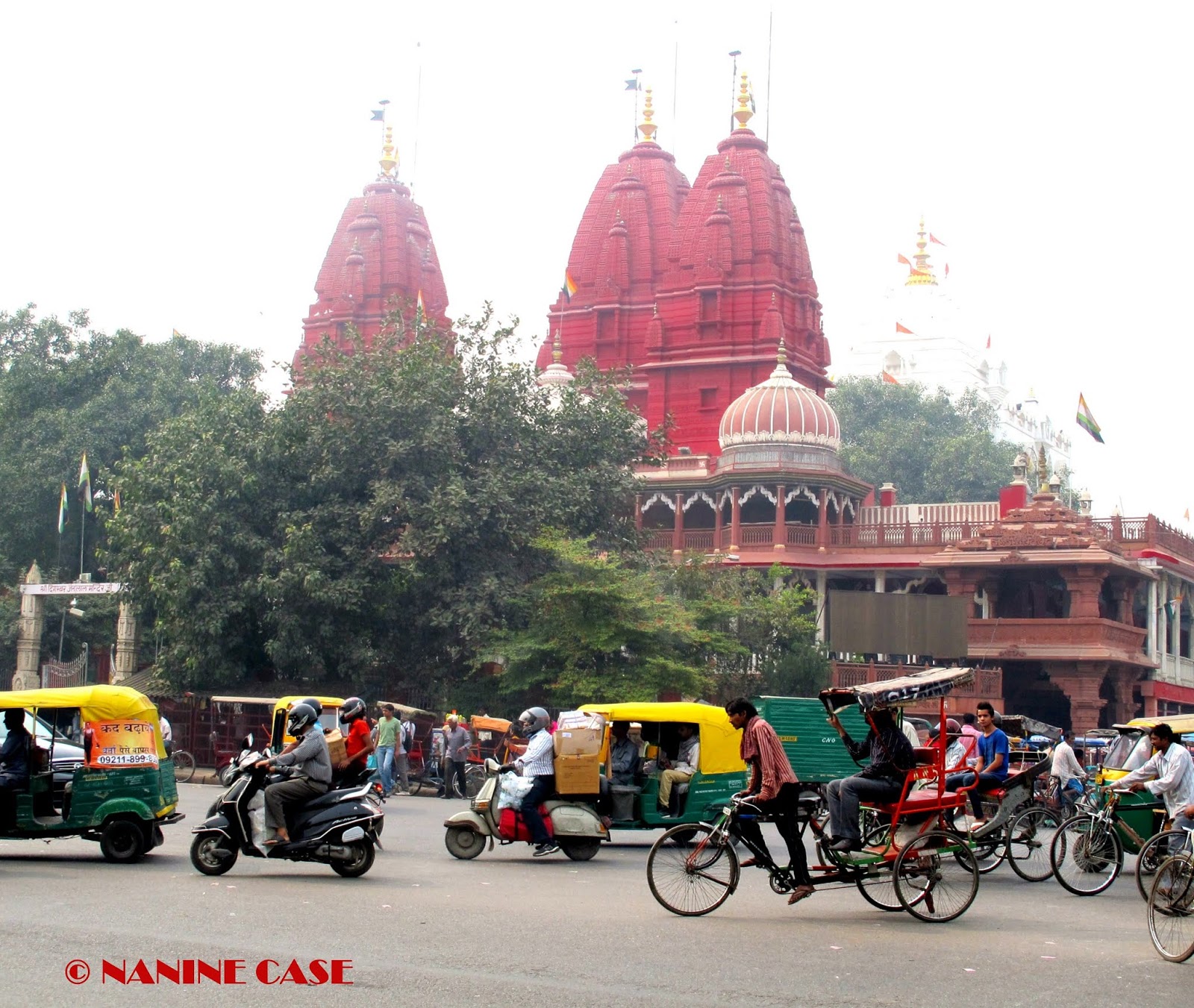
RICKSHAWS AND MOTORIZED BIKES shared the crowded streets with pedestrians and cars and oxen-drawn carts, ALL, at work claiming their small piece of the road.

NO SPACE was left unused;
even the center median offered a poor man a place to lay down his head.
Amar Singh negotiated with a rickshaw driver for a city fare and before long I was swept up and carried off to face the unmerciful DEMANDS of Delhi’s streets.JOSTLED IN MY SEAT beside my self-appointed protector, Amar Singh, I was amazed by the skill with which our nimble driver carried his burden, his sandal-covered feet moving in a steady, quick stride as he navigated his rickshaw through the unending string of traffic.
THE ONLY ESCAPE from the madness was the RAJ GHAT, a quiet park where a memorial dedicated to, Mahatma Gandhi, allowed me a brief respite alongside those in quiet reverence to the beloved man that had once led India to independence, and inspired movements for civil rights and freedom worldwide.
`````````````````````````LEAVING DELHI BEHIND, Amar Singh, proceeded along a four-lane, passing the New Delhi and its modern high rises strung along the highway.ARRIVING LATER at the town of FATEPUHR SIKRI in the Agra District of Uttar Pradesh, my prearranged guide waited outside the palace entrance where he would offer up--in vivid detail--India's OPULENT history.
~THE EMPEROR AKBAR'S 14thCENTURY PALACE~
THE BULAND DARWASA ("Gate of Victory") "Crafted of red sandstone with accents of white and black marble. It was built by Akbar in 1572 to commemorate his victory over Gujarat. It is the main entrance into the palace’s quadrangle, and the HIGHEST gateway in the WORLD."
TOMB OF SHEIKL SALIM CHISHTI "Famed as one of the finest examples of Mughal architecture in India. Built during the years 1580 and 1581."
```````````````````````````````````````````
WITH THE PALACE IN OUR REAR VIEW MIRROR, Amar Singh, began our 48 km drive to the city of AGRA, traveling through small villages that provided a STARK CONTRAST to the grand palace we had left behind, and the even greater "WONDER" planned for later on.


````````````````````````````````````````````````````````````````````````````````````````````````````````````
ARRIVING IN AGRA, a city on the banks of the river Yamuna, I can still remember the honking horns and mid-morning traffic coughing out smoky exhaust while an unruffled, Amar Singh, moved at a crawl from traffic light to traffic light. Although twinges of guilt for those much less fortunate than I crept in, I relished in the comfort of his brand new taxi with its AC and tightly sealed windows that protected me while allowing me to witness it all.
TRAVELING ALONG THE YAMUNA I felt the excitement chase down my spine as the Taj Majal, set boldly against the horizon and settling in soft reflection on the river, came into view. Majestic though it was, that image would prove to be a mere GNAT in comparison to the GIANT that would soon take my breath away.

`````````````````````````````````````````````
~TAJ MAJAL-1632~ ("Crown of the Palaces") ONE OF THE SEVEN WONDERS OF THE WORLD

AMAR SINGH, PHONE HAND-HELD in communication, delivered me safely to my guide (also with phone in hand) who waited at the entrance to the gait. The pleasant, male Indian man introduced himself, asked for my passport to present to security, and led me to the gate where I was about to follow suit beside others standing in silent AWE, our gaze fixed on the sprawling white marble mausoleum lit by the sun.
 MY GUIDE began his discourse doing his best to keep up with my weaving in and out of the crowd and venturing off the beaten path to shoot photos, and with a photo at every turn, we were soon dancing in step.
 HIS TONE WAS POLITE: "Madam, the complex is set in a 300-meter square Mughal garden that's divided into four quarters." While I looked for the best angle to capture the garden, I proceeded to do the math in my head; "That's about 1,000 feet," I replied, stopping the guide mid-sentence and leaving him on pause while I moved about the raised, pastel-colored marble pathways that divided each of the garden's four quarters, squatting down to compose the next shot.
I WAS IN LUCK with the sun at the right angle, because halfway between the tomb and the gateway, smack in the center of the garden, the mausoleum smiled its reflection in the narrow pool.
CONTINUING with his unceasing script, I felt my neck strain as I fixated on the exterior, aiming the lens while the quide talked: "Madam, notice how the decorations change with each surface.


Those that you're taking photos of were created with paint, stone inlays and carvings. Some areas depict passages from the Qur'an." I paused in memory of morning chants from loud speakers flooding the city of Cairo, Egypt with sound during my trip in 1998.Doing his best to move me along at HIS pace--for I could have lingered in the shadows of the mausoleum until sunset--I gave in to his invitation to move on to the inside tomb, forcing me to leave my tour of the outside 'til the next day when I would return on my own to see the Taj Majhal change color in the RISING sun.
AS A WOMAN, I can not even begin to IMAGINE being so loved that a mausoleum--the likes of theTaj Mahal--would be built in my memory; but as my guide explained in a voice that hinted disapproval: "The Emperor, Shah Jahan, built this ostentatious display of wealth in memory of his favorite wife, Mumtaz Mahal, who SO ranked in favor over his other TWO wives that he gave little attention to his POLYGAMOUS rights!"
AS THE DAY DREW TO A CLOSE, I stood along the south wall to gaze one last time up the misty Yamuna River, quiet and lonely in pose. Five hundred-eighty-five years hence of the Taj Mahal's birth, I could not help but think that little had changed of the scenery other than the style of the boat resting along the bank.
~SUNRISE~WITH THE TAJ MAHAL CAST IN SHADES OF PINK.
A SIGHT TO BEHOLD.

`````````````````````````````````````````````````````````````````````
LEAVING THE TAJ MAHAL BEHIND, WE BEGAN THE FINAL 240 km LEG OF THE GOLDEN TRIANGLE ALONG INDIA'S HIGHWAYS AND BYWAYS.

WITH A GLIMPSE OF VILLAGE LIFE ALONG THE WAY.
 DUNG DRYING IN THE SUN FOR FUEL
 COOKED SYRUP LATER HARDENED INTO CANDY.
`````````````````````````````````````````````````
JAIPUR ("THE PINK CITY")
HOME OF AMER FORT AND THE WORKING ELEPHANTEstablished 1729

POPULATION 3.1 Million


HAWA MAHAL ("Palace of Winds")LOCATED IN THE HEART OF THE CITY."Built in 1799 by Maharaja Sawai Pratap Singh. Constructed of red sandstone. 953 small windows and decorative lattice work give it the appearance of a honeycomb; since the royal ladies had to obey the strict rules of "purdah" which forbade them from appearing in public without face coverings, these small windows allowed them to observe the street scenes below without being seen."

INSIDE THE PALACE
CHANDRA MAHAL BUILDINGPEACOCK GATE


~JAL MAHAL (WATER PALACE)~
A Picturesque Centerpiece Seated in the Middle of the Sagar Lake in Jaipur City.
 JAIPUR WAS A MILD VERSION of Delhi, easily navigated, and I wanted to partake of all it had to offer, so after a drive along the main street and a visit to the Hawa Mahal Palace, Amar Singh, drove me to a park to view the Jal Mahal by day.
THE PALACE was a beautiful, stand along piece that appeared to be afloat on the water's surface. With my back to the park, and a dutiful Amar Singh waiting behind, I was oblivious to the children who had become aware of the white-skinned woman taking photos. When I turned, there she stood, that featured, stunning, green-eyed child of the streets. I WAS CAPTIVATED as she stared back at me, her penetrating eyes and beguiling smile reaching out to the camera lens. Caught in the moment, my once again, over-active mind flashed to the famous cover photo of the green-eyed Afghan girl taken by a National Geographic Photographer in 1984. Had it not been for the urgent calling of Amar Singh, standing by the open passenger door, I might have been tempted to linger for more shots. But I followed his urgent call, for I would have been encircled by begging children demanding equal time and money to provide for their impoverished state.~~~~~~AMAR SINGH left no stone un-turned in his ongoing effort to provide me the RICHEST experience, which meant unexpected side trips for those startling photographs.
THAT NIGHT we would travel the long winding road uphill to witness the SPECTACLE of Amer Palace Fort--perched atop the hill--lit and reflected in the Maota Lake below.


~~~~~~~~~~~~~~~~~~~~~~~~~~~
AMER, THE SMALL TOWN which is home to Amer Palace was en route to the fort, and I asked Amar Singh to park the taxi and allow me a quick stroll through the village. My first preview was a calf attempting sleep on a side street with its tail curled up in pursuit of the pesky flies that clamored around its eyes, and the fresh lettuce scraps someone had deliberately placed nearby.
FARTHER ON in a square, a woman and her children lay claim to the street, her less than meager possessions strewn on the dirt beside a mattress. She peered out at me from her partially covered face and eyed me skeptically. While viewing her from behind the lens, I felt tears well up in my eyes, her state of being tearing at my heartstrings.
BEYOND, where life was happening at a leisurely pace, the villagers appeared unruffled by my presence.


TO INCLUDE a veiled onlooker who soon revealed her privileged status, evidenced by the gold embellishments that smiled against her bronze-colored skin.
 ~~~~~~~~~~~~~~~~
 NEARBY, we stumbled upon the huge well at Kheri Gate--an architectural wonder and ingenious concept for storing and collecting water--left over from another time.

A SERIES of artistically laid out steep stair steps led down to an algae-stained, well. The absence of support rails, combined with the steep drop and slippery stairs, proved challenging, but reaching the bottom made it possible to envision the difficulty one must have faced carrying vessels of water up the steep incline.


~~~~~~~~~~~~~~
~AMER FORT AND PALACE~
VENTURE THE LONG STEEP PATH ON THE BACK OF A COLORFULLY CLAD ELEPHANT OR WALK? THE ELEPHANT WON...HANDS DOWN!
AS BEFORE, I would be met by a guide, this one best characterized as a wannabe "Casanova", and one who would prove to be very entertaining, inquisitive, and admittedly fearful of heights. He was not so entertaining, though when he insisted on taking possession of my camera while I was being hoisted up and onto the elephant's padded seat for two. A nice gesture had it not been for the fact that he turned my prized possession over to the elephant attendant , who promptly tossed the camera in the air with the now on board Casanova barely catching the projectile with his fingertips! GRRR!
 UP THE COBBLESTONE ROAD the string of regal elephants trod, elephants minus their human cargo passing us on the opposite side. Our elephant's wobbled gated caused me to rock and tilt precariously in the seat, Casanova, occasionally holding a firm but deliberate and prolonged grip on my arm.
 "AMER FORT and PALACE ARE made of red sandstone and marble. The Fort is known for its artistic-styled elements of large ramparts, series of gates and cobbled paths. The opulent Palace is laid out on four levels, each with a courtyard."


"AMER FORT--along with Jaigarh Fort--is located on the Cheel ka Teela (Hill of Eagles) of the Aravali range of hills."
 "THE PALACE and Jaigarh Fort are considered one complex as they are connected by a subterranean passage. This passage was meant as an escape route in times of war to enable the royal family members and others in the Amer Fort to shift to the more formidable Jaigarh Fort."
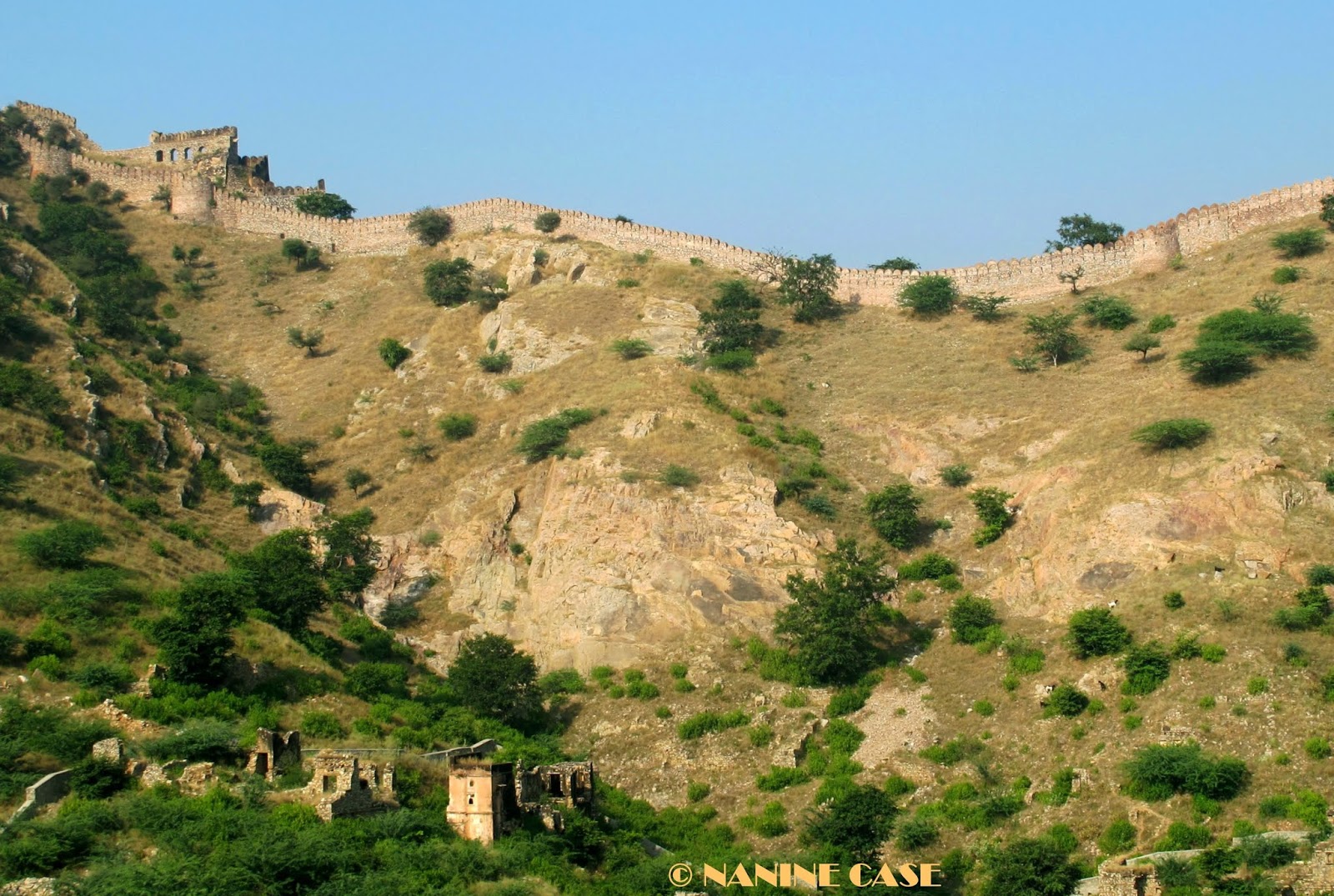 FOR HOURS I would be stunned by mirrored ceilings, bejeweled surfaces, archways that resembled suspended crowns and age-stained sandstone that brought even the palace's empty spaces to life in unceasing swirls of color. And every so often, a common person--planted as a prop--would lend a timid smile to remind me of another life that existed beyond that atmosphere of unimaginable wealth.


~~~~~~~~~~~~~~~~~~~~~~~~~~~~~~~~~~~~~~~~~~~~~
THE LAST STOP ON THE GOLDEN TRIANGLE ROUTE~ROYAL GAITORE~


THE DAY WAS NEARING AN END causing the sun to creep along the hallways and light the Gaitore's courtyards. Aside from the monkeys who lay claim to the grounds, Amar Singh, and I were the only people present. In the absence of a guide, and Amar's lack of the English language, I would be left to imagine the faint murmurings of the ancients and listen to the background chatter of the resident monkeys perched on a wall.


~~~~~~~~~~~~~~~~~~~~~~~~~~~~~~~~~~~~~~~~~~~~~~~~~~~~~~~
WHAT A PRIVILEGE IT HAS BEENReliving...Sharing...WritingMY GOLDEN TRIANGLE ADVENTURE.
A VERY SPECIAL THANKS GOES OUT TO, Amarjeet Singh, and his gracious wife who planned the Golden Triangle trip--SPARING NO DETAILS. I will NEVER forget the fun and laughter, and how you opened your hearts and shared your home with me en route. AND OH, THE MOUTH-WATERING, HOME-COOKED, INDIAN DISHES!

AND TO MY SIKH FRIEND AND DRIVER, AMAR SINGH, who kept me safe and comfortable AT ALL TIMES. Who made me laugh. And, who, when I attempted to thank him for his efforts and apologize for keeping him waiting, said:

NEITHER DISTANCE NOR TIME CAN EVER GET IN THE WAY OF MEMORIES.
November 12, 2013
KARVA CHAUTA
 NAVNEET
On the fourth day after the full moon Indian women participate in a one day ceremony known as Karva Chauta which is considered to be an "auspicious" occasion. They are required to fast from sunrise until moonrise at which time they pay tribute to their husbands by granting them longevity and safety. On the day of the fast, women from Punjab awake to eat and drink just before sunrise. It is also a time for the ladies to dress up in their finest clothing, cover their exposed skin with gold adornments and decorate their hands with the ancient Indian art called Mehandi. As a witness to all of the events that took place, I can say firsthand that they were stunning in every detail.

 Experts in the art of Mehandi apply a henna paste to the skin with a small metal tipped jacquard.
 I saw it performed on the streets of Patiala as well as watching a young woman apply her art to the hands of
 Navneet, and her niece the night before the ceremony. The process reminded me of cake decorating as a soft and flowing paste squeezed from the metal tip does much the same as frosting flowing from a tube. The artist performing Mehandi creates a series of dots, swirls and intricate patterns on the arms, palms and upper hands.
  The paste is then left to dry overnight and removed the following morning leaving behind the beautiful orange colored Mehandi pattern. Unlike a tattoo, it is a temporary adornment which washes off several days to a week later.
 That morning of Karva Chauta, I sat across the breakfast table from, Navneet, who abstained from solid foods in anticipation of the ceremony later that night. There was enthusiasm in her voice as she reminded me of the much-anticipated fashion show later that afternoon. She said I would witness Indian women doing what women the world over love to do and that is dress themselves up and strut their stuff.

But in the meantime, I would have a preview of coming attractions with her and her niece in their parlor performance.
 Later at the country club—where I was cordially received and made to feel welcome--- I didn’t mind the fact that I was under-dressed in my long white skirt, simple blouse and silver adornments; I was too focused on the dazzling display that met my eyes as I entered the room full of women, livened by their brilliantly colored saris and ladies suits.
  The sari consists of a midriff top and yards of fabric draped over the body in a variety of styles leaving a small amount of flesh exposed. The suit is a knee length type dress under which is worn regular or balloon pants that gather tightly at the ankles. A long and wide accenting chiffon-like scarf draped over the shoulder hangs down at varying lengths. Both styles feature bold colors and are worn in everyday life, the suit being the most widely used. Under ordinary circumstances the women look beautiful, even to the peasant women in the rural villages dressed in their electrified colors; these weighty, hand beaded outfits were definitely not for street wear, reserved only for the most elegant of events.
  In short order, the fashion show/contest began. One by one the contestants paraded down the aisle, one outfit more beautiful than the other; their gold body adornments shimmering in the light.

I knew the minute I saw the stunning woman wearing the orange beaded gown that she was the winner, passing my vote of approval on to, Navneet.

A photographer was snapping pictures as was I, the lady announcer lending her commentary. That’s when I diverted my attention from the contestants and saw the magnificently adorned lady in her quiet, but elegant pose seated on the stage.
My photography could hardly do justice to the event, but if you’re startled by what you see, then you can imagine the dazzling sight that met my gaze.

November 9, 2013
INDIA AND PAKISTAN FACE OFF FOR A CHANGING OF THE GUARD

After our visit to the Golden Temple, Navneet, Neru, Kuljit and I parted company with our escort, and after a quick freshen up at our hotel, made the 28 kilometer drive to the Wagah, Pakistan border to witness the changing of the guard.
 Every day at sunset the Indian and Pakistan soldiers face off at the border gate in a flag lowering, gate closing ceremony that draws a crowd of thousands. I understood in advance that the two countries were at odds with one another; but it was not until I witnessed that menacing barbed wire fence rising out of the mist, coiled in places like a snake ready to strike, the emptiness of the forbidden ground inside it and the resulting hostile atmosphere, that I, a free American unencumbered by borders, was able to put it into its proper prospective.
 At the border a frenzy of cars raced to get a space in the parking lot while hordes of lively stepping people converged on foot. A parking attendant urgently directed our driver into a spot so tight that I could barely squeeze through the car door opening. I had not expected such a turnout; but then, neither was I prepared for the crowd-pleasing performance I was about to witness.
 There were several military guards collecting tickets at the entrance to the event, all trying their best to maintain tight security. Amidst that difficult task, loud speakers were blasting music and voices cheering, causing the excitement to build inside me. One of the guards had all he can do to keep up with the mad rush of people shoving their tickets in his face, much less our driver and the two uniformed border policeman that met us at the gate who were trying hard to garner his attention above all the others. We could not enter until he checked our names against the VIP list of reservations… compliments of the very accommodating colonel's wife. In the midst of numerous interruptions, the guard finally managed to find our names and at long last the gate was opened allowing us to push our way through the crowd and gain entry.
 A dynamic street scene, much the same as that of a New Years parade awaited us. Two sets of bleachers filled the entire side of a two lane road accommodating twenty or so rows on one end and six rows on the other, all taking up at least a fourth of a city block. They were already nearly full to capacity and the crowd from outside had yet to enter.
  On the opposite side of the road, two rows of spectators had taken their seats, but seven front row seats remained empty. A guard looked at our tickets and led us to four of those seats where we were positioned front row and center of the two countries' gates; no doubt providing us some of the best seats available.
One end of the roadway was dominated by the India gate where two armed sentries looking dwarfed atop their lofty spot flanked an enlarged picture of India’s beloved, Mahatma Gandhi.

About a sixteenth of a mile farther down the road a twenty to thirty foot long red and white metal gate lay open to the Pakistan border where another towering gate featured an enlarged photograph of some notable figure.
 Amidst the incoming spectators, armed Indian border police and soldiers worked hard to keep an overzealous crowd in check. A German shepherd with its nose to the ground sniffed the area around the bleachers. The loud speakers vibrated with the sound of Indian music leaving the crowd entertained by a large group of young girls showing off a traditional dance in the street.

Even the two members of Mother Teresa’s Missionary of Charity seemed charged by the impending event.

 As the sun began its ascent the crowd chanted and cheered jumping up and waving their arms high above their heads. People of all ages were getting in on the act, to include me, foot tapping and itching to get in the thick of it. On the other side of the gate, I could see the empty Pakistan bleachers and a small crowd—paled in size to the Indians-- attempting to cheer on their soldiers; but they were no match for the uproarious Indians. A sense of patriotism pervaded; pride was written on the faces of India’s citizens. I could feel the goose pimples rise on my arms at the sight of it all.
At the onset of sunset six foot extra plus, modern day Adonis’s all head adorned, decorated and spit shined line up in formation on the street, reigniting the anticipating crowd.

 One by one the soldiers carried out their breathtaking spectacle of high stepping, arm thrusting and foot stomping march that ended up in a face off at the gate with their Pakistani counterparts.


 With the sun now settled on the horizon, the flags were lowered, the gate once again closed against another day.
 I wondered as I watched the stand off between opposing soldiers what they must have been thinking as they stared into each others eyes. They were, after all, enemies, united only for a short ceremony. In the morning, the gates would reopen and allow the trucks from either side to transport their goods, only to be closed again at sunset for a repeat performance.

Outside, the spectators were gathered around the soldiers who stood on display for the visitors. Across the border, two Pakistani soldiers in profile were motionless atop their horses.
 Another soldier standing at ease stared back at me as I aimed the camera in his direction. A faint smile—or maybe it was a smirk—temporarily parted his lips. Unfortunately, the girls whisked me away so I did not have the opportunity to tell the Indian soldiers just a few feet away that they took my breath away with every step!
~~
 It seemed more events were in store that morning following the changing of the guard, to include another visit to the border. But not before we stopped for breakfast at the second storey hole in the wall restaurant in Amritsar where I ate the creamy fresh yogurt and mouthwatering, fresh off the fire thin breads…probably made by the man on the street standing on his stool and ladling the delicacies out of a huge wok.

Our first stop was at Wagah for a very brief but memorable visit with the colonel and his wife, Preeti, whom I soon viewed as being like-minded, for she, too, loved to write and saw life through a similar lens as I; and who, at one point during our conversation, looked me square in the eye and delivered words that rendered me speechless: “You are a very sensitive person. You inhale the breath of every conversation.” Although I wished for our meeting not to end we had no choice as a military vehicle with two soldiers under the colonel’s orders was waiting outside to accompany us on our day’s journey. I rode in the back seat crammed next to the other women, staring out the window as we bounced along the narrow winding country roads that passed lush fields of crops and tall pampas grasses in full feathery bloom, stopping finally at a small military installation only a stone’s throw from the Pakistan border.

The only thing interrupting the calm and peaceful country atmosphere of this modest base was the hostile barbed wire fence and watch tower separating the two countries.

Otherwise, it seemed a lovely place where one might escape the madness and pollution of the city to breathe in the clean air and take a leisurely stroll along the avenue of trees that meandered in contrast alongside the ominous looking fence.

Off in the distance, though, the faint outline of another tower was a constant reminder that someone might be watching my activities with suspicious eyes, sending a tiny shiver of fear down my spine as I took aim with my camera.

At one o’clock we sat at an outside table where the soldiers began piling our plates with food that came non-stop. Afterwards we were introduced to life on a border base.
 Several soldiers, male and female appeared on the scene and I began to feel those all-too-familiar stares that had become my constant companion. News had traveled fast on this small complex, and I supposed that they had come to satisfy their curiosity and meet the American woman visiting their base, because they all eagerly posed for a group photo positioning me in the center. We traveled back along the same winding road where, at some point, we stopped to let our escort out to join two other soldiers waiting at the entrance to the small village of Dera Baba Nanak.
  By now I was dizzy from all the events, this time being hurried down a narrow street in the company of the now three guards who, for obvious reasons, weren’t overly keen on my stopping to have a peek at the sights along the way. Outside the very modest gurudwara where shoe removal was a must, I was beginning to develop an intense dislike for the reluctant buckles of my sandals that always left me lagging behind the other women. The guards stood patiently by my side watching my struggle. Shoes off, scarf now positioned on my head, camera secure around my neck, I entered the holy place feeling the cold marble slabs on my bare feet, witness now to the reverence being displayed by those standing before the glass encased, five-hundred-year-old wedding dress of the tenth guru, Guru Nanak, which was on display in this most modest of gurudwaras.

There was pride written on the face of the turbaned man who told the story of the guru who once wore the now, age-worn garment, and of his wife who embroidered the cloth below it. “I am the 17th generation descendant of the guru,” he said in broken English.
 His was a long dissertation, mostly in Hindi, so I let my eyes wander and my lens do its work. Finally, he honored us four ladies with the orange cloth which we wrapped around our necks. Others who had entered the gurudwara after us seemed to pause and view us as special…and I suppose we were special for aside from the Guru Sikh, we were the only ones wrapped in orange. In fact, for two days we were given nothing shy of the royal treatment; first from our escort at the Golden Temple the day before; and finally when we were met by, Preeti, and her military entourage who came to wish us farewell on the road leading out of Wagah.
~~ My sincerest thanks go out to the colonel and his wife who made it all happen…and in a way that I will never forget. And to those escorts who assured our safety, I also extend my gratitude. And finally, to all those splendid looking soldiers, some of whom I managed to capture up close in spite of their high stepping…you are an asset to your country.

November 2, 2013
THE DARBAR HARMANDIR SAHIB

We were four women and a driver crammed into an economy car, off for an overnight excursion that would take us to the Golden Temple in the city of Amritsar. Later that same day, we would travel to the Pakistan/Indian border to witness the changing of the guard
By now I was well acquainted with Indian driving and quite happy with my front seat position, completely unruffled by India’s version of, Mario Andretti, gripping the wheel, honking and weaving his way in and out of the maze of vehicles. Navneet, and her two lady friends, Neru, and Kuljit, a trio of chatty magpies, were oblivious to all but the conversation that was non-stop most of the two-hundred-fifty kilometer trip. I caught enough of what they were saying to know they were being typically female and that Navneet was feeding their curiosity about me. Many Indians speak Hinglish---a combination of Hindi and English which is quite commonly spoken amongst the educated class. Occasionally, Navneet, would come up for air and chime from the back seat; “Any questions, Nanine?”

There were a few, but my focus was on the passing villages that hugged the roadway, and the simple peasant way of life on display.
 Although the scenes were typical of other Indian villages and towns, there was one noticeable difference; we were entering the part of India that boasted a large population of Muslims.

That was evident by the women walking in pairs, their faces hidden behind the veils that covered their heads. If there was a need to slow down because the herd of goats and the man coaxing them along with his long stick were taking up the roadway, then those pedestrians that took notice would stop in their tracks to stare at the awestruck, fair skinned female staring back through the car window…oft times taking aim with her camera. And if there was time, some being photographed would approach the car and tap on the window showing an outstretched hand.
 Five hours later we were approaching downtown Amristar, fighting with the pedestrians, cars, carts, bicycles, motorcycles and rickshaws that were all competing for their little piece of the road. I have often wondered….where are they all going?

The city was a mob scene and unlike Patiala--- that is not geared to tourism and rarely sees an American--- Amristar was nothing but tourists who were either dodging the pesky street vendors insistent in their pursuit to push their tourist trinkets on them, hopping on the rickshaws to get to the Golden Temple, or outside the temple sitting on the rows of wooden benches removing their shoes so that they could gain entrance.
While I struggled to get the strap to my shoe unbuckled my road companions disappeared and were no where in sight. Then, when I was feeling the pangs of abandonment, Navneet, was back urging me to make hast while informing me that her friend, Neru, had a friend whose husband was a big wig colonel in the Indian army, and this friend had arranged for us to have a personal police escort at the Golden Temple. Somewhere in that crowd of people, our escort waited. It was, I thought, an unexpected but nice touch. I wasn’t clear as to the reason for the escort, but I would later find out how valuable this man’s services would prove to be.
There are certain rituals that must be followed before entering the Golden Temple. Bare feet can not carry the dirt from the outside so you must first wade through a shallow marbled trench of flowing water before entering. Once inside, the hands that touched the feet for shoe removal have to be washed at one of the series of washtub type sinks before proceeding.

One never need walk on the marble floors of this massive complex and I was extremely grateful for those hemp runners--harsh to the touch though they were—as they protected my feet from roasting on the hot marble slabs..

 Having walked down the final flight of stairs into the gurudwara, I was in awe of the sight of the Golden Temple rising out of an immense pool, and the sunlight playing off of its gold exterior, its reflection cast upon the water’s surface.

The pool is fed by the Ganges River, and is known for its healing powers; for that reason, pilgrims come from all over to bathe.
 A thin framed, partially disrobed Guru Sikh stood so perfect at the edge of the pool that I just had to chance a shot. I was offered an opportunity to bathe naked in a special room away from peering eyes, but I declined. Our escort was hurrying us along and I was holding the girls up taking my photographs as there was
no end to the fascinating faces and sights. Silently, I was wishing we could move at a little slower pace, but, Navneet, informed me in her gentle but firm way that I needed to catch up and take my photos later. It seemed we had a prearranged appointment—compliments of the colonel’s wife-- to have an audience and take prayer with the Guru Sikh who had the esteemed position of being the Head Priest of the Golden Temple.

At 1 PM we entered a small room resembling a studio apartment. The Head Priest was seated on a chair inside. He was a man of imposing build with plump cheeks that protruded above his curved mustache, and extremely kind eyes that twinkled when he extended his warm welcome.

There were a few moments in conversation which was spoken in Hindi that included questions about me and the reason for my visit to India, and then a final minute for a silent prayer that brought our fifteen minute meeting to a close. We all stood, the women clasping their hands in the prayer position to show their respect for their priest and we took our exit, the heavy sound of the door closing behind us. I felt rewarded.
 Our young escort appeared and we were about to continue on our journey when the door opened with the priest now filling the opening; much to my surprise, he was motioning me to come back inside. I turned to Navneet for an explanation. “Go, he wishes to speak with you alone.” The priest took me by the arm and led me to a table where he produced a length of cloth. I felt dwarfed in size standing beside this towering figure of a man, humbled as he said a few words in English then wrapped my neck with the bright orange cloth. “Good bye. Go with God,” he said in parting. Outside, the ladies greeted me with their smiles of approval and informed me that the priest had bestowed a great honor upon me by rewarding me with the cloth. Why had he honored me? That is a question that will forever remain a mystery. The Golden Temple is in a surround of majestic buildings and is accessed only by a covered bridge. Our escort is moving us quickly passed the long double line of people waiting on the bridge to enter. Navneet tells me the wait is often as long as three hours but one more time, we are given special treatment and allowed to enter the temple ahead of those in line. Heads turn as we pass and squeeze our way through the crowded opening into the temple. It’s beautiful beyond description inside. There are three Guru Sikhs positioned alongside the altar playing instruments and singing hymns. At the altar, another Guru Sikh is waving a silver handled instrument with a long white tail resembling that of a horse, rhythmically waving it back and forth over the altar keeping it free of insects. In the background I hear a priest reading scriptures from the Guru Grainth Saib. People are kneeling and bent over in prayer crowding the area around the altar, but I manage to take a peek and observe the ceremonious way in which it is all being conducted amidst the elaborate fixtures.

I’m being pushed from every direction by the crowd and there’s little time to stop and take photographs much less take time to study the temple’s outstanding architectural features and beautiful components. I do, however, feel the reverence exuding from the worshipers who have managed to tuck themselves into a corner or a tiny cubicle for a few moments of silent meditation.
 As is the custom in all Sikh gurudwaras, the langar (free meal) is served at all times of the day or night. We were all hungry so we entered the immense canteen where hundreds of people were seated in rows cross-legged on the floor, the sound of many voices and clanking utensils echoing off the walls. We followed suit and were immediately given a stainless steel bowl, a cup, a sectioned plate and a spoon.
 Sikh males rapidly ladle the food onto our plates, moving down the long line of people serving them one by one. First the traditional vegetable dishes were served...a different Sikh for each food, then a chapatti from the man with the basket, then water from a tank on wheels, and finally a sweet rice pudding, all served with lightening speed and astounding efficiency. Although it was not the most comfortable way to eat soupy lentils balanced precariously on my legs, the food was delicious, hardy, and completely free. As we left, hundreds more waited outside to replace those whose appetites had been satisfied. I could hear the almost deafening sound of metal on metal making it hard for me to hear Navneet’s explanations. What I was experiencing was an outdoor covered wash kitchen where thousands of metal utensils flashed in the light as a countless number of people engaged in washing and rinsing them. Navneet told me they wash and rinse the dishes three times to assure proper hygiene. I was so impressed with the assembly line process and the dedication with which each and every person performed his or her duty that I would not allow myself to be swept away before taking the time to walk beside the helpers and soak in that very special moment.
 Our escort was urging us on as it was time to leave and head for the Pakistan border. I was very grateful for having experienced the Sikhs’ holiest of places, the Darbar Harmandir Sahib (Golden Temple), reminding myself that it was the central worship place for all of the world’s Sikhs, and that it was called the Golden Temple because of its unique white marbled features overlaid with gold leaf. I paused for one last look at its stunning reflection before leaving.


Later that same day we made a return trip to witness the spectacle of the temple lit at night. Unlike our daytime visit, I would enjoy leisurely time without the hoards of tourists and loud voices that had been replaced with near whispers. I ambled barefoot along the dimly lit corridors and cool marble walkways, sparing my feet the discomfort of the hemp runners that had prickled their bottoms earlier that day.
 There I viewed the devout followers deep in meditation, splashing the healing water on their faces. At eleven o’clock I followed the soothing sound of male voices chanting, and at the temple bridge saw several Sikhs supporting the weight of an elaborately decorated glass container on their shoulders. It carried something resting on a pillow and when I asked, Navneet, what it was, she explained that they were taking the Guru Granth Saib, referred to as the “Holy Book,” to the room where it would be put to rest for the night. “We Sikhs do not think of the Holy Book as a book like Christians do their bible. We think of it as our soul which must be put to rest as we do our own.” I felt her eyes reaching into my soul with every word.
October 31, 2013
THE ROAD TO CHANDIGARH
Navneet plans my days…and full days they are. That particular day she had planned a road trip to the city of Chandigarh. I really didn't know what was in store but eagerly anticipated the experience, whatever it was. Remember the “nightmare in the making” drive from the airport I said I’d talk about in a later writing? Well, this trip was about to give it a new and even more exciting dimension
In India if it honks, bellows, snorts, neighs, moos, heehaws, oinks, barks, trumpets or speaks (in any tongue) it can be found on the road. Four legged transportation independent of a driver absolutely owns the road. There is one rule on Indian roads and that is THERE ARE NO RULES! Praise heaven for economy size cars.
 Why? Because a two lane becomes a four lane, a four lane becomes an eight, and so on. However, there are the trucks…lots and lots of them; outside of the elephant, transport trucks are boss.
 Imagine, if you can, one truck passing another truck on a two lane road with a motor cycle on the shoulder carrying a husband, wife and two children, an oxen driven cart piled high with hay taking up his lane and the rest of the shoulder on the opposite side, and several cars coming from the opposite direction passing one another and gaining fast. What happens then? The passing truck honks at the truck he’s about to overtake, at the motor scooter --whose driver yields as best he can without running into a tree or toppling over the embankment--and at the driver of the oxen-driven cart who’s trying to get out of the way of an oncoming car that’s just passed the truck in front of it. A car behind the truck that wants to pass the passing truck honks at both trucks and whatever else is in his path and attempts to get around the passing truck. In the meantime, the driver of the motor scooter we just left behind is honking at the motor scooter in front of him so that he can pass but another approaching truck honks at both scooters and the overtaken truck. Who knows…by now the oxen-driven cart could be laying on its side in a ditch. The oncoming car that is just barely squeezing into the lane before hitting the passing truck coming from the opposite direction that is being overtaken by the car are all honking at each other and….. IF YOU DIDN’T GET ALL THAT, YOU’VE JUST EXPERIENCED DRIVING IN INDIA. Mind you, through it all, yours truly is completely relaxed and splitting her sides with laughter in the back seat. Baljit, who is honking and overtaking the car in front of him, is making sure he adds more humor. “LOOK! There are five people on a motorcycle.”
 The women, by the way, do not straddle the passenger seat of the motorcycle or scooter…oh, no; they have no choice because they’re wonderfully attired in their ladies’ colorful suits with long scarves that blow free in the wind, so their only option is to sit side saddle. Now, if a truck being passed gets too close to a scooter and the driver hits a bump, this fair maiden might be catapulted onto the back of one of the bulls in the passing truck.
 After complimenting me on the fact that I was so “relaxed” about it all, Navneet, added even more humor to my side-splitting experience: “Unlike you, most of our American friends are so terrified the first time they ride on our roads that they never want to come back.” I could just visualize the scene as the tears of laughter rolled down my cheeks and I caught a glimpse of the car barely squeezing in before taking a piece of our fender…or so it appeared.
 I asked Baljit how many different modes of transportation occupied Indian roads. He started the count and with Navneet’s help, came up with a total of twenty to include the elephant. “LOOK! The man has pieces of rebar strapped on his bicycle.” My reply: “Maybe he’s planning to instant skewer one of the pigs along the side of the road for the evening barbecue.” “No. He doesn’t eat pig. He’ll use it to build his house.” Says Navneet: “It’s really boring driving in America. All you do is put your hands on the wheel and go.” Sounds like a pretty good concept to me. Says Baljit: “You never use the horn, either. Car is not car without using horn. In India, all you need is wheel and horn….no brakes.” Of course you have no brakes…they’re worn out!

Necessity is the mother of invention, and with 1.7 billion people to provide for, you use whatever mode of transportation is available; that includes carts, rickshaws, donkeys, camels, elephants

and the human head.
 Regardless of their size or shape, weight permitting, goods are often carried on a bicycle or motorcycle. I saw 6 to 8 stacked plastic lawn chairs tied to the back of a motorcycle appearing as a tall seat on wheels moving down a four lane highway. Had, Baljit, been present he would have said, “LOOK, a chair without a driver,” and added another number to his list. The most incredible part of all that I have just described is that it works and no one ever seems to get ruffled; in the end, isn’t that all that matters? What's more I can not ignore the fact that I thoroughly enjoyed the emotional release all that laughter brought. “I guess I should be frightened, but I’m smiling,” I finally said to my master of comedy. “ “That’s good,” Baljit, replied, dryly. “Better to die with a smile on your face.”~~ Although Chandigarh is worth the visit alone--owing to the fact that it is the best-planned city in India and said to be the cleanest--- that was not the purpose of our visit. When, Baljit, informed me at the entrance that we were going to see a rock garden, I assumed the obvious. Inside the gate, however, I could not believe the wonder that was unfolding before my eyes, nor the story surrounding the rock garden’s creator.

An Indian government official by the name of, Nek Chand, a self-taught artist and a man of great vision, secretly created an illegal garden on a land conservancy that was not supposed to be built on.

In his spare time, he began collecting materials from demolition sites around the city. From bottles, glasses, bangles, tiles, ceramic pots, sinks, rags and broken ceramics he created ceramic covered concrete sculptures of dancers, musicians and animals. He kept his creation secret for eighteen years--that alone is mind boggling owing to the fact that he had utilized 12 acres of the forbidden ground for his work. One day he was found out and his dream was nearly lost to the die hard bureaucrats. Favorable public opinion won out, however, and this wonder of wonders was officially inaugurated in 1976. The park is a series of intricate paths of man made waterfalls, trees and sculptures. You have to see it to believe it, but Ill try and take you on a journey Cannon style.


And to think...the world nearly lost out on a great work of art borne out of the mind of a creative visionary.
October 29, 2013
FESTIVALS IN PUNJAB
When asked what I wanted to do while I was in India, I emphatically stated: “Immerse myself in the Indian culture.” That’s not a difficult thing to do when you are the invited guest of Navneet and Baljit who have introduced me to their large circle of friends and family members, all of whom are eager to share all aspects of their culture.
To my Indian and Hindu friends who may read my interpretation of the festival, I beg your indulgence if I make an error. I attempt only to present the facts as I best understand them.
~~

The state of Punjab, where I am staying, is a region in the northern part of India, and home of the Sikh religion…the fifth largest in the world. The Sikh Gurus are highly revered in Punjab and are easily recognized by their turbans, long beards and the knives hanging from a black belt slung over their shoulders.
 I find the most impressive Sikh costume to be that which was originally worn by the soldiers of the first Guru Nanak in the sixteenth century. It is deep royal blue in color with a turban to match; an orange cloth is worn around the neck as well as being an added accent to the turban. Although many followers of the Sikh religion are bearded and do not cut their hair, some have liberated themselves from this custom, wearing the silver colored bracelet on the left wrist to identify them as Sikhs.
 Upon my arrival, Punjab was honoring the first guru, Guru Nanak’s, birthday, April 14, 1469, in a celebration known as a gurupurab. Nanak, was the founder of the Sikh religion which incorporates a “spiritual, social, and political system of beliefs that considers spiritual life and secular life to be intertwined.” Sikh temples all over the world offer a langar (free kitchen) twenty-four hours a day, 365 days a year, to anyone in need, regardless of race, color, creed or cast. People with maladies come to the Sikh temple at Patiala to pray. By offering a handful of salt and a small hand-held broom to the Gods you are asking with your prayers to be healed. Baljit’s brother was plagued with painful growths on the bottom of his feet. His offering left him completely healed.
 Early in the morning I can hear male voices chanting their hymns from the temple that rises beside the wall of Shangri La. It is in that same temple that I was an invited guest the second night of my arrival.
Shoes must be removed and left outside the temple, heads covered, and all must squat or sit cross-legged on the floor during prayer.

 With that ceremony I wintnessed Hindu worshipers make offerings to one of their many Gods (Baljit informs me that Hindus worship more than a thousand Gods depending upon the occasion) and dance to music accompanied by a man beating on a drum. I was encouraged to participate in all aspects of the ceremony and made to feel a welcomed part even though I was not of their religion. At its conclusion we were served a sweet grainy ball by the priest. It had a peanut buttery flavor. After that, we sat on the floor where we were fed a meal from a traditional silver metal plate.
The third day found me an invited guest in the Hindu neighbor’s home. There, I witnessed a ceremony celebrating the return of Sita, the wife of King Rama who was abducted by the Sri Lankan King but later returned after a bloody battle was fought and the Sri Lankan king’s head was cut off as a punish ment for his ill deed. Whether historical or mythological, to the Hindu woman, Sita, is considered to be the “esteemed standard-setter for wifely and womanly virtues.”
 I am asked to sit in a chair while the Hindu woman sits cross-legged on the floor beside me. There is a table nearby, covered with silver plates of assorted foods. It is not irreverent to speak during the ceremony so I ask questions. I’m told that the figure of a man drawn with wheat flower is the King Rama, Sita’s husband. The ten rolled wheat balls placed within the figure represent the ten gurus. The woman’s two sons enter the room and all three engage in silent prayer to the figure of a God placed in front of the offerings. The son produces a box filled with freshly green sprouts grown especially for the occasion.
 The woman plucks small clumps from the box and places one over each of the foods now displayed around the figure of Ram. The purpose of the grass she says is to purify the offered foods. A bowl of red dye is uncovered and each forehead, to include mine, is smeared with a small red circle…also a sign of purity.
The same red dye is used by the son to finger paint a swastika-- the symbol of peace in the Hindu religion—in a log book Also recorded in this log are the names and dates, past and present, of those in attendance, to include mine.
 I am honored by the fact that each year when the book is revisited, I will be remembered. Afterwards, I sit with the family for a traditional meal of lentils, fresh yogurt, chapatti and garbanzos which settle quite nicely on my empty stomach. Before taking my leave, the woman presents me with a book written in English telling the story of the battle fought by the King Ram.
 The festival comes to its startling conclusion a week later. I’m not sure what to expect as the descriptions are coming at me fast and furious, and some things do get lost in the translation, but I have the general idea that the story of King Ram and Sita will be reenacted on an outdoor stage in town.
 What I’m not prepared for are the throngs of people that gather to witness the event.
 It’s a short walk to the park from Shangri La and I must watch my back as the horn-honking vehicles come within a breath of me. We enter the park and
 as usual all eyes are on me while I move through the crowd with Navneet and Baljit to a stage where four giant effigies symbolizing the four evil heads of the Sri Lankan king rise above the crowd. The visit is short because Baljit has arranged for us to avoid the crowds and see the fireworks and the burning of the effigies from the rooftop of a friend’s home directly across the street.
 The daughter of the owners swings open the heavy, ornate, iron gate, allowing us entrance onto the property. I’m introduced to the host and hostess who are busy serving their other guests absorbed in a program on the wall-mounted large screen television. They stop to give me a very warm welcome and I compliment them on the design of their gorgeous home.

It is a stunning piece of Indian architecture supporting curves and angles in every aspect of its design. I simply can not resist taking a shot of the staircase which is the center piece of the room.
 On the rooftop night sets in and I meet Kuljit and Kipu, the well-matched, close friends of Navneet and Baljit. Kipu is a cricket coach for a college; his son, a celebrity cricket player, whom, Navneet had pointed out one evening during one of his television interviews. I will later spend many wonderful evenings in the company of this fine couple. The women are off to one side engaged in endless chatter, the men, off to another, drinks in hand. I am standing at the wall, camera ready, staring at the brightly lit effigies and watching the park fill to overflowing. I see the figure of a bull passing under a street lamp of clamoring insects, then disappearing around a corner.
 A loudspeaker is sounding the voices engaged in the reenactment…”Ah Ha Ha Ha Ha,” a gruff male voice finally says. The crowd is cheering. Fireworks begin to light the sky, popping, cracking and whistling against the night. The audience moves from one stage to the other where the effigies are ignited into a fiery inferno lighting the darkness around them, forming a tall screen of sparks that cascade into a pile of burning embers. The king is dead. The festival has come to its conclusion. There’s a mass exodus as thousands rush to the street and the bull makes one more loop.
 It’s late, but not too late for an Indian to eat the tastefully seasoned and irresistible curries, noodles and vegetables that are arriving at the table. I am answering a slew of questions in between bites to an audience that seems to hang on every word. My plate is never empty, even when my hand goes up. Indian’s don’t take no for an answer, especially when it comes to food. Everyone is complimented by my obvious appreciation of the fare and pile my bowl full of the noodles that light my face with every bite. I make it a point to let them know how much I enjoy each and every one of their dishes. Now, I must blame King Ram for the added inch on my waistline.
October 28, 2013
SHANGRI LA AND PATIALA
It takes a lot of time to have fun, leaving little time in between to write. But in all truthfulness, borrowing that extra time to reflect on what I've seen enables me to reach inside and pull out the essence of my experiences, and in turn, deliver the truth as I see it. Today, I’ve come up for air. So here goes!
~~

Before I dazzle you with the unbelievable events that have gobbled up my time and filled me with a sense of belonging these last weeks, I’d like to introduce my Indian host and hostess, Navneet, and her husband, Baljit Singh Johal, who have made me a part of their family, and made it possible for me to have the ongoing and rich experience I'm about to share with you, my fellow travelers.
Baljit owns a travel agency in Patiala. There are not enough words to describe the man so I’ll sum it up by saying he's devilishly witty and uncommonly knowledgeable about a whole host of subjects, most especially (and lucky for me) Indian history. Navneet epitomizes class, style and grace. Above all, she is pure of heart and kind beyond words. As, Baljit’s, cousin so affectionately stated: “Navneet spoils her guests. None can match her hospitality and unselfish desire to please, therefore making it impossible for any future hostess to match up.” I, a very lucky recipient, can attest to the truthfulness of those words.

Their home--which I've named Shangri La for reasons you will later understand--with its lovely garden of tropical foliage and brightly painted clay pots, is only a few city blocks from the main market of Patiala.

 They have in their employ two gardeners, a young man who cleans the house every day and a barefoot, Nepalese cook named, Danny, who is never seen without his baseball cap, and who generally sits on a stool behind a three burner stove where he carefully prepares his delicious Indian dishes and fresh chapati (wheat bread) which --at the expense of my waistline--I relish in eating three times a day.

Outside the protective walls of this haven there exists another class. It is a class so stark in contrast, that nothing could have prepared me for what met my eyes and jarred my senses that day I ventured out on my own.
 ~~ I am picked up by a rickshaw that morning. The man is bone thin and labors under the weight as he peddles his way through the old gate into the market place. A maze of interconnecting narrow streets belong to every moving thing, including my rickshaw and the driver who is fighting his way through the crowd, unruffled by the vehicle hugging his rickshaw from behind, and the insistent horn attempting to honk him out of the way.
 He reaches our destination and I step down onto the dusty street and out of the path of a manned cart stacked with green chili peppers. I am startled by the rushing crowd and vehicles converging from every direction. I think. Beware! Cross the narrow street at your own risk lest you be mowed down in your attempt. Shops tempt me with their wares, but I step cautiously from their steps back onto the street because the driver of the motor scooter charging toward me is counting on me getting out of his way. I am deafened by the uninterrupted sound of honking horns reverberating off the buildings while dizzily watching cars, scooters, and pedestrians elbowing for space, compete with one another for a tiny piece of the rutted lanes.
  A resting calf in a surround of flies claims its piece of ground, sleeping its way through the madness, while the street dogs rummage for food, weaving their way in and out of the crowd.
  In the center of the town I find myself in awe of it all...on one hand shocked, on the other, entertained by the utterly astounding manner in which it all seems to work. Before long, I’m hooked, caught up in the ambiance, soaking up each and every street scene and feeling the rapid heartbeat of a thriving Indian town. My eyes no longer see the grime; my ears unaffected by the noise. Every street is a photo waiting to be taken;
  the architecture looking like it belongs to a movie set featuring an exotic scene from Casablanca or the like. But there's no director on this real life set, and only one camera person...me.

I am dazzled by the electric colors of the women’s attire.

Amused by
a salesman buried in a mountain of fabric.
 I'm waving my camera at the man with the basket of flowers balanced atop his head in the hope he won't resist my overtures. He turns back. There’s a riot of color wherever I look. Heads turn to watch my frenzied picture taking, if not at my western clothes, wide-brimmed hat and the camera suspended from my neck. Navneet forewarned; "You will be the talk of the town as some have never seen light-skinned Westerners walking the streets of their town." There are admiring smiles, looks of curiosity, a few expressions I can’t read. I don’t mind. I smile at everyone because I understand.
  I come to an intersection where a row of weathered rickshaws sit idle, the drivers competing for my attention; “Rickshaw, lady?” Two young males sharing a scooter make kissing sounds and shout as they pass. “Hey baby!” I chuckle under my breath.
  Everyone that sees me “clicking” (as Navneet puts it) wants to get in on the act, to include the two young woman that stop dead in their tracks and boldly position themselves in a tight pose. “Click us.”
  It seems that Indians are not camera shy as evidenced by the three boys who are watching from the sidelines and finally work up the courage to come over and practice their English on me, looking to each other for help and laughing between questions. "Where your place? You like India? How long you stay? I love U.S.A.! You make our picture, too."
 I pass a group of overweight, male cross dressers outfitted in saris cranking out loud music. One, who is very flamboyant in his actions, spots me and dashes across the street flailing his arms. “Come, dance he says in his giveaway male voice.” I try to resist but am helpless to the lightening speed and bullish strength with which he pulls me into his arms. My hat flies off my head. We’re so close that I can easily count the pores on his thickly made up face. The owners of the neighboring shops are looking on in amusement now at these dual curiosities. I have to pry myself from his grip, still fighting as he holds tight to my fingertips. Finally, I’m free to move on. But I’m stuck momentarily in the crowd. A young woman gives me an inviting smile as she speaks in perfect English. “Where are you from?” I reply, “America.” The old woman with her looks at me with wonder. “I just live around the corner. Will you come home with us?” I’m moved by the girl's warm invitation and reminded of a book about India I’d read before leaving. During his travels throughout India, the author had experienced similar invitations. It’s endemic to these people, I think to myself.
 The crowd thins and a shiver of excitement runs down my spine when I spot my first Sikh guru. Despite his advanced years his step is lively and he's quickly hidden in the crowd keeping me from getting the shot. I’m not sure Sikhs will be comfortable with their photos being taken but I must at least try so I chase after him, grateful to find him paused in front of a shop. I show him the camera. “Photo?” He adjusts the scarf wrapped around his neck, brings forward the knife and sheath hidden from view, then without hesitation, proudly poses, the light shining off his snow white turban.
 Hours have passed since the rickshaw driver left me alone on the streets of Patiala. I have been richly rewarded. But I begin to feel the life drain from me as a scorching afternoon sun and the accompanying humidity cause my clothes to cling to my sticky flesh. I’m badly in need of the quiet of Shangri La, longing for a cool shower in the luxury of the tiled bathroom that is larger than many of the shops lining the streets.
Yes, Shangri La and Patialia are two different worlds, but as a wise, male Sikh recently said to me: “Those people may be poor on the outside, but they are rich on the inside.” Seeing it firsthand, I understand only too well the powerful message behind those words.
October 21, 2013
A PERFECT START
I could not have timed my arrival in India any better. Not only is it festival season, it is also wedding time in Patiala. Despite the fact that I had only slept three and a half hours, I made it a point to rise at 9:30 that first morning for it was important that I begin to reset my internal clock to fit the drastic time difference. My bedroom is situated on the second floor with an adjoining terrace overlooking the neighborhood. As I lay in my bed taking in all the new sounds, I thought I heard trumpets and a rapid drum beat rising over the roar of the traffic from the nearby four lane. Curious, I stepped out onto the terrace startled by the sight of the top half of a bull appearing above the concrete wall that surrounded the house. He slowly made his way down the road, his tail curled to chase away the flies as he disappeared from sight. In the distance, the tail end of a group of people were rounding a corner. Downstairs, Navneet, was calling up at me to grab my camera and go in search of the wedding procession responsible for all the racket. The drum sounds, she explained, were authentic. The trumpets, that sounded out a few bars resembling Mexican songs, were, to my surprise, sounds created by the trucks' horns. I was barely awake and looking a bit disheveled, but I could not resist such an opportunity, so off I went, camera bouncing off my chest as I ran down the narrow side street, passing the bull and a few undernourished dogs along the way. At the main road, the over-exuberant procession of colorfully clad Indians were gathered and dancing to ethnic music and a sounding drum draped over the male player's shoulder. They seemed oblivious to the horn-honking cars that passed frighteningly close, the approving drivers catching a quick glimpse of the goings on. What was the chance that I would start off my first day witnessing a scene that begged for the lens of my camera? But there it was, a wedding procession, big and bold!

I stood along the sidelines keeping my distance so as not to be too conspicuous, focusing my camera on the groom with his suit of gold threads and a beaded turban adorning his head. He was accompanied by a boy; both were seated atop a horse draped in a brightly colored cover. I promptly learned that my attire and light-skin were a real attention getter. Within minutes all heads were turned in my direction. It was one of those, discovered and no where to go, kind of moments, and I realized that I was the object of the crowd’s curiosity, asking myself...what to do? A lively woman dashing toward me was about to decide my fate. This extremely animated woman was in my face babbling on at me in Indian. My bewildered response: “I don’t understand,” No matter, she took hold of my arm, swept me into the crowd and locked me tightly in an embrace, no doubt for the benefit of the cameras that were capturing the crowd’s mood.
 The professional camera men shifted their attention, readjusting the settings on their lenses while taking advantage of the opportunity to add a different flare to their photographs and shoot pictures of me...
“Where are you from?” a voice from the advancing crowd shouted. “America,” I replied, freeing myself from the clutches of my captor. The faces of the halted crowd lit up at the news, curiosity replaced with an admiring smile. Someone rewarded me with a cup filled with an orange drink. The women leaned into each other, whispering, giggling, fixing their stares on me. A captive in their surround, I could feel penetrating eyes...even from behind.

I scanned the crowd and spotted a little girl, all frills and ruffles, standing with her mother...a perfect opportunity to divert my attention from the staring people. I showed the mother the camera. She nodded her approval and gripped the girl's arm tightly, showing off her forearm wrapped with sparkling spangles complimenting her outfit. The child gazed at me wide-eyed while I shot the picture. Meanwhile, others decided they needed to get into the act with a pose. My camera was clicking picture after picture.

My self-appointed“guardian” was waving her arms in the air now and swinging her body from side to side. All were urging me to follow suit. It was a perfect opportunity to set aside the drink I feared was made of fresh water, and one I had no intention of drinking lest I start off my Indian experience with an acute stomach disorder. Cheers followed my awkward attempts at mimicking the woman’s strange body movements. Nonetheless, I through all caution to the wind and allowed myself to get caught up in the whole scene; admittedly I was enjoying the attention. The camera men came in for a close up. Talk about the sleep-deprived American! Eyes barely open wide enough to see the light of day, much less camera ready. I ran my tongue over my unbrushed teeth and produced a reluctant smile. A man with a tray of the same orange drink saw that I was without. I tried to decline but to no avail for he was determined to fill my empty hand. I took the drink and felt my stomach lurch in disapproval.
It had all came at me so fast and furious that I forgot about the poor upstaged groom who had waited so patiently on his horse while I innocently stole his thunder. And of the heat that was rising off the pavement and cooking my sandal clad feet. And of all the urges a morning brings that needed attention. It was time to make my exit. I gradually eased my way out of the crowd, attempting to show my gratitude with my body language, and finally waving goodbye as they once again focused on the groom and moved on.

I caught one last glimpse of the departing, expressionless groom, now being attended to by the woman who'd set the stage for my incredible experience, and the horse whose only concern was the flies gathering around its hind end. When I was absolutely sure no one was looking, I left my full drink behind on the sidewalk for the benefit of the street dogs, no doubt close by. Back at the house, Navneet, was waiting anxiously for my reaction. I delivered a long-winded and very emotional response, and told her how I'd managed to avoid drinking the beverage. Her response: “You have just sampled your first taste of Indian hospitality, and the drink was orange soda!" And so it was, for the next two days---while Navneet tenderly cared for me and helped me recovery from the long trip-- that curious family members, friends and neighbors would come to look upon the face of the fair skinned American woman. For as, Navneet, later explained: “Your kind is a rarity in Patiala, so you will be stared at and revered wherever you go.” Little did I realize how true a statement that would prove to be.