
Stephen K. Ray's Blog, page 81
September 14, 2022
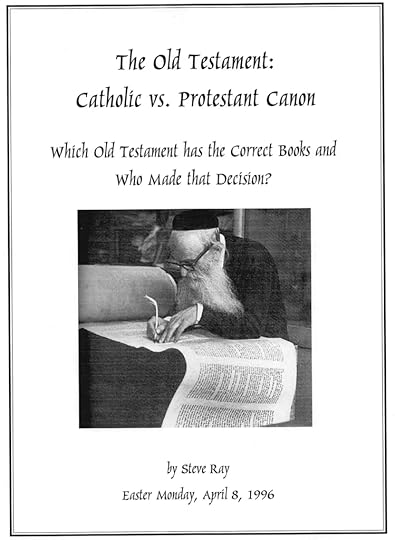
Canon of the Old Testament – Catholic or Protestant Collection?
Going through boxes of family history and things I have written – I discovered this article I wrote about the canon of Scripture. I wrote it two years after becoming Catholic, around the same time I wrote Crossing the Tiber. I thought folks might find it interesting and helpful. Enjoy!
The post Canon of the Old Testament – Catholic or Protestant Collection? appeared first on Defenders of the Catholic Faith.


September 13, 2022
Eucharist in the Fathers – an article by Steve Ray in Legatus Magazine
Click on the page to open the whole article in a PDF file – two pages and easier to read!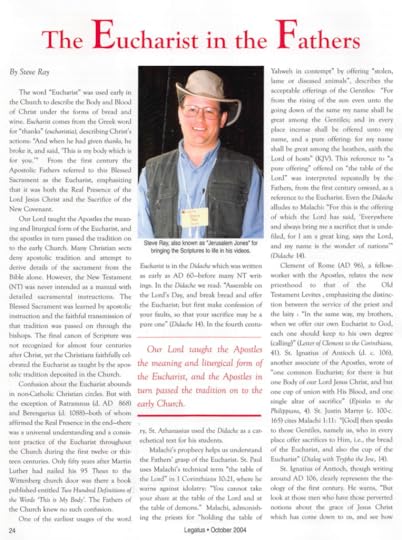
The post Eucharist in the Fathers – an article by Steve Ray in Legatus Magazine appeared first on Defenders of the Catholic Faith.
September 12, 2022
Time is Fleeting; Eternity is Forever
High up in the North there stands a rock. The rock is 100 miles high and 100 miles wide. Once every 1000 years, a small bird comes to sharpen his beak. When the rock has thus been worn away by the bird’s actions, one day in eternity will have passed.
This goes for Hell as well as for Heaven…
The post Time is Fleeting; Eternity is Forever appeared first on Defenders of the Catholic Faith.
September 10, 2022
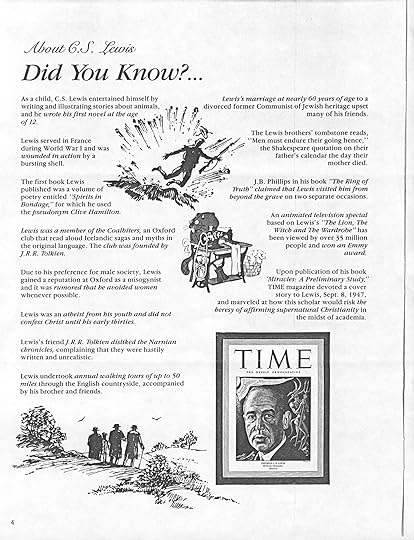
Did you know these things about C. S. Lewis?
C. S. Lewis has always been one of my favorite authors, both in former days as an Evangelical Protestant and now as a Catholic. Here are some interesting facts about this brilliant former atheist turned Christian.
The post Did you know these things about C. S. Lewis? appeared first on Defenders of the Catholic Faith.
September 9, 2022
22% of Democrats believe men can get pregnant! Really?
22% OF DEMS: MEN CAN GET PREGNANT More than one in five Democrats say that men can become pregnant, according to a new survey. “The online survey, conducted by WPA Intelligence from August 22-25, found 22% of Democrats agreed with the statement, ‘Some men can get pregnant,’” The Daily Wire reported on Tuesday. Women identifying as Democrats were more likely to agree that men can become pregnant, including 36% of white, college-educated female Democrats. READ
The post 22% of Democrats believe men can get pregnant! Really? appeared first on Defenders of the Catholic Faith.
September 6, 2022
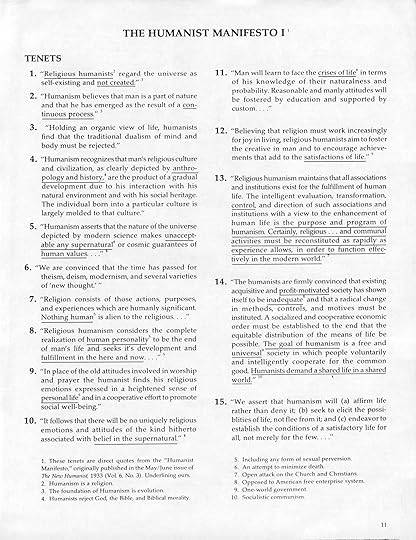
The Humanist Manifesto I – Reality and Live without the Intrusion of the Divine
This Manifesto is sad. Consider really where it leaves people in the end.
The post The Humanist Manifesto I – Reality and Live without the Intrusion of the Divine appeared first on Defenders of the Catholic Faith.
A Modern Creed – Let’s Stay Up-to-Date
The basis for this Modern Creed is from a book entitled Up to Date by Steve Turner. I have edited it a bit.
We believe in Marxfreudanddarwin
We believe everything is OK
as long as you don’t hurt anyone
to the best of your definition of hurt,
and to the best of your knowledge.
We believe love is love and not tied to two sexes
Sex is good and you decide what kind and with whom or what
You choose what you want to be
Reality will adjust based on your impulses;
You choose one of 100’s genders and which bathroom to use.
We believe in sex before, during, and after marriage.
We believe in the therapy of sin.
We believe that adultery is fun.
We believe that sodomy’s OK.
We believe that taboos are taboo.
We believe that everything’s getting better
despite evidence to the contrary.
The evidence must be investigated
And you can prove anything with evidence.
We believe there’s something in horoscopes
UFO’s and bent spoons.
Jesus was a good man just like Buddha,
Peaceful Mohammed, and ourselves.
He was a good moral teacher though we think
His good morals were bad.
We believe that all religions are basically the same-
at least the one that we read was.
They all believe in love and goodness.
They only differ on matters of creation,
sin, heaven, hell, God, and salvation.
We believe that after death comes the Nothing
Because when you ask the dead what happens
they say nothing.
If death is not the end, if the dead have lied,
then it’s compulsory heaven is for all
excepting perhaps
Hitler, Stalin, and Genghis Kahn
We believe in Masters and Johnson
What’s selected is average.
What’s average is normal.
Safe is more important than free,
With free we need safe spaces for the safe
What’s normal is good.
We believe in total disarmament.
We believe there are direct links between warfare and bloodshed.
Americans should beat their guns into tractors
and the Russians would be sure to follow.
We should drive electric cars to avoid pollution
Though coal factories burn coal to generate
power for dangerous batteries
but if it makes you feel good it is OK
Airplanes should fly on batteries or rubber bands
We believe that man is essentially good.
It’s only his behavior that lets him down.
This is the fault of society.
Society is the fault of conditions.
Conditions are the fault of society.
We believe that each man must find the truth that
is right for him.
Reality will adapt accordingly.
The universe will readjust.
History will alter.
We believe that there is no absolute truth
excepting the truth
that there is no absolute truth.
We believe in the rejection of creeds
and everyone should be happy.
The post A Modern Creed – Let’s Stay Up-to-Date appeared first on Defenders of the Catholic Faith.
September 4, 2022
Crap, Castration & Two Creations – Colorful New Testament Wording
Since we are in Philippi Greece today, I thought I would post this colorful blog 
We miss a lot when reading the English Bible. We’re at a great disadvantage. The early Christians read the writings of the apostles in the original language – they understood the words and expressions must better than we do. The original language of the Bible is full of rich imagery, stark reality, and colorful terminology.
 For example, Paul writes that he considers all things as refuse that he might gain Christ (Phil 4:8). We lose the impact of his graphic language. Paul wrote in Greek and in Greek the word refuse means human waste or crap. In Paul’s day it might have been the equivalent of the “sh–” word forbidden in proper communication. Paul used crude language, and it was very graphic for the original readers. Our English translations are very “proper”.
(Picture: Steve sitting on old stone Roman toilets in Philippi, filming in “Paul, Contending for the Faith“)
As a Pharisee, Paul tried to earn his righteousness by his self-righteous efforts and pride. But now that he has learned of faith in Christ and salvation by grace along, he considers his old efforts and self-righteousness to be nothing but crap. English Bibles santize this wording for us
Let’s look at another crude example. In Galatians 5:12 Paul reacts to the Jewish converts who tried to make the Gentiles get circumcised. They said the pagans must be circumcised and obey all the 613 laws of Moses to be saved (Acts 15:1). The heretics made Paul so mad that he says he wished the false teachers would not just cut off the foreskin of the penis but slip and cut the whole thing off. Ouch!
 Everywhere else this Greek word is used in the New Testament, it is translated “cut it off” but in this passage most prim and proper English translations render the word as “mutilate themselves” though a few say “castrate themselves” or “go all the way and emasculate themselves.” Paul didn’t mince his words, nor hide his anger and frustration.
(Picture: Ancient flint knife, the kind used for circumcisions in biblical times)
One of my favorite gold nuggets that I discovered in the New Testament is a Greek word used only twice in the whole New Testament. This word relates to God’s two creations. By reading the English Bible you would never know these two different passages use the same Greek word. But you would never know it from reading the English. When you dig deep you find gold!
What are these two creations of God? The first is obviously the physical world created “in the beginning.” The second creation is the Church, into which we are ‘born again” through baptism, a new creation. Both creations were “born” out of water with the Spirit of God hovering over the water (Gen 1:2; Mk 1:9-110, John 3:1-5).
Ready? Well here are the two verses; I have italicized the English words that have the Greek word in common:
First, the physical creation: “Ever since the creation of the world his invisible nature, namely, his eternal power and deity, has been clearly perceived in the things that have been made” (Romans 1:20).
Second, the spiritual creation: “For we are his workmanship, created in Christ Jesus for good works, which God prepared beforehand, that we should walk in them” (Ephesians 2:10).
Was I right? Would you have known that the underlying Greek word in both verses is poiema? It is the Greek word from which we get our English word poem. In Romans 1:20, five English words are used to translate one Greek word: poiema which refers to the physical created universe. The word workmanship is what you are, what the Church is. The poem of the Church includes you.
So, God has “written” two poems: the physical world and the Church. God is a poet, He is an artist, and his two great works of art reveal much about Him as an artist. You can learn a lot from looking at the paintings of an artist or by reading the pages of a poet. Just as any poet can be understood by reading his work, so God can be understood to some degree by reading his poetry.
 Go out at night and look at the sky – ponder the masterpiece of God’s creation. Look at the symmetry and beauty of a flower, the power and creatures of the oceans, the majesty of mountains and thunderstorms. Then look at the Church around the world as she redeems sinners. Think of the billions of people that have accepted her embrace and been born into a heavenly family, a culture of love and blessings. Two marvelous, breath-taking creations.
Any you? You are part of God’s two creations, you are written into his poetry and painted on his canvas. He treasures you. You are not a random mass of molecules that happened to appear on lonely planet earth spinning meaninglessly around the sun. No, you are part of God’s glorious poetry that angels admire and God cherishes. Be proud, be thankful! Live worthy of your place in God’s heart.
So, the New Testament is rich in its vocabulary. It is richer than the English language reveals. Like Paul says, anyone that tries to please God by their meager human efforts has nothing but crap to show for it, unworthy of the kingdom of God. Anyone who says we must be circumcised to be a Christian opposes God’s plan of free grace. Paul wanted them to castrate themselves.
Actually the New Testament is rich in imagery and figures of speech. You are blessed to be freely made part of God’s two creations. You are beautiful. The Word of God says so!
The post Crap, Castration & Two Creations – Colorful New Testament Wording appeared first on Defenders of the Catholic Faith.
September 2, 2022
Did St. Paul Pray for the Dead? Yes!
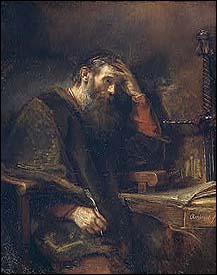 St. Paul wrote 2 Timothy shortly before his martyrdom. He spent the last days of his life in the Mammertine Prison in Rome, north of the Roman Forum. While in that prison he wrote to Timothy and says a prayer for a man dead man.
“It seems apparent that St. Paul DOES pray for the dead. Here is my short article that gives a pretty clear example of St. Paul praying for a dead man, a man named Onesiphorus.
This will be interesting for those who deny prayer for the dead and must find supposedly find everything explicitly in the Bible before they are willing to believe it.
Does the Bible record St. Paul praying for a dead man? Does the New Testament relate an incident of prayer for the dead? It seems quite certain that it does.
Let’s begin with Onesiphorus—a faithful Christian who cared for St. Paul while he was in prison and who took great personal risk to serve the apostle. He was such a good man that Paul writes, “[Onesiphorus] often refreshed me; he was not ashamed of my chains” and “he searched for me eagerly and found me” and “you well know all the service he rendered at Ephesus” (2 Tim 1:16-18).
But from all indications—certainly from the words Paul uses—Onesiphorus has died or been killed before Paul wrote Second Timothy. Almost all commentators concede that Onesiphorus had probably died—maybe even martyred during Nero’s persecution.
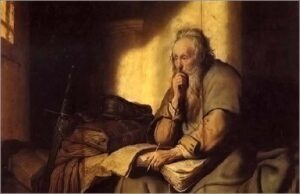 Paul speaks of him in the past tense and strangely asks for God’s mercy on his “household” without mentioning him, as though he was no longer here. Because Onesiphorus had served so well and was no longer alive, Paul prays for God’s blessing on his surviving family.
All implications are that Onesiphorus has died. But Paul prays for him!
In 2 Timothy 1:18, while in prison awaiting his death, Paul prays for the dead man and it is recorded in the Bible. Here is what St. Paul writes, “May the Lord grant him to find mercy from the Lord on that Day.” This is not just an expression of sentimental emotion—this is a prayer for a man who has died, it is prayer for the dead.
Paul, who was earlier known as Saul the Pharisee, was well immersed in the teaching and tradition of the Pharisaical Jews. The Jews prayed for the dead and Paul would not have seen the practice as egregious or unbiblical; rather, he would have viewed prayer for the dead as a proper practice for a Jew, and also now for a Christian who believes in the afterlife.
Here is what the widely respected six-volume Anchor Bible Dictionary writes……”
To read the article, click Prayer for the Dead: Did St. Paul Do This?
The post Did St. Paul Pray for the Dead? Yes! appeared first on Defenders of the Catholic Faith.
August 31, 2022
First Seven Ecumenical Councils – Excellent Summary
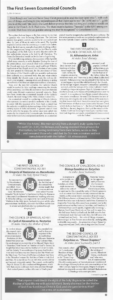 First Seven Ecumenical Councils
This is a simple, very short and helpful summary of the First Seven Ecumenical Councils of the Catholic Church.
These councils were foundational for the doctrine and establishment of the Church. They are accepted by Catholics and Orthodox alike.
The article was included in the August 2022 newsletter of the Coming Home Network which is worthy of a subscription and your support. Marcus Grodi and crew set it up to share conversion stories and to support those who enter the Catholic Church.
The post First Seven Ecumenical Councils – Excellent Summary appeared first on Defenders of the Catholic Faith.
Stephen K. Ray's Blog

- Stephen K. Ray's profile
- 27 followers

