
Stephen K. Ray's Blog, page 75
October 28, 2022
What does the word “Catholic” mean? A history of the word “Catholic”
By Steve Ray
As a Protestant, I went to an Evangelical church that changed an important and historical word in the Apostles Creed. Instead of the “holy, catholic Church,” we were the “holy, Christian church.” At the time, I thought nothing of it. There was certainly no evil intent, just a loathing of the Catholic Church and a distinct desire to distance ourselves from its heresy and man-made traditions.
I assumed that early on C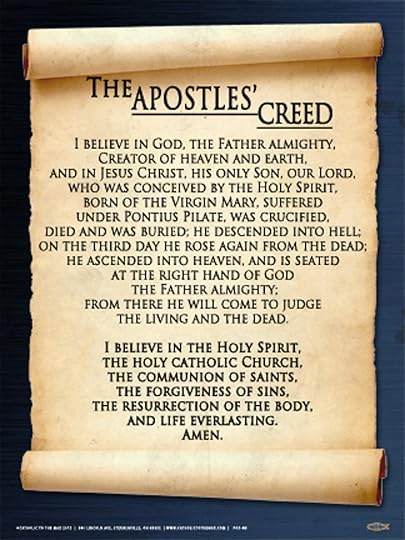 atholics deviated from “biblical Christianity” so they simply invented a new word to describe their new society. Since we Evangelicals were supposedly the ones faithful to the Bible we had no interest in the word catholic since it was found nowhere between the covers of the Bible. It was a biased word loaded with negative baggage so we removed it from the Creed.
I should have asked myself “Where did the word catholic come from, and what does it mean?” Was I right to assume that Roman Catholics invented the word to set themselves apart from biblical Christianity?
A short and interesting investigation will turn up some valuable information. Let’s start with an understanding of doctrinal development and the definition of catholic, then let’s “interview” the very first Christians to see what they thought of the Church and the word catholic and then we will study the Bible itself.
How Doctrines and Words Develop
The development of doctrine is not just a Catholic phenomenon. It is also a fact among Protestants and all religions or theological traditions. Over time, theological words develop to help explain the deeper understanding of the faith.
As Christians ponder the revelation passed on by the apostles and deposited in his Church the Church mulls over God’s Word, thinking deeper and deeper. It is not unlike peeling the layers away from an onion as one goes deeper to the heart. The development of doctrine defines, sharpens, and interprets the deposit of faith.
The Bible is not a theological textbook or a detailed church manual, such as say a catechism or study guide. The Bible’s meaning is not always clear as St. Peter tells us (2 Pet 3:15−16). Thousand of competing Protestant denominations also make this fact apparent as they fail to agree on what the Bible says. It takes the authority of a universal Church and the successors of the apostles to formulate the doctrines of the faith. As an Evangelical, I was naïve enough to think I could recreate the “theological” wheel for myself.
For the whole article, click here.
The post What does the word “Catholic” mean? A history of the word “Catholic” appeared first on Defenders of the Catholic Faith.


October 27, 2022
Are you Catholics Born Again? You Betcha! A Bible Study…
By Steve Ray
Grilled salmon sizzled on his plate as Andy and his family sat down for dinner. No sooner had they crossed themselves to bless the food, than the doorbell rang. Andrew dragged himself to answer the door while his family began eating.
Two smiling faces peered in the door. “Good evening, we hope we’re not interrupting your dinner.” Rolling his eyes, Andy responded, “Can I help you?” The first smiling face said, “We are from the local Baptist church and stopped by to see if you are born again.”
Andy had been a Catholic all his life and remembered hearing that phrase somewhere in his past, but at this moment he hesitated. “Well, ahh, I’m a Catholic.” The second smiling face displayed a hint of glee, “Can we come in and share the Gospel with you?” Andy blurted out, “Actually, we are in the middle of dinner-maybe another time.” “OK”, said the delighted Baptists, “how about next Tuesday evening?” Andy sighed and agreed.
Sitting down to cold salmon, he realized he had his work cut out for him. After dinner, he retreated to his den, grabbed his Bible and Catechismdid and got to work. Take a few minutes and study along with Andy as he prepares for the Tuesday visit and the inevitable debate on the much-abused phrase “born again”. Andy started by reading the third chapter of St. John’s gospel. Open your Bible and read along with Andy.
Andy began his mission with a barrage of questions. Is the phrase “born again” in the Bible (Jn 3:3)? Does the Catechism mention this “new birth” (CCC 720, 591)? To understand, Andy thought about Nicodemus. What did Nicodemus and his legalistic system represent (Ro 7:5-6; CCC 1963)? Can the Jewish Law bring new birth and salvation? Is being born of the seed of Abraham sufficient for salvation (Mt 3:8-9; Jn 8:33-47)? What is Jesus bringing to Mankind (Heb 9:15; 12:24; Lk 22:20; CCC 292)?
After thinking about Abraham, Andy concluded that Jesus’ teaching was obviously based on Old Testament passages which Nicodemus must have known well. How did the Old Testament explain the approaching new covenant (Ez 36:25-27; Jer 31:31-34)? How might Ez 37:1-10 have pictured the new covenant (CCC 715)?
Next, Andy sought the source of this new birth and what it means. Who brings about this birth from above (Jn 1:12-13; CCC 505, 526)? The Greek word for “born again” is “anothen” which can also be defined as “born from above”. How does Nicodemus misunderstand Jesus’ use of the word “anothen” in verse 4?
What two elements are necessary to “enter the kingdom of God” (Jn 3:5)? Is faith necessary (CCC 505)? Does Jesus proclaim “faith alone” as the means of achieving new birth? What does Jesus mean by “born of water and the Spirit”? (Titus 3:5; 1 Pet 3:20-21; CCC 720, 1215, 1225, 1257; see also Acts 2:38; 22:16). What was the result of this birth from above (2 Cor 5:17; CCC 1214)?
For the full study, click here.
The post Are you Catholics Born Again? You Betcha! A Bible Study… appeared first on Defenders of the Catholic Faith.
October 24, 2022
Watched Three Good Movies (oldies but goodies)
Running on the treadmill and flying international gives Janet and I a chance to watch movies we wouldn’t otherwise take the time to watch. Here are a few of our recent viewings. All of these, interestingly enough, have Catholic themes, especially Henry Poole is Here and the Secret Life of Bees.
While running last week I watched RUDY who was a little runt of a fellow who dreams of playing football at Notre Dame. He takes on every obstacle. It brought tears to my eyes a few times. Great movie to watch while running! Too bad though, seeing the glory days of Notre Dame with the disgrace it is now.
HENRY POOLE IS HERE was an off-beat intriguing movie. I bought a copy to pass around. The face of Jesus appears on a man’s wall and what follows is quite nice. THE BOY IN THE STRIPED PAJAMAS is a prison camp movie told from a completely new angle with a surprise twist at the end. SECRET LIFE OF BEES is a redemptive movie with a strong Catholic theme. I recommend them all.
The post Watched Three Good Movies (oldies but goodies) appeared first on Defenders of the Catholic Faith.
October 23, 2022
Old Testament Priests; New Testament Priests – Isn’t Jesus our ONLY Priest Now?
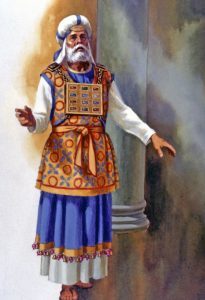 This is a common fallacy among Protestants. Now that Jesus has become our high priests, priests are no longer needed; in fact, they detract from the priesthood of Christ. We don’t need priests now because Jesus has become our one and only High Priest.
We believers are all priests in the New Covenant. We are the “priesthood of all believers” and there is no need or biblical suggestion that there should be priests in the Church.
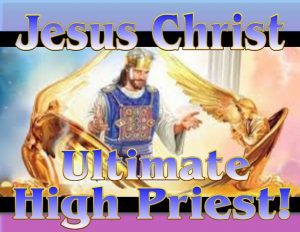 This is a typical reaction to the priesthood in the Catholic Church. Is it valid? Did the Catholic Church create a man-made institution to supplant the work of Christ. The answer, of course, is a resounding NO. The priesthood was intended for the Church from the beginning, practiced by the very first Christians and is easily and readily defended from the Bible and the very earliest traditions.
Jimmy Akin has an excellent article that lays it all out in a simple and understandable way. You can read the whole thing here. See his debate on the priesthood here.
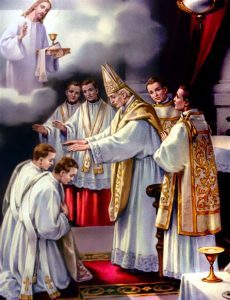 But here is a simple chart to help visualize the correspondence between the Old and the New Covenants remembering that the Church is the New Israel and would be assumed to have a similar structure of priesthood, authority and structure.
OLD TESTAMENT = Aaron the High Priest + Levitical Ministerial Priesthood + Priesthood of all the Israelites
NEW TESTAMENT = Jesus the High Priest + Ordained Ministerial Priesthood + Priesthood of all believers.
The parallels are always remarkable because, well, that is the way God intended it to be. Welcome to the fullness of the faith and Scripture in the Catholic Church!
The post Old Testament Priests; New Testament Priests – Isn’t Jesus our ONLY Priest Now? appeared first on Defenders of the Catholic Faith.
Cruise 10 Comments & Farewells
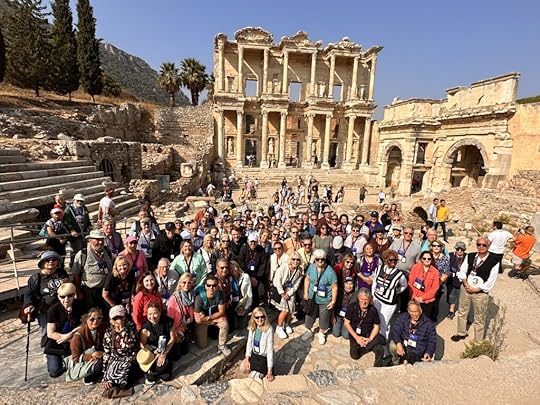
 At the end of our amazing cruises and pilgrimages it is always nice to hear what the folks thought of the experience. Enjoy!
The post Cruise 10 Comments & Farewells appeared first on Defenders of the Catholic Faith.
Cruise 9 Corinth and the Erastus Stone
We arrived in the port of Pireus in Athens, and disembarked from the ship early. We boarded the buses and drove to Corinth. I shared my conversion story on Bus 1 going to Corinth and Bus 2 coming back from Corinth.
This is quite an amazing day, and it really takes us back to the 1st century. First we cross the man-made canal for ships to pass through the isthmus between mainland Greece and Achaea of the New Testament. We stopped at the canal for lunch on the way back to Athens.
We arrived at Corinth for our outdoor Mass at the Bema (Judgment Seat) mentioned in Scripture and walked on the streets St. Paul knew, and where he lived for 18 months. We saw the Temple of Apollo and got a feel for the paganism during Paul’s time there.
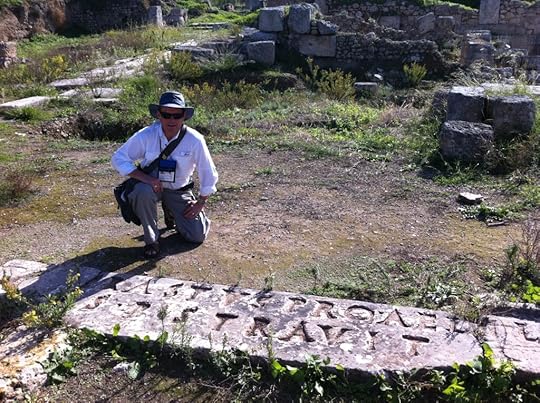
I also take everyone down to see the Erastus Stone, which is confirmation of the truth of Scripture. It’s one of my favorite things to show people on a pilgrimage here.
We stopped at the Temple of Apollo Shop to learn how they painted pottery in Ancient Greece and to buy some Greek and religious items. Back to the hotel for Saturday / Sunday Mass, to re-group share a nice meal and get a night’s sleep before flying home Sunday morning.
The post Cruise 9 Corinth and the Erastus Stone appeared first on Defenders of the Catholic Faith.
October 22, 2022
2 Corinthians: St. Paul Bears His Soul
(In this article I emphasize Paul and his apostolic calling along with the actual letter. In 1 Corinthians I emphasized the city of Corinth, the immorality and the actual letter.)
The water was cold and his legs were numb. His skin was wrinkled after the many hours of bobbing in the waves desperately clinging to a beam ripped from the ship as it capsized in the storm.
It was dark and the moon was still hidden by the frightening storm clouds swirling low over the sea. But he was not concerned for himself, even though in dire straits. Far be it from this rugged traveler to worry about himself when he had the churches on his mind. God had called and the apostolic call was more important than his own comfort, even more crucial than his own life.
It was hard work—even harder than staying afloat in the waves. Separation by miles of mountains and seas made the internal struggle acute. The brethren in other cities and lands, exposed to temptations, divisions, pagan cultures, and sin were on his mind. His labor of prayer was intense. At times he longed for them as a parent longs for a lost child. His prayers were agonizing—and his prayers were heard.
Writing to one of these churches, the church in Corinth, Paul describes his labors, imprisonments, beatings—his sufferings external and internal. He humbly boasts, “Five times I have received at the hands of the Jews the forty lashes less one. Three times I have been beaten with rods; once I was stoned.
Three times I have been shipwrecked; a night and a day I have been adrift at sea; on frequent journeys, in danger from rivers, danger from robbers, danger from my own people, danger from Gentiles, danger in the city, danger in the wilderness, danger at sea, danger from false brethren; in toil and hardship, through many a sleepless night, in hunger and thirst, often without food, in cold and exposure. And, apart from other things, there is the daily pressure upon me of my anxiety for all the churches” (2 Cor 11:24-28).
To another church north along the coast of the Aegean Sea, Paul again pours out his heart, informing them that he is “praying earnestly night and day” for them (1 Thes 3:10). Paul begins his letter of Second Corinthians by expressing this concern: “For I wrote you out of much affliction and anguish of heart and with many tears, not to cause you pain but to let you know the abundant love that I have for you” (2 Cor 2:4).
This is the life of Paul, former persecutor of the Church, now himself persecuted for their sake. Involved with taking the life of others, he now lays down his own life for others. Having watched Stephen pray while the rocks crushed his body, Paul now prays under the crushing weight of his apostolate and concern for the churches. Nowhere in the letters of Paul is he more intimate, more personal, or more vulnerable than in Second Corinthians.
For the whole article, click here.
The post 2 Corinthians: St. Paul Bears His Soul appeared first on Defenders of the Catholic Faith.
October 21, 2022
1 Corinthians: Standing Firm in a Pagan Culture
(In this article I emphasize the city of Corinth, the immorality and the actual letter; in the next article on 2 Corinthians I will emphasize Paul and his apostolic calling along with the actual letter.)
It was a wicked city. The sandals from travelers of every country in the Empire trudged over its cobblestone streets. Vice and immorality was imported along with exotic cargo and trade goods from around the world—but sensuality and license were also part of the city’s stock, trade, and religion.
As a major crossroad of the Empire, ships were unloaded, dragged over the isthmus, and reloaded for transport around the world. During the loading and unloading of ships thousands of travelers entered Corinth to revel in her pleasures and bask in her luxury. Roman soldiers, imperial dignitaries, shipmates, slaves, traders, preachers, and prostitutes all passed through the beautiful Roman city nestled in the Greek province of Achaia.
St. Paul—the rugged traveler and fiery preacher—arrived by ship or along the coastal road from Athens, the philosophical and intellectual center of Greece and the world. He now stood looking out over the city of Corinth, the economic and commercial center and the Roman capital in Greece. To the south, and majestically rising almost 2,000 feet above the city of Corinth, stands the mountain of Acrocorinth. Here, overlooking the city below stood the famous temple of Aphrodite.
The finite and pagan gods of Greece and Rome were often as immoral as the human residents. People resemble their deities. Aphrodite was the goddess of love and beauty, of sexual freedom and courtesans. The Temple of Aphrodite at one time boasted of a thousand temple prostitutes who paraded their “sacred service” in the city and certainly were behind Paul’s exhortation to avoid union with prostitutes (1 Cor 6:15-16).
It is in this newly rebuilt city, under the shadow of the temples of Apollos and Aphrodite, and milling about in the pagan throngs among pagan shrines and deities, that St. Paul preached the word of God. Here he lived for eighteen months, and founded a church. It was here that he was dragged to the Judgment Seat to make defense of his gospel (Acts 18:12) and it is to Corinth that he wrote three letters. “Wait,” you say, “I only know of First and Second Corinthians. Where do you find a third letter?” We will discover that in a moment.
Paul arrived in Corinth about ad 51 or 52. He walked up the Lechaion Road through the Agora (marketplace) into the heart of Corinth. Two Jews befriended Paul and invited him to share their trade for making much needed money. Aquilla and Priscilla were tent-makers, which was Paul’s trade as well (Acts 18:3). With his usual pattern of going to the Jew first, Paul “argued in the synagogue every sabbath, and persuaded Jews and Greeks” (Acts 18:4) but when the Jews rejected Paul’s message he shook out his garments and went out to the Gentiles. God told him to stay in Corinth and not to be afraid, so Paul “stayed a year and six months, teaching the word of God among them” (Acts 18:11).
For the whole story, click here.
The post 1 Corinthians: Standing Firm in a Pagan Culture appeared first on Defenders of the Catholic Faith.
Cruise 8 Island of Patmos and St. John’s Revelation
An easy day compared to yesterday. We arrived early at the Island of Patmos where St. John was sent into exile. You can read about that in Revelation chapter 1.
It’s a small harbor, so the ship cannot dock. We stayed offshore a bit and took tenders into the dock. These are like little boat taxis. We visited the cave of St. John where he wrote the book of Revelation, the last book in the Bible. We celebrated Mass outdoors overlooking the island and the harbor right next to the cave.
Then we all went up to the top of the mountain to visit the Greek Orthodox monastery, and then there was free time to enjoy all of the shops and restaurants and walks along the beach. Oftentimes we feel rushed, but today everyone had six hours of free time to enjoy the Island of Patmos.
We came back to the ship for Fr. James Conlon’s talk and dinner and a free evening. Tonight we head back to Athens for a day in Corinth.
The post Cruise 8 Island of Patmos and St. John’s Revelation appeared first on Defenders of the Catholic Faith.
October 20, 2022
Catherine of Siena and Leaving the Church
Thomas McDermott, OP
In the wake of so many clerical sex abuse scandals, too many people the Catholic Church appears hypocritical and bankrupt morally and spiritually. In the midst of such trying times, how can Catholics justify remaining in the Church? The words and deeds of St. Catherine of Siena (1347-1380), Dominican Mantelatta—or penitential woman—who lived during an earlier crisis, can offer us some guidance and hope.
 Catherine lived in worse times than our own because it was not only the Church that seemed to be collapsing but larger society and even the world itself. The Black Death, or bubonic plague—one of the deadliest pandemics in human history—reached Sicily via Genoese trading ships from the Black Sea the year Catherine was born.
It is said that four-fifths of the population of Siena died from the plague the following year. There would be several successive waves of the disease during Catherine’s lifetime. One anonymous chronicler in Siena at the time wrote: “And no bells tolled, and nobody wept no matter what his loss because almost everyone expected death…. And people said and believed, ‘This is the end of the world.’”
At the time, Italy was a conglomeration of feuding monarchies, communes, and republics with factions such as the Guelphs, who supported the papacy, and the Ghibellines, who supported the northern Italian rulers. The Italian peninsula was beset by foreign mercenaries, the most famous of which was the Englishman John Hawkwood, to whom Catherine directed one of her 381 letters.
 Outside of Italy, the Hundred Years War between England and France was raging, and there was the additional threat of militant Islam as seen in the advance of the Turks twice to Vienna.
Catherine lived during a time of pessimism and cynicism. Barbara Tuchman, in her historical narrative A Distant Mirror: The Calamitous 14th Century, described the period as “a time of turmoil, diminished expectations, loss of confidence in institutions, and feelings of helplessness at forces beyond human control.”
The popes lived in exile in Avignon between 1309 and 1377, only returning to Rome after Catherine went personally to the papal court and pleaded with Gregory XI. Monasteries and convents in Europe were decimated by the Plague, and in order to re-populate them unsuitable candidates were often accepted. The secular literature at the time described clerical celibacy as a joke. By the time Catherine died in 1380, the Church was in schism with the election of an anti-pope, Clement VII.
Yikes! For the whole encouraging article, click here.
The post Catherine of Siena and Leaving the Church appeared first on Defenders of the Catholic Faith.
Stephen K. Ray's Blog

- Stephen K. Ray's profile
- 27 followers

