R. Radhakrishnan's Blog, page 26
March 3, 2021
Excerpts from my new Novel
I plan to share the portions of the new novel that I am writing.
This is the first part.
Come join me in the journey as I create the story.
Would appreciate if you let me have your feed back. And your suggestions for a suitable title.
These is the first draft and will undergo changes as it proceeds.
Chapter 1 -The Mysore Dussehra
Chapter 1 -The Mysore Dussehra
She felt him staring at her, a tall, lean dark young man, and blushed. There was chaos, confusion, noise and ...


February 26, 2021
Hope and the Pandemic
Life during the Pandemic
It has been a Topsy turvy world for some time now, where uncertainties abound and you never know what life will throw at you round the next corner…somewhat like driving on Indian roads.
In this situation the only certainty is change and the need for adaptability. We humans have reached where we are only because we adapted. That is Darwin’s theory…
Well, …that may be true or not true, we may have descended from monkeys or not…but the virus has had us hopping,...
February 23, 2021
The Temple of Kalleshwara, Bagali, Karnataka
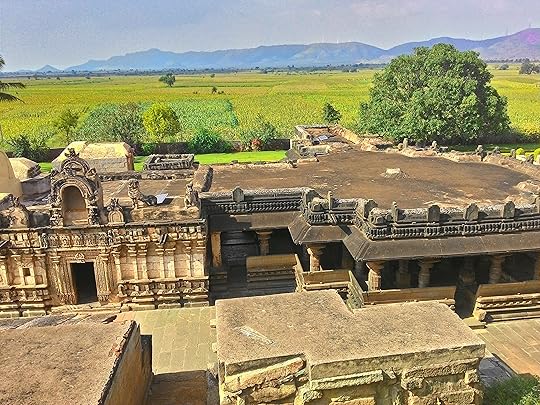
The Temple of Kalleshwara, Bagali, Karnataka
I keep saying this, the temples in India were not just places of worship.
As I wrote in my earlier blogs, they were the cultural moorings of life.
The temples were also institutions of political and economic significance, especially so in the south, where the rulers built large temples full of grandeur as a reflection of their power.
As the Mauryan Empire expanded under Asoka, the influence of Buddhism also increased. We find Asokan ins...
February 7, 2021
The Temples of India: 4 The temple of Chennakeshava, Mysore
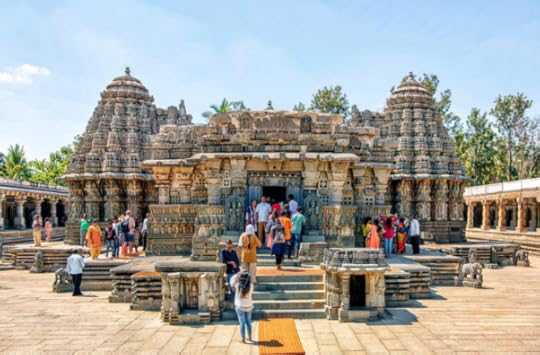
The main temple, Photograph courtesy of Shri Gopinath Kollur.
Mysore is a royal city full of elegant palaces and buildings, broad and green roads. It struggles as modern India catches up and Bangalore encroaches on this elegant city that was once the capital of the Mysore Kingdom.
There is a battle going on between the old kingdom and modern India here as the leisurely pace of old Mysore is getting replaced by the frenetic changes that are taking place as India develops.
A little distance from the city, just an hour’s pleasant drive at a distance of about 36 kms is the small hamlet of Somnathpur or Somanathapura.
I had often heard about the temple there and was told it was the ruins of an ancient Hoysala temple now being maintained by the Archaeological Survey of India. I was told it was a small temple and the locals did not seem to give it much importance.
When people came to Mysore they were normally taken to the famous Mysore Palace, the temple of Chamudeshwari, Tipu’s fort and palace at Srirangapatnam. A few ventured to the Bandipur sanctuary to see the elusive Tiger and the Elephants of Bandipur.
It is said in India that just below the lamp the darkness is the most. I, though living in Mysore then, had never visited this temple of a forgotten kingdom. I had rather gone all the way to Belur and Halebid and seen the temples there.
But once posted away from Mysore I went back with my family and as we had nothing planned for an afternoon, my son was insistent that we see the temple rather than me catch my afternoon nap.
Somanatha Dandanayaka, a general of the Hoysala kings, built an Agraharam, which is a village for brahmin priests, and donated land dedicated to building and maintaining of a temple. The settlement he created came to be known as Somanatha pura, where he built and consecrated the Keshava temple around the year 1258. This is as per the inscriptions there. The name Dandanayaka, h I believe denotes his power to give punishments (Dand = Punish, Nayaka: Leader)
Keshava or Kesava is another name for Krishna and Chennakeshava means handsome Kesava and the lord here is indeed handsome.
There is no actual temple here, in the sense that there is no regular worship that takes place.
What is left today are the ruins of a magnificent temple built with love and a lot of detail and hard work.
There were several temples built by Somanatha and they were all built with equal care and attention, but nothing remains of the other temple as they were destroyed in the wars between the Hindu Kingdoms and Muslim Sultanates that ravaged the region.
The Chennakeshava temple was repaired by the Vijayanagara Kings but was damaged again sometime later and was repaired to some extent by the Mysore Maharaja in the early 20th Century.
Having read and heard the history as above, I was prepared for a view of some broken stones and carvings and an afternoon not well spent.
The first view of the temple took my breath away. This was a gem of a temple, and though there was no regular worship, I could feel the reverberations of a divine force. The above is an excellent photo taken by my friend of the magnificent temple.
The temple is built in the typical Hoysala style of intricate carvings all around the temple. The temple plan itself is perfect with its corridors full of perfectly aligned pillars.
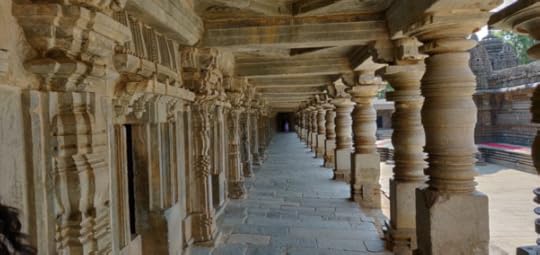
The perfectly aligned pillars
There are stories from our epics and puranas carved in stone here, lovingly and intricately done. At many places there are inscriptions of the stone carvers, their logos showing that they knew they were creating something wondrous.
The carvings are intricate and detailed and we spent hours looking over them. Though it was very hot as we had gone in May we did not really feel the heat so immersed were we in the carvings and the stories they told us.
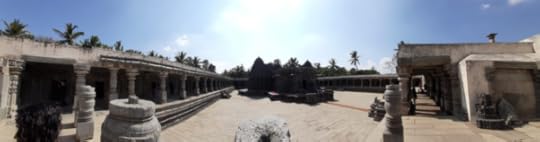
A panoramic view of the entire temple complex
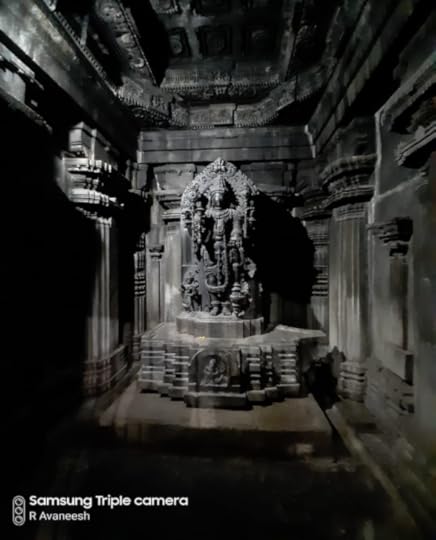
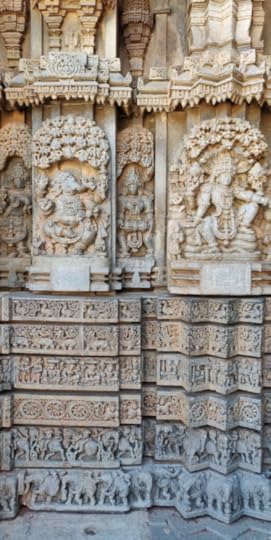
The intricate carvings from our epics and puranas.
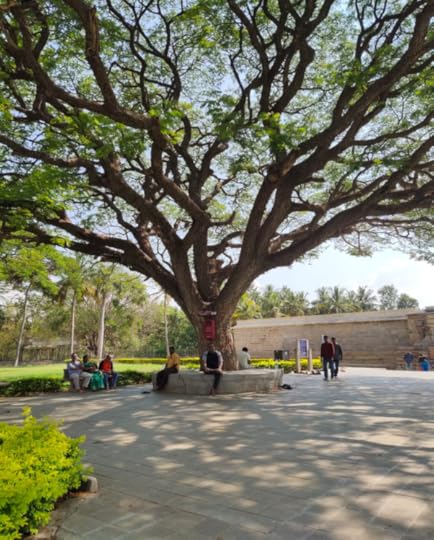
I found the temple here smaller and more intimate; the gardens maintained well by ASI and everything kept neat and clean. The only heart-breaking aspect was the random destruction we can see around, which was caused by wars in the region. But sitting under the spreading branches of a tree was peaceful and relaxing.
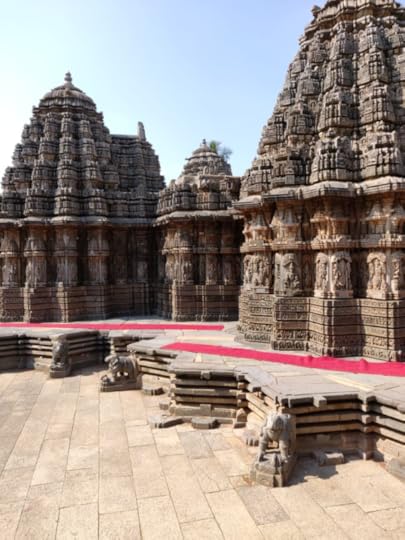
The side of the temple with more carvings all telling you stories.
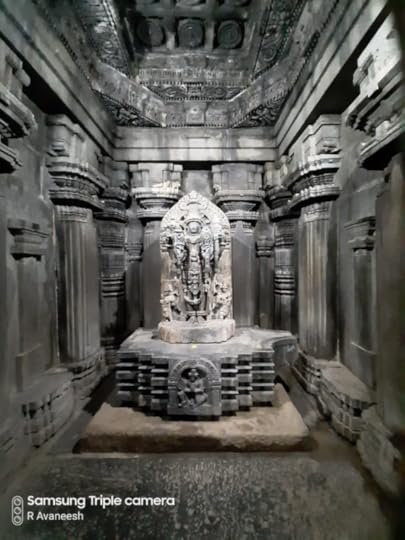
Chennakeshava, see the Garuda image carved so intricately at the bottom.
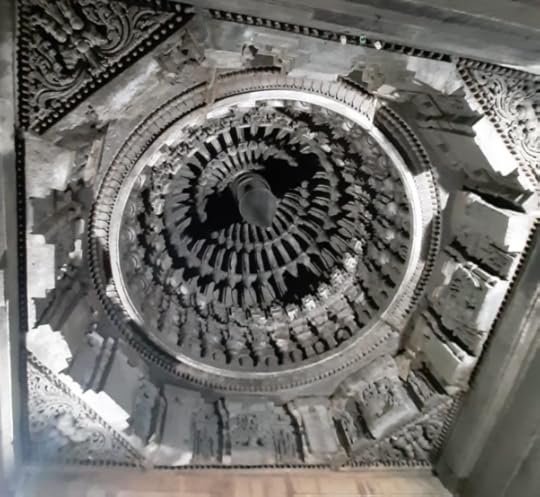
A very intricate carving on the roof!
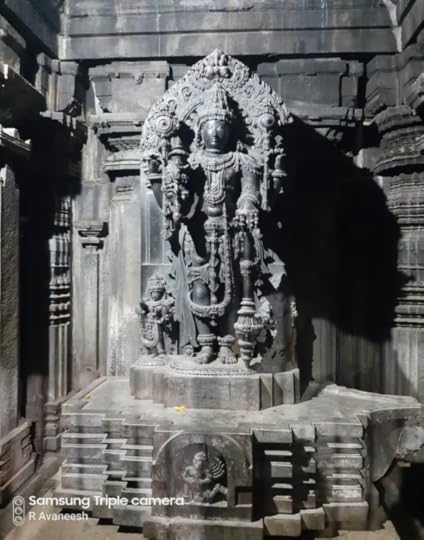
Keshava.
It was with a pang we realised we had to leave this beautiful place now.
When you plan a visit to Mysore or Karnataka, plan to visit this monument to a grand kingdom and its architecture lost now in the mists of time.
It is a short distance from Mysore and you require only a few hours to visit and see it but it is well worth it.
We took many photographs which really do not do justice to the place. I leave you with a few images which speak of the grandeur of this place.
Namaste till next time.
__ATA.cmd.push(function() { __ATA.initDynamicSlot({ id: 'atatags-26942-6020638633cef', location: 120, formFactor: '001', label: { text: 'Advertisements', }, creative: { reportAd: { text: 'Report this ad', }, privacySettings: { text: 'Privacy', } } }); });January 27, 2021
The Temples of India : Guruvayur- Kerala
Guruvayur
 Entrance to Krishna temple Guruvayur
As I wrote in my earlier blog, Temples in India have a cultural mooring. The Guruvayur Temple in the District of Thrissur is probably the temple closest to the heart of the people of Kerala, specially for those who have migrated away from Kerala for a living.
I grew up in Mumbai and remember the “Kochu Guruvayoor” temple in Matunga. Kochu means small in Malayalam. This was a temple built by the Ashtika Samaj initially as a Sri Ramachandra temple. Later, based on demands from devotees the temple added lord Karthikeya, Navagraha idols, lord Kochu Guruvayurappan and Lord Ayyappa. Thus, this became a multiplex temple!
For each in and every function all the people from Kerala would rush off to this small temple. Whether it was marriages, birthdays or festivals you could be sure of a large number of us congregating at Kochu Guruvayur.
The annual visits to Kerala during vacations would also involve at least one visit to the original Guruvayur temple. Even today for all of us spread over the world a visit to Kerala would not be complete without a visit to Guruvayur for Darshan.
The visits to Guruvayur did not involve much planning those days, there used to be no such crowds as you see today. You left your village by the earliest bus available and there used to one at 6 am from our village direct to Guruvayur. Getting up early in the morning, having a bath and getting into the rickety state transport bus was a small adventure for us. So different from Mumbai. There would be our aunts with us, the younger ones detailed to look after us kids.
The journey would seem long and interminable to our young minds, but it was just about 3 hours. There would be a noisy bus stand with buses from all over Kerala, hordes of people, the small shops selling all sorts of stuff but we kids would focus on the soda and lemon juice available at these shops.
The loudspeakers on the temple would be blaring devotional songs interrupted with announcements. There normally would be no long lines of devotees waiting outside the temple but there would be a small line inside.
The visit to the temple would involve removing our shirts and keeping our upper bodies bare for the males irrespective of age. There would be an elephant or two in the courtyard, percussion and Nadaswaram being played inside. We would have our darshan and then scramble for the sandalwood paste from the priest. One of the adults would go and get the payasam, the sweet milk and rice that we so loved. A meal at one of the “brahmin hotels” outside the temple and we would be back at the bus stand by afternoon.
The returning crowds would have now gathered here and it would be noisy and interesting for a small boy from Mumbai with its colors, noise, smells so different from Mumbai. There would be persons standing near each bus shouting the destinations of the buses and the places it would stop en-route. But most of the private buses would stop anywhere you wanted if you asked nicely. There would also be announcements over the public address system. It would be chaotic noisy and quite dirty with rubbish strewn around and people chewing pan and spitting it out anywhere and everywhere. The public toilet would be unusable and we kids would relieve ourselves on the roadside bushes.
Over the years as we grew up the visits changed as the crowds increased and we needed more comfort. We would start in the evening in our own vehicle, reach late evening and book into one of the hotels which had mushroomed all over the place.
Early morning there would be a scramble to have a bath and reach the line early so as to be as ahead as one could be.
There would jostling and pushing once you were inside the temple precincts and people shouting out their devotion and once you reached inside in front of the lord you had seconds only to view him before being pushed out.
We would then go for lunch or breakfast depending on how much time it took for the darshan. If it was breakfast, we would still go to Ramakrishna hotel, just outside the temple.
Lunch earlier would have been at the Hotel Elite but over the years the standards at Elite have deteriorated.
I had not been to Guruvayur for at least three years though I am back in Kerala now. A childhood friend and his wife were driving down on a long journey all the way from Mumbai to the forests in Kerala in search of the elusive slender loris.
We planned to meet at Guruvayur as it would give them a welcome break, have darshan and also give us time to catch up over a long evening.
The pandemic had brought in changes, you needed to book in advance, online, selecting your time slot. There was a limited number available for each time slot on a day so you needed to do this well in advance. But the booking is easy on the Guruvayur Devaswom board website and if required you can book accommodation at their various guest houses too. You need to know your birth star for the booking and if you don’t know you can get it from their site based on your date and time of birth. The temple entry is allowed only for Hindus.
I booked for a 9.30 am darshan and set off on the 21st to Guruvayur from Cochin alone in my car.
The NH 66 is the shortest route from Cochin and you avoid going through Thrissur. It is a fairly decent road with not many potholes or bad surfaces, some very scenic stretches and not too crowded over all on the day I went. But on the flip side, it’s narrow and twisty has vehicles coming at you at top speed with little regard for safety. Some of the stretches are very narrow and when there is a huge truck coming at you from the opposite side… It’s a bit frightening for someone not accustomed to drive on Kerala roads. Add to this pesky three and two wheeler who turn without any indication or just come on to the road from the side suddenly. You are kept on your toes and I was reminded of the video games my kids play, you need to be alert and focused all the while, which means you cannot really enjoy the scenery if you are driving.
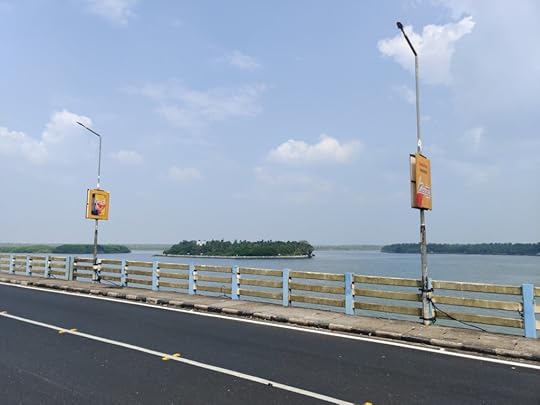
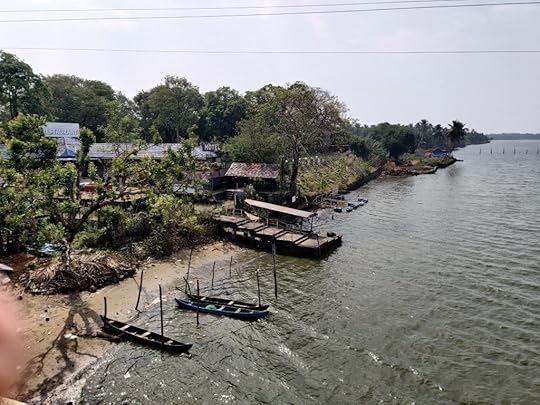
 A Scenic Drive
I had booked the Devaragam hotel opposite the Guruvayur railway station. This hotel is owned by the K.P. Namboodiri group. I had no difficulty in finding the hotel, google took me right up to the main entrance and also the hotel being opposite the railway station helps in finding bit easily.
We had stayed at the Windsor Rajadhani during a recent trip to Trivandrum and the experience was horrible in all respects. As such I was worried about my stay here in Guruvayur.
I need not have worried Devaragam Hotel was one of the best I had stayed not only in Guruvayur but in Kerala.
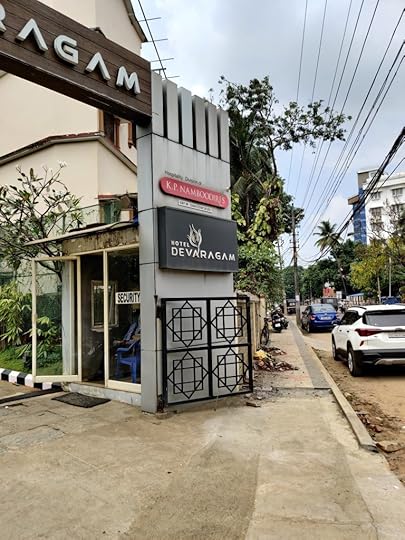
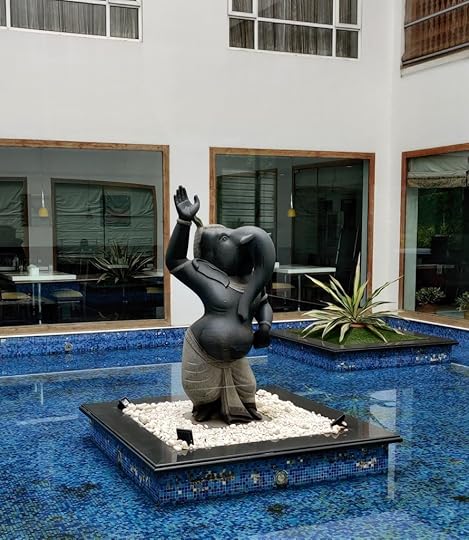 The Hotel Devaragam
The staff were friendly, helpful and eager to make you comfortable. The hotel is not very large, a mid sized hotel but very clean and well maintained. The check in was smooth and quick, the hotel Wi-Fi worked well and a refreshing bath later wiped out all the tiredness from my trip.
Once my friends joined me, we walked up to the Mammiyoor Shiva temple nearby which was just under a km from our hotel.
The story goes that after Dwarka was submerged in a deluge, Guru Brihaspati and the wind God Vayu met Krishna who gave them an idol instructing them to install and consecrate it an ideal spot-on Earth.
Guru and Vayu come down to the banks of the Rudratheertha lake where lord Shiva was doing meditation for ages. Recognizing the need of the two, Lord Shiva suggested them to build on the banks of the lake where he was doing his meditation and moved off from there to Mamiyur.
Guru and Vayu built the temple and installed the lord there and thus the place became Guruvayur and Krishna became Guruvayurappan here.
Legend has it that in view of this magnanimity on the part of Lord Shiva, you need to pray to him also to get the full benefit of your darshan at Guruvayur.
The climate was pleasant and the walk did not tax us much. The Pandemic has meant that the crowds are much less but there are restrictions in place. After taking down our names, places of origin and mobile numbers we were let inside the temple. As we were not wearing dhotis, we could not go right up to the Garba griha, the inner most sanctum, but had a good darshan from the outer door and went around the outer part of the temple. Photography is not allowed inside the temple so we could not take any photographs.
We moved on and took an auto to the Krishna temple and found that if we had worn dhotis and carried our e booking details, we could have entered the temple tonight itself though our booking was for the next day. This was because there were no crowds and the line for darshan was empty.
There was a line to have darshan from outside, you could stand just outside the main entrance and view the lord. You could do this without wearing a dhoti or any advance booking. We stood in this line and after about 30 minutes we were in place to have a darshan albeit from outside.
The dinner service at our hotel would close at 9 pm and most hotels in Guruvayur close early especially now that there is a pandemic so we did not linger around. We just looked at the shops lining both sides cursorily and walked back to our hotel which was just a few minutes from the temple.
The hotel, like most Guruvayur hotels, served only vegetarian fare which was fine by us. We had chapatis and paneer fry ( Indian cottage cheese) and a mixed vegetable. The food was good and the service excellent.
After an excellent breakfast of idlis and orange juice and coffee we walked to the temple and found that there were a few people ahead of us.
Our bookings were checked along with our identity proofs and soon we were in line waiting to go inside. It was a smooth process, the security personnel friendly and helpful.
Due to the pandemic, you are not allowed inside the Garba Griha and can only have the darshan from the main door of the Garba griha. The crowds were much less due to the restricted entries and you could walk around to your heart’s content on the outer perimeter and pray at the small temples here.
The counters for the sandalwood paste and for booking the puja are inside but the prasad counters for the payasam etc. had been moved outside. There were no elephants and the whole atmosphere was muted and relaxed, there was not the frenzy seen saw during earlier visits.
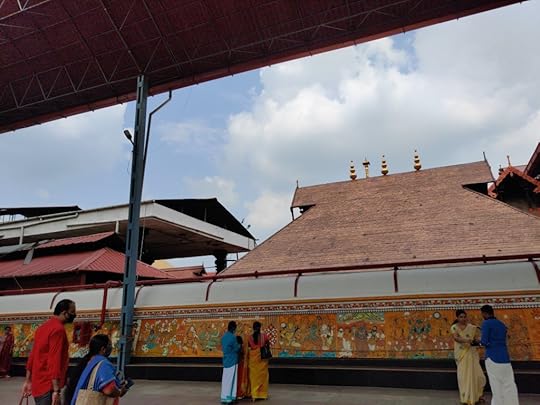
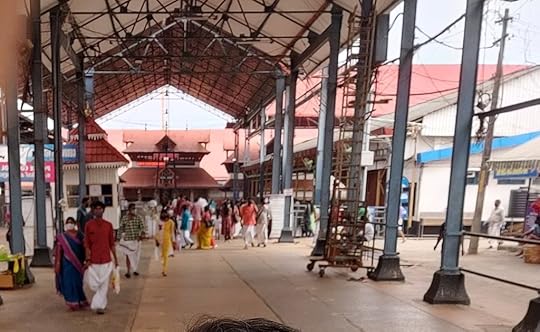
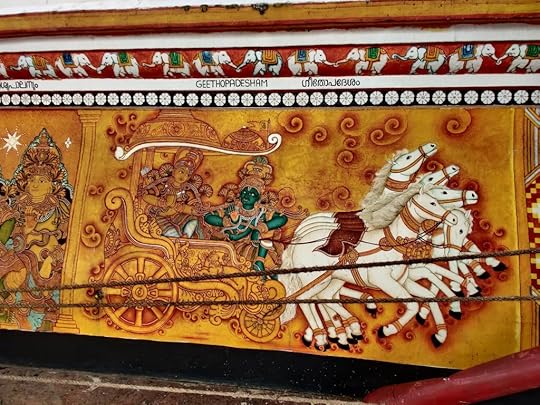
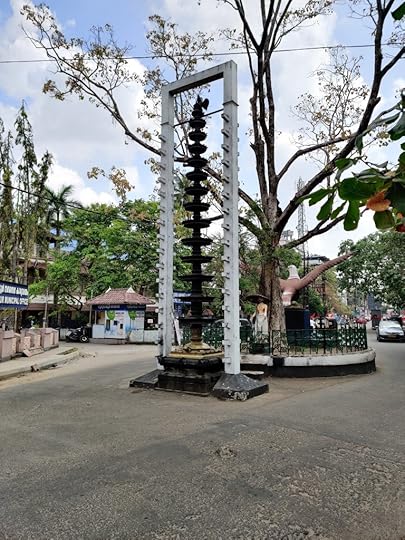
 Views from the Main street
 Guruvayur town itself has been cleaned up, it’s much neater now, the shops lined up neatly, no rubbish anywhere near the temple. The crowds and noise at the bus stand were missing, maybe they will come back once the pandemic is over.
I had a pleasant time walking around, alone after my friends left, reliving my childhood, peeking into shops, having a sweet soda and lemon at one of the small shops and generally feeling relaxed after a long time.
Many people crib about having to wear a dhoti or removing shirts and vests for going inside, but we found dressing up in our traditional way was a reaffirmation of our identity and we enjoyed that.
 The Traditional Dhoti, elegant and very comfortable.
 We felt we belong to this land and the darshan drove away our cynicism and worldliness’ for some time as we focused on Krishna, praying to him.
We were relaxed and at peace with ourselves and the world.
Namaste till next time.
December 28, 2020
TEMPLES OF India II:The Sri Malle Mahadeshwara Swamy Temple, Karnataka.
The Malle Mahadeshwara Temple, or to give it the correct name, The Shri Malai Mahadeshwara Swamy Temple, is in the Mahadeshwara hills in Hanuru Taluk of Chamarajanagar District of Karnataka.
The Mahadeshwara hills are called the MM hills in view of this.
The temple is about 140 kms from Mysore and it takes little more than a pleasant 3 hours of driving to reach there by car.
Leaving the beautiful city of Mysore, you drive towards Tirumakudalu Narasipura or T. Narasipura which is at the junction of the Cauvery and Kabini rivers and the hidden lake the Gupt Gamini.
The rivers are magnificent when full during the monsoon. There is a sense of peace and wonder when we stand on the banks near the temple, watching the fast-flowing water.
The best time to travel would be just after the rains in August or September, when the rivers would be full, and the trees lush and green.
T. Narasipura is also a pilgrim town and there are hordes of pilgrims during auspicious days, specially to have a bath in the confluence of the two rivers.
When the rivers are in full flow, they bar access to prevent any accidents as it is quite dangerous because of the fast and furious flow of the rivers.
The traffic reduces as you leave T. Narasipura and the greenery increases. It is a beautiful drive with many wildlife sightings on the way. Monkeys and deer are common and if lucky you may even get to see the Indian Pangolin.
The road itself is a bit of a drag as there are broken sections which jar you into the reality from the beautiful India that you see as you traverse these rural areas.
Small picturesque villages, fields of vegetables, fruits and paddy and forest sections flit by as you coast along the road.
As you near the temple the forest sections increase and on a good day you will have little or no traffic and the chances of wildlife sightings increase.
Beneath the surface calm is an area that was in turmoil a few years back. This is Veerappan, the brigand, territory. Before he was killed in a police action Veerappan held sway here, a terror, with a larger-than-life image which still evokes powerful passions and views. For some he was a heartless demon with many cold-blooded killings, others claim a robin hood image for him.
The temple of Malle Mahadeshwara Swamy was also where he is said to have come and prayed as he belonged to these areas.
The first view of the Temple nestled in a valley surrounded by verdant hills is breath-taking. The temple stands out nestled in a valley surrounded by verdant hills.
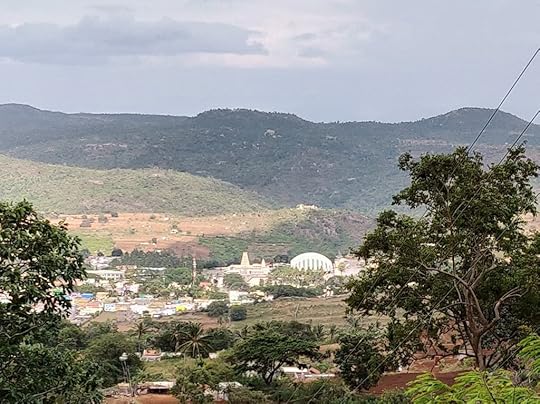 First view of the temple
The location is on the borders of Tamil Nadu and Karnataka, and people from both these states throng the temple.
The pilgrims are mostly villagers from nearby areas, and there are only a few tourists.
The winding road soon takes you to the temple proper and on some days, there would be a heavy rush of people from nearby villages both from Karnataka and Tamil Nadu.
The temple is managed by a trust under the Karnataka Government and is fairly well maintained, and they have a guest house where you can get fairly well-maintained rooms.
An incarnation of Shiva, Lord Mahadeshwara, or the Saint Mahadeshwara is believed to have lived around the 15th Century.
As per legends, the Saint travelled around sitting on a tiger and they depict him sitting astride a tiger in the popular pictures in the area.
The Saint came to the Mahadeshwara hill, which were thick forests then, for meditation, and it is believed that he is still in meditation here in the form of the Lingam in the Garbhagriha of the temple.
The lingam here is self-formed or swayambhu and a manifestation of the Saint, who is credited with many miracles in the area.
As per local legend the Saint, travelling on his tiger came to the forests which were under the control of an evil king who was an expert in black magic. The saint freed the people in the forests from the sway of the King and his black magic. He also enlightened the tribes in the area and made them his disciples.
The locals still sing songs of the saint and his miracles. These songs handed over through generations and there are supposed to be no written records of the same. The singers are dedicated to Lord Mahadeshwara.
The local villagers offer their farm produce to the lord here, and the temple godowns are full of vegetables and fruits and grains.
One of the most popular offering are shallots or sambar onions as they are called locally. They lay the offerings down in rows and it is amazing to see the vast quantity of shallots, specially, arranged in neat rows.
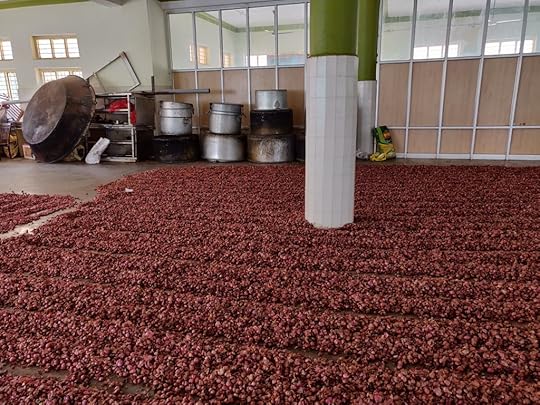 SHALLOTS STORED IN THE Kitchen
The temple offers free food to the pilgrims three times a day, and I always have lunch at the temple. It is a prasad from Lord Mahadeshwara to his people.
The lunch is simple, just rice, sambhar, rasam, a vegetable and a sweet and sometimes butter milk.
When the crowds gather for the various festivals and auspicious occasions, it amazes you to see the faith and simple devotion of the people.
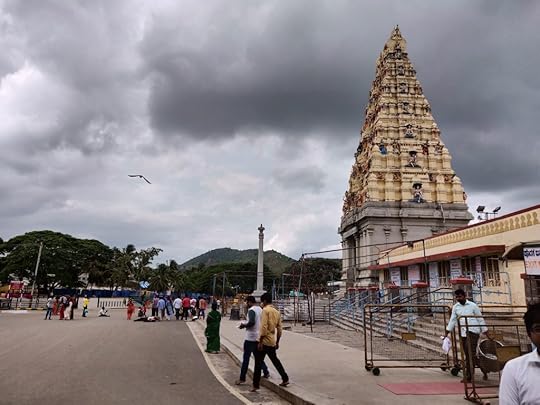 Front view
 The food freshly prepared from the produce offered, and they prepare even the masalas fresh on the premises. The aromas from the masalas being made are enticing and the food, though simple, delicious and full of flavours.
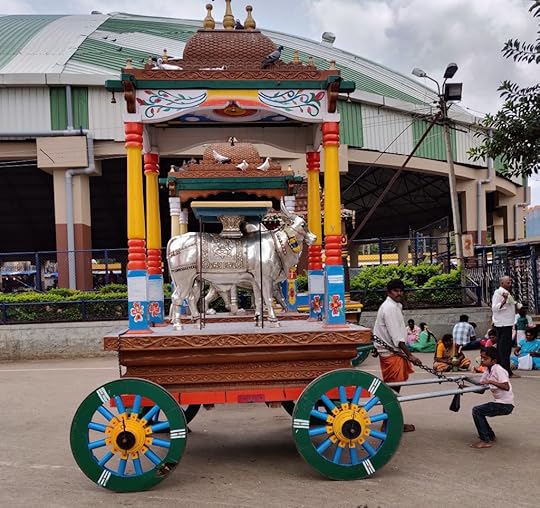
When the temple is not crowded it is a very peaceful place, the ambience, the beautiful mountains around, the neat and clean temple, evoke a sense of peace and calm to connect you to the spirituality within you
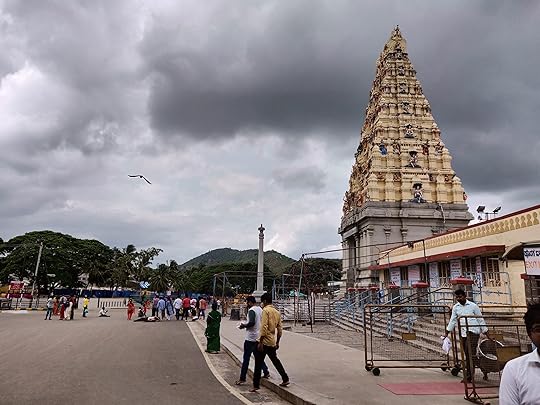
It is an uplifting spectacle to see the vast crowds and how they all intermingle cheerfully, happily accepting the inconvenience and discomfort for a greater cause. Amidst all the confusing chaos there is an underlying unity and happiness which is unique to Hinduism in India.
A visit to Malle Mahadeshwara is a treat to all our senses and also a should be on our travel plan in Karnataka.
Namaste till Next time.R.Radhakrishnan
November 29, 2020
Temples of India: Aranmula Temple: Kerala
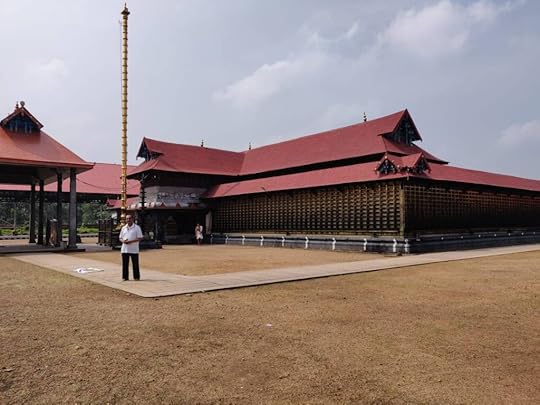 Front view of the courtyard of the temple.
Temples in India have a cultural mooring. They are not just places of worship but depositories of traditions, knowledge, culture and a meeting place for the people.
Each temple has its own legends, stories and practices which make them unique.
South Indian Temples are very different to the ones in the north or east or west. The temples in Kerala, the southernmost state, are distinct and different from the ones in the other southern states in architecture as well as some of the practices and traditions.
The Aranmula Temple is about two hours’ drive from Cochin. It is a pleasant drive if you get no traffic. The winding narrow roads, the small rivers that you cross, the back waters and the greenery make it a pleasant drive.
The Temple is dedicated to Lord Krishna as Parthasarathy and legend has it that it was built by Arjuna, the Pandava hero of the Mahabharata, to atone for the sin of killing his brother Karna who was unarmed.
Arjun is also called Partha and Sarathy means charioteer. As Krishna was the charioteer of Partha, he is also called Parthasarathy.
It is fitting that Arjuna built a temple for his charioteer as Krishna was the guiding force in the Mahabharata, especially for Arjuna.
My favourite Aranmula story is of Balarama and Krishna. The brothers were travelling and a tired Krishna requested his elder brother Balarama to find a place for resting awhile. Balarama reached the place where the temple now stands on the banks of the Pampa river. He found a good place to rest near the river and to tease and play a prank on Krishna, Balarama rested there without waiting or fetching Krishna.
When a Krishna reached the place, he found a smug Balarama resting comfortably.
Krishna to teach Balarama a lesson and also being the younger brother wanted to upstage Balarama. So, he built a bigger place at a higher elevation which overshadows Balarama’s house.
Even today the main temple of Parthasarathy is a large beautiful temple at a higher elevation and poor Balarama is near the river at a lower level so you walk down to worship him.
Hindu stories of the Gods are so much fun, the Gods too have foibles, siblings have rivalry and tease each other.
Aranmula is an ancient temple and there are many legends and stories associated with the temple. Krishna came here on a raft made of six bamboos and hence the name Aranmula which means six bamboos.
The temple structure, as can be seen in the photos, is typical of the Kerala style of temple architecture. It is a large and beautiful temple, well maintained and preserved. It is built on an elevation and you climb a about 18 steps to enter through the main doorway to the outer courtyard of the temple.
The outer walls of the sreekovil, the inner sanctum have frames holding lamps which are lit during festivals and it is a sparkling sight to see all the lamps lit and the temple radiating in the mellow light of the thousands of oil lamps.
Legend has it that a devout brahmin, a nambuthiri, promised to provide the Thiruonam sadhya at the temple, a feast to celebrate the festival of onam. He was on the way to deliver the provisions to the Aranmula Temple in a boat, locally called a ” Thoni”.
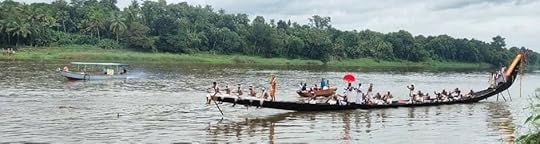
While on the way to the temple, one year, he was attacked by thugs and all seemed lost. But snake boats, war canoes called “Chundan Vallam” from nearby villages came to the rescue. The villages around than constructed snake boats and since then the tradition of snake boats escorting the canoe carrying the supplies for the feast on Thiruonam started. Today about 52 snake boats accompany the Nambuthiri from “Kattor Illam” who comes with the provisions for the feast on Onam day.
Interestingly the ornaments of Ayappan, the lord of Sabarimala, is kept at Aranmula temple and is taken every year to Sabarimala from here.
Aranmula Temple is an interesting place of worship for its architecture, legends and the peace you get worshiping here. Early mornings at all Kerala temples are blissful when there is not much of a rush, there is silence, solitude and spiritual awakening that touches a primal chord in us.
Aranmula, by the side of the rive Pampa is a blissful place to visit and pray.
Namaste till next time.
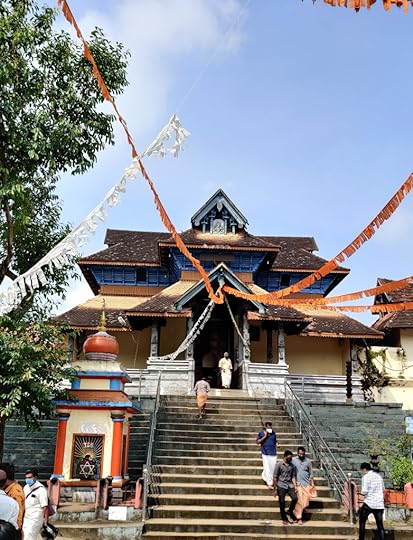 The entrance to the temple.
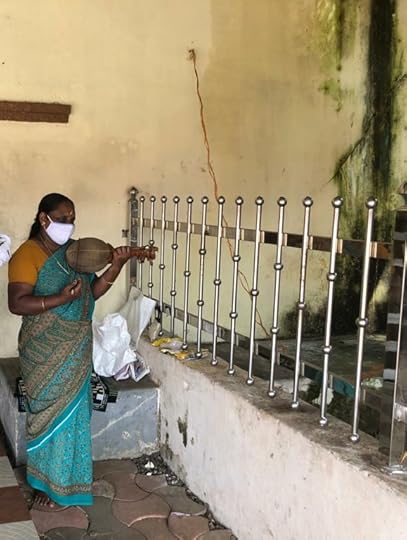 In many temples in Kerala, you have folk singers who will sing a prayer for you to the Nagdevtas, snake Gods, for protecting you and blessing you. This lady sang for me. It’s soulful and pleasant to hear the folk song accompanied by single string instrument.[image error]
November 27, 2020
The Writer’s Block
The mind is numb the blank page or in my case the blank laptop screen stares back at you. There are ill formed vague ideas crashing through an overworked brain. Or is it that the body is just too lazy to process thoughts?
Often people imagine that the thinking process is a sedentary one. But that may not be true for everyone. Thoughts can come at any time, there will be ideas clashing in your head each seeking prominence.
Many a time a sedentary silence does allow one the luxury of choosing an idea and building on it.
But its also true that an activity can spark an idea, I have found walking alone in peaceful surroundings helpful.
I also know people who can write just about anywhere even while commuting.
The ultimate is one friend who claims he gets his most profound insights while sitting on the toilet seat, but then I guess, that’s one time he is alone and peaceful lol.
The lock down during the current COVID-19 pandemic has meant less of physical human interaction, almost no travel and an apprehension every time you step out. This may have not been conducive for creativity for some people.
For me the lockdown and personal issues caused distress but also sparked a rush of poetry, mostly dark and not my regular style at all.
Worries mundane and practical do intervene and cause a block and it becomes difficult to focus. How does one cope with this?
Many expect the writing process to be one where you just put pen to paper or fingers to the keyboard, lol.
But there is a much longer process where you think, look back at your experiences , distill your thoughts and then put them in words.
When the writers block hits you, you dont feel it initially, and then it hits you, you worry and that makes it worse.
You try harder, creativity is lost in a maze of blankness and there seems to be no light at the end of the tunnel.
Worrying about it never helps, talking with someone who understands may be a solution but fear holds you back from sharing.
I have been struggling since I retired last month, not able to really come up with anything. My book is stalled in between, my poetry has dried up and the only writing I seem to do is on ‘what’s up.”
I am sure that this is a temporary phase and will sort itself out in the normal course. One way I thought to overcome the block is by writing this blog and well it seems to have worked out![image error]
So all of you struggling with a block, let go of your fears, worries, enjoy life and sure enough the spark will come and the fire lit.
R.Radhakrishnan