
Joe Gray's Blog, page 2
May 4, 2022
A liberté without freedom, an égalité devoid of fairness, and a fraternité blind to kinship: Life as a bird in France

Posted by
Joe Gray
4 May 2022ABOUT the authorIt’s the evening of 3 November 2016, and the journalist John Laurenson is informing listeners to BBC Radio 4’s World Tonight of a population in serious decline in France. Following year-on-year decreases, he explains, numbers have fallen to roughly half of what they had been thirty years earlier.
The population to which Laurenson is referring is participants in hunting and trapping (hereafter, just hunting): “an old French tra...


January 25, 2022
Beneath the birch and pine: Prelude to a series
This is the first post in a category titled ‘Beneath the birch and pine’. The uniting theme for this series—beyond the writer’s nature-centred standpoint—will be the inspiration that each piece finds in some aspect of life in the Scottish Highlands. For an associated photography project by the author, which is called ‘The Cairngorms Up-Close’, please head here.
Since the ‘Publish’ button for this first piece was clicked just before the author tucked into a plant-based Burns Night supper, it s...
August 4, 2021
Technoscepticism and the machine-proof Muir
I don’t know about you people, but I don’t wanna live in a world where someone else makes the world a better place, better than we do.
Gavin Belson, a big tech CEO, in the comedy series Silicon Valley
Can Wearable Devices Save Your Relationship? This is a question posed in the headline of an online article that…
Okay, I can’t do this. I had no intention of reading that piece. A link to it appeared in a computer-curated column to the right of an article that I had willingly sought out. And I...
July 27, 2021
Smiles and scowles: Puzzles in the Forest
Ten by twenty miles of secluded, hilly country; ancient woods of oak and fern; and among them small coal mines, small market towns, villages and farms. We were content to be a race apart, made up mostly of families who had lived in the Forest for generations, sharing the same handful of surnames, and speaking a dialect quite distinct from any other. Few people visited the Forest of Dean. They thought us primitive, and looked down on us. I remember one visitor expressing pity for an elderly cripp...
September 19, 2020
Bare-faced forestry
It is early autumn, and I am spending the night in woodland on the edge of Loch Tay—a slender Scottish waterbody whose shape, viewed from above, resembles the S-curve of a logistic-growth plot. As afternoon turns into evening on this mild, dry day, I study the scene through my lightweight, eight-by-twenty-five binoculars. Across the loch from me, cars stream in both directions along the A827, a narrow road that, for fifteen miles, hugs the water’s northern edge. There is something in the sight of these vehicles that brings to mind a population of migrating lemmings, conscious that carrying capacity looms but not certain where to go. I am staying on the quieter side.
There is something in the sight of these vehicles that brings to mind a population of migrating lemmings, conscious that carrying capacity looms but not certain where to go.
A sound I know well, the conversation of goldfinches, draws my attention to the near shore. As I point my binoculars in the rough direction of their liquid chatter, the index finger of my right hand turns the focus-wheel anticlockwise, almost instinctively. I find them: they are about twenty paces from me, and we are separated by lush vegetation and a lively burn. They are a small charm—one crimson-faced adult and three less extravagantly marked juveniles—and they hungrily tweeze out seeds from knapweed heads.
After a minute’s gorging, the birds depart in unison, bounding along the loch-side and away from me; and my attention turns to the small stream beneath the knapweed patch. With the last of the motorboats gone, and the pleasure-seeking over for another day, the soundscape is now dominated by the tinkle and gurgle of this burn as she tumbles over a final scattering of smooth rocks and disappears into the loch.
I am examining these stones, with no particular thought in my mind, when a patch of white flashes into view. The white is the throat and upper breast of a dipper, and, settling on one of the rocks, he begins to bob in the characteristic rhythm of his species, with wings held out at four o’clock and eight o’clock. I count a dozen dips before he heads tentatively into the shallow water where the burn enters the loch. Like a child who is striving to do a handstand but lacks the confidence to commit fully to the manoeuvre, he repeatedly plunges his head into the cool liquid before quickly returning to the upright. Soon he is bobbing once more on a rock.
The next flash is yellow. A grey wagtail, with lemon-and-cream underside, has joined the dipper on the stones. The visit is fleeting: after a few flicks of the tail, the bird is gone, issuing a series of piping calls as she bounces woodpecker-like after the goldfinches.
Sated with nature’s wonders, I find an unwelcome thought returning, and I reluctantly begin to turn the focus-wheel clockwise as I lift my binoculars to the opposite shore. There it is: the ghastly sight of a recent hillside clear-cut. The devastation is obvious without the aid of magnification. But through the eyepieces the full story becomes clear—stumps, brash, deep ruts, and a slope whose earth looks precarious in its denudation. A stand of trees remains, to the left of the clear-felling as I look at it. The edges of this stand are abrupt and violently sharp, and within the perimeter each tree appears to be of an identical age and of the same species, a non-native conifer. The contiguity of clear-cut and monoculture would, I suspect, be perceived as an eyesore by almost anyone whose aesthetic taste did not encompass a sympathy for brutalism.
The contiguity of clear-cut and monoculture would, I suspect, be perceived as an eyesore by almost anyone whose aesthetic taste did not encompass a sympathy for brutalism.
Exacerbating my own negative impression of this industrial forestry operation are two juxtapositional effects: one is with the soul-soothing observation of goldfinches, dipper, and wagtail that immediately preceded my appraisal; the other is with the band of native woodland, complex in structure and rich in species, that fringes the edge of the loch below the clear-cut. A jackhammer would never cause a listener more offence than when they had just emerged onto the street after hearing a concert of gentle grace.
Beyond eyesoresThere is an aspect of the industrial forestry method that is more significant still than its creation of eyesores: It betrays local ecologies. For now, the approach remains a common practice in Great Britain. Fortunately, though, it is something that national bodies are gradually moving away from. (Until recently, I could have written ‘the Forestry Commission’ in place of the vaguer ‘national bodies’, but the past few years have witnessed a mini-radiation of forestry agencies on the island. The slow process of devolution leaves a complex ancestry of administration in its wake.)
The alternative to forestry methods that betray local ecologies are, naturally, practices that work with them.
The alternative to forestry methods that betray local ecologies are, naturally, practices that work with them. These are practices that permit the type of native woodland fringing Loch Tay, which I described above: one that is complex in structure and rich in species. Something else that I mentioned earlier about this loch was her similarity, from above, to the logistic-growth S-curve, a classic graph in biology. If you turn this curve clockwise through a right angle, you end up with a so-called ‘rotated sigmoid’, which describes the distribution of tree diameters in at least some old-growth forests. In plain language (for forests where this curve applies): very small trees are by far the most common; small, medium, and large trees are all somewhat common, with a gradual drop-off in frequency as size increases; and very large trees are present but much rarer. Crucially, then, there are trees of a mixture of sizes and ages all growing together. This is also what should occur when ecological forestry is practised. And with that second discussion of curves complete, I promise a straight run into the finish.
To complete the discussion of ecological forestry, I will mention two crucial features beyond the already-stated diversity of (native) species and mixture of ages. The first is the presence of significant quantities of standing and fallen dead wood, along with senescent feature, such as rot holes, on larger living trees, as this decaying material offers food and homes for a variety of life forms. The second is the small-scale nature of felling events and other operations. The benefits of this approach to forestry are manifold and include: a greater resilience to anthropogenic hazards, such as the introduction of alien phytopathogens; the protection of watersheds and soil; true long-term sustainability; and support for diverse and complex food chains through the provision of varied nourishment and habitation. If we are going to use timber and wood, we owe it to the landscape to work with respect and care.
PostscriptAfter a restful night, I awake to the sound of rain on the corrugated-metal roof above me and gaze out across the loch once more. The eyesore is gone. The Earth, as if in shame, has covered the denuded slope and the remaining monoculture in cloud. In fact, all I can make out of the hill, the only part that is clear of the heavy curtain of water vapour, is a thin band along the bottom, the fringe of mixed native woodland.
Read ‘Bare-faced forestry’, by Joe Gray, on the #EarthTongues blog
Tweet
August 10, 2020
The zebras of Kidderminster
The following has happened to me quite often in recent years. I check in at a colourless corporate hotel. I drag my feet heavily along a corridor. And I enter my insipidly styled room. Yet, once inside, I find my eye being caught by an item that is conspicuously vibrant—at least in relative terms. The contrast is heightened by this item being located, invariably, next to the usual monochrome bumf. You might know the types of thing: an impenetrable set of remote-control instructions; a long list of astronomical per-item laundry prices; and a short list of microscopic steps towards sustainability that the hotel chain has taken (sufficient, nevertheless, to make it a ‘green leader’).
The item in question is a glossy large-format hardback; its subject matter, the local area. Before saying more about these books, I should note that the travel is for my day job. In this, I rarely have a say in my accommodation—or much at all, for that matter. And I should add that the hotels are in English cities like Leicester and Birmingham. A lazier writer might have implied a mundanity of these places, in the last sentence, by sarcastically replacing ‘English’ with ‘exotic’; but then this, as you will see, would rather undermine the point that I shall attempt to make in this piece.
Back to the hardbacks. The idea of these books—an aim that I cannot fault—is to showcase noteworthy aspects of the region in which the particular hotel is located. And, so, among the assorted images within the grid of crisply shot photos that decorate the cover will be items of local produce, a famous street for shopping, an indicator of the local industry, and a significant building or structure, such as a castle or bridge.
There will also be some non-human life. This, however, is ‘local’ only by residence, and not by origin. Furthermore, the living being depicted is never wild and never free roaming. That is to say, the life form with the honour of being the pictured non-human representative of the region will be a big cat or great ape from a local zoo.
The same, it seems, happens on hotel websites too. I was recently exploring the accommodation options for a trip to Kidderminster—this time with a personal motivation for travel—and I found that the non-human image of choice depicted a zebra, who is an alien resident of a local safari park.
The choice of a zebra, here, should not be taken as implying that the countryside surrounding Kidderminster is depauperate. For only a few miles to the west there is the Wyre Forest National Nature Reserve, which is a particularly important component of one of the largest ancient lowland oakwoods that survives in England. The Wyre Forest—a large part of my desire to visit the area, in fact—is home to many species that could by no means be considered common in England.
To name just a few of these, there is the exquisitely patterned pearl-bordered fritillary, the arrestingly handsome hawfinch (see below), and a breathtakingly attractive beetle known as the scarlet longhorn. A more adventurous selector of pictures for tourist information would also have the lemon slug and strawberry spider—two further local specialties—at his or her disposal.
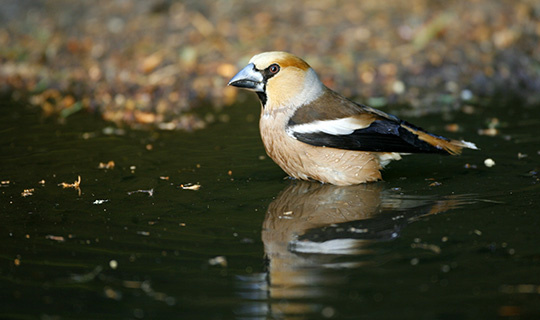 A hawfinch
Instead, the choice of a zebra for Kidderminster (and big cats and great apes elsewhere) is, I believe, a symptom of one of two things: the modern separation of wild nature from our everyday living; or, worse, the modern ignorance of our non-human neighbours. Not helping matters, as far as draws for tourism go, is that many of the more iconic species that roamed Britain at the dawn of the Bronze Age—wolves, bears, and others—have since been erased from the island. True and distressing though this may be, I feel that there remain many reasons, in wild creatures and natural features, to still take pride in one’s local area.
Many of the more iconic species that roamed Britain at the dawn of the Bronze Age—wolves, bears, and others—have since been erased from the island
I am not sure if the phenomenon that I have described above is a quirk of the English tourism industry or is more geographically universal than that. I do know, however, that modern humans’ loss of contact with, and awareness of, wild non-human life is global in scope. Since the perceived separation, and the fall into ignorance, are both incompatible with ecological citizenship and ecological societies, it follows that their remedy must lie at the heart of any deep solutions to the ecosphere’s woes.
Through radically enhanced school curricula, through hard-working civic organizations, through the actions of dedicated individuals—through all of these things, there can be a large-scale resurgence of natural history, an activity that involves, above all else, paying attention to non-humans as our brothers, sisters, and cousins on this shared home… and to the Earth as our one mother.
In a grand revival of natural history lies a significant proportion of the work that needs to be done if humanity is to awaken to the appalling crisis of life’s erasure—and to the rational and emotional responses that, together, could motivate a counter-rally against the destructive and morally repugnant trajectories of societies and economies: a rally like none that has been witnessed before.
Read ‘The zebras of Kidderminster’, by Joe Gray, on the #EarthTongues blog
Tweet
April 21, 2020
Life and death in the suburbs
On fair evenings, my wife and I stroll along the residential streets surrounding our small terraced house in St Albans, a city in the East of England. Selecting from the roads that carry a lighter load of traffic, we vary the route that we take. Every so often we light on a lane that we have overlooked or rediscover a disregarded drive. Whichever route we pick, the greatest pleasure always comes from the tops of cypresses, where song thrushes beckon the dusk by rehearsing phrases from their seemingless inexhaustible repertoire.
And how merciful this birdsong can be. For on some of our walks, a sombreness falls cloak-like. These are the ones on which we pass the signs of a recent murder, or evidence of a slaughter in progress. Invariably, the killer will have left details of their identity, in proud letters on a spotless signboard. The boards say something like Father and Son Driveways or Everyman’s Artifical Lawns. (Murder is perhaps the wrong term for these acts. The ‘landscape architects’, as they are called, are more like assassins: in one sense complicit; in another, just doing a job, merely carrying out a command.)
When we encounter such sites—where beds of flowers have been suffocated under a layer of concrete, or where a mossy, yarrow-rich lawn has been replaced with a lifeless plastic simulacrum—we stop to dip our heads in mourning of what has passed away. Gone is a dusk playground for skittering blackbirds. Lost is a living lamina in which earthworms pulsed with ecstasy at every new drop from the sky. On a hermetically paved driveway there can be no joy.
In these erasures of life, a botanically and structurally diverse front garden, which might be two hundred square yards in size or more, is converted into a single homogenous space for cars to turn and park—a space that is perfectly level and perfectly desolate. Before this, the householders would have needed to reverse their vehicles in and bring them to rest on a much smaller berth, or even park them on the road, a full three paces distant from their property. Now they are spared such inconveniences.
As long as society is making rules for anything, these acts of ecocide should, in my opinion, be outlawed. I admit that this would be only a superficial remedy. For it would address a surface-level symptom of a problem that lies deep under society’s skin: a problem that arises from too strong a feeling of human supremacy and too weak a system of ecological education. Nonetheless, and continuing the medical analogy, some form of cauterization is surely needed here, as is the case with so many other symptoms of the problem. Or, if you prefer a gentler trope—one from the restaurant trade—surely we need to take bad choices off the menu.
At present, though, there are only minor obstacles that stand in the way of death-by-driveway. English planning permission rules stipulate that newly installed impermeable surfaces of any size are acceptable as long as the water runs off into a border, rather than onto the road. And tree preservation orders, while admirable as an idea, may simply not be in place. Or, where they are, they may be circumventable. Moreover, no level of fine can revive the lost majesty of, say, an ancient yew, centuries in the making.
Moreover, no level of fine can revive the lost majesty of, say, an ancient yew, centuries in the making.
I believe that such destruction of life without consequence arises directly from the idea—supported by the human supremacist worldview—that not just land, but also everything that grows, grazes, breathes, or breeds on it, can be owned. The ideation of this probaby dates back at least as far as the earliest generations of human’s agricultural history. And make no mistake: it is an exlusively human notion.
Birds and other animals may defend territories with a drive that approaches possessiveness. And some plants pump out allelopathic chemicals to inhibit the growth of others in their vicinity. But not a single other-than-human organism has the arrogance to claim ownership to anything approaching the degree that is understood by modern human culture.
That is all I can bring myself to say on driveways. Nor do I wish to add anything on plastic lawns: they are simply too awful. But, as it is a fair evening, I will brave the streets again and take another walk with my wife…
This particular stroll is one on which we encounter a sign of hope. It is a sign in a literal sense: a board on a post that has been hammered into someone’s front garden declaring their road to be a ‘hedgehog street’. Here, neighbouring residents are making holes in the bottom of their fences to give the prickly, precipitously declining mammal access into otherwise-sealed-off territory. With intensive agriculture’s onslaught on the wider countryside, urban areas are more important than ever as a potential refuge for hedgehogs.
With intensive agriculture’s onslaught on the wider countryside, urban areas are more important than ever as a potential refuge for hedgehogs.
We pass another house. Hanging from the gate into its front garden there is a box containing home-made packets of wildflower seeds for passers-by to take. This, as a note explains, is to help encourage the planting of a corridor of nectar- and pollen-giving life sources.
At times, it can seem like there are two significant masses within the population moving in opposite directions. One group, the garden-destroyers among them, is busy hating anything wild and unhuman. The other group is defying them and striving to give nature-as-we-know-it a final chance.
As we near home on another of these walks, I brood about my tentative typology and what it means. In previous points in history, such shearing forces within a populace have foreshadowed major conflict. And if the bilious vitriole that is pumped out each day on social media—both that written against the green movement and that inspired by it—were to be taken as a good indicator, then even the most optimistic of commentators would surely have to concede that the streets must run red. Then we pass a house that shatters my typology. Its front garden has been converted to uniform and sterile paving. Yet there are numerous birdfeeders hanging from the windows, and there stands a tree that has been spared from the landscape architecture. It dawns on me then that human supremacy does not make one hate nature.
A farmer might hate a fox who kills the chickens in his coop. A widower might hate the virus that took his wife’s life. But I have never met anyone, not even a politician, who hates nature en masse. (Only a corporation can hate the non-human world.)
But I have never met anyone, not even a politician, who hates nature en masse.
What human supremacy does instead is skew priorities. In the case of driveways, it leads to human convenience outweighing a duty to play one’s part in giving non-human nature a chance.
What all of this leads me to suggest is that, in addition to fighting for strengthened legislation of a cauterizing type, the role of anyone with a deep love for the more-than-human world is to play their part in shifting people’s priorities. And to do this we must nudge their value systems towards the ecocentric. The suggestion of nudging value systems, I grant you, would not rouse an army or even sell a T-shirt, but I believe it is where the heart of our work lies. And if we can do this, we can hope for many evenings to come that will be fair. Fair for blackbirds. Fair for earthworms. Fair for all life.
Read ‘Life and deaf in the suburbs’, by Joe Gray, on the #EarthTongues blog
Tweet
[Photo by Nate: CC BY-NC-SA 2.0.]
Joe Gray's Blog

- Joe Gray's profile
- 3 followers

