
Tim Stafford's Blog, page 16
April 22, 2016
Law and Justice
This is the second in a series of short reflections on justice.
The Old Testament word translated “justice”—the Hebrew mispat—is used more than 400 times. Just as often as “justice,” it is translated “laws.” It frequently speaks to a situation where laws are adjudicated in court. So, superficially, one can easily read mispat as concerned with legal rights and wrongs, vindication or punishment, just as justice is today.
That’s what I’ve frequently noticed in conversations about justice these past years. As noted in the first post of this series, people hear justice and automatically shift to injustice. And the content is almost always legal. What is the crime? What is the punishment? What compensation should be assessed? Whether environmental destruction or family violence or embezzlement, the framework is the same.
Yet if you read through the Old Testament, you will recognize that this legal mindset misses something at the heart of Old Testament justice. The problem is not that justice is unrelated to law—it certainly is. But the difference is that God’s law stands worlds away from our modern legal environment, where murder, fraud, theft and abuse, property, contract and regulatory mechanisms dominate. God’s law is something different altogether.
The laws of Israel begin with the command to worship Yahweh only. They thus open up a whole life of praise and delight. And how does Jesus sum up the law? He speaks of love. This is proven in the particulars. God’s laws include regulations requiring care for orphans and widows, redistribution of the means of production on a systematic and regular basis, and the forgiveness of debt. The law demands generosity toward immigrants and love for neighbor.
“Good will come to those who are generous and lend freely,” says Psalm 112:5 in a typical parallelism, “who conduct their affairs with justice.” Isaiah speaks for God in demanding, “Stop doing wrong! Learn to do right! Seek justice, encourage the oppressed. Defend the cause of the fatherless, plead the case of the widow” (1:16-17). One could add many examples where doing justice is synonymous with charity or activism on behalf of the poor and vulnerable.
What emerges is not a tale of crime and punishment, but a portrait of the good life, life as God intended his creatures to live it: life full of love, generosity, and care.
When we think of the law, we think of people who have done wrong and must be punished. When Israel thinks of the law, by contrast, they think of the kind of people God has called them to be. That explains why the psalms can say, “Oh, how I love your law!” (119:97). Nobody would say that today, not even lawyers or legislators; Israel put it in their hymnal for all to sing.
So justice has to do with law—but God’s law, of love and worship. Justice is God’s world set right.



April 20, 2016
Refugees in Europe
As you may remember, I spent several seeks in Europe during January and February, researching an article on the refugee crisis. With photographer Gary Gnidovic I visited Germany, Austria, Croatia, Serbia and Greece on behalf of Books and Culture Magazine. It was a very memorable experience and I am thrilled to report that, finally, the long article has appeared in print. Here’s a link.


We Need a Larger Justice
“Justice” is a polarizing word. Progressives have camped on it so much that conservatives have a Pavlovian reaction to its mention, as they do with “global warming.” Inject the word “justice” into a room and you can begin to extract blue from red.
However, the conservative reaction against government overreach also has a foundation of concern for justice. It’s not worries about economic efficiency that fuel white-hot rage against government mandates . It’s unfairness—the perception that it’s unjust for unaccountable pen pushers to rule over personal liberty. “You’re not the boss of me” is also a cry for justice.
Both sides of this divide have this in common: their idea of justice is punitive and accusatory. Somebody is to blame, and justice involves assigning that blame and making somebody pay.
This is in accord with the American justice system, which has to do with applying written laws uniformly, such that all wrongdoers are punished and forced to repay their victims.
Much can be said in favor of that, especially by anyone who has brushed up against whole countries where the rule of law is only arbitrarily applied. Indeed we Americans also have a lot to improve on, since our American legal system punishes or rewards some groups more than others, depending on their income or their skin color. Conservatives and liberals can easily agree that this fails the standard of justice.
It seems to me, however, that we need a more expansive view of justice, one that draws on an ancient tradition that is largely forgotten. I have recently understood this from studying the ancient texts of the Hebrew Bible. There one learns of a justice that demands love for neighbor, and welcome for strangers. There one learns of a justice measured by the care of the poor and the vulnerable in society. There one learns of a justice where “trees clap their hands in joy.”
A “judge” in these ancient societies was not someone who had studied the law carefully and knew exactly how to apply it to particular cases. The judge was not a legal technician. Rather, the judge might actually be a warrior, defending an embattled tribe or liberating an embattled people. A judge took tangled disputes and had the wisdom to bring harmony to quarreling people. It is not that the English word “judge” does a poor job of translating the Hebrew. It is that a very different view of the law and of justice is in view.
I recently served as general editor for a Bible (God’s Justice: The Holy Bible) that examined the theme of justice throughout the sacred text. This edition of the Bible was remarkable because of its authors: 55 scholars and activists from all over the world, north and (emphatically) south. It was fascinating to see how they commented on familiar material. Westerners are accustomed to a tradition that reads the Bible as a matter of personal spirituality. That is, of course, certainly in view. But my authors from the global South rather easily pointed out that the Bible has to do with history, that its history constantly comments on alienation from other people and from the created world itself. They saw how often it spoke to the condition of the poor and the most vulnerable—not merely the fact that they got a raw deal in court, but that they were and remained poor and vulnerable. And most importantly: they saw everywhere that a God of justice is determined to set the world right!
What does that mean? In these ancient traditions, setting the world right certainly means setting it spiritually right. But it also means the full flourishing of the whole creation. It means an end to war. It means international reconciliation and peace. It means building beautiful cities and producing bumper harvests. It means nature itself rejoicing in the goodness intended for it from the beginning—nature frolicking! Justice, in these ancient traditions, is beauty and truth. Justice is love, and love is justice. Justice is a flourishing society.
And yes, these ancient traditions certainly recognize the existence of real evil. They speak of the judgment of evil powers. Here too, God is determined to set things right. That means not just punishing evil, it means doing away with it.
Thus our western fascination with crime and punishment is a portion—an important portion—of a much larger picture. The world is intended for good. On the road to that good, we need laws to promote that good, and these laws must be enforced.
However, preoccupation with crime and punishment will not get us very far down the road. Rather we need to be clear on where we want to go, and we must focus not only on what has stopped our progress, but on what we must do to get where we seek to go.
I do not know how to “fix” our current political polarization, the reflexive assigning of people to camps of good and evil that stops all discussion and has, as a matter of fact, put an end to politics that can accomplish anything.
I believe, however, that a fix will come only when we re-learn to focus on what the Bible calls “a new heaven and a new earth.” That speaks not of a filmy spirit reality but of a real and physical society with real people who flourish together. Assigning blame invariably leaves a residue of anger and resentment, and rarely leads to productive encounters. Defining hopes and arguing over how to realize them has a tendency to push us closer together. We will not always agree. Perhaps we will not agree very often. But we will point forward, rather than only doling out scorn on the sins of the past.


April 19, 2016
Justice/Injustice
This is the first in a series of short reflections on justice.
When you spend years working on a study Bible that focuses on the theme of justice, you stare at “justice” from a number of different angles. Sometimes, just from staring, you see things you haven’t seen before.
The team working on the Bible—now published as God’s Justice–was holding a planning meeting. As we grappled to define the contents of the Bible, we fell into a discussion of whether to include short articles on key justice issues—things like sex trafficking, domestic abuse, bribery. Somebody—I don’t remember who—made a point against including them. “We aren’t planning an injustice Bible. It’s about justice.”
As though a light switched on, I saw that, almost automatically, we change the subject. When we say the word “justice,” we think of offenses against it—trafficking, slavery, corruption, pornography, prejudice.
Those aren’t justice. They are violations of justice. Justice is positive and beautiful. God’s justice is a shining city lit by God’s presence. Tears are banished. So is death.
Because we switch injustice for justice, it becomes an adversarial and political subject. A lot of people feel antipathy toward it: justice makes them nervous; they brace for a fight.
Whereas justice is a hope we all share. Justice unites.
Of course we have to fight for justice, and we can’t ignore politics. But we need to frame such struggles inside a hopeful narrative. I like the subtitle for God’s Justice: the flourishing of creation and the destruction of evil. God does away with evil so that his creation can flourish. It’s this flourishing we must never forget.


March 15, 2016
Pregnant Dinosaur
Here’s the latest finding by Mary Schweitzer, whom I wrote about in The Adam Quest. She’s confirmed her belief that the bone tissue in a T. rex leg is unique to pregnant bird-like creatures. Pretty interesting stuff.


March 14, 2016
New Article in Books and Culture
Here’s a link. No, this isn’t the big piece on the refugee crisis. It’s about the meaning of justice, with particular emphasis on the biblical view. It tries to sum up a lot of what I have been thinking about over the past three years as I’ve worked on God’s Justice: The Holy Bible.


March 7, 2016
Overflowing with Gratitude
I’ve had such amazing opportunities drop in my lap in the last few years, and none bigger than the chance to act as general editor for God’s Justice: The Holy Bible. I wrapped up the work on it more than a year ago, and it’s just appeared in print. (You can buy it on Amazon.com or Christianbook.com or at your favorite local bookstore.)
This Bible is unique in several ways. First, it’s genuinely a global production. When I was first given the assignment, I was given this basic premise: we can’t have a bunch of westerners talking about justice as though they owned the subject. The whole world must have a voice in this. So my first and greatest task was to find writers from all over the globe, male and female, north and south, who share a deep love of Scripture and a deep commitment to justice. Counting myself, there are 56 of us who wrote book introductions and notes for the entire Bible.
Second, God’s Justice relates justice as the core narrative of the Bible. Much of what I was raised on–and that is reflected in some of the Bibles I’ve seen–considers justice an important grace note. “There are over 750 verses in the Bible about justice.”
Justice, however, is not sprinkled on the Bible like confetti; it is the backbone of Scripture. The Bible tells the story of God setting right his beautiful but damaged cosmos. That is the story of God’s Justice. One of the core commitments of God’s Justice was to find writers who would take each and every book in the Bible and show the part it plays in telling that story. It’s not just Amos. It’s the Psalms. It’s Philippians. It’s the whole Bible.
Third, God’s Justice is beautiful. Nate Young is an amazing, world-class designer. He made God’s Justice elegant and timeless in its appearance. That underlines a core message: God’s Justice is wrapped up in God’s Beauty.
This assignment hit so many sweet spots for me. I love Scripture. I love working cross-culturally. I love working with a team. All I can say is: I’m overflowing with gratitude.


February 19, 2016
Footsteps of Paul
I was in Europe for 2.5 weeks, visiting places I had never seen before, but with no time for tourism. Virtually every waking moment I was chasing interviews with refugees and the people who were helping them. In Berlin I saw the Brandenburg Gate from the window of my bus. Look quick!
The exception was my last day in Greece, when I spent a wonderful afternoon around the Parthenon with Theo Karvounakis and Sokratis Anastasiadis, my delightful and generous hosts from Scripture Union. A friend of theirs is a professional guide, and he took a little time off between gigs to walk me through Mar’s Hill, where Paul preached his famous sermon regarding the Unknown God. (Acts 17:16ff) Mar’s Hill, better known as the Areopagas, is a rounded rock outcrop near the foot of the Parthenon. It’s quite an obvious feature of the terrain. Our guide said that archaeologists have discovered that it had a parapet all around it, so there was only one access to the small forum at the top. That access was a staircase cut out of the rock, still visible today.
“So you are saying,” I asked, “that Paul must have walked up those very stairs.”
“Yes.”
“So if I were to climb up there, I would be walking in the exact place where Paul walked.”
“Yes, but I wouldn’t advise it, it’s very slippery.”
“I’m a mountain guy,” I said. “I will have no problem.”
So here I am with Theo. I can’t quite explain why I got such pleasure from this, but it really was the highlight of my trip.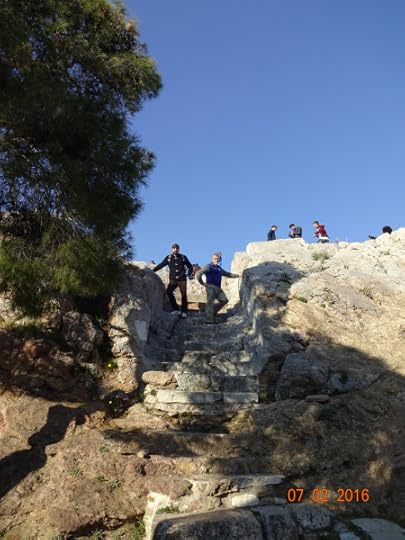


February 9, 2016
The Refugee Crisis
I just returned from 2.5 weeks in Europe, traveling with photographer Gary Gnidovic on behalf of Books and Culture magazine. My job is to write a report on the European refugee crisis. Gary and I visited Germany, Austria, Croatia, Serbia and Greece, more or less tracing backward the path for most migrants. I interviewed many refugees and many people helping them; I tried to understand the situation from the ground level. It was an amazing chance to see a world-historical event as it unfolds. I was challenged and inspired and sometimes depressed by what I witnessed.
Books and Culture has published a couple of short posts I wrote while traveling; here’s one. You can follow that to the other. But the big article comes out in May. I’ll let you know.


January 21, 2016
Healing Power
I’m very grateful that I can still run. However, with age comes injury. It’s one ticky-tacky problem after another. I get over plantar fascitis, and a week later I have a mild calf strain. Then it’s my ankle, then it’s my knee.
I’m talking minor problems–nothing life threatening. Nevertheless, these injuries are extremely annoying.
This morning I went out on a cautious run, fearing that a calf strain would shut me down, as it has for most of the last week. To my surprise, everything worked fine! I had a good run, and when I was almost home I remembered that I had asked God to heal my leg. Apparently he did! So I thanked him for answering.
He’s been doing this, not just since I turned 65, but my whole life. How many hundreds, maybe thousands of flus, colds, strains, sprains and fevers have I recovered from? How miserable would my life be if I had not?
I think this is what Psalm 103:3 means when it exclaims: “Praise the Lord, my soul, and forget not all his benefits, who forgives all your sins and heals all your diseases.” The psalmist is not saying that nobody need ever die of disease. He’s noting the ordinary nature of life in God’s world. Sin is ordinary–it happens every day and perhaps every minute. God forgives it in his children. Disease is ordinary too–and God ordinarily heals it. He made the world such that we get well. I don’t want to take away anything from the spectacular, miraculous healing. Who doesn’t wish to see that? But we should not overlook the equally supernatural reality of the ordinary.


Tim Stafford's Blog

- Tim Stafford's profile
- 13 followers

