N.L. Brisson's Blog, page 12
June 7, 2021
The Invisible Life of Addie LaRue by V.E. Schwab-Book
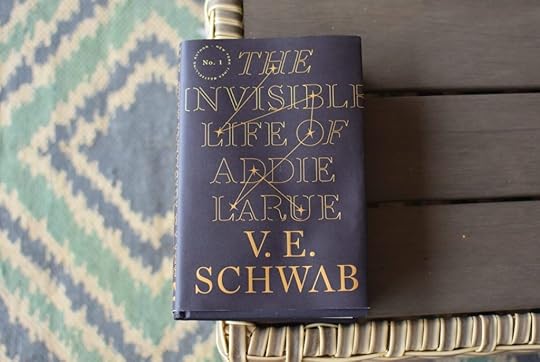
From a Google Image Search – Book Club Chat
The Invisible Life of Addie LaRue by V. E. Schwab warns us to follow her neighbor Estelle’s advice and never make a deal with gods who answer after dark. The tale of Adeline LaRue shows what can happen if you make such a deal, even by accident, or because you are desperate. Adeline ends up making a very bad deal with a tricky god who takes on the appearance of Adeline’s perfect partner, a made up figure she has been drawing for many years.
Adeline grows up in the 18th century in a small village called Villon in France. It is practically impossible for a daughter to avoid a local marriage and the life of a wife and mother, hard and full of toil if you are not from a wealthy family. Adeline doesn’t want this life. She wants to be free, in a time when freedom for women was also something that might be marginally possible only if you were rich. Adeline’s family is not rich. Her father carves small, and quite desirable figures from wood and sells them at local markets.
Be careful what you ask for.
I almost put this book aside because I don’t usually read fiction about the occult or magic but I was ready for light entertainment and so I kept reading. Adeline’s deal means that she gets to live a long life as a ‘free’ woman, but no one remembers her. She can’t rent a hotel room or own any thing or have a normal relationship because she is always unknown. Everything is temporary. She can’t even say her own name. She is not really free at all because she sold her soul to ‘Luc’ for a freedom that is worthless. Luc visits Addie frequently to see if she is ready to give up her soul yet, but she is a stubborn girl. The more he tries to get her to give up, the more determined she becomes to go on. Three hundred years later, looking back, she acknowledges the things she has gained from her long life. Certain pieces of art work seem to give credence to Addie’s story. But she is tired.
In 2014 she finds a way to change the deal – at least temporarily. How does that happen? Read and find out. This was an inventive and entertaining piece of fiction, although the word ‘palimpsest’ cropped up a bit too often perhaps. Good job, V. E. Schwab.


May 26, 2021
Project Hail Mary by Andy Weir – Book
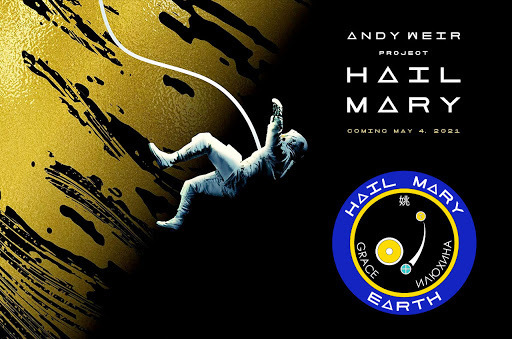 From a Google Image Search – collectSPACE
The only complaint I have about Andy Weir’s new book Project Hail Mary is that I finished too quickly. But I had a big smile on my face most of the time. Weir’s book has upset some physicists and astronomers because they say Andy Weir doesn’t always get the science right. I am not a physicist or an astronomer, although I like to read articles about both areas so, for me, this book offered enough math to make it seem authentic, without getting too esoteric. The main character, Ryland Grace, is, after all, just an eighth grade science teacher and the math seems just about right for that level. Acceleration in different gravities, temperature ranges that support life, an alien culture that uses base 6 rather than base 10, spectrographic analysis and control screens that can offer up any missing information or do the math—all of these elements are intended for readers who are not physicists or even biologists.
I don’t usually read reviews before I write about books but The Washington Post kept dangling one in front of me so I finally opened it but I tried to just lightly skim it. Another thing the reviewer found annoying was the use of coma amnesia by the author as a device to prevent information overload. We learn everything in flashback mode. If our reluctant astronaut only remembers info as needed we learn about technicalities as he relearns them or remembers them. He wakes from his coma alone and has lost the team of true experts that were supposed to keep the mission on track. This device did not bother me, it seemed useful, but it might bother some readers.
Earth has a pressing problem. For some reason the sun’s energy is being diminished and it looks like the culprit is Venus. With a probe scientists are able to collect samples from the place where the ‘Petrovian’ line heads from the sun and hits the atmosphere of Venus. We learn that the true culprit is a tiny organism called an ‘Astrophage’ and that it goes to Venus to breed because it needs carbon dioxide to reproduce, which cannot be found in the sun. It then returns to the sun to collect more energy for a return trip. Each trip increases the Astrophage population. So, as if climate change were not enough, now our own sun will get so dim that we will starve to death.
When Grace (corny name or perfect?) finds himself alone in space he hears a Tap, Tap, Tap and finds he has a neighbor, an alien spaceship is nearby. He makes a leap of faith and allows his neighbor to connect the two ships with a tunnel. “Rocky” and Grace cannot share the same spaces or they will die. Rocky requires an atmosphere heavy on ammonia and he lives in extreme heat. Thank goodness for xenonite. Rocky’s planet is also being attacked by Astrophage, but Tau Ceti, the sun they are both visiting is infected with Astrophage and yet it is not losing energy. Why? Grace and Rocky find ingenious ways to figure it all out.
When my friend’s daughter was four she saw a movie over and over, as children love to do. The movie was called The Land Before Time. There was a character in the movie, Ducky, who would always say “yup, yup yup” or “nope, nope nope,” three times. It was so catchy and we all heard it so many times that summer that it has stayed with me all these years, although I never even watched the movie. Rocky and Grace also talk in threes after they learn enough of each other’s language. “Bad, bad, bad” they intone, or “good, good, good.” Rocky is a really lovable little alien engineer with a can-do attitude and a pretty even disposition. Does he make the book childish? I don’t know. That WaPo critic claims that the book is written like a movie script rather than a novel. Maybe. But Ducky prepared me well for a space engineer that looked like a turtle on top and a spider underneath, who had the lovable habit of saying things three times.
What is relevant about the book is not an imminent Astrophage attack on our sun, but the way humans come together to solve the problem quickly and efficiently. It is reminiscent of the way The Ministry for the Future by Kim Stanley Robinson tackles climate deniers by just finding ways to develop strategies that bypass them, right down to the leader of the Ministry, Mary Murphy, a strong woman who doesn’t take no for an answer. Dr. Eva Stratt is just such a strong woman and she leads the group of scientists from all of earth’s nations in getting a mission ready to travel to Tau Ceti as soon they see that earth will die if they don’t figure out why that other sun is not losing energy.
Mary Murphy had a male counterpart who used the most aggressive and unethical approaches. Dr. Stratt plays both roles. She does not mind getting down and dirty. But this idea that humans, even humans and aliens, can let go of jealousy and animosity when the survival of their species is at risk is present in both books. It is cooperation, even enforced cooperation, that solves existential problems. We end up with the question of whether our problems are existential enough to get us to work together towards a common goal, which just so happens to also be related to carbon dioxide. What do I have to say about Project Hail Mary? It was good, good, good!
May 23, 2021
The Sympathizer by Viet Thanh Nguyen – Book
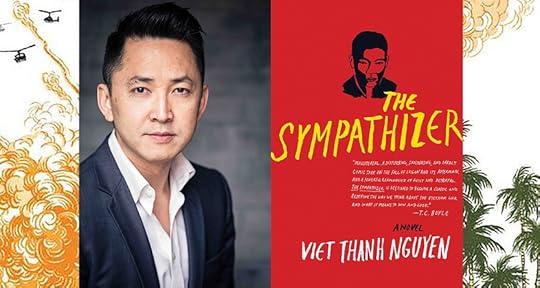 From a Google Image Search – itsaphanlife.com
The Sympathizer reads as if the author was there at the fall of Saigon, except that the author, Viet Thanh Nguyen, although born in South Vietnam, was born after those events. His parent were there, the authors of the source materials he read either were there or had used journalistic methodologies to research Vietnam history, the Vietnam War, the fall of Saigon and the aftermath. He may have learned about the war second hand, but he writes about it very much as a first hand observer/participant.
Others have written about those harried days when the U. S. admitted defeat and had to get out of town fast, but here is a new voice. And, although the book is fiction, it is immersive. Until I read the end notes I was convinced that V. T. Nguyen had been in Vietnam throughout the war. Our narrator remains unnamed and the use of first person is consistent throughout. This novel offers us an expert’s use of point of view.
Our unnamed main character is both simple and complex. He is the “man with two faces,” “the man with two minds.” The child of a culturally unacceptable liaison between his Vietnamese mother and a French priest, he’s reviled by villagers–his mother shunned and very poor–he is labeled a bastard. He is also handsome and bright and is sent to a Californian college where his views become more global. He has made a blood pact with two other guys, Man and Bon, and they are the only two who command his loyalty. They are communists.
Back in Vietnam during the war years, our narrator is imbedded in the South Vietnamese Army, but he is a spy who sends off reports to Man in North Vietnam. He appears to be a shallow, somewhat cynical guy, his voice is irreverent and politically ambivalent. He works as an aid and driver to the Commandant of the Vietnamese troops in the South. His grasp of English makes him valuable to both the Vietnamese and the Americans. He doesn’t seem to have any real ideological attachment to communism and certainly, given his deceptions, doesn’t even think in revolutionary rhetoric. He tells us on the very first page that he can see both sides.
Our narrator escapes the fall of Saigon with a General and others, including his sworn brother Bon, whose wife and child are killed during the escape. Our narrator may not have many values that demand his absolute allegiance but he is determined to keep Bon from despair and suicide.
The book is masterful, so well-written, evocative of what we already understand as the senselessness of war, combined with the truth that we seem unable to end our apparent love affair with wars.
“…our revolutions had gone from being the vanguard of political change to the rearguard of hoarding power. In this transformation we were not unusual. Hadn’t the French and the Americans done exactly the same? Once revolutionaries themselves, they had become imperialists, colonizing and occupying our defiant little land, taking away our freedom in the name of saving us…Having liberated ourselves in the name of independence and freedom—I was so tired of saying those words!—we then deprived our defeated brethren of the same.” (pg. 326)
Nguyen dazzles as he traces the occupations of Vietnam back to its origins, starting from the origins of his character.
“…if history’s ship had taken a different tack, if I had become an accountant, if I had fallen in love with the right woman, if I had been a more virtuous lover, if my mother had been less of a mother, if my father had gone to save souls in Algeria instead of here, if the commandant did not need to make me over, if my own people did not suspect me, if they saw me as one of them, if we forgot our resentment, if we forgot revenge, if we acknowledged that we are all puppets in some one else’s play, if we had not fought a war against each other, if some of us had not called ourselves nationalists or communists or capitalists or realists, if our bonzes had not incinerated themselves, if the Americans hadn’t come to save us from ourselves, if we had not bought what they sold, if the Soviets had never called us comrades, if Man had not sought to do the same, if the Japanese hadn’t taught us the superiority of the yellow race, if the French had never sought to civilize us, if Ho Chi Minh had not been dialectical and Karl Marx not analytical, if the invisible hand of the market did not hold us by the scruffs of our necks, if the British had defeated the rebels of the new world, if the natives had simply said, Hell no, on first seeing the white man, if our emperors and mandarins had not clashed among themselves, if the Chinese had never ruled us for a thousand years, if they had used gunpowder for more than fireworks, if the Buddha had never lived, if the Bible had never been written and Jesus Christ never sacrificed, if Adam and Even still frolicked in the Garden of Eden, if the dragon lord and the fairy queen had not given birth to us, if the two of them had not parted ways, if fifty of their children had not followed their fairy mother to the mountains, if fifty more had not followed their dragon father to the sea, if legend’s phoenix had truly soared from its own ashes rather than simply crashed and burned in our countryside, if there were no Light and no Word, if Heaven and earth had never parted, if history had never happened, neither as farce nor as tragedy, if the serpent of language had not bitten me,…” (pg. 307-8)
Nguyen leaves us, like Bon, in despair that we will ever find ways to suppress the flaws in our blighted human condition. It’s depressing but the narrator’s rather amoral and insouciant patter takes some of the sting out of some really dreadful things. Viet Thanh Nguyen is an excellent new voice in both American and global fiction.
May 22, 2021
Whereabouts by Jhumpa Lahiri-Book
 http://www.wsj.com
Jhumpa Lahiri finds herself in Italy, with time between books and engagements. In Whereabouts she takes a notebook with her as she meanders around a country she knows well. She’s not a tourist. She’s more of a ‘flaneuse’ or in Italian, a ‘fannuilona’ or a ‘perdigomo.’
Her notebook is not actually a journal because it’s not organized by dates (or days), but by geography, places, “whereabouts.” She is mostly alone and her writing reflects some of the decay, weight, and beauty of antiquity. Italy has a long history.
Although published in English in 2021, as translated by the author, the book was first published in Italian in 2018. So, we are not experiencing Italy either during or in the wake of the coronavirus pandemic. Italy was hit early and hard but would not have allowed for a whimsical wander about any of its cities in those sad days.
Chapter names reflect content: On the Sidewalk, On the Street, In Spring, In my Head, Nowhere.
From In My Head, page 31
“Solitude: it’s become my trade. As it requires a certain discipline, it’s a condition I try to perfect. And yet it plagues me, it weighs on me in spite of my knowing it so well. It’s probably my mother’s influence. She’s always afraid of being alone and now her life as an old woman torments her so much that when I call to ask how she’s doing, she just says, I’m very alone…”
From At the Museum, page 33
“The most beautiful room—it belonged to an emperor’s consort—has a garden painted onto the walls, teeming with trees, flowers, citrus plants, animals. Pomegranates have split open and birds perch on the branches of the trees. The scene is fixed, faded. The trees with their thin branches, seem to bend as if from the soft breeze that courses through the landscape. This semblance of a breeze is what makes the painted nature tremble, rendering everything paradoxically alive.”
Interesting to be in someone else’s head and space for a while, especially in the head of Jhumpa Lahiri, an author I admire. Virtual reality, old style.
April 26, 2021
Hummingbird Salamander by Jeff VanderMeer – Book
 chireviewbook.com
Jane Smith, is a mom and a wife, with a job in the security business in Jeff VanderMeer’s novel Hummingbird Salamander. Jane lives a normal American life, constantly questioning if this is the best life she could be living. She is a big woman, a wrestler who no longer wrestles, but does work out at a strip mall gym, not the designer variety. Her boss has named her giant hand-bag ‘Shovel Pig,’ signaling to her that she is not exactly a dainty woman, which she already knows. She decides to keep the name. She is in the American game, working to get ahead, trying to avoid office politics. Until one day someone hands her an envelope outside her favorite coffee shop with a cryptic message – an address and a key, and a message that says if Jane receives this envelope the sender is probably dead.
Would you bite? Would you get more and more distracted from your fairly normal life, lose everything to solve an increasingly twisted and dangerous mystery pathway, somehow related to either ecoterrorism or solving climate change? Can anyone embrace a cause fully without having it take over their life? Can you be a true activist without putting your family in jeopardy, without losing your job, perhaps even your home, your reputation, your clean criminal record? Would living a life on the run make you feel rootless and disoriented? Could you keep your focus on your target goals until you reached your own personal endgame?
Silvina, the woman Jane never meets, the woman who sent her the note, who leads her to a hummingbird, and eventually a salamander, the woman who puts Jane in mortal danger, is just such a committed activist. She seems, for some reason, to pick Jane as her successor. Will Jane ever solve the mystery of who Silvina is, how she is connected to Jane, and what she wants Jane to see and do. Entering this book is like entering an Escape Room where clues keep leading you to an exit that seems to recede into the distance just when you think the riddle is solved. You don’t get out of this Escape Room unless you finish the novel. Halfway through I got so frustrated, so angry at what Jane was doing to her life that I wanted to quit, but I could not put the book down.
There are no plans for stopping climate change in this book that would ever have worked. But we do learn if Silvina was a fraud or a true activist and she does present us with a result, sort of, maybe. As the story moves along the climate worsens, the color of the sky is a sickly gray-green and weather conditions are erratic – rain alternating with snow and sleet, excessive warmth replaced by freezing cold. Life doesn’t stop in an instant. The world goes on and people adapt to each new climate change as best they can. There are refugee ships full of climate migrants out on the oceans with nowhere to land.
There will be a hummingbird, and a salamander? What happens to them? What do they represent? Hummingbird Salamander is a conundrum because of the clues Jane follows and the threats she faces. It’s a thriller.
April 18, 2021
Nomadland by Jessica Bruder – Book
 Apple Books
Nomadland by Jessica Bruder is an authentic piece of journalism about Americans fed up with our social systems which consistently rob middle-class Americans of things they felt were part of the ‘social contract.’ In a land where our Declaration of Independence proclaims that all men are created equal, and endowed by their creator with certain inalienable rights (life, liberty, the pursuit of happiness), we assume that our government would not legislate against our rights.
Although governing is complicated it seems clear to most of us ‘bottom dwellers’ that our laws have been skewed to advantage the wealthy. When the wealthy play with the stock market and the economy to tweak it so they can get wealthier it hurts those whose finances are least secure. We are taught that consumption is good. We are dazzled by credit card offers that allow us to live well.
But when the rich go too far and we land in the Great Depression or the Great Recession people at the bottom, perhaps those very folks who believed the promise of credit as a road to comfort, fall off the economic scale.
They lose a job, they age out of the job market, they can’t pay their mortgage, they can’t afford health insurance and a major health crisis hits, their long time employer goes bankrupt and they lose their pension, or they are a widowed housewife who now has to live on the abbreviated Social Security they get from their dead husband’s account.
These are the people who sell their homes or lose their homes, who refuse to be homeless, who can find employment but not unless they travel to where employers are hiring. They buy a van or an RV, new or used depending on how much they were able to salvage from their previous life.
They outfit their RV, or van, or bus, or even just their car using lots of advice from those who have set out on this journey before them. They make places to bed down, they deal with how they will get electricity and water if they end up at a campsite with no amenities, they add solar panels hiding them if possible because they are not allowed to have them in some places where they camp, and they figure out what to do about showers and wastes.
There are websites for this. On Reddit there is a thread called ‘vandwellers’. There are searchable maps on a site like FreeCampsites.net, Allstays.com. There is a Wallydocking app. There are websites for Workampers who are seeking jobs to pay for their expenses, to possibly save up for a more comfortable van experience.
Jessica Bruder is a journalist, a writer. When she decided to write about this population she had a hard time getting vandwellers to speak to her. The media had not been kind; they tended to eventually get around to using the word ‘homeless’ which is offensive to vandwellers. These nomads tell the author that they have nothing against the ‘homeless,’ they are just not at all homeless. They have a home; it just is not anchored in one place.
Because the National Park Service allows campers only fourteen days on a site, vandwellers have to move frequently. You can work as a camp host, cleaning bathrooms and campsites, checking in campers, stay for an entire season, and get paid, but these jobs are being eliminated.
Amazon hires workampers at Christmastime but these jobs are difficult for seniors as they involve walking for many miles on the concrete warehouse floors, bending and rising, and hefting a weighty scanner that keeps track of your every move. Workampers consider the challenges worth the rewards, although some do not make it in these physically taxing jobs.
Bruder makes friends with a camper named Linda May and she finally outfits a van of her own, which she names Halen, and joins Linda at sites vandwellers frequent, such as Quartzite, Arizona (The Gathering Place) and the Rubber Tramp Rendezvous. She gets to listen to and learn from many vandwellers when she actually lives the life. Swankie Wheels is one of her sources, Bob Wells who started the website CheapRVLiving.com, Silvianne the astrologer, someone called Ghost Dancer.
One of her sources tells her, “[w]e’re facing the first ever reversal in retirement security in modern US history. Starting with the baby boomer, each successive generation is now doing worse than previous generations in terms of their ability to retire without seeing a drop in living standards…” (pg. 62) Another source says, “[b[y moving into vans and other vehicles people could become conscientious objectors to the system that had failed them. They could be reborn into lives of freedom and adventure.” (pg. 75)
Bruder writes, “[w]hile it’s human nature to put on a good face in turbulent times — and to present that face to strangers – something else was also appearing among the nomads. The truth as I see it is that most people struggle and remain upbeat simultaneously, through even the most soul-testing of challenges. This doesn’t mean they’re in denial. Rather it testifies to the remarkable ability of humankind to adapt, to seek meaning, and kinship when confronted with adversity. In other words the nomads I’d been interviewing for months were neither powerless victims nor carefree adventurers” (pp. 164-5)
Linda May is an especially interesting and aware vandweller. Beset by adversity she still has a grand plan to build an “Earthship” of dirt-packed tires and to get off the grid on her own land. As Nomadland ends she sets foot on the property she has saved for, searched for and purchased, and she is getting ready to build. She has made friends along the way who have promised to help.
The author finds it hard to leave the vandwellers and return to her own life to write the book she has researched and she concludes in this way:
“The most widely accepted measure for calculating income inequality is a century old formula called the Gini coefficient. It’s a gold standard for economists around the globe, along with the World Bank, the CIA, and the Paris-based Organization for Economic Cooperation and Development. What it reveals is startling. Today the United States has the most unequal society of all developed nations. America’s level of inequality is comparable to that of Russia, China, Argentina, and the war-torn Democratic Republic of the Congo.” (pg. 247)
Obviously, I also have had some trouble leaving the vandwellers behind as I continue to digest the details of life on the road and the philosophies that maintain those whose lives have become nomadic. I worry that this could happen to me, or indeed, anyone I know. I have a friend who chooses to be nomadic for a portion of the year, but he and his wife own two expensive properties. Not the same thing at all.
The fact that women are safe and able to pursue this lifestyle if it becomes necessary helps lift my spirits a bit but the thought of 10-hour shifts at an Amazon warehouse to keep me in groceries has the opposite effect. It’s as if we are playing a game where colorful ‘peebles’ are lined up on a shelf and as new ‘peebles’ are added at the front end of the shelf, identical looking ‘peebles’ are falling off the shelf at the other end. Are you ready for Nomadland? Check out more of what Jessica Bruder learned and do a bit of soul-searching.
April 13, 2021
The Female Persuasion by Meg Wolitzer – Book
 Amazon.com
There is a writer’s lecture series at a local theater which is currently held as a Zoom presentation because of the covid pandemic. You buy a ticket and you are registered to attend. Meg Wolitzer was the writer and the book she was speaking about was The Female Persuasion. I ordered the book but did not finish it in time so I never bought a ticket to the presentation. I find it hard to keep track of the many zoom meetings that come to me in my email. I am sorry I missed it though. I don’t often get to see a best-selling author in person (on zoom).
I finished the book not long after that, although spring had been a pleasant distraction. The Female Persuasion by Meg Wolitzer covered women’s rights territory that had key moments in my younger years, and here in this novel we have young people involved in the women’s movement which is having another key moment. Women’s rights are under attack. Hard won concerns, once thought resolved, could possibly be overturned here at the beginning of the twenty-first century. Wolitzer’s book does not spend much time arguing the issues though.
Greer Kadestsky, a young lady who did not get to attend the college of her dreams with her boyfriend, Cory, finds herself at a smaller college. Despite having to travel to keep her relationship with Cory alive, Greer makes a good friend Zee. Although Zee is gay and Greer is not, their friendship transcends their sexuality. When Greer meets an iconic figure from the women’s movement of the 60’s, Faith Frank, she finds her focus. Zee has guilted her into going to the lecture, but it is Greer who becomes a Faith Frank fan.
After college Greer goes to work for Faith and overcomes her fear of public speaking, but she also learns about the compromises Faith has felt it necessary to make. Greer eventually criticizes the lack of purity in her mentor. Her mentor reminds Greer of something Greer has done which is a betrayal of a relationship.
Greer also has some lessons to learn about her relationship with Cory, a man who does not just talk the talk. It turns out that he understands love and sacrifice in ways that Greer does not recognize – until she finally does.
It’s a good story and some of the observations about compromise, and purity, and the correlations between means and ends are interesting to think about for our own lives and issues. It just didn’t grip me. It wasn’t relevant enough to women’s rights to hook me. Today’s news, modern activism and the current makeup of the Supreme Court offer far more gripping concerns. The mentor relationship was less interactive than it kept promising to be. However, Cory I came to like very much, and he might end up being the best mentor for Greer in this novel.
March 23, 2021
Klara and the Sun by Kazuo Ishiguro – Book
 From a Google Image Search – http://www.nwaonline.com
Kazuo Ishiguro may seem to be telling folkloric tales in his most recent books, but they are actually quite philosophical and contemporary. In Klara and the Sun we meet a number of AF’s on display in a shop in a city very like London. The Manager rotates the AF’s into and out of the front window hoping to attract the attention of a teen who will convince an affluent parent to buy an attractive friend, dedicated only to them. Klara and Rosa are both B2’s, with the newest B3 models hot on their heels. They follow all the manager’s directions to try to attract a buyer. A teenager named Josie admires Klara and tries to convince her mother to purchase her but then she disappears. Klara takes a chance and turns down a potential buyer because she is waiting for Josie to come back. Manager lets her get away with it, but tells her she will not be allowed to turn down a buyer again.
Klara is an unusual AF because she pays attention to what is going on around her and draws conclusions from what she sees in the store and outside the front window. She watches when the sun seems to resurrect the Beggar Man and the Dog and when it smiles on the reunion of long separated lovers. She is shocked when the Cootings Machine comes to park in the street with its 3 funnels that vacuum pollution and send it out into the air, turning day into night.
This is a future, perhaps a near future, when some children are genetically “lifted” in their childhood years if parents so choose. A social gap arises between those who are lifted and those who are not. Josie is “lifted.” Her best friend from a young age, and now her boyfriend is Rick, who was not “lifted.” For some young people being “lifted” can cause illness and even death. Josie is at the critical age when she is ill and she could die. That’s when her mother buys Klara for her. Klara goes home with Josie to their home in the suburbs.
I believe this is a story about soul; do we have one, can an AF have a soul, what is a soul. Perhaps Ishiguro is answering back to someone like Yuval Noah Harari who doesn’t put much stock in a human soul in his book Sapiens. To Harari we are animals, human but not “lifted” above any of the other animals on the planet. In fact, to Harari our big brains have been more of a liability than an advantage, especially to the planet we call home.
But Ishiguro may be suggesting that our soul may be a function of what we do, of how we live our life. If even a robot can do something that seems soulful, could believing in a soul prompt us to do better, to be less selfish. Klara undertakes a task that she thinks will cure Josie but she is unsure how her own abilities will be affected by the bargain she accepts and the sacrifice she must make to complete it. We can’t help but compare Klara’s optimism to the way Josie’s mom, Chrissie, gives in to the past experience she has had in this matter and sets a truly selfish and rather macabre plan in motion. If Klara had chosen to go along with Mother’s plan how would things have turned out differently, for everyone?
Do we have a soul? Do we build a soul by believing that we can affect the universe in positive ways? Is soul the same thing as character? Regardless of how you answer these questions or others you might arrive at, it is almost certain that you will find Klara an extraordinary AF indeed. This one speeds by. Make sure you stop and ponder the ideas as well as the story.
March 18, 2021
How to Avoid a Climate Disaster by Bill Gates – Book
 From a Google Image Search – Gates Notes
How To Avoid a Climate Disaster by Bill Gates – Book
If you like a level-headed, carefully researched roadmap to ‘get to zero’ (zero greenhouse gas emissions), tapping into the mind of a man who brought on the age of technology can’t hurt. Bill Gates in How to Avoid a Climate Disaster, is exactly the unemotional problem solver, backed by a team that has helped collect data and facts (you remember facts) who could foment the kinds of changes the humans on our planet need.
Did you know that 51 billion tons of greenhouse gases are added to the atmosphere in a year? How do we get that number to zero? Gates comes as close to showing us how we can do this, without making our lives unrecognizable, as any one has. “I came to focus on climate change in an indirect way – through the problem of energy poverty,” says Gates. (pg. 8) Eventually Gates divested of all stocks in coal, gas, and oil.
Gates offers plenty of graphs and charts but not to prove that carbon dioxide and methane are heating up the world and causing global warming that is great enough to affect climate. He begins with the assumption that this correlation is real and spends his time exploring every thing humans do that creates emissions and how we get each to zero global warming emissions. He uses one graph and some dramatic examples to show how warming affects the earth and some people more than others. He admits that ‘getting to zero’ will be hard. The effects of warming will be worse in poorer countries that are not responsible for emissions. The changes will have to be made in rich nations who will be most reluctant to change their ways.
“To sum up: we need to accomplish something gigantic we have never done before, much faster than we have ever done anything similar. To do it we need lots of breakthroughs in science and engineering. We need to build a consensus that doesn’t exist and create public policies to push a transition that would not happen otherwise. We need the energy systems to stop doing all the things we don’t like and keep doing all the things we do like – in other words, to change completely and also stay the same…But don’t despair. We can do this.” (pg. 48)
Gates starts us off with a chart on page 51 which shows “How much greenhouse gas is emitted by the things we do?” Making things (cement, steel, plastic) – 31%, Plugging in (electricity) – 27%, Growing things (plants, animals) – 19%, Getting around (planes, trains, trucks, cargo ships) – 16%, Keeping warm and cool (heating, cooling, refrigeration) – 7%
Using this chart every greenhouse gas producing activity is assigned a Green Premium. That green premium needs to go to zero. Gates, with the help of his research groups (Gates Ventures and Breakthrough Energy) takes each greenhouse gas emitter and shows how we get to zero carbon emissions. This is another climate book you really need to read. In fact, if you are an inventor, there are any number of areas where you could follow in the footsteps of Bill Gates and perhaps get in on the revolutions in energy that we all need. Will you end up skyrocketing to fame and fortune? Perhaps, perhaps not, but you could end up in some future history books. Help Bill Gates, help yourself.
March 8, 2021
The Three Mothers by Anna Malaika Tubbs – Book
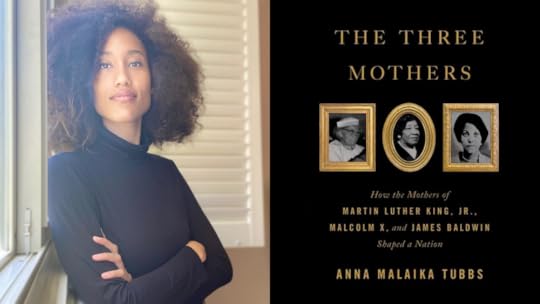 From a Google Image Search – Women’s Foundation of California
Anna Malaika Tubbs has given us a book about The Three Mothers: How the Mothers of Martin Luther King Jr., Malcolm X, and James Baldwin Shaped a Nation. I began reading this book near the end of Black History Month and finished it on International Women’s Day, a serendipitous accident of relevance.
Emma Berdis Baldwin was born on the island of Grenada to an activist mother and father who faced the same fights for racial equality we have seen in America. America had claimed to be a nation where all men (and they did mean men) were created equal, but of course when she arrived she found that she was not in any racial nirvana. James was Berdis’s eldest child. Berdis was able to communicate love, pride, and the value of an education to her family and her family remained a close and loving one living in a four story Harlem building owned by James Baldwin which offered places for his sisters and brothers. Finding a mother as beloved as Berdis, a mother who produces a child of such value to the nation and the world is surely enough to hold a place for Berdis in our historical memory.
Louise Little, mother of Malcolm X, was an activist all her life. She and her husband and her children moved frequently because her activism made them targets. She was a follower and an important worker in the movement begun by Marcus Garvey. She wrote in his newspaper and spread his message despite one close call with the KKK and other terrorist attempts to force her to be quiet. Her husband Earl was killed when he was pushed in front of a trolley. She and her children struggled with poverty after Earl’s death. Social services (welfare) pursued the family, eventually sending Louise to a mental institution, although her only mental illness was the stress of single parenting in a world where she could find no work. Malcolm X had followed in his mother’s footsteps, although he was not a Garveyite. He founded the Black Panthers and was assassinated for his embrace of violence as a means to change, but of course Martin Luther King Jr. who believed in nonviolent protest was also assassinated. Louise was released after 25 years in the mental institution and was able to spend her last years surrounded by her family in a lovely and peaceful black town they founded.
Alberta King was married to the powerful reverend at the Ebenezer Baptist Church in Atlanta. She led a life of greater affluence. Alberta was a talented musician who played the organ at that famous church and led a renowned choir that people came from miles around to hear. She also gave lessons in music to many black Atlanta children. As she watched Martin Luther, (ML) as he was called, turn into a speaker who captured the attention of the entire world she worried constantly about the forces arrayed against him. One day a stranger entered the Ebenezer Baptist Church and shot Alberta and four others as she sat at her organ. She survived to be surrounded in her age by her remaining children and grandchildren.
Anna Malaika Tubbs is well aware of how women, especially Black women get erased from history and she did not want that to happen in the case of at least these three moms who gave the world so much. As she writes she shows us the ways that these sons were products of their upbringing and how the mothers were the most influential forces in their children’s lives. These mothers lived through many dark days and they kept their families afloat and put hope and love and a need to speak out in their hearts. Our nation benefitted from the lives of these three men and they would, all three, wish us to remember their mothers. I can’t think of a better message for International Women’s Day (March 8, 2021)