
Allan Kelly's Blog, page 25
August 9, 2019



July 26, 2019

June 29, 2019
June 18, 2019

June 6, 2019

May 23, 2019
Identity over roles and responsibilities

When was the last time you read your “roles and responsibilities” description?
My guess is, it was about the time you applied for your current position. Of course, if your HR department, or agile coaches, have decided to change your description you might have read the new document but even then, did you?
My guess is most people remember little more then the job title.
Like so many documents, it goes in one eye and out the other. And the longer it is, the more detail the less you are likely to remember.
So it won’t surprise you when I say: I don’t think roles and responsibilities documents have much use.
And it might not surprise you when I say roles are pretty pointless too.
To my mind your personal sense of identity, your own idea of who you are and what you do, plays a much bigger role in the actions you take in work and the responsibilities you accept – and those you ignore.
If, for example, your business card says “Business Analyst” it is not because someone defines your work as a “Business Analyst” it is because you see yourself as a business analysts and your sought out a business analyst role. You are a business analyst because you see yourself as a business analyst. You are not a programmer because you didn’t apply for a programmers job because you are not a programmer.
Let me suggest that what you actually do has little to do with what it says in some document, rather what you do is determined by your sense of identity, your identity may well be entwined with a job title. Identity is a powerful motivator.
If you consider yourself to be a programmer, a software engineer, software developer or whatever, then you probably shun business cards altogether but the same idea applies: you are a programmer not because you read a job description and say “I like the sound of that”. You are a programmer because you like doing the things you think a programmer does.
Of course this can cause problems because different people see things differently. Things fall between the gaps – your manager expects you to update the user manual and you see that as someone else job. Or things get difficult because two people try to do the same thing: the programmers try to design the software and so too do the architects.
Things get more complicated when people – us consultants! – start trying to change things. Maybe we say “programmers should test the code they write” but programmers say “testing is a Testers job.” Its even more difficult when you try and remove responsibility for someone: “programmers are no longer responsible for updating the system documentation.”
This is why I despair when people tell me problems can be fixed by updating the “RACI matrix” – don’t ask me what R A C I stands for, it seems to be a tool where responsibilities are listed against roles. RACI doesn’t change identity.
But you know what? – I like the way the world is. I do not want a world were people do what is on their job description and don’t do what is not.
People who are doing what they think needs doing, and who are doing it with the aim of producing a better outcome are motivated.
People who are doing something because it is in a job description, or because they’ve been told it is now their responsibility are not so motivated. Job description documents are pretty useless.
Whether you agree with me or think that people “should” do what is in some document: simply stop expecting them to do what it says. Instead look at what they do.
Go further, if something is missing ask “Who would like to do this?”. Work with people who are motivated by asking them what they want to do.
Few, very few, people are truly disruptive and working against you – unless of course your final outcome is something evil. Work with them.
Delete the roles and responsibilities documents.
Like this post? – Like to receive these posts by e-mail?
Subscribe to my newsletter & receive a free eBook “Xanpan: Team Centric Agile Software Development”
Check out my latest books – Continuous Digital and Project Myopia – and now Project Myopia audio edition
The post Identity over roles and responsibilities appeared first on Allan Kelly Associates.
April 26, 2019
Building software is not like building houses (thankfully)
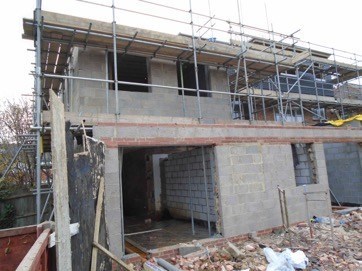
I hate the “building software is like building buildings” metaphor. For a start most software people know so little about physical building that they are comparing the messy world of software construction with a idealised image of what they think happens in construction.
The above is a picture from my back garden last week. Only a couple of weeks ago the back of this house looked much like the back of my house, except it had an small, ugly, 2m x 1m kitchen extension on it. And it had an over grown garden, a third of which houses this big extension while the rest of it is full of building debris.
The builders moved into this house less than six week ago. During that time they have: cleared the garden, cleared the house of remaining furniture, dug foundations, concreted foundations, built a two story side and back extension, ripped the roof off both this house and the ajoining house and replaced the roof while also constructing loft conversions on both houses. The roof came off on Monday and the new one was done by Saturday.
Builders – roofers and brick layers – go fast. Three years ago I had some work done on my house. I was well impressed with the speed the builders ripped the back rooms apart, tore down a wall, bricked up a door, and built a new wall.
Then it goes slow.
Once the actual “building” is done the wiring, plumbing, plastering, decorating and other fitting-out starts and o my, it goes so slow. Hold ups are regular as parts and people are not available when needed. There is a constantly changing cast of workers as specialists appear for a few days and then disappear.
I expect it will be four or five months before anyone is living in my neighbours house again.
During that time it goes slow, work people come in but it is hard to see progress. And the progress is far less clear than when a wall disappears, or a new wall comes into being overnight.
And so it is in software… usually.
The thing about construction – both physical and software – is that so often the most visible bits are actually among the most quickest and straight forward. These are the bits where not only can progress be made rapidly but visibly too.
But lots of time is spent on less visible bits – the tricky bits. The Devil is in the Detail as the saying goes.
When people say “How can is possibly take so long?” they are speaking from the experience of seeing the visible bits happen fast. The less visible bits, where the time is consumed, they don’t know what is happening during the less visible bits and have few memories to guide them – but they did remember it went fast last month!
When my house was being worked on I often felt like saying “why isn’t it done yet?”. The big changes, the heavy lifting, was done. How could all this other stuff? – the minor bits, the bits which didn’t require actual building – take so long?
Fortunately, software doesn’t need to be like this. There are alternatives. But working such ways means slowing down the early stages to deal with the detail as you go. Overall you get a more consistent (and sustainable) pace, and may well finish sooner but you loose the quick start that impresses people. Almost from day-1 they start complaining about the lack of progress.
Not being a builder I don’t know, but I do know I hired experts and I have to trust them. And I never tried to say to them “If this was software you would be done by now.”
(Now I’ve written this blog I remember, I’ve said something two years ago… Heavy Lifting is the Easy Bit. Worth saying again I think.)
The post Building software is not like building houses (thankfully) appeared first on Allan Kelly Associates.
March 22, 2019
Story Generators

Recently I’ve been looking again at Jobs to be Done and OKRs (Objectives and Key Results). I increasingly see them as story generators and a potential solution to the tyranny of the backlog I described last time.
When I first looked at Jobs to be Done (and OKRs actually) I wondered if they constituted a fourth, top, level on top of Epics, Stories and Tasks. I’ve long argued against having more than three levels of things to do (or requirements as we used to call them.) There are big meaningful things to do (stories), really big things which we don’t as yet understand but look really valuable (epics) and the immediate small things to do right now (tasks).
Actually, I’d rather think most things can be dealt with by two levels and one level is the even better. So adding a fourth “even bigger” thing on top of Epics just felt wrong. Technologists (like myself) have a tendency to map everything into hierarchies; inverted trees with fractal like branches. But not everything is, or should be, a hierarchy, mapping the world into a tree like structure can add complications.
Unlike stories (and epics and tasks) Jobs to be Done don’t really lend themselves to the transactional “Done”. While you could put a Job all the way to Done on your Kanban board and track it from “To do” to “Done” in reality the customer job still exists. Sure you’ve improved it but you can improve it again – another example of Stable Intermediate Forms. This seems to be the great potential of Jobs to be Done, they keep on giving: as much as you improve your product to help with the job you can still improve it some more.
So each time you analyse the Job to be Done you should be able to find more stories to deliver to improve it. Hence the Job to be Done is not a “story” to do, it is a Story Generator. Every time you look at the job to be done you find more stories, every time you examine the result of the latest improvement you find more stories. The job will never be done. Some might see that as a bad thing but that also means the job presents a stable focus for ongoing work.
The same might be true of OKRs but in a slightly different way. Because the objective is reviewed periodically – every quarter or so – it lacks the continuity of Jobs to be Done but perhaps allows the team to switch targets, maybe it is stable enough.
The key results may well be stories in their own right, or they may be things which lead to stories. Either way one can expect some key results to be achieved and marked as done regularly. As they fall they are either replaced by new key results building towards the objective (which themselves lead to stories) or new key results are added for new objectives.
I’m sure there are other story generators out there but the key thing for me is not the mechanism but the existence of the generator. Once you have a story generator you do not need a big backlog of things to do. The generator will replenish the backlog whenever you need more stories – either because you have done them or the value has fallen.
Using a generator removes the need to have a big backlog which removes the tyranny of the backlog. The team are now free(r) to concentrate on delivering value towards their objective.
Finally, I wonder if anyone has used both OKRs and Jobs to be Done together? Right now they feel like alternative generators to me, having both seems like a bit like overkill. Although I accept that maybe OKRs are more corporate and Jobs to be Done are more product focused. Anyone got any experience using them together?
Like this post? – Like to receive these posts by e-mail?
Subscribe to my newsletter & receive a free eBook “Xanpan: Team Centric Agile Software Development”
Check out my latest books – Continuous Digital and Project Myopia – and now Project Myopia audio edition
The post Story Generators appeared first on Allan Kelly Associates.
March 14, 2019
Tyranny of the backlog
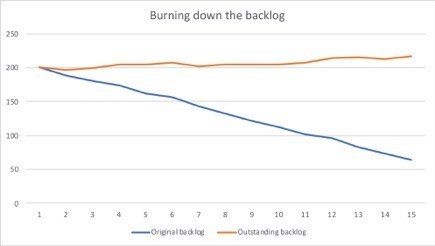
The backlog is a great idea: all the things we think the team will build, or perhaps: things they might build, and it might contain other work, like evaluation or reviews. Yes, the backlog is a great idea, all the stuff the team might do, well perhaps not all, it is seldom complete, after all, as they say “stuff happens”.
The truth is: backlogs have a tendency to grow. All too often I find teams who are struggling under the weight of their backlog. They can’t spare time to do experiments or learn something because there is stuff to do. The backlog becomes a tyrannical ruler and all of it MUST BE DONE.
Look at that hypothetical burn-down chart above. By sprint 15 the team is well on its way to completing all the original work. But the amount of work they need to do is higher than when they started. It is not as if the team have been doing nothing. Look at the next chart, it shows how, most weeks, more work is added than is done.
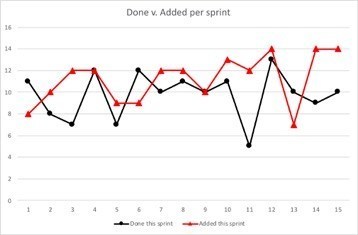
To my mind finding more work isn’t a problem, indeed teams should be finding more work. Problems stem from the fact that backlogs – and tracking mechanisms like burn-down charts – try to full-fill competing needs.
The backlog is used as a store of ideas for work to do. This makes sense, you can’t do everything today so postpone some to the future. A backlog allows you t move some things from peak time to off-peak, although software development teams rarely seem to see off-peak time.Plus, having a backlog makes it easier to say:
“Thanks for your suggestion Fred, I’ve added it to the backlog, I’ll let you know when we get to it.”
Rather than:
“Thanks for your e-mail Fred, we deleted it once we stopped laughing.”
It makes sense to give a new idea a quick once-over. But doing a proper analysis is time consuming:Discussing what is being asked for takes time, as does setting acceptance criteria are. And then there is business value to assess and other work priorities to consider. Therefore, put it in the backlog and do all that later (if it ever gets scheduled.)
Without a backlog we would be forced to make a binary decision: do it and do it now or reject it.
In fact the backlog can become a natural filter: as stories age in the backlog some items will jexpire. Unfortunately many Product Owners don’t feel they have the authority to delete old requests so the backlog grows and grows.
I call such a “constipated backlog”: work goes in but very little comes out. When the only way for items to leave the backlog is by doing them the rate of return falls.
The backlog fills another role because so many teams are still expected to meet project success criteria which ask for “everything to be done.” The backlog becomes a tyrant when people believe that one day it will all be done. Worse still, some people plan using this assumption.People want to know when “it” will be done, how long it will take and how much it will cost. It takes time to answer those questions and if the backlog is growing any answer is going to be wrong.
In fact, it is probably wrong to think everything will ever be done. Unless one freezes the backlog and refuses to add new work then it is likely that low value items will be postponed while new, more valuable items, will take priority.
As an industry we need to drop the idea that a backlog will ever be done: the backlog as repository of ideas is at odds with the backlog as a measure of completeness.
Think about it this way: some of the items in the backlog are very valuable. Some items are worth very little. Some will cost more effort than the benefit they bring. If we do everything then the low value and the high value will all get done. Conversely, if we encourage new ideas and weed-out as many low value items as possible our rate of return will be higher.
But very few teams follow this model. Many more teams are slaves to the backlog, and their quest for an empty backlog is doomed.
Like this post?
Like to receive these posts by e-mail?
Subscribe to my newsletter & receive a free eBook “Xanpan: Team Centric Agile Software Development”
The post Tyranny of the backlog appeared first on Allan Kelly Associates.
February 26, 2019
Audio & free eBook of Project Myopia
A little bit of time sensitive news, albeit at the risk of overwhelming my regular readers – especially those who take this blog on the mailing list. Sorry.
The #NoProjects book, Project Myopia is available as a free ebook from Amazon (Amazon USA) for two days, Tuesday 26 February and Wednesday 27 – well, strictly speaking midnight Monday/Tuesday till midnight Wednesday/Thursday Pacific time, so 8am Tuesday to 8am Thursday GMT.
This is to celebrate the release of the audio version of Project Myopia which is now available on Audible and Amazon (where the free ebook is too), and possibly some other places where Audible has distributed it.
Unfortunately, Project Myopia will not be free in every Amazon. My full apologies, I think it is going to be free for UK and US Amazon customers, and probably Germany customer too. Elsewhere I’m not sure, Amazon don’t make it easy to find out.
I know I have readers elsewhere so I’m really sorry about this. At some time I’ll see what I can do about this restriction.
The post Audio & free eBook of Project Myopia appeared first on Allan Kelly Associates.
Allan Kelly's Blog

- Allan Kelly's profile
- 16 followers

