Ambrosia Hawthorn's Blog, page 2
December 4, 2021
Getting Started with Ceromancy: Divination with Wax
While candles are an essential part of any witch’s magickal toolkit, modern witches often forget or overlook one particular use for…


October 30, 2021
Samhain and the Cycle of Life, Death, and Rebirth
Samhain happens during the time of the year where we celebrate the end of the warmer, lighter season and head into the cooler, darker one.
October 25, 2021
Working With Thresholds of Power
No matter what style of home you live in, you have access to your home’s “thresholds of power.” These thresholds mark spaces of the…
September 4, 2021
How to Celebrate the Season of the Hearth and the Home
Two days a year, the Northern and Southern Hemispheres receive the same amount of sunlight and darkness…
August 10, 2021
Is it Lammas or Lughnasadh?
How and Why Witches and Wiccans Honor the First Harvest Holiday
August 9, 2021
April 20, 2021
How to Choose Your Witch Name
And how do you know which witch name is right for you?
February 3, 2021
4 Ways to Protect Yourself as a Witch

Protecting yourself from negativity, outside forces, and unwanted energy is essential to any witch’s practice.
Continue reading on Wild Goddess Magick: An Online Witchology Blog »
November 12, 2020
An Autumnal Spell for Harmony and Healing
 Mallory JohndrowThe air is chilly, crisp, and promising.
Leaves are turning hot orange, golden rose yellow, and pale red. The night howls dark earlier. Our season is shifting as is our communities, our needs, and the cosmos around us at large.
We are enduring trying, traumatizing, and unprecedented times. This means it’s the perfect time to take mystical action, to stand up for the voiceless and the powerless, and to lend a guided divine hand for healing in our communities and the communities around us. We can be the alchemists of change and perseverance.
This autumn season is the time to blend a mighty wand of action and healing.
A simple and direct action spell for harmony and healing can be a north star for more inspired actions to better serve the world around us. This spell is crafted in mind at fighting toxicity, in particular the gaze of toxic classism, racism, patriarchy, masculinity, and sexism.
More importantly, this spell opens up the liminal space to direct your energies and perform ritual magick to harness the power of harmony and healing in the fall season.
The spell is a duality in itself – this magick is profound and also expressive as it is crafted as a poem. Why poetry magick? Because poetry spells are blending our highest, innermost creative expression with directed magickal energies. Magick is sharper, more succinct, more focused, and more powerful as the words are sacred wands in their own right. And, anyone–you, me, new and seasoned witches alike–can write a poem. Your inner poet hopes, dreams, conjures, and enchants abundantly. Take your inner poet to weave a spell of harmony and healing.
Get ready to grow strong and encourage healing with this ritual. A poem spell like this is doubly powerful under the new moon. Use this ritual with reverence to call forth new, progressive chapters of action and change. Then, the real healing takes its amorphous shape.
An Autumnal Harmony and Healing SpellMoon phase: new moon
Day of the week: any
Tools:
SeleniteLavender or cleansing sprayAction is a part of our lives. New beginnings, change, adventures, healing, harmony, and journeys all require some kind of action whether it is in our inner selves or in the physical world. To get wheels in motion, engage with this spell. This spell is all about moving forward and cutting cords of experiences, energies, or thought patterns that no longer serve you.
For example, if you’re seeking action to move forward in dating and meet new and interesting people, perform this spell. Perhaps, you want to start your own business, and you’ll invoke this spell to release fears of failure and finally develop your business plan. Or, you might want to take a sabbatical from work and travel. Whatever you’re seeking, you’re craving a new beginning and some kind of action to take place. The spell is the first step for internal change and healing so you can see external action in the world around you.
Create your sacred space and cast a circle when you are ready.
Sit on a pillow or another comfy space in your home. Purify your sacred space with lavender or a cleansing spray.
Queue up music that makes you excited and reminds you of adventure. Use the selenite like a wand over your body.
Recite the poem-spell below.
Close your eyes. Move the selenite wand over your body as you visualize your new chapter. Visualize what you’ll do, how this new action will make you feel, what you’ll look as the action or change progresses. Go deep in the visualization. Imagine the time of year for the action or new beginning, how the process starts, moves, and evolves. Visualize all five senses around this new chapter.
Move the selenite around your body once again to close the ritual. Open your eyes.
Look forward to new beginnings.
Poem:
Today,
I begin a new journey,
Sweet and uncertain,
So much
Will be uncertain,
Delicious and exciting,
Mysterious,
Beautiful,
Magical,
Unknown.
I am ready.
I open my life,
Like a book.
A new chapter,
Unfolds now.
Close the circle and cleanse your sacred space. Breathe in your new moments in healing.

An Autumnal Spell for Harmony and Healing was originally published in Wild Goddess Magick: Witchology Blog on Medium, where people are continuing the conversation by highlighting and responding to this story.
September 28, 2020
The Last Rites of the Harvest
 By zakharovs
Excerpt from Scottish Herbs and Fairy Lore by Ellen Evert Hopman
If the last sheaf is taken early, it is called “the Maiden” (the Land Goddess in her youthful aspect). If late in the season, it is called “the Cailleach” (the Old Woman of winter, the veiled one, the ancient Land Goddess). It is dressed in clothing appropriate to a maiden or a crone, and given a place of honor at the harvest supper table where it is toasted and thanked.
Some houses keep the Cailleach or the Maiden in the farm kitchen for luck, maintaining a small collection of such figures for years. A Corn Mother, Rye Mother, Pea Mother, Flax Mother, etc., may be made to honor the fertile Spirit of each of these different crops.
 Photo © by Maigheach-gheal and licensed for reuse under Creative Commons.
A portion of the last sheaf of the harvest is kept to be buried in the first furrow plowed the next spring. Of course, every farm, and homestead must have a section of land that is never plowed and where no human ever goes (The Gudeman’s Croft). Wild weeds and grasses are allowed to grow undisturbed as a shelter for the Brownies and other Fairies.
Wheat Weavings and Corn Dollies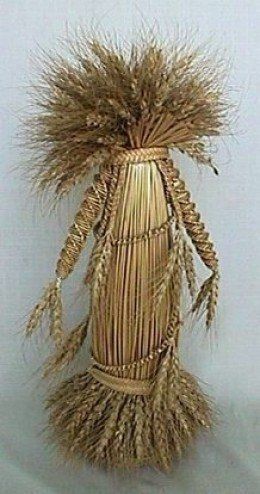
The Ivy Girl of Kent is a traditional straw piece that depicts the primitive image of the Earth Goddess in Britain.
The tradition of making a “Corn Dolly,” or female figure from the last sheaf of the harvest, has very ancient roots. The wheat weaving does not have to be a human figure, it can be a cornucopia (a horn of plenty) to be hung over the door for luck or a plaited weaving that is given to a lover or neighbor as a gift, for luck and to celebrate the end of the harvest.
 Ray Colliers Wildlife in the North — Corn Dollies https://www.wildernesscottages.co.uk/
In some areas the Corn Dolly is shaped like a dog. In Orkney, a straw dog (called the “bikko” [bitch] from the Old Norse “bikkja”) is placed at the door of the last farmer to bring in the harvest and is usually accompanied by a satirical note. The Orkney, “staw” dog (pronounced “stray”) is a life-sized dog made entirely of straw, sometimes with twisted straw ropes wound over a wooden frame.
On the Isle of Skye in the West of Scotland, the last sheaf embodies a Spirit goat called the gobhar bacach (cripple goat) and the woman who carries it home must pretend to limp (in Shetland, the Fairies are said to dance with a limp and their dance is called the “haltadans”).
The goat is passed from house to house and must be gotten rid of as quickly as possible or it will bring bad luck. It is carried in secret by the last farmer to thresh to a neighbor who is still threshing, and if the farmer is caught bringing the goat, there can be trouble because no one wants to receive it. The constant passing of the taunting goat has the effect of speeding up the harvest.
The goat has a deep spiritual meaning in the ancient Indo-European religion. In the Rig Veda of India (a collection of Vedic hymns from 1200–900 BCE), the goat is paired with the sacred horse, a solar animal that is offered as a sacrifice. At the horse sacrifice, a goat companion accompanies the horse to announce the offering to the Gods:
The Sacrifice of the Horse“When, as the ritual law ordains,
The men circle three times,
Leading the horse that is to be the oblation
On the path to the gods,
The goat who is the share for Pusan
Goes first, announcing the sacrifice to the gods.”
(Verse 4)
The goat is a fitting symbol to announce the great sacrifice of the Earth in the harvest season.
Straw Men and Scare CrowsWhile the last sheaf of grain is usually associated with the Land Goddess or with a female animal such as a bitch or a mare, in some areas, it is made into the figure of a straw man, a bull, a cock, a hare, a boar, or a billy-goat.
In northern Orkney, a scarecrow of straw is occasionally made at the end of the reaping. The “straw man” is seen as a magical helper for the farm, his function is to protect the farm from the trials of winter. Such a figure must never be dressed.
“When Broonie got a cloak or hood (Brownie)
He did his master nae mair good.” (no more good) (Traditional)
 Scottish Herbs and Fairy Lore, by Ellen Evert Hopman, Pendraig Publishing (June 21, 2011)
The Last Rites of the Harvest was originally published in Wild Goddess Magick: Witchology Blog on Medium, where people are continuing the conversation by highlighting and responding to this story.