Andy McGee's Blog, page 2
April 18, 2021
The McKinnon Institute
The constant drip, drip, drip was the worst. Even the cold, the dark and the musty cave smell weren’t so bad once you got used to them. Just no more drip, drip, drip …
Chapter 1“We would plough Geoflex into the ground, a couple of feet deep and forty or fifty feet along the line, centered around the shotpoint. The recording truck was out of the way a little, plugged into the lines of jugs via a thick cable and recording the signal as we went. The dozer ops would sometimes have a little fun with the Observer. That’s what they called the nerdy electronics guy in the truck running everything. They used to plough it a little shallower as they approached the spot where the recorder truck would set up. When the Geoflex exploded, the truck would be sprayed with dirt and the Observer would jump out swearing at anyone who happened to be around.”
“Wasn’t that against the HSE policy” Steven asked, looking incredulously at Kevin who was pissing himself laughing.
“OH &S it was called back then, but no one took much notice of all that shite back then; we were too busy getting the work done. It was all one big party back then. A mate sent me some photos recently of a bonfire they had to get rid of all the left-over flex at the end of one of the surveys. What a blast! Here, have a gizz at this.” Kevin was thumbing through photos while he kept on laughing to himself. He just couldn’t help himself. Everything was funny when you thought about it.
“Don’t listen to him, he just makes shit up to scare the kiddies.” I interrupted. I had just walked in to the lunch I had organized and followed by saying my hullos to all those already present. Mark B, a computer nerd and his University student son Steven B, Kevin, a senile ex Bird Dog and now a lost soul, Mark C, another computer nerd but more hardware oriented and John, the lone geologist amongst us. For those not in the know, a bird dog is a field supervisor on a seismic crew, most likely a geophysicist by training. I am also a geophysicist, but of the lazier, office variety.
“Hi Bob and thanks for organizing another lunch. We haven’t had one for a while. Everyone must be too busy for such nonsense.”
I looked at Mark for a second and gave a little snort. “How can we be too busy, everyone has long retired, except Hassie of course and I don’t think he’s going to stop until he dies.”
“And Steven as well. He hasn’t even started yet and the way things are going who knows if he ever will.”
I pulled up a barstool, ordered a pint of West End and put it on the tab. I had a feeling it was going to get huge by the end of the day. Ten for lunch, the best we had managed in a while. It just depended on the collective mood whether we would be done by three pm or three am. Well, perhaps when we were a little younger. Nine pm was about the latest we had managed recently and even then, we all thought we should have left earlier.
“Hey, good to see you all.” Hassie was larger than life in most of the ways you could imagine. Tall, rotund, loud, colourfully dressed and always ready to tell you his latest joke, whether you were ready for it or not. He grabbed a wine menu, looked at it for a few seconds and ordered the most expensive red he could find.
“Big day, let’s celebrate. How many glasses do we need?” I looked down, smiled and shook my head. It was definitely going to be a big day. I would need to consider what I could manage to drink and pace myself without prompting another heart attack. They were no fun.
“What have you done now?” Mark asked.
“Just wait till Wassa and Boogie arrive and we’ll tell you all about our new Venture” was all he would tell us for now. Wassa or Was was really Walter, another bird dog and everyone always joked about the contraction. Boogie was Bogdan, a seismic surveyor with plenty of other skills to his name. Everything was always a secret with Hassie; the next new way to make some big bucks was always on the horizon. His diamond mine out on the Gawler craton had made him a fortune when he sold it; his software venture with Mark B and Anil selling bookmaking code to the Indian cricket entrepreneurs lost a bit of it again but best of all his Bollywood movie venture. It was as much about tax as it was about the idea and it was the tax break that made him money.
“Let’s hope you don’t get threatened with kneecapping again” I added just to be involved in the conversation but making everyone laugh in the process. The Indian venture had not gone well. The talk was always thick and fast and a little hard for the slowest of us to get a word in. Luckily, we regularly broke up into smaller, more intimate groups.
“What do you think Bob? Will there be much of a career in Oil and Gas as a geophysicist if I take it on?” It was a problematic question and I was unsure how to answer it in the boisterous setting we were in.
“Big Question Steve and probably one you need to think through for yourself. I am sure you will get lots of views about that this afternoon. My simple answer is probably yes, but you will need to be smart about it. Whatever we do, we are going to need oil and gas for at least another twenty years and probably quite a bit more. Everything from fertilizer to pharmaceuticals are made from gas and while we need to find new ways to make these, I can’t see gas disappearing quickly, at least not in Australia. Most people would prefer to use Aussie gas rather than import foreign oil.”
“And how can I be smart about it?”
“I think you are going to need to be clever about choosing any career, as they are all undergoing rapid change. You know, with robotics, AI and all the rest; but with exploration I reckon we are going to have less in the way of new discoveries and more in the way of new ideas to extract what we can out of the discoveries we already have. Stuff like 4D seismic and more detailed analysis, probably incorporating some of those robots and AI.”
“4D? Seismic recorded over time. We should learn from what they are doing with fMRI in the medical business. That’s what they do isn’t it? MRI scans repeated over time while they look at brain function?’
“I think so. I reckon that’s going to be your domain young feller. Us old farts can’t keep up with all that fancy stuff”
“How many geophysicists does it take to change a light globe?” And there was Walter or Was as he was better known, making a big entrance. “None” someone yelled back, “They would just hire an electrician. You Fizzle sticks don’t do anything for yourselves.” And it was on, with lots of good-natured banter giving everyone in the room a bit of shit.
“Who’s this noisy bunch, then?” Boogie yelled as he walked in with Anil, another office bound geophysicist. “Looks like we need another round, gents” as he started organizing beers with the bartender. “And that’s a single malt and coke for you was it, Was?”
“Sure thing” he answered a bit sheepishly. Apparently, they had started this silliness on a Variety Bash drive, a kind of car rally involving lots of dirt tracks and lots of drinking and Was kept on the tradition back in real life.
“And your West End, Bob” as he passed my beer over. I was glad I had a chance to talk to Josh the barman a bit earlier and come to an arrangement. After my first, he would pour me a Peroni Zero quietly on the side and hand it over with no one being the wiser. One West End, any number of Zeroes and a few reds should keep me merry, but with a little less in the way of consequences over the next few days. It meant that I would have to put up with a lot of repetitive conversation later in the evening, but what the Hell. I couldn’t remember most of it anyway.
“Hey, a bit of shush y’all. Keep the noise down or you’ll get us chucked out.” Hassie started his planned speech.
“Never, we spend too much and tip too well” John responded to accompanying cheers and whistles.
“If y’all would just shut up a second I’ll tell you all about our new venture. We, that’s Boogie, Wassa and me have got hold of a share in some acreage down in the southeast. We are going to start our own oil company.”
“What are you going to call it?” John yelled out again. “The two percent Wankers?”
“Hey we have a five percent share,” Boogie protested. “That gets us a vote and a seat at the table. Free sandwiches for lunch every three months.” At that everyone laughed and congratulated the trio and then pestered them with questions about cost, exploration risk, social consequences and the general wherewithal about how they were going to set it up.
“How can you afford it?” I asked Was quietly on the side.
“Easy” Was replied. “Hassie had a mate who had an idea. He told a few people about it and we eventually convinced a third party with deep pockets to farm in. We got a five percent share, free carry for the drilling as a finder’s fee. Problem is, they are arguing over the need for more seismic and that is likely to cost us big time as it’s not part of the free carry arrangement. Hassie doesn’t care, as he can cover the cost easily. Bit more of a problem for Boogie and me. We might need to make alternate arrangements.”
“Oh” was all I could come up with as a reply. But I put on a concerned expression to show I cared. In reality I was a bit jealous. It sounded like a lot of fun.
The conversation was loud for the first ten or fifteen minutes as everyone was excited to be together again, but it soon settled to a leisurely pace. We had been doing this for about forty years with a few new faces over that time and a few who had been lost to various overseas locations. It had started as a working arrangement back in the early eighties. I was organizing five or six seismic crews at a time in different parts of Australia, all from different acquisition companies with a variety of capabilities. Bird dogs on rotation were the go between me and the field, which meant a lot of bird dogs.
We only had radio communication in those days, passing messages back and forth at organized schedules, morning and evening. That was good for actual data or daily problems and requirements but there was necessarily a lot left unsaid. So, I did a deal with the bird dogs that I would make sure they got a day’s pay for a debriefing session if they agreed to take an interested group out to lunch. It was all legit as all we ever talked about was work anyway.
And so began the legendary bird dog lunches at a historic hotel, a little out of town. They were a very regular occurrence at first but slowed down with the pace of the business and necessities of life. After a few years, local crews were down to one or two a year operating for six months or less. No matter if we had any field operations or not the odd bird dog lunch continued regardless, just with fewer bird dogs.
They were pretty much all blokes, as that was the industry at the time. Over time more women joined the industry and a few would come along for lunch. Now that we were old it was just the blokes again.
I looked at my watch, realized the time and suggested we all move into the dining room for our actual lunch. More wine was ordered, menus surveyed with relish and toilet breaks taken as we all settled into more meaningful conversation at the dinner table.
“You guys call yourselves the McKinnon Institute. Where did that come from?” Mark had cleverly left me sitting next to his son while he was having a tense discussion with Hassie at the other end of the setup. I was left to tell Steven all about the industry and how he might fit in.
“Well, I guess you realise that your old man is mixed up with a pretty odd bunch. Everyone is a bit of a genius in some ways and a bit of a nutter in other ways. One day, when everyone was a bit drunk some wise guy suggested that we should give our group a name to make it all sound a bit more official. Kevin here is a deep thinker, but we reckon he is losing his wits a bit, but on this day, he just stood up, glass in hand and told us ‘we should call ourselves the McKinnon Institute’. We were all taken in by the occasion, raised our glasses and agreed. ‘To the McKinnon Institute’ we chimed.
A bit later Wassa asked me why and I stupidly replied that it was the name of the street the pub was located on. Even as I said it, I realised that no, it wasn’t. That was the next street over. Was and I pissed ourselves laughing and soon everyone else had joined in. There was to be no changing it.
We had become the McKinnon Institute.
The post The McKinnon Institute appeared first on MCGEE.id.au.


April 10, 2021
Nuclear Batteries
I have written previously about nuclear power stations still relying on steam power to generate electricity. While we have been able to provide the direct conversion of heat to electricity for sometime it has been highly inefficient running at about 1%. The TESS system has similar issues getting their systems to profitability. Things might be changing.
A more effective way for a nuclear source to supply electricity is by employing fissionable particles themselves. Electricity is the movement of electrons to provide a current in a wire or semiconductor for example. Another view is that the positive “holes” move. Another description calls them Beta particles (positrons and / or electrons).
It is possible to use these electrons directly from radioactive decay in a process called Betavoltaics to create electricity, often using Tritium as the isotope source. Space stations and heart pacemakers have used this process in the past, but it has never really caught on due to price and possibly safety aspects. Alpha particles (helium nuclei) and gamma rays can be similarly converted directly to electricity. In fact, the latest perovskite solar panels may have improved performance over silica due to the Gammavoltaic effect.
The latest in this story is a concept called a nano diamond battery (NDB) being developed by a new startup called NDB for obvious reasons. It supposedly uses nuclear waste which it surrounds completely by a nano diamond layer that absorbs all of the energy released and converts it to electricity by “inelastic scattering”, or so the hype goes.
I am not sure about what happens next. It’s a bit like a coal fired power station in that it is always switched on, producing heat and radiation energy which will need to be used instantly or stored again, presumably in a chemical battery. NDB says they will have protypes available later this year. Watch this space, I reckon.
While it sounds like science fiction, we have been using these sorts of things in space craft for a while and their potential is enormous. NASA’s current Perseverance Mars rover is nuclear powered, using a Plutonium isotope with the power system containing a Multi-Mission Radioisotope Thermoelectric Generator, or MMRTG. This stores the electrical energy created in a couple of lithium-ion batteries. There is plenty of excess energy in this process which materialises as heat. On Mars this is not such a bad thing. It keeps the whole buggy warm and prevents it from seizing up in the cold. On Earth it would be more problematic.
Ingenuity is Perseverance’s detachable helicopter that is looking to take its first flight on Mars, probably this coming Wednesday (14 April 2021). It is lithium-ion battery powered, recharged from Perseverance’s MMRTG.
With advances in direct electric generation from radioisotopes, Small Modular Reactors (SMRs) and Nuclear Fusion we are in exciting times for electricity generation. In my view we are not quite there yet with a myriad of health, safety and economic issues yet to solve. What we need is a good, direct heat to electricity generator or serious advances in thermoelectrics. Now that would be a breakthrough.
The post Nuclear Batteries appeared first on MCGEE.id.au.
April 4, 2021
The older the Better
I just enjoyed reading the Alchemy of US by Ainissa Ramirez, a good choice if you are interested in science communication. In my view this is a great mix of science, history and an understanding of culture and how it effects discovery. A great piece of science communication from the heart. It struck me yet again on how ideas and understanding are often far older than they appear to be. I have written about Eratosthenes accurately calculating the circumference of the Earth way before Galileo or Columbus. I am sure that in a similar way, gravity was well understood by archers for many thousands of years.
I like to write about ancient civilisations and how, for example they had a standard brick size in the Indus Valley Culture times, extending across hundreds of cities. These were of the 4x2x1 variety still common today. In recent times they were standardized again as part of the idea of standardizing paper sizes by Ernst Neufert. The printing of books led to the A0 paper sizes and the standardisation of architecture. I always find interesting the number of mathematical concepts that could have been then considered by ancient bricklayers as they played with ideas on how to stack bricks.
In my field I was intrigued by the timing of oil generation as that substance is cooked up in the subsurface. In the Cooper Basin area of South Australia there was (or probably still is) an argument over Permian aged sourcing versus Jurassic. In the end, the pattern of discoveries favoured the older rocks with subsequent migration into the younger formation. Geochemists suggest that the predominance of Jurassic biomarkers is simply because there are more of them. So, what about the possibility of Cambrian or Devonian sourcing instead? For those in the know, the Inland field suggests this possibility.
As we go back in time, it is more difficult to find the relevant data and hence we go for the younger or better defined option. In recent times we have discovered that Australian indigenous culture is much older than previously thought and indeed the whole concept of modern humans is now also postulated to be much older. A stone tool discovered in northern India is thought to be 2.6 million years old and may force a revision of our understanding of early humans.
Science historians find evidence of modern concepts in ancient writings on a regular basis. Paul Halpern in Synchronicity discusses these at length. I like Empedocles concept that Love is the universal attractant, bringing all the substances together and strife being its opposite forcing things apart.
The writing down of a concept, especially with an associated proof is essentially the realm of science, but a concept does not start this way. Concepts are the ideas that spread amongst the initiated until they can be proved or disproved and then written about. Ainissa does a great job of showing that a lot of effort by multiple people goes into bringing a concept up to a useful stage. I loved the opening story about Ruth and Arnold bringing accurate time to the burgeoning industries of the age.
Many ideas for future study can be found by researching the past and many of our older folk are worth listening to about those ideas. My suggestion is to talk to an oldie during April about how they see the world and how we might improve it. It might give you some new ideas.
Or you might just enjoy a novel like the Great Escape from Woodlands Nursing Home by local author Johanna Nell. My reviews of these books and many others are available on Goodreads.
The post The older the Better appeared first on MCGEE.id.au.
March 28, 2021
Australian Energy Needs
It was a bit sad to read that many South Aussies still want to push the Nuclear power option for South Australia when all evidence points to it being be a very expensive and unnecessary proposal. We do not have the necessary knowledge base or infrastructure for such a project and could not possibly have a plant operational for at least twenty years. Similarly, nuclear subs are not a good option for Australian waters and a poor plan for Australia.
So, what instead? The cheapest power generated at the moment is solar at about 2c per kwatt hour (compared to 20 or 30 for nuclear) which is why solar is being pushed by many. If you set up your industry next to a solar power provider with no poles and wires or admin costs, power would be dirt cheap while the sun shines. Mike Cannon-Brookes, one of Australia’s richest young fellers, is pushing a huge solar power installation in Central Australia and exporting its power via a DC (direct current) line to Singapore, so I guess he thinks it is a good idea and a big part of the future for us.
First the DC current bit. Our grid is set up for large scale AC (alternating current) generated by big steam turbines. It is a lossy system, with a large amount of energy wasted in transportation (high voltage power lines). If you are interested you can read up about the fascinating War of the Currents between Thomas Edison and Nicola Tesla in the 1880s and 90s. Tesla won because it was easier to convert AC between high and low voltage in those days. Now it seems that a comprehensive DC system could act as a storage system as well and maybe a better option.
Which means we need to have a good look at how power is distributed over the next hundred years or so. It needs major government planning rather than allowing it to grow ad hoc. Solar creates direct current naturally, while nuclear is still mostly used to turn steam turbines and AC.
The other big elephants in the room are storage and transport (or mobile fuels). The best options for storage are the simple physical ones like pumped hydro where water is pumped uphill when there is excess energy, stored in a dam and allowed to fall back down again creating AC electricity. It may not be the best environmental option though.
Batteries are the next best and they store and supply DC. While lithium ion are our most effective batteries at the moment, I think it a waste to use them for electricity grids. They are brilliant for small scale storage (phones, tools and even cars) where their light weight is handy. Grid storage does not need light weight but could do with longevity. Vanadium flow, sodium ion, zinc bromide batteries and heat storage systems (TESS) are all a better bet for storage where weight to power ratio is not so important. Overall energy loss is the big issue.
We also need long term chemical storage. Gas and oil have always been good at this. If you leave your electric and petrol vehicles sitting in storage for a few months the petrol one will be ready to fire up straight away but you electric one will require a charge. During major catastrophes for example it would be good to have a mobile power backup rather than rely solely on batteries, electricity generation and grid connection.
In Australia we have plenty of natural gas and the industry is relatively well controlled and managed. We have little home-produced oil and little refining capacity, relying on other countries to supply us with a usable product. Most of this is shipped through the Great Australian Bight coming from the Middle East and Singapore. If Australia is serious about our security and safety it would be great to use our gas as our major transport fuel and reduce our reliance on overseas fuels.
Electric cars are a great innovation but require us to get rid of our current vehicles completely and manufacture new ones with different materials (lithium, aluminium, copper). The average age of a car in Australia is about 11 years, about the same as the life of a lithium-ion battery. It will be quite a while before all Aussies have electric vehicles. Whereas we could convert all of our transport to some sort of locally produced liquid / gas fuel almost immediately.
Hydrogen is likely to be the base for this local fuel system and with any luck be produced 100% sustainably in the near future. Our best options at the moment are methane (natural gas), LPG, methanol (from gas), ethanol (from plants), hydrogen and ammonia.
The cheapest hydrogen currently comes from natural gas with no carbon storage at about $1 per kg and the most expensive from solar electrolysis at about $4. I am sure we can get the electrolysis costs down considerably with scale of production, and this is the economic issue at the moment. Why not move quickly and make the process more sustainable as we can. Surely it is better than importing oil based products.
Hydrogen does have some physical issues as well including embrittlement, where metals become brittle after exposure to hydrogen. Also, the tiny hydrogen molecules escape more easily than other gases. If significant quantities reach the ozone layer, we are in for trouble. A better storage system is to convert it to ammonia (NH3) using nitrogen from the air. Burned under ideal conditions it produces nitrogen and water.
My favourite for a long term liquid transport fuel is ammonia.
The post Australian Energy Needs appeared first on MCGEE.id.au.
March 23, 2021
Science vs Marketing – a Dilemma #andyfromscience
Science seeks the truth; marketing doesn’t care. Experiments, mathematics and logic show whether something can be assumed as fact, and are the hallmark of science. If a well-designed experiment is done, repeated numerous times and shows a certain result, then we have an established local truth. It maybe expanded or modified over time but is still taken as true.
Marketing on the other hand, doesn’t care if it is true or not; so long as it can sell an idea, a product or a dream. Celebrities make good marketers as they don’t seem to have any qualms as to whether products should in fact be marketed.
So, can or perhaps should scientists be good marketers. I think not, as it defeats the basic purpose of science. Scientists can advertise, but not market. They should not be trying to sell their work but instead they should loudly advertise it. Once we fall into the trap of marketing, we stop being scientists.
As a professional geophysicist working as a seismic interpreter, I used all the data I could to create an accurate view of the subsurface as I was able, with no regard to how others thought it should look. I then presented my best story on how the geology worked and where hydrocarbons were likely to be found. Luckily, I got it close enough to reality often enough to survive in the job for 40 years.
During that time, I was often asked to beef up my results in order to sell the acreage, but always refused. If someone else wanted to market my work, then that was their job. Mine was to establish the probability and risk associated with each target to the level the data allowed, not to embellish it.
Can there be such a thing as marketing science or is it an oxymoron? The science of marketing is essentially psychology or quite possibility the study of hypnosis. Or at least I think that is likely to be the case.
No one really understands what is going on during hypnosis. It is associated with receptiveness, mindfulness, sensory processing and those sorts of things (however they are defined). Best theory at the moment is that it involves an induction phase and a suggestion phase. You are lulled into a receptive state and then it is suggested that you do something in particular, and hey, it seems to work. It is also thought that you do it to yourself rather than it being done to you.
Religions, politicians, leaders have been proficient at lulling and suggesting for years and marketing science seems to be catching up using data to establish what works best. There we go, learning science from religion. So, should science do the same?
My answer is an emphatic no. Science requires non scientists to process the data for themselves to some degree at least. It is about discovering reality, not about being convinced something is true. Scientists need to question everything, not go along with a suggestion from someone else.
For my part I believe scientists should not use celebrities, soft voices, shiny objects or other ploys to manipulate or hypnotise people to believe. That is not the way of science or scientific progress.
Instead, scientists need to be enthusiastic about their work and describe it honestly. Its logic should stand up for itself (eventually).
So, do I market my science novels or just advertise them?
Sublime Murder and Signs of a River are available as ebooks.
Signs of A River eBook: McGee, Andy: Amazon.com.au: Kindle Store
Sublime Murder eBook: McGee, Andy: Amazon.com.au: Kindle Store
The post Science vs Marketing – a Dilemma #andyfromscience appeared first on MCGEE.id.au.
March 17, 2021
Signs, Signs everywhere some Science
Lots of people have good ideas about how the world works, health tips and well being so why not listen to them? I keep being asked why should you listen to what scientists have to say rather than charismatic figures. Aren’t conspiracy theories just as valid?
The whole idea of science is to not believe but to be skeptical about everything, while slowly developing a view as to how the world works based on the evidence at hand. In the evidence market, science wins hands down; you just need to understand the limits of the evidence. While science can be said to be seeking the truth, pretty much everything else is marketing. There is always an ulterior motive be it sales, control or some other prevailing dominance.
A simple question: do we live on a spheroid (or ball shaped earth) or is it flat? Even today many people believe in a flat earth and come up with all sorts of ideas on how that can be. To them it is as obvious as looking around you and not seeing any evidence of a curved earth. Science tells a different story, none better than a quick review of gravity. Any two atoms are attracted by the force of gravity such that in open space particles will begin to collect together to form a mass. AS gravity works the same in all directions, the shape quickly becomes a ball (or something similar). For large masses, that’s pretty much all it can be without some amazing additional force.
Of course, it is verified in many other ways including observation from space. A guy by the name of Eratosthenes actually calculated the circumference of the Earth, to a fair degree of accuracy back in the third century BC and he probably got the idea from learned folks before him. These ideas of the beginnings of science are discussed in my book ‘Signs of a River’ if you want a more detailed discussion.
OK, that one is an easy call for most of us, but not all. I’d say that most conspiracy theories fall into the same category. They have little evidence-based backing, just a call to believe. So, the first step is to look for the evidence and weigh it up. Politicians, celebrities and mischief makers are unlikely to be the best source of information. Science mags or experts in their field are a much better bet. The mags tend to make the experts opinions a little more palatable as experts often concentrate too hard on being just right. I find New Scientist pretty good.
Özlem Türeci and Uğur Şahin are the Turkish German scientists who created the mRNA vaccine for COVID-19 being distributed by Pfizer. They might be billionaires but are the sort of person that scientists tend to be. They ride pushbikes to work from their fairly ordinary apartment each day to help come up with cancer treatments and vaccines. I imagine that the science is what they care about, not the trappings of wealth and power.
Pfizer on the other hand is probably a different story, with profit the most likely motive for the work they do. They do provide the ability to produce and distribute the vaccine at a rapid rate, a most beneficial service.
Is the vaccine safe? As far as we can tell, yes; or at least as safe as any other medication. I find it hard to believe that Özlem and Uğur would be adding microchips to their vaccine. Again, it is a simple matter to test what is in each vaccine and it would be a hell of a conspiracy for everyone involved to go along with it. Conspiracy theories are so much more complicated than the process itself in pretty much all cases. It is probably easier to go to the moon rather than pretend you did.
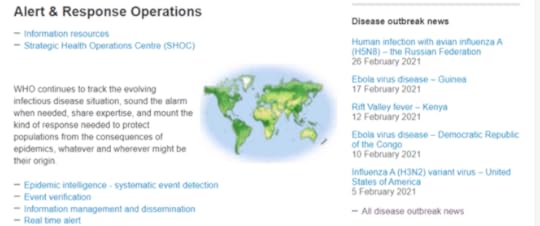
New viruses turn up on a very regular basis without a need to create one in a lab. In the last hundred years or so we have had Sin Nombre hantavirus (SNV), Hendra, Ebola, Nipah, Zika, Swine flu, HIV, MERS, SARs, etc. viruses turn up without any thought of being created in a lab. By pure luck and hard work by the WHO they have been largely contained. The WHO does an incredible job following disease outbreaks around the world and assisting in their eradication. Remember they have no actual power to do much themselves. They are not a world police service.
So, my suggestion is to go with the science. It is a proven commodity that has provided us with our modern lifestyle. Conspiracy theorists, snake oil sellers and homespun remedies have provided very little, other than taking your money.
Well that’s my opinion anyway.
The post Signs, Signs everywhere some Science appeared first on MCGEE.id.au.
March 8, 2021
Two Be or not Two Be
There are two types of people –
… Those who accomplish things and those who claim to accomplish things – (Mark Twain)
… Those who finish what they start.
… Those who believe there are two kinds of people and those who don’t.
Lots of jokes, but humans do like to think in binary – good / evil, dark/light, yes/no – to give a few examples. But is the world really that simple? It is a bugbear of mine that we try to fit things in separate boxes and call it science. Psychology is particularly fond of this.
Thinking binary is great for simple systems. Computing uses simple on off switches to represent 0s and 1s, creating a seemingly endless mathematical world. Those 0s and 1s quickly create complexity like no one could have imagined even a few years ago. Those digital movie downloads are basically 0s and 1s.
A coin toss is binary, if landing on its side is eliminated as a possibility. Summing the results of multiple coin tosses gives us a normal distribution with a mean about the middle. So, if we toss a coin ten times, we guess we will have 5 heads and 5 tails, or perhaps 4 and 6, but we might also have 10 and 0 as a long shot. There are 2x2x2x2x2x2x2x2x2x2 possible combinations. Phew!!
A human body is estimated to have something like 100 million base pairs of nucleotides that make up its DNA. These are the things that make the proteins that define us; adenine (A), thymine (T), guanine (G) and cytosine (C) and are considered our genetic makeup. A pairs with T and C pairs with G. Simple mutations mean one base pair is swapped for another, AT for CG or vice versa. Such a mutation is called a snip (SNP or Single Nucleotide Polymorphism).
SNPs occur regularly and are the basic cause of evolution (along with sexual reproduction and natural selection). So, a SNP is a binary event, one or the other base pair swapped for the other in a particular location. The result of many SNPs in many humans is anything but binary however.
Robert Plomin recently published a book titled Blueprint in which he describes how our DNA makes us who we are with plenty of details about SNPs. It is a good read if you like science. There are some variations or conditions caused by a single SNP and these can possibly be corrected by gene editing, a great outcome of modern science. Most variations are created by hundreds or even thousands of associated SNPs meaning near infinite possibilities.
I use the term variations here to mean personality types, body shapes, autistic behaviours, sexual behaviours and pretty much anything that defines the differences between human beings. Obviously, each of these variations have near unlimited expressions and are not binary. There are no natural boundaries defining short or tall, thin or fat, extrovert or introvert.
There are not 2,4 or 8 personality types. There is no justification for this binary thinking. Carl Jung came up with the basic idea as a way of considering personalities, but cautioned against the use of binaries by suggesting such thinking was nonsense (nobody could possibly be 100% extrovert for example). Myers Briggs ignored his advice and have created a marketing phenomenon that is largely nonsense in my opinion .
Thinking, Fast and Slow by Daniel Kahneman is another binary publication, suggesting that there are two types of thinking, fast and slow or intuitive and logical. Why stop at two? Surely thinking is an infinite range of simple to complex reactions to stimuli either real or imagined. There are certainly many ways of thinking or reacting.
Autism is not created by 4 behaviour types as suggested by Simon Baron Cohen in the Pattern Seekers. Some autistic people may be geniuses (Marcus Chown’s the Magicians) and good at seeing patterns, but that does not automatically tie with a lack of empathy as suggested. These things are simply not binary. Plomin estimates that hundreds of SNPs are involved which gives a high level of complexity rather than binary. Greta Thunberg does not lack empathy and Donald Trump probably has little. One is autistic.
The mental side and physical expressions of sex and gender are not binary. Some might like to think so, but it is simply and obviously not the case. Forcing it to be so by law is madness. The recent Mardi Gras shows how wrong that thinking is.
A coin toss is binary, but we mostly deal with complex systems in life and these are rarely binary. It does not help anyone to force binaries on these systems and it is certainly not science. Science is all about experimental proof and psychology papers have fallen considerably short of the mark. Many published experimental papers have been shown to be unrepeatable. It is about time for psychology to up its game.
Most SNPs do nothing for humans or viruses and are lost to time. The occasional one has a profound effect and survives through natural selection. As new SNPs collect together, new lineages form and if they develop further they become new strains (viruses) or adaptions (humans).
My rant for the week. Read Plomin and Chown. Avoid the others.
The post Two Be or not Two Be appeared first on MCGEE.id.au.
March 4, 2021
Magnetic Reversal – Science or Science Fiction
The earth’s magnetic field is created by an internal dynamo of swirling magnetic material in its outer core. Heat convection through this liquid mass of mostly iron is thought to create an electric current and an associated magnetic field which extends into space surrounding us. This then interferes with the magnetic solar wind, protecting us from all manner of evil.
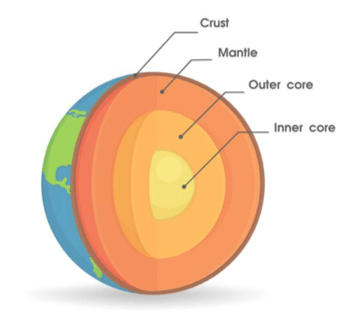
The liquid outer core is about 15% of the earth’s volume. In comparison our oceans are about 0.1% of the earth’s volume and the solid inner core is about 0.7%. A combination of gravity and nuclear decay in the core create the heat.
The whole of the earth’s mass is made up of about 32% iron, the most stable element according to its binding energy ( the end result of nuclear fission or fusion reactions) . Luckily the earth’s crust has a different composition to the core, like a floating scum of essential minerals spewed out from the centre, otherwise life would have little chance of being created or surviving.
The earth’s rotation controls the rotating liquid iron, creating an incredibly stable magnetic field. That said it does flip on an irregular basis, the last measured time being 780 000 years ago (from the rock record). Or so it was thought until recently when it has been suggested a possible reversal, or at least a loss of field (Laschamps Excursion) also occurred about 42 000 years ago, albeit a very temporary event of a few hundred years.
So how do we know that this happens? Mostly from the setting of magmatic flows about the mid-Atlantic Ridge. The Americas and Europe / Africa are on separate tectonic plates that have been moving apart for about 150 million years. Where they split new magma is continually flowing to the undersea surface and setting solid in place (think Iceland as a surface example). When cooled to solid this magma has a magnetic signature that locks in place a NS line, telling us when the magnetic field was one way or the other. A magnetometer can then tell the polarisation for any particular flow.
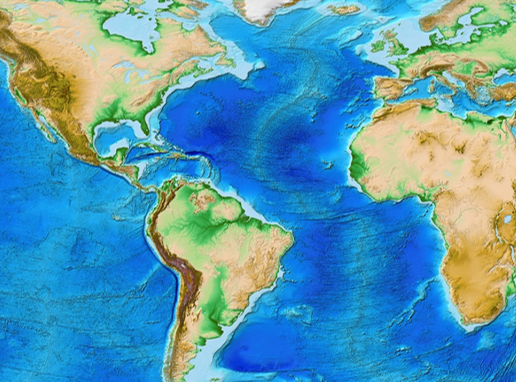 From NOAA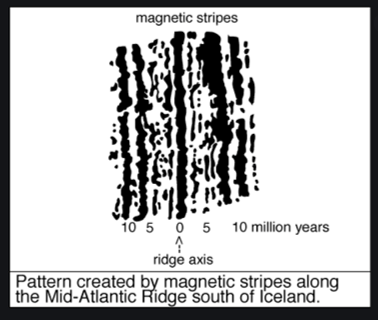
And what causes a flip? That is the big question and fundamental to understanding the timing of such flips. A better question might be ‘why don’t we have flips more often?’ It is thought that if the core is completely liquid, we would have regular flips every few thousand years, but the faster rotation speed of the solid inner core (also mostly iron) prevents this from happening. Magnetohydrodynamic computer models have shown that flips occur naturally based on our knowledge of the earth so far.
Is a reversal due? It is probably overdue and signs that the magnetic field appears to be currently weakening increase geophysicist’s fears. It has also increased its annual drift over recent decades.
Why is this a worry? The major concern is the time it takes to flip (another unknown) and whether the field diminishes substantially during this time. Earth’s magnetic field protects us from harmful particles ejected continuously by the sun as well as cosmic rays (high energy particles coming from wherever). If we had no magnetic field, we would be severely bombarded by cancer causing rays that would slowly strip off the atmosphere. Sounds pretty nasty.
If it happens, let’s hope it is quick. If not, we are in for a tough time. CMEs (Coronal Mass Ejections) occur regularly in the sun and if pointed directly at earth can cause what is called a Carrington event. The last big one was in 1859 with a few smaller ones since. Carrington events can fry the world’s electrical circuits by inducing currents in closed conducting loops (eg electric wires). In 1859 there were few of these, while today we have millions. If a Carrington event occurred during a reversal caused, magnetic minimum, the modern world would be in serious trouble. It has been suggested that a large enough CME may actually cause a flip!
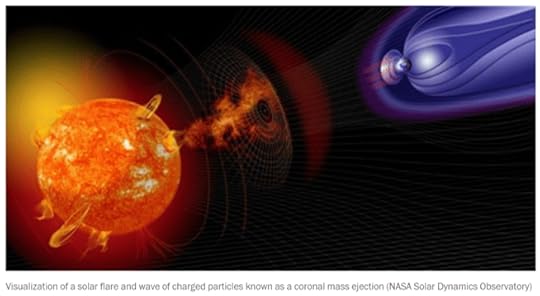
Reversals have obviously occurred throughout the history of life on the planet, with unknown effect on the resident fauna and flora. Some animals depend on the magnetic field for navigation but have obviously survived previous reversals.
Recent studies of tree rings in ancient Kauri trees in New Zealand have suggested a major climate event with ecosystem collapses at the Laschamps Excursion. It is suggested that the magnetic field faded for a few hundred years creating severe weather events and a collapse of the ozone layer and may have been responsible for megafauna extinctions.
So science tells us that an event is likely (in the next few thousand years), possibly soon (due to mobility of current poles) and is likely to be catastrophic for modern humans. With any luck it is slow enough for us to recognise the event in advance and take some precautions. We have a precarious existence over geologic time.
The post Magnetic Reversal – Science or Science Fiction appeared first on MCGEE.id.au.
December 2, 2020
June 7, 2019
Quantum Apple – Chapter 1
Third Novel in Ferg Series – unpublished
My name isSimon Truscott, though most people just call me Ferg. No, not that one, he was my great grandfather,the forensic geophysicist, or that’s what he liked to call himself. He loved to tell stories on any manner oftopic, but mostly they were related to his life in some way, like where he hadtravelled to, the fabulous people he had met, unexplained coincidences or mostlikely some weird science he had just thought up. That Ferg was like a fatherto me as I was growing up.
My greatgrandmother Safrina Kanjin died a few days back, after a very long and happylife. She was one hundred and twentynine years old in body. Her telomeres had frayed and allowed her DNA to startunravelling, just like a missing aglet does on a shoelace, but her mind wasthat of a twenty year old, still full of fun and a desire to learn. I have just attended her funeral, and am aboutto head over to her wake, but need a minute to assess where my life is goingand fathom what is happening to me after an eventful few months. Well probably a bit more than a minute, butyou have to start somewhere.
I sort offollowed in Ferg’s footsteps, studying heliophysics, or in other words, the associationof the sun and the earth and all of the material in between. After the great Carrington event of 2091 ithad become a popular field of study and now, as I approached the ripe old ageof twenty four, I had managed to achieve the reassuring milestone of completingmy PhD. It was received with massivefanfare world-wide as some of my peers had suggested that I had conquered thediscipline of quantum gravity and that nothing would be the same again. And they were certainly right about that.
AlbertEinstein theorised, in his General Theory of Relativity, that the force called gravitywas simply emergent from the shape of spacetime, and by doing so, created a newera for the field of macro physics. Afellow German, Max Planck also established the basics of the micro world atabout the same time, over two hundred years ago. This was the world of very small, quantisedunits of pretty much everything. Allthings had a smallest unit; matter, light, space, energy were all seen to bediscrete and digital rather than continuous and analogue, but these smallestunits did not contain any hint of how gravity emerged.
For twohundred years both theories, General Relativity and Quantum Mechanics had aremarkable success, explaining all manner of phenomena, and giving us most ofthe technological goodies that we have today. They just had one problem, they did not agree with each other. The micro and macro worlds just could not bebrought together into one believable theory. That was until my thesis, apparently.
I calledmy thesis document simply “It’s About Time”, because that was the real problem,an understanding of time and what it really is. Could time be seen as an emergent property of Space Gravity? Without space and matter, there is no gravityand hence no Time. And where better tostudy relativity and quantum weirdness than in the vacuum of local Space.
But, enoughof these unfathomable details. For themoment I am simply trying to unravel the preposterous events that have occurredaround me since that day of the publication of my thesis.
Saffy wasinvolved, that much is for certain. Fergwould have been too, had he been able. Ican just see the input he would have had along the way, but he is gone forever,whatever that means in this new understanding of time. He now belonged in the time cone of mypast. I could imagine myself at the apexof a 3D cone, where I am the sole survivor, all of my ancestors relegated tothe annals of time. Two parents, Murdo and June, four grandparents includingTilley and Dave, eight great grand-parents, doubling up each generation in anexponential progression to make a very wide and ever inclusive circle ofhumanity at its base. A cone defining myfuture may extend in a similar way in the opposite time direction, depending onwhat my future held for me, creating a kind of Minkowski diagram of family-possible,end to end cones in my head.
My familyhistory included many people from my past, tapering down to a pinpoint of me inmy present and extended out again into the future. People outside my family cone may never impactme or my family, but remain forever on the outside of my history. My girlfriend Maitri would potentially enterthis cone or may just brush past like a ray of light, a beam of individualquanta. It was as yet undetermined, orperhaps more importantly, unobserved.
It was mythesis that everything worked in this same fashion. Time was different for everybody and allthings had their own Minkowski cones of broad past, narrow present and an unknownfuture. This was just an extension ofthe old quantum loop gravity theory or possibly the even more ancient I Ching. Theselight cone thoughts had chewed up my own teenage brain until everything I nowthought about took on the same structure.
“Are youcoming over?” Maitri’s approach burst me back into the real world of funeralsand wakes, relationships and all that future planning based on past decisions.
“Hey,thanks for holding the fort. I justneeded a minute to myself, and I am sure everyone can do without me for a shortwhile.”
“I am surethey can too, but no one can relax if they can’t see that you are handling itall OK. It might be time out for you,but it is time spent worrying for everyone else. You will have plenty of time alone soonenough.”
I lookeddirectly into her eyes and saw the obvious compassion, concern and a hint offear and so I did as asked. While thefuneral had been orderly, the wake was the opposite. People were getting stuck into the alcoholand telling loud stories about Saffy and her amazing life and I could not helpbut join in.
“I justwish that I had been able to meet her when she was young. Her life was unreal. What an adventurous time she had, growing upin India and travelling the world, saving the coral reefs. I did so much appreciate her presence on ourrecent adventure. Without her, I don’tthink I would have made it back.” Benwas massive, standing at over two hundred centimetres and built like theproverbial brick shithouse. He was agood man to have on your side at any time, and as Maitri’s brother, that wasinevitable. His dark, curly hair, darkskin, broad nose and ever present smile were part of his obvious aboriginalheritage. From my point of view he had regularlysaved the day, rather than Saffy.
“I thinkthat you got to know her better than most in those few meetings and I am sureshe learned to love you dearly. You had so much in common, with your love ofadventure and I am sure you will agree time is always such a malleableconcept.”
“Nottonight” Maitri intervened. “We do nottalk about time tonight, just Saffy, family and good times. I just loved her stories about when she firstmet your namesake in that bar in New Delhi.”
“Not abar, a restaurant called the Dum Pukht and it still makes me laugh. Old Ferg was quite a character.” The old song would always burst into my headat the mention of the Dum Pukht. But Iwould walk 500 miles…
“That hewas” added Beatrice, my somewhat laconic cousin and family counterpoint. “We had a great time exploring the Himalayasaround the remnants of the old Badrinath Glacier, researching the changes toplant species for my research paper. Hehad me entertained the whole time with those endless stories of the ancientIndians, the Harrapans. It was thatknowledge that saved me.”
Beatrice,or Trixie as she was generally addressed was a concern. As the only other known descendant of Saffyand Ferg, she stood to inherit a small fortune once Saffy’s will was read. Having not ever submitted her Doctoratetreatise, her career was always on life support, never progressing in anyparticular direction and always requiring family intervention. She was a good thirty years older than me,but had not yet reached maturity, financially or otherwise.
“They bothappreciated your generosity of time in their later years, probably as you werethe only one always ready to listen. Inever had the time, always too busy and I missed out on so much. I for one am grateful for your knowledge ofthe Himalayas.”
“You arealways too focussed on your research and have little time for anyone else’sfoibles, young Ferg” Maitri admonished. “You need a real world hobby or two.”
And Trixieis just the opposite I thought and fought hard to keep the thoughtprivate. Everyone knew of my personalityquirks and mostly let them go without question. I am what they used to call an Aspie, or an SP in my ownnomenclature. I thought of Asperger’s asan experiment of evolution, perhaps creating people better equipped for themodern world. My thought processes tendto highlight logical progression and ignore things I see as irrelevant. I have enormous empathy but the emotions thatcome with that are just too hard to deal with, so I do my best to put allemotion aside, except of course for fun times and laughter with close friends. Those emotions I let roam free.
“Come on,snap out of it. Let’s find a whisky andhave a drink for Saffy and Ferg and forget everything else for tonight.” I looked at Maitri and realised my mind waswondering again and her suggestion was enticing.
“Yes letus do just that”
Next thingI know is that today has become tomorrow, or is that the other way around. How is that even possible I ponder, as I domost mornings on waking. There is a quantum pinpoint of now between yesterdayand today, generally marked by a measure of sleep. Today my head hurts and my mouth is horriblydry but I manage a smile as I think about the previous night.
“Ready fora coffee?” asks Mai in her usual cheerful way, and I smile a little deeperinside. Why would anyone ever bedepressed about life when every tiny facet can so easily be appreciated andenjoyed.
“Thanks.” My attention immediately wonders back to lastnight and I briefly think that I should not have been so forceful in myarguments with Florence. She means well,but her obsession with achieving immortality or longevity in her life is a bitextreme. I can never help myself andalways feel the need to knock her back a peg or two. But I know that I shouldbe more appreciative of her knowledge of materials and remember to thank hernext time we meet. We would not be herestill without her sharing that knowledge. I figure that our characters just clash. She is an Entee or NT after all, a NeuroTypical who craves order and themindless honouring of tradition.
Ramblingthoughts move in every direction but I quickly return my mind to the issues athand. First and foremost is thepossibility that someone is trying to kill me. I can’t get my head around the concept still but the police feel thatthere is enough evidence to believe it is true. When the ai-car dropped me off at the port a few days back, it continuedon its journey only to drive over a cliff and into the sea. There was now incontrovertible evidence thatthe vehicle had been tampered with and, had I not disembarked early so that Icould walk the last stretch, I would have still been inside as it plunged intooblivion.
There wasalso that near miss with a rampant arrow and the poisoning incident on the dayof my dissertation, but I still could not believe that they were potentially alldeliberately targeting me. Was my assertionabout quantum gravity that controversial? Who has the most to gain? Is the biggestthreat of a commercial, theoretical or military nature? The security now surrounding my every move, suggestedit was possibly all three.
Then therewere the myriad events of the last month, after I began addressing my discoveryof TIME. I had no idea on how tointerpret those and where they would lead next.
But themost pressing matter today was the reading of the will, and that was happeninglater this morning. It would all beorganised and controlled by the AI from the Downer’s law firm and security wouldbe so high that there was little to no likelihood of any interference, butnevertheless it would be a complicated process. KTE had become a massive holding company, controlled by Saffy andbreaking it up would not be a straight forward matter. Saffy would have left a large share to me asthe major beneficiary, of that there was no question, but it was also certainthat there would be a number of other beneficiaries, creating the certainty thatthere would be fighting over the spoils. Mai and Trixie would also be most certainly directly involved, as thepolice had most pointedly informed me.
My home isa penthouse suite in the town of Davenport, on the southern coast of YorkePeninsula in South Australia. It hadbecome home to automated manufacture in Australia since the massive FusionPower Generation and Desalination Plant was built in the sixties. Rapid seawater movement through InvestigatorStrait made it an ideal location for a game changing desalination and pumpingscheme which utilised that unlimited baseload power generation. The lack of topographyallowed this fresh water to be pumped right across the peninsula with ease. Sea level rise had turned the area into anisland once more, just as it had been in geologic history. The old Peesey Swamp was now a waterwayfilled by luxury yachts with their brightly coloured electrically controlledsails. It only required a metre sealevel rise and a little geoengineering.
It should justbe a short walk to Downer’s or even a pneum ride on any normal day but securityneeds put an end to that. Today it wouldbe via a drone, beginning with a landing on our roof port, and would include asmall security force and an optional manual pilot. This was not the way I like my days to go. I much prefer the peace and quiet and beautyoffered by the natural world.
The squealof the high velocity rotors announced the landing and I was escortedaboard. A second drone would take Maitrias we had been advised to travel separately. Two other drones hovered nearby and I assumed they were heavily armed.
We weresoon seated in Downer’s office, provided drinks and snacks by an office clerkand then introduced to Rob, the lawyerbot. Rob was a hologram of indeterminatesex, age or humanity who spoke in a comforting voice.
“We aregathered here today for the reading of the last and final Will of SafrinaKanjin, who passed away on the 14th of July 2113.” Rob paused for effect and looked at eachperson in turn. Beside myself and Mai inthe main office, holos of Beatrice, Florence, Ben and numerous lawyers and potentialbeneficiaries were also looking on. Eachacknowledged Rob in return.
My mind had already drifted. How on earth had a robotic AI come up with the concept of passed away? What did it think it meant by that phrase? Surely deceased was a better, a more descriptive word. Why would an AI assume that Saffy had passed away somewhere, perhaps now non-living on a desert island? Of course, it was just a marketing tool, for the benefit of us living humans, an attempt at softening the experience. I wondered if it had been learned from observation and experience, genetic algorithms, neural networks or had the concept been implanted by its human controllers? Marketing was an insidious process, the direct opposite to the demands of Science, the reading of the Signs.
Mai nudgedme back to attention, freeing me from my runaway thoughts.
“… readthe Will in its entirety and then address any specific questions as to howthese instructions will be carried out.”
Asexpected, I was to inherit control of the Truscott Kanjin group of Companies orTKE as it was mostly known and a fortune in property and possessions. I was always aware that this day would comebut I had refused to consider all of the implications. There was little point pondering thehypotheticals and so it came as a shock when I began to take in what it allmeant. My simple life would disappearand I would be expected to be involved in endless management duties for thegood of thousands of direct employees. Inmy head though, I had moved on. I was ascientist, first and foremost and had recently come to think of myself as aTime Lord to boot.
This was all too much.
The post Quantum Apple – Chapter 1 appeared first on MCGEE.id.au.