Jill MacLean's Blog, page 2
September 15, 2018
Here’s a Novel That Stirred Me Up. What More Can We Ask of Any Book?
A friend gave me a copy of Iain Pears’s The Dream of Scipio several months ago because it’s set in Provence, which I’m visiting this year, and it’s partly about the plague of the mid-1300s, a century that has me hooked. I took over a week to read it.
In it, the stories of three men are told to devastating final effect. Manlius is a learned nobleman in the 5th century, striving to preserve the remnants of Roman civilisation from the barbarians. He is under the tutelage of Sophia, a philosopher of great wisdom, and sums up her thought – or so he believes – in a manuscript he calls The Dream of Scipio. Olivier is a 14th century poet in Avignon whose wily, ambitious patron, Cardinal Ceccani, wants to remove the papacy from France back to Rome; he is also a collector of manuscripts, one of which is Manlius’s, and which Olivier reads. Julien is an intellectual who joins the Vichy government in its early days in France and only slowly realizes that the decisions he’s making cause deportation and death. He too has obtained and read a copy of the Roman’s manifesto.
There are the friends of each of these men, Felix, Pisano, Marcel and Bernard. And there are the women they love: Sophia herself, unable to teach Manlius what he needs to know; Rebecca, the illiterate servant-girl sheltered by an intellectual Jewish rabbi who comes to the attention of the cardinal; and Julia, the wayward Jewish painter who, under Nazi rule, must find her own way to the truth of her art.
The novel is an erudite and morally complex interweaving of the three men’s lives, and more than one reviewer worried that even a précis (such as the above) would scare off potential readers. Neoplatonism. Virtue. The nature of civilisation. The distortions of history and religious dogma, the bonds and betrayals of love and of friendship, the attainment of immortality – and, throughout, the dangers of being a Jew in three eras of rampant anti-Semitism. These are not small matters and yes, the book is a dense read that makes demands of its reader.
In case I’m giving the impression this is too abstract a novel, too caught up in its own ideas to be compelling, Pears is highly skilled at grounding each of the three stories in concrete and believable mundane details. I see the crumbling walls around Manlius’s estate, smell the devil’s breath in the plague victims, hear the peaceful buzzing of bees around the chapel dedicated to St. Sophia.
The beginning of the book – apart from the first page – was slow, requiring a certain amount of patience, and I found myself wondering whether a story so layered and complicated almost necessitates a slow beginning – to give you, so to speak, your bearings, before you plunge deeper.
Initially, the changes of point of view from section to section (none of them lengthy) distanced me from the narrative. Furthermore, I feel Pears fails to represent Olivier’s poetry convincingly – the examples he gives are minimal and uninspiring – and there were times when I wondered if the allocations of reason and emotion to the three men wasn’t a little too tidy.
But these are quibbles. Page by page, I was drawn into the characters’ motivations and limitations, caught up in the power of a good story well-told. I won’t tell you which character drew me to him more so than the other two – although, should you read it, I’d be interested to know if you agree. Simply put, I loved the book. Masterfully constructed, filled with foreboding and suspense, it gathers itself towards an ending that reveals Manlius’s inhumanity, Olivier’s terrible silencing and Julien’s fiery end, each with its own logic, its seeming inevitability, its accretions of choice and responsibility.
How do we lead good lives? How can we, when it’s impossible to foresee the consequences of our words and actions, of deeds we carry out in the light of our limited factual and moral comprehension? This novel is an intricate and intelligent answer to questions vital to the survival of our planet’s civilisations, which are so thin-skinned, so easily ripped open to loose the barbarian within.
The post Here’s a Novel That Stirred Me Up. What More Can We Ask of Any Book? appeared first on Jill Maclean.


June 30, 2018
A Spin-off From Shakespeare: Can Art Be Transformative?
At Central Library in Halifax the week of Shakespeare’s birthday (after I’d written the previous Book Talk post on Hamlet), there was a display near the front door of books related to the bard. I picked up Shakespeare Behind Bars: The Power of Drama in a Women’s Prison, by Jean Trounstine. Four hundred years have passed since Shakespeare wrote Hamlet. How did he affect the lives of women in a high-security US prison?
From 1986 to 1996 Trounstine taught college-level English literature and drama in Framingham Women’s Prison in Massachusetts, to inmates who volunteered for the program. She structures her book around six women whose identity she has protected and who may, at times, be composites of more than one woman. Nevertheless, it seems important that I name them: Dolly, Bertie, Kit, Rose, Rhonda and Mamie. The literary focus is on The Merchant of Venice (the book’s epigraph is the “quality of mercy” speech), for this is the play they stage to 150 inmates and a few guests, under heavy security – the first of eight plays.
I didn’t really get into the book for the first hundred pages or so, yet I persevered – not always my practice when a book doesn’t grab me fairly quickly. The six separate sections for the six women caused some repetition and skipping around in time, characters would be introduced then drop out, and initially I found the author herself elusive. I came to realize that the loose ends and my increasing confidence in the narrative quite possibly reflected Trounstine’s own experience. Her students often didn’t turn up for class – they could be in Iso or Max, transferred to pre-release or Shattuck Hospital, or could have dropped out – and she herself is finding her way in an oppressive and punitive environment whose rules, spoken and unspoken, she has to learn.
Learn she does. A fascinating aspect of this book was the gradual revelation of the author’s character and motivations. We are told from the start that she was a rebel in her youth with a fighter instinct who had earlier taught drug addicts and troubled adolescents. But by reading between the lines we begin to see her perseverance, her courage, her ability to motivate the women with free-writing and improvisations, her understanding of the self-knowledge such exercises can bring and her deep belief in the power of art to change lives. In the classroom she offers the freedom for each woman to discover something of her own individuality, the very individuality prison strives to crush.
After much hard work and many frustrations, the performance of The Merchant of Venice is a huge success. The audience “gets it” and is generous in its applause. The actors are lifted out of themselves – as one of them says, “We were stars.” A first, for many of them. An experience that will enrich them and give them confidence when they are released.
Trounstine’s time at the prison is marred by constant surveillance. She’s pat-searched on entrance. She’s reprimanded for stepping between two prisoners who were fighting, for encouraging another woman to write her observations of her neighbours in “the cottage.” Any such reprimand could exile her permanently from the prison. The unspoken rules are stark. No demonstrations to the outside world that the prison is “soft” on the inmates. No involvement of a personal nature with the inmates. Don’t get conned. Don’t hug an inmate. She is often afraid, often uncertain of her course, often overwhelmed by the stories she hears.
High-adrenaline work. She does it for ten years.
In 1994 the federal crime bill is amended and most community college and university classes are cancelled throughout the United States, despite clear proof that education reduces recidivism. The balance swings from attempts at rehabilitation solely to punishment (and lest we Canadians should feel smug, remember Harper’s “tough-on-crime” Bill C10, introduced after 33 years of dropping crime rates).
Trounstine teaches for one more year, funded now by Boston University. In the book’s epilogue she presents her 8-point political “to-do list,” an eminently sensible list, or so it seems to me. And by the time we reach the epilogue she has shown us the power of art –Shakespeare’s art, as well as that of many other writers – to change the lives of women who all too often have been born into circumstances of race, class and dire poverty that have granted them no opportunity to shine.
The post A Spin-off From Shakespeare: Can Art Be Transformative? appeared first on Jill Maclean.
June 17, 2018
“To be or not to be?” OR, “Is there method in my madness?”
This spring the 2015 HD version of Hamlet starring Benedict Cumberbatch came to Park Lane Cineplex in Halifax. I read the play first, carefully (no, I’d never read it, and yes, I’m admitting this on a public forum). Then off I went to the movie theatre.
But before I went, obeying one of those intuitions that can lead you places you need to go for reasons that are obscure, I detoured to Central Library and took out two DVDs of Hamlet – the reissue of Olivier’s 1948 film and David Tennant’s 2010 version.
After the movie, having scribbled a few notes of my impressions, I went home. And over the next ten days or so, I watched Olivier, Tennant and Kenneth Branagh take on the Danish prince. I re-read parts of the text. I read reviews of all four productions. Was there indeed any method in this temporary, exhilarating madness?
First thought: I was astonished by how many of the lines in Hamlet have become part of our day-to-day speech, even to the point of cliché – alas, poor Shakespeare.
Second thought: is this enterprise intended to sharpen my critical (in the best sense of the word) faculties?
Third thought: there are no stage directions in the play other than Enter, Exit and Exeunt – no he throws her to the floor or he raises his dagger. Each Hamlet is free to elucidate a character whose intelligence, rage, wit and indecisiveness furnish plenty of scope: the power of dialogue, and only dialogue, to feed depth and breadth of interpretation in actor and viewer – a bracing exercise for any writer to contemplate.
Kenneth Branagh’s 1996 film is the only one to present the whole text. Four hours, a version that Branagh himself has called the “eternity” version. After watching this film, the cuts in the other versions become problematic, particularly in Olivier’s – he gets rid of 90 minutes, shuffles the text around and reduces Hamlet to “a man who could not make up his mind.” One reviewer lamented how Tennant is deprived, near the end of the play and his own premature end, of the line, “Since no man, of aught he leaves, knows aught, what is’t to leave betimes?” Death in youth or death later in life, Shakespeare seems to be saying, what difference?
Given our modern understanding of a universe that counts distance in light years and time in billions of years, the question is particularly poignant. I find that brief speech of Hamlet’s to Horatio about death…“if it be now, ’tis not to come…” one of the most moving in the play, perhaps because he has, at last, understood the full cost of the task laid upon him.
Mysteries abound, though. Did Hamlet ever love Ophelia? (I believe so.) Did Gertrude knowingly drink the poison to save her son? (I think not, but can one be sure?) Was Hamlet projecting his rage against his mother onto Ophelia when he so brutally tells her to get herself to a nunnery? (Oh yes.) How could Gertrude supply so many details about Ophelia’s drowning – was she a witness or was she using her imagination? (I don’t know.)
And why did Hamlet fail to act? He loved his mother (no question of that) yet had sworn to the ghost of his father that he would slay her second husband. Kill a king to avenge the killing of a king – can he square that with his conscience? Was the Ghost deceiving him or was he an honest Ghost? Or was Hamlet resisting the “cursèd spite” that he was born – fated – to set the moral rottenness of Denmark to rights, as he so cogently tells us near the end of the first act in a line I feel is crucial to the whole play.
Then there are the varying impacts of grief throughout: Hamlet ponders self-slaughter, cowardice and truth, Ophelia goes mad, Gertrude, too late, realizes she married a murderer and lies in an “incestuous bed,” Laertes abandons principle in favour of vengeance – and the gravedigger tosses bones and skulls and makes mockery of us all.
A short postscript. For a little light relief, watch Rosencrantz and Guildenstern are Dead, based on Tom Stoppard’s wonderfully witty play.
Which Shakespeare production in London’s Globe Theatre would be your first choice? Hamlet is playing this summer….
The post “To be or not to be?” OR, “Is there method in my madness?” appeared first on Jill Maclean.
May 31, 2018
Research = Digging
How do you counterbalance too much time spent at the computer?
I vowed I’d never write a blog at the very last minute, and here I am – with three blogs stashed in
Microsoft Word – writing one I want to post tomorrow.
I’ve started researching a sequel for the as-yet unpublished medieval novel. However, I never
talk about a prospective story when it’s in its tender early stages (actually I talk very little about a
novel until it’s out there on the bookshelf). The study floor is covered with scribbled notes and
piles of library books studded with neon-green stickies. Encouraging signs. But am I the hen
who’s gone broody over a sterile egg? Or will characters crack through the shell, shake
themselves off and eventually take flight? Who knows. In the meantime, I’m becoming, dare I
say, rather more adept at navigating the various online channels to that elusive article from 1968
that’s about something absolutely vital that happened six hundred years ago.
It’s late May. For me, the perfect counterbalance to all this head work is gardening. I’ve been an
avid gardener since I was very young and my elder sister and I would grub in the dirt (English
dirt) under the walnut trees at 71 Pinkneys Drive – my sister, who died young of cancer.
Gardening is about loss – I discovered a discouraging amount of winter-kill this spring. Too little
snow-cover, temperatures that soared in February then dipped in March, torrential rains all
winter. My sister grew the most gloriously scented sweet peas in a tidy row by the vegetable
garden and planted an old-fashioned, fragrant honeysuckle by her back door – gardening is about
scent and hence, inevitably, about memory.
Gardening seems to have an inbuilt balance between order and chaos. In the two gardens I tend
on the grounds of my apartment building, I provide space for each perennial along with compost,
water, and the required sun or shade, and thereby endeavour to impose a degree of order and
design. But the lilies of the valley are spreading, the sylvestris anemones have self-seeded under
the hemlock, Canterbury bells are pushing aside Wargrave cranesbill, and bee balm has shot up
expectedly against the fence. Perhaps that’s why I’m not a fan of Hostas – too stolid, too
irredeemably smug. Too little sense of adventure.
Gardens are also about colour, and although my aim for artistry is often thwarted, last year the
purple spikes of Siberian iris were surrounded by pale yellow English buttercups, and this spring
has produced a beguiling combination of deep-blue creeping Veronica, white candytuft and the
ever-dependable pinks and mauves of rock phlox. I decided to ignore that I planted two orange
butterfly weeds beside a patch of magenta cranesbill. But as my hands dig and my arms lug
mulch, my mind is free to contemplate, to go backwards in time to the fourteenth century and
other gardens, where Edmund is spading in his scanty store of dung and Agnes is weeding her
hyssop, lavender and St. John’s wort, in the sunshine of late May….
The post Research = Digging appeared first on Jill Maclean.
May 15, 2018
Book Reviews: Do you read them before you read the book or afterwards?
Do you read book reviews before you read the book or afterwards?
I opt for “afterwards.” I want to read the novel, think about it, then check out the reviews to see if I agree with them or if I’ve missed something crucial.
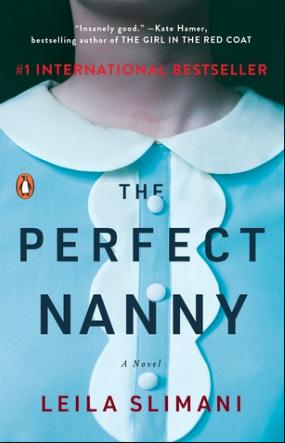
I read Leila Slimani’s The Perfect Nanny (2016) this past week. A close reading, because the terrible events of the first page lead the reader, inevitably, to ask “Why did this happen?” and I didn’t want to miss any clues to the nanny’s motives for killing the two children in her care (her name is Louise).
The novel won the Prix Goncourt. Only after reading it did I discover it’s based on the actual murders of the Krim children by their nanny in 2012 in Manhattan. I was made very uneasy by the close correspondence of detail between the real killings and the first page of Slimani’s book, and can’t help wondering how the Krim family feels about this, particularly since the novel came out in the States just before the trial of their nanny began (yesterday I found out that she has been convicted of the murders and faces life in prison).
The Washington Post praises how the language and complexity of The Perfect Nanny raise it above its “formulaic premise,” yet says the novel can’t leave you with much more than the obvious conclusion that there is no perfect nanny, and a “psycho” nanny is always a possibility. The New York Times lays the blame for the crime on a depth of loneliness that drove Louise to madness and murder.
Yes, Louise was hospitalized for “delirious melancholia,” a fact the parents, Myriam and Paul, don’t uncover in the brief time-slot on a Saturday afternoon they’d set aside to find a nanny for their two children. Still, I found it interesting the reviews didn’t place more emphasis on Louise’s dire poverty, her lifelong lack of money, education and even minimal emotional support.
This is a political story. There are telling scenes which describe the other nannies whom Louise joins at the park, those whose lives will never be recorded even though they’re filled with “shameful secrets” and “awful memories.” Power, class, dependence, subjugation and ambition all play out their varying roles among Myriam, Paul and “their” nanny – an interesting use of the possessive.
The point of view is omniscient, opening up the many factors that bring Louise to the brink. Sometimes, in my opinion, the narrator is guilty of “telling” that isn’t character-rooted, or of unrealistic switches in character. Overall, however, Slimani describes actions that illuminate character: Louise’s obsessive cleaning of her ten-year- old shoes, the sinister games of hide-and-seek she plays with the children, the immaculate chicken carcass she leaves out for Myriam as a rage-driven condemnation of her employer’s wasteful habits. The carcass makes Myriam edgy; Paul laughs it off.
As the novel progresses, the boundary between employee and friend becomes blurred. When the family goes to Greece for a holiday, they take Louise. Paul tries to teach her to swim, they all eat together and for the first time in her life, Louise experiences beauty and comfort. The vacation ends. She is dropped off at her wretched apartment to spend the weekend alone. Gradually friendship is withdrawn, and with it the safety of the little nest Louise has found with Paul and Myriam.
As the novel narrows to the point at which it began, it simultaneously has broadened and sometimes, although not always, deepened. We have been given personal, situational and societal motives for a horrendous crime. But in the end, as we all know, the causes for another person’s actions must always remain enigmatic.
The post Book Reviews: Do you read them before you read the book or afterwards? appeared first on Jill Maclean.
January 26, 2016
What has Jill been up to?
In January of 2014, I decided I needed a new challenge.
I’d written five novels for young people and thoroughly enjoyed doing so. But I was beginning to feel I was in a rut. Four of the books were set in Newfoundland. Four of them had bullying as a major theme. Was I a one-trick pony? (Writers often ask themselves the sort of questions you don’t really want to be answered. Or is it only me?)
So…I embarked on a medieval novel for young adults set in England. I read and read. Fortunately, the library of Dalhousie University has a huge medieval collection. I went to Wales and England to do research in September of 2014 (luckily my son did the driving on the left-hand side of the road, better for the safety of all concerned). I read and read and read some more, and started buying books, many of which were out of print. In January of 2015, I took the plunge, opened a file on the computer, and started writing. By May, I was beginning to realize the book was for adults. Another of those nasty questions reared its head: Who do you think you are, trying to write for adults?
I’m now at 83,000 words, the end is hovering somewhere in the distance, and my hope is to finish the writing by the end of 2016.
This is a long way of saying there will be no more books by Jill MacLean for the next year or more – a very different pace from the last few years. But I’m having fun, I’m a fount of useless information, and the characters are very much alive. Oh, yes, and it’s definitely a challenge.
Stay tuned…..Jill
October 21, 2014
2015 Ontario Library Association’s Silver Birch Nomination
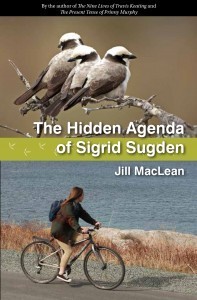
Good news! The Hidden Agenda of Sigrid Sugden is one of ten books nominated for the 2015 Ontario Library Association’s Silver Birch Award for fiction. This book was published by Fitzhenry & Whiteside.
Both The Nine Lives of Travis Keating and The Present Tense of Prinny Murphy were nominated for the same award.
And best wishes to fellow Nova Scotian writer Philip Roy for his nomination for Me and Mr. Bell.
October 8, 2014
White Ravens Selection 2014 – Nix Minus One
Blog October 8 2014:
A big gap since my last blog. I took some downtime – what a concept! Read, relaxed, walked the beach, gardened, spent time with friends and family – and then was seized with the idea that I should write an historical novel set in medieval England.
Why, you ask? Not sure I know the answer. It’s a period that’s always interested me. Visiting Chartres Cathedral (near Paris) four years ago, for instance, was a real high point. And over the years I’ve seen several medieval illuminated manuscripts – so beautiful, with such rich colours. Done by hand. By candlelight. With brushes and quill pens. Think about it as you text your next message.
So now I’m reading, taking notes, listening for the voices of my characters – and hoping you’ll wish me luck! A lot of it. If writing Nix Minus One in free verse was a challenge, could this next project be seen as certifiable madness?
On a different note, Nix Minus One, so I just found out, has been selected for the 2014 White Ravens List. Never heard of it? Neither had I.
It’s a list of books selected annually by the International Youth Library in Munich, Germany. Books from around the globe “that deserve worldwide attention because of their universal themes and/or their exceptional and innovative artistic and literary style and design.”
According to my wonderful editor, Ann Featherstone, it’s a very prestigious list. Good for Nix!
And I’m permitted to use this logo

May 26, 2014
Atlantic Book Awards – Ann Connor Brimer Award for Nix Minus One!
At the 2014 Atlantic Book Awards, held in Charlottetown on May 21st, Nix Minus One received the Ann Connor Brimer Award for Children’s Literature. Yes, I was very happy!
 This is a wonderful affirmation of a book that was both challenging and rewarding to write.
My thanks to the Brimer family for their longtime support of this award, and to all the many organizers of the event.
The reception prior to the ceremony, at The Merchant Man, was filled with familiar faces (and very good food!), and it was enlivening to be in the company of so many fine writers – including, of course, Jan Coates (The Power of Harmony) and Meghan Marentette (The Stowaways), also nominated for the Brimer for their strong, heart-warming books.
Oh, and I wanted to bring all balloons home with me!
For a complete list of all the winners, click here.
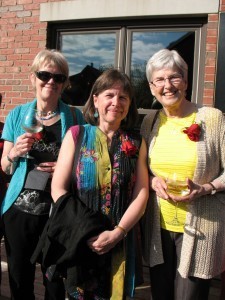
Jackie Halsey (Bluenose Adventure), Jan Coates and Jill at the reception
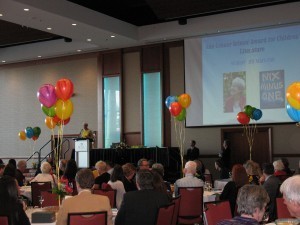
Jill after receiving the award – plus balloons!
Festival of Trees
 I had a whirlwind week in Ontario for the White Pine nomination for Nix Minus One – such an honour to be nominated. And warm congratulations to Lisa Harrington for her win with “Live to Tell”.
There were three Nova Scotians among the ten writers nominated – Lisa, Don Aker (Running on Empty), and myself.
Writing is alive and well in the Maritimes!
On May 13th I took an early train (a very early train) from Union Station – which, like a lot of Toronto, is under construction. A delightful ride through the Ontario countryside – green fields, trees in leaf, and trilliums in bloom. I was met in Belleville by Jane Foster, who drove me to Centre Hastings School in Madoc. I always enjoy meeting the students for whom I write, and it was fun to have lunch with the reading group. Thanks to Jane for organizing this.
May 14th was the Festival of Trees at Harbourfront (also under construction) – complete with crowds of screaming students. You feel like a rock star, you get to meet kids who’ve read your book, and then you can relax at the reception when it’s all done. Lovely to see familiar faces, among them my publisher, Gail Winskill.
May 15th I went by subway to North York Central Branch of the Toronto Public Library, where I did a presentation of Nix on one of the six floors of the library – I wanted to pick up the whole building and all its books and take it home with me. Thank you, Nasim, Deb and Leigh. And I was very happy to see a friend there who dated from our high school years.
Lunch, then off to Hillcrest Branch on Leslie Street, which reminded me of my home library in Bedford. Another presentation of Nix, with more attentive readers (thank you, Mary), then back by subway and bus to Dufferin Street, cab to Billy Bishop Airport (fog, all flights delayed), then plane to Ottawa and cab to the hotel.
May 16th was theFestival of Trees in Ottawa at the Nepean Centre, again so many enthusiastic fans and so well organized, such a delight. My only complaint? I wanted time to play some of the games arranged for the kids!
Warm thanks to Meredith Tutching and all the many helpers and volunteers who make the amazing Ontario Festivals happen year after year.
And – to all of us – keep reading!