Jyoti Subramanian's Blog, page 2
June 16, 2021
Kriya Yoga~ speedy, scientific and practical? OR esoteric, secretive and mystical? Part 2
“Yog”, says Yogiraj Siddhanath my Satguru, “is an inner ascent through evermore refined and evermore expanded spheres of mind to get to the godessence that is at the core of our own being.”
And Kriya Yog as discussed in an earlier blog is a lightning path that takes us to this godessence at our core- faster!
As always the points put forth are my own arrived at by realisations through practice and inner and outer study and learning, anyone is welcome to disagree and have other points of view. These blogs are an attempt at studying my own thoughts and are used as playful recreation, shared with those who may find them helpful.
In part 1 of this same topic we had discussed the beginning of Kriya Yoga as we know it today; its introduction to the modern world, around 1861 to be exact, by Lahiri Mahasaya; the Kriya Yoga lineage starting from Mahavatar Babaji to Lahiri Baba and branching out through his various disciples and their disciples to present day teachers; understanding why Yogiraj Siddhanath calls Mahavatar Babaji, Shiv Goraksha Babaji. Also briefly discussed was the process of entering the stream of this practice today.
In this part I would like to touch upon the actual practice itself, drawing upon what I have learnt and understood from my master, my own realisations from my practice and from sharing it with others over many years, from this and other lives past. And how while being a practical and scientific method of speedy recovery Kriya Yoga also unlocks an esoteric, secretive and mystical world to its dedicated sadhaks.
Kriya Yoga is a subtle pranayam technique practiced in the central Sushumna channel in the spine. Yogis and Rishis in ancient Bharat discovered early on the connection between the breath and the mind and how it can be used to holistically heal the human body of its ailments while taking the practitioner towards the yogic goal of Self realisation.
The Kriya Yoga practice- speedy, scientific, and practical
Though earlier the emphasis in science was physical and applied, science moved swiftly towards the empirical, once the influence of the mind on the body became apparent in studies of psychology. At first, the role of the breath was confined to oxygenation of body cells, but science today is fast discovering the importance of breath in treating many cardiological, respiratory and neurological diseases at a deeper level. The use of breath work in the psychiatric field, for hypertension, for children with ADHD syndrome and people suffering from PTSD amply reveals the connection between the mind and the breath in controlled environment of science. Yoga at the level of asanas/postures and pranayama/breathwork is a field of much scientific research today and is being accepted as means of post trauma healing and recovery from surgery and mental health issues. Even the mulabandha a technique of applying a yogic lock and an important part of Kriya Yoga is practiced under the name of Kegel exercises to improve the pelvic floor muscles. Meditation with medication is a new mantra now.
Kriya Yoga is universal, easy to learn, simple to practice and is available to all; it does not need any prerequisites. It can be practiced sitting on the floor or on a chair. There are no age restrictions, no restrictions on diet or require any kind of lifestyle change. The results of Kriya Yoga, if practiced with regularity are apparent very quickly. Each step in Kriya Yoga is conducive to a good physical, emotional and mental health.
In the primary practice of Kriya Yoga a rythm is established between the incoming and outgoing breath that in turn effects the brain waves and the agitated waves of stress and tension start to slow and the mind responds by calming. This systematic breathing is conducive to lowering blood pressure and hypertension. It gives a much needed rest to the organs in the body; the heart and the lungs along with the rest of the body are deeply oxygenated and decarbonised preventing premature decay of tissue.
The spine is used as the medium of transport for the inhaled and exhaled breath. The gentle friction of the regulated and concentrated breath calms the central nervous system, popularly called the command centre. Like the stroking of a parents hand on the back of a child, the practitioner is immediately relaxed and feels supported. A harmony is formed between the brain and the body, the benefits are too numerous to count. The central nervous system is a conduit between the brain, the cerebellum, the cerebrum and the nervous system that regulates the functioning of the whole body. The practice is conducive to stimulate and regulate the vagus nerves achieved by controlled breathing and holding of the breath. The Kriya breath, by its very nature, balances the left and right brain hemispheres.
Certain steps of Kriya Yoga work upon the various plexuses aligned along the spine. The plexus are a hub of intersecting nerves situated along the spine and simply put, communicate information from the body to the brain. A healthy non corrupted exchange of information is necessary for a healthy functioning of the organs and the various biological systems of the body, respiratory, digestive, lymphatic, excretory et al. A special mention is required here of the glandular or endocrine system, and though working on all the glands, the pituitary, pineal and the hypothalamus receive an immense amount of care and attention in the practice and are responsible for the overall feeling of quiet and joy that results from the practice of Kriya Yoga.
A quick look at the diagram below reveals the scope and expanse of the nervous system and its reach into every portion of the human body.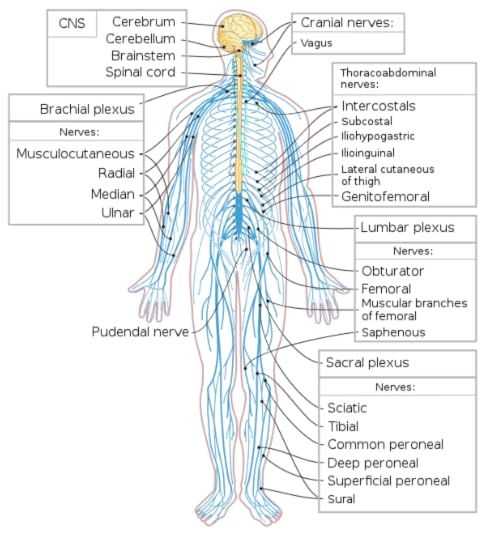
The physical stretches in the practice elongate the muscles and make room around the organs for better absorption of the oxygen for better health.
Quantum physics is another field that is studying the deep correlation between matter and energy and may one day be able to bring the mystical and the scientific together on the same board. At present Kriya Yoga does this in a wonderful way for the practitioner.
The Kriya Yoga Practice- esoteric, secretive and mystical
For me the scope of Kriya Yoga from scientific to esoteric is beautifully explained in this verse from the Shikshavalli (initiation of students into an education system in the Vedic times), the first chapter of the Taittreya Upanishad,
नमो ब्रह्मणे ।नमस्ते वायो । त्वमेव प्रत्यक्षं ब्रह्मासि ।त्वमेव प्रत्यक्षं ब्रह्म वदिष्यामि ।ॠतं वदिष्यामि ।सत्यं वदिष्यामि ।
namo Brahmaney. namaste Vayo (vayu). tvameyva pratyaksham Brahmaasi. tvameyva
pratyaksham Brahma vadishyaami. Hritam vadishyaami. Satyam vadishyaami.
Here the student while bowing to Vayu, the diety of air, one of the panch bhutas (earth, water, fire, air and space) proclaims it to be the perceptible and tangible aspect of Brahman -the ultimate reality. The student continues to proclaim this as right and truthful. A simple verse repeated by rote by many but with a very deep understanding for practicing kriyabaans who understanding the connection use the tangible Kriya breath (the inhaled pran vayu and the exhaled apan vayu) to access and merge into the Brahman- the ultimate reality in the Kuthasta Chaitanya.
The fact that I cannot share the technique or completely reveal the practice here is the esoteric nature of this practice. Though meant for everyone there is a unique code of sharing between the teacher and the student. From the time of Lahiri Mahasaya a discipline has been established of sharing the actual technique in the environment of the Guru-Shishya Parampara. That is, the technique is taught in a sacred environment; a dakshina- fee, not necessarily monetary, as prescribed is charged; and the knowledge is passed on from the teacher to the student in a special and sacred manner with an oath of secrecy. The mystique of this technique is maintained even in the ancient texts that though obliquely referring to this practice does not ever reveal the whole method. Of course, now one can find all of it exposed on the internet and in books. Bur serious practitioners still prefer to receive it from a Guru and there is a reason for it.
After observing how science is in the process of discovering and adopting yogasanas and pranayam for benefit in the field of healing trauma, here is what I understand the rishis and yogis discovered through inner study and practice. The yogis went a few steps further and discovered that the breath is not only invested with oxygen but is infused with the even more subtler pran, called the life force energy by the western world today, that permeated every breath taken by a living being, whether human, animal or plant. In fact they realised that the whole universe was held together by this intelligent force of pran and by connecting with it a yogi could become part of this universal source! A giant leap from unified field theory to practice, methinks with amusement.
The Kriya practitioner goes beyond the perceptible breath and becomes aware of the 5 Pran or vayus in the body which are referred to as the pran, apaan, samaan, vayan and udaan; though inherently same, these descriptions are according to the function they perform and all of them are infused with the intelligence of the Pran the life breath. In Kriya Yoga also called the Kundalini pranayam, the tangible spine is let go of and the practing kriyabaan enters into the subtler central Sushumna Naadi and as the practice improves penetrates even further into the Vajra, Chitrini and Brahma naadis. These lead to heightened states of awareness and are subjective to individual practitioners, their level of concentration, grace of the Satguru and karmic load. In the advanced stages of practice the Kriya practitioner achieves the task of transmuting the body of flesh into a body of light.
The inhaled and exhaled breath become the subtle pran and apan. The kumbhaks, antari and bahiri and the three bandhs combined with purak and rechak are used in prescribed ratio to bring all the 5 pran to flow seamlessly towards the divine indweller.
Interpenetrating the plexus in the physical body are the subtle chakras in which the Kriya yogi experiences the deeper truths of existence, personal and cosmic. The practice dissolves past karmas while emboldening the practitioner to face present karmas, with grace. Remember karma here refers to both, those perceived as positive or negative.
Called the lightning path by Yogiraj Siddhanath and the aeroplane path by Yogananada, the practice of Kriya Yoga expedites once journey towards the inner guru exponentially. In the esoteric practice of the Kriya Yoga as the student immerses in the inner cosmic body they realise the microcosmic body as the reflection of the macrocosmic universe.
Since none of these realisations can be computed by science, are individual in nature and are extremely hard to share or explain they remain in the realm of esoteric and mysterious.
The Role of the Satguru- enlivening the pran
A compassionate and healing Light
A Hamsa in its splendid flight
Away oh darkness! Fly oh night
The yogi comes in radiant might.
– Yogiraj Siddhanath
In the Indian context a lot of importance is given to the role of the Satguru in ones spiritual unfoldment. A living guru seen as a necessary ingredient in the shishyas inner journey towards the realisation of the Self. This is not because one cannot achieve significant progress on ones own but because at certain points in the journey a special wisdom or information needs to be imparted according to each individual seeker, a key so to say to unlock a door to further progress. One size here does not fit all. Though many seekers are happy to progress at their own pace reading and following innumerable techniques given in many of our texts and treatises; learning from many and adapting the techniques to their own liking, the training done under one true guru overrides lifetimes of wandering, is my understanding.
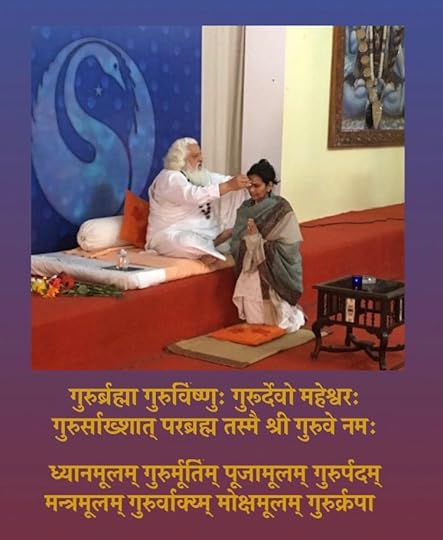
In the Kriya Yoga lineage, the living Satguru transforms and enlivens the pran in the disciples spinal channel giving a boost to the disciples progress along the path. Simply put, the pran is enlivened to become capable of penetrating the kuthasta and taking the seeker to the highest of samadhi. This pran is referred to as the marut pran. For this service the disciple is forever beholden to the guru with whom they often travel from lifetime to lifetime until final salvation.


June 8, 2021
Pranayam For The Very Young
Article published in Esamskriti; link here
See video here

As a kriya yog teacher I am often asked this question by parents, as to what age children should be introduced to pranayam. My answer to this always is ‘from the womb!’ When mothers to be practice the ayaam of pran- training and tuning the pran to flow smoothly, they plant the seed of it in the child growing in their body.
The practice of pranayam, just like yog, is not a regimen to be done as an exercise three times a week. It is an awareness of the life force that flows through us regulating our every emotion, thoughts and the functioning of our metabolism.
I have had the great honour of students from age two accompanying their parents for my classes, often because there was no one home to mind them and I have been surprised at their absorption and learning in what was a casual attendance.
Many of these children are now in college and some working. Recently, I had the pleasure of seeing my eleven month old granddaughter imitating the pranayam practice which she had seen me do that morning and which has now become a daily play.
The techniques given in the video are a result of the observations on my part of children in my class and in schools where I have shared yog practice with students. To see VIDEO
The gift of Pranayam
It’s a no brainer to even compute the benefits of correct Pranayam techniques for children. It’s like trying to fathom if our breath keeps us alive.
When our children learn the art and science of correct breathing they actually learn the art and science of life. The following plusses have been observed by me in the children who were, even if in a limited way introduced to pranayam.
As children it’s an effortless learning that is imbibed by them as second nature.
The tuned and trained breath fills them with vitality, joy and alertness.
It improves their concentration and helps them to complete tasks at a much faster pace. This leaves more time for rest and leisure, both important ingredients for a happy childhood.
Since the pran is so closely connected to the mind, a calm breath leads to a calm mind giving the children the much needed assistance for dealing with peer pressure, unhealthy competition, bullying and other stressors from the external environment.
Some simple do’s and don’ts
This video is meant to be an introduction for very young children. Of course I don’t expect them to see this video. Hence, it is for their caregivers be it parents, grandparents, aunts, uncles or nannies who must see. They are simple to follow and easy for children to comprehend.
Remember children and infants follow by observation more than instructions, so whatever we want them to do, we must do ourselves. In short walk the talk!
Begin by practicing in front of them, for sure you will ignite their curiosity.
Forcing them can have the opposite effect, so if they get distracted or lose interest let them move away and calmly carry on with the practice yourself so they can observe your discipline despite the distraction.
Make sure this activity does not happen immediately after meals. Give a gap of at least an hour.
Even if they are yet not talking, converse with them as you breathe explaining the benefits of the practice.
Keeping it light hearted and playful benefits both, the teacher and the taught, forming a bond that lasts a lifetime.
Yog sadhana is a wonderful way of life leading to a peaceful co-existence with people inhabiting this earth and with nature. It fosters respect for all that is around us. This is a gift we can and should give to the children who are going to be the keepers of the future world.
To see VIDEO 7 minutes
Author is a Kriyacharya based in North India.
May 11, 2021
Holistic Health – A Daily Discipline
BY JYOTI SUBRAMANIAN ON MAY 11, 2021
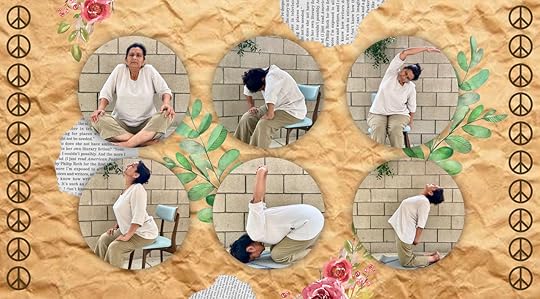
This piece by me was published in a local Chandigarh epaper. Link below
https://tricityscoop.com/holistic-health-a-daily-discipline/
After recovering from the dreaded COVID, I realised that one of the reasons for my recovery, at home without medication and the positive attitude while in the throes of the symptoms was my relatively disciplined lifestyle and practice of yog sadhana. Holistic health is a consistent effort, treating the body as a temple, taking care of diet and staying away from toxins that affect the body and the mind is a routine that helps at the critical moment of stress, I came to understand deeply at his time.
I am sharing below a combination of asan, pranayam and mudra that can be practiced by everyone and helped me during my illness. All yog contributes towards good health one cannot compartmentalise them into sections, but since the concentration here is specifically on the present pandemic, I am highlighting and modifying those that can be easily practiced by both who are recovering and those unaffected yet new to yog.
Some points to keep in mind:
1. Please wear loose comfortable breathable clothes. This is to let a free-flowing movement of oxygen and pran without restriction through the body.
2. Keep a light stomach, last heavy meal at least three hours before commencing practice, unless otherwise mentioned.
3. Keep to your own level of comfort while practicing the asan, do not overstretch or push your limit. Be comfortable and rested in the posture.
4. You can practice all the following techniques out in the open, facing or with back towards the sun.
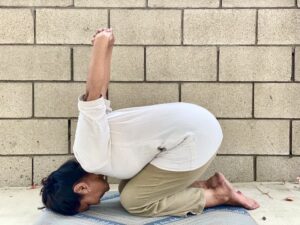
Asan Chalityogmudra (Pic 1) and (2)
1. Sit on your knees or back on your heel, depending on your level of flexibility. You can put a pillow behind your knee if you are comfortable with it.
2. Clasp your hands behind your back at the hip level.
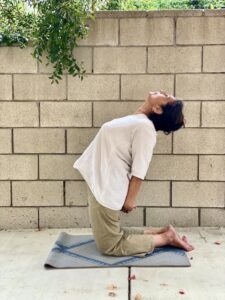
3. Now bend forward breathing out, gently raising and extending the clasped arm behind you to shoulder level. When all the breath is out, gently squeezing your whole body while bent forward.
4. Now slowly breathe in as you straighten up and continue to bend back opening up the chest fully as you keep filling your lungs and extending open your diaphragm. Once again hold the breath in and gently squeeze the body. The arms are now back at hip level.
5. Repeat four to six times.
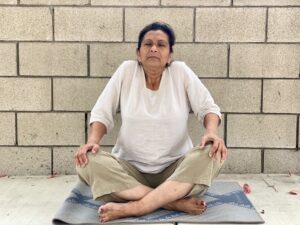
Pranayam (Pic 3,4, & 5)
Set of breathwork for all three parts of the lung. Remember the breath never bursts out or in, you are in control
1. Seat yourself comfortably, on the floor or on a chair. Inhale as you squeeze your shoulders up towards your ears pulling and stretching the spine up. Hold your breath. Exhale as you drop the shoulders down and relax. Repeat 6-10 times. This is for the upper lung area.
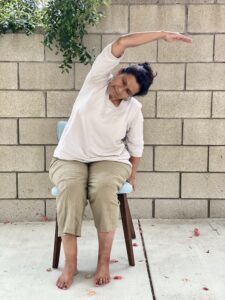
2. Maintain the seating posture. Place your left hand on the floor by your side or on the chair and extend the right arm over the head raising the right shoulder and bending towards the left breathing in as you go into the posture. Hold the posture and the breath. Breath out as you bring your right arm back and lower your right shoulder. This is for the middle portion of the right lung.
3. Now place your right hand on the floor by your side or on the chair and extend the left arm over the head raising the left shoulder and bending towards the right breathing in as you go into the posture. Hold the posture and the breath. Breath out as you bring your left arm back and lower your left shoulder. This is for the middle portion of the left lung.
4. Repeat the alternate sides 6-10 times
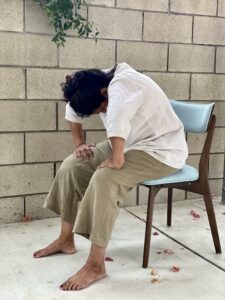

5. Now we come to the lowermost tip of the lungs. Bend forward with both hands placed firmly on your knee. As you inhale, curve your back bringing the shoulders forward towards each other. Hold the breath for a little while. Exhale as you move your shoulders back and extend your chest. Hold the breath. Repeat 6-10 times.
6. In all the above exercise visualise the golden pran along with the oxygen permeating every alveoli of your lungs.
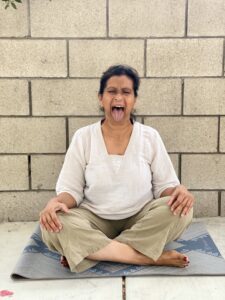
Mudra (Pic 6)
1. Sit comfortably on the floor or a chair.
2. Loosen your shoulders and drop them.
3. Breathe in slowly filling your lungs with oxygen and pran. Feel every alveoli saturated and completely filled with this life-giving pran.
4. Hold your breath for as long as you can comfortably.
5. Then explosively throw the breath out through the mouth as you throw and extend the tongue out. Purging all breath fully. Remember the breath is thrown out from the bottom of the lung.
Take care not to overextend or overstretch yourself during practice. Stay within your comfort zone and stay safe.
About the Author: Introduced formally to yoga at age 11, Jyoti has effortlessly incorporated in her life, the philosophy of yogic living. With a teaching experience since 1999 in Mahavatar Babaji’s Kundalini Kriya Yoga and Siddhanath Yoga, she takes great pleasure in sharing all that she has learnt with others who seek. Author of the book One Master One Disciple, she is an ardent blogger and inspired writer.
January 6, 2021
Kriya Yoga~ speedy, scientific and practical? OR esoteric, secretive and mystical?
This article was published in an online magazine on the 7th of January 2021. link provided
https://www.esamskriti.com/e/Yoga/Meditation/KRIYA-YOGA~speedy,-scientific-and-practical-OR-esoteric,-secretive-and-mystical-1.aspx
Before getting down to write, I typed in Kriya Yoga on the search bar and it threw up 1,10,000,00 search results in seconds. That made me wonder what new information I could share that will be different from everything told and retold about this practice. It is my friend Sanjeev who urged me to write about this very special form of Yog Sadhana, one that has been a part of my present life since 1998, when I met my Satguru, first in a vision then initiated into this in person, a practice which I, from day one, took to like a fish takes to water.
As usual I write from personal experience and inference about spiritual truths as revealed to me by the grace of my Satguru Yogiraj Siddhanath and my personal journey in this sadhana of Kriya Yoga. Read it for what it is, a respectful bow by a sadhak to a practice given by a Satguru. Yogiraj Siddhanath is one of the masters of the present times entrusted with teaching the Kriya Yoga by none other than the Mahavatar Babaji.
But first the beginning of Kriya Yoga in modern times
(Lahiri Mahasaya)
The torch of Kriya Yoga in its present form was brought to humankind by Sri Shama Charan Lahiri, aka Lahiri Mahasaya, pronounced Moshai in Bengali and Mahashay in Hindi; it is a common form of address in India meaning revered or most respected sir. His meeting with Babaji has been detailed by Paramahamsa Yogananda in his book Autobiography of a Yogi. For the accounts of Lahiri Mahasaya’s life in this article, I have referred to the book Purana Purusha, excerpts from the diaries of Lahiri Baba himself and its introduction by Yogacharya Vacaspati Dr. Ashok Kumar Chatterjee.
From the start what endeared and inspired me most about Lahiri Baba, was his simple life. Despite his spiritual brilliance, of which he seemed unaware until his meeting with the Mahavatar at age 40, he went about life in a most ordinary manner.
A childhood normal in most ways, with some indications of his spiritual yogic nature, a father who paid great attention to his education, his early marriage to Kashimoni followed in time by birth of two sons and three daughters. At age 23 he was commissioned a sarkari job as a clerk in PWD, Military Engineering Works. To bolster his income he gave lessons in Hindi and Urdu to a few English army officers.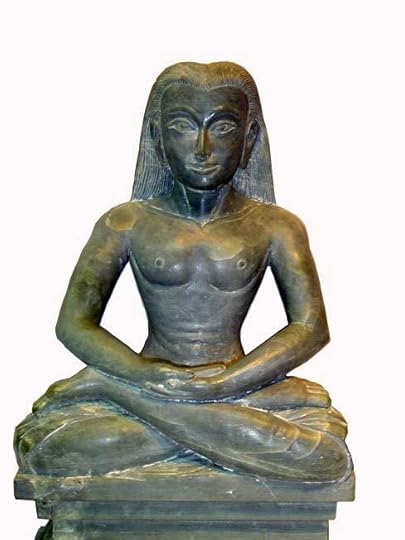
(Mahavatar Babaji)
And then in the year 1868, one day while out on a walk in the hills of Ranikhet, he was authoritatively summoned by an ascetic and taken to meet the divine Mahavatar Babaji. After this momentous experience and realisation, Lahiri Mahasaya went right back to his job and family and in a quiet manner started to carry out the instructions of his Guru to spread the light of Kriya Yoga from his home in Kashi.
In fact his second and youngest daughter were born after his meeting with the radiant Mahavatar, proof of a continuance of a normal householder’s life. The Master showed by example how a truly spiritual life can be led whilst living in the material world – for me this is one of the greatest teachings by Lahiri Mahasaya.
That is how simple Kriya Yoga is, a fast track evolutionary technique of pranayam that takes you to the highest stages of yog sadhana while keeping you rooted in the ground of a householders life.
This lesson is amply set forth in present times by my Satguru who is also a householder yogi and continues to radiate the awareness of Kriya Yoga from his forest ashram in Pune Maharashtra, inspiring disciples to find tranquility in the midst of turmoil.
A quick note here as today most people know of Kriya Yoga and the lineage of Lahiri Mahasaya, Sri Yukteswar Giri and Yogananada due to the world famous book Autobiography of a Yogi. But it is important to note that Shama Charan Lahiri had many advanced disciples of whom one was Sri Yukteswar who in turn had many advanced disciples one of whom was Yogananda. Now all these disciples have their own lineages and student and teachers base. Most follow the original Kriya Yoga as revived by Lahiri Mahasaya with the grace and blessings of Mahavatar Babaji, and many of them in their own right had personal and deep experiences with Babaji.
The importance of a living Guru
Satguru’s have been appearing from time to time to enliven and refresh this evolutionary fast track practice to attain self realisation for disciples. Often the disciples who come and quickly flow into the practice are also souls who have been introduced to this path in lives past and come to continue the journey with the present master. Actually nothing is lost, the practice continues from where it was left off. Yogiraj Siddhanath is one such master.
Personally for me the present Guru, in my case Yogiraj Siddhanath, is enough to lead one to enlightenment without the unnecessary encumbrance of past masters and the desire for “original” techniques. As the human brain and nervous systems evolve the practices are tweaked by the masters who come to suit present day requirements.
This is a point of much debate and lots of jostling by various branches of Kriya Yoga schools, but this is my realisation that the present true Guru leads the disciple without fail towards the goal of self realisation (sabikalpa/sarvikalpa) and god realisation (nirbikalpa/nirvikalpa). As a disciple what is required is Vivek buddhi and swadhyaya which will help in discerning a true master from a pretender, that’s the only thing to watch out for and what many seekers fear.
When I met Yogiraj Siddhanath, the first time it was in a vision where he summoned me to his ashram in Pune. Those were pre-internet days of landline phones in 1998, how I reached the Pune ashram is a story by itself. You can read about this in my book, One Master, one disciple. This guiding to the Guru, bolstered my confidence that the disciples find their way to the Guru without fail when their time comes and this has been proved by recounts of many disciples on how they found the Guru or on how the Guru found them!
The living Guru, for me, is the concrete connecting bridge who steers the disciple unerringly on the path individually. Also there are no doubts about the messages, instructions and milestones that arrive during practice which can otherwise be coloured by our own ego and or flights of fancy or just misunderstood by the mind. The living guru keeps the disciple steady and on course each according to their own needs. The greatest gift the living guru bestows is as the disciple reaches out to the external Guru, the external Guru guides the disciple to the inner Guru and once this connection is established no separation of the Guru and the disciple is possible.
The Mystical Mahavatar Babaji
Lahiri Mahasaya said simply, “Budha baba ohi Kisun,” hinting at the stature of a person addressed as Babaji, a generic term used for the elderly in India connecting him to the purnavatar Krishna. There are accounts by many of their meeting with this exalted being, their trysts with the Mahavatar and the lessons learnt from him. The magical mystical meetings have given rise to many books and schools of learning.
Here I write about the one I know firsthand recounted by my Guru, Yogiraj Siddhanath. Yogiraj had deep and personal experiences of this Being, whom he calls Mahavatar Shiva Goraksha Babaji, in both the human and cosmic form in the Himalayas at the Jhilmili Gufa at the base of the Neelkantheshwar peak in Badrinath and at the confluence of the Alakhnanada and Mandakini rivers at Rudraprayag, Uttarakhand. In his experience of the Mahavatar is the realisation of the Mahavatar as none other than Gorakhnath, the being who burst out of the heart of Adi Nath Shiva. In his book, Babaji: the Light Standing Still he connects the Mahavatar Babaji unerringly with Shiva Gorakhshanath and the Nath lineage with references from historical and spiritual texts.
Among other inferences, Yogiraj has shown the similarity between the Goraksha Kriya from the Goraksha Shatak and the Babaji Kriya of Mahavatar Babaji. Says Yogiraj Siddhanath in his book Babaji, the Lightning Standing Still, “The hundred verses of the Gorksha Shataka given below connect beautifully to the original Kriya Yoga which is given to us by Shiva Goraksha Babaji, Lahiri Mahasaya and Sri Yukteshwar Giri. Some of the instructions of Kriya Yoga have been taken ad verbatim from the Goraksha Shataka.
This only goes to make clear that Babaji of Autobiography of a Yogi and Goraksha Nath, who wrote the Shataka, are one and the same.” Both have the Omkar Kriya, Hamsa (pronounced Hong Sha in Bengali) sadhana, Kriya Yoga Pranayam, Nabhi Kriya, Mahamudra, Yoni or Jyoti Mudra, Unmani/ Para Avastha, Khechari Mudra, Thokar Kriya and so on.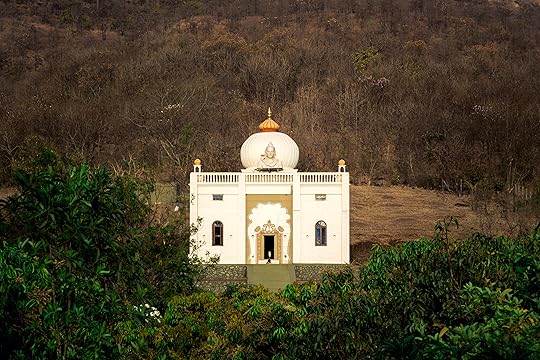
(Earth Peace Temple at Siddhanath Forest Ashram)
The Earth Peace Temple at the ashram in Pune houses one of the largest consolidated akhanda mercury shivling. Disciples and devotees from across the globe visit to sit in the peaceful radiation of this linga and be propelled to high states in their sadhana. The consolidation of mercury is an alchemical process whose custodians are the Nath yogis. Yogiraj Siddhanath, it should be noted is the first to reveal the commonalities between the Nath Sampradaya of Gorakhnath and the Kriya Yoga lineage of Mahavatar Babaji.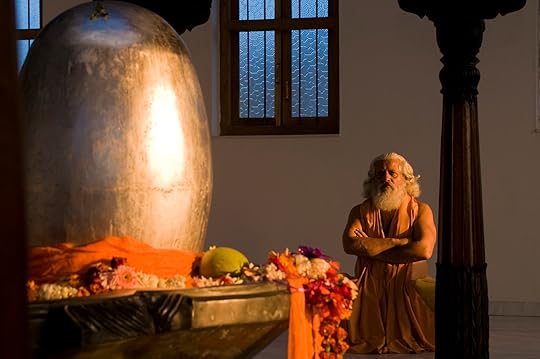
(Yogiraj with Parad Shivling)
Kriya Yoga, the spinal highway to evolution
Much has been written about the practice itself so I will limit myself to a few fundamentals according to my realisations. Yogananda called it the aeroplane path and Yogiraj defines it as the lightning path. Both showing the fast track nature of this pranayam to propel the practitioner towards realisation of the Self.
The spine has been the measurement of evolution from invertebrate to vertebrate to Homo Erectus, the upright man. Further evolution from human to divine, I understood, also takes place along the subtle sushumna channel within the spine, wherein starts the scope of Kriya Yoga.
The fundamental goal of any practice from the sanatan repertoire is to free the soul from the cycle of birth and rebirth into suffering…, Kriya Yoga achieves this by a dual movement of evolving the awareness while simultaneously burning past karmas of the practitioner freeing them from this cyclic repetition.
As the practice takes roots the practitioner is propelled towards the higher stages of yog sadhana- to pratyahar, dharana, dhyan and by the grace of the living Satguru samadhi.
The Process of Learning
A simple technique to learn, the magic of transformation is in the consistency of practice. There are many schools of Kriya Yoga that have branched out of the fountainhead of Lahiri Mahasaya and his disciples and their disciples and so on and so forth. All have their own systems in place for the sharing of this wisdom.
In some, the initiation or deeksha is given by authorised teachers and the empowerment or anugraha is imparted in a sacred ceremony by the Satguru. In others both are done by the Satguru who initiates and empowers in one ceremony. Some give all the Kriyas together and others over an extended period of time. As a seeker one must find the one that suits the most.
Yogiraj Siddhanath has authorised many teachers in India and around the globe to impart this technique but seekers are also welcome to go directly to his events, at the Pune ashram or in various cities of India and abroad, which he visits periodically, to be initiated and empowered by him directly.
The forest ashram in Pune is built at the base of the Singhad hills and has room for over a hundred people to stay. The ashram is rustic but with all modern amenities, a gym and a swimming pool. Retreats are organised regularly and one activity is meditating in the pool as the water helps in the movement of the meditative breath. The other daily activity is meditating in the presence of the Satguru and the consolidated mercury shivling for enhanced meditation and healing.
Yogiraj is one of the rare living masters who is still personally available and disciples can spend time in his presence at the ashram and during his travels. The very environs of the ashram brings stillness and peace to the person entering.
For more information on Yogiraj’s events: www.siddhanath.org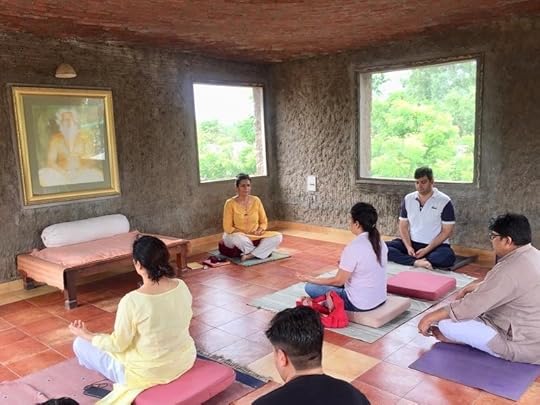
(Picture of Chandigarh Centre)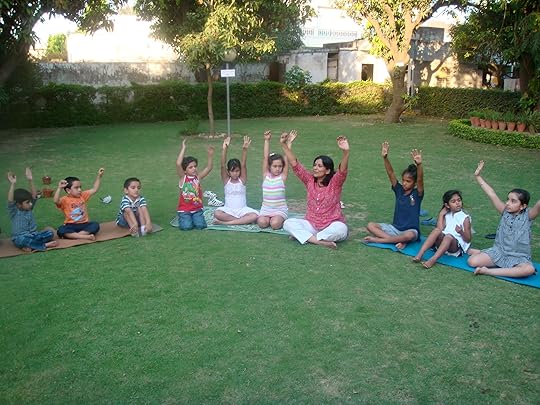
(Author with kids)
At my centre in Chandigarh regular yog classes and initiations into Kriya Yoga are held. Though, these days all classes have moved online. Activities also focus on introducing children to the benefits of yog and meditation, on living in harmony with others and nature.
When Yogiraj visits it becomes a hub for people from all over who come to be in his presence and partake of the Kriya knowledge and avail of the transmissions of Shaktipat, Pranpat and Shivapat that Yogiraj is constantly radiating.
In conclusion do I think Kriya Yoga to be speedy, scientific and practical? Or esoteric, secretive and mystical? Yes to both of course, a speedy, scientific and practical technique to learn, the practice of it introduces and opens up the awareness to esoteric secrets of the mystical. Liberating one from the daily trammels of one’s life it leads one unerringly towards the goal of yog sadhana- final liberation.
Author Kriyacharya Jyoti lives in Chandigarh.
To read by Yogiraj Siddhanath – Babaji: The Lighting Standing Still
To read about and buy by author – One Master, One Disciple A thrilling spiritual adventure
To read all articles by author on site (eSamskriti)
December 2, 2020
Leave the mind/ego outside with the shoes?
-An antithetical viewpoint
[image error]
Offering my respect to that irritating grain of sand that initiates the forming of the pearl I will dive right into a topic that has been bubbling on the surface of my mind for a while. Do remember my blogs are written as a bit of fun and light heartedly.
Establishing having an Ego
Being my nature to ponder on the spiritual and the so called spiritual, the intellectual and the so called intellectual, and finding it exciting to engage in this pursuit in my time away from my sadhana, it has become a rather enjoyable pastime of mine. In reality, some of these realisations are a result of the said sadhana when the lens turns and shines a light upon, among other subjects, popular sayings that belie a belief system. In fact you can call this my rubik’s cube, sudoku or crossword puzzle, so to speak. An engaging of the intellect to keep it sharp and not dulled or rather lulled into complacence. An Adi Shankaracharya inspired dialogue/debate occurring within myself; it is not uncommon for me, to find myself in conversation with my Self!
This habit, I realise now, had started very young when often I would find myself deeply (deeply yet humorously, for sure) pondering the vedantic philosophies discussed at home and the meaning of brahminical mantras constantly chanted by my elders. Stories from the Bhagavatam, the Mahabharat and Ramayan, the panchatantra would all be examined while being enjoyed. Adi Shankaracharya was a great favourite of my father and his quotes were applied to many and sundry situations internally and externally. This inculcated an atmosphere of debates and discussions, sometimes heated but always ending in a handshake, on which my father insisted.
“Where the mind is without fear,” wrote Tagore, “and the head is held high, where knowledge is free.” A poem that had impacted me deeply as a child. Even then I had known that though the poem was directed towards the country as a whole, it applied to each individual; for what else is a country made up of, if not its citizens. “Where the clear stream of reason has not lost it’s way into the dreary desert sands of dead habit,” continues Tagore. Into that heaven of freedom I would wish to be awakened as a young adolescent. Needless to say that did not bode well for any adult in my vicinity, be it teacher or parent who would ask me to follow obediently what was asked of me and what they deemed was the best for my development. Everything would have to pass this self study. That’s not to say I have not indulged in many spontaneous actions and learnt insightful lessons from all of them some pleasurable some not-so, all contributing to the formation of my ego as it were.
It would be correct to say, hence, that I had expended a sizable amount of my years in the attempt of developing intellectual skills which it would in later life not be wrong to call a well developed sense of the self, popularly labelled ego by philosophers and pundits. Said acquired skills also used to demolish without prejudice, perceptions that did not resonate with my own realisations. As usual, the views expressed here are mine alone, arrived at after much pondering in my free time and anyone who disagrees with them I accord a more than cordial shake of the hand.
A Not so Gentle Coaxing
[image error]
New age yoga studios quickly follow a catchy phrase without due diligence.
First expressed in eastern philosophies, it is a common statement today used by priests, clergymen, gurus and pundits to ask the congregation to leave the ego outside with the shoes. This apparently to keep their flock humble and not fall a prey to pride. The idea mooted is that the ego is an obstacle on the path towards the Lord God.
This statement has always irked me and if asked to leave my mind or ego outside with my shoes while attending watering holes of any hue, it immediately makes me more attentive and a bit suspicious. It is meant to be a cute statement meaning don’t be argumentative but I find it an assault on a discerning mind. The ego of the person inside trying to override the ego of the person entering! Not so Om Shanti after all!!
Ego, A Brief Summarisation
Simply stated, ego in Latin stands for I. Any person using this I word excessively is perceived as an egoist. For me, though this was too simplistic a definition of the ego. I craved for a more detailed understanding of ego as identity, as an understanding of the self and a tool for gathering knowledge and wisdom.
A throwback to college where being a student of philosophy, I had studied Immanuel Kant’s Critique of Pure Reason and his theory of a priori and a posteriori. Putting it simply and keeping it light, they are the two methodology of gathering knowledge by an individual mind and goes to form the substance of the ego. A priori the first based on deduction and reason is independent of experience and the second a posteriori is empirical and based on subjective experience. Most western philosophers give precedence to information and knowledge gathered through the former a priori as it’s, according to them, a more scientific approach, an objective study which determines that a particular formula when applied would in every instant bring the same result. The latter path of a posteriori is empirical and based on information gathered from subjective experience, a method which for obvious reasons, is very difficult to compute. The latter is usually debunked by those referred to popularly as ‘intellectuals’. But I have found both work in different ways to help the individual mind gather information.
In the Sanatan philosophy the sanskrit term used is Ahankar. Ahankar which does not just mean the ‘I’ but the ‘I maker’. The first sign of ego is developed by the infant at the moment of birth. My Satguru Yogiraj Siddhanath, explains how when the baby emerges from the womb of the mother the heresy of separateness occurs and the soul forgetting it is divine starts identifying with the body. The first I of identifying with the external form grows roots.
According to my understanding the identity of Aham or self strengthens as the baby grows by identifying with traits of its gender, family status and name. This sense of the self deepens further as the manas- the mind, and intellect- buddhi becomes more consolidated with social conditioning and upbringing and the very personal experiences in that souls journey. The I then refers to itself as the sum total of all 5 koshas, the panchakosha – the body of flesh, the body of breath, the body of mind and emotion, the body of intellect and the body of intuition. How this I collects information, knowledge and wisdom depends on how the I perceives the world through the 5 senses, panchendriyas. Further the substance of the I is textured by the play of the three gunas, the clarity or otherwise of the vivek buddhi.
भूमिरापोऽनलो वायु : खं मनो बुद्धिरेव च । अहङ्कार इतीयं मे भिन्ना प्रकृतिरष्टधा ॥ ४ ॥
Interestingly Krishna in the Bhagavad Geeta has pointed out how the earth, water, fire, air, ether, mind, buddhi (intellect) and ahankar form the eight grosser manifestations of the energies of the descending Purusha– pure consciousness. All serious practitioners of yog sadhana know that the body consists of all these elements and together they form the grosser I. For clarification Purusha, in my understanding, has no ‘masculine’ connotation here. More on this in my next blog.
This is a vast topic by itself and my reason for touching upon it here is only to lightly stroke on the nuances of what is meant by an ego.
Case in favour of not leaving the ego out
Let me begin by saying that according to me, those who have an Ahankar, an ego will not be successful in leaving it behind. And those who can leave it behind need not enter at all, for after all they without Ahankar become -Nirankar- निरङ्कार्, without form, formless.
1. योगश्चित्तवृत्तिनिरोधः
Patanjali in his treatise of YogSutras says yog (union) is calming the vagaries of the fluctuating mind. The mind, the ego is the sense of lower self, which is transformed to the realisation of the Universal Self. The calming of the fluctuations and turbulence of the mind is the basis of yog sadhana. If you have already achieved it you need not enter at all, if you haven’t, leaving it behind what will you transform? It is after all the ego that has to pass through the crucible of fire to purify itself into Atman, then Paramatman.
2. स्वाध्याय
One of the tenets of niyam is swadhyay, self study; turning the lens inward in order to observe and experience the transformation of the chitta and the manas all a part of what forms the ego. Having left the mind and ego self outside, what is there to study.
3. शरीरे संहारः कलानाम्3. शरीरे संहारः कलानाम्
“The destroyer is within the body,” read the Shiva Sutra discovered by Vasugupta on a boulder in the territory of Rishi Kashyap around the 9th century CE. The movement of discovery is inwards and outwards. As the seeker takes the first step into the room the spirit within recognising that effort inwards is filled with joy and moves to embrace and reward this endeavour by a soul in returning to its parent source and the ego dropping all its beauty and ugliness regains its natural form of splendour.
4. Transformation
“Yog is an inner ascent, through ever-more refined and ever-more expanded spheres of consciousness to get to the Godessence which lies at the core of one’s own being,” says Himalayan Satguru Yogiraj Siddhanath.
As a practitioner of yog sadhana for this and many lives, I am palpably aware of the movement of my consciousness from grosser to more subtler aspects of my being. It’s a transformation from the grosser emotions and passion to the subtler love and light which is the purpose of the practice for many. The journey of the transformation itself is what gives joy. It is to learn this transformation that we enter any room and if asked to leave the ego outside it will defeat the purpose of the sadhana, we may as well just be mindlessly anywhere.
Finally, complete leaving of the Ego is when you realise you were never the Ego nor any of its manifestations. Adi Shankaracharya in his NirvanShatakam explains.
निर्वाणषटकम्
मनोबुद्ध्यहङ्कार चित्तानि नाहं , न च श्रोत्रजिह्वे न च घ्राणनेत्रे ।
न च व्योम भूमिर्न तेजो न वायुः , चिदानन्दरूपः शिवोऽहम् शिवोऽहम् ॥ १॥
I am not the mind, intelligence, ego or conscience
Neither am I the sense of hearing, taste, smell or sight
I am not the sky, earth, fire or air
Eternal Bliss attribute of Shiva I am, Shiva I am
Earlier Krishna explained the descent of purusha– pure consciousness into ego and here Shankaracharya explains the ascent of ego into purusha– pure consciousness. Still a vestige of I aham evident in the last line and a degree of separation as the attribute rupa of eternal bliss, in my understanding if the last coat of ego had dissolved in Shankaracharya, there would have been no NirvanShatakam.
Note: Most of my writing comes from casual conversations around a cuppa or a random sentence left floating or observing a rather repetitive spiritual anecdote. There are many blogs that are already arising from this one. If you enjoyed reading and would like me to ramble on like this more. Leave a comment with your own bubbles of thought and we will thus have a conversation. And yes sure bring in your ego, Egos welcome!!
November 10, 2020
Baba Siri Chand – Yogi, Guru of Gurus and son of Guru Nanak
This article was commissioned by and published online. Posting here as is.
https://www.esamskriti.com/e/Spirituality/Philosophy/Baba-Siri-Chand-~-Yogi,-Guru-Of-Gurus-And-Son-Of-Guru-Nanak-1.aspx
Baba Siri Chand- Yogi, Guru of Gurus, son of Guru Nanak
This is a topic of much trepidation. Though I feel humbled and inadequate to broach this topic, I write purely out of my love and reverence for this great Yogi and mean no disrespect to any other beliefs that may be held by others.
As usual my interpretation is based on personal experiences and I look for no validation. My intention is neither to offend nor refute, nor to please anyone. Enjoy this writing as a heartfelt tribute to the glorious being called Baba Siri Chand, son of Guru Nanak Devji and Mata Sulakhani (or Sulakshana Devi).
A Personal Note
My association in this life with Baba Sri Chand started as a remembrance of a flavour, a fragrance, a remnant from the past that flowed and could be savoured in the present. A difficult morsel to chew for many, but the fact remains that in the Indic thought of birth and rebirth, it firmly understands that the soul is reincarnated in every life to complete past life karmas.
It was early morning on a full moon day in April 2002. I got up in the wee hours and went to my newly constructed temple studio to meditate. The full moon was shining through the large window looking almost as if I could reach out and touch it. As I went in and out of my deep sadhana my eyes opened and lo I saw this face forming in the moon and emerging out of it.
Though not associated in any way with the Udasis in this life, I immediately identified the vision as that of Baba Siri Chand, a figure of no immediate connection at that time. Smiling gently he silently communicated that I should visit his akhara that day itself……I had a lot of appointments planned for that day so I asked if I could come next day? At this, he smiled gently and disappeared back into the moon.
Of course, I dropped everything and after making enquiries, made my way to Kiratpur, the only place connected with Baba Siri Chand that I could find out about at that point of time. Later I got to know that the sacred ground breaking ceremony for this city was done by Baba Siri Chand and the Gurudwara I visited was established by Baba Guruditta, son of Guru Hargobind Ji (1595-1644)
[image error]
Kiratpur Sheesh Mahal Gurudwara
It was with a wonderful sense of homecoming that I entered the very simple premises of this sacred place. Unlike most Gurudwaras I had visited, this one was very unostentatious and basic. At that time I did not know the significance of this Gurudwara called Gurudwara Sheesh Mahal.
While being summoned by Baba Siri Chand appearing in the full moon, he had asked me to bring, as an offering, a shawl I had bought for my Guru Yogiraj Siddhanath whom I was to meet later in the month at his ashram near Pune, Maharashtra. So I had carried it with me and very reverentially offered it at the darbar sahib and the kind Sikh Udasi there helped me to unfold and lay it on the platform besides the granth. I then went and sat at the Dhuni for a while before heading back to Chandigarh.
This first contact led to a realisation later of past interactions with this evolved being from the time of the sixth Guru, Guru Hargobind Ji also known as Sachhe Patshah, and which mystically led me to discover a gurudwara in Sector 39, Chandigarh ie dedicated to and associated with Baba Siri Chand; and which was also, as was revealed to me, used as an army camp by Guru Hargobind, instrumental in preparing soldiers for the coming resistance to the then ruling Mughals.
Baba Siri Chand 1494-
Early Life
[image error]
[image error]
Siri Chand was born in the year 1494, his birthday is recorded as the 8th of September.
It is believed by his devotees that Mata Sulakhani had a vision of Mahadev Shiva while carrying Siri Chand in the womb. Also remembered is the recounting of Nanak’s meeting and debate with the Siddhas in the Siddha Goshti. Here he is said to have defeated Guru Gorakhnath who then told him he will take birth in the Nanak household as his son. Hence, many believe Siri Chand to be an incarnation of Gorakhnath.
According to local tradition, baby Siri Chand was born with natural flesh mundra in his ears, matted locks and ash smeared body, giving additional credence to his connection with the lineage of Guru Gorakhnath.
What warms my heart is the fact that Nanak recognised and respected the interests of his son and instead of forcing him to follow in his footsteps, gave his blessings and sent him for training on his chosen path.
The adolescent Siri Chand excelled in yogic practice and is today recognised as the founder of the ascetic Udasi sect. Not much is known about him (in this period of time) except that he continued to blossom and along with yogic practices spread awareness of his father Guru Nanak Devji’s teachings.
According to Dr Satish Kapoorji, noted educationist, historian and spiritualist, “Siri Chand was invested with yajnopavita (sacred thread) and formally initiated into Vedic literature by Pandit Hardayal. At 11, he went to the gurukul of Acharya Purushottama Kaul in Srinagar for a comprehensive study of religious texts, and subsequently received initiation from Avinash Muni.” Source The Tribune.
It is interesting to note that Guru Nanak himself a Bedi (from Vedi for those who can orally recite entirely one Veda), rebelled against the wearing of this sacred thread yet initiated his son into this ceremony. For me this reiterates my understanding that Sat Gurus guide each one according to their own nature, to follow the path to the divine. The rigidity is mostly brought in by subsequent followers.
His Teachings
The travels of Guru Nanak Devji are called Udasis. It is believed, by followers of Baba Siri Chand, that when his father Guru Nanak returned from his travel, after every Udasi he would bless his son by giving him the choga (long dress or cloak) that he carried during his journey. In a way entrusting Baba Siri Chand with the responsibility of continuing the Udasi Sampradaya. Guru Nanak Devji also gave him the satnam of Ik Onkar Satnaam, Wahe Guru as jaap.
Udasis are also known as Nanakputra, sons of Nanak. Many consider the Udasis to be the original and genuine followers of Guru Nanak, who they believe to be the founder of the Udasi. The word Udasi itself is derived from the word udas as in sad, meaning one is sad until the final merging in the divine, Parmatma.
The most known works of Baba Siri Chand are the Arta Sri Guru Nanak Dev, an Aarti for Guru Nanak and the Matras a presentation of the Udasi philosophy.
What I first learnt about the activities in a Gurudwara dedicated to Baba Siri Chand was from the historical (for me) Gurudwara I visit in Chandigarh. This place is looked after by followers of Maharaj Virsa Singh of Gobind Sadan, Delhi.
They mostly study and read the Jaap Sahib (written by Guru Gobind Singhji) around the Dhuni as they do the havan, the Ardas in the darbar sahib where the Guru Granth Sahib is kept, is the same as in traditional Sikh Gurudwaras. This is followed by a special tribute to Guru Gobind Singhji; also performed is an aarti of Baba Sri Chand and the aarati of Guru Nanak Devji as written by his son Baba Siri Chand. Along with this is recited the Matri of Baba Siri Chandji, Guru Gobind Singh’s Chandi di vaar and the Hanuman Chalisa. (Note that the late Maharaj Virsa Singh did not adhere to what is considered mainstream Sikhism today and the activities of this Gurudwara reflect that and are more inclusive including celebrating Christmas).
It was only when I visited the Baba Siri Chand Akhara in Amritsar that I came to know more of the yogic practices taught by Baba Siri Chand to the Udasi sect. It involved advance Pranayam, Kumbhak and Chakra Bhedan, activation of Kundalini through thokar (thokar is called Chakra Bhedan in Kundalini Yoga).
These are very similar to the practices I do in this life. I was initiated into them by Satguru Yogiraj Siddhanath, who highly reveres and constantly educates his disciples about Baba Siri Chand whom he calls Yogi Shri Chandra. On his visits to Chandigarh he always takes time out to visit the Baba Siri Chand Gurudwara mentioned above.
It is tragic that not much is available in written form about the yogic teachings of Baba Siri Chand. The books I found on my first visit to Amritsar were no longer available on my subsequent visits.
[image error]
Dhuni at the Baba Siri Chand Gurudwara, Sector 39 Chandigarh
[image error]
The Adi Granth in the sanctum sanctorum of the 39 Gurudwara
In most gurudwaras of Baba Siri Chand, called Akharas as in the Nath language one will find the Guru Granth Sahib enshrined within the sanctum sanctorum and the Dhuni fire with the chimta (fire tong) of the Nath yogis on the outside. Udasis are known for lighting Dhuna or fire that burns continuously, a tradition followed since ancient times by the Gorakhpanthis of the Nath order.
For me, this combination of the Adi Granth and the Dhuni is a lesson on how while being a householder one can also be detached like ascetic yogis. The true confluence of both and a river I seem to be floating down from past lives.
Baba Siri Chand and the Sikh Gurus
Baba Siri Chand was extremely revered by the subsequent successors of his father. Few incidents stand out. I recount them here as recited to me by devotees.
[image error]
Guru Amardas with Baba Siri Chand
When Guru Amardas (third Guru 1479-1574) met him he recited the Anand Sahib joyously. He offered Baba Siri Chand his son Mohanji. Baba Siri Chand in turn entrusted Mohanji with the handwritten pothi – notes of Guru Nanak Devji which were later compiled by Guru Arjan Dev into the Adi Granth.
[image error]
Guru Arjan Dev with Baba Siri Chand in Taran Taaran
When Guru Arjun Dev (fifth Guru 1563-1606) went to meet Baba Siri Chand at Barth Sahib, he had to wait many days as Siri Chand was deep in meditation. At that meeting, after naming the Taran Taaran sarovar, Baba Siri Chand poured water from his holy pot and blessed the lake to never dry up and imbued it with healing properties.
To this day devotees come to take snaan in this sarovar to heal themselves and to be blessed. Later when Baba Siri Chand visited Amritsar, Guru Arjun Devji was composing the Sukhmani Sahib and had got stuck at sixteen verses. Then Baba Siri Chand gave him a new impetus to complete by reciting the shlok- Aad sach, jugaad sach, hai bhi sach, nanak hosee bhi sach, meaning True in the beginning, true throughout the ages, true in the Now, Nanak forever True.
One of Baba Siri Chand’s feats I heard about talks of how when Guru Arjan Dev was made to sit on a hot tawa and when hot sand was being poured over him, Sitting far away in his dera, Baba Siri Chand had his disciples pour water on a sapling, the water steamed and boiled as it was poured and devotees believe that gave relief to Guru Arjan’s suffering.
[image error]
Guru Hargobind Ji offers his son Guruditta to Baba Siri Chand
Guru Hargobind Ji (sixth Guru 1595-1644) went to take blessings from Baba Siri Chand and he too gave his son, since then to be known as Guruditta, given by the Guru or to the Guru is an interpretation open to the follower.
Guru Hargobind was instrumental in carrying forward the instructions of his father to start preparing an army of steady soldiers for the coming onslaught. This is the period of my connection with both Baba Siri Chand as spiritual Guru and Guru Hargobind as militant Guru. His instructions of Miri and Piri, temporal and spiritual swords, have been carried forward, resonating very deeply with my practice in this life too.
[image error]
Maharana Pratap offering respect to Baba Siri Chand.
Besides the Guru’s other great emperors also came to meet Baba Siri Chand. One such person was Maharana Pratap, who came to seek his blessings in Udaipur when Babaji was visiting the city. It is said that Emperor Jahangir sent his personal elephant with his soldiers to escort Baba Siri Chand to his court but the elephant could not even lift his blanket. This way Babaji sent the emperor a lesson on ego.
Teachings through Miracles
For me miracles is a science, acting faster than the human brain can comprehend so they seem unexplainable to the ordinary mind. To bend and override laws of nature to their will seems to be an act of child’s play and our Gurus’s lives are full of such acts which they apparently accomplished with no effort. Importantly, most of these miracles are to teach lessons in humility, compassion and courage to those witnessing them.
[image error]
Baba Siri Chand reaches out reaches out to pluck Dharam Chand and bring him back to earth.
In a very dramatic story, Baba Siri Chand is depicted reaching out with a long arm reclaiming his nephew Dharam Chand from his brother Lakshmi Chand as he and his wife leave for their heavenly abode apparently as penance for killing animals during shikar. He does this out of compassion to save the lineage of his father Guru Nanak.
Later he is shown feeding the hungry baby milk from his big toe, thus completing the role of father and mother. Which for me was a lesson in showing the presence of both male and female energy in this great evolved being. He went on to teach how the discriminations in gender is created by humans and has no relevance in the realm of the divine.
When once Yakub Khan, Governor of Kashmir went to meet him full of anger, ready to trample the area underfoot Baba Siri Chand calmly picked up a burning log of fire from the dhuni and planted it firmly on the ground, and lo behold it sprouted leaves and came alive again.
Once again by a simple act Siri Chand taught a lesson to Yakub Khan on how anger harms and burns one to ashes and how by overcoming it new life can be born and immediately calmed him.
There are many other incidents of Baba Siri Chand – bringing forth fresh water by the seaside, bringing dead animals and people alive, bestowing longevity, stilling the storm to guide ships of a merchant devotee and such are the legends of great beings in India.
It is believed that the great Siddhas came to hear his discourses and see the miracles he did with so much ease. The beauty of these oral traditions are that we get the flavour of the land and the people. For me that is an invaluable ingredient in savouring them.
[image error]
Baba Siri Chand crossing river Ravi on a boulder.
Finally on a day in 1643, nearing his 150th birthday, Baba Siri Chand is believed to have mounted a boulder and crossed over to the other side of river Ravi. He disappeared from mortal eyes after having promised his disciples that wherever a dhuni is lit, there he will be present. And so to this day the dhuni is lit and kept alive in the Gurudwara Akharas dedicated to him across this country, and his presence felt by the sadhaks sitting around this sacred fire.
October 6, 2020
Understanding Lineage- a no brainer
An extremely short blog, a no brainer, on a question that comes up very often for teachers about the lineage of the practice they are teaching and its importance. Once again the views expressed are my own and others are welcome to have their own understanding.
Some seekers think themselves to be like ‘free’ beings in the wild and see lineage as a bit being forced into their mouth and will do anything to rebel against it…I can empathise with it, being of the hair flying, eyes rolling and nostril flaring type myself, fighting any attempt at being suppressed and brought under control. But lineage is actually very simple.
Lineage is not Tradition.
(for me)
Imagine taking admission into an educational institution, the first look is at the faculty, the person who heads that establishment, the history of that university, college or school. Lineage does exactly that, tells you about the evolution of the organisation of which that particular teacher or in the case of the spiritual- the Satguru or Guru is a part of, who started it, the philosophy behind it, its relevance and path of growth etc. Tradition, on the other hand, is an unwritten but strongly enforced pattern of behaviour, usually called a custom of that organisation, this, according to me, can be questioned, nay in fact, it is the duty of any self respecting sincere seeker to be alert and with awareness rebel against such patterns that have developed over the ages and possibly was never the intention of the original founder who themselves were probably rebelling against the societal mores of their times.
On a lighter note, a meme that I found hilarious said, “Tradition is peer pressure from dead ancestors.” Bingo!
I have a more personal and esoteric understanding of this term called lineage. When I step into the Ganga for a dip, I am conscious of the source wherein it is flowing from- the Gaumukh; collecting the medicinal properties of the Himalayan herbs growing along its path; charged with the energy of the rishis and the yogis meditating by its banks since ages, the ancient history; for moi it ceases to be just a flowing water body but transforms into a personification of all the above; a living, breathing energy that I form a bond with. The river itself may not care for this adulation, but for me it makes the dip that much more sacred and joyous. Alternatively, not knowing the lineage or not acknowledging it does not take away from the benefit of it.
And the closer you are to the source, the less contaminated the water..duh
Taking the Dip and Being close to the Source
Below is an answer I gave to a student/teacher over a year ago to a question about why one must take empowerment from a Master, who for me is ‘The Source’, luckily the student saved it. In fact one cannot undermine the service that is done to humanity by such masters who, like King Bhageerath brought the Ganga down from the heavens, bring the practice to sincere seekers to benefit from.
As all writers know, words flow at certain times in a certain way and often cannot be duplicated. Reproduced below verbatim.
“In empowerment the Satguru enlivens the practice, providing the high octane fuel (in Yogiraj’s words) to fire up the engine of the practice (the car). Until then the student is in preparation for the race to self realisation.
So it’s vital to receive the empowerment to enter the humboldt current of evolution. Masters come from time to time to fine tune the practice and propel practitioners on the fast track path, Yogiraj is one such master.
It’s important as teachers to understand this and be able to communicate it to students. We are not selling anything, it’s a genuine urge to introduce those we can into a practice of the peaceful breath, Kriya Yoga.
Hence the importance of also being as many times as possible in the presence of the Satguru. Many people think oh I have already learnt the Kriya once and been empowered so why should I pay again and attend the same technique. But with a Satguru like Yogiraj who is very very rare every time you are in his presence the transmissions transform you. I have been attending Kriya basic sessions for over 22 years!”
Only those who bathe in the Ganga with awareness truly realise the gain of taking the dip again and again.
When you realise that the reins of the bit are in your own hands, you are truly liberated and free to set your path and move towards the goal and enjoy every moment of the journey.
July 14, 2020
not a deer but a seer- BE
There was a dilemma in my mind as I wrote this blog post that it should not come out as a rant but as a study of the subject of this philosophy in present day context. As always I have followed a stream of thought in my mind and anyone is welcome to disagree with the prognosis I have attempted to arrive at.
This thought process started when I heard this beautiful rendition of an ancient chant performed by many artists. You can listen to the performance by clicking on the mantra below. The process of the thought though went from feeling mellow at the auditory experience of this divine chant to the intellectual interpretation in today’s context to a realisation far beyond in the spiritual field, in course of a few days from the first moment of thought contact.
अयं बन्धुरयं नेतिगणना लघुचेतसाम्।
उदारचरितानां तु वसुधैव कुटुम्बकम् ॥
-(महोपनिषद्,अध्याय४,श्लोक७१)
Meaning of the mantra.
“(Saying) This one is a friend; this other does not count, is for the small-minded. For those of a magnanimous character, the entire earth is one family.”
– Mahōpaniṣad, VI.71.-circa 3500-300 BCE
My mind marvelled at the antiquity and the depth of the Sanatan philosophy in which is rooted the modern day ism of the hindus. At a time when the world is talking of “lives” matter, of women’s and LGBTQ+ rights, of environmental degradation; this wisdom of the earth as family was prevalent on a land thousands of years ago, expressed simply and succinctly in a language as ancient as the thought. But what is more of a marvel is that both the language and the philosophy is still a living phenomenon as a prayer and an adage even today. Also to be noted the shlok says vasudha meaning earth and not just manav humans. Called one of the loftiest Vedantic thought, this shlok is etched on the entrance of the Indian Parliament.
Many of the ancient Vedic chants show this inclusiveness in their realisations. More on this in another blog or not.
Modern Usage
The term “vasudhaiva kutumbhakam,” the world as a family, is a popular saying oft repeated by present day Gurus and Saints and even politicians in India as they try to showcase the all-encompassing nature of the hindu religion to the world, the politicians to emphasise the secular nature of the country. In their eagerness either due to real innocence or carelessness or craftiness, they forget to warn their followers of the pitfalls of such a philosophy applied without filters in today’s sectarian world.
However this sentiment of caution had been expressed in a story from the Hitopadesha I had heard as a child and which came to mind when I heard this music and was mulling over the philosophy behind it.
The Hitopadesha is a compilation of stories for children, drawn from the more ancient Panchatantra written by Vishnu Sharma dated 1200 BCE to 300 CE. The Panchatantra were written as lessons to teach the art of ruling- (raj) niti- to three princes, who were sent by their father the King to a brahmin in the forest. In order to make it interesting to the young princes the stories involve animal figures and weave together to educate the children in the intricacies of politics and ruling a kingdom. It talks of friends and foes, of making allies and causing dissent amongst enemies for benefit, of war and peace, of loss and profit from alliances and results of hasty actions. As an adult I went back to read the original unabridged version and was quite literally blown away at the elaborate detail with which the lessons were taught. A treatise on politics, it is worth inclusion as text in school and college curriculum, which will of course get labelled a move towards Hindutva, seeing the state of the country today.
The later Aesops fables, the Arabian Nights, Grimms fairy tales and many western ballads draw from the Panchatantra for their inspiration. The first known translation is into Persian and Arabic around 750 CE, while one version reached Europe in the 11th century. Versions are also found in Indonesia, Laos and Thailand. The french teller of fables, fabulist La Fontaine acknowledged his indebtedness to this work.
“Sanskrit literature is very rich in fables and stories; no other literature can vie with it in that respect; nay, it is extremely likely that fables, in particular animal fables, had their principal source in India.”- Max Muller, On the Migration of Fables (source wikipedia for the above info).
Max Muller is credited with systematically trying to demolish the Hindu education system replacing it with the Christian Missionary schools, one of whose product is me. Obviously his intent to subvert the Bharatiya mind has sort of backfired with many like me now able to express better our rooted sentiments about Indic philosophy in english language!
Lesson of the Panchatantra/Hitopadesha
However coming back to the present chant of vasudhaiva kutumbhakam, in the story the wily fox quotes this very shloka to befriend the naive deer. To calm the trepidation of the deer and gain confidence the fox keeps repeating that we can be friends for after all we are all one family. The motive being to lead the deer to the pack to be killed and devoured. The crow a former friend of the deer keeps warning the deer who foolishly follows the fox in a euphoric state of bonhomie. In the childhood recital of the story the deer escapes through the intervention of the crow. The lesson of this story was to beware the princes of foes befriending them by quoting and professing a philosophy of inclusiveness with an ulterior motive of defeating them.
[image error]
India and Earth family
Leading from there I thought of India in present day scenario, struggling to upkeep her image of a secular country and society. Battered by narratives of pseudo liberals and a far left determined in its hatred of Hindu thought and philosophy, by majority and minority appeasement politics, struggling still to free herself from the emotional burden of 700 years of Islamic rule and then over 400 years of the French and Portuguese in certain parts and the British in the rest of the country. A country that gave refuge to the persecuted Parsis, the family of Prophet Mohammed and the Tibetans to name a few, is today being called to prove her inclusiveness! I was moved to tears at this thought.
In this context the story of the fox and deer needs to be more understood, I felt. When in the name of vasudhaiva kutumbhakam (secularism) forces with an agenda (the fox) lead the good at heart and easily misled folks who are majority of people (deer) and the wise seers (crows), who keep warning and are either ignored and called names or are in fact labelled anti peace forces and conspiracy theorists, it is time to take note. I feel one reason for India’s being conquered time and again has been an adherence to this deep rooted mindset of vasudhaiva kutumbhakam and the dilemma it creates in the mind of its people.
This was the first extent of my process of thought how when the philosophy of a country and its majority people is inclusiveness, has to deal with narratives that are fashioned to prove otherwise by forces whom they have to be warned of and somehow exclude from this earth as all embracing family philosophy. A very difficult task indeed and which could cause a mental psychotic breakdown in the sensitive or make them put their head in the sand and refuse to engage or keep on embracing the fox as they are torn apart.
As I practice and teach yog sadhana and heart centre expansion and unconditional love is a by product of the yog sadhana as the human transforms into the divine, it’s a moot point to understand how to amalgamate the qualities of a warrior with a lover without losing either.
But I am emboldened when I think of our texts like the Bhagavad Gita which extol to fight to protect the weak, to uphold dharma, of personages like Adi Shankaracharya who came at a time when the Buddhist outlook, it was felt was robbing the Bharatiya mindset of its warrior like qualities. May he have seen the future to come, I wonder. The invasions and the long stint of being ruled by foreigners subjected to genocide and systemic conversions and economic loot, to famines, taxes and subjugation of our culture? Our Sikh Gurus started preparing well in time for the great fight, gurus like Swami Samarth Ram Das took heed and started training soldiers and warriors for the war. There was no dichotomy in being a spiritual practitioner, warrior and saviour.
As a result of which India is one of the only country to have survived with its indigenous culture and ancient customs still alive and thriving, visible from the shlok, the subject of this blog . The rest of the world crumbled under Islam and Christian conquests.
Deer and Fox in the Marketplace.
Then cruising along this thought stream my mind came to the field of the market of spirituality and religion. The simple folks (deer) who are led on a merry dance by charlatan saints, priests, gurus, granthis and maulvis (fox), do include any others I may have forgotten here! Promising the followers everything from a state of eternal bliss, to virgins in heaven, to a promised land. In their greed for name and fame they quote vasudhaiva kutumbhakam or its equivalent! The seer who warns the seekers is often shamed and brought down. (That does not mean everyone who is brought down is a seer!)
The corporate world is not free from this phenomenon either, the world seemed to me to be divided today, into deers and foxes with very few seers, people with the ability to see with clarity to be able to give a right direction.
At a time like this how can one be sure one is the seer and not the fox or the deer?
When the deer sees without doubt, the fox for what IT is, the deer becomes the seer. For me, this clarity of perception only comes as our biases and conditioning is cleared. This can be achieved in many ways, the path of yog sadhana being one of them. It is the heightening of our intuitive perception that cuts through the obvious and the apparent and can get to the core motive of the other. Until then one swings like a pendulum or seesaw between deer and the seer unless one is the fox, in which case we are part of a larger skulk (a pack of fox) and may require an immense effort to self extricate and get away.
June 11, 2020
āyukahat- life says
Progressing along in my yog sadhana, my mind started to awaken to truths that though they may have been around, were special to me as they unfolded to me, personally. Short one liners would appear in the minds lake along with their realisation. The whole process is like the blooming of a thought bud into a full flower realisation. A process that I enjoy thoroughly as it still continues.
Finding it pompous to post them as “jyoti” kahats – jyoti says or quotes by me 
May 25, 2020
The Game of Acing -why we play
This is a quick blog conceptualised and written at speed on a question that comes up time and again. It came up for discussion during one of my class and then took on a life of its own, as most things do with me. So here are my thoughts on it, anyone can as usual, form their own opinion about it.
The question started with why one should meditate and what makes them continue. I add these others as subsidiary concerns, what is the best technique, which teacher or Guru we should go to, how expensive are the courses and how long should we practice to become good at it, how flexible should I be for practicing etc etc etc.
Now I am going to replace some words in the above para and see what we get. Why should I play a sport, what is the best sport, which coach should I go to, how much investment is required for the equipment, how arduous is the practice, what level of physical fitness am I looking at etc etc etc.
Now let us apply this to any other activity we want to indulge in, singing, dancing, cooking, playing an instrument…. Yes, that’s right you get the gist.
In all these activities is needed the same ingredients, training, commitment and a desire to learn, and this applies to meditation as well. Being meditation does not make it different, at least that’s my understanding from the experience of sharing a practice since over 21 years with various levels of practitioners, complete novice to adepts.
Modern usage has made meditation a mystical and esoteric field, almost as if one has to be esoteric and mystical to practice or teach it! Far from it, according to me.
“Practice the necessary means to achieve the necessary end,” I have heard my satguru Yogiraj Siddhanath repeat many a times. This practical approach is what endeared me to his teachings.
Having set that as a perimeter let us begin, feel free to replace the word meditation with any activity of your choice and vice versa.
The Choosing of the Game
The following modes are some of the ways in which, according to me, we are led to a practice, be it spiritual, a form of sport, an art or leisure activity.
Let us begin with a hereditary inclination, the sport is already in the DNA, you are a child prodigy. All you have to do is get a bit of training and the genes take over. Even you don’t know why you are so good at this activity. You sit and you melt into meditation, no effort, you are five years old; you play an instrument or sing like you have trained for years but you are only 10. You drive a ball, in tennis or golf or cricket and the body moves in tune, you are a pro and you have just started. People around you who have been struggling for years look at you with awe. In yogic terms we would call them past life practitioners, taking off from where they left off.
Then there is the family you are born into, your elders are musicians, you are trained from birth. Just by being around grown ups who ride, play polo or chess or tennis, billiards, carrom. The Bhagavad Geeta, sanskrit mantra chanting and their meaning, the Vedas and the Upanishads are part of a daily discussion; you learn all the various traditional rituals, what flowers to use for which deity, which of the Gods are angered by what, the chants for protection, for bringing luck in exams. Your education into meditation starts at birth, you may or may not take to it but the opportunity is there. You may love it or hate it, may move to another field or flow into the already prepared field.
Often parents want to live their life through their children or want them to do what they couldn’t do as kids, did not have the opportunity, nobody cared to teach them, whatever. Or they are pursuing a hobby and take you along. So here is a yoga teacher next door, a music academy, a paatu maami (music teachers, female) who comes home to teach. Sometimes you chafe at this but slowly you develop an interest and love for the teaching, the instrument or sport. Reluctance gives way to a fondness for it, you like sitting in silence, to watch your breath. While the same sport or practice may just leave others unaffected or unimpressed by the activity.
[image error]
Influenced by friends we take up an activity as means for being with like minded people, we join a club, learn to play cards or alternately go for a yoga class. Same reason we try a meditation session because a friend recommended it.
Sometimes it’s a passing fad, a fashion statement of the day, like everyone is playing golf or doing yoga so maybe it is the ‘in’ thing to do. Trying a fad you sometimes get hooked to a practice.
It could also be a recommendation from a doctor or psychologist for mental and physical health reasons, start meditating to relieve tension, start walking or some milder physical activity.
In all the above scenarios, whatever motivated you, the fundamental requirement to carry on with the chosen sport or activity, you have to have an inner curiosity and interest. Only then are you able to sustain the practice. That is the basic common denominator, to want to explore the possibilities of the practice after choosing it.
In a short simple statement, as I understand, one can meditate only by choosing to, whatever the path that has led one here, one has to make the choice. Just like in any other sport, you choose to play.
Investing in Equipment.
One of the primary concerns of people looking at starting a practice is how much it is going to cost. You can buy simple and start, most meditation centres, yoga studios, sports clubs have standard essentials to start practice with.
Remember there is cheaper equipment and very expensive, it’s for you to choose. And you don’t have to buy everything all at one time! Not having an expensive yoga mat or bolster, a state of the art racquet, surfboard or ski, is not going to take away from the pleasure of the activity.
In meditation all you need is a mat, which can be a shawl, a cushion or a used blanket from home.
Continuity in Training.
To start all you may require is intention and a keen desire, but it is continued commitment that starts to improve proficiency. A desire to come back again and again for training.
When we say we meditate it’s a popular term but what we are actually doing is practicing the art of concentration that leads us into meditation. In the yogic practice Dharana comes before Dhyan.
Dharana is exactly like the training put in for learning or excelling at any sport or hobby. If you want to ride that bike, surfboard or ski, if you want to hit that ball, you have to keep training. If you want to sing or play the sitar or violin, you have to go through the stages of training. Ditto with meditation, Dharana is the training of the mind, bringing it again and again to a point of concentration to enable it to flow into Dhyan, since that is what you signed up for.
“To ease disease of random mind, a remedy suitable we must find,” says Yogiraj in his poem. “A rythmic breathing tension free.” To achieve that state tools are given that may involve a vision, a sound, a repetitive chant, a pattern of breathing. To move into meditation the training in Dharana has to be put in. Some days practice will go well and some days not so well, but if you are keen to learn you will not give up. If you try to get on a bicycle twice and fall and give up you will never learn to ride it. The effort to put into meditate is as simple as this.
Once the basic skill is learnt then you start to enjoy the process. You have got on that bike, you are standing on the surfboard and now you can enjoy the breeze on your hair, you can see the view around you, you are no more concentrating on the angle of your body or placement of your hand. It becomes second nature to you, you are not constantly struggling. The training starts to become pleasurable and at every opportunity, at every moment of leisure from your chores you want to get back to it, you dream about it. You have learnt to swim, you are no more thinking of the stroke to stay afloat, you put your mind only to perfect it.
In meditation too, as the technique of Dharana that you have chosen takes root, the mind from a turbulent and unruly state will deepen into a still pool. You will start to experience moments of peace and stillness while you continue to perfect your concentration.
As in all other training some people will be better at this before others, depending on the fitness of the body or the mind that you already had to begin the training with.
Choosing A Coach.
In the marketplace of today, choices abound with instructors and gurus promoting their expertise. No more trolling the vast Himalayan ranges looking for a guru, which of course you can do if thats what you want to. Though believe me many of them can be found on the internet today, having students from all over the globe to help put them on the world map. Once you have decided what you want to invest your interest, time and money in, take a tour. Look at the options available, most schools give some free classes, you can start with those. If you have already been inducted into a practice, treat it like any training be at it with the help and guidance of your instructor or guru.
It is important to form a rapport with the teacher to have confidence and a feeling of trust. Some teachers are harsh, some are kind, see which nature suits you. Some students do well under what to others may seem an unduly hard trainer, so be wise and choose the one who will help you excel. The teacher should be able to inculcate a love for the practice and see to your progress. In any case if you feel in any way consistently threatened you should look for alternate options. A disgruntled and dissatisfied mind is not a tool easy to use for training. Remember you as student are in charge of your continued attendance in that class.
If the coach is bad for you, change the coach not the sport!! It would be foolish to give up something that is giving you peace and happiness for a spat with a teacher or a disagreement on views.
I have tried to write this as a practical ready reckoner for seekers beginning a yog sadhana, without too many nuances. My more extensive blog on the Satguru, Gurus and Disciples you can read here.
Wishing you a wonderful journey of adventure on a path that has given me immense stillness and liberty.
Do feel free to write in any questions that may arise from it. I will be happy to answer them in my own style while hoping it helps in some way.