
Ann Shorey's Blog, page 3
March 3, 2016
AMISH SWEETHEARTS, by Leslie Gould
 Lila Lehman's father wants her to marry the bishop's son. Zane Beck, her neighbor, joined the Army impulsively as a reaction to Lila's news. They each buried their feelings for the other, but sometimes feelings just won't stay buried. When Zane is deployed to Afghanistan, Lila is torn between her father's wishes and her fears for Zane's welfare.
 The story gains momentum with every chapter. I especially enjoyed (if that's the right word) the scenes that took place in Afghanistan. Leslie Gould provided valuable insights into our country's initial hopes for the Afghan people. This quote from page 264 resonated with me: “The true cost of war was beyond his comprehension. Soldiers and families and civilians all paid for it their entire lives.”
Amish Sweethearts is the second book in Gould's Neighbors of Lancaster County series, and is a worthy follow-up to the series' first novel, Amish Promises. It's not necessary to have read the first book to enjoy this one, but knowing some of the background to the characters is helpful for people like me who like to know why people do what they do.
I recommend Amish Sweethearts highly. Don't be misled by the gentle title--the story will have you holding your breath in countless suspenseful scenes.
My thanks to the author and Bethany House for my review copy.


November 16, 2015
RESCUING FINLEY, by Dan Walsh
 Finley is a golden retriever mix, a dog with a heart made for love, and with a dog's view of life. Of course, what else could he have? He is a dog. One of the delights of reading Rescuing Finley is being allowed to see how a dog reacts on the inside when his world is shaken on the outside.
Amy is a young woman who has made some drastic mistakes in her life. Rescuing Finley takes the reader into Amy's life, sharing the pain and confusion she faces each day.
We first meet Chris when he is serving in Afghanistan, then again after his discharge. Through Chris, readers have a clear look at the mental torments of PTSD.
Dan Walsh's skills at drawing readers into his heart-warming stories shine in Rescuing Finley. Told from three points of view, this is a story of redemption, changed lives, and new beginnings. I'll just say that Finley is not the only one being rescued.
I loved this book, and have to confess to a few tears now and then as I read. One of the things I liked most was learning how certified dog trainers approach the task of turning a rambunctious puppy into a well-behaved companion dog. It gave me insights into how to respond to my own dog's actions.
Whether you're a dog lover or not, Rescuing Finley is a book you won't be able to put down once you start reading. I highly recommend this story!
My thanks to the author for providing my review copy.
October 21, 2015
KEEPING CHRISTMAS, by Dan Walsh
 This is the first Christmas that Judith and Stan Winters have spent without their children and grandchildren at home. Jobs have taken the young families to distant states, and somehow Judith can't summon the energy to celebrate the season. Her depression has her husband and friends worried. Nothing they do to try to cheer her makes any difference. Reading about Judith's struggles is sure to resonate with empty-nesters everywhere.
 I loved the "Ugly Ornaments" in the story--a box filled with handmade ornaments from the children's growing-up years. The contents of the box made me smile, thinking of the "ugly ornaments" that go on my tree every year. It wouldn't be a Christmas tree without them.
In true Dan Walsh fashion, he leads the reader to a surprise conclusion that kept me turning the pages to see what would happen.
I recommend Keeping Christmas as a great gift for the person on your list who loves warm-hearted holiday fiction. This book will leave them smiling. (Be sure to buy a copy for yourself, too.)
My thanks to the author and Revell for providing my review copy.
October 13, 2015
MURDER AT THE COURTHOUSE, by A. H. Gabhart
 Hidden Springs, Kentucky, was supposed to be a peaceful little town where nothing serious ever happened. That’s the reason Michael Keane left a big-city police department to become a deputy in his hometown.
Then one morning a dead body is discovered on the courthouse steps, and as a result the community is in an uproar. Everyone has a theory as to why a stranger would end up murdered in Hidden Springs, of all places. When the mystery spreads from a truant young man to long-ago deaths, Michael is forced to question everything he ever believed about his hometown.
Gabhart has done a masterful job with Murder at the Courthouse, her first venture into writing a mystery. Fans of Ann H. Gabhart's previous books will recognize her warm touch with small town characters, along with her skill at providing readers with a page-turner of a story. I loved Murder at the Courthouse, and look forward to reading the next book in the Hidden Springs Mysteries series.
Two thumbs up!
My thanks to the author and Revell for providing a copy of this book for review purposes.
August 4, 2015
Through Waters Deep, by Sarah Sundin
 Self-effacing Mary Stirling's job in the Boston Navy Yard keeps her out of the spotlight, which is just what she wants. At the launching of a new ship, she encounters naval officer Jim Avery--a childhood friend. The two of them begin to spend time together, although Mary knows Jim's heart belongs to her best friend.
 When signs of sabotage appear on the ship to which Jim is assigned, Mary becomes interested in solving the crimes. She and Jim grow closer as they share suspicions, with Mary ever mindful that Jim is only interested in learning the saboteur's identity.
Through Waters Deep drew me in on two levels. The novel is set during the months leading up to World War II, and the historical background fascinated me. I hadn't been aware of the deep divisions between Interventionists and Isolationists prior to Pearl Harbor. On a story-telling level, Through Waters Deep explores the lives of two people who are each overcoming childhood guilt as they strive become the person they were meant to be.
As with her previous books, Sarah Sundin's wartime scenes are breathtaking. I love the authenticity she brings to the story. Oh, and Jim and Mary? You’ll have to read the book to find out what happens. You won't be disappointed.
My thanks to the author and Revell for my review copy.
July 17, 2015
THE INNOCENT, by Ann H. Gabhart

Carlyn Kearney is living life at the near edge of poverty. Her soldier husband was reported missing during the last years of the War Between the States. The war has ended, but no word has come as to whether he is alive or dead. Since she has no income and a mortgage debt she cannot pay, an unscrupulous mortgage-holder demands the sheriff evict her from the house she shared with her husband. The sheriff, Mitchell Brodie, takes an interest in Carlyn and negotiates an agreement to give her time to find someplace else to live.
With nowhere to go, she seeks shelter in a nearby Shaker community. The Shakers are reputed to be peace-loving and willing to accept refugees from the world. From the beginning, Carlyn finds life in the community anything but peaceful. The rules are overwhelming, and she learns immediately that she's not allowed to keep her dog or any of her "worldly" possessions.
Things go downhill from there, and Carlyn finds herself a suspect in mysterious events that take place within the village. She has an ally in the sheriff, but he's not welcome in the community and she cannot leave.
This story fascinated me in many ways. Carlyn's dilemma is heartbreaking and the mystery kept me guessing until the final pages. Beyond that, I appreciated how Ann Gabhart gave readers a look at Shaker life from the viewpoint of a doubter.
This story goes beyond the "bonnet cover" to reveal the lives of real people. I recommend The Innocent highly.
My thanks to Revell and the author for my review copy.
May 5, 2015
AMISH PROMISES, by Leslie Gould
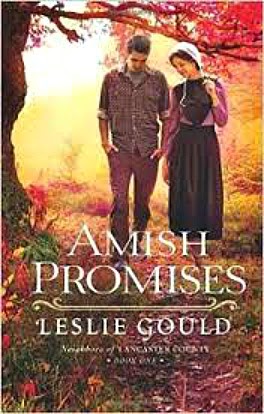
The back cover copy of Amish Promises begins, "Journey down a quiet lane in Lancaster County . . ." Let me just say, this story is far from a 'quiet lane' journey.
Joel and Shani Beck have decided that the best place for Joel to recuperate from the injuries he received in Iraq is in the farmhouse left to Shani when her grandfather died. Their neighbors are Amish, as are many of the families in the area. This could be peaceful, except that the nearest household is headed by Tim Lehman, a stern patriarch who is opposed to having an Englisch family next door. He does all he can to keep his children and his sister away from the Becks.
When Joel, who suffers from PTSD, compounds his war injuries in an accident, his Army friend Charlie comes to help the family. From this point on, the Becks' and the Lehmans' lives spin into a web of complications.
Once I started reading Amish Promises I could hardly put the book down. I've heard it said that Amish novels are always the same. If that’s true, then Amish Promises breaks the mold.
Leslie Gould is a talented storyteller. The concept of putting an Amish family and an Englisch family side by side is a refreshing change in the world of Amish fiction. The characters in Amish Promises are real people with the same flaws we all possess.
I give this book an enthusiastic two thumbs up!
My thanks to the author and Bethany House for providing my review copy.
April 14, 2015
DEAD WAKE, by Erik Larson
 I finished reading Dead Wake several days ago, and still can't stop thinking about it. Larson unwraps the story step by step, just as the events happened. By giving us names and details about various passengers, he gives this historic event a sense of immediacy. The narrative switches back and forth between the captain of the German submarine that ultimately sank the Lusitaniaand the shipboard days that unfold during the Lusitania's fateful final trip to England. Again, the details are what make the story. I've read The Devil in the White City and Thunderstruck, also by Erik Larson, so I knew I'd enjoy Dead Wake. But I had no idea how thoroughly captivating this book would be. I read every word, all the way through the end notes--which are interesting in themselves. Larson's narrative voice shines through Dead Wake.You don't have to be a history buff to appreciate this story. It's one of the best books I've read in a very long time.
March 30, 2015
SPRING ON THE OREGON TRAIL
My great-grandparents' journey over the Oregon Trail with their young children was filled with detours. Funds were scarce, so my great-grandfather, William Kirk, followed the developing railroad lines to find work. Some of these lines took the family far off the beaten trail west. They spent the winter of 1882 in a tent on an Indian reservation in Montana so William could take a job hauling freight from Missoula to railroad camps in the area. When spring approached, the freight-hauling work came to an end. William and another man then took a job hauling rock to rip-rap a river bank. (Rip-rapping is using loose stone to line a stream bank in order to prevent erosion.) When that task ended, it was April of 1883 and William was anxious to resume the trip to their planned destination--Washington Territory. Nearly a year had passed since they left Missouri, and they were still far from their goal. The distance between their camp in Montana and Spokane Falls, in Washington Territory, was only about 125 miles. However, the earliest date the road over the mountains would be open for wagon travel would be sometime in June. Rather than wait, William decided to backtrack the way they'd come--to Deer Lodge and southwest to the Idaho line. I can't help but wonder at my great-grandmother's reaction to this decision. For all intents and purposes, it was still winter where they were. They had six children, now ranging in age from 15 (my grandfather) down to a three-year-old. Living in a tent was no picnic, but traveling in a wagon through snow, ice, and mud wasn't going to be a stroll in the park, either. They left their winter camp on April 17. Seven days later, still in Montana, they arrived at Deer Lodge, a distance of 124 miles on today's roads.
In 1997, my husband and I retraced their route. This photo shows our "covered wagon"when we stopped for lunch between Birch Creek and Argenta. My husband is the sandwich maker at the tailgate of our pickup.
 The road south took them (and us) through a narrow canyon--boulders on one side and the creek on the other. Traveling down a 6200' pass, they passed through Argenta and Bannack. We probably drove over the same road they traveled.
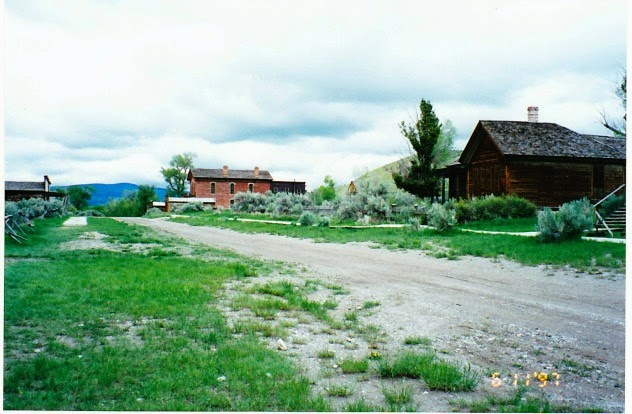 Here's a photo of Bannack (now a preserved ghost town), taken in 1997.
On May 2, they reached the Idaho border. It snowed on that date, so they stopped for a couple of days to wait for the trail to open up again.
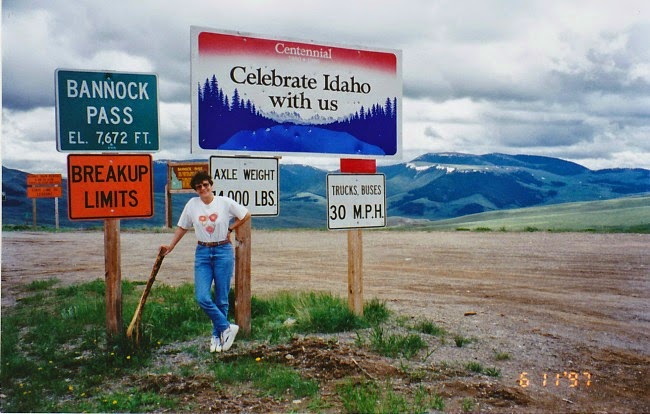
Here's a photo of how it looked when we were there--old road, new signs!
Soon they were traveling through the Idaho desert west of the lava beds (now a National Monument). On May 22, they reached Boise City, where they set up camp. In his memoir, my grandfather wrote, "This was the first time and place we had enjoyed any spring weather. People remarked when we came into town, 'These people are wearing their winter clothes.' " They camped there for at least two weeks, while William took a job transporting firewood to the Idaho State Penitentiary. June 14 found them crossing the Snake River into Oregon. At this point, they still had to travel north through Oregon before they reached Washington Territory. In September, 1883, they finally arrived in the area of Washington they had started for when they left home on May 12, 1882. They still needed to locate a homestead site, and another winter was coming on. But that's a story for another day.
December 1, 2014
A DIFFERENT KIND OF CHRISTMAS STORY
DECEMBER ON THE OREGON TRAIL
Sometime back, a friend and I were discussing my upcoming novella, State of Matrimony, to be included in the Oregon Trail Romance Collection from Barbour--release date April 2015. Since my great-grandparents came west on the Oregon Trail, my friend asked me what Christmas on the Trail would have been like. I replied that most emigrants traveling west made every effort to reach their destinations long before Christmas. Typically, families would depart from Missouri in April or May, and allow six months for the journey. Thus, they'd arrive in the fall, hopefully well before snow fell in the mountains.
However, my great-grandparents, William and Harriet Kirk, weren't typical emigrants. They had limited funds to cover the entire journey--think ferry charges, food supplies, animal feed, etc.--so they stopped along the way to allow my great-grandfather to find work. He was an expert at handling horse teams, and most often sought jobs with the railroad lines that were pushing westward at a rapid pace. They left Missouri on May 12, 1882, as part of one of the last great wagon train migrations. Their family consisted of themselves and their six children, who ranged in age from 14 (my grandfather, James) down to a two-year-old.
When the fall of 1882 arrived, instead of hastening west they turned north into Montana. Here's their story, taken from my grandfather’s memoirs:
In September they arrived in Missoula, Montana, where the Northern Pacific Railroad was under construction. William Kirk stopped the family at a railroad construction camp about twenty miles northwest of Missoula, just inside the Flathead Indian Reservation (now called the Confederated Salish and Kootenai Tribes). William did team and scraper work grading the roadbed for three or four weeks, then moved to another railroad site in October for a few more weeks.
In November, they packed up and moved farther northwest to another grading job. The family set up camp on the Clark Fork River, not far from the Idaho line and about sixty miles from Missoula, still on the reservation. William and James worked on railroad construction in a narrow valley following the river until the grading was finished, well into the winter. William then spent the rest of the winter hauling freight from Missoula to railroad camps where rock work was being done along mountainsides. My grandfather remembered the temperature dropping to as much as 40 degrees below zero part of the time.
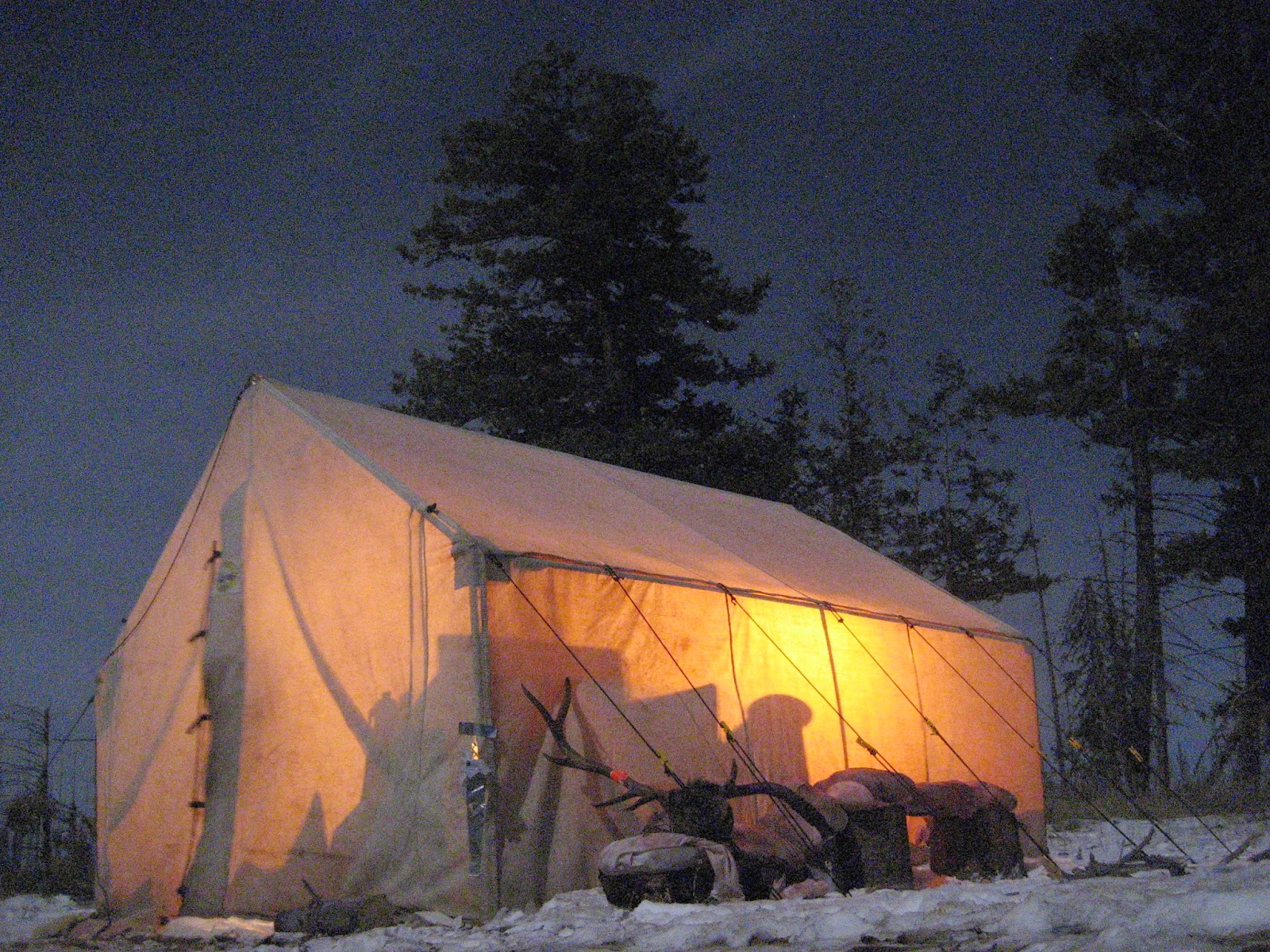
And where was the rest of the family--Harriett and the five younger children--while husband and eldest son were on the road? They were living in a tent on the Flathead Indian Reservation. I'm assuming it was a canvas wall tent, similar to those used during the Civil War. At most, it probably would have measured 12 x 14 feet. To give you an idea, although the snow isn't as deep, above is a photo of our tent taken during one of my husband's elk hunting trips. Picture six to eight people living inside for five months during a Montana winter.
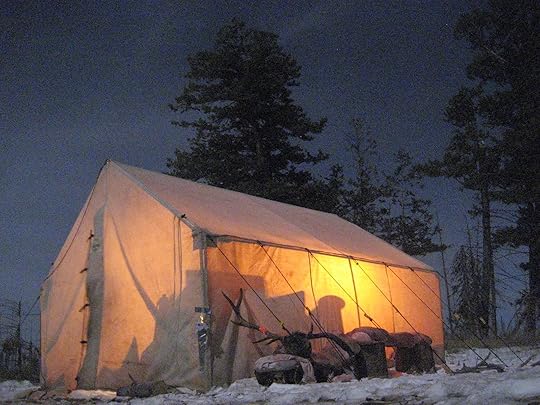 They had a little camp stove for cooking and heat, which kept them warm until the fire went out during the night. James remembers waking some mornings to find that water left warming on the stove when they went to sleep had frozen solid.
My grandfather's memoirs are filled with events he witnessed during that winter. Perhaps in another blog I'll share more of his story. Unfortunately, he didn’t mention Christmas at all, which leads me to believe it was a very limited celebration.
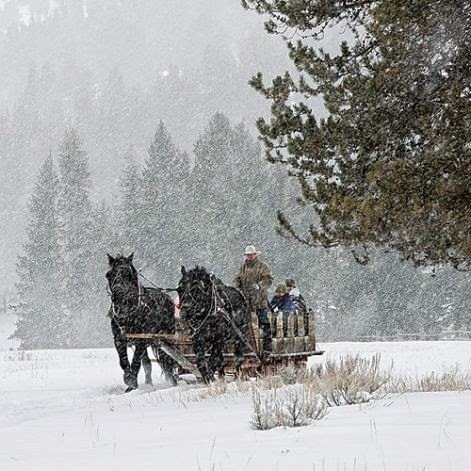
Under these conditions, Harriett would have done what she could to create a Christmas celebration for her family. Since William and James had access to supplies from Missoula, she had necessary staples to supplement the wild game her husband and son furnished. Perhaps their Christmas dinner consisted of a venison roast, or a roasted wild turkey. Given what she had to work with, there would have been potatoes, biscuits, gravy, and perhaps a precious orange or two from Missoula. This photo from Sunset Magazine helps me to picture my great-grandfather returning to the family tent with Christmas supplies.
 What if Harriet brought carefully packed jars of canned mincemeat or berry jam from home? Spices also travel well--cinnamon, cloves, or nutmeg would flavor sugar cookies. She may have stayed awake after the children were asleep to knit mittens or hats for them. Would William have brought any toys or books from Missoula as gifts? I wish I knew.
For the sake of this different Christmas story, we'll picture the family together, warm, and well-fed in their tent on that special day, and let our imaginations fill in the gaps.
What do you think they may have done to make the day special? I'd love to hear your thoughts.
Sometime back, a friend and I were discussing my upcoming novella, State of Matrimony, to be included in the Oregon Trail Romance Collection from Barbour--release date April 2015. Since my great-grandparents came west on the Oregon Trail, my friend asked me what Christmas on the Trail would have been like. I replied that most emigrants traveling west made every effort to reach their destinations long before Christmas. Typically, families would depart from Missouri in April or May, and allow six months for the journey. Thus, they'd arrive in the fall, hopefully well before snow fell in the mountains.
However, my great-grandparents, William and Harriet Kirk, weren't typical emigrants. They had limited funds to cover the entire journey--think ferry charges, food supplies, animal feed, etc.--so they stopped along the way to allow my great-grandfather to find work. He was an expert at handling horse teams, and most often sought jobs with the railroad lines that were pushing westward at a rapid pace. They left Missouri on May 12, 1882, as part of one of the last great wagon train migrations. Their family consisted of themselves and their six children, who ranged in age from 14 (my grandfather, James) down to a two-year-old.
When the fall of 1882 arrived, instead of hastening west they turned north into Montana. Here's their story, taken from my grandfather’s memoirs:
In September they arrived in Missoula, Montana, where the Northern Pacific Railroad was under construction. William Kirk stopped the family at a railroad construction camp about twenty miles northwest of Missoula, just inside the Flathead Indian Reservation (now called the Confederated Salish and Kootenai Tribes). William did team and scraper work grading the roadbed for three or four weeks, then moved to another railroad site in October for a few more weeks.
In November, they packed up and moved farther northwest to another grading job. The family set up camp on the Clark Fork River, not far from the Idaho line and about sixty miles from Missoula, still on the reservation. William and James worked on railroad construction in a narrow valley following the river until the grading was finished, well into the winter. William then spent the rest of the winter hauling freight from Missoula to railroad camps where rock work was being done along mountainsides. My grandfather remembered the temperature dropping to as much as 40 degrees below zero part of the time.
And where was the rest of the family--Harriett and the five younger children--while husband and eldest son were on the road? They were living in a tent on the Flathead Indian Reservation. I'm assuming it was a canvas wall tent, similar to those used during the Civil War. At most, it probably would have measured 12 x 14 feet. To give you an idea, although the snow isn't as deep, above is a photo of our tent taken during one of my husband's elk hunting trips. Picture six to eight people living inside for five months during a Montana winter.
 They had a little camp stove for cooking and heat, which kept them warm until the fire went out during the night. James remembers waking some mornings to find that water left warming on the stove when they went to sleep had frozen solid.
 My grandfather's memoirs are filled with events he witnessed during that winter. Perhaps in another blog I'll share more of his story. Unfortunately, he didn’t mention Christmas at all, which leads me to believe it was a very limited celebration.
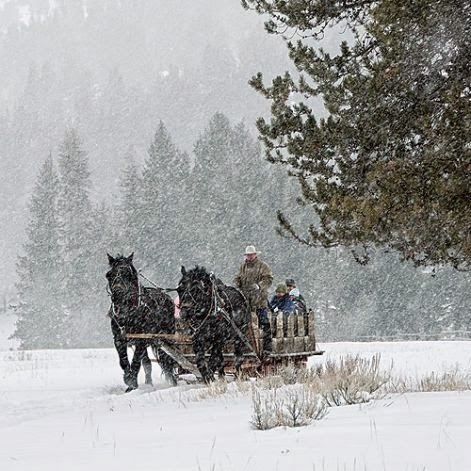
Under these conditions, Harriett would have done what she could to create a Christmas celebration for her family. Since William and James had access to supplies from Missoula, she had necessary staples to supplement the wild game her husband and son furnished. Perhaps their Christmas dinner consisted of a venison roast, or a roasted wild turkey. Given what she had to work with, there would have been potatoes, biscuits, gravy, and perhaps a precious orange or two from Missoula. This photo from Sunset Magazine helps me to picture my great-grandfather returning to the family tent with Christmas supplies.
 What if Harriet brought carefully packed jars of canned mincemeat or berry jam from home? Spices also travel well--cinnamon, cloves, or nutmeg would flavor sugar cookies. She may have stayed awake after the children were asleep to knit mittens or hats for them. Would William have brought any toys or books from Missoula as gifts? I wish I knew.
For the sake of this different Christmas story, we'll picture the family together, warm, and well-fed in their tent on that special day, and let our imaginations fill in the gaps.
What do you think they may have done to make the day special? I'd love to hear your thoughts.


