Donald Furrow-Scott's Blog, page 2
November 11, 2019
Winery Log, Fall 2019; Twenty-one
While lugging this year’s freshly-picked grapes into the cooler, a family member complained about having to heft the grapes an additional time for weighing. Given the number to times we already have to touch those grapes, it struck me as amusing, from both a farm work and wine-grower perspective.
First off, vineyards are farming, with all its dirt, sweat, tools, prayers, and hopes. I want to pick grapes along the Rhine or on the cliffs of Portugal some time to remind my muscles just how easy we have it here.
Secondly, when we use volunteers to help pick the grapes, the winemaker knows we’re going to have wildly erratic lug weights, from a few pounds to thirty pounds in each, as well as empty water bottles, clippers, and gloves tossed in the lugs for good measure. After decades of picking as a vigneron, we can accurately estimate lug weights. Still, if any simple farm task, such as pausing every lug on a weigh scale, can help build the winemakers’ confidence in a vintage, you say “Yes, Boss.” So, let me walk you through how many times we might touch a grape before you drink it.
The first touch will thrill the “life begins at conception” people reading this blog, because the first touch on a grape begins the year before your grape crop arrives. In May and June, we need to leaf-pull the leaves around the clusters of this year’s grapes (See #7), but this also exposes sunlight onto the forming buds of next year’s crop on the canes. Your crop load in these buds is thus established a year ahead of time. Why a grapevine bud exposed to sunlight produces a more fruitful bud makes more sense if you realize the plant needs birds and animals to see the grapes, so they eat the fruit and pass the seeds on, away from underneath the parent vine. Grapes are not good acorns.
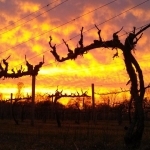
The second touch is eight months later, in the dead of winter, pruning. Cutting the canes of last year’s growth makes room for this year’s crop.
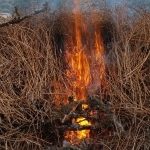 Then, of course, you have to do something with those cut canes. Left piled up under the vines; they could cause a lot of disease and pest problems. Raked away into piles or put through a chipper to make a quickly biodegradable mulch are a common third touch, but some vignerons simply burn canes in a wheelbarrow as they prune to keep warm in the cold. Myself, I prune the canes into a trailer, and about one plant in ten into a bucket and use a scale to measure cut cane weights and adjust my pruning accordingly. I then burn the big pile during snowstorms.
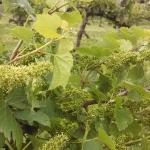 As the spring warms the vines up and they bud out, we begin the fourth touch, thinning. We want the same number of canes and leaves per cluster of grapes (See #11) to create uniformity. Too many canes on one plant over another cause imbalance in both the crop and the eventual wine.
The fifth touch is how most wine-growers spend the spring, tying; attaching the new vines to trellis wires or containing them in a specific growth style. Left to wild abandon, grapevines get unruly and become difficult to care for, keep healthy, and pick. Fine in the wild, but bad for business. In places where the vineyard real estate gets pricey per square foot, they use elaborate wire trellis systems, easily costing 10K per acre, and even more for the farm labor to tye them up to it.
Now that the plants are growing comes the Health Care portion of the grape’s sixth touch, spraying. Insects and fungus want the grapes more than we do, and they are not nearly as picky as the vigneron about quality. Whether one goes organic, biodynamic, or modern, the grapes are constantly hand-inspected for disease problems, and something is being sprayed on them to alleviate those problems. Here the “what” has a tremendous impact on the vineyard and the nature around it. Lots of rules and regulations here, no matter what style of sustainable responsibility the vigneron chooses.
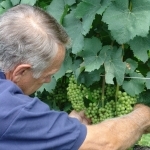
For our seventh touch of the grapes, we arrive back at leaf-pulling again, but this time the focus is on getting the current grape clusters more exposed to sunlight, drying winds, and the sprays of #6. And yes, we are also starting the process for next year at the same time.
Rinse & repeat is the rule for tucking, our eighth touch, and begins the traditional image of the vigneron in the summer fields. Wind and nature despise pristine arrangments and the human compunction for an order to things. Still, vignerons dutifully put the canes back into place day after day like Disney employee’s keeping the landscape fresh every morning. Some vignerons go so far as to tye individual vine canes in specific leaf orientations to the sun for wine quality goals. You will know this by the price of the finished wine because this labor is costly meso-management of the vineyard canopy.
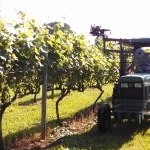 Now that our grapevines are growing happily with visible clusters of grapes forming underneath, we begin hedging, our ninth touch. Cutting off the top of the cane stops it growing endlessly. Canes will often happily grow into its neighbors and along wires, causing problems with vine disease and dramatically affecting the quality of the wine. Think of hedging as reminding the vine to concentrate on watching over the kids (the grapes).
With many varieties of grapes, the moment you hedge the top of the cane, it responds by forming new canes off buds up along its length. These perpendicular canes are called laterals. These laterals can act like rogue canes in a trellis, and can often create little “earing” clusters of grapes that are weeks or even months behind the main ripening crop below. Touch ten is removing laterals before they become a more severe problem.
The eleventh touch is a critical, tearful touch for the grapes & grower, and it goes by two names. “Balancing” is what the vigneron is doing, by dropping off certain little parts of clusters called shoulders, or dropping whole clusters off vines that have developed too heavy a crop load compared to its leaves and neighbors. This tearful moment can also be called “dropping money,” because, at $2 a pound for grapes, that is precisely what you are doing. Again, this is a quality decision every winemaker wants and every vigneron fears. Sampling grapes begins here as well, to access that quality.
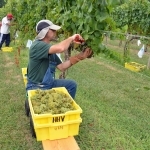 Finally, in fall, we arrive at the most critical twelfth touch, picking. Picking has so many variables that it would take an entire blog to cover all by itself. Suffice here to say someone or something has to separate the grapes from the vines to proceed. Machinery to do this can cost a quarter of a million dollars, so that is out for the small producer like us. Paying to have a service come to us and use such mechanical harvsters is also cost-prohibitive. Harvest picking thus tends to rely on family and volunteers to get the job done.
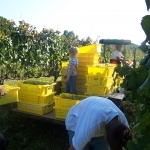 Lugging is the process of picking up those picked grapes and taking them to the winery. This thirteenth touch is the back-breaking portion, and at a minimum, requires the picked grapes to be carried and dumped into another container. We use stackable lugs that are lifted and put on a trailer, but again, there are many options here based on size, scale, and personal preference.
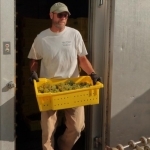 Cooling is the fourteenth touch. We once heard in class that you should treat a cluster of picked grapes the same way you would a glass of milk, and I’ve always loved that advice. You can’t just leave the grapes out in the hot sun, and very few modern wineries can crush every grape within minutes of picking it. We also feel the cooling process makes a better wine for us, so the brimming lugs are stored temporarily and kept cool. Under a shade tree is the old stand-by, but we use a walk-in refrigerated cooler. The cooler lets us keep the grapes above freezing but cold enough to stay fresh as we take a couple of days to finish picking the entire crop.
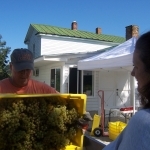 The fifteenth touch is almost as famous as picking; the crush. If you picture Lucy dancing about in a vat of picked grapes, you probably count this touch as feet instead of hands, though nobody really stomps grapes to make commercial wine. Ancient winemakers didn’t always have a wine press available nearby, and medieval lords charged peasants a stiff percentage to use their expensive wine presses, so folks figured out alternative ways to squash grapes into juice themselves.
The sixteenth and seventeenth touches, pressing and fermentation, are reversible, depending on if you are making white or red wine. With white wine, we take the crushed grapes and press out only the juice into tanks, where we will add yeast and ferment the juice into wine. With red wine, we add the yeast to the crushed grapes, skin and all, and then press out the red wine when the fermentation is complete. This critical touch is where good winemakers earn their keep.
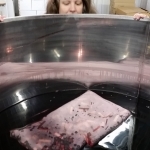 Letting the tanks of wine, red or white, settle over weeks is how wine is clarified. Filters would remove lees and things faster, but filters also remove flavor, body, aroma, and color. Fining is where winemakers can add items like oak, powdered milk or egg whites to tweak wine flavors. As the milky layer forms at the bottom, the cellar workers start racking, or draining off the more transparent wine above it into another tank and throwing away the thin cloudy layer. We can perform this eighteenth touch once or repeat it several times, depending on the style of wine and winemaker’s wishes. This can also be the coveted touch know as “barrel-tasting,” where the winemaker (and happy potential guests!) “steals” wine with a long “thief” to judge how the vintage is coming along.
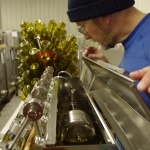 Unless you want to drink out of barrels like Fortunato (and look where that got him), the nineteenth touch is bottling.
Twenty touches and probably two years from when we started, we arrive at the bottle of wine released from the cool winery into the tasting room, or a fine wine shoppe or restaurant, or perhaps your grocery store shelf.
All this brings us to the last, most important touch. Twenty-one is handing the finished bottle of wine to you.
Sometimes, like live musicians and painters at an exhibition, winemakers get to witness your emotional reaction to their art instantaneously. Usually, though, winemakers, like novelists, now step back from a similar artist’s perspective once they hand the sealed labor to you like a wrapped gift. As you savor the wine, may you begin to understand and appreciate the long process and work that goes into crafting something purely intended for your potential enjoyment.


September 2, 2019
Winery log, Fall 2019; Wine tasting with the sommeliers
Every art form we humans enjoy has opinionated experts ready to guide and train others in that art’s appreciation. We find it with movies, food, music, books, and yes, particularly wine.
Benjamin Franklin wrote in Poor Richard’s Almanack: “Beauty, like supreme dominion, is but supported by opinion.” Catchy, especially for our ambassador to France and a guy who palled around with wine aficionado Thomas Jefferson. More to the point, it helps explain good, bad, expectations, and opinions in art taste.
Order ice tea in Pennsylvania, and you will get unsweet tea and sugar packets. Order ice tea in Georgia, and the spoon will stand up without ice. The opinion makes one good or bad for your taste, and the location sets up the expectation. Ordering the fish off the menu and having it arrive sushi raw or blackened to a crisp will not meet most people’s expectations. A popular food critic will know their audience well enough not to insult their social opinions en-masse but will be confident enough to point out actual flaws and mislabeling. If you want to avoid being confused, offended, or are seeking confirmation about your art opinion, it is entirely up to you to find and follow a critic that has similar tastes to yours. And so it is with wine.
Firstly, you need to understand that wine is art. There are faster ways to get drunk and cheaper ways to drink all night. Boone’s Farm, Arbor Mist, and Barefoot are good examples of mass-produced reprints or pop-music. They sell. Whether these wines are any good is subject to opinion. That these wines maybe don’t represent the epitome of artistic expression is not snobbery so much as a common expectation of “you get what you pay for.”
Sommeliers are thus wine art critics, and as an organization, they specifically cater to those affluent enough to be looking to dabble in something special. Think of them as safari guides to wealthy unicorn hunters. Some are excellent teachers and can guide us to wonderful discoveries about wine. Others will talk down to us like an idiot. Seek out the former in your wine journeys, because until we increase our salaries x10, the latter won’t have much time for us.
Understand those sommelier organizations do not exist to uplift the wine world for the common consumer. They exist to help sell high dollar wine in 5-star restaurants and resorts. If it helps, try to remember that “sommelier” to the old French court meant “napkin-holder” and the “supply train.”
So how do you connect with knowledgeable sommeliers? Well, the good ones have already connected with you, before your introduction. Let me explain, using music.
Sommeliers are like classical music conductors. It helps if they can all speak the same language and use the same descriptors, to do their jobs of selling. So conductors learn to read music notation well. When they step up to the podium, they get everyone on the same page.
Conductors know every instrument in the symphony by heart. They not only know who First Chair is, but they can also often name every other musician. They intimately know the difference between the viola and the violin’s mood and effect in the piece and can tease it out for everyone to hear. After the concert, they will schmooze with the big donors, and tell stories about the original composer. Finally, at home afterward, they can play parts of the performance back from memory because they remember the music that well.
You, however, can walk into this concert hall and be completely moved to tears by the music and never know any of that. And THAT is where you and a good conductor have already connected. You share a deeper love of music in the first place.
So find in your sommelier someone who likes what you like, even if it’s only in print or a blog, and let them teach you with a shared passion. You are joining a welcoming social art form that wants to include your opinion. You are joining a herd. Set aside, for now, those critics who recommend what you know you don’t like, understanding your artistic choices may or may not change one day to make them more alluring. And realize if you really want to rub elbows with the biggest stars, you’re going to have to move up on the donor’s list to get noticed. The lion snobs will insist you to spend a fortune on a bottle, but the good sommeliers will recognize your budget and recommend an excellent wine to fit.
The good ones can share their love of wine with yours.
Winery log: Fall 2019, Wine tasting with the sommeliers
Every art form we humans enjoy has opinionated experts ready to guide and train others in that art’s appreciation. We find it with movies, food, music, books, and yes, particularly wine.
Benjamin Franklin wrote in Poor Richard’s Almanack: “Beauty, like supreme dominion, is but supported by opinion.” Catchy, especially for our ambassador to France and a guy who palled around with wine aficionado Thomas Jefferson. More to the point, it helps explain good, bad, expectations, and opinions in art taste.
Order ice tea in Pennsylvania, and you will get unsweet tea and sugar packets. Order ice tea in Georgia, and the spoon will stand up without ice. The opinion makes one good or bad for your taste, and the location sets up the expectation. Ordering the fish off the menu and having it arrive sushi raw or blackened to a crisp will not meet most people’s expectations. A popular food critic will know their audience well enough not to insult their social opinions en-masse but will be confident enough to point out actual flaws and mislabeling. If you want to avoid being confused, offended, or are seeking confirmation about your art opinion, it is entirely up to you to find and follow a critic that has similar tastes to yours. And so it is with wine.
Firstly, you need to understand that wine is art. There are faster ways to get drunk and cheaper ways to drink all night. Boone’s Farm, Arbor Mist, and Barefoot are good examples of mass-produced reprints or pop-music. They sell. Whether these wines are any good is subject to opinion. That these wines maybe don’t represent the epitome of artistic expression is not snobbery so much as a common expectation of “you get what you pay for.”
Sommeliers are thus wine art critics, and as an organization, they specifically cater to those affluent enough to be looking to dabble in something special. Think of them as safari guides to wealthy unicorn hunters. Some are excellent teachers and can guide us to wonderful discoveries about wine. Others will talk down to us like an idiot. Seek out the former in your wine journeys, because until we increase our salaries x10, the latter won’t have much time for us.
Understand those sommelier organizations do not exist to uplift the wine world for the common consumer. They exist to help sell high dollar wine in 5-star restaurants and resorts. If it helps, try to remember that “sommelier” to the old French court meant “napkin-holder” and the “supply train.”
So how do you connect with knowledgeable sommeliers? Well, the good ones have already connected with you, before your introduction. Let me explain, using music.
Sommeliers are like classical music conductors. It helps if they can all speak the same language and use the same descriptors, to do their jobs of selling. So conductors learn to read music notation well. When they step up to the podium, they get everyone on the same page.
Conductors know every instrument in the symphony by heart. They not only know who First Chair is, but they can also often name every other musician. They intimately know the difference between the viola and the violin’s mood and effect in the piece and can tease it out for everyone to hear. After the concert, they will schmooze with the big donors, and tell stories about the original composer. Finally, at home afterward, they can play parts of the performance back from memory because they remember the music that well.
You, however, can walk into this concert hall and be completely moved to tears by the music and never know any of that. And THAT is where you and a good conductor have already connected. You share a deeper love of music in the first place.
So find in your sommelier someone who likes what you like, even if it’s only in print or a blog, and let them teach you with a shared passion. You are joining a welcoming social art form that wants to include your opinion. You are joining a herd. Set aside, for now, those critics who recommend what you know you don’t like, understanding your artistic choices may or may not change one day to make them more alluring. And realize if you really want to rub elbows with the biggest stars, your going to have to move up on the donor’s list to get noticed. The lion snobs will insist you to spend a fortune on a bottle, but the good sommeliers will recognize your budget and recommend an excellent wine to fit.
The good ones can share their love of wine with yours.
July 10, 2019
Vineyard Log, Summer 2019; Shamir

Folks who see my novels for sale in the tasting room often ask where I find the time to write. This time of year, I don’t. It’s the vines who are busy spinning yarns. This is the time of year to simply listen to them tell me their ancient tales, whisper their secrets, and share in their story one more season.
Soon enough, they will slumber again, and the hard struggles of summer will be carved and polished into the rich-grained stain of winter. A shamir of wine, to reveal the stories of old I was told as a patient, appreciative guest.
June 6, 2019
Author’s Log, Summer 2019; Lessons learned as a new author (for a KDS guest blog)
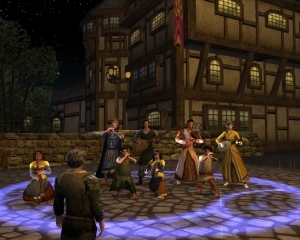
At a very early age, music began to affect me quite profoundly. I adored music, loved it actually, to the point I consumed it. AM radio was my most significant source of music in the 1960s, but my older brothers got record players, and then the living room got a big quadraphonic stereo system, seemingly as important as the television in the late ’60s. My parents and brothers taste in music exposed me to everything from musical show tunes to Simon & Garfunkle to Classical to the Beetles. My older brother Robert played in folk and bluegrass bands as well as school musicals. I remember bearded mandolin players frequently playing in the living room crowded around tape players, and long hours wandering theater backstages during his rehearsals for shows like Auntie Mame. Classical music, however, intrigued me the most.
In 6th grade, I tried to learn to play music. I wanted to play the flute, but it was too “feminine” an instrument for a boy. They gave me a saxophone instead, probably because the school band needed another saxophone player more than a flute player. To my honest shame and puzzling confusion, though, I had no real musical talent. As a very late bloomer, guitar necks and saxophones were too big for my small hands and body. I could play notes, understood chords, but making music did not come as freely, or so easily, as listening to music. The talent eluded me. I left Band in Jr High, despite boot-camp threats from the Principle that I would have to stay and learn anyways. Ah, no.
My classical music and show tune album collection were joined by Walter/Wendy Carlos’ Switched on Bach. Wow. That began an electronic vibe and connection that is still one of the core musical values of my soul to this day. Alan Parson’s record Tales of Mystery & Imagination was a gift from one of my brothers to the other, and grass mowing money earned me my copy to wear out. I Robot followed, as did every other album they made ever after. Vangelis’ Pulsar came next, and then Larry Fast’s Synergy. I still own the vinyl of all of them, as well as the mp3s now.
I grew almost a foot after High School (I said I was a late bloomer!), to the point that teachers did not recognize me a year later. I took up the guitar again, which fit my hands much better now, and employment let me buy Stratocasters, amps and then a Tom Scholz “Rockman” so I did not explode my neighbor’s patience. I padded the closet of my apartment into a sound studio, and reel-to-reels and twinkling equalizers drove my nights and weekends.
My music still sucked. My failing talent was not a question of devotion to practice; I played daily for years and took lessons from pros. Every copy song I tried would never surpass “almost” to my listeners. Every original song I tried to write sounded the same. For a decade.
Long periods with an acoustic trying pure classical guitar did a little better, but I could never break through some magical, professional-sounding barrier. I added a big Aspen bass, which I enjoyed but lacked the natural rhythm to pull off. Then in an attempt to find a deeper connection with my electronic love I got a synthesizer and discovered I was even worse at keyboards.
I sold off and gave away all the equipment at the end of the 1980s, from reel-to-reels to spare strings, and gave up on playing music. My only reminder of that whole long experience is a bamboo flute my brother gave me eons ago, which I play in the vineyard when I’m feeling sentimental, and the vines ask for a song.
By this point, you probably believe you misread something and have rechecked the blog title at least twice. Neither of us is mistaken.
You see, parallel to my musical journey was my writer’s journey. Reread the above paragraphs. Every time you see the word “music” replace it with the word “writing.” Then; song with story, guitars & basses with fantasy and sci-fi, reel-to-reel with word processors, and keep all the same stupid teenage angst, long hours of practice and effort over the decades.
After giving up playing music, my purer enjoyment of listening returned. My depression began to subside. By focusing on my writing, while listening to music, my art improved, and I broke that mysterious elusive “bubble” where the people who were reading my stuff began to compliment me. I wasn’t just “almost” anymore; it was the beginning of talent. It sounded good to them and me. Online cooperative fiction was like being in writer’s bands, and my growing ability encountered encouragement, correction, envy, and praise from peers and then older pros. I got a lot of excellent guidance and had to process a lot of tricks, advice and style choices.
Ten years of such daily writing practice honed necessary skills to the point I could write for the public and folks enjoyed it. This was my “copy band” phase as a writer. Then came another decade of intense focus, finding my own voice for stories instead of fan-fic based on other author’s fine works. Long hours in the quiet, peaceful vineyard fueled my imagination like endless epiphanies.
To crescendo this musical journey metaphor blog about my writing; I’m self-published now. I’m “out there” with my art, and it is advertised to those who seek its various topics. Will I ever be on the radio? Doubtful, but like a lottery ticket, at least there is some tiny chance over the solid “no” that accompanies not trying. Will I ever attract the attention of a publisher? If my writing is good enough, yes. Will I ever be known as a local author and entertain friends and family? I’m already living that glorious dream. My books on wine history are for sale in the tasting room and are the subject of questions, inquiries, and discussion with strangers every day. My new books flow onto the screen every morning with the sunrise before I take to the vines.
Do I have talent? Your clapping will let me know if that’s true.
Do you have the talent? I can only encourage you to get over your stage fright and try and then applaud your efforts.
The metronome of your art life is already ticking for you…
March 30, 2019
Author’s Log, Winter 2019; Marinade pt. 2
So marinade can make a huge difference to food and makes a big difference to wine, but it is also a unique ingredient to better writing.
You can throw salt & pepper and a touch of garlic on a steak and pan-fry it up in minutes. It’ll be good. But not every steak is prime sirloin, and not every story we write is prime either. Some are deeper, with complex plots that take thought to follow. Stew meat, port roast, prime rib, they take preparation to make the difference between tasty and chewy.
Over time, letting a novel of mine “marinate” for 3-6 months dramatically improves the story. It used to drive me crazy. Is the artist’s rush of excitement to get a new story out to the public merely pan-frying a steak to satisfy basic hunger? Are we looking for the cheer of a captive crowd to feed our egos? Is it the musical thrill of playing a song with written words? Writing is not playing music, and the immediacy of writing’s lost applause is ultimately forgotten by the gentle wash of time’s perspective. Good music is responded to; good writing is considered. Both can still be quite emotional.
When I finish a novel or a re-write of a novel, the first thing I do is put on hold and start another one. First, it clears the mind of all the excess baggage that seems to come from the incredible focus it demands to finish a book. Coming back weeks or months later gives a healthy perspective. The flaws glare like a desert sun. The cracks have appeared, the sauce reduced, and the emotions nuanced. Quick fixes, lost in the sprint to the finish line, become obvious flat tires.
There is not one story, novel, or blog of mine for that matter, that doesn’t benefit from a change in time and perspective. I have to let a novel marinade to (hopefully) get you to close your eyes and give s savory “Ummmm..,” at the critical moments in the story. I may want applause, who knows, but I’ll trade a few seconds of clapping for someone asking when the next dinner party will be.
February 19, 2019
Winery Log, Winter 2019: Marinade pt. 1

Time does exciting things to wine as it is first made and then ages. How long grapes hang on the vine starts the ticking clock. What temperature did the picked grapes reach? How soon is it crushed, how hard, and for how long is it pressed? Once a wine is fermented from the juice, the real changes over time begin. How it is kept, filtered, adjusted, left alone, ignored and lavished with attention, all change the wine’s fundamental nature. Bottle it, and you put everything into slow-motion. Fast forward to the cork popping, and begin the third phase. How much air? Decanting, aerating, swirling, pairing, all make a difference. The wine clock goes from weeks to months to years to hours or even minutes.
In my research of ancient wines, particularly Phoenician and Roman eras, I’ve got to say, the entire Mediterranean was just as nuts over wine as they were over something called garum. Salted fish, particularly mackerel, was reduced into something that was a lot like modern Whorstichire sauce. And the ancient well-to-do to near-do-wells all wanted it in their recipes.
Exactly what was garum? Ok, you asked. Fish-gut wine. Fermented fish-guts. Highly-treasured over the whole Mediterranean Sea. Not exactly my cup of tuna.
People exposing their opinion of “fine” wine often fail to realize their opinion is rooted in the pure moment. You cannot take an argument that Merlot is passé or that dryer wine is more cultured if you don’t understand that to shift a few decades one way or the other changes the paradigm. Opinion is transient and entirely mutable to culture. There is no “this wine is the best for any time, place or mood.” Searching for such eternal truths is noble. Beating people over the head with it is just rude.
One of the primary uses for garum was as a marinade. The acidity helps break down meats and moisten them into juicy tidbits. The salt adds flavor. The fish adds flavor. Add fresh spices to the garum, and you get a flavorful bonanza of tastes that certainly appealed to a lot of ancient people.
Our wine-making at the beginning of the process is a lot like a marinade, as the acidity on the skins hydrolizes, extracts and alters the character of the tough, tannic wine. Oak is a lot like fresh herbs in the marinade, adding new and accentuating flavors in the wine. Long-term storage is like putting the marinating meat in the refrigerator and letting cool patience soften the dish.
So ask how the wine you are being poured was made. Inquire about how the wine was marinaded, because the Merlot from one vineyard can be the same cloned plants as the next, but the flavors entirely different.
And realize, as you rinse out your glass with water or slowly swirl the wine sample, you are adding your own touch of marinade to your tasting.
January 15, 2019
Vineyard log, Winter 2019
(me in Virginia Tech vineyard seminar) “I adore pruning.”
(young fellow student in class ) “Yeah, sure. Numb fingers in the freezing cold, the canes thwapping you in the face. You’ll come to hate it soon enough.”
(me) “I’ve been pruning for twenty years. When do you think this hate will kick in?”

Pruning is one of the most wonderful times in the vineyard. It is quiet. The world leaves you alone in peace. Each vine gets its own moment of love, its few minutes of focused study, bare naked of leaf and bug and sweat distractions. It is part forensic (why did you die?), part medicine (trim out the weak, favor the strong) and part zen philosophy (How do we wish to grow in life, vine?)
For a boy who wanted to run away and live on an island, then discovered you really can’t, the vineyard in winter is pretty dang close.
Sheets of clouds are the winter norm. The big fluffy cumulus are not as common. The sheets of ice and snow seem to match the sky.
Once you have sized up the vine, the routine is pruner clipping, which are like small by-pass lobbers. It is hard to believe how they used to use saws for this task.
Your mind wanders. Thumb on cordant, 2 buds, snip. Put the canes in the trailer. Rewrite those two sentences again. This imagery would work there. What are that character’s motivations? Why would they do it that way, it wasn’t one of the emotional markers I had assigned to them. Better to have the other character suggest that.
Next vine.
Getting dark. Park the tractor & trailer. Time for chicken soup, grilled cheese, and a St. Emilion beside the woodstove at the writing desk for the evening. To get those thoughts down, while they still sing in your mind, before sleep and the chores of the next morning erase the clarity.
November 11, 2018
Author’s Log: Fall 2018 Rebooting
Starting over is cathartic for artists. Gut wrenching, painful, but from that can come artistic growth. So in the late 1990’s, I started over in so many ways.
During this rebuilding time, I met my soulmate and wife. I don’t know why she fell in love with me, but whatever the original reason, we were obviously meant for each other. Slowly we built a life together, and I learned what love really was from her.
I still had no players for D&D, Star Trek, or tabletop gaming. As she studied for her MCSE I began playing Dark Sun, an online RPG, but it was an empty, dying video-game world. Then on a second chance, despite the box graphic, we both began playing the online game Everquest. Kaladim and Kelethin, the dwarf and elf towns in the game became our second home, and we spent at least two thousand hours playing together over the next couple of years. Tejj the Klingon engineer became Tejj the Dwarf wagon drover, now adventuring with Turakin the Elf druid, and my writing spirit came back. We made friends online who became friends in the real world, and we visited each other in New York.
After Everquest came the online game Dark Age of Camelot, where new yet old Tejj & Turakin defended Midgard relics night after night after night, and where Ali bin Sophos ibn Al Andalus found his way from Gibraltar to Camelot England, and my fantasy writing in the online forums continued and grew.
After a couple of years of Dark Age of Camelot came the online game Star Wars Galaxies, and Tejj the wookie doctor of Nashal was born. Gelk Industries was built from cross server trades, with a dozen houses and hundreds of resource generators, and millions of credits in selling “Talus Water”, exotic crafting stations and feeding the bulk materials needs for level grinding the game required to become Force enabled. Star Wars writing took me to new places, and Dr. Tejj along with his mate wookie scout Turakin and her two killer dogs rode our falumpasets over ever every square bit of Talus, Naboo, Tatooine and other alien worlds. It is still the most fun in any online game we ever played and enjoyed.
Star Wars Galaxies was perfect for us but so unstructured that it annoyed too many people and it eventually failed; the only game to ever leave us instead of vice-versa.
The online game World of Warcraft came along about the same time as our daughter. My wife got into beta. I joined her when it went live. Dwarves and Elves became Taurins and Orcs, and then became Gnome wizards. The in-game roleplay was frequent, but my fantasy writing was not. Warcraft didn’t lend itself well to my fantasies.
I enjoyed the star ship aspect of Eve Online, and enjoyed building a merchant’s empire, but again, fantasy adventures alone loses some of its charm. Nobody seemed to be role-playing in Eve in the 2Ks. The somewhat visceral PvP nature of Eve was also a bit more stressful than I wanted for a passtime.
I had followed MEO, Middle Earth Online, for many years, waiting impatiently. MEO eventually changed into Lord of the Rings Online, and I joined a group of online writers who formed a guild waiting for the game to come out. They were called the “Gathering of Laurelin”, and twelve years later I am still with the “Leaves of Laurelin”, though thru many iterations, leader and server changes.
Thus the most serious writing I had ever done to date began, and has continued for over a decade. Incredibly gifted writers, and wonderfully engaging writing. I am humbled these people even included me.
A problem with Tolkien fan-fic writers is that none of us are Tolkien, but some of us think they are. Even finding general agreement on le hannon is beyond the ability of anyone but the dead author himself, and this kind of debate can lead to pointless arguments. It is very difficult to please such a learned, imaginative group that holds such strong emotional connections to their interpretations of the original story. We are almost denominationally religious in our enthusiasm, and subject to excessive drama over trickiness and sensitivities.
I have been a vigneron and winemaker for almost 20 years now, and have poured wine to over a quarter million tasters in that time. I have learned a great deal about wine, and a great deal about tasters, and a tremendous amount about unnecessary pretentiousness. This industry is far too often fools selling wine to fools, and it desperately needs to strike a tone closer to music appreciation than unapologetic snobbery.
Along with learning about wine, I learned about wine history, and slowly the idea began to develop that my creative writing could move into historical fiction about wine. I’ll leave potential futuristic wine fiction till another day.
Thus a past of writing, decades of wine industry exposure, research and time have lead to the Wine’s Anvil series.
September 30, 2018
Winery Log; Fall 2018; Wine tasting with the Unicorn Hunter
How do you meet dead people? Or legendary people who only exist in some other-worldly realm? This is the dilemma of the Unicorn Wine Hunter.
Now, there certainly are the braggarts that want to show off to the people at their table, and maybe the tables next to them as well, by paying a few hundred bucks for a bottle of wine. Revel in the blessings of the Universe if you have such cash to blow on something like that. The rest of us think of that as Rent Money.
But amongst the high priced bottles, estate auctions and quiet couples that wander into out of the way wineries, there are the Unicorn Hunters.
Imagine for a moment that you get to watch a special movie with your favorite actress or actor. It will only be shown once, to one group of movie-goers, and never released on video or TV. Or, imagine a private sporting event with your favorite players. That one day, in that one stadium, they will play a game that will not be recorded or televised; no highlights, just those players, playing at their hardest and best for one stadium full of lucky people.
This is the essence of a Unicorn Wine to a devoted Hunter; the rare treat to find or discover something truly out of the ordinary, an almost magical moment marrying wine and taste and opportunity. The Unicorn Hunter will talk about the rare wine they came across like the moviegoer will describe the movie plot, camera work, and score, or the sports fan will talk about the winning run, goal or save. You missed it. You should have been there.
Now, to be certain, a Unicorn Wine is as rare as real unicorns and can be just as fickle about revealing itself to Herds and Lions. Sometimes it is the rare wine from a legendary winery that is no longer available from anyone, but, look here! In the wine cellar of dead Baron von Blowhart is a case! Call Sotheby’s! Unicorns are treasures.
The inner dream of every winemaker who gets into the winery business is that they manage to craft the legendary Unicorn Wine that some Lion critic wanders in, discovers, and puts the winery on the map of Holy Grail Wineries for the Herds to go stampede. Just like authors and their novels, there is far more day to day grinding of average and even mediocre wines out there than unicorn dreams, and at some point, the overwhelming majority of authors and winemakers have to come to grips with the reality over their dreams.
Not so for the Unicorn Hunter, though, for there is always another winery around the corner. Always another Lion who has a bottle or two squirreled away and willing to share on that rare night. Always a chance, just that chance, they might stumble across a Unicorn if they are very patient.