
Nathan Delling's Blog, page 2
April 24, 2021
Rust and Recuperation
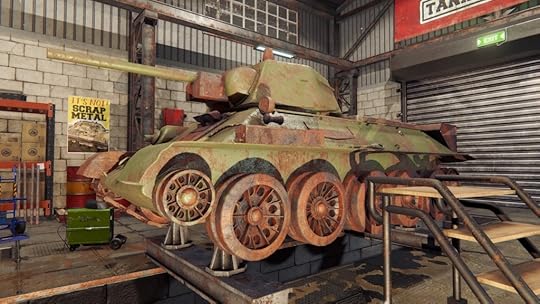
Back in December, I started writing another novel and it’s been a joy to do: I’ve never known a story to fly together quite the way this one has. Rust and Recuperation is the story of a resourceful underdog who owns a workshop where he repairs armoured fighting vehicles for collectors.
OK, I admit it: I was playing a lot of Tank Mechanic Simulator late last year. It’s not exactly a game – not least because there’s no real challenge other than coping with the alarming number of bugs – but the process of finding, cleaning, de-rusting, and reassembling a tank wreck into a fully restored vehicle is incredibly therapeutic. Despite the fact that there were only fifteen types of vehicle to find, I kept on digging them out and fixing them up… and as I did so, I started telling myself stories. Imagining the conversations with awkward clients; the challenges and the scrapes I might get into.
Inevitably (because I wouldn’t be me if I wasn’t scribbling) I started writing. I listed a few of the ideas that I had for chapters, then added a heading that might have been a working title: “Lovejoy with Tanks.” That’s basically what I went with, writing about adventures and challenges where each involves neglected or abandoned armoured fighting vehicles.
There’s Simon, the self-confessed tank nerd who quit school because he was in a hurry to start working with tanks. There’s Alex, the reformed car thief who would hate for anybody to think that she’s succumbed to the “tank thing” (although it seems quite likely that she has)… and there’s Mike, who would tell you he’s trying to run a business: not a retirement home for tanks or a club for misfits. And then there are the Bad Guys, because life as a tank mechanic is about to get dangerous.
(Is there even a genre for this?)
In any event, it’s currently being read by a good friend and I’m nervously awaiting his feedback – the first time anybody’s seen it. (Yeah, I can write sixty thousand words on a whim…) He isn’t performing a proof-read exactly, because I don’t share half-finished documents and expect other people to find my typos – but more of a “what do you make of this?” kind of read-through.
If he says it sucks, kindly forget I mentioned it.
If not, perhaps the world is ready for historical vehicle restoration crime fiction after all.


February 6, 2021
Quite Literally from the Vaults
Early drafts of ‘Outbreak 1917’ had quite a substantial preamble, but I got rid of it in the end. I think it was Alwyn who said that it didn’t add a lot to the story: thus it was axed in favour of the far shorter opening that you see below. (Or in the freebie preview at Amazon.)
Item: a pocket diary for 1921, used not for recording appointments but as a notebook. Written largely in pencil. Found during building renovations at St George’s Hospital – formerly Stafford County Asylum. Top Secret.
final version
Dredging through my old drafts, though, I found this… and thought it might be interesting. Superheroes all have origin stories nowadays, so why can’t stories have origins?
A Prologue, UnusedI never knew my grandfather, Malcolm Lawrence. Until recently, virtually all I could have told you about him was that he served as an Assistant Surgeon in the Royal Army Medical Corps during the First World War – and that when at last he returned home, he was a sick man. Almost at once, he was admitted to the Stafford County Asylum, and it was there that he lived until his death in 1937.
As children, we all used to joke about the asylum and its inmates. At that time I didn’t know that my grandfather had once lived within its forbidding walls. In the 1950s it was renamed St George’s Hospital and the building continued to house disturbed people for four more decades until it was finally closed. Then a property developer began work to convert the vast building into luxury flats. The workmen found basement storerooms packed with masses of rubbish that had accumulated over almost a century, and in one dark corner, a safe. This they hauled out and levered open, probably hoping there might be valuables inside. Instead, they found some papers.
A friend of mine who is a keen local historian managed to rescue the contents before everything was thrown away. He found himself in possession of some ledgers, some architect’s drawings and a fat file containing case notes for a single patient: my grandfather. He brought these to my house soon afterward.
Since his admission to the County Asylum in 1919, it seems that Malcolm Lawrence had exhibited the symptoms of what we would now call post-traumatic stress disorder: anxiety, social withdrawal, nightmares, and emotional outbursts. His treatment was crude, by modern standards. Psychoanalysis was in its infancy and all but unknown outside of London. The asylum must have been more prison than hospital, in those days.
In the file were photographic portraits taken at intervals of two years, showing a man ageing steadily and clearly declining in health. The notes from his doctors made reference to his being ‘delusional’, although this was not elaborated upon.
“I think perhaps you should read this,” my historian friend said, producing one final item from the file. It was a pocket diary for 1921, but instead of detailing appointments it had been used as a notebook, written entirely in pencil.
My friend left, offering no further explanation. I got myself a drink and settled down to read the notebook. What follows are my grandfather’s words, and without a doubt the strangest tale I have ever read.
Dennis Lawrence
Victoria Park
October 2012
January 25, 2021
When everything is unusual, nothing is.
This is something that I wrote when I was on a short course with Writers’ HQ. Recently named one of the top 100 online resources for writers, you really should check them out. Boot camp for your drafts; chicken soup for your muse.
Mid-way through the course ‘Seven Days, Seven Ideas’ we were challenged to select one of four photographs and see where it led us. Here’s the photo that I chose to use:
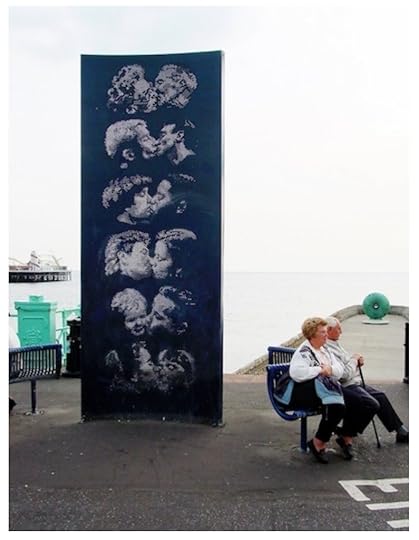
No context was provided. I’m guessing… Brighton. While I’m fascinated by the sculpture in the distance that makes it look as if the old man is holding a cast iron balloon, it’s the installation with the kisses on it that led to the story that follows.
Business as Usualby Nathan Delling It had been a bit blowy overnight, but the rain had held off. They were in one of their usual spots. Perhaps Harry would offer Shirley a cuppa in a bit. Or a Choc-ice. Hot or cold, either was fine on this indeterminate September day. He seldom asked for anything in particular. People remarked upon how ludicrously easy-going he was. He never raised his voice; never got angry. Tea of coffee? It was always “whatever you’re having.” This had been the pattern for so much of Harry’s life. No point changing now. In nine months he’d be dead. “May he rest in peace,” they would say, but when Dave gave the eulogy, he’d say that Harry was a man who had lived in peace. A gentle man as well as a gentleman. Harry had insisted on just one thing in over fifty years of marriage: that they must live by the sea. So they did. Shirley would have preferred to live in Cirencester, close to her sister, but this was not to be: could not be. She felt no real resentment. This was Harold. You couldn’t expect the sea to come to the Cotswolds. Perhaps Harry felt that he had expended a life’s worth of goodwill, though – because he never asked for anything else: not even if you asked him, “What shall I cook you for your birthday, dad?” Whatever you like. Harry had married Shirley when he came back from the War. She had waited for him, so he married her. Of course: in that first year of peace it was practically a law of nature. Everybody got married. It wasn’t love. Not exactly – although it grew to be something that he imagined must be what love meant. For other people. You came back from the War and you found a job. Got married. Had a family. Harry had played his part. Done his bit. The cancer didn’t frighten him. Nothing frightened unflappable, easy-going Harry. Nothing since that night in November 1940. A night for rash promises and a frantic see-sawing between relief and despair. They’d installed an auxiliary fuel tank in the navigator/observer’s position on each of the Swordfish. Harry had been ashamed at the relief he’d felt. They didn’t want him on this deathride, after all. Then the briefing: observers were to occupy the wireless operator/air gunner’s position. It was the gunners who were spared. The observers were for the chop. The pilots as well, of course, but at least they would be busy. They would feel as if they had some kind of control. Harry was facing backwards as they roared away from the deck of Illustrious. When they reached Taranto, he went into action facing backwards. There were no enemy fighters: Harry never fired a shot.
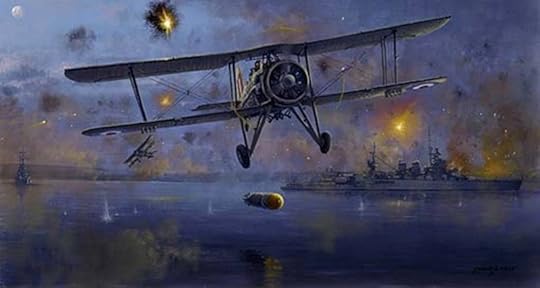 Harry observed, and what he observed was horrifying. Tracer from a hundred guns reached for them. Heavier guns coughed flak that buffeted the ridiculous canvas biplanes; punched holes through-and-through. Dear God, just bring me safe through this and I’ll never ask for anything again, he prayed. He came through, in the hands of his pilot and the hands of God. They did good work that night, and five years later – five years – he was able to come home. If Denis had survived the war, would Harry still have come home, and meekly married? Might he and Denis have dared to explore the feelings they shared? No. Of course not. Harry had wept quietly when he read that the Sexual Offences Act had been passed, but that was in 1967 and Denis had died in ’43. “Sometimes,” Harry observed, “you just have to put your life in the hands of another, and trust.”
ENDS
January 16, 2021
Flash Fiction
I was invited to read a short piece at a writers’ workshop, recently. The theme for the event was mental health and most of those in attendance were students of an online Masters programme in creative writing. There were some really good entries and I was more than a little nervous when my turn came… but they made me welcome. (Thanks for that…)
To match that mental health topic, I wrote a short story called Moodswing. To read for just five minutes, you have to write just 750 words: brutally short, but it does make for an interesting exercise in deciding what to leave out.
If I can get the hang of this truly nasty new WordPress editor… perhaps I can share the piece that I performed…
Moodswingby Nathan Delling
I bumped up my sincerity.
“Please,” I said, “let’s just give this one more chance!”
She scrolled, paused, scrolled and tapped twice.
I could guess what she’d called for. I use the same app: Moodswing. We’d both been regular users when we met – and on our first date.
That choice, though.
“Resolve?” I shook my head. “Then your mind’s already made up?”
She smiled sadly. “Yes.”
That was cruel. The sad smile: an emotion on a knife-edge of perfect calibration. How did she do that? I’ve searched all the menus and I’ve never found the right combination to let me project that. Those moments of acute equilibrium were what I first noticed about her.
“A mind made up,” I said. “How… old-fashioned!”
Bitterness? Where had that come from? I hadn’t asked for bitterness.
It felt almost natural – which was, in itself, distinctly unusual. I felt intruded upon; gatecrashed. Almost without thinking, I turned to Moodswing for an infusion of happy.
Once, there had been whole evenings when we’d dialled for happy together. We’d twirled on the waterfront, laughing in the rain, buzzed on borrowed endorphins.
Damn the expense, we used to say: we can worry about that tomorrow.
But tomorrow comes.
We were at the zoo when it happened. Admiring the animatronic polar bears.
“Don’t you ever worry about someday having to come down?” she asked me.
“I never worry about anything,” I laughed, waggling my mobile in front of her. Moodswing displayed a calm, carefree face with a hint of naughtiness.
It had been precisely the wrong thing to say. Emily had pondered for a while, still pawing at her mobile as we strolled among holographic chimpanzees. Presently, she said she was moving out.
Her phone showed strong levels of decisiveness, so I didn’t argue: not then. Plenty in the days ahead, as we went through the mess of unravelling lives that had snarled together. Perhaps my determination to remain upbeat undermined my appeals that she should stay.
At last, nothing remained. The flat was half-cleared and if I had allowed it I would have been miserable. Her one concession, that we could meet up once in a while, since (she said) we were parting as friends.
She joined me for coffee, though I spoiled it almost at once.
“I agreed to come here for old times’ sake,” she said, “but perhaps the old times are no good without the old feelings?”
“I have the old feelings saved,” I started to say, but I sensed that this was a blunder. I managed to change it at the last moment:
“I have the old feelings… still.”
Her distaste was obvious; moreso in the telltale orange glare of high-end organic LEDs. (A new mobile?)
Denial, I hazarded.
“I’ve hurt you,” I said – despite thinking that since hurt is avoidable, any hurt you choose to feel is basically self-inflicted – “but I can be better!”
“Perhaps,” she conceded, carefully, “if you weren’t so…”
She shrugged.
I tried to call up enthusiasm, but the damned app said I didn’t have enough credit. How much did I have left, then?
I swiped. Four hundred and fifty-two points. All that money and all my frequent user bonuses: how had I burned through it so quickly? Christ: somehow, I had to live through the remainder of the evening on four hundred and fifty-two points. That wasn’t even enough for mild optimism.
“Listen, Emily,” I played for time. “Do you mind if I… make a call?”
Two minutes: that was all I needed. To shift some funds around; load my Moodswing account with enough credit for some fortitude, maybe dignity…
“You can do what you like,” she said, but as I began to thank her she went on: “– with the rest of your life.”
She rose, the chair clattering away. She hadn’t touched the coffee and now she was heading for the door.
It was checkmate. I didn’t have enough credit to prepare myself for the conversation I wanted to have; didn’t have time to load up on credit before she disappeared into the night.
There must be something I can do, I thought, but nothing came to mind. Paralysed by indecision (another freebie, like the bitterness?) I watched her go.
Later, from the cut-price moods still available to me, I chose paranoia. It was better than feeling nothing at all – and might offer somebody that I could blame for all this.
ENDS
April 29, 2019
The Unknown
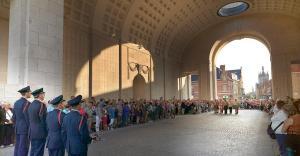
We went to Ypres, in Belgium: a city perhaps most notable nowadays as the location of one of our most significant war memorials.
The Menin Gate is the site for the ‘Last Post’ ceremony, taking place every evening at 8pm, since July 1928 (except while the city was occupied by the Nazis, in the Second World War).
The scale of the Menin Gate is alarming: a barrel-vaulted passage wide enough for traffic to flow into and out of the city. On walls that stretch much higher than one can comfortably study, there are names inscribed: each name a soldier who gave his life in the 1914–1918 conflict. As the visitor glances from panel to panel, they realise how little they really know about the defining conflict that was optimistically termed the “War to End All Wars.” All those regiments raised among the Empire, for example: included are the names of 400 Indians who died far from home.
 Last Post Ceremony
Ypres is a beautiful city, nowadays. It’s home to some good people and some great beers. The cuisine is fine and the countryside beyond the walls is lovely as well. Perhaps these were worth fighting for, back then.
We’re not done with the scale of the place, though. Halfway down each side of that inscribed, vaulted tunnel is a passageway. Each leads through to a double stairway that gives access to the city battlements – and like the main vault itself, these stairways are lined with panels bearing the names of the dead: so there are names recorded not only inside the Menin Gate, but also on its periphery. More names; more young lives lost.
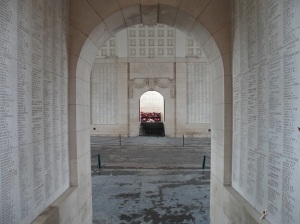
On one of these outer sections I noted the relatively small number of casualties recorded for the Heavy Section of the Machine Gun Corps – an early name for a new kind of soldier: tank crews. Their new weapon would ultimately play a large role in ending the deadlock of the trenches, and I was grimly satisfied to see relatively few casualties recorded.
This was a mistake, though, as you will appreciate if you understand the purpose of the Menin Gate memorial.
Back inside, an inscription reads:
“Ad Majorem Dei Gloriam – Here are recorded names of officers and men who fell in Ypres Salient, but to whom the fortune of war denied the known and honoured burial given to their comrades in death.”
You see, this massive structure doesn’t record the names of all who died: it’s a place to remember the missing; the unrecognisable; the lost. Those who could be identified acquired a grave: perhaps one among the vast array of headstones that you can see at Tyne Cot, and elsewhere. The tank crewmen in which I had taken an interest were not miraculously unscathed: they were just more readily identified if found in the wreckage of their vehicles – and thus buried elsewhere, with a marker showing their name.
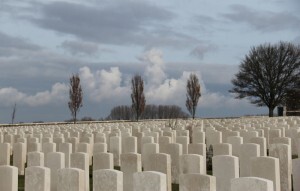 Tyne Cot Cemetery
The Menin Gate commemorates only those for whom there is no known resting place – and only Commonwealth troops, which is to say only those on one side of the fighting. 54,395 of them. That lump in your throat, when you first see all those thousands of names inscribed on the walls… magnified when you realise that there are thousands more lining the four stairways that lead up to the ramparts… well, these are only the troops from Britain and the Empire… oh, and it doesn’t include the men from New Zealand and Newfoundland who have their own memorials elsewhere. Finally, get this: there’s a cut-off date. The memorial is full, so the names of another 34,984 soldiers who died after August 15th 1917 are inscribed on the Tyne Cot Memorial to the Missing instead.
Every soldier had not just a name, but a story. A pair of boots. Some personal effects… and likely some loved ones who would never see him again.
Overwhelming.
[image error]The excellent podcast series 99 Percent Invisible offers an interesting counterpoint to this piece on our unknown servicemen, in the form of a recent episode, “The Known Unknown.” You really ought to listen to it – although if you do, you may find yourself outraged by the underhanded actions of US authorities when seeking to procure an “unknown” service casualty from the Vietnam War.
March 8, 2019
“All Quiet”
I felt most uncomfortable at times, setting a story within the trenches of the First World War. In these days of peace (or perhaps, of fighting our wars at arm’s length in somebody else’s theatre) it’s hard to imagine the scale of world war.
Not just the number of people put into uniform, but the mindset. Nowadays, the news reports on each death, where in the major wars of the past that would have been simply impossible. On the opening day of the Battle of the Somme, some 800 men of the Newfoundland Regiment Battalion went into action. Only 110 survived unscathed. The Divisional Commander recorded of their efforts thus: “It was a magnificent display of trained and disciplined valour, and its assault failed of success because dead men can advance no further.”
“He’s a cheery old card,” grunted Harry to Jack
As they slogged up to Arras with rifle and pack.
But he did for them both by his plan of attack.
(Siegfried Sassoon, ‘The General’)
There are estimated to have been seven and a half million military casualties among the allies, on the Western Front – and five and a half million for the central powers. That’s through four and a quarter years of fighting, almost all of it in a deadlock where only the smallest gains were possible.
With my 21st century detachment from the nationalistic urges that caused the men of the Empire to return to dysfunctional Europe and join in their war, it’s hard to comprehend their bravery and sacrifice while at the same time believing that those same lives were frequently thrown away by leaders who barely understood the circumstances into which they sent them.
Things become still more morally ambiguous when you set a piece of fiction against that background. In the afterword to ‘Outbreak 1917’ I considered saying something about the true scale of the war at that time… but an adventure story isn’t the right place to do that. Professional historians can do that job far better.
The line between entertainment and education can be a blurry one. In 2019 we will mark 75 years since ‘D-Day’, with acts of remembrance but also with re-enactments. How would a veteran feel about that? In the case of the First World War, there are none left to ask: that generation has passed completely into history, some taken during the war and others much later, but now all gone. Does that make it OK to take their war and adulterate it with zombie mythos? No. But their war is still their war. I worked hard to suspend disbelief in ‘Outbreak’, presenting Lawrence’s diary/memoir as an epistolary novel… but the spring of 1917 where the Mud Madness erupted can only be seen as an alternate timeline. I would hate to think that I have treated the combatants of the First World War in a disrespectful manner.


