Anna Sayburn Lane's Blog, page 9
November 14, 2018
Corpus Christie College Cambridge: Marlowe’s student home
For three short years as a child, I lived in Cambridge. The bustle of the market in the city centre, the honeyed stone of the university’s ancient colleges and the peaceful flow of the River Cam were mine only until the age of eight, but they are the backdrop to some very happy childhood memories.
I wonder how happy Christopher Marlowe’s memories of his six years at Cambridge were? He arrived at Cambridge University in 1580, a scholarship boy supported by a bequest from the former Archbishop of Canterbury, Matthew Parker. As with all the Parker scholars, he attended Corpus Christi College (founded 1352), which had also received Archbishop Parker’s amazing library, containing priceless treasures from the ransacked monasteries of England.
Marlowe might have been acutely aware of his social status and restricted budget, compared to the sons of the nobility who were his fellow students. Perhaps that was what motivated him when, a couple of years later, he was recruited by Queen Elizabeth’s secret service, reporting to spymaster Sir Francis Walsingham. It seems that Cambridge has a long, long history with spying. In addition to his studies and other activities, it’s likely Marlowe wrote his first play, Dido Queen of Carthage, during his student years.
[image error]Portrait of the evangelist Luke, in Saint Augustine’s Gospel
I revisited Cambridge a couple of years ago, entering Corpus Christi College on a lovely September day, when the library was open to the public. My visit wasn’t just prompted by curiosity; I was researching a scene where the two heroes of Unlawful Things visit the Parker Library on the trail of Marlowe’s lost manuscript. I marvelled at the library’s incredible collection, including the sixth century Gospels of Augustine (see left), brought to England by Saint Augustine when he arrived to convert the heathen British to Christianity.
I enjoyed wandering around the lovely Old Court, the humble buildings hidden away behind the impressive Victorian frontage, where the college buildings that Marlowe would have known are preserved. All the time, I tried to see the place through the eyes of my fictional characters, Helen and Richard. They would have loved this, I thought.
Perhaps my early fondness for Cambridge found its way into the novel. I can’t help noticing that the Cambridge section of Unlawful Things is probably the happiest time that I allow Helen and Richard together. A hiatus, a sunny day and a scholarly moment to enjoy the beauty, before it all starts to go so very, very wrong…


November 7, 2018
Thomas Becket: Canterbury’s martyr saint still making headlines
For an event that took place almost 850 years ago, Thomas Becket’s death is surprisingly well documented.
Four knights rode to Canterbury Cathedral, shortly after Archbishop Becket returned from a lengthy exile in France. They demanded to speak to him; they claimed to be acting for the King, Henry II. They drew their swords and cut Becket down, leaving him dead on the stone floor.
The murder shocked Europe and outraged the church. Henry II is alleged to have signed Becket’s death warrant with the hasty words: “Who will rid me of this turbulent priest?” He swiftly declared his repentance, walked barefoot into Canterbury and prayed for forgiveness. Pope Alexander III declared Becket a saint. Saint Thomas Becket was buried in Canterbury Cathedral, in an ornate golden shrine studded with precious stones. Rumours quickly began that the saint worked healing miracles, and the pilgrims started to come. Thousands of them, down the ages, remembered best now in Geoffrey Chaucer’s epic poem The Canterbury Tales.
What happened next is less well-documented. We know that Henry VIII, in his own bitter battle with the Catholic Church, declared Becket a traitor, and had the shrine destroyed. What happened to Becket’s remains? Nobody really knows, and that mystery is a key part of the plot of Unlawful Things.
So I was excited to see that Saint Thomas Becket’s remains are back in the news – or at least, his blood-stained tunic is. The tunic was given to the Basilica of Santa Maria Maggiore in Rome, some 50 years before the shrine at Canterbury was destroyed. The basilica will loan the relic to Canterbury for an exhibition to mark 850 years since the saint’s death, in 2020.
Two years ago, a sliver of his elbow joint toured Britain, attracting crowds. When I started to write Unlawful Things, I wondered if modern Britain would be in the slightest bit interested in what had happened to the saint’s remains. Happily, it looks as if Becket can still pull a crowd, eight centuries after his death.
But what does Thomas Becket have to do with Christopher Marlowe, modern day London and Unlawful Things? Sorry, you’ll have to read the book to find out!
October 31, 2018
Five stars for Unlawful Things!
Unlawful Things published one week ago, and I’m thrilled that the reviews are overwhelmingly positive. There’s nothing like a good review to put a smile on my face. At the time of writing, the first nine reviews published on Amazon UK all gave the book five stars.
The best thing was that people seemed to really get what I wanted to do with the book – to tell a gripping, exciting story, and to tell it well.
Here are a few of the highlights:
[image error] [image error] [image error] [image error]
October 25, 2018
Unlawful Things: back to where it all started
In the week that Unlawful Things is finally published, I made a little pilgrimage back to the church yard where it all began. St Nicholas Church in Deptford, tucked away in Deptford Green, is a tranquil corner these days.
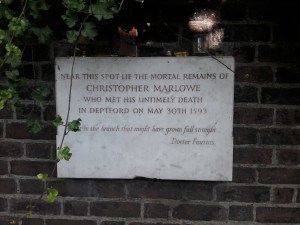
But in May 1593, it witnessed the burial of the mercurial, astonishing playwright Christopher Marlowe, dead at the age of 29. As his friend, the printer Edward Blount, wrote to his patron, Thomas Walsingham, it was there that “we brought his breathless body to the earth.”
Marlowe’s death – he was stabbed after a dinner in a house in nearby Deptford Strand – was the starting point when I began to think about the plot that became Unlawful Things. The novel’s opening scene takes place in contemporary London, with another man stabbed in the church yard where Marlowe is buried. Although I used to live nearby, it had been many years since I visited.
It was a glorious, sunny day, the sun filtering through the plane trees and making the famous gate post skulls look almost cheerful. I was surprised and touched to see a little leather-bound notebook propped up on the plaque which commemorates Marlowe. Inside, people from all over the world had left messages for him, about how much his work meant to them. I couldn’t resist adding a few lines, signed by my novel’s protagonist, Helen Oddfellow. Take a look if you ever go there; you might like to see what she said.
Unlawful Things will be published today. I have a long list of “thank you’s” to everyone who has helped me get to this point. But I shouldn’t forget to thank Christopher Marlowe, whose eternal plays and poetry set me on this path.


October 17, 2018
Why “Unlawful Things”?
[image error]Finding the right title for my novel was a real challenge. I’d written at least three drafts before I managed to alight on a title I was comfortable with.
For a time it was going to be The Marlowe Connection, until someone pointed out that could be mistaken for a book about railway travel in Buckinghamshire. For a while I considered Cut is the Branch, a line from Marlowe’s Doctor Faustus. But then… might someone think it was a gardening manual about pruning trees? Or that we were back to railways again, with a critique of cuts to rail services?
But Marlowe did supply the title I finally alighted on, Unlawful Things. The full quote, from the epilogue to Doctor Faustus, has the chorus moralising on Faustus, whose pact with Mephistopheles results in him being dragged away by demons to hell:
“Faustus is gone: regard his hellish fall,
Whose fiendful fortune may exhort the wise,
Only to wonder at unlawful things,
Whose deepness doth entice such forward wits
To practice more than heavenly power permits.”
In other words, profit from Faustus’ example and stay well away from the ‘unlawful’ necromancy he used to pry into secrets that should only be known by ‘heavenly power’.
I liked the title because one of the themes of the book is the price we risk paying when we try to uncover secrets. And Unlawful Things has an unsettling, mysterious ring to it, which is always an asset in a mystery novel.
As a journalist, prying into unlawful things is pretty much in my job description, so I don’t have much sympathy for the idea that we should all just mind our own business. Humanity has risked much and gained much from the pursuit of its curiosity, down the ages. But there can be a high price to pay, whether it’s Marie Curie succumbing to cancer after discovering radium, or contemporary journalists murdered in the pursuit of corruption and organised crime. One of the questions I wanted to explore was, how high a price should we be prepared to pay?
Unlawful Things will be available to buy on Amazon next week, at a very reasonable price. I do hope you’ll take the opportunity to discover it for yourself.
October 3, 2018
Eastbridge Hospital – an inspiration for Unlawful Things
I get a lot of inspiration from visiting real places and learning about their history. One of the most enigmatic places I visited while researching Unlawful Things, which eventually played quite a big part in the novel, was Eastbridge Hospital in Canterbury.
Eastbridge is not a medical hospital, but an ancient place of hospitality, or hostel as we would call it today. It has been welcoming pilgrims and visitors to Canterbury for an astonishing 828 years, ever since Saint Thomas Becket was murdered in his own cathedral. It was set up to cater for the thousands of pilgrims who walked to Canterbury to visit the saint’s shrine in the cathedral, until its destruction during the Reformation. You can easily imagine Chaucer’s less wealthy pilgrims finding shelter here.
I first visited after walking the 60 miles from London to Canterbury, a walk that partly prompted the story that became Unlawful Things. Footsore and weary, I could well imagine stretching out on the tiled floor of the undercroft, chatting to my fellow pilgrims, eating in the dining hall and falling asleep to the sound of the river which runs under the bridge.
[image error]The undercroft of Eastbridge Hospital
I’ve been back since to learn more about its fascinating history. I learned about some of the figures who became Masters of the Hospital, about their links to Canterbury Cathedral, and about the hospital’s time as a school. I can’t tell you much more, because lots of this wound up in the book. Of course, I designed my own version of historical events to fit my story. I was a little nervous about how modern-day Eastbridge might react to this version of history, but happily the present-day clerk to the hospital is a crime fiction fan and has been very understanding!
Eastbridge today remains an almshouse, continuing its tradition of hospitality. It has two chapels, and also welcomes visitors to events and exhibitions. It’s well worth a visit next time you are in Canterbury.
September 26, 2018
Unlawful Things: launch date announcement
[image error]Some good news – I finally have a launch date for Unlawful Things – and it’s just one month away.
The novel will be published in paperback and e-book formats on Thursday 25 October. Initially, it will be available through Amazon, although I hope to widen that out at a later stage. While not everyone is a fan of the online megastore, it does offer the best opportunities for independent authors to get their book into the world.
It’s been incredibly exciting seeing the whole project coming together. I’ve been involved with every decision to do with publication, from this website, to the mailing list (do sign up if you haven’t yet!), to the cover design. I’ve worked with talented editors and proof-readers, designers and marketing gurus. It’s been a huge challenge finding out how the publishing business works, and I’ve learned so much along the way.
So there’s not long to wait now. I’ve ordered the first review copies and I’m looking forward to having a physical copy of the book in my hands. I’m a fan of the convenience and accessibility of e-books, but there’s something special about having an actual physical book, full of paper and ink, with your name on the front!
As soon as it’s ready to order, I’ll post the link here and on the newsletter. Thanks to everyone who’s supported me on the journey so far.
September 17, 2018
Who was Christopher Marlowe?
One of the key historical figures in Unlawful Things is the Elizabethan playwright Christopher Marlowe. Why Marlowe, my writing tutor asked? Where did your interest begin?
Well, I knew Marlowe’s plays from school and university. Marlowe, a contemporary of William Shakespeare, wrote some of the most amazing plays of the sixteenth century, such as his enduring classic Doctor Faustus, about one man’s pact with the devil. I loved his plays, but knew little about his life until I went on a three day walk from London to Canterbury, which took me past both his burial place (in Deptford) and the church where he was christened (in Canterbury). Made curious by this co-incidence, I decided to find out more.
There was a lot to learn. In his short life, Marlowe was imprisoned for killing a man in a street brawl, suspected of spying for the government, accused of being an atheist, Catholic and occultist (all considered equally reprehensible by the Protestant church at the time) and deported from the Netherlands for involvement in counterfeiting coins. Goodness knows when he got time to do any writing.
Marlowe’s turbulent life was cut short at the age of 29, when he was stabbed to death in an after-dinner brawl in Deptford. There have been many theories as to what was behind his death. Some believe the Elizabethan secret service wanted him dead because his work as a spy had become too dangerous. Others think he wasn’t actually killed at all, but faked his death and escaped abroad, where he wrote Shakespeare’s plays. Indeed, the witty Ben Elton Shakespearean comedy Upstart Crow made much of just this scenario a couple of weeks ago.
The more I read about Marlowe, the more intrigued I became. He was born the son of a shoe-maker in Canterbury, then was picked for a scholarship to Cambridge. At Cambridge, where he was probably intended to become a priest, he wrote his first plays, and quite possibly became a spy. He then moved to London to wow the Elizabethan stage, gaining a reputation for hell-raising. I began to wonder whether he’d learned a secret in Canterbury that had led to his early advancement, and finally to his death in Deptford. What if… but you’ll have to read the rest for yourself!
Want to find out more? Subscribe to my newsletter here.
September 10, 2018
Walk through Helen Oddfellow’s Southwark
Have you got your free map of Helen Oddfellow’s Southwark? Every subscriber to my newsletter is sent a downloadable PDF of a hand-drawn map, drawn by Crystal Palace artist David Vallade. The map shows some of the key locations from Unlawful Things, enabling you to recreate the guided tour to Southwark that Helen gives near the start of the novel. I include background information about the sites, which formed part of the research I did for the novel.
Southwark and the Bankside area have been the heart of London’s entertainment district for hundreds of years. From the inn where Chaucer’s pilgrims set off to Canterbury, to the sites of the Rose Playhouse and Globe Theatre, they reflect the ways that people enjoyed themselves in days gone by. Part of this history is because theatres and other places of entertainment were banned from the city centre, so moved south of the river, where the authorities took more relaxed approach.
To get your copy of the map, sign up for the newsletter. You’ll receive regular updates on my books and events, and of course you can unsubscribe at any time.
September 3, 2018
Judging a book by its cover
[image error]Despite the advice not to, we do all judge books by their covers – how else are you to know whether a particular title is the type of book you love, or not your cup of tea? So getting the right cover for Unlawful Things was a big challenge for me.
I spent a lot of time hanging around libraries and book shops, looking at the shelves. Where would my book fit? What sort of covers did thrillers and mysteries have? What made one book stand out and catch my eye, while others barely registered?
There are clear conventions in book genres. Curly writing, pastel colours and idyllic settings or pretty illustrations spell romance. Stark, often brightly coloured text against a dark background, perhaps with a woman looking fearfully over her shoulder – psychological thrillers. I was after something that conveyed mystery, intrigue and a historical back story. I had a few ideas, including using the skulls on the graveyard gates where Marlowe is buried, and where some of the key scenes in the novel took place. I commissioned cover designer Jessica Bell.
After some discussion about the book and my ideas for the cover, Jessica sent me some options to choose between. One very spooky graveyard scene was particularly impressive – but after asking people what they thought, it was clear that it suggested a horror or ghost story. Good as the cover was, it promised the wrong thing. I asked Jessica to rejig an image from one of the other options, with a mysterious staircase – and she came up with this terrific cover, which I really love. I hope it intrigues you and makes you want to take a look inside – which, after all, is the only real way to judge a book.
Keen to find out more? Subscribe to my newsletter here.