Debbie Levy's Blog, page 3
March 22, 2017
Voices From The Cold Camps
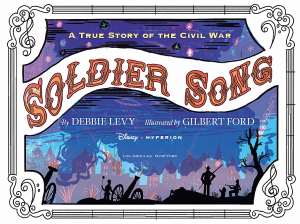
 We’re having a last blast of winter in Maryland today, and as I look out at the still-bare trees bending in the wind gusts, I’m thinking of the hardships of soldiers. My newest nonfiction book, Soldier Song, is about soldiers of the North and South in the U.S. Civil War, during and after the Battle of Fredericksburg in December 1862. It tells the true story of an impromptu concert after the battle, when the two sides were camped across the narrow ribbon of the Rappahannock River from each other.
After engaging in their usual “battle of the bands”—“Yankee Doodle” from the North, “Dixie” from the South,” “The Battle Hymn of the Republic,” “The Bonnie Blue Flag”—one of the bands began to play one of the most popular and evocative tunes of the day. That song was “Home, Sweet Home.” (The Library of Congress today calls it “America’s first bona fide hit song.”) The other side joined in. The song finished, and there was sustained cheering and joy. As one Confederate soldier wrote of the evening:
“I do believe that had we not had the river between us that the two armies would have gone together and settled the war right there and then.”
 Well, maybe. My book doesn’t suggest that music can magically mend the deep differences between enemies. It does suggest that music is powerful enough to draw people together, even if only temporarily. And, for me, the deeper meaning of the story is the possibility of seeing the humanity in our opponents and enemies.
More on all that, perhaps, in another post. This morning, I’m thinking of those poor guys—nearing 200,000 men and boys—camped out not so far from me in Virginia, not even all that long ago, who sprinkled water on their tents so that it would freeze and provide some kind of insulation, and the wounded ones who died from exposure in the freezing night after the worst day of the fighting at Fredericksburg.
One of the most satisfying things I got to do in Soldier Song was include lots of excerpts of letters and journals and memoirs in its 80 pages. So here, an assortment of voices from the cold camps, North and South, just after the Battle of Fredericksburg:
“We are as uncomfortable as possible. . . . I have just read a very affectionate letter picked up on the field from a Northern lady to her husband. It is dated Nov 20. This battle will cost a world of pangs and sorrow. She will never receive an answer to her affectionate epistle.” –Confederate soldier Milo Grow, letter of December 16, 1862
“Dear Farther [yes, that is how this letter is addressed]
“Farther, I never want to get into another battle it is terrible Persons falling all around me. . . .
“The Weather is now getting very cold the army is Suffering on account of the cold. We layed out in the open fields and woods without tents or eny other Shelter for nearly one week before the Battle on frost and snow Whilst the Stay at home party were enjoying their good warm beds.” –Union soldier James A. Harman, letter of December 17, 1862
“Dear Friends, Our sufferings have been intense. . . . The ground is hard frozen up; and our poor fellows have nothing but flimsy ‘shelter tents,’ under which to lie and shiver. Talk about Valley Forge, and the huts Washington and his army had there! Why, they were infinitely better off than we are.” —Union soldier James Rusling, letter of December 21, 1862

I’ll close this with a letter written by Walt Whitman. Whitman traveled to Fredericksburg just after the battle in search of his brother George, who fought for the Union. He found George, only slightly injured, and then spent time in camp, especially with the wounded soldiers. Walt wrote regular letters to his mother:
“December 22 to 31. —Am among the regimental brigade and division hospitals somewhat. Few at home realize that these are merely tents, and sometimes very poor ones, the wounded lying on the ground, lucky if their blanket is spread on a layer of pine or hemlock twigs, or some leaves. . . . It is pretty cold. I go around from one case to another. I do not see that I can do any good, but I cannot leave them. Once in a while some youngster holds on to me convulsively, and I do what I can for him; at any rate stop with him, and sit near him for hours, if he wishes it.”


March 14, 2017
It’s RBG’s Birthday! Still Surprising After All These Years
March 15: Ruth Bader Ginsburg’s 84th birthday. To mark the occasion, I give you–you, dear reader, not RBG, who does not read my blog!–an audio file that I think will make you smile.
Let me set up the clip: It’s from last month, February 6, in Palo Alto, California. Justice Ginsburg had just given Stanford University’s “Rathbun Lecture on a Meaningful Life” and sat for an interview with the event’s host, The Rev. Professor Jane Shaw. (See photo below.) Now she was into a question-and-answer session with students in the audience.
Previously, Justice Ginsburg had shared advice she had received years before from her mother-in-law about how to have a happy marriage: “It pays, sometimes, to be a little deaf.” This has long been a staple of RBG’s talks and interviews–when someone says something unkind, whether in marriage or at the Supreme Court or in life, don’t respond in anger. Act as if the unkind words weren’t said. Now a Stanford freshman named Sasha had a question about this advice: How do you balance this choice to be deaf to unkindness with the need to speak out against things that seem wrong?
I’ve heard and read RBG repeat this it-pays-to-be-a-little-deaf chestnut many times. But I’d never heard the answer she gave at Stanford. Justice Ginsburg tells a fine, funny, surprising story, and if you stop listening before you hear the words “sexist pig” come out of her mouth–you have stopped too soon. Take a minute and 20 seconds and enjoy.
Happy birthday, Ruth Bader Ginsburg!
http://debbielevybooks.com/wp-content/uploads/RBG-at-Stanford-2-6-2017.m4a


March 1, 2017
Women’s History Month: Resisting and Persisting and RBG
You will not be surprised to hear that I’m kicking off Women’s History Month by contemplating Ruth Bader Ginsburg. She resisted and persisted, and still does.

(From I Dissent: Ruth Bader Ginsburg Makes Her Mark.)
Of course I would like the entire world to read I Dissent, but let me also bring to your attention RBG’s own book–My Own Words, a collection of her writings and speeches, thoughtfully curated by Mary Hartnett and Wendy W. Williams. Excellent reading, it was published in October. I love the contents, and I love the cover, taken from Justice Ginsburg’s official Supreme Court portrait, painted by Constance P. Beaty (and just unveiled at the Court last week!).

February 12, 2017
The New York Times List
I learned this was coming about ten days ago–publishers get advance notice from the Times and writers get the heads-up from their publishers. But until I had The New York Times Book Review of February 12, 2017 in my hand, I wasn’t quite ready to believe it. Now I’ve got today’s paper. The best sellers are listed there in black and white. There’s newsprint on my fingers. I still don’t quite believe it, but I don’t deny it!

February 2, 2017
We’re Back In Stock
I Dissent was sold out for several weeks–I’m sorry to the parents and grandparents and aunts and uncles and educators who got in touch to ask WHERE ARE THE BOOKS!–but now we’re back in stock everywhere. Read, dissent, repeat!

January 27, 2017
“Be brave”–Says RBG
She also reads from a certain book.
January 11, 2017
Awards, and Missing Mom
They do give award winners a heads-up–that is, the Association of Jewish Libraries, for their award for children’s books “that authentically portray the Jewish experience”; and the Jewish Book Council, for their National Jewish Book Award for Children’s Literature. And so, recently, I received advance notice from the AJL that I Dissent: Ruth Bader Ginsburg Makes Her Mark is the 2017 Sydney Taylor Book Award Winner for Younger Readers, and separately, from the JBC, that it is winner of the 2016 National Jewish Book Award in the children’s books category.
 My husband and I, on the evenings that we learned of these honors, raised our glasses to toast Ruth Bader Ginsburg for being such an outstanding subject for a kids’ book. I violated the secrecy I was asked to maintain around the awards, but only to tell our grown children and my in-laws. I was thrilled as could be. Imagine! Two separate Jewish groups dedicated to children’s books both selected I Dissent. We Jews will argue–excuse me, DISSENT–about everything, and yet these two convocations of book lovers were in agreement over this book, which, at its core, is about the power of disagreeing.
 This morning the respective award-giving organizations made their announcements public. I still felt as thrilled as could be. I was thinking about how the one award is named for the author of my favorite childhood books–Sydney Taylor, who wrote the All-of-a-Kind Family series. I was thinking of how I used to go to the Silver Spring, Maryland library on Colesville Road, week after week, taking out piles of books, and multiple All-of-a-Kind Family titles at a time. And so I was thinking, and this was inevitable, about my mother, who of course was driving me to the library all those years.
These awards for I Dissent may not be the shiniest, most-coveted awards in the wider world of children’s literature–after all, they’re for books that relate one way or another to Jewishness, which means vast shelves of outstanding books aren’t in contention. That doesn’t diminish my gratitude, and OH MY GOODNESS, how my mother would be reacting to this news if she were still here. “Yes, I remember you and the All-of-a-Kind books,” she would say. “Cindy Taylor?” Sydney Taylor. “Debbie, you have to write it down so I get it right.” And–“the National Jewish Book Award–for the whole country?” she would ask, and I’d promise to write it down so she could get that right, too. Then she would tell me she was so proud of me and, assuming we were on the phone, we’d sign off, me saying, “I love you,” and Mom saying, “I love you more,” and then hanging up real fast so that she could have that last word. And then she would start calling her friends–Norma, and Patsy, and Shirley, and Adele, and Sybil, and Lotte, and on and on.
So it’s a good thing I had a water exercise class to get to this morning after the news went public and I got to thinking of these things. I had some tears to cry about the indignity of a world that has taken my mother away, and the pool is a perfect place to deal with that. It’s a good place to blow out the bubbles of a laugh, too, as I did when I thought that my mother would likely be on the phone to the U.S. Supreme Court right about now to make sure that Justice Ruth Bader Ginsburg knew about her daughter’s good news. Somehow I think she’d get through to the justice’s private line (“tell her it’s Jutta Levy”), and she would get all the details just so.
December 19, 2016
One Good Thing After Another
I started my book about the Glorious RBG, I Dissent, with this sentence: “You could say that Ruth Bader Ginsburg’s life has been . . . one disagreement after another.”
Carrying that rhythm forward, I have to join many observers in saying that this year, 2016, has been one disagreeable thing after another. But in one little corner of my life–in the RBG corner–it really has been one good thing after another.
There was the Elle magazine writer who included I Dissent in her article “How To Build A Feminist Library For Your Baby,” and shared the delicious tidbit that her toddler calls Ruth Bader Ginsburg “Ruth Bagel Wonderwoman.”
There were the kind reviews. (You can find links to some here, under “Praise.”)
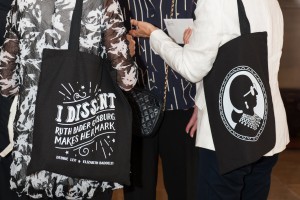
There were the I Dissent tote bags.

There were the Ruth Bader Ginsburg Halloween costumes.
 There were the Indie Bestseller weeks.
There were the year-end “best-of” lists, and even a couple of awards. (See ’em here, again under “Praise.”)
There were the interviewers with the very good questions. (Under “More,” here.)
There were the thoughtful teacher and parent guides to I Dissent. (Here; again under “More.”)
There were the baby registries with I Dissent among the layettes and the onesies.
There was the pleasure of reading RBG’s own book, with professors Mary Hartnett and Wendy Williams, collecting her speeches and writings on everything from dissents to diversity.
There were the unexpected, delightful social media shout outs. A sampling:


 There was the gratitude in the news that, thanks to the generosity of PJ Library, a special edition of I Dissent will land in the homes of thousands of children early next year.
Justice Ginsburg enjoyed that news, too–here she is holding the PJ Library edition in her lace-gloved hands.
I can’t say that all this agreeableness canceled out the awfulness that characterized so much of 2016. But it helped, and I am grateful to the readers, writers, teachers, librarians, parents, kids, publishing people, and enthusiastic friends who embraced this book and sweetened my year.
November 21, 2016
A Very Fine Lunch
I was having a very nice lunch at the annual conference of the National Council of Teachers of English last weekend in Atlanta. Look, here is the pretty place setting:

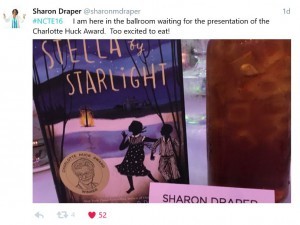
It was the Children’s Book Awards luncheon, and hundreds of us in the big ballroom of the Omni Hotel had just heard a stirring talk by Sharon M. Draper, winner of the NCTE’s 2016 award for outstanding fiction for her novel Stella by Starlight.
The next order of business was the announcement of the 2017 Orbis Pictus Award for Outstanding Nonfiction.*
And, oh!–I Dissent: Ruth Bader Ginsburg Makes Her Mark was announced as an Orbis Pictus Honor Book!

I was so surprised and excited I forgot to eat my cupcake. (See above, pretty place setting.)
Books by two talented friends were recognized with this honor, too: Giant Squid by Candace Fleming, and Olinguito by Lulu Delacre. Congratulations, my ladies!
Here are Candace and I afterwards (also pictured is children’s lit professor and blogger Mary Ann Cappiello):

The top Orbis Pictus Award went to Melissa Sweet for Some Writer! The Story of E.B. White. And the 2017 recipient of NCTE’s award for outstanding fiction, called the Charlotte Huck Award, was Jason Reynolds, for Ghost. Congratulations, you writers!
* In case you’re wondering: “The NCTE Orbis Pictus Award, established in 1989, is the oldest children’s book award for nonfiction. The name Orbis Pictus commemorates the work of Johannes Amos Comenius, Orbis Pictus—The World in Pictures (1657), considered to be the first book actually planned for children.” –from the
November 17, 2016
Yes. I Do Love This.
Earlier this week, Glorious RBG–that is, Justice Ruth Bader Ginsburg–read aloud from I Dissent at a PJ Library event here in Washington D.C.
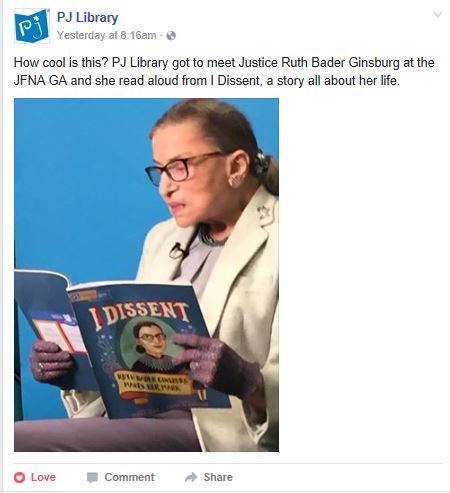
I think I’m just going to look at that picture for a while now. Goodbye!