
Harold Davis's Blog, page 150
August 31, 2015
Lumiere Fillagree

Lumiere Fillagree © Harold Davis
This is a combination of two hand-held shots. The carousel in the foreground was photographed at 3 seconds and f/22 at ISO 64. The three second exposure produced the filigree effect. The Eiffel Tower in the background was shot at a relatively stable and sober 1/5 of a second and f/8 at ISO 200. The two exposures were combined in Photoshop.
By the way, I’ve been asked if I am in Paris because of the Paris photos that are appearing on my blog such as Beneath the Pont de la Concorde. No, I am home in California, and just working through and processing some images from the last few years. With the press of the things going on right now in my life, it does sometimes take me a while to get around to post-processing my work!


August 30, 2015
Beneath the Pont de la Concorde

Beneath the Pont de la Concorde © Harold Davis
The modernism of the underpinnings of this bridge over the Seine River in Paris, France belies the ornate fancifulness of the bridge from above. This is one of the joys of photographing in Paris—styles with huge inherent differences are cheek and jowl together, and somehow work in harmony.
From a formal viewpoint, this is a photo with a great deal of symmetry in lines and construction. But for me the composition works because of the unusual negative space cut-out, across to the opposite bank of the river.
Exif data: Nikon D800, 35mm, six exposures at shutter speeds from 4 seconds to 1/8 of a second, each exposure at f/3.5 and ISO 50, tripod mounted; combined and converted from RAW in Nik HDR Efex Pro and Photoshop, processed in Photoshop, Nik Color Efex, Topaz Adjust, and Topaz Simplify; converted to black and white using the LAB color space in Photoshop and Nik Silver Efex Pro.

August 29, 2015
Special Print Offer: Kiss from a Rose
Special Print Offer: Kiss from a Rose by Harold Davis on Moab Juniper Baryta
I am offering a limited-time print special: my Kiss from a Rose, shown below, printed at roughly 11″ X 14″ on Moab Paper’s wonderful new Juniper Baryta. The price for the print is $250.00, which is a fraction of our normal studio retail print pricing.

Kiss from a Rose © Harold Davis
The fine print: California residents add sales tax; shipping within the continental Unites States is $25; offer subject to withdrawal if we feel like it; contact us by phone or email with questions or to place an order; payment accepted via cash, check, or credit card.
Kiss from a Rose is my image most often mistaken for a Georgia O’Keeffe painting; also see When is a Harold Davis rose a Georgia O’Keeffe?

August 28, 2015
Simulating a Calotype Glass Negative Print

Forest Reflection © Harold Davis
The underlying photography in this image consists of two photographs of trees reflected in a puddle that I made in the Parc de Sceaux in suburban Paris, France with the camera on a tripod. One photo was made when the water was still, so the reflections of the trees were very clear. The other was made from the same position when it was windy, so that much of the image consisted of motion blur. Both were shot for as much depth-of-field as possible at f/22.
After combining the two photos in Photoshop using layers and masking, I applied the Calotype Glass Negative preset from Perfect Black and White’s 19th Century Processes preset to create the final appearance of my image. The Calotype preset digitally simulates an early photographic process invented by William Henry Fox Talbot that exposes a silver iodide coated substrate to light. The simulation shown here would have been of a print made from a calotype glass negative, rather than the negative itself.
Keeping in mind that I am a digital artist using my photographs as my source material, I am working on printing this image, with a number of possible papers and presentations in mind,

August 27, 2015
Sunflowers and Friends

Sunflowers and Friends © Harold Davis
Sunflowers and Friends is a light box bracketed high-key sequence combined in Photoshop. The sunflowers, echinacea, and other flowers are from our garden, and shown in In the field for transparency and I can only give my heart. The background is a sheet of old paper I put on a flat-bed scanner, and added in Photoshop using the same formula as the Dietes iridioides and Nigella Damascena images shown in Two Botanicals.
To learn more about the techniques I use to create this kind of imagery, please see my FAQs Photographing Flowers for Transparency, Using a High-Key Layer Stack, and Backgrounds and Textures. You can also check out my related webinar recordings (paid access is required): Painting in Transparency Using a High-Key Layer Stack and Using Backgrounds and Textures.

August 26, 2015
Unmade Bed in homage to Lilo Raymond
My friend and mentor Lilo Raymond died a few years ago. Lilo was a wonderful photographer with a wonderful eye, who fled from the Nazis as a youth and ended up settled in a small Hudson River village. Probably Lilo’s most famous photos are of pillows and unmade beds—so this iPhone shot of my empty bed taken in my hotel room on Monhegan Island, Maine should be seen as homage to Lilo.

Unmade Bed © Harold Davis
Phyllis describes meeting Lilo for the first time as an “encounter with a force of nature,” which is apt enough. I truly miss Lilo.
Regarding unmade beds, the question is always what was in them before they transitioned into the unmade state. Lilo’s photos manage to convey graphic compositional perfection with the suggestion of rumpled love-making, adding the human touch to inanimate objects.
But I’ve also seen one of her photos licensed to a programming text book, with the caption, “An unmade bed is like an uninitialized variable, you never know what you’ll find in it.” So there is a universality to these images that belie the modest apparent subject matter.
In some ways, the beds, tangled sheets, and curtains in front of stark windows that form Lilo’s images make up the “day material,” to use Freud’s term, that can be used as a projective device for the deeper material lying below the conscious that bubbles up in dreams. In other words, there is more to Lilo’s imagery than meets the eye.

August 25, 2015
I can only give my heart
Words have a place as a companion to photography, as titles, in captions, in statements, and in books that combine words and imagery. It’s often a useful exercise to attempt to write about one’s own photographic process and goals, as well as writing to describe the narrative behind a specific image.

I can only give my heart © Harold Davis
Regarding cryptic titles, such as “I can only give my heart,” modern painters have led the way with this, sometimes applying titles for abstract paintings that can seem far-fetched. But I believe that metaphorical titles can be appropriate and, when apt, do enhance the poetics of a photographic image.
Ian Roberts puts it this way: “Authenticity results from the depths of the artist’s feelings.” In other words, I only follow the labor intensive process of creating an image like this one because the subject and treatment move me, and because I speak from the heart. So, I can only give my heart.
From a formal perspective, “I can only give my heart” is about the relationship between soft petals and the “harder” flower core of the flowers with pistil, stamen and so forth. Compared to the fluff of the petals, all the flower really has is its core, or heart, which is another meaning for the title.
By the “poetics of a photographic image,” I am really talking about the subjective individual experience to the viewer. There’s no doubt that the image title can influence this experience (for better, or for worse). In your experience, doesn’t an allusive title like “I can only give my heart” lead to a more poetic viewing experience than the straightforward title “Echinacea” for the image shown below? Which kind of image titling do you prefer?

Echinacea © Harold Davis

August 24, 2015
Happy Birthday Mom
The other day we celebrated my Mom’s 86th birthday. My Mom, Virginia Davis, is a working artist, deeply interested in the textiles and art of Mexico. So it seems appropriate that her reflection in this photo is apparently examining the reproductions of paintings by Frida Kahlo on the walls of the restaurant where we held her birthday party.

Happy Birthday Mom © Harold Davis

August 23, 2015
In the field for transparency
One interesting point that often comes up in my Photographing Flowers for Transparency workshops (such as the recent one I gave at Maine Media) is whether the techniques I teach in this workshop are limited to shooting flowers on a light box. Of course, the answer is a resounding “No!”—because these photographic and post-production methods cut a wide swath. One application is studio photography on a dark background, which reverses the direction of the bracketed shooting sequence and the order of layer stacking as in this in-class example. Conceptually, other than the order inversion, this is the same set of ideas as photographing on a light box.

Sunflower © Harold Davis
The techniques advanced by this workshop work well outside the studio as well as in it. The same shooting and post-production ideas as in light box photography work for backlit situations in the field—which is what I used for this shot of translucent sunflower petals, with the early morning sun coming from behind.
Exposure data: Nikon D810, Zeiss 50mm Makro-Planar f/2, two exposures (one at 1/40 of a second and one at 1/10 of a second), each exposure at f/14 and ISO 400, tripod mounted; exposures processed and combined in Adobe Camera Raw and Photoshop.

August 22, 2015
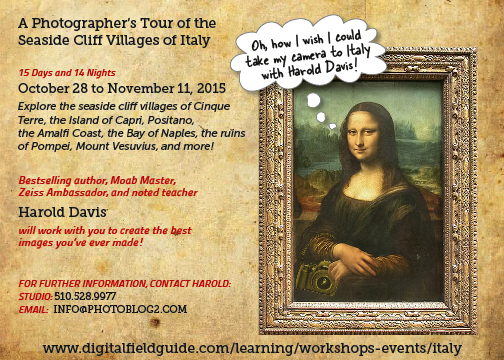
Come with me to Italy this autumn!
I am leading a small group of photographers to Italy for two full weeks at the end of October (15 days and 14 nights beginning October 28, 2015). We will visit and photograph Florence, the leaning tower of Pisa, Cinque Terre, Naples, Vesuvius, Pompeii, the Island of Capri, Anacapri, Amalfi, Positano, the Sorrento Peninsula, and more. Please click here to view the photo tour details, and the incredible amount that is included in this exclusive tour.
Tired of big-bus photo tours? Tired of banging elbows and tripods with a photographic crowd? Then this is the photo tour for you. With a maximum of six participants, this exclusive photo tour of Italy will let you come home with great images without someone’s hat or tripod leg in the picture.
Here’s what some folks who have been with me on photo tours have said:
“Harold navigates foreign countries with astuteness and cultural sensitivity. His choice of guides, hotels, locations and restaurants is always impeccable. I returned from our trip with a much better sense of how to photograph in a diverse and wonderful array of locations, and had a great time with a compatible group while I learned.”
“Harold is a distinguished author of many books, educator, and photographer. It was amazing to spend so much one-on-one time with him in these great photographic locations.”
“Harold is a gifted artist, AND a great teacher! A rare combo, IMHO.”
“Harold is a peach. Great skill, without the ego of most master photographers. Travel arrangements were perfect.”
“One thing I really liked about the photo tour that Harold set up is that we had plenty of time to photograph in the best locations, and really prioritized when the light would be good.”
We have two openings on the Sea-Girt Villages of Italy photo tour. If you register by the end of August, we can give you a $500 discount on the single supplement as a special “thank you.”
If you are interested in learning more about my style of photography when abroad, please ask for complementary access to my webinar recording Making Memorable Travel Photos (normally a $19.95 value).
Please contact us if you are interested in registering, or for more information.


