Stella May's Blog, page 14
November 11, 2022
RAIN ON A METAL ROOF
RAIN ON A METAL ROOF
By Linda Lee Greene, Author/Artist
Opening onto the sliding glass doors of the bedroom of my previous house was a three-season room. I called it my solarium because it was a space of windows more than of walls, a lovely and light-filled area facing due south—ideal for potted plants tucked among wicker chairs and wrought-iron pieces in warm weather but scorching hot for human beings and other mammals. The windows were single-paned, drafty, and ill-fitting, and the walls and roof were slabs of Styrofoam clad in aluminum sheets. In winter it was a freezing space suitable only for hanging slabs of beef, if I had been of a mind to use it for such a purpose. In fact, the months of April and October were the only times of year during which it was fit for living beings of any species. All the other months of the year, it was either too cold or too hot to be functional.
Despite its negative aspects, my solarium had a vital redeeming quality: it gained me access to the rain. Actually, the inspiration for much of my writing came from the sound of rain that washed the sides and battered the roof of my metal solarium. As I stretched out on my bed with my laptop astraddle my thighs, the sliding glass doors were open to my solarium, open to the sound of the rain, a sound that carried me back to the rains of my childhood, rains that are the source of my love of rain, and one of the most enduring connections to my past.
The sound of rain on the metal roof of the porch below the window of my room in our West Second Avenue house in Columbus, Ohio often pulled me to a joyful waking when I was a child. If it happened to be a Saturday morning, my family and I would pile into our car and drive eighty-five miles south to the farm of my maternal grandparents for the weekend. Featuring a red barn, whitewashed chicken houses, and raw-wood pigpens, the saltbox farmhouse rose to two-stories within its whitewashed clapboard sides and pitched metal roof.
 The farmhouse sat on the south rim of the star-wound crater in Peebles, Adams County, Ohio, which is the bedrock of the world famous “Great Serpent Mound.” The metal-roofed front porch of the farmhouse offered an unfettered view of the crater as well as its backdrop of the Appalachian Mountain foothills, preferably taken in while sitting in the front porch swing.

From the porch one stepped into the parlor of the farmhouse, its focal point a chugging wood-burning stove in winter. Adjacent to this central room were two bedrooms, a kitchen, and at the back, a summer kitchen. A door from the summer kitchen opened to a long path that terminated at a gelid in winter and malodorous in summer outhouse.
Tucked behind the front entrance of the farmhouse was the door to the steep staircase to the upper floor, and at the head of the stairs was a small bedroom that housed a full-sized bed and a mirror-topped chest of drawers. I recall some of my younger cousins being folded cozily into the spacious bottom drawer of that chest in lieu of a bassinette when they were babies. A doorway in this first bedroom opened to the largest room in the house, a sleeping room set up with several beds in dormitory fashion, all of them topped with feather-stuffed mattresses. The enormous collection of feathers had been plucked over the years from the farm’s chickens before they were fried to a crisp in my grandmother’s enormous iron skillet. In that dormitory bedroom, my mother, my aunts, my brother, my baby sisters, our young cousins and I were crooned to sleep to the sound of rain dancing on the metal-capped roof of the farmhouse.
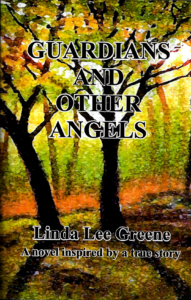 The farm featured in the above essay forms the backdrop of Guardians and Other Angels, multi-award-winning author, Linda Lee Greene’s novel that chronicles the story of two heroic families played out against the bad and the good of the early to mid-twentieth century, years of worldwide economic depression and war, as well as the spawning of the “Greatest Generation.” Firsthand accounts of the times in authentic letters written by members of the families are peppered throughout the book.
Available in paperback and eBook on Amazon
 Multi-award-winning author and artist Linda Lee Greene describes her life as a telescope that when trained on her past reveals how each piece of it, whether good or bad or in-between, was necessary in the unfoldment of her fine art and literary paths.
Greene moved from farm-girl to city-girl; dance instructor to wife, mother, and homemaker; divorcee to single-working-mom and adult-college-student; and interior designer to multi-award-winning artist and author, essayist, and blogger. It was decades of challenging life experiences and debilitating, chronic illness that gave birth to her dormant flair for art and writing. Greene was three days shy of her fifty-seventh birthday when her creative spirit took a hold of her.
She found her way to her lonely easel soon thereafter. Since then Greene has accepted commissions and displayed her artwork in shows and galleries in and around the USA. She is also a member of artist and writer associations.


November 10, 2022

November 4, 2022
Scary Things or Imagination
by C.D. Hersh
 Years ago, a teaser news story from Huffington Post popped up in Catherine’s email about a mysterious “star jelly” found in the RSPB Ham Wall nature reserve in Somerset, England. Being paranormal buffs (which, for us, includes sci-fi), naturally, Catherine looked up the article. There are a lot of theories out there, but not much positive proof about what this substance is. Some people postulate that the jelly is slime mold, a form of cyanobacteria, the remains of regurgitated amphibians, or frog spawn. Personally, all of the above are too ordinary. As paranormal fans, we like the more supernatural of the explanations that says the “star jelly” is related to the sighting of a strange meteor like object seen over the reserve last week—an extraterrestrial substance dropped to earth from the meteor shower.
This isn’t the first time “star jelly” has been found. Records dating back to the 14th century mention finding this gelatinous material after meteor showers. It’s been called star jelly, astral jelly, star rot, star shot and astromyxin. Non-paranormal believers say it’s coincidental that people find star jelly after meteor showers. Curiosity about finding a meteor rock leads them to places they wouldn’t normally go, and they find the substance, which has been there all along. In other words, they want to believe it’s this baffling substance from outer space.
Star jelly has been a part of several fiction stories. Sir Walter Scott’s novel The Talisman, and H.P. Lovecraft’s short story The Colour of Space.
 Putting words and stories on paper is second nature to co-authors C.D. Hersh. They’ve written separately since they were teenagers and discovered their unique, collaborative abilities in the mid-90s. As high school sweethearts, and husband and wife, Catherine and Donald believe in true love and happily ever after.
Their paranormal series is titled The Turning Stone Chronicles.
They are looking forward to many years of co-authoring and book sales, and a lifetime of happily-ever-after endings on the page and in real life.
Follow C.D. Hersh on social media:
October 28, 2022
A Shapeshifter Called Harper
from Carol Browne
You’re expecting to read about a shapeshifter called Harper now, I know, but it’s why this character is called Harper that is the reason for me writing this blog. The name was originally Tyler.
 Tyler was the MC in a sci-fi novella entitled The Star Attraction, which I wrote in 2016. In May 2019, I was offered a contract for the book by my publisher. Said publisher closed down a few months later and that was that. Following this, I found myself dealing with a multitude of life problems, not to mention my other books and the demise of my third publisher. Hence, it was only in July 2022 that I found time to submit this book elsewhere (no verdict as yet!). Meanwhile, I am writing a sequel.
This week I saw a promo post on Facebook for a new release and, lo and behold, the male protagonist is a shapeshifter called Tyler. What are the odds? I might have been the first person to use this name in this way, but the other author got published so Tyler is damned and has morphed into Harper (which seems apt).
In this same week, a fellow author was distraught when she found that her latest manuscript, which she was about to send to her agent, has the same theme as another recently published book. I won’t reveal the theme, but it is such a novel, specific and original concept that it beggars belief that someone else came up with the very same idea. I hope she and her agent can find a way around this dilemma.
Last year I had an idea for a crime thriller, and I believed that the crime and the reason behind it was so outlandish and original that the chance of anyone else coming up with the idea was remote. More fool me. Yet another of those promo posts on Facebook was to show me the error of my ways as a concept I had deemed so unusual and unique was there for all to see in someone else’s stylish new book trailer. Meanwhile, as I toyed with the idea of an epic fantasy involving women with magic powers, I found that my story had already been given its marching orders by The Wheel of Time.
When there’s nothing new under the sun, it’s a challenge trying to create original concepts, and even more difficult to avoid accusations of plagiarism even though you had no idea that your ideas duplicated someone else’s. In the same way, it’s not possible to be aware of every book that has been, is being, or will be published. The fact that there’s no copyright on titles is a small crumb of comfort!
So, what is going on? Is it the Collective Unconscious that causes so many people to have the same ideas at the same time? How often does this happen to other authors and what do they do about it? Would any author reading this blog have changed Tyler to Harper or kept the original name? I’d love to know.
For now, my shapeshifter is called Harper. I lay claim to this in writing in the hope that there aren’t any other shapeshifters called Harper out there already! If there are and anyone has any objection to mine, speak now or forever hold your peace!
Once upon a time a little girl wrote a poem about a flower.
Impressed, her teacher pinned it to the wall and, in doing so, showed the child which path to follow.
Over the years poems and stories flowed from her pen like magic from a wizard’s wand.
She is much older now, a little wiser too, and she lives in rural Cambridgeshire, where there are many trees to hug.
But inside her still is that little girl who loved Nature and discovered the magic of words.
She hopes to live happily ever after.
Stay connected with Carol on her website and blog, Facebook, and Twitter.
Fantasy author Carol Browne is a published author who is currently seeking an agent.
October 21, 2022
from Emma Lane
 One of the nicest things about root veggies is that they are almost always around ready for serving to your family. Stored in the bottom of the pantry or in a cool, dry place in the cellar, potatoes are a staple for meals. Carrots, onions, and both types of potatoes can be prepared fairly simply for easy cooking. Satisfying and healthy, these root vegetables can be presented many different delicious ways.
BREAKFAST
Fried Sweet Potatoes
3 medium sized sweet potatoes
½ cup butter
Brown sugar to sprinkle
Wash, peel, and slice potatoes in ¼ inch thick rounds. Melt butter in skillet, place potato rounds in and sprinkle with brown sugar. Cook until tender, 15 to 20 minutes, turning occasionally. Brown sugar forms a syrup to pour over potatoes after cooking.
I suggest serving summer sausage patties, hot biscuits, raspberry jam, and orange juice.
Wash, peel, and slice potatoes in ¼ inch thick rounds. Melt butter in skillet, place potato rounds in and sprinkle with brown sugar. Cook until tender, 15 to 20 minutes, turning occasionally. Brown sugar forms a syrup to pour over potatoes after cooking.
I suggest serving summer sausage patties Hot biscuits, raspberry jam, and orange juice.
LUNCH
Mashed White Potato Patties
2½ cups leftover mashed potatoes
1 tbsp. all-purpose flour
2 cups shredded mild cheese
1½ cups finely chopped green onion
Dash pepper
1 egg, beaten
1 cup breadcrumbs
1 – 2 tbsp. vegetable oil
Mix potatoes, cheese, flour, green onions, and a dash of pepper to taste together in a medium sized bowl. Form into thin 3 ½ inch patties.
Brush with beaten egg then cover with breadcrumbs, Turn gently with specula and cover with breadcrumbs other side.
Sauté in heated oil until browned and completely warmed through. Flip gently to brown both sides. Serve warm.
Great with scrambled eggs and bacon.
SUPPER (OR DINNER)
Carrot Casserole
1½ to 2 cups cooked and mashed carrots
1 small, sweet onion chopped
⅔ cup sharp grated cheese
½ tsp. yellow mustard
⅔ cup mayonnaise
1 tbsp. sugar
Salt and pepper to taste
Ritz crackers, crushed
Preheat oven 350° F.
Combine mash carrots in a mixing bowl with all ingredients except crackers. Pour into casserole dish and top with crushed crackers.
Bake for approximately 40 minutes.
Suggested serving with browned pork chops topped with onion rings, mushroom soup and baked. Fruit cups as salad.
Here’s a peek at my Cozy Mystery, Murder in the Neighborhood, a novel which introduces you to Detective Kevin Fowler and the intriguing murders which infect this small-town Americana. The series follows the detective, colleagues, friends, and lovers through a whirlwind of events, good and bad, over the next three novels.

A killer is attacking respectable citizens in picturesque Hubbard, NY, and leaving corpses on their front steps in the middle of the day. Detective Fowler isn’t certain who causes him to lose the most sleep, a certain sexy reporter with bouncing curls and sparkling black eyes, or the elusive psychopath creating panic in his small-town community. Together, the detective and the reporter race to find the monster in their midst and return the town to the desirable place where people come to raise their families in peace and contentment. Can they sort through their differences to find romance even as they search for a determined stalker with murder on his mind? The clock ticks down on a man in a rage with a deadly mission.
Amazon Buy Links Kindle – Paperback Read more cozy mysteries by Janis Lane on Amazon . Janis Lane is the penname for gifted author Emma Lane who writes cozy mysteries as Janis, Regency as Emma, and spice as Sunny Lane.
She lives in Western New York where winter is snowy, spring arrives with rave reviews, summer days are long and velvet, and fall leaves are riotous in color. At long last she enjoys the perfect bow window for her desk where she is treated to a year-round panoramic view of nature. Her computer opens up a fourth fascinating window to the world. Her patient husband is always available to help with a plot twist and encourage Emma to never quit. Her day job is working with flowers at Herbtique and Plant Nursery, the nursery she and her son own.
Look for information about writing and plants on Emma’s new website. Leave a comment or a gardening question and put a smile on Emma’s face.
Stay connected to Emma on Facebook and Twitter. Be sure to check out the things that make Emma smile on Pinterest.
October 14, 2022
POPPAW’S JUG
From Linda Lee Greene, Author/Artist
In light of so many unspeakable tragedies in an out-of-control world, to put hopeful words of any kind to paper touches on the grotesque. However, life’s troubles concurrently remind us of our courageous ancestors who sacrificed so much to pave the way for us. They would roll over in their graves if we give into helplessness and are thus struck silent. To be human is to contend with disaster and the grief it leaves in its wake. We must express our grief even as we attempt to master our despair. We have learned through our everyday living that grief can be transformed as something bearable through acts of love. To honor our traditions is an act of love that celebrates and validates our forebears. It is also a comfort-seeking pursuit for us as we carry on in their absence. The following is a true story. It recounts such an act of love on the part of my family:
 “My maternal ancestors were faithful to their generational commitment to express their respect and gratitude to their deceased relatives and friends by visiting their graves on every holiday and change of seasons. Each visit involved decorating and maintaining the graves.
Back when my mother and her siblings were youngsters, their old car of the day being too small to accommodate their large brood, their mighty team of broad-backed workhorses, Roger and Smoky by name, pulled the heavy, buckboard wagon on their visits to the various graveyards in the area. Mommaw and Poppaw, taking a rare break from the demanding duties of their farm, were at the helm of the wagon. Dean, the baby of the family, sat between his parents on the high seat of the buckboard, a vantage point that overlooked the ample rumps of the horses. In the back, the seven other children, my mother among them before she was my mother, sat on bound bundles of hay perched vicariously on the gaping floorboards that formed the flat bed of the conveyance. The group of them, in perfect harmony and at the top of their lungs, accompanied by Uncle Bob and Uncle Bussy on their mandolins, sang the old song, “On Top of Old Smoky,” while the groaning wagon appeared in danger of imploding from the weight of its human cargo and the strain of the rough terrain that suffered its challenged wheels and chassis. Years later and as the first grandchildren born to the family, my brother and I also rode on that wagon on similar excursions, singing that old song in unison with our aunts and uncles at the top of our voices. My brother and I then got to ride between Mommaw and Poppaw on the high seat that overlooked the broad backs of Roger and Smoky. I was a grown woman and married, with children of my own when suddenly one day it dawned on me for the first time that the song was about the Great Smoky Mountains rather than a horse named Smoky.
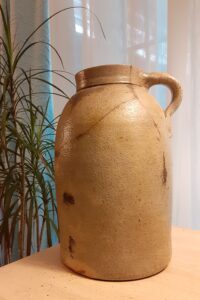
I still can see in my mind’s eye the wobbly wheels of the buckboard and the iron-shod hooves of the horses kicking up clouds of dust on the deeply rutted, mud-caked lanes that lead to the remote cemeteries. One of my prized possessions is the old, earthenware jug that contained the grease Poppaw used to lubricate the screeching wheels of the buckboard. The interior of the jug’s fissured walls are coated to this day with black and slick remnants of the grease. During those journeys, every once in a while, Poppaw yelled, “Whoa, Roger…Whoa Smoky,” and the buckboard came to a grating halt. While the horses snorted from their huge nostrils and pawed the ground with their heavy hooves, their hot bodies steaming and making auras of their perspiration all around them, down from the high seat on his long legs Poppaw jumped, pulling the jug from beneath the seat, a stick jutting from its open top. The working end of the stick was wrapped in a grease-blackened cloth, and he smeared the axles of the wheels with it.
At the entrance to the road that loops the community of Cedar Fork where my parents spent their formative years, although several new homesteads have sprung up over the years, still it feels to me as if I’m entering an evolutionary backwater, a safe haven cut off from the rest of the world. These days I come to call in my car rather than on a buckboard. I take the right turn in the loop that leads past “Greene Acres,” the location of the fallen log cabin where my father and his family lived back in those days. I pull my car into the area, park, and then walk to the edge of the property, its border high above Cedar Fork Creek.
In the canyon below, sunlight filters through the trees, winking gaily upon the rushing water of the creek. I stretch my eyes to get a glimpse of the footbridge by the ancient, mountain spring that was the source of drinking and cooking water for my father’s large family long ago, and a bright ray of sun, as if switched on for my benefit by the Hand of God, isolates it and sets it aglow. I take it as a “token” message, a greeting from the spirit of my paternal grandmother, and I smile and wave at her as if she is actually standing there. Satisfied that my presence has been acknowledged and welcomed, I return to my car. Over the decades, the markers of my deceased, maternal relatives have accumulated in the graveyard in Cedar Fork, and I am shocked, as always, at the increased number of them, as beneath the tires of my car the gravel on the lane to the small, country cemetery loudly pops and crunches. There exists a legend that birds shun other neighboring trees, preferring to gather en masse instead among the leaves of an ancient pipal tree in a shimmering land across the sea, the pipal that is said to be a direct descendant of the holy tree the Buddha sat beneath while attaining enlightenment during his days of contemplation there. It might be my prolific imagination at work, but I swear a similar phenomenon occurs in a venerable oak tree that arches above the burial plot of my family, where, among Civil War and other war veterans, upper-crust titans, and lower-caste farmers of the area, Mommaw and Poppaw, my mother and father, my sister and most of my nearest, deceased maternal kin now lie.
And as if in testimony to my childhood memories of such a phenomenon, while its abutting trees appear to be empty, huddled within the gnarled branches of the wizened, oak tree, the gathered birds are perched. As I approach the graves, my presence sets in motion the flight of the birds, their overlapped and snapping black wings, for those brief moments in time, blotting out the sun.
I have read that birds are manifest angels on earth, but I am less wise about such things than when a child. Knowing it will not be confirmed to me until I complete my own earthly journey, I leave it to the humming wheel of the universe, and to my elders, all of whom on my mother’s side of my family, are already there in Cedar Fork Cemetery, and where someday my remains will mingle with theirs.”
The above essay is an adaptation of an excerpt of Guardians and Other Angels, my novel of historical fiction and true family lore. It is available in eBook and paperback on Amazon.
Multi-award-winning author and artist Linda Lee Greene describes her life as a telescope that when trained on her past reveals how each piece of it, whether good or bad or in-between, was necessary in the unfoldment of her fine art and literary paths.
Greene moved from farm-girl to city-girl; dance instructor to wife, mother, and homemaker; divorcee to single-working-mom and adult-college-student; and interior designer to multi-award-winning artist and author, essayist, and blogger. It was decades of challenging life experiences and debilitating, chronic illness that gave birth to her dormant flair for art and writing. Greene was three days shy of her fifty-seventh birthday when her creative spirit took a hold of her.
She found her way to her lonely easel soon thereafter. Since then Greene has accepted commissions and displayed her artwork in shows and galleries in and around the USA. She is also a member of artist and writer associations.
October 10, 2022

October 7, 2022
Oktoberfest is Wunderbar in Cookbook Author Sloane Taylor’s Eyes…
Oktoberfest is the festival to end all festivals that is celebrated around the world but started in Munich, Germany for a royal wedding in 1810. The citizens of Munich were invited to all the festivities held in fields just outside the city gates. And from there the world adopted this grand event. It runs from late September to the 1st Sunday in October. Be sure to include plenty of German music when you celebrate.
MENU
Sauerbraten – Marinated Pot Roast
Boiled Potatoes
Red Cabbage with Apples
Rye Bread
German Red Wine – Spätburgunder which is German for Pinot Noir
Sauerbraten – Marinated Pot Roast

5 black peppercorns
4 whole juniper berries*
1 med. onion, sliced thin
½ cup (120ml) dry red wine
½ cup (120ml) red wine vinegar
2 cups (450ml) cold water
2 small bay leaves
4 lbs. (2kg) boneless beef roast, top or bottom round or rump
3 tbsp. (43g) lard or solid shortening
½ cup onion, chopped fine
½ cup carrots, chopped fine
½ cup celery, chopped fine
2 tbsp. (30ml) flour
½ cup (120ml) beef stock, if needed
½ cup (50g) gingersnap cookie crumbs
Use a mortar and pestle or a baggie and hammer to crush black peppercorns and juniper berries together.
In a medium-sized saucepan combine peppercorn mix, sliced onion, wine, vinegar, water, and bay leaves. Bring marinade to a boil over high heat. Remove pan from stove and let cool to room temperature.
Trim excess fat from roast. Set beef in a deep flat bowl or pot just large enough to hold it comfortably. Pour marinade over the top. Add more wine if marinade is not halfway up the sides of the meat. Turn meat to moisten all sides. Cover pan tightly with foil or cling wrap. Refrigerate for 2 – 3 days. Be sure to turn the meat over at least twice a day.
Preheat oven to 350° F (180°C).
Remove meat from marinade. Pat dry with paper towels. Strain marinade through a fine sieve set over a bowl. Discard spices and onion, but reserve marinade.
Melt lard in a Dutch oven over high heat until it sputters. Add roast and brown well on all sides. Adjust heat so as not to burn the meat. Transfer meat to a platter. Pour off and discard all but 2 tbs. (30ml) of fat. Add onions, carrots, and celery to pot. Cook over moderate heat until they are soft and light brown, 5 – 8 minutes. Sprinkle flour over veggies. Cook, stirring constantly 2 – 3 minutes or until flour begins to color.
Pour in 2 cups (450ml) of reserved marinade and ½ cup (120ml) water. Bring to a boil over high heat. Return meat to pot. Cover tightly. Cook in the oven for 2 hours or until meat shows no resistance when pierced with the tip of a sharp knife. Transfer meat to a heated platter. Cover with foil to keep warm.
Discard veggies. Pour liquid from pot into a measuring cup. Skim off fat. You need 2½ cups (570ml) liquid for the sauce. If you have more, boil briskly to reduce the amount. If you have less, add beef stock. Combine liquid and gingersnaps in a small saucepan. Cook over moderate heat, stirring often, for 10 minutes. The crumbs will dissolve and thicken the sauce. Strain sauce through a fine sieve. Keep warm on very low heat until ready to serve.
To serve, carve meat into ¼ inch (.64cm) slices. Arrange on individual dinner plates or a large platter. In either case moisten the meat with a little sauce. Pass the remaining sauce in a gravy boat.
*Rosemary is a good substitute for juniper berries. Use one fresh sprig.
Boiled Potatoes
1 red potato per person, peeled and quartered
Chicken stock, not broth
Tap water
1 lg. bay leaf
Freshly ground pepper to taste
Butter to taste
Add potatoes to a saucepan that holds them comfortably. Pour stock halfway up the potatoes. Top off with water, covering potatoes by an inch (1.25cm) or so. Add bay leaf. Set a lid on top.
You can do up to this point earlier in the day. Leave on the counter or stovetop until you are ready to cook.
Bring pan to a boil over medium heat. Adjust the lid and heat so the water continues a soft/light boil, but does not spill over. Cook 15 – 20 minutes, then test for doneness. A fork will insert easily.
Drain potatoes and discard bay leaf. Sprinkle pepper over potatoes. Add butter. Stir carefully so as not to smash potatoes.
Don’t have bay leaf? Add 1 tablespoon (20ml) or so of dried basil to the pot. When you drain the potatoes most of the leaves will be gone, but the good taste remains.
Red Cabbage with Apples
2 – 2½ lb. (1 – 1.5kg) red cabbage
⅔ cup (150ml) red wine vinegar
2 tbsp. (30ml) sugar2 medium-sized apples, peeled and cored
2 tbsp. (25g) lard or bacon fat
½ cup (50g) onions, chopped fine
1 whole onion, pierced with 2 whole cloves
1 bay leaf
5 cups (1.2L) boiling water
3 tbsp. (45ml) dry red wine
3 tbsp. (45ml) red currant jelly, optional
Wash cabbage under cool water and then remove tough outer leaves. Cut cabbage into 4 pieces. Remove core. Shred easily by slicing each section into thin strips.
Place cabbage in a large mixing bowl. sprinkle with vinegar and sugar. Toss with a spoon to cover the shreds evenly.
Slice apple into thin wedges. Melt lard or bacon fat in a large pot. Add apples and onions. Cook, stirring frequently, for 5 minutes or until apples are lightly browned.
Add cabbage, onion with cloves, and bay leaf. Stir well while pouring in boiling water. Bring to a boil over high heat. Reduce heat so cabbage does a slow simmer. Cover and cook 1½ – 2 hours, or until cabbage is tender. Check occasionally to be sure cabbage is moist. If it seems dry, add 1 tbsp. (15ml) or so of boiling water. When cabbage is tender there should be almost no liquid in the pan.
To serve remove whole onion and bay leaf. Stir in wine and jelly. This recipe freezes nicely.May you enjoy all the days of your life filled with good friends, laughter, and seated around a well-laden table!
Sloane Taylor is an Award-Winning author with a second passion in her life. She is an avid cook and posts new recipes on her blog every Wednesday. The recipes are user friendly, meaning easy.
Taylor’s cookbooks, Date Night Dinners, Date Night Dinners Italian Style, Summer Sizzle, and Recipes to Create Holidays Extraordinaire are released by Toque & Dagger Publishing and available at all book vendors.
September 30, 2022
from Sharon Ledwith
 Antebellum-style Plantation House
Visions of Scarlett O’Hara’s Tara from the movie Gone with the Wind or the famous Oak Alley Plantation sweep through ones’ mind when conjuring up those antebellum period plantations of the deep south for some. However, for the black race and people of color, plantation life in the 1700s and 1800s was a constant struggle just to stay alive. In The Last Timekeepers and the Noble Slave, the third installment of The Last Timekeepers time travel adventure series, eleven-year-old protagonist Drake Bailey must confront not only his demons, but the terrible oppression and cruelty against his race in antebellum Georgia.
When I researched these grand Southern homes for my novel, I found a few myths in this mired past. In movies, plantations were often depicted as ‘mansions’ with fluted columns and a broad porch; massive trees with their drooping limbs lining circular driveways, and finely dressed men and women parading their wealth for all to see. Um, no. There were a few plantations which fit this description, but these were the exceptions. Most plantation owners lived modestly and some even poorly. The overwhelming majority of slaveholders held less than twenty slaves. Yet, even if a man only held one or two slaves, he had considerably more status in southern society than a man who held no slaves. Status was everything to the South’s white population, and the more slaves a man owned, the more respected he was.
The plantation was a world in itself. I created the fictional Taylor Plantation situated near Athens Georgia, close to where my time traveling characters would land. Trying to keep the grounds as authentic as I could, the plantation was comprised of the slave owner’s house (the Taylors) which was called the ‘big house’, the line of single-room cabins dubbed ‘slave row’ where slaves called ‘home’, and nearby loomed the overseer’s house. Scattered about this plantation were various barns and sheds where animals, tools, and the harvested crops were stored. Surrounding everything were cotton fields and woods and situated in the back of the property lurked the slave cemetery by a winding creek.
 Interior of slave quarters
Curious on how plantations came to be? In the early 17th century, when the British colonized what would later become the United States of America, the crown offered large plots of land to settlers as an incentive for them to journey to a strange and harsh new world. Many settlers who took the deal combined their properties into larger settlements—in the South, these eventually became plantations. As these landowners needed immense manpower to maintain the plantations, they turned to slavery, importing captured peoples from Africa as forced laborers.
Plantations operated relatively unfettered in the American South for more than 250 years; the Northern states, however, had all abolished slavery by 1804. Despite Congress banning the African slave trade in 1808, the domestic slave trade in the South continued until the ratification of the 13th Amendment in 1865, which banned slavery outright.
During Reconstruction (post-Civil War years), the plantation system collapsed. While some plantations were destroyed, many were subdivided, with both black and white farmers leasing these smaller plots as sharecroppers (who would give a portion of their harvest to the landowner as ‘rent’) or tenant farmers (who paid rent). These farming practices continued through the mid-20th century until the Great Depression and advancements in farming technology got rid of traditional plantations for good.
Many people descended from African American slaves consider plantations to be the American version of Auschwitz. They’re
not wrong. Filled with echoes of death and despair, Southern plantations—many of which are in disrepair and decay—are places where slavery made the romanticized southern lifestyle possible and continue to carry their dark legacy to this day.
Here’s a snippet of what to expect in the third installment of The Last Timekeepers available for purchase on all
your online bookstores…

True freedom happens only when you choose to be free.
Eleven-year-old Drake Bailey is an analytical thinker and the genius of the Timekeeper crew. However, no logic or mathematical acumen can change the color of his skin or prepare him for this third Timekeeper mission in antebellum Georgia. To survive, Drake must learn to
play the role of a plantation slave and when confronted with the brutality, hatred, and racism of the deep south, he’ll have to strategically keep one move ahead of his sadistic captors to ensure his lineage continues.
In a dark world of Voodoo, zombies, and ritualistic sacrifice, the Timekeepers must ensure a royal bloodline survives. Can Drake remove both literal and figurative chains to save both
himself and a devout slave girl from a terrible fate? If he can’t summon the necessary courage, humanity could stand to lose one of its greatest leaders.
Here’s a glimpse of the premises of both my young adult series:
The Last Timekeepers Time Travel Adventures…
Chosen by an Atlantean Magus to be Timekeepers—legendary time travelers sworn to keep history safe from the evil Belial—five classmates are sent into the past to restore balance, and bring order back into the world, one mission at a time.
Children are the keys to our future. And now, children are the only hope for our past.
Mysterious Tales from Fairy Falls Teen Psychic Mysteries…
Imagine a teenager possessing a psychic ability and struggling to cope with its freakish power. There’s no hope for a normal life, and no one who understands. Now, imagine being uprooted and forced to live in a small tourist town where nothing much ever happens. It’s bores-ville from the get-go. Until mysterious things start to happen.
Welcome to Fairy Falls. Expect the unexpected.
The Last Timekeepers Time Travel Adventure Series:
The Last Timekeepers and the Noble Slave, Book #3
MIRROR WORLD PUBLISHING ׀ AMAZON ׀ BARNES & NOBLE
The Last Timekeepers and the Dark Secret, Book #2
MIRROR WORLD PUBLISHING ׀ AMAZON ׀ BARNES & NOBLE
The Last Timekeepers and the Arch of Atlantis, Book #1
MIRROR WORLD PUBLISHING ׀ AMAZON ׀ BARNES & NOBLE
Legend of the Timekeepers, prequel
MIRROR WORLD PUBLISHING ׀ AMAZON ׀ BARNES & NOBLE
Mysterious Tales from Fairy Falls Teen Psychic Mystery Series:
Lost and Found, Book One
MIRROR WORLD PUBLISHING ׀ AMAZON ׀ BARNES & NOBLE
Blackflies and Blueberries, Book Two
MIRROR WORLD PUBLISHING ׀ AMAZON ׀ BARNES & NOBLE
 Sharon Ledwith is the author of the middle-grade/young adult time travel adventure series, THE LAST TIMEKEEPERS, and the award-winning teen psychic mystery series, MYSTERIOUS TALES FROM FAIRY FALLS. When not writing, researching, or revising, she enjoys reading, exercising, anything arcane, and an occasional dram of scotch. Sharon lives a serene, yet busy life in a southern tourist region of Ontario, Canada, with her spoiled hubby, and a moody calico cat.
Learn more about Sharon Ledwith on her WEBSITE and BLOG. Look up her AMAZON AUTHOR page for a list of current books. Stay connected on FACEBOOK, TWITTER, PINTEREST, LINKEDIN, INSTAGRAM, and GOODREADS.
BONUS: Download the free PDF short story The Terrible, Mighty Crystal HERE
September 23, 2022
AIR CONDITIONING
from C.D. Hersh
What to you is the greatest invention in human history? The wheel? Sliced bread? Electricity (not exactly an invention)? The light bulb? The list is endless of the various inventions in human history, but only one that helps when the temperatures move beyond 90 degrees. Can there be any doubt that our most amazing piece of technology is the air conditioner?
In 1902 Willis Carrier created the Apparatus for Treating Air for a Brooklyn printing company—a break-through that, as it developed and spread over decades, changed the human condition. Today close to 87 percent of U.S. homes have AC, but we’re old enough to remember when it was a luxury.

During heat waves, people barely moved or did anything. You would sit in front of fans of all sorts to try to stay cool. Some even used tubs of ice in front of the fan to blow cooling air. Nights were a sleepless ordeal, with sweat pooling in various places of the body. Then morning came and you had to wash the damp sheets. Did we mention we lived through this? Carrier set us free from such torment with his invention. Why is he not honored with a special day on the calendar?
Air conditioning is not simply a comfort but has now become a part of modern life. Without it keeping people and computers working when the mercury climbs past 90 all activity would slow or even stop. Would computers even operate? Air conditioning has made it possible for millions of people to live in the Sun Belt states that nature intended for lizards, not humans. As the world warms, the demand for AC grows ever greater. Currently consuming 12 percent of U.S. home energy expenditures, some climate change warriors suggest we all wean ourselves from Carrier’s invention. They argue for a return to a more natural way of life. Been there, done that, not going back!
Sorry, we’d give up about everything else before we went back to living without conditioned air. If they come for our AC, as the saying goes, they’ll have to pry it out of our wonderfully cold, dead fingers.
Now, if your AC is working, settle into a comfy chair and check out some of our hot books on our website’s book page, or on our Amazon Author Page
C.D. Hersh–Two hearts creating everlasting love stories.
Putting words and stories on paper is second nature to co-authors C.D. Hersh. They’ve written separately since they were teenagers and discovered their unique, collaborative abilities in the mid-90s. As high school sweethearts, and husband and wife, Catherine and Donald believe in true love and happily ever after.
Their paranormal series is titled The Turning Stone Chronicles.
They are looking forward to many years of co-authoring and book sales, and a lifetime of happily-ever-after endings on the page and in real life.
Learn more about C.D. Hersh on their Website and their other social media pages, Soul Mate Publishing, Facebook, Amazon Author Page, and Twitter.