Timothy P. Brown's Blog, page 25
November 21, 2024
Today's Tidbit... The 1901 Wisconsin-Nebraska Slugfest
Anyone who knows football understands that Wisconsin's visit to Nebraska is the top game this weekend. Two teams best known for pounding the rock have their fans pounding their heads as they search for their identities in their 18th meeting. The teams have met eight times in Madison, seven times in Lincoln, and once in Indianapolis for the 2012 Big Ten Championship game. Their first meeting, however, came in the city of Brotherly Suds, Milwaukee, in 1901.
Back then, teams often played in larger c...


November 19, 2024
Today's Tidbit... Fair Play Before Hash Marks
Since football began, the ball has sometimes gone out of bounds during play, so the game found ways to deal with those events through tactics that changed dramatically over the years. Until 1926, the ball remained live when it went out of bounds, leading to players scrambling for it, knocking over whatever was in the way while pursuing the oblate spheroid.
These days, balls that go out of bounds are returned to the team that last possessed the ball (or last touched it in Canada), with the ball br...
Pigskin Dispatch Podcast... Giant Stadium in Houston
Pigskin Dispatch podcaster Darin Hayes and I discuss a proposal for a 100,000-seat covered football stadium in Texas. Proposed by Glenn McCarthy, a Giant of a man, it’s an amusing story of what might have been and never was.
Watch or listen to the podcast here and/or read the original Tidbit.
Follow me on Bluesky: fbarchaeology.bsky.social or search for Football Archaeology
Football Archaeology is reader-supported. Consider becoming a paid subscriber or buying one of my books here.
Subscribe for fre...
November 17, 2024
A History of the Mouth Guard and Other Sound Bites
The story is being sent early today so you can read it without being interrupted during tonight’s Grey Cup. (6:00 ET on CBS Sports Network)
Football players may not have worn mouth guards since the game began, but they nearly did so. In fact, mouth guards were likely the first protective equipment football players wore, along with shin protectors. Shoulder pads arrived in 1895, head harnesses were on the scene by 1894, and Wright & Ditson marketed rubber mouth guards for football players by 1883,...
November 15, 2024
Today's Tidbit... Only Fools Rush On
We have seen a recent spate of publicity, and fines have been levied due to fans rushing the field in victory. Such behavior illustrates how kids these days no longer respect authority, think only of themselves, and do not consider how their behavior potentially endangers the players and coaches on the field.
Back in my day, we knew our place and did not venture onto the field following a victory or a loss. We knew better than that. However, let me tell you a story or two of fan behavior before t...
November 14, 2024
Stadium Size, Football Droppers, and Deemphasizers: Vermont
There are 134 FBS football teams spread across 41 states. Of the nine states without an FBS team, 7 have one or more FCS teams. The exceptions are Alaska and Vermont. Alaska had the University of Alaska Polar Bears in the mid-1950s, so they qualified as one of a handful of states with college football before statehood.
Vermont, on the other hand, has college football teams competing at lower levels today. Also, the University of Vermont had a football team from 1886 to 1974, when it ended its pro...
November 13, 2024
Today's Tidbit... Football and Archaic Language
Words are good. Words written during football's early years are sometimes better. We understand the words despite word choices and phrasing that differ from how we speak and write today. Here’s a collection of little stories from the pre-forward pass era that include entertaining word choices.
Some early writing uses a grander style than today. Other times, they use terms whose common meaning has shifted a bit. Take, for example, the short article below about holiday services at a Massachusetts p...
November 12, 2024
Today's Tidbit... Marquette and Hairbrained Football
Harebrained thinking is considered foolish, crazy, or unlikely to succeed. While the term has been around for about 500 years, Marquette University showed harebrained and hairbrained thinking in the early 1940s when Harold "Hal" Eigner played quarterback and fullback for the Hilltoppers.
Before football players wore helmets or other protective headgear, it was common practice to grow their hair long to protect themselves from the blowing wind and blows to the head.
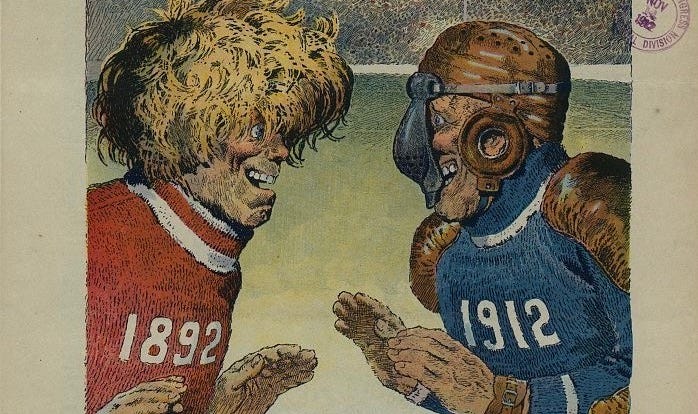 Puck magazine cover, November 13...
Pigskin Dispatch Podcast... Henry Mitchell McCracken and Football's New Rules
Pigskin Dispatch podcaster Darin Hayes and I discuss a recent Tidbit about NYU, specifically the contributions of Henry Mitchell McCracken, who played a critical role in helping resolve football’s safety crisis from 1905 to 1906.
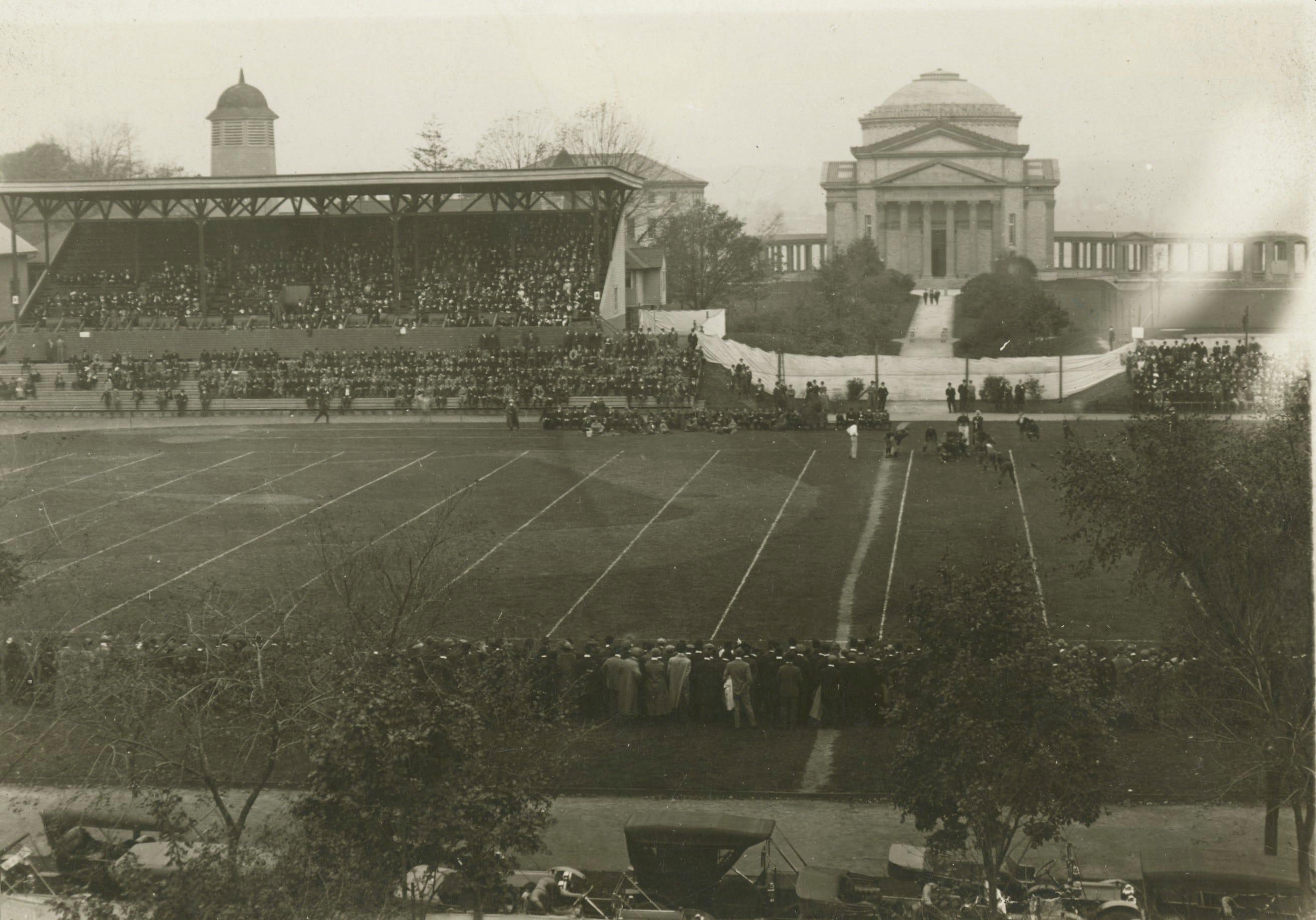 NYU’s Ohio Field and grandstand, with the Hall of Fame for Great Americans in the background. (NYU Archives)
Watch or listen to the podcast here and/or read the original Tidbit.
Football Archaeology is reader-supported. Consider becoming a paid subscriber or buying one of ...
November 10, 2024
Today's Tidbit... The Albert Russel Erskine Trophy
About two weeks ago, I wrote about the mid-1920s to early 1930s Bonniwell Trophy, an early attempt to name and award a trophy for college football's national champion. Named for the president of the Veteran Athletes of Philadelphia organization, they awarded the Bonniwell Trophy only in the years the club members unanimously voted on a deserving winner.
As I wrote in How Football Became Football, experts or groups of experts, mathematical formulas, or play on the field have determined football na...