Cliff Lerner's Blog: Explosive Growth Blog, page 2
December 18, 2017
The Worst Ideas I Had As A Founder (That Went Extremely Well)

Much of this information is taken from my #1 Best Seller Business Book , Explosive Growth — A Few Things I Learned Growing To 100 Million Users & Losing $78 Million .
There is one truth that all founders — I don’t care if you’re a former CEO or a 22 year-old college dropout — must come to terms with:
Most of your ideas are bad.
This shouldn’t come as a surprise to anyone. Having bad ideas is just part of being human. Your “CEO & Founder” business cards don’t come with a brain implant that stops you from having dumb ideas in the shower (Look at that! Another terrible startup idea!).
The difference between a successful founder and a failed founder isn’t always the quality of their ideas. It is their willingness to put even their seemingly worst ideas to the test.
My career is a testament to this fact. I founded AreYouInterested? (now known as FirstMet), which was the first successful Facebook dating app, and now connects over 30,000,000 singles.
As Tony Robbins says, “There is no such thing as failure, only results.” And I firmly believe that the more results you get, the more you learn, and the closer you get to success. This philosophy became a core value at my company, and why we believed in testing nearly any idea, regardless of how bad I thought it was.
#ExplosiveGrowthTip: If you want more out of life, or have any fears that are holding you back, attend the Tony Robbins event, “Unleash The Power Within.” This event dramatically changed my life for the better.
I’ve written before about some of the different growth strategies we executed as a young startup, but I’ve never written about the “What the heck, let’s try it out.” moments that generated explosive growth for AYI.
The truth is, many of my most successful growth strategies began as horrible-sounding, off the cuff ideas. For example…
1. The Hottie FeatureI was a very product-focused founder — and by that, I mean I used my own dating app to find dates.
There was one afternoon where I was getting ready to head home from the office, when I glanced over at my senior engineer’s monitor. He was scrolling through AreYouInterested?, but his feed looked completely different than mine.
My feed was full of the people who used our service, which meant an eclectic mix.
His feed was full of women who I assumed were supermodels.
I assumed it must be a weird coincidence, so I went over to his desk and asked him if he’d ever seen this happen before. His response was not what I was expecting:
“Promise me you won’t be mad?”
That’s generally not what you want to hear from your developer.
He continued:
“I spend 10 hours every day looking at the site while I work on it, and I’d prefer it if I only saw beautiful women. So I built this feature for myself that filters the women I see in my feed according to how often people engage with their profiles. In other words, if a woman is more sought after — generally meaning more beautiful — she appears in my feed.”
What he was describing was a more primitive version of Tinder’s famous ELO rating, roughly 3 years before Tinder ever existed.
#ExplosiveGrowthTip: Try to hire employees who will also use your product, because they will have some of the best ideas and will outperform non-user employees. Visit the Explosive Growth website to see my Top 10 Growth Tips For Entrepreneurs .
He was expecting me to lose my temper about him messing around with the product, and so my response startled him a bit.
I paused, gave it some thought, overlooked the obvious interpretation of shallowness, and responded, “You’re a genius! Can we ship it as a feature by tomorrow?”
I called it “The Hottie Feature,” and everyone on the team thought it was the dumbest idea. From the name to the functionality, no one thought it was going to work.
But it did. Tens of thousands of users were happy to pay an extra fee to only see beautiful people in their feeds, and as a result, The Hottie Feature — one of the dumbest-sounding ideas I’ve ever had, if you asked my team at the time — generated millions in revenue for AYI.
2. Free In-Office Massages For EveryoneAt one point in our history, AreYouInterested? was faced a struggle every successful startup deals with:
Scaling quickly was destroying our culture.
We had grown incredibly quickly, and everyone’s workload was increasing. As our teams grew larger and our task lists elongated, culture started to slip away.
Getting out in front of the problem, we had a giant brainstorming session where we invited people from all over the company to come and share not only their experiences, but their ideas for activities that would reinforce our culture better.
One idea that gained instant popularity was the suggestion that everyone in the company should get a monthly, in-office massage.
More accurately, the idea was instantly popular with everyone but me.
Being the data-driven marketer that I am, I instantly calculated that we would be losing 10 hours of productivity for people to essentially fall asleep during work. I also calculated the wildcard risks associated with paying someone to come in and touch all of my employees.
However, as a data-driven marketer, I also believe in testing everything, so we gave it a try.
It was the single best thing we ever did for our culture.
People were so excited about the massages, mass chaos ensued on sign up day. One of our engineers actually developed a service — on his own time — to randomly select the massage schedule.
In no particular order, the benefits included:
We had, without fail, near-perfect attendance on every massage day. At a company of our size, it’s pretty rare to have 100% of your staff on hand.People were actually more productive and happier after massages than before.Our culture was reinforced. Everyone understood what we were trying to build a company where everyone is mission-focused and high-achieving, but where their leadership is willing to do whatever they need to stay healthy and happy.It’s been 8 years now, and the massages are still a mainstay of the office.
#ExplosiveGrowthTip : Do you offer fifteen-minute in-office massages to all employees at least monthly? Trust me, do it.
3. Throwing Out Our Roadmap — MomentarilyOne of the things every growth-minded founder has is a roadmap. You want to hit x goal by y date, and you’re going to track these KPIs to make sure you’re on track.
As your company grows, however, your goals get more complicated, your list of KPIs grows, and eventually, your roadmap actually stifles innovation.
It took me a while to notice when I first experienced this. All of my experience as a founder had taught me that having a detailed growth roadmap was the only way to keep your team focus on what mattered, and to move quicker than your competition.
That mindset had served me really well. Our company was worth over $100 million, our team had exploded in size, and everything seemed to be humming along well.
But we were stagnating.
We were missing that same furious pace, the fountain of new, employee-generated ideas that had really driven our innovation so far.
Speaking with our head of engineering, I asked him what he perceived the problem to be. His answer was exactly the opposite of what I expected:
“We’ve hired really talented people, but talented people only do great work when they’re given freedom and challenged to solve new and interesting problems.”
In other words, having our best engineers focused on fixing critical bugs and our top product managers tasked with eeking out 3% growth, both very important items to me that would contribute millions to the bottom line, was of little interest to the most talented employees.
#ExplosiveGrowthTip : If you want to retain and motivate talented employees, make sure they are working on the biggest challenges and opportunities instead of the biggest problems. Are your most talented people working on the biggest opportunities instead of the biggest problems?
I couldn’t believe it. I was thinking about ways to increase productivity, and here was my top engineer telling me I needed to demand less productivity.
I was skeptical, to say the least.
But, willing to test any idea, we tried it out. We implemented a monthly 3 day hackathon where employees could work on whatever they wanted, with suggested topics if they needed inspiration.
The results were incredible. The process had so many benefits, including:
Team members felt free to swing for the fences — and miss — because failure wasn’t a big deal. As a result, we had a lot of strikeouts, but we also had some home runs.People who would never otherwise talk to each other were collaborating. Customer support reps were giving ideas to engineers, marketers were guiding product managers, and as a result, the overall education level of the company rose.Morale increased across the board. By telling your team, “This is a time to only work on things that excite you,” you’re telling your team that their excitement and passion are important.Individuals who would never contribute in creative ways were motivated to. We had one engineer who had never contributed a single idea develop a genius new messaging feature, just because we offered a pair of tickets to The Book of Mormon to whoever won the hackathon.Some truly innovative work came out of those hackathons, including a predictive model that forecasted the future revenues of marketing campaigns, based on initial user interactions — something tech writers today would refer to as AI.
#ExplosiveGrowthTip : Make sure your employees have ways to be creative and try their own ideas? Do you have a monthly hackathon?
4. Our Secret Hiring Weapon: The Beer TestIn 2011, we raised a lot of money, and we did what any recently-funded company would do — we spent it. In our case, we spent it by hiring aggressively.
We listened to what the “experts” on Wall Street said, and we grew our staff from a collection of twentysomething tech people to an expanded talent pool with a lot of more “experienced” people making over $200,000 per year.
Those people looked great on paper, were impressive to outsiders, and gave us a nice bump in perceived maturity as an organization, but unfortunately, they were a total culture clash.
One giant issue was our development cycle. We were a very lean and agile organization. We wanted to start the morning with an idea, build it, and push it live to users the next day. We would often perform twenty to thirty code pushes in a single day.
That became a big problem, however, when we hired high-priced senior leaders who were used to pushing one new feature per month (or quarter), because they wanted to thoroughly test, measure, and perfect each feature before launch.
The cautious, controlling mindset of our new hires clashed intensely with the high-speed, creative mindset of our original team, and it led to us eventually letting go of many of our new hires.
To prevent this from ever happening again, someone suggested “The Beer Test.”
As part of every job interview, we would take the interviewee out for at least one hour of social activity — bowling, karaoke, drinking, whatever — and if their personalities clashed with our team, they were a no hire.
I couldn’t think of anything dumber than singing karaoke with a potential engineering hire — but it worked.
After implementing The Beer Test, we had several rounds of hiring where we dodged landmines — people who interview well, but are complete culture clashes — and our overall retention went way up as a result.
More importantly, employees starting staying later at work, and even hang out together on the weekend, which had an amazing impact on the culture, productivity, and overall happiness of everybody.
#ExplosiveGrowthTip : Don’t hire someone you wouldn’t want to have a beer with (or hang out with) after work. Several of our best ideas came as a result of hanging out with coworkers outside of work. Do you want to enjoy a beer with most of your coworkers?
5. That Stupid, Incredible Heart Icon ❤️One of our guiding principles at AreYouInterested was that anyone — regardless of position in the company — could contribute an idea, and if that idea could be quickly implemented and tested, we’d do it.
Our best ideas, as a rule, didn’t come from people with the highest salaries who were normally tasked with generating new ideas.
In fact, the largest chunk of them came from the administrative and support staff, who were among the lowest-paid employees at the company. When you think about it, this actually makes a lot of sense. The customer service team interacts with the customers substantially more, perhaps infinitely more, than management, and is therefore acutely aware of the customer’s needs, desires, and pain-points. Yet rarely are they empowered to contribute ideas or encouraged to interact with the decision makers.
That’s another interesting lesson I’m going to take with me wherever I go — seek creativity and feedback from everyone in the organization, because you never know where true genius may be hiding.
To ensure that I and other leaders remained connected to the users, we had the ‘community team’ send a weekly summary of the top issues and ideas from users and their ideas as well for management to discuss.
One of the ideas was to put a heart icon in the subject line of certain emails.
I thought, “That’s the dumbest idea I’ve ever heard.”
Of course, I didn’t say it, because it would have been extremely destructive to the brainstorming process (and to our core values).
The rules of our culture indicated that as long as an idea could be reasonably implemented, and didn’t harm the user experience, we had to try it. So, we tested putting a heart icon in the subject line of certain emails, and lo and behold, the amount of emails opened increased by 18 percent.
#ExplosiveGrowthTip: I found that many of our best ideas came from the customer service team, which makes sense since they are acutely aware of the customers’ needs. Is your customer service team empowered to contribute ideas? Have you tested an idea recently that your customer service team was passionate about?
Try Anything, Test EverythingIf you take anything away from this story, take this:
If an idea can be quickly implemented and a/b tested — and it is isn’t blatantly offensive or destructive — you owe it to your team to try it.
Worst case scenario, you lose a little work time. Best case scenario, you stumble into explosive growth.Two books that I highly recommend about testing ideas are The Lean Startup By Eric Ries and You Should Test That by Chris Goward, which are both on my list of the Best Books For Entrepreneurs.
If you enjoyed this article, please hit that clap button below

December 11, 2017
How To Get $100,000 In Free Press For Your Startup This Week

Much of this information is taken from my new book Explosive Growth , which you can purchase on Amazon .
In 2007, my company’s marketing efforts were, in a word, lackluster.
I ran a dating service called IAmFreeTonight.com (later known as AreYouInterested, and now, FirstMet), and in 2007, we’d launched the following marketing campaigns:
We dumped $50,000 into one Spring Break promotion involving helicopters, skywriting, and girls in bikinis. It netted us zero signups.We tested viral features that failed.We’d appeared in a few major media outlets — USA Today, Geraldo, etc. — which had driven some signups, but not nearly enough.In short, we had nothing but a handful of good stories.
Dating apps do not work without a massive network — if someone logs on in Albuquerque, you need 100 other singles in Albuquerque to make them stay — and we needed to grow our user base fast if we wanted to stay around.
With these middling marketing results, we weren’t going to be able to stay afloat.
Our company managed to survive for one reason:
We figured out how to consistently generate thousands of dollars in free press .
In this article, I’m going to break down our strategy so that you can use it to generate free press.
How College Basketball And Wardrobe Malfunctions Saved My CompanyOur strategy for generating free press was simple:
Take a hot button current event.Combine it with some data relevant to your industry.Arrive at a hypothesis that may or may not be crazy.Get massive publicity.You might have heard this referred to as newsjacking.
The first time we put this idea to work and realized that we had something very useful was when the Duke Blue Devils lost in the opening round of the 2007 NCAA Men’s Basketball Tournament.
Although Duke was far from a powerhouse that year, it was still a shocking defeat, because they had a tradition of deep tournament runs. For them to lose in the opening round was quite the stunner, and more than depressing for the alumni and current student base.

Source: TodaysACCHeadlines
Seizing the opportunity to steal publicity, we piggybacked off this story and created controversy through our own press release that drove attention to our website.
#ExplosiveGrowthTip: Speed is key and the big boys can’t keep up. Have you contacted key writers to tell them you will provide any data and survey information they need within a tight timeframe?
The press release stated that the shocking tournament loss made Duke students so upset and depressed that they flocked to online dating sites to cure their depression (misery loves company), and we provided some data to back it up.
About a week later, we got an e-mail from the school newspaper, the Duke Chronicle, asking for some more data around the Duke’s students’ online dating activity. They ran a follow-up story on it, and it quickly became a hot-button issue on campus.
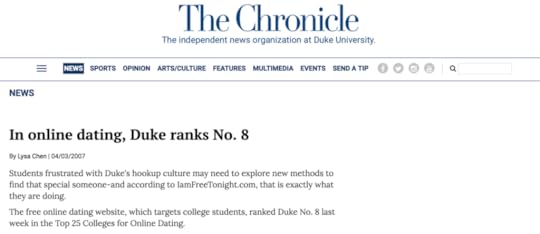
The story ended up getting republished all over the country, and the Chronicle ran another story on it a week later.
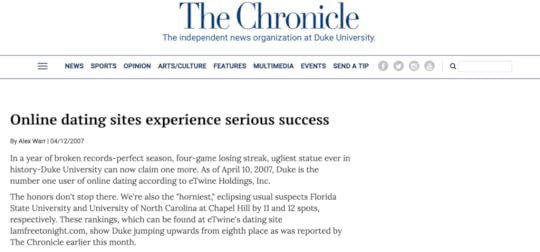
They interviewed a student who claimed she was in a statistics class, understood all about confounding factors, but found absolutely no correlation between the basketball team losing and online dating, which I thought was hilarious.
The story had gone so viral that I started thinking about how I could take it even further. I wanted to keep the positive momentum going, so I tried to speak to Duke’s Hall of Fame basketball coach (Coach K) to ask him if he noticed any depression among the players.
Unfortunately, (but not surprisingly) I never got a call back from him.
Nonetheless, the insane popularity of the topic made it very clear that we were on to something.
From Duke Basketball To Britney Spears’ CrotchA couple of months later, we seized another opportunity for newsjacking: this time related to Britney Spears, right around the same time she broke up with K-Fed. All the entertainment sites were talking about an awards show scene where she was spotted coming out of her limo, and it was crystal clear to everyone that she wasn’t wearing any underwear.
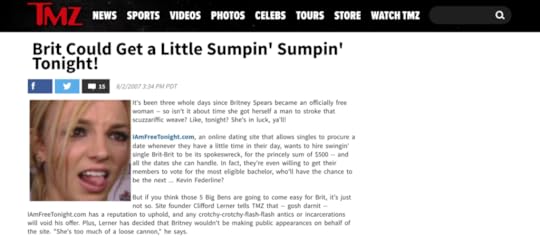
At the time, we’d been thinking about hiring a celebrity to become the face of IAmFreeTonight.com, so the timing was perfect. Our press release stated that we were offering Britney $500 to be our spokesperson, but we had a reputation to uphold and refused to relinquish any of our high moral standards.
Therefore, should she accept the offer, and have any other flashing incidents or momentary lapses of character, we would have no choice but to void the offer.
We pitched that to several news outlets, and TMZ absolutely loved it. In fact, they loved it so much that they interviewed me for an article about it where they said, “Lerner has decided that Britney wouldn’t be making any public appearances on behalf of his site. He says she’s too much of a loose cannon.”
#ExplosiveGrowthTip : Find a fun and positive way to include your targeted blogs or influencers into a data story. They just may connect with you on it!
What’s Happening Right Now That You Can Newsjack?Remember the formula:
Take a hot button current event.Combine it with some data relevant to your product or industry.Arrive at a hypothesis that may or may not be crazy.Get massive publicity.It doesn’t have to be an super risque, tabloid-esque story either. Just a story that people care about.
#ExplosiveGrowthTip: Anticipate newsjacking opportunities by identifying upcoming concerts, festivals, sporting events, conferences, annual events, elections, and trade shows. Do you have a list of at least three upcoming opportunities for newsjacking?
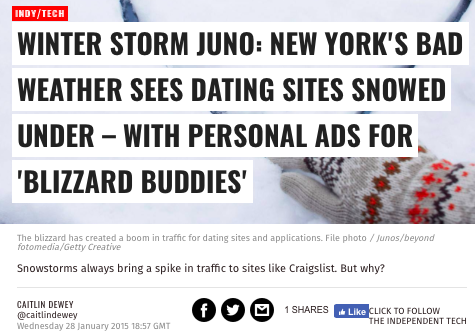
For example, some of our best PR was done around severe weather. Storms happen cyclically, and people are always reading the news about them.
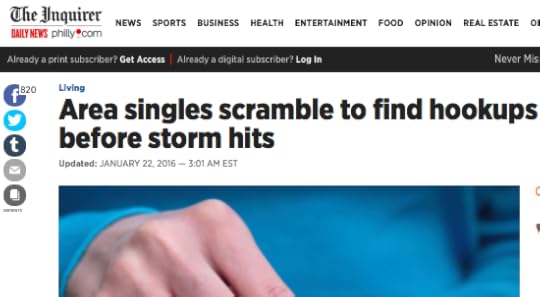
So, whenever a snowstorm was predicted, we would immediately provide data to reporters that showed how users flock to dating sites during a storm, likely looking for a “cuddle buddy.”
We used data to show that messaging activity on our online dating app increased 340 percent during the prior year’s storm. Using this method, we were able to inject ourselves into a national news story about severe weather at least once per year:
Right now, what’s happening in the media that you can piggyback on to get massive attention for your company?
Two of the best books for entrepreneurs that I highly recommend about how to get your articles and ideas to spread virally are Contagious By Jonah Berger and Made To Stick by Chip Heath.
If you enjoyed this article, please hit that clap button belowNovember 30, 2017
5 Genius Things Tinder Did To Achieve Explosive Growth

Much of this information is taken from the chapter, ‘Tinder Cracks The Code,’ in my new Best Seller Business Book , Explosive Growth , which you can purchase on Amazon .
As soon as I saw Tinder, I knew it was going to crush the competition. Unfortunately, I was included in that competition.
How did I know Tinder would succeed? Tinder found the Holy Grail — the one thing all online dating services (mine included) had been trying to find to no avail:
A way to stimulate word-of-mouth referrals.
Before Tinder, there was a serious stigma around online dating. You only told your friends you were dating online after you’d successfully met your match — and even then, it wasn’t information you went around broadcasting.
That made it extremely difficult to build up any word-of-mouth momentum. At one point, my company actually spent $50,000 on a single Spring Break promotion to try and stir some word-of-mouth excitement — and earned ourselves a whopping 0 new signups.
#ExplosiveGrowthTip : Learn how to validate an idea with as little time and financial investment as possible.
The only silver lining was that every dating service experienced this same frustration, meaning we weren’t alone in our struggle.
And then Tinder happened.
Tinder did five genius things to get people talking about their service, and their results speak for themselves. I’ve broken down all five of their masterstrokes below, starting with…
1. Tinder Took The Shame Out of Online DatingWhen I first saw Tinder, I was at a bar in Manhattan.
I was sitting next to a group of young women who were enamored by some app they were all simultaneously playing with. I assumed it was a new game, and went about my business.
After 30 minutes of them continuing to look at each other’s phones and say, “Left!” or “Right!” I was curious enough to ask them what the game was.
That’s when they showed me Tinder.
After one of the women explained it to me, I asked her, “Oh, so it’s a dating service?”
She responded, “No, it’s a game.”
We went on to have a strangely animated debate back and forth about whether Tinder was a dating site, a game, or an online retail store with an inventory of available men.
Finally, one of the girls got really frustrated and defensive, and she shouted, “No! We’re not online dating! It’s like we’re shopping, but for men, get it?”
That’s when it occurred to me — Tinder was going to change the entire landscape of online dating. They’d cracked the code. For the first time, people weren’t afraid to talk about online dating in public — because it wasn’t “dating,” it was a game.
Even Tinder’s copy underscored this message. In other online dating apps, when you matched or sent a message, you’d get a message that said something like, “There are more singles waiting to meet you!”
Tinder said, “Keep playing.”
Tinder had made a game out of dating, and what do you do when you find a fun game?
You invite other people to play.
2. Tinder Was Literally 10x BetterIf you’re a new app trying to compete in a market with giant incumbents, as Tinder was, your product can’t be marginally better. It needs to be 10x better at least.
Tinder created a user experience that was just that, and they did it in some pretty amazing ways:
Instant Access: Dating services like mine were constantly trying to reduce user friction, and making signups simpler was a big part of that. We had our signups down to a couple of clicks, which was great — but Tinder made signing up as easy as a single click.Hyper Local Geo Targeting: Dating services typically used your location to find you dates in a 50 miles or so radius. That way, you could set up a date sometime that week. Tinder showed you people within 1 mile of you, so that you could go on a date in 15 minutes.Highly Optimized Algorithms: Having a big user base is critical to a dating service’s success, but it can also mean creating a huge pile of profiles for users to sift through. Tinder algorithmically identified very attractive people, and showed you them first.Even the features Tinder didn’t pioneer, they did better. Other apps had a swiping-esque feature, but Tinder made it simpler and quicker than anyone else.
My Tinder ExperimentTo quantify how much better Tinder was, I ran an experiment with several of my friends — guys and gals — to verify that Tinder was really ten times better than other online dating sites at meeting someone quickly.
It was important for me to quantify Tinder’s superiority in order to fully gauge how serious of a threat they would be to me.
You see, if a product is marginally better, or just a little different, it’s unlikely to succeed. Changing services is a pain for users, and so a service needs to be 10x better to justify the switch.
So, I asked my friends to try a variety of online dating apps to see how quickly they could get a date on each one.
With zero exceptions, all of them came back with the same result: Tinder allowed them to meet someone more quickly than any other site.
Most of them met someone on Tinder within one hour, as opposed to two or more days on the other websites. In other words, Tinder’s ability to deliver on the core user objective, a date, was literally ten times faster than other dating sites. Game, set, match to Tinder.
#ExplosiveGrowthTip: Great products are at least 10x better than the competition at delivering on its core value. Can you quantify how much superior your core product offering is than the competition? Is it 10X better?
3. Tinder Made Women Priority #1Ben Thompson, the genius behind the tech strategy blog Stratechery, explained the dynamics behind Uber’s success like this:
“As (Uber) acquires users (and as users increases their usage) Uber attracts more drivers, which makes the service better, which makes it easier to acquire marginal users (not by lowering the price but rather by offering a better service for the same price).”
In other words, Uber gets more riders, meaning more drivers are attracted to the platform. The fact that they have more drivers in each area makes for a better user experience (quicker pickup times), meaning even more users sign up, meaning more drivers, and on and on.
This process is called a virtuous cycle, and it works because Uber understands that only one group of people matters in this equation: The riders.
Now, what does Uber have to do with Tinder?
Tinder made a similar observation to Uber. For Tinder, only one group of people matter, and that’s the women who use Tinder.
If you create an amazing experience for women in online dating, they will use your platform. If every woman uses your platform, men will have no choice but to flock it.
By implementing a double-blind match system in which men could only contact women who liked them back, Tinder cut out the non-stop, unsolicited messages women on other dating apps would get. In other words, every time a woman received a new message, it was a ‘beautiful’ experience.
Now, things have changed since Tinder’s early days. As with any app, when you scale to such incredible size, your user base is going to include some people you wish it didn’t — in this case, creepy guys who spam the women they match against with uncomfortable messages.
As one can imagine, some of these ‘messages’ can lead to a less than ‘beautiful’ experience for women, however, compared to the services that predated Tinder, the difference was still night and day.
4. Tinder Tapped CoedsOne of Tinder’s first marketing efforts was a stroke of genius.
If you had never used an online dating service, what would make you try it out?
In the past, dating services had tried things like sending prospective users advertisements and messages like this:
“See who has a crush on you!”
Tinder did the opposite. Tinder figured that the thing that would motivate you to try out their service wasn’t the knowledge that other people had a crush on you, it was by telling you that your crush was using Tinder.
Tinder went to college campuses and threw parties, inviting all of the most popular, attractive students and requiring them to download the Tinder app to get into the party.
I can just picture the marketing meeting to plan that event. “Here’s an idea: What if we throw parties at a bunch of different college campuses around the country? We invite the sororities with the hottest college girls we can find, and have the frat guys show up.
Then, tell everyone to download our app to get into the party. After that, they can swipe left or right all night. By the next morning, the entire campus will have our app, and they’ll be telling everyone about it!”
It worked to perfection.
The strategy had three main benefits:
For people who weren’t cool enough to be invited to the party, this meant that the person you had a crush on was on a ‘dating’ app looking for dates, and you could be on it too.For anyone downloading the app for the first time, it was already seeded with the most attractive, popular people in your network, creating a beautiful initial experienceFor anyone nervous about online dating, it instilled a massive fear of missing out — after all, the person you were interested was probably on Tinder talking to other people.The idea worked like magic, initiating massive word-of-mouth growth and Tinder spread like wildfire.
5. Tinder Never Made You Pay For Core FeaturesOne of the keys to my company growing revenue from $3m to more than $19m in just 2 years was this simple formula:
We acquired a lot of users by giving our unique service away for free.When our user base was full of committed users, we started charging them.We made a ton of money right away when we turned on the subscription model, but we drew a lot of ire and lost a lot of passionate users who were crucial in spreading the word. Even worse, these users expressed their displeasure en masse by giving us negative 1-star reviews in the app store, which negatively impacted our user acquisition efforts.
Tinder took a completely different approach.
To this day, none of Tinder’s original core features cost money. You can sign up today, and spend the rest of your Tinder-life swiping for free (you just can’t swipe too much in one day, that’ll cost you).
To make money, Tinder has rolled out a series of non-essential, but hugely valuable upgrades, including boosting the number of people who see your profile, going back if you swipe too fast (rewind), changing your location (passport), or unlocking unlimited swipes.
All of that has lead to Tinder’s paying-member count exceeding 2 million last quarter, with a valuation likely in the billions.
It’s nothing short of brilliant execution by Tinder’s management. To be able to monetize a previously free app so lucratively, and not suffer any hiccups in user growth, is extraordinary.
#ExplosiveGrowthTip: Never start charging for something that users are used to receiving for free. They will revolt and cause irrevocable damage with bad reviews. Come up with new features to monetize.
You Can’t Control Timing, But Everything Else Is On YouTinder definitely benefited from some perfect timing:
Online dating was finally familiar enough for an app like Tinder to break the social stigma.People were finally comfortable sharing their personal information, specifically your location, with an online dating app. Previously, there was significant pushback about apps that tracked user location and would reveal users nearby.The iOS ecosystem was a uniquely powerful platform for spreading Tinder, whereas incumbents had either built stand-alone sites or built off platforms like Facebook.However, none of that timing can take away from the brilliance of Tinder’s strategy. To be sure, there are plenty of companies with brilliant ideas that fail because the timing is wrong — but for the most part, timing is not what keeps startups from growing.
There are countless factors that make or break most startups’ growth, but having a remarkable product, constant a/b testing, and having a talented team to execute on a brilliant growth strategy are necessities, and completely within your control. However, the right timing can make all the difference in the world.
Two books that I highly recommend about how to ignite viral growth are Pyromarketing by Greg Stielstra and Contagious By Jonah Berger, which are on my list of the best books for entrepreneurs.
If you enjoyed this article, please hit that clap button belowNovember 24, 2017
This is a great list, will be checking these out.
This is a great list, will be checking these out. I also find Wunderlist is a great app for reminders and to-do lists.

Explosive Growth Blog

- Cliff Lerner's profile
- 19 followers