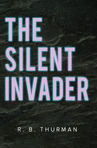
R.B. Thurman's Blog, page 5
July 10, 2018
OOPS!
I forgot to finish my blog! I’m so sorry!
I plan to publish by this time tomorrow. If you’re in a rush, please warm up your time machine and put in 24 hours. I’ll reimburse you the cost for the trip at a future date/time not yet revealed to me by my finances.


A Government Project
Once, long ago, I thought I could draw.
I mentioned in an earlier blog
Thanks for reading! Please like and share! You can follow on Facebook, Tumblr, and read excerpts from The Silent Invader @RB_Thurman (and follow!), in addition to the chapters I add here. If you prefer, you can also read my posts on Goodreads (I do a few book giveaways there, so you may want to check it out for that). Your comments are welcome below. Also, sign up now to receive notifications for when the next blog arrives.
July 3, 2018
Me of the Month: July 2018.
In June, I mentioned that I bought a rather large vehicle as my first car, and there might be ‘concerns’ surrounding why. Allow me to explain.
Let’s look at each of these concerns:
Gas guzzler!
The thought of excessive fuel consumption is one many would consider when purchasing a car today. Even when I started driving, gasoline wasn’t free. But, it was hovering around a dollar a gallon, so it could also seem relatively inexpensive, depending on where you are on earth then.
And while it did have a 5.7 liter V8 and a 21-gallon gas tank, it did average about 25-27 miles to the gallon (highway mileage. It was about 17-18 city driving). Which if you do the math, is around a 500+ mile range in this car. My present car is more fuel efficient, but I can’t go that far on a single tank of gas. And I can assure you I was testing my driving range often since I wasn’t spending much on that ‘cheap’ gas.
Imports were better, especially then!
I would agree that several cars could likely be less maintenance than this one. However, given this car was 20+ years old by the time I got it, not only was ‘maintenance-free’ not applicable to this car, it probably wasn’t too many others of the same age. A 1976 Honda Civic may have started as a more reliable car, but after 300k miles and 20+ years, it might not be. Rubber goes bad, no matter how good it was to start with, and time is merciless to metal and protective coatings (like paint).
I would also consider the demographic that was likely to drive the vehicle when it was new, and as it aged. A large older car is more likely to have an elderly driver. In the late 20th century, the average Buick owner was likely nearing retirement, if not already. My grandfather bought his new. In the 1970s! These were going to start out well cared for, even if they didn’t end up that way later.
Smaller cars were not owned in significant numbers by the elderly (Where I live. A ‘small’ car to them would likely be larger than anything Honda was trying to import in the 1970s), so you run the risk of a car not being cared for. Not because a person was hard on the car, but likely for the same reason I wasn’t a great steward of my first car: I wasn’t rich. It’s tough to buy a new radio for your car when you need to save up for an oil change (The priority here is obvious. So obvious that I feel like pointing it out would just be silly. Even if I hadn’t bought the 6x9s yet…). And I really didn’t like the fact most of those cars didn’t have power anything. Including power steering.
I will add this aside: Of all the problems I had with my car, none were with the things most would assume to be problematic: All the power accessories (mine had power windows/locks/seats, etc.) worked in the car. I replaced the transmission twice, but I could go out to my undrivable car and roll down the windows and listen to the stereo any time I wanted.
And while having a car prone to ‘expensive’ breakdowns may seem an issue, it’s worth noting that I don’t think I spent more than 2k keeping that car on the road, including oil changes (and transmissions). The breakdowns were expensive because of poor money management, not because they actually cost too much. If I hadn’t bought that awesome stereo for it, I probably could’ve afforded a remanufactured transmission (complete with every wear component replaced with something better, I’m sure), instead of a more basic repair that got the car going again. But where’s that fun in that? Not only would I not have a radio, but I also wouldn’t even be able to hear the transmission once it was done!
Wasn’t it expensive to put gas into it? (Probably burns 3 gallons to the mile!)
Um, I think I addressed this earlier, but let me reiterate: I saw gas prices as low as 79 cents a gallon to about 1.13 per gallon when I owned this car. And while I wasn’t keeping it full (that was like twenty bucks to fill it up! that’s food for two weeks! Do you know how many 50 cent cheeseburgers I could buy with twenty bucks?), I’ll just say my struggles to keep gas in this car were not related strictly to finances. I found a lot of uses for money beyond keeping gas in the tank.
Enough about cars. And enough about me. I was young once, that’s what we can take away from this. Let’s see what else this kid had in mind to write, even as he was completing this book. Next week: The other projects. I touched on one, so let’s go there again.
Thanks for reading! Please like and share! You can follow on Facebook, Tumblr, and please feel free to read excerpts from The Silent Invader @RB_Thurman (and follow!), in addition to the chapters I add here. If you prefer, you can also read my posts on Goodreads (I do a few book giveaways there, so you may want to check it out for that). Your comments are welcome below. Also, sign up on my contact page, and receive notifications for when the next blog arrives.
June 26, 2018
Weapons for Extraterrestrial Melee
I touched on how they get around, along with how they defend themselves. Now for the ‘fun’ part.
What is the Tyberian ‘ultimate’ weapon?
I will allow Richard to explain:
Richard pauses. “But there are a few that were developed in the past that were forbidden for use ever again.” He looks up, remembering the things his father had told him not long ago. “Like the fusion pulse cannon.”
“I’ve heard of that,” Samantha mutters to herself. “Wasn’t that a weapon that could damage several ships by triggering a fusion reaction in key elements?”
“Yeah! How did you know?” Richard says in amazement.
“I know a little about your history. Your ancestors used it on the Maxians and started the three-hundred-year war,” Samantha relates.
Richard looks down at her, his face expressing frustration by the remark, but then he sighs. “Yeah, I guess so,” he finally slides out. “But after that war, the weapons design was given to the kings on each side. Then any other record of it was destroyed.” Richard suddenly smiles, a new spark of excitement enters his eyes. “That weapon could be the key to defeating them!” He looks over to Samantha, trying to impart his sudden surge of optimism, “If we build it and use the power source Joe created, we may be able to reorient this!” He continues down the hall, grinning.
Richard & Samantha
There are a few things I want to point out with Richard’s comments.
First: He is young
I think it shouldn’t be lost on anyone that Richard is not very old. In fact, I’ve already pointed this out here. And I wrote this novel when I was younger than Richard, so my assumptions were this was a mature perspective on the matter. I can’t say I (now) agree with me (then) about whether Richard was ‘mature,’ but it does influence his views on a few issues.
That said, Richard is likely expressing his view of this weapons’ awesomeness from an emotional standpoint. It would feel awesome to need to use this, to eliminate the threat with a tool that is absolutely certain to do it (until it doesn’t, but that’s another matter…). The weapon is still no less powerful. I didn’t go into detail regarding the weapon itself because of its history (it’s not in this book, but it will be addressed), but it will affect Richard’s perspective as the story continues.
Second: He isn’t a ‘warrior’
War seems easy when you aren’t the one taking a swing at your enemy (though, even Richard is helped with this). This weapon is much like the catapult of ancient times: you don’t have to see it hit your enemy to know it will hurt when it does. Richard will know using this will inflict pain, and it can possibly end the conflict quickly if circumstances permit, and he doesn’t have to understand its inner workings for this to be accomplished. Don’t dwell too much on why he doesn’t seem to know the technical side of matters; understand that his goal is to stop the conflict, and he feels this will.
Now having said that, yes he’s not wrong this is a powerful weapon in the novel. In fact, this is only its first use, and you will see that its’ simple design as the series continues underlies a more significant issue regarding its design. And while it may seem awesome here, it actually is not used to its potential:
“I tied the fusion pulse cannon to our onboard fold systems.” He turns toward Richard. “I discovered your reactor power conduits can handle 75 percent output from the power plant, so I tied the cannon directly with them.”
Richard frowns. “What kind of efficiency had we gotten with this weapon?”
Joe turns back to his console. “Around 15 percent.”
Richard looks ahead for a moment, dwelling on these words. “A fivefold increase?” He turns back to Joe, who is still grinning.
“Isn’t it cool? I was afraid the weapon couldn’t handle the power input, but it’s so well designed, it actually is more efficient with larger amounts of power!”
Joe & Richard
As the series progresses, the things that Richard knows and understands about the weaponry and defensive tech they use will come to light, through the history that he will relate.
There is one final thing I want to point to regarding this weapon: One thing that struck me was how ‘simple’ Richard will state the weapon is, mentioning that at one point in the book anyone could build one. It might seem crazy that this is possible until you look at the catapult example again. This is also a powerful weapon, and with various ways to modify and enhance, this is still used in a variety of tools (and even weapons) today. The principles employed are simple but easy to multiply for additional impact. That is how this weapon is. Once the weapon is built correctly, it can be used by anyone. Once the principles employed are understood, it can be multiplied exponentially. At a later date, I hope to discuss that.
Unfortunately, it won’t be next week. I have to talk about me. I know, you’d prefer a visit with an 18th-century dentist (I believe they were called barbers then), but I promised myself I’d work to stay regular.
Next week, prune juice.
I mean, me. Actually, that’s the same thing…
Thanks for reading! Please like and share! You can follow on Facebook, Tumblr, and read excerpts from The Silent Invader @RB_Thurman (and follow!), in addition to the chapters I add here. If you prefer, you can also read my posts on Goodreads (I do a few book giveaways there, so you may want to check it out for that). Your comments are welcome below. Also, sign up now to receive notifications for when the next blog arrives.
June 19, 2018
Defenses for Extraterrestrial Conflicts
Which is more useful: the perfect weapon, or the impenetrable shield?
A debate could be had on that that could last for hours, without resolution. But rather than debate which is more important, we’ll touch on how the Tyberian Empire employs each.
As the title suggests, we’ll start with the shield, since most will be more interested in the weapons anyway (that’s how this works, right?)
The Shield(s)
In science fiction, there have been various methods for describing defensive measures. Most typical, a parabolic bubble surrounding a vessel and everything just bouncing off or being absorbed. After several direct strikes by typically light-energy based weapons, this ‘shield is corrupted, and a prescient difficulty is faced in restoring it to its former glory (likely because of ensuing attacks). While the ‘shield’ is not always parabolic, it is usually assumed to be some distance from the vessel it protects. I have read of some that use a combination of the hull and electrical current, directly applying the energies to the existing plating, offering additional protection from harm, though there is not an extra barrier in this instance.
I thought about all of these while giving some thought to other methods beyond these. The chosen approach is something more distinct.
My first concern was with light-energy weapons (lasers, duh). While sufficient energy will allow a ‘laser’ to fire even with the effects of the atmosphere to distort it, in empty space such a weapon would be several times more destructive. The thing I looked at was more the effect the laser is attempting to overcome by firing in through the air, and even why.
A laser is a concentrated beam of light, often amplified and focused, to minimize the distortion. The more focused (in the case of a laser, it is typically a single color and wavelength), the better. There is one small problem with these, as pointed out in this article:
Any weapon that relies upon light traveling through the atmosphere runs into the problems of dust, humidity, and fog—features which absorb and scatter the laser energy. In addition, atmospheric distortions such as turbulence can deflect a beam of light. And at the same time that the photons in a laser’s beam must overcome all of these obstacles, they must also stay focused in a tight column and keep advancing forward without diminishing in power. Meanwhile, the user of the laser weapon must account for the movement of the target, the movement of the firing platform, and any decoys, dummies, or multiple war warheads that the enemy throws up.
– Bulletin of the Atomic Scientists
While there are several things being brought up as problems for lasers, the primary obstacle we will focus on is distortion, mostly in the form of dust, clouds, maybe even snow and rain. These objects often refract laser light, forcing it from its coherent (and intensified) beam. I wondered though in space how to recreate such a state, and be able to use it as a ‘shield.’
A form of dust seemed the most plausible since water will freeze in space, and lose its effectiveness as the heat dissipates it. But dust would be finite, the vessel would likely need to remain stationary, and it wouldn’t make sense have cavernous reserves of an item that will likely be used on limited occasions, given the fuel requirements to ship it around. And while even a military vessel will do that if it needed to be done, it’s worth noting that such an effort would limit the number of engagements (or even the length of said engagements).
One thing I’ve always questioned with space conflicts is the reliance exclusively on light-energy weapons (I’ll touch on explosive warheads shortly). Yes, they look pretty and futuristic, but if your goal is to WIN a battle, not merely to HAVE one, you probably won’t use a typical complement of weapons.
I decided that the protective barrier (the Tyberian Military refer to it as a ‘field’) would take on a physical form, rather than be energy. Though, this is not to say an electromotive force is not needed. The shape and form would most closely resemble this:
[image error]Aerogel – the cloud you can hold!
I thought of aerogel. It had the appearance I sought and already performs similarly, even with no modifications. And even x-aerogel adds strength and impact resistance to the equation. Because of its lack of mass, it would make carrying it along minimally impactful, and given its natural transparency, it wouldn’t obscure any threat.
The only real problem with it is that it is solid. In practical terms, a ship likely would have the aerogel ‘deployed’ like typical armor-plating, rather than a ‘field’ that appears as needed. And while a cloud-like ship might make for an interesting looking vessel (while difficult to maintain an oxygen-rich environment within. And privacy, duh), I had already determined the appearance of their ships, so I decided that the aerogel would simply take a cloud-like appearance over the vessel. The reasoning is that you can defend the ship from both light-energy and explosive-warhead or even solid-projectile type weapons. While I’ve only seen solid projectiles used once in a Science fiction movie, and probably it is utilized more often in novels than anywhere, It seems obvious to need defensive measures that take this into account.
What would make this variant of aerogel different is that it would be made ‘as needed,’ meaning it would be formed and deployed when the field is needed. When not in use, the materials used are stored for future use (as base components, which we’ll discuss later) in this or any other required capacity.
Now while having a sound defense is important, having an offensive capacity is also needed, especially when dealing with the threats faced in The Silent Invader. Next week, we will look at one weapon that augments their offense.
Thanks for reading! Please like and share! You can follow on Facebook, Tumblr, and please feel free to read excerpts from The Silent Invader @RB_Thurman (and follow!), in addition to the chapters I add here. If you prefer, you can also read my posts on Goodreads (I do a few book giveaways there, so you may want to check it out for that). Your comments are welcome below. Also, sign up on my contact page, and receive notifications for when the next blog arrives.
June 12, 2018
Vessels for Extraterrestrial Voyage
I could tell you that nobody needs them in the future, but I like spaceships so, unfortunately, we still do.
The challenge is, of course, is an original approach to the design philosophy. Even naming convention. Why would they call their ships what they have?
In this book, many of the naming conventions are similar to what we (the Terrans) may typically use in English since Richard was taught some of these things on Earth (see the blog for him), and he hasn’t completed his education at home at the start of the novel. Many of the people who staff his first ship (in command roles) are also from Earth. They’re using what they know.
However, there is one term his cousin Tess (and later, Richard) use to describe the Tyberian flagship:
As they follow the bride and groom into the reception area, they take in the view this part of the flagship affords them of the planet. Ana looks up at the horizon of Alexandria, the star that shines its warmth on the planet peeking over the crest, the shadows on the planet below receding. “This is incredible,” she remarks. “How could a capitol ship afford to have such a view?”
Tess steps forward. “We’re actually still in the hanger. The main bay doors, where the battleships come in, are open.” She spreads her arms wide as she steps toward the view. “This is the first naval constellation we built for the future guardian of the crown.”
Maice steps forward. “This ship is large enough to have a battleship dock within it?”
Tess nods. “And six corvettes!” She walks slowly toward the center of the room. “Not counting the fighter squadrons.”
Ana, Tess & Maice
Richard’s flagship os referred to as a ‘Constellation.’ There are a couple of reasons:
-It is the basis of a fleet
The Maelstrom Constellation, as the quote ascribes, carries its complement of vessels within. The ship provides the principle transit for the others. In a later blog, I’ll try to explain my logic for this approach, since this does present some challenges to travel for these ships, or engaging in battle. The one real advantage I will point to is that with one ship providing the majority of the flight, it means one ship is burning most of the fuel. It also means the other vessels within are ready at a moments’ notice and could be prepped for a mission (possibly even a long-range assignment) at all times, without concern of refueling or topping off before departing.
In this scene, I was trying to decide where the opening would be for this ship on the Maelstrom. I don’t remember where I thought it was at the time of writing (it was a while ago), but it would be easy to assume it was on the front of the ship.
Until you read the passage and think about how ships are often portrayed as orbiting a planet. I’ve yet to see a ship pointing the nose of the ship at the planet itself. It appears that the battleship makes a side exit from the ship.
From a combat standpoint, that would make the most sense, since maintaining a smaller forward profile toward an approaching threat (remember: there could still be several miles between the ship and the ‘threat,’ so pointing toward a threat, even with such a large ship, can still have an advantage). This would allow the deployed ships to train their main weapons on the threat as they emerge, and would help maintain a strong defensive/offensive posture.
I will admit I am not well versed on combat theory (not sure why you would think a teen would read The Art of War, when he wouldn’t read Lord of the Flies when it was required), so whether this ‘sound’ is up to you to decide.
-It’s REALLY BIG!
As I was trying to think of how the groupings for their fleets would be, I realized that ‘constellation’ could have a double meaning in this context. The fleet group is a constellation since an actual space constellation is a particular grouping of stars.
[image error]A portion of the Big Dipper, taken on the ISS
However, that grouping of stars isn’t without purpose. They are ‘grouped’ that way to help make them recognizable as this specific group, as this can present an image in the mind that can be recalled quickly. That image is often what we think of when we point to a constellation.
The Maelstrom is a constellation in the same sense. The collectives of ships that make up its fleet group are a ‘constellation,’ in that this is to what the Tyberian Military call their ship fleets. But the Maelstrom is a Constellation, as a result of hosting said fleet. The terms are used in this manner in the novel.
I should state that although the Tyberian Military calls this a ‘constellation,’ The Terran Government does have a designation for this type of vehicle, As Maice makes inquiry in the scene:
Maice shakes his head. “This isn’t merely a capitol ship. This is some kind of mobile battle platform.” He looks at Tess. “Who are you people at war with?”
Tess frowns. “Nobody. Why?”
“Why would your people need something like this if you are at peace?” Maice insists.
Tess folds her arms. “There are worlds on the other side of the unified territories that actively dispute our boundaries. While we would prefer a more peaceful alternative,” she sighs, “the K’Nough won’t have it any other way.”
The Terran equivalent would be the ‘Mobile Battle Platform,’ and much like a constellation, it also has several ships it ferries within. In a later blog, I’ll touch on a few of the differences. Next week, we will discuss one of the principle defenses used by the Tyberian Military, along with something readers will notice regarding all the ships in the Tyberian fleet.
(UPDATE 6-12-2018: It appears my main computer is up! However, it is also a clean slate, needing everything recovered to it. So I don’t have complete access to everything, along with not getting the chance to complete my scheduled posts – like the one that got out prematurely today! I’m hoping to get caught up in the coming week and have everything back to normal by the end of the month. Thanks for your patience.)
Thanks for reading! Please like and share! You can follow on Facebook, Tumblr, and read excerpts from The Silent Invader @RB_Thurman (and follow!), in addition to the chapters I add here. If you prefer, you can also read my posts on Goodreads (I do a few book giveaways there, so you may want to check it out for that). Your comments are welcome below. Also, sign up now to receive notifications for when the next blog arrives.
June 5, 2018
Me of the Month: June 2018.
After sailing in a land yacht, one would think everyone would want to drive.
The ‘one’ of course being me.
In the course of growing up, it was necessary for me to secure transportation. Where I live, the public transit options are not … robust, we’ll say. A search was then made for a suitable mode of transit.
I enlisted the aid of my father. My father seemed to have a gift for finding vehicles that were low mileage and cheap. Sometimes even classics. He would know since he owned a few.
[image error]This is not that car. My dad’s car was better (to me!)
One that stuck out for me was the 60s Impala couple owned. Rebuilt small-block 327, painted a racing orange and driven when he was courting my mother. I know this because not long after I was born, they soon parted ways with it (I’m guessing I had something to do with it). The crime was the amount.
50 dollars. 50 DOLLARS! I would’ve given them the money if they gave me a little time!
50 dollars…
Given his experience, I thought Hey, maybe he could help me find a car like that, super cheap! I’m sure everyone has a car like that they want to unload for nothing!
So, he went to work. In the meantime, I used the time-honored tradition (at the time) of using a newspaper (yes, it was still on paper then), looking in the classifies (it was a print version of cars.com, I guess), and seeing what was out there.
For 50 dollars?
I likely thought car pricing was not that dynamic in the late 20th century, or I thought cars would drop to zero, regardless of how well-maintained they are. I was in for a surprise.
The 60s Impalas were not in my price range. Even the ones ‘needing work.’ And almost any classic American muscle car was often laughably expensive.
For me, that is.
[image error]This is also not that car. Why would I have a picture of a car I didn’t buy?
My father, however, seemed to have cars being thrown at him for nothing, and people begging him to buy their cars. One he found while I was deliberating was a Plymouth Gran Fury, with less than 80k, one owner. All the service records (the car was approaching 2 decades by this time, so this was exhaustive), no accidents, no dents, no rust, garaged its entire existence by an elderly gentleman who never drove it harder than was needed to keep it from coasting to a stop. The interior was showroom perfect, the trunk spotless. Even under the hood, every hose and wire was updated and new, and it shined like the rest of the car.
It could be had for 500 dollars. But my dad said, “No, you don’t have a job yet.” 500 dollars! 500 DOLLARS! I will sell lemonade in the front yard and raise the 500 dollars! This car won’t stick around till I do! I will pay you back! This was the fun of searching for a car with him. My dad would take me to look at awesome cars that could be had for nothing, then decide later that I probably couldn’t afford even that nothing.
I don’t want you to think we were wealthy or had resources unlike anyone else at our disposal. It’s more likely that when I was younger, I had no idea what I was talking about when it comes to automobile ownership. I knew I would need to insure it, put gas in it, maybe change various items.
The problem is that young people can be flighty when making durable goods purchases with other people’s money. Something about not appreciating dollar values. I would eventually get work, and sufficient income to purchase a ‘cool’ car.
But once again, I faced a challenge. As I feared, all the awesome cars my dad found all disappeared as soon as I had money, so I was forced to buy something less perfect. It was still special.
I bought this:
[image error]This make and model. Not this color, year, or trim (I think…)
I decided to go with a Buick. While I was sure I had a LeSabre, this is the body style of the car I had, which is actually a Park Avenue Electra. I remember the fins the most.
And like most older vehicles, it was not aging gracefully. It needed work. The first thing was tires. Fortunately for me, I had extra money after I bought the car, so I was able to buy a complete set of tires for like 200 bucks. I know, I was outraged, too. But it didn’t stop there.
The starter went out. Then the battery. Then the Carburetor was out of adjustment. The plugs and wires needed replacement. Yes, it needed brakes. It’s an old car!
I think I mentioned that we were not a monied family. This was another thing my dad was wanting to avoid, with babysitting a car while I saved up the dough. Even a well-cared for auto would eventually need work.
But when it ran, wow.
Before I ruffle any more feathers with my goings on about this car, a few inquiries might be made (or, a few accusations made):
-Isn’t this a rather large car? (Gas guzzler!)
-You’ve already mentioned your maintenance foibles. Shouldn’t you have bought a low-maintenance car? (Imports were better, especially then!)
-Wasn’t it expensive to put gas into it? (Probably burns 3 gallons to the mile!)
[image error]It was darker than this.
Um, I’m going to answer the questions in a later blog. For now, I will explain why I chose the Buick: my Grandfather. I remember when I was in elementary school, we would occasionally go out to lunch, and I would get to sit in the front seat (the Front Seat!) of his Electra 225. The paint was the brightest yellow ever put on a car, but the interior was black velour. It was like sitting on a couch while riding a cloud. I couldn’t tell you if the road was riddled with potholes, gravel, or freshly paved asphalt. The ride was smooooooth…
So, I bought one, too. I miss that ride. I remember driving on some terrible roads and thinking, that wasn’t so bad. Newer cars, of course, handle dramatically better and can turn and stop. That ride was almost worth the maintenance headaches.
Except when the transmission went out the second time, I kicked it to the curb. Nope, not buying two transmissions for one car!
Thanks for reading! Please like and share! You can follow on Facebook, Tumblr, and please feel free to read excerpts from The Silent Invader @RB_Thurman (and follow!), in addition to the chapters I add here. If you prefer, you can also read my posts on Goodreads (I do a few book giveaways there, so you may want to check it out for that). Your comments are welcome below. Also, sign up on my contact page, and receive notifications for when the next blog arrives.
May 29, 2018
The K’Nough – Cuddly Edition
In one of the tweets for my previous blog, I asked if you were willing to hug a spider. That was not a random aside.
Before we get carried away with the ‘soft’ side of the K’Nough, a reminder of who we’re talking about:
“Before you go, you should know the K’Nough have a policy of fighting intruders to the death, so be careful.”
Caspillian
The K’Nough has an unusual history in that not only are they the mortal enemy of all human life (it seems), but they were also pets.
Today, people do have spiders for pets. And while they (the pet spiders) are much larger than most spiders, they typically aren’t dangerous or aggressive. The K’Nough mainly differ from your typical ‘pet’ spider with their size and lifespan. We’ll get to both of those a little later. The focus, for now, is the idea of a ‘Pet’ K’Nough.
How do you Pet a K’Nough?
I don’t want you to dismiss the danger the K’Nough pose, just because some people made pets of them. In a way, that could easily be why they’re dangerous. I mention that because when I was developing the book, I was wondering what type of ‘enemy’ I would want the K’Nough to be. What would be their motives to attack Richard and even other humans? That was when the idea of them being pets came to the fore.
A race of wronged pets, traveling through space seeking vengeance. Or something like that, I don’t remember. It didn’t really convey much in the way of depth.
So, like everyone else, I created them a history. Where do they come from? What is their first contact with humans, and how did that go? When did they move from being a cuddly pet to a creature flying massive battleships and causing havoc for humans? Just think about what I just asked there for a moment.
Here is a passage that encapsulates that very question:
“What is that?” Richard mutters to himself, stepping closer.
The glowing sphere then jumps to the planet… Jennifer too jumping up as it passes through the planet. Her hands cover her face as the planet begins to collapse. Jennifer then turns to walk away, stopping quickly to face Samantha. “Permission to …” her voice cracks, her eyes watering as Samantha nods to her. They watch as Jennifer walks to the back of the tent, still covering her face as she proceeds.
“The lieutenant gets very emotional about this type of thing. She actually thinks the baby K’Nough are cute.” Samantha states. “I have to admit I think they are, too.”
Richard, Jennifer & Samantha
Despite the threat, they can still be cute. I would like to point to a few facts that I probably won’t share exhaustively in the books regarding the K’Nough, but will help put things in perspective with this enemy:
-They are very large
I wanted to find a picture of the largest spider on earth, and I did! But, I lost it before publication, so if I find it later I will add it here:
(Picture of VERY LARGE SPIDER!!!!!!!!!)
This spider is smaller than the newly born children of the K’Nough. My notes say a leg span of roughly 1 meter, a thorax (I know there’s a technical name for it because it is a fusion of what would be the neck and thorax, but I do not want to always write for Scientific American. look at the Wiki here) about the size of a cantaloupe, and an abdomen the size of a rugby ball. My notes say the mature female has a leg span of roughly 23 meters, standing at least 6 meters tall. The males were about 80 percent of the size of the females, though they were typically the more aggressive compared to the female K’Nough. I’m thinking from my notes I saw them as a type of tarantula, but I don’t have drawn pictures; only written descriptions.
I don’t want you to think that there is a specific type of spider modeled for the K’Nough, or that I sought them to have behavior peculiar to spiders. They may, but that wasn’t by design.
-They live a long time
As you will see as the series progresses, time is highly relative. Not in the ‘time doesn’t move in the same direction’ or ‘time has no indiscretions’ sense of the word. It’s more the ‘time is short’ sense of the word.
For example, my estimation of the time to maturity of a K’Nough is in the thousands of years. Their time as what we would think of as ‘childhood,’ proceeding ‘adolescence’ still is in the hundreds of years. So, unlike a pet we would own that would likely die well within our lifetime, a ‘pet’ K’Nough would be more like an inheritance passed from family member to family member.
Till it tried to kill you. Probably not a good thing, the ‘pet’ wanting vengeance and acting on it. But, it also seemed in my notes they didn’t reproduce rapidly. But, I would point out that this is relative to perhaps our reproduction rate. After all, if a female K’Nough reproduced like a typical spider but only every what, 500 years? But each litter was 900 1-meter rugby-cantaloupes with long legs and a poor disposition, would it matter? In 500 years, your family would definitely need a head start on having a higher headcount than them! On the other hand, if they’re valuable, a single litter could set your family up for generations to come.
A lot of ways to look at this ‘pet.’ The first book didn’t have a chance to cover as much as I hoped with the K’Nough, especially why they are so dangerous to the Tyberian Empire. Such that the ship Richard is given is built for that reason:
Ana looks up staring toward the distant horizon of the planet they orbit. “This is incredible,” she remarks. “How could a capitol ship afford to have such a view?”
Tess steps forward. “We’re actually still in the hanger. The main bay doors, where the battleships come in, are open.” She spreads her arms wide as she steps toward the view. “This is the first naval constellation we built for the future guardian of the crown.”
Maice steps forward. “This ship is large enough to have a battleship dock within it?”
Tess nods. “And six corvettes!” She walks slowly toward the center of the room. “Not counting the fighter squadrons.”
Maice shakes his head. “This isn’t merely a capitol ship. This is some kind of mobile battle platform.” He looks at Tess. “Who are you people at war with?”
Tess frowns. “Nobody. Why?”
He points to the open hangar doors. “Why would your people need something like this if you are at peace?” Maice insists.
Tess folds her arms. “There are worlds on the other side of the unified territories that actively dispute our boundaries. While we would prefer a more peaceful alternative,” she sighs, “the K’Nough won’t have it any other way.”
Maice nods in agreement. “That is true.”
Ana, Tess & Maice
The K’Nough are such a threat to the Tyberian Empire, most of their defenses center on matching or countering their threat. It seems this ‘pet’ has gotten quite dangerous. Speaking of that defense, let’s touch on the ships and weapons in this novel and the series. But before we do, I’ll have to talk about myself again. I know, this comes up a lot, but it’s that time of the month for me.
Thanks for reading! Please like and share! You can follow on Facebook, Tumblr, and read excerpts from The Silent Invader @RB_Thurman (and follow!), in addition to the chapters I add here. If you prefer, you can also read my posts on Goodreads (I do a few book giveaways there, so you may want to check it out for that). Your comments are welcome below. Also, sign up now to receive notifications for when the next blog arrives.
May 22, 2018
The K’Nough -An Introduction.
I hope you like them.
The K’Nough are one of the few non-humans in this novel. I figured I would also touch on them because they live in the universe as well. If you’ve read the Prologue, you would recognize that they are,… well, let’s see what it says about them:
As time progressed, other, more helpless civilizations joined, pooling their resources in order to defend themselves against the onslaught of the many powerful races in existence. Races such as the K’Nough; a furry, arachnid-like race who had many times before attacked these worlds, including Earth colonies.
Prologue
In this novel, the menace of the K’Nough is central to the short story at the beginning of the book, showing the caution this captain warrants for their threat.
However, even I could tell that I don’t think the threat was as serious to him as maybe it should be. I wondered about that for a while, till I thought about another example:
[image error]
In the course of investigating weather, I rediscovered a recent hurricane. One that was so unusual, I didn’t even know it was possible.
The event was a hurricane off the western coast of Ireland. Hurricane Ophelia (known there as Storm Ophelia, as an extratropical – I’m in the United States) made landfall in October 2017. While only 3 deaths were attributed to the storm, it likely wasn’t an unknown possibility for such a storm to make its way there, even with this intensity.
[image error]
What made it hard to believe (for me) was the track of the storm. Typically a storm emerging from the west coast of Africa makes its way to the United States and/or the Carribean. Possibly more to the south or to the north, but typically going west.
Typically.
This storm not only went east but went almost straight for Ireland, the UK Norway. All of which are are typically in waters too cool for such an intense storm (it did fizzle out past Ireland, but still).
This storm though was unusual because it was the easternmost Atlantic hurricane on record. I’m sure some storms were terrible, and Wiki made note that there was a similar storm 50 years earlier, so it was still possible, even if it was not every year. But it was dangerous if you didn’t reasonably prepare, or receive warning that it was coming.
This is the sort of threat the K’Nough pose initially in the book. In that short story, the K’Nough were not actively fighting the parties involved; there was no ‘war.’ But, the quote makes mention of ‘colonies of Earth’ being invaded by the K’Nough. It points to the threat being there.
The nature of the conflicts, and likely the nature of their movements may also dictate his responses. Consider this passage:
He looked back at his tactical officer, Lt. Susan Anderson, who looked intently at her console. He wrinkled his brow. “Problem, Sue?”
She shook her head. “I don’t think so …” she said, her voice trailing off.
Kershaw stood again to walk around to her position. She looked up, briefly intimidated by his sudden presence. “It’s probably nothing,” Sue stated and then pointed at the center screen on her console.
Kershaw looked down, noting the triangular blob at the top of the screen. He looked at Sue. “Sensor anomaly?” he inquired.
Sue shook her head. “I don’t think so. There’s something out there moving, but I’m not sure exactly what.” She pressed a few nearby buttons, creating a small yellow point below the blob. “Here’s where we are in relation to it.” She looked up at the main forward view screen. “It should be in visual range now,” she noted, pointing up at the screen.
Kershaw looked up, fixating on a dark mass, darker still against the blackness of space itself. The nearby stars reflected clearly off its smooth surface. “Magnify the image by a factor of ten.” Kershaw moved closer. “What is that?”
In the earlier passage, The captain is aware of his location, of the threat the K’Nough pose, and given his experience, the nature of their Melee. Yet he is unaware of what this is. It would seem this ‘threat’ has changed its approach and thus catching our captain off guard.
But, it could also be something more basic: complacency. It is not clear how long ago the K’Nough threatened anyone. Even in this passage, Richard shows it has been centuries since they last dealt with them:
Tess shakes her head. “Well, we’ve got a better fleet then they do, don’t we? We can defeat them, can’t we?”
“Tess, we have not been to war with the K’Nough for four hundred years. I … we cannot know what kind of enemy they are.”Tess & Richard
However, the threat seems prescient, given what happened in their previous engagement:
Richard groans. “When they took the perimeter worlds, they exterminated everything on them… 232 million killed, seventeen systems and ninety-six worlds claimed.”
The K’Nough then are indeed a threat. They simply do not threaten often, or so it would seem. For Richard and his people, it motivates their efforts to bolster their fleet (we’ll touch on that in a later blog), and the need for other things, like their gate system. We will revisit why the K’Nough attacked, but next week, we’ll touch a little on the K’Nough themselves, and their link to Richard’s people.
(5/22/2018 Note: I want to apologize for the recent delays getting my blog out. Technology has failed me, and at present, my main computer is undergoing what amounts to open heart surgery, and as such, causing delays since I am editing and publishing from another (one without a lot of the same sources and information compiled on the main computer). I’m fortunate to have a 2nd computer to use. Otherwise, there wouldn’t be a blog period. Thanks for your support, and hopefully things will normalize soon.)
Thanks again for reading! Please like and share! You can follow on Facebook, Tumblr, and read excerpts from The Silent Invader @RB_Thurman (and follow!), in addition to the chapters I add here. If you prefer, you can also read my posts on Goodreads (I do a few book giveaways there, so you may want to check it out for that). Your comments are welcome below. Also, sign up now to receive notifications for when the next blog arrives.
May 20, 2018
The… um, things…
Understand the ‘Physics’ in The Silent Invader. Learn more here.