Erik Christensen's Blog, page 2
October 6, 2017
My Biggest Influence
I was recently asked which authors had most influenced my writing, and the question got me reminiscing about my childhood. To my surprise, I could think of few authors from that period of my life who really affected me much as a writer. Of course, it’s possible that I’m actually deeply affected by them, but can’t recognize it because their influences were introduced so early that they formed the foundations of both my reading and writing, but let’s be honest: I don’t write like A. A. Milne. At least I don’t think I do.
If I had to pick one author whose writing I’d most like to emulate, it would be Robert Heinlein. I was a pretty late addition to the RAH fan club, being over thirty years old when my mother finally got around to introducing his books to me. I’m not sure why it took her so long, since she was the one who got me into science fiction and fantasy in the first place, but it may have to do with some of the adult themes in his later books.
At any rate, I was hooked from the first book I read, which was “Have Spacesuit, Will Travel,” the last of what are known as his “juveniles.” Since my mother didn’t like his older works as much, that’s what was available to me, and I worked my way through her library until I was forced to reach out on my own and collect the rest, including his more adult-oriented works.
What draws me to Heinlein is the way he conveys his settings. I love his way of describing scenes almost in passing, often using dialog, rather than long, prosaic passages outlining every last detail. I notice what the characters notice; the rest is filled in by my imagination, or left blank as desired. His characters, too, are admirable: not full of themselves, but reliable and determined in a stubborn sort of way, and probably smarter than they (the characters) believe themselves to be. His snappy, sassy dialog is fun to read, and I found myself devouring book after book.
As I delved into his later works, I was intrigued and challenged by his socially liberal viewpoints. These are sometimes introduced under the guise of “smart people make their own rules,” but I eventually came to understand that his philosophy was more along the lines of “if it doesn’t hurt anyone, it ought to be allowed.” It might be too much to say that Heinlein was groundbreaking, but he did challenge prevailing morals fairly early in his career, at a time when it was dangerous to do so, including premarital and extra-marital sex, homosexuality, plural marriage, transgenderism, and even incest. At no time, however, does he ever condone anything non-consensual—although I did find his undercurrents of preadolescent sexuality a trifle troubling.
Heinlein’s social views were part of a larger libertarian stance that is often echoed in his work. The older I get, the less appealing this is to me, but he didn’t trowel it on so thickly that I can’t enjoy his work today. Some of the underlying aspects—such as personal responsibility and accountability—still ring true, but I can’t help thinking that he might have changed his mind about weakening the power of government if he saw today’s governance in action. Then again, he may be spinning in his grave at the loss of privacy in the name of security. I find it difficult to label him politically—today’s libertarians are not the same species as those of his day—but all of his stories lean heavily on the idea of justice, especially for the individual over the collective, whether it be country, corporation, or church. He was staunchly anti-racist, although imperfectly so, and decidedly feminist while still harboring some unexorcised prejudices.
Years later I find myself trying to emulate him, perhaps more than any other author. My characters are modeled in part after his, and I’ve borrowed some of his socio-political themes, which I’ve tempered with my own leanings. But before I start writing something descriptive, I often ask myself if Heinlein would have thought it important. The answer frequently saves me some typing. Don’t get me wrong, I enjoy Tolkein as much as the next geek, but let’s face it: it can be slog to read, and I don’t want to do that to my readers.
What I try NOT to do is to limit my female characters the way he did. While they are usually smart, confident, competent, and complex, they are almost NEVER in a position of authority—unless it’s at the head of a household. Plus, they were always horny. Not to the exclusion of other important things, but much more so than his male characters ever were. How much of this was due to the time he grew up in is hard to say, but I feel like he came so far and refused to take the final step. Was it laziness? Male fantasy? Or just some out-dated, quasi-romantic viewpoint that he clung to? Whatever the reason, it’s something I strive to avoid.
That and all the sex. I certainly don’t mind reading about sex, but I can’t write it. Maybe it’s because I initially intended to write for a younger audience, but even now I’m just not comfortable delving into that subject on paper. Who knows…maybe I’ll change in my old age.
Are any of you Heinlein fans? If so, which were your favorites works? I think I’ve read most of what he’s written, aside from some posthumously published short stories that he himself referred to as “stinkeroos,” but maybe I’ll get around to those too.
Happy Reading!


September 23, 2017
Book 2 Outline is Complete!
 After a crazy couple of weeks since the launch of The Defender of Rebel Falls, I have finally returned to working on the second novel in the series. I have yet to come up with a working title, but I’m happy to announce that the basic outline is complete. Of course, I’ll probably change a few things along the way, but the main plot points are mapped out. This, for me, is the hardest step in writing. I’m not the sort of person who can simply write from the seat of my pants–I need an outline in order to be productive, and I have to know where the story is going before I can type a single word of prose.
Why is it hard? Because I’m starting with next to nothing. Sure, I might have an idea, or even a few full scenes in mind. But once I sit down and try to make all the pieces fit together, I can’t really tell what’s useful and what’s not. It’s like working on a jigsaw puzzle where you’ve never seen what the picture looks like and half the pieces don’t belong. It’s fun, but frustrating, and rarely done in one sitting. More like thirty.
My next step is to go through each of the scenes (there’s 104 of them so far) and add detail: what’s William’s goal, what are the conflicts, what sort of success does he have, and what’s his reaction? And what leads him to his next goal? Adding these serves two purposes: first, to make sure these things exist. Without them, the scene would be boring, and potentially not fit into the plot. Second, it gives me a great starting point when it comes to writing the first draft. At this stage, I also try to add notes about what each character is doing in this scene, or if they are not in the scene, what they are doing elsewhere. This serves to maintain continuity, and prevents me from writing a scene where a character enters when they should be three hundred miles away.
After that comes the Great Slog: the first draft. I have to constantly remind myself that the first draft is not supposed to be good writing, and to think of it as shoveling sand to build castles later. I’ve set myself a huge goal: to finish the first draft by spring. Half a year to write over a hundred thousand words is not an impossible task, but when you work full time, travel a lot, and do most of the cooking an shopping (by choice!), it seems somewhat daunting. Plus, I need time for World of Warcraft!
But having finished the outline will make it easier. I’ll be posting weekly with my progress and word count. If I fail to do so–or if my word counts seem low–please feel free to cheer me on.
Happy Reading!
Erik
September 15, 2017
William’s next adventures
Well, it’s been a busy week since the launch of The Defender of Rebel Falls, and the response has been amazing! Over 700 copies have been downloaded so far, and it’s now in the top ten in two different sub-categories at Amazon, and top twenty in another (for free listings; they don’t rank them together with paid books.) So all that remains is to write a sequel and repeat the success!
Which brings up the following questions. What sort of adventures would you like to see William get into next? Are there any characters you’d like to see again–or not? Any places you’d like to see William visit? I can’t make any promises because I’ve got most of the next story mapped out (sorry…no teasers just yet!), but there’s enough wiggle room in the outline still to make a few changes.
September 9, 2017
Release Day!
 It’s finally here: the official release day of The Defender of Rebel Falls! The past week has been hectic as I submitted the various formats to the retailers, corrected errors in the manuscript, and worked my various marketing channels. But the work is done, and the finished product is available for free on most sites, including:
Apple (through iTunes)
If you haven’t done so already, pick up a copy at your favorite retailer and enjoy the adventure! Please don’t forget to leave a review if you liked it–each one will help me get noticed in the retailers’ rankings. If you didn’t enjoy it, please let me know what I could have done better.
For those who don’t have an eReader, I will be making a PDF version available soon.
Happy Reading!
August 31, 2017
Passing the Bechdel Test
 In 1985, cartoonist Alison Bechdel wrote about a character who would only watch movies that passed a certain test. At first, it was nothing more than a fictional character’s wish list, but it has since moved into the mainstream as a litmus test for gender diversity in movies and plays.
The test itself is simple: at least two female characters must speak to each other about something other than a man. Common variants of the test also insist that the characters be named, and not just some minor character like “blonde waitress” or “salesgirl”. Seems easy, right? No requirement that they be main characters, or smart, strong, or even respectable. They just have to have names and talk to each other, and not make it about men. You know, like in real life.
And yet a surprising–or not so surprising, I suppose–percentage of movies fail even this basic level of gender inclusion. It’s worth noting that a movie can pass the test, and still be horribly sexist (Weird Science, I’m looking at you), while others that would otherwise seem like a lock to pass actually don’t, even while having a “strong female lead” (Run Lola Run).
It’s even worse in my chosen genres of science fiction and fantasy. All the Lord of the Rings and The Hobbit movies fail the test, as do all the Star Wars movies aside from The Force Awakens (and some question how well even that episode passes). The Princess Bride fails as well, due to its titular character being wholly dependent on her True Love–male, naturally–to push the plot forward (not even Miracle Max could conjure a lesbian royal wedding in a 1980s children’s movie).
What has any of this got to do with my book? Simply put, I wanted to pass the test. It’s not just about getting credit for it, or earning the right to fly my feminist colors, although those are worthy enough pursuits. The fact is, it forced me to analyze my character selection and development, rather than follow blindly whatever internal biases I have–and yes, I have them. I doubt I’ll ever be compared favorably to Tolkien, Heinlein, or Lucas, but I don’t want to make the same mistakes they did by largely ignoring the potential of my female characters.
In the end, it’s about making my stories believable. I’m already asking my readers to suspend their disbelief long enough to accept dragons and interstellar planetary colonization; I don’t want to strain credibility further by suggesting that only straight white cis males are worthy of being plot-driving characters. I can’t imagine a world in which women aren’t both champions and catalysts (although it’s entirely possible to imagine a world in which they get no credit for it). Fiction, to be believable, must acknowledge this.
I faced two challenges in this epic quest. First, my main character is male. Second, my POV is third person, over the shoulder, meaning the only thoughts the reader hears are William’s, and all conversations have to take place within his hearing. Rather than change either of these–something I was unwilling to do–I decided to contrive a way to pass the test under these conditions.
It was easier than I thought it would be, and the solution was pretty much what it is in real life: respect. My main character had to respect women enough to listen to them, especially in their areas of expertise. Also, he had to shut up, and not assume his ignorance was equal to their knowledge. (Stay tuned for a future post in which I mansplain what mansplaining is).
The first episode in which William does this, he is recovering from a serious injury. Motivated to find out more about Rachel, who has declined thus far to share any personal information with him, he feigns unconsciousness while he listens in on her discussion with Maya about how strangely the wildlife is acting. Not exactly an honorable reason for “allowing” two women to speak to each other, but we have to start somewhere.
The second instance is forced upon him by both Rachel and Maya, who want to inspect the tunnel they’ve just stumbled on without the interference of William and Jack, who don’t share their experience in such things. William, to his credit, agrees to this without argument.
It’s not until the third time that the moment of respect comes of his own volition. Faced with near certain death, William tries to distract the members of his team with jobs suited to each of their skills, and assigns a task to Maya and Rachel that blossoms into an excited conversation about how they might escape their predicament. He doesn’t expect results, or even a chance to try out their ideas, but that’s not the point–he simply recognizes his own limitations, especially in light of their greater experience.
During all three of these conversations, William refrains from interrupting. His reasons for this evolve over time, ranging from self-interest and curiosity to actual respect. My intent was not to portray him as perfect, but as someone willing to face his shortcomings, including in how he relates to women. It’s how I see myself, too. I have a lot of work to do in showing the respect that I feel, and while bad habits learned early are the hardest to break, I refuse to shy away from the challenge.
I especially look forward to hearing from any women who think I could have done something better. I promise I’ll listen.
August 25, 2017
Are You Going To Write Another One?
 “Are you going to write another one?”
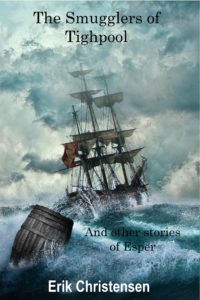
That’s the third most common question I get. Thing is, I already did. “The Smugglers of Tighpool” is a collection of short stories of people around the world of Esper whose lives have been changed one way or another by William Whitehall’s adventures. Strictly speaking, it’s not a sequel, as neither William nor his friends show up in these stories, but the connections are clear, and in some cases close. Also, some of the new characters will be showing up in the second book of William’s adventures, so this is a great way to get to know them first.
So who are they? In the first story, which shares its name with that of the book, Leith Ransom is a bored teenager forced to follow her father in his job–as a smuggler. When a buyer doesn’t show up, John Ransom gets in over his head, and it’s up to Leith to save the cargo, the ship–and their freedom.
Lucy Robey–aged eight–and her mother are sheep farmers in the foothills of Azuria, trading sheep to the dragons for iron. Mearah Robey falls deathly ill, and Lucy must hurry to the nearest town for medicine. But bandits lurk in the area, and Lucy becomes their latest victim, losing her dog as he defends her. Knowing how valuable herding dogs are, Lucy must work quickly to save him–and maybe the town as well.
Hamish Slovik lost any chance of inheritance. Not knowing what else to do, he left his family and signed up for the Guard. The experience is not what he expected, and on his patrol exam he suffers one humiliation after another. When his big mouth gets him captured, he faces a dilemma that seems to lead to death no matter what he decides. With nothing left to lose, Hamish makes a huge gamble–because if he doesn’t, it’s not just his life on the line.
I wanted to write these stories to give readers a glimpse of what has changed in the Kingdom of Esper since William’s great discovery. A world this big is too much to fit into one book, and short stories seemed the best way to fill the gap.
But don’t worry…William and his friends will return in 2018 with even bigger adventures than before.
“The Smugglers of Tighpool” will be available for free download directly from the back page of “The Defender of Rebel Falls”.
August 20, 2017
What’s it about?
“What’s it about?”
Even more than the genre question, this is what I’m asked most about my book. Reasonable, right?
To put it succinctly, it’s about William Whitehall–hence the name of the blog. William lives on Esper, a planet that long ago regressed into an agrarian, feudalistic society, and struggles to find where he fits in. With no master to apprentice him, no land to inherit, and only his skills with pen and sword to recommend him, his options are limited. Luckily, he knows exactly what he wants: to follow his late father’s footsteps in the Guard.
Instead, he is selected to work in the Library, the result of his mother’s insistence on getting the best education she could afford for him. Devastated, but honor-bound to serve, William throws himself into his work, his reports catching the attention of a far-off nobleman. He is then sent on what should be a simple mission, but instead turns into a series of adventures, each more dangerous than the last. As time runs out, William and his team must not only finish their quest, they must also uncover the secret that threatens the very fabric of society. And William must decide how much he is willing to sacrifice in order to stop it.
August 14, 2017
Sci-Fi or Fantasy
“What genre is it?”
That’s the most common question I get about my book, second perhaps to “what’s it about?” After all, readers want to know what they’re getting into before they hand over their money, or decide to invest their time. No one wants to be disappointed, and book stores and portals especially don’t want their customers to be upset, so they adhere rigidly to the genre model, and force authors and publishers to pigeon-hole their books whether or not they behave like good pigeons ought to.
So where does The Defender of Rebel Falls fit? It’s a tough question to answer, not because it’s a special snowflake of a book, but because I can make reasonable claims for four or five genres. But at the same time, there are good counter-arguments to all those claims.
If you look closely, you’ll see a dragon flying around the bottom right of the book cover. Sure enough, dragons play a significant role in the story, so one could be forgiven for jumping to the conclusion that it belongs in the fantasy section. The medieval sword clashing with the quill would seem to support this view, at least on the surface. But what about below the surface? There’s no magic in the story, nor are there elves, dwarves, unicorns, vampires…in other words, nothing related to fantasy. Furthermore, the story takes place in our universe, not some alternate plane of existence, or dream world.
So…science fiction, right? Makes sense. It takes place in the future, after all, on a distant planet colonized from Earth. But where are the space ships? The robots? The advanced technologies? Heck–the technology on Esper is seriously regressed, not advanced. Readers expecting the trappings of a space opera may find themselves disappointed.
I could claim–a stretched one, perhaps–that William’s character arc makes this a coming of age story. On the cusp of manhood, he faces both internal and external struggles that force him to both grow, and to accept who he is over who he thinks he should be. Satisfying as that may be, it’s not as though it’s the main point of the plot. Necessary, maybe, but not central. Also, it seems to me that a true coming of age story needs to take place in something closer to the here and now, otherwise readers may fail to identify with the main character on a personal level; their circumstances are too different. It’s one thing to imagine you could be the main character; it’s quite another to imagine you are.
Perhaps RPG, then. A group of five adventuring across the wilderness, facing all sorts of obstacles sounds a little like World of Warcraft to me. William Whitehall himself is paladin-like, fighting with righteous indignation to protect the innocent and purge the world of evil. I may be overstating the case, but all he lacks is mana and spell-power. Well, that and plate metal armor. The rest of the group can easily be compared to a rogue, a healer, a hunter, and a warrior respectively, which I did deliberately, I admit, but not with the intent of writing a D & D story or WOW fan-fiction. I’ve written stuff like that before, and I know the difference. At most, I borrowed a few ideas from the gaming world. Or maybe I stole them outright, like a light-footed halfling thief.
Okay, confession time. The decision of which genre my book belongs to wasn’t as difficult as I’m making it out to be. But it’s still an important question to address, again because of reader’s expectations. In the end, I decided on science fiction, with adventure as the sub-category, and I’m quite satisfied with this. While important parts of the book were inspired by fantasy, or gaming, or even coming of age, the implementation was decidedly sience-y (I won’t call it scientific, because, frankly, a lot of the science was simply imagined). I took elements that I wanted–such as dragons–and asked myself what if at some point in the future we found out they really existed, and the old stories were based on fact and not fantasy? How could we explain it? And when our explanations don’t contradict known facts–or try not to, anyway–we’re definitely leaning toward sci-fi and not fantasy.
Will this genre straddling be a good thing or not? I’m not sure. It wasn’t a calculated thing; it was simply the story I wanted to write. My hope is that this comes through in the writing, and that readers will enjoy it, regardless of what they expected.
August 7, 2017
Book Cover
We’re often told never to judge a book by its cover, but it turns out we all do. Without a good cover, even a great book has little chance of reaching a large audience.
Even though The Defender of Rebel Falls will be available primarily in electronic formats, it still needs a cover. While I may make the book available in paperback sooner or later, the primary purpose is for search results on Amazon, Apple, Kobo, and all the other fine purveyors of the written word.
Having no skill whatsoever in the visual arts, I turned to a pro. Tatiana Vila from viladesign took my brief description of the book, and a general idea of what I wanted, and came up with a brilliant design. Here it is in all its glory:
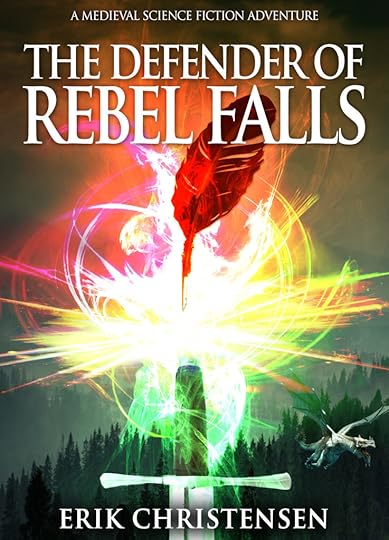
I couldn’t be happier with it. Thanks, Tatiana!
August 6, 2017
Introducing the William Whitehall Adventures
Announcing the upcoming launch of the first book in the William Whitehall Adventures: The Defender of Rebel Falls.
The pen may be mightier than the sword, but William knows which one feels better in his hand. As a librarian—a reluctant one—his reports catch the eyes of a powerful nobleman, who selects William for an important mission. As he faces danger after danger, he soon realizes that having the right weapon is one thing, but having the wits to use it is quite another. Because it’s not just his own life at stake.
Due to be released September 9, 2017 on all the major sites, including Amazon Kindle, Apple iBookstore, Sony, and Kobo, it will also feature links to free short stories about other characters in William’s world.
Stay tuned for more updates in the near future. The adventure is just beginning!