Luke Bauserman's Blog, page 2
July 13, 2017
The Legend of Soap Sally
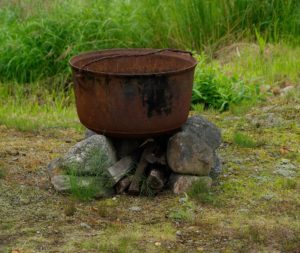
The way I heard it, Soap Sally lived in a small mill town somewhere in Georgia, or maybe it was North Carolina or Tennessee. Anyways, wherever it was, Soap Sally lived on the top of a big old hill near the local swimming hole. She had three big black kettles in her front yard where she did the washing for the whole town. All around those three kettles she had long clotheslines stretched between crossed supports to hang the laundry up.
On a windy day her yard a beautiful sight, with clothing of all colors fluttering on the lines like flags of every nation. In fact, if you saw Soap Sally during the day you’d think she was just a regular little old washerwoman. But folks that lived in that mill town knew otherwise.
If you stayed around town after dark and looked up on that hill by the swimming hole, you could see the fire and embers still burning under those big kettles. See, Soap Sally did the washing by day, but by night she made soap. And it wasn’t any ordinary soap.
Sally roamed the town at night gathering up children who had misbehaved. She’d stuff them in a croaker sack, take them home, kill them, then use the fat in their bodies to make her soap.
Children around the town were constantly warned: “Be home by dark or Soap Sally will get you, “Stay out of those fields or Soap Sally will get you,” “If you don’t mind your ma, Soap Sally will come and get you!” The children who obeyed survived, while those who didn’t vanished as quickly as a soap bubble pricked by a needle. Some folks said that the parents of really bad children didn’t even wait for Soap Sally to come collect their wayward youngsters, they just gave them to her.
Years passed and Soap Sally died. Now before you breathe a sigh of relief, let me tell you, they say her ghost still roams the South every night. And rumor has it that she’s still in the soap-making business.
The post The Legend of Soap Sally appeared first on The Weekly Holler.


June 27, 2017
The Astonishing Story of the Goat Man
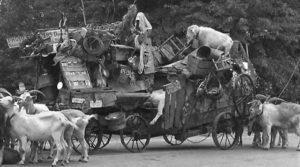
The subject of this week’s episode was recommended to me by Jay Wright the President of the Foothills Writers Guild in Anderson, South Carolina. It’s the story of a man who’s become something of a modern tall tale, like Johnny Appleseed, Paul Bunyan or Pecos Bill. It’s the story of Ches McCartney, the Goat Man.
Ches earned his title of Goat Man by spending over four decades on the road traveling in a goat-drawn wagon. From the 1930s to the 1960s, he visited many small towns across the midwest and south. Ches was made to be a legend. His strange way of traveling and larger than life personality made an impression on anyone who saw him.
Before Jay emailed me, I’d never heard of the Goat Man. So the first thing I did was give Jay a call to hear the story. Jay told me he had seen the Goat Man as a child and about 20 years ago I found out more about this strange character.
Jay Wright: See, what happened, about 20 years ago … I got a baby sister that lives in North Georgia and we were just sitting there talking one day and she said, “I got to get home.” She says, “I need to clean up my house. It’s like the Goat Man lives there.” I had not heard that word in years, and I started laughing. I said, “What in the world made you think of that?” because she was absolutely a baby when he used to come through.
Luke Bauserman: So when you were growing up, did you … You saw him come through town then? You were old enough to remember?
Jay Wright: Yeah. It was probably … He might have skipped a year or something or maybe went a different route, I don’t know what, but I can remember either five or six times between when I was maybe five to 15 that he came through. He always came up Highway 27, and it was just the biggest deal going for kids and a lot of adults.
People would hear about him and just literally go get in their car and drive to wherever they heard he was. People would bring him food and sit out there with him. He always … He’d pick up junk on the side of the road and turn right around and sell it to people and make money with it. He was almost like a recycler.
Luke Bauserman: I saw in that piece that you sent me that he would sell postcards for 25 cents each or three for a dollar.
Jay Wright: Yeah, and people just … They looked for reasons to give him money. All of us lived sort of in that neighborhood, but across the street from my grandmother and down about two houses there was nothing. It was just an old field with a railroad track behind it. He would always spend the night there when he would come. He came out there burning a damn old tire … He picked up tires on the side of the road, but he’d bring a tire out there and set that thing on fire and the smoke … You could see the smoke all over the place. People would see that smoke coming and they’d say, “There he is.” He’d draw a crowd with that, because he’d get money from them.If they didn’t … If they hadn’t heard, because not everybody had a phone and people … Everybody had a party line, but not everybody knew that he was there, but they’d see that smoke and they’d say, “Well, either something’s on fire or the Goat Man’s here,” and they’d go get in their car and … You know, there was nothing better to do. Some people didn’t even have television, so they’d go over there and sit out with him, and pretty soon he’d start preaching.
If they hadn’t heard, because not everybody had a phone … Everybody had a party line, but not everybody knew that he was there, but they’d see that smoke and they’d say, “Well, either something’s on fire or the Goat Man’s here,” and they’d go get in their car and … You know, there was nothing better to do. Some people didn’t even have television, so they’d go over there and sit out with him, and pretty soon he’d start preaching.
Now I never heard him preach. He always … Everything he talked about was something about God and going to heaven and everything else, but he didn’t … He wasn’t preaching. He wasn’t actually preaching a sermon. They said that, you know, when things kind of settled down he’d just start preaching, often on a Sunday. I never saw him there on a Sunday, but if you’d sit around and shoot the bull with him … We weren’t allowed to do anything like that, but if you did, they said, you know, he’d sit out there with the menfolks and they’d get out there and get to talking and the next thing you know he’d be preaching and pass the hat and everything else and they’d just have a regular old … Basically almost like a camp meeting kind of a thing.
He didn’t hold back cussing right in the middle of a prayer. He’d get worked up and there were some people who didn’t appreciate his language, that couldn’t get into the religious aspect of his language. He was of an unusual sort, I’m not kidding you.
Luke Bauserman: Now do you remember the smell too? I’ve read about that.
Jay Wright: Oh, yeah. Oh, yeah. Oh, yeah. That’s … That’s … That as much as everything, because … I don’t know that he bathed. I think what happened was he just got rained on, and he would just be hot and sweaty.
Luke Bauserman: And all those goats on top of it.
Jay Wright: And he slept with them. He actually slept with them. They would … He kept the little ones up in his wagon and … There was a little place back there. They didn’t just sleep there, they actually birthed little goats there. If he had one pregnant, he’d … They didn’t … You know, I guess if he could he’d put them up there.
But it was just sort of … It was like a barn inside his wagon. He had a lot of junk and stuff, you’ve seen that in the pictures, but really you could be standing there … We always wanted to shake his hand or just say hello or speak to him or stuff like that, but, oh man there was no difference between the way he smelled and the way the goats smelled.
Jay wasn’t the only subscriber to the Weekly Holler who remembers the Goat Man. Linda DeWitt saw him in Morganton, North Carolina when she was 10 years old.
Linda DeWitt: What I remember about him was it was a very dirty situation, you know, because I guess he never had a bath and all of this kind of stuff. What left the impression with me was the goats that he walked until they were walking on … They had no hooves left and they were just walking on the bloody leg, on their bones I guess.
Even as a child, that seemed terribly cruel to me. I grew up on a farm and we treated our animals better than that, you know. There was a lot of fanfare there in town, you know. It didn’t take much to entertain us. My momma had heard it on the radio and so it was a big thing, you know, that he was going to be coming down a certain road on that day, and so people were going out to see him. It was like a circus coming to town or something like that.
There were others who had an altogether different idea about the nature of the Goat Man.
Jim Broome: I remember my dad telling me the Goat Man was coming, and I think that must have been the first time. I don’t remember how old I was, but it was scary, the Goat Man is coming. It liked to have scared me to death.
When Jim Broome first heard of the Goat Man he was convinced that it was a monster, like the Boogeyman. That impression didn’t last very long though.
Jim Broome: He wasn’t bad at all, just smelled bad. I remember seeing him coming down the road and if the goats that were pulling the wagon, it was eight or 10 or whatever, and they were pulling the wagon, and if they were struggling a little bit he would talk to these goats that were in the rear and they were usually the bigger billy goats with bigger horns, and they actually put their head against the back of that wagon and pushed. I said, “Lord have mercy, he’s got pullers and pushers.”
So just who was Ches McCartney? I wanted to know more about the man behind the legend. It turns out that the Goat Man was from Sigourney, Iowa. From an early age, he had a sense of adventure. When he was 14 years old, he ran away to New York City married a Spanish knife thrower 10 years his senior.
During the Depression, Ches lost his farm in Iowa and went to work cutting down trees for the WPA. One day, a tree fell on him breaking many bones on the left side of his body and pinning him to the ground. According to Ches, a search party found him several hours later and, presuming him dead, took his body to the local funeral home. As the undertaker prepared to embalm him, he regained consciousness.
The accident left him with a crippled left arm. Unable to return work and unwilling to go on government assistance, Ches decided to take to the road in a goat-drawn cart. He even had his wife sew some goatskin clothes for him and their son, a fashion statement inspired by his favorite book outside the Bible, Robinson Crusoe.
Traveling at a pace of one mile an hour, news of the Goat Man’s arrival had plenty of time to spread to before he actually made it to the next town on his route. Local newspapers and radio stations ran stories about him.
Ches eventually started up an actual church in Jeffersonville, Georgia, the Free Thinking Christian Mission.
Renown author, Flannery O’Connor saw the Goat Man on multiple occasions and even mentioned him in a letter to a friend:
When we were somewhere above Conyers, [Georgia] we saw up ahead a pile of rubble some eight feet high on the side of the road. When We got about fifty feet from it, we could begin to make out that some of the rubble was distributed around something like a cart and that some of it was alive. Then we began to make out the goats. We stopped in front of it and looked back. About half the goats were asleep, venerable and exhausted, of kind of a heap. I didn’t see Ches. Then my mother located an arm around the neck of one of the goats. We also saw a knee. The old man was lying on the road, asleep amongst them, but we never located his face.
Flannery O'Connor to John Hawkes in 1961
Many literary experts have pointed to Ches McCartney and his son as the inspiration behind some of O’Connor’s most famous characters, the backwoods preacher Mason Tarwater and his great-nephew Francis in, The Violent Bear It Away.
Cormac Mcarthy’s novel, Suttree also has a character based on the Goat Man.
But Ches McCartney didn’t inspire Southern Gothic authors alone, one young boy who saw him changed his career plans. The boy’s father owned a store that the Goat Man visited to buy a new pair of overalls. The boy was horrified by the Goat Man’s smell, which lingered in the dressing room for days after he left. But even more than that, the boy was disturbed by the state of the Goat Man’s teeth. He later credited seeing the Goat Man’s teeth with his decision to go to become a dentist instead of running his father’s store.
The Goat Man’s traveling days came to an end due to a tragic incident on Signal Mountain outside of Chattanooga, Tennessee when he was attacked late one night. He was injured and eight of his goats were killed. He retired to Jeffersonville where he and his son lived in an old school bus. He eventually entered a rest home where he passed away in 1998.
Sources:
Footage by Robert Bonner
Photos by Durell Bouldin, courtesy of Charles Bouldin at chaserl.com
Special thanks to Jay Wright, Linda DeWitt, and Jim Broome for providing interviews.
For further reading about the Goat Man, check out America’s Goat Man (Mr. Ches McCartney) by Darryl Patton.
The post The Astonishing Story of the Goat Man appeared first on The Weekly Holler.
June 18, 2017
Three Tales from a Smoky Mountain Icon
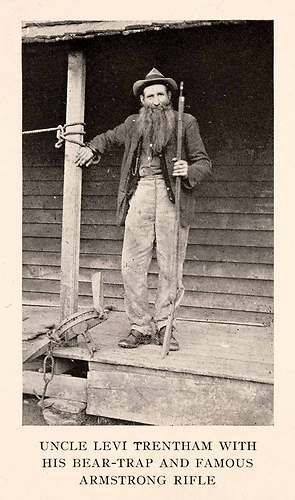
One of the most famous characters to live in the Smoky Mountains was Levi Trentham. Born on Feb. 22, 1852, Levi was one of 10 children. In his younger days, Levi Trentham scratched out a living trapping bears and selling hides. When outsiders started traveling to the Smokies as tourists, he worked as a guide, storyteller, and ran a grocery store.
Enlarge

Levi became something of an icon and was given titles like “Prophet of the Smokies.” His photos were featured on postcards. He led an interesting life, one that could justify a full-length documentary.
I recently ran across several of Levi’s stories, recorded by people who had heard him tell them, and I thought I’d share them with you for this week’s episode of The Weekly Holler.
One story Levi liked to tell was the cautionary tale of a blacksmith named Huskey who decided to hike over Blanket Mountain in the middle of a blizzard:
“We warned the old man not to go, but go he would in spite of hell and high water! He got up there top of Smoky, a skiff of snow was fallin’ when he left here, and got bedevilled in the snowstorm a-comin’ up, and the frozen fog got down on him, and drivin’ cold like hell a hootin’ for sideways, an’ got into a bear trail a-thinkin’ it was a path. He got his foot cotched fast in a big bear trap and drug it around there in the snow and fog a-right smart. And they found him next spring under a pile of brush where he’d crawled, and he was as dead as a doorpost. He’d been there no tellin’ how long. These fellers as sets bear traps with out markin’ ’em is just doin’ the general public an injury. Them traps can be marked with a sourwood switch just as easy as not, but the matter with a plenty of ’em is they’re just too lazy and triflin’ to take the trouble! They’re just too triflin’ to live!”
Another of Levi’s favorite stories was a tale about a time he killed a bear with nothing more than a pine knot:
“[A] bear was a-pesterin’ me a good deal, a-killin’ my shotes up there at the edge of the pasture. I just allowed I’d get rid of him. I set a big bear trap up there where the stock couldn’t get to it, and where nobody’d get cotched, and I waited. One cold mornin’ I went up there to look after my hogs. A little skiff of snow had fell, and I wasn’t lookin’ for my ole bear so soon. But there he was; in the trap, a-snarlin’ and a-snappin’ and layin’ back his tusks at me.
“I didn’t have no gun, but the thoughts of them pigs I was losin’ just went all over me, and I flew into a temper. There was a heavy pine knot layin’ there, and afore I thought, I had snatched it up and was belaborin’ that bear, and he was boxin’ ‘with me, tryin’ to slap that weapon out of my hand. We fought up and down for a spell. After a while I give him a crack that seemed to daze him and seein’ my chance, I run in and let him have a good’un on the ear and down he went. I had finished him. The hook of the trap was cotched on a little root no bigger than my little finger and if he’d made a lunge, I wouldn’t have been here to tell this tale!”
In his book “Whistle over the Mountain,” Bill Hooks says that Levi was illiterate, but had devised a unique way to run his grocery store. Levi’s accounting system consisted of a series of nails hammered into the walls of his store; each nail signified a customer. When a customer purchased an item on credit, Levi would sketch a picture of the item they’d bought and put it on that customer’s nail. This occasionally led to some humorous mix-ups. One day a man walked into the store and accused Levi of cheating him. He’d been in earlier to pay off his account and said that Levi had charged him for something he hadn’t bought. Uncle Levi said, “What be it?” The customer said, “Well, you charged me for a wheel of cheese and I ain’t bought no wheel of cheese.” Levi said, “Well, what did you buy, then?” “I bought a grindstone!” Levi told him that he’d just forgotten to draw the hole in the picture and that’s why he got the cheese instead of the grindstone!
The post Three Tales from a Smoky Mountain Icon appeared first on The Weekly Holler.
June 4, 2017
Recording discovered of an amazing old-time storyteller!

One of my favorite memories from childhood is sitting on the floor in front of my Grandpa’s chair while he told me Brer Rabbit stories. Films and the written word are wonderful mediums for telling tales, but I don’t believe that either will ever replace or replicate the experience of oral storytelling.
Author Lars Mytting has a wonderful comparison of a wood-burning fire to the modern ways of heating homes that applies here. “Scientifically speaking,” he writes, “there is no measurable difference between the heat generated by electricity and that produced by combustion, but the body reacts in a different way to the more intense heat from the [wood burning] stove . . . An ordinary electric radiator or heat pump warms only the air in the room, but flames and glowing embers release electromagnetic, infrared radiation that has much the same characteristics as sunlight. Warming occurs in the skin and the body as the radiation arrives, with an immediacy and an intensity that bring a feeling of well-being and security . . . These factors, combined with the smell of wood and a little woodsmoke, and the sight of the ever-changing play of flames, connect us with the primordial magic of the fireplace.”
Oral storytelling is as old as mankind and like a wood-burning fire it brings with it a sense of immediacy found in no other medium. Much in the same way that radiation from a fire causes warming to occur in the skins and body, oral storytelling causes a story to unfold in the mind of the listener, no screen or page is necessary. The ultimate result is the same as a fire, we are connected to a primordial magic.
A lot of American folklore was collected as part of the WPA’s Federal Writers’ Project during the New Deal. There have been numerous anthologies of these folktales published over the years and having read quite a few of them, I’ve come to realize that not all folktales are created equal, the same principle applies to folklore collectors.
After reading one collection of Appalachian folklore that had stories ranging from spectacular to yawn-inducing, I went through the table of contents and highlighted the best stories for future reference. It was then that I realized that the majority of these high-quality tales had been collected by one man: Raymond Sloan.
Sloan was a folklore collector for the WPA Writer’s Project in Franklin County, Virginia in the late 1930’s. I did some digging and discovered that he had been interviewed in 1976 and recordings of those interviews still exist. Imagine my excitement when I heard the voice of one of my favorite storytellers relating tales from his native hills and hollers. So, even though Mr. Sloan is no longer with us, I’m happy to welcome him as a guest on The Weekly Holler this week. I usually add music and video into these stories, but I’m not going to for this episode. Sit back, close your eyes, imagine you’re sitting at the feet of your grandfather, and get ready to enjoy the tale of Nat Nichols from an authentic Appalachian storyteller:
Well, the old house had stayed abandoned for a number of years. And people shied away from it, wouldn’t go by it because Nat Nichols had deserted from the Confederate army, and had returned to the house, his old homeplace, cabin, and details had been sent out by the Confederacy to bring him back. So one or two men went to the back of the house and some went to the front. And being a little bit trigger happy, because he ran out the front door (he heard them trying to break into the back of the cabin to capture him, he ran out the front door) and one of the details shot him immediately, see, and he fell right in the front yard. They shot him dead without giving him a chance to surrender. So it was quite a tragedy because they could’ve captured him without all that. And years later, relatives of old Nat, I think his grandson probably, had the land, and there’s the cabin. So his grandson gets married, and with his new wife decides to move into the old Nat Nichols house, rather than try to build one for himself. But all of them heard stories of old Nat’s ghost showing up every once in awhile out in the front yard where he’d been shot dead by the Confederate details. So, my father was telling me that as an old lady, young Nat’s… the grandson’s wife, was telling the story. He remembered her telling it just as it had happened to her. They were sitting on the front porch of the old cabin, and she was an old lady when she was telling this story, said: “We were sitting out there and it was dark, awful dark; no moon, no stars, quite a few clouds, pitch black.” And so young Nat, the grandson, said: “It’s a good night to drive black sheep.” And the woman telling the story said “Yeah, I think I see a white’un now.” And said, “Out in the front yard, there had rize up this white thing, just where old Nat had been shot.” And she immediately fainted, dead away. She said that when she came to, her husband was rubbing her with camphor, trying to reassure her that everything was all right. But now, whether she saw something, or her imagination ran away with her, at least here’s a ghost story where she was convinced to the extent that she fainted, dead away. So that was old Nat’s ghost out near the stump in the center of the yard.
Sources:
The transcription of this story comes from a recording in the Ferrum Collection of Blue Ridge Institute and is used here for non-commercial, educational purposes.
Lars Mytting’s quote comes from his book, Norweigian Wood.
The post Recording discovered of an amazing old-time storyteller! appeared first on The Weekly Holler.