C.J. Cook's Blog, page 2
June 21, 2017
About Tyree: From Marine to Professional Artist — South Pacific Dreams
Ralph Burke Tyree returned from the island of Samoa and the World War II battlefront in April 1944. He was now a corporal in the US Marine Corps, the highest rank he would achieve. He was first stationed at Camp Elliot, then the Marine Corps Depot in San Diego, and finally at the Marine base at Camp Pendleton, near Oceanside, California. There as the resident artist and still working for his old friend General Charles Price, he would paint a large rendition of the flag raising on Iwo Jima just months after that horrific battle took place in February 1945.
Tyree and Margo would continue their long romance after being separated for years. He had showered her with pencil and watercolor paintings (“ten thousand words” love letters) twice monthly while on Samoa and then from San Diego bases. He married his high school sweetheart Margo on June 27, 1945.
The war of the Pacific with Japan would end in early August 1945 with the dropping of two atomic bombs on the Japanese cities of Hiroshima and Nagasaki. Tyree and his new bride would remain in the Oceanside area near his Marine Camp until being honorably discharged from the Marine Corps on January 24, 1946. He could now get on with a career as an artist and begin raising a family. The travels to the South Pacific and all the “practice” portrait work of painting officers and their loved ones would propel him into his professional career as a superb portrait artist of the South Pacific peoples.
Read about Tyree’s middle years in the Marine Corps here.
Read more about about Tyree: A Marine and Artist.
And read about his early years here.
Originally published at https://www.southpacificdreams.com on June 21, 2017.
[image error]

April 7, 2017
Tyree: Marine and Artist
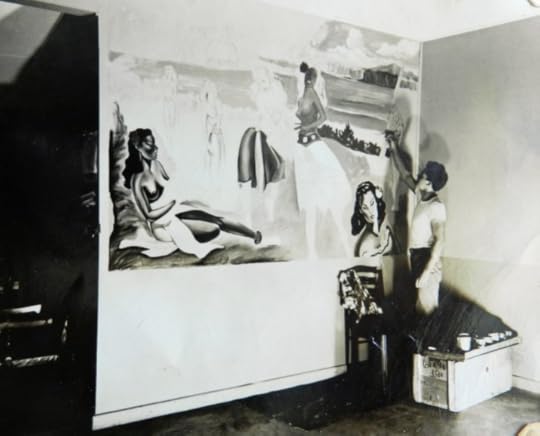 Private Tyree, US Marine Corps, starts painting a large mural in the officer mess hall in Samoa.
On December 7, 1941, the Japanese surprised the United States with an all-out aerial attack on the US Naval Base at Pearl Harbor, Honolulu, Hawaii. For America, World War II began. Anger and patriotism drove thousands of Americans to join the service immediately. Ralph was 20 years old and, like many Americans, passionate about his country. He joined the Marines via the recruiting depot in San Francisco on January 27, 1942, a mere seven weeks after Pearl Harbor. Tyree was assigned to the 2nd Recruit Battalion, Recruit Depot at the Marine Corps Base in San Diego. Private Tyree was an infantry rifleman and a member of the 22nd regiment of the 6th Division just before his departure to Samoa in July 1942.
On July 19, 1942, Private Tyree and his fellow Marines of the 22nd Regiment set sail on the SS Lurline for America Samoa in the South Pacific, arriving there on August 1, 1942. With the start of WWII in early 1942, General Charles Price was placed in command of the 2nd Marine Division for the defense of American Samoa. This base would be the staging center for the Pacific Theater of Operations of the US Marine Corps. The Marines recognized Tyree’s artistic talents and reassigned him on October 7, 1942, from the infantry to the Headquarters and Security unit (Intel) of the 22nd Regiment, and his specialty was changed to “Draftsman” for making maps. Tyree would remain as a “Draftsman” until August 10, 1943, when his specialty title was changed to “Sign Painter”. Tyree’s artistic abilities soon caught the eye of his commander, General Charles Price. As of November 1943, the title was changed to the most unusual title of “General Price’s Portrait Painter.” Under Price’s orders, Tyree had several responsibilities: creating morale-boosting murals in the officer’s mess hall, as well as other artistic endeavors such as illustrating menus and painting portraits of the officers and their wives.
Tyree quickly improved his portrait painting, using his officers and their loved ones as subjects. He set up a studio so that he could jump to his general’s demands and wishes regarding. The young artist was pampered with gallons of paint and art equipment flown in from Honolulu. He saw beauty where there was so much destruction and death. Many of his war-related paintings have not been found, probably lost. We know these works were exhibited with other US Marine artists at the de Young Museum in San Francisco (1944 & 1945) as well as an exhibit in Philadelphia.
Interestingly, in 1943, a young naval officer stationed in the Pacific, James Michener, was asked by his naval superiors to investigate possible fraud by the military leaders on America Samoa. Michener’s experiences there with the natives and on the other nearby islands inspired him to write Tales of the South Pacific, which he published in 1947. This book would win the Pulitzer Prize and later become a successful Broadway musical and movie ( South Pacific, 1958). It is fascinating that James Michener, the sailor, and Ralph Burke Tyree, the Marine, began their respective artistic careers on these remote islands of Samoa. Whether these two young World War II servicemen ever crossed paths while in America Samoa is not known.
Private Tyree, US Marine Corps, starts painting a large mural in the officer mess hall in Samoa
Originally published at https://www.southpacificdreams.com on April 7, 2017.
[image error]June 24, 2015
South Pacific Dreams Vignettes
“Don’t judge each day by the harvest you reap, but by the seeds you plant.”
— Robert Louis Stevenson (1850–1894)
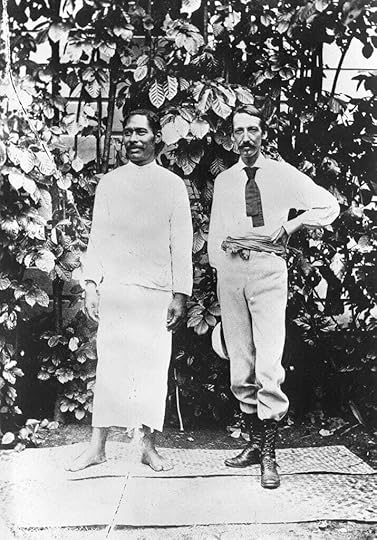
For the first blog on South Pacific Dreams, a series on art and life in the South Pacific, famed Scottish writer Robert Louis Stevenson suffered from tuberculosis and looked for a warm climate to ease his respiratory distress. He visited Hawaii in 1888 and befriended David Kalakaua, the Hawaiian King, and his niece Princess Victoria Kaʻiulani. After a couple of years, he and his family set sail for Tahiti, the Marquesas, and New Zealand. They finally settled in Samoa. He established his residence there around 1890. Stevenson purchased about four hundred acres of land and built his final home near the village of Vailima outside Apia in Western Samoa. He became embroiled in politics, befriended the locals, helped them with political problems, and wrote extensively. Stevenson died suddenly four years later, in 1894, from an apparent cerebral hemorrhage. He was 44 years old. This was less than fifty years before South Pacific artist Ralph Burke Tyree was deployed in Samoa as a US Marine, chronicled in my book, Tyree: Artist of the South Pacific, and the forthcoming biography, Beauty in the Beast: Flora, Fauna, and Endangered Species of Artist Ralph Burke Tyree.
Originally published at https://www.southpacificdreams.com .
[image error]