Sarah Aronson's Blog, page 6
September 30, 2016
Presidential Quote #4: Franklin D Roosevelt
Today’s quotes come from FDR. (I couldn’t choose.)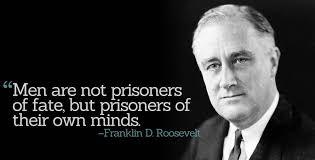
And the quote that every writer I know can identify with:
“So, first of all, let me assert my firm belief that the only thing we have to fear is fear itself – nameless, unreasoning, unjustified terror which paralyzes needed efforts to convert retreat into advance. In every dark hour of our national life a leadership of frankness and vigor has met with that understanding and support of the people themselves which is essential to victory. ” – Franklin D. Roosevelt
 If you love great quotes (and Presidents) as much as I do, we have 39 more days until we elect a new President! That means 39 more amazing quotes!


September 29, 2016
Presidential Quote #3: Dwight D Eisenhower
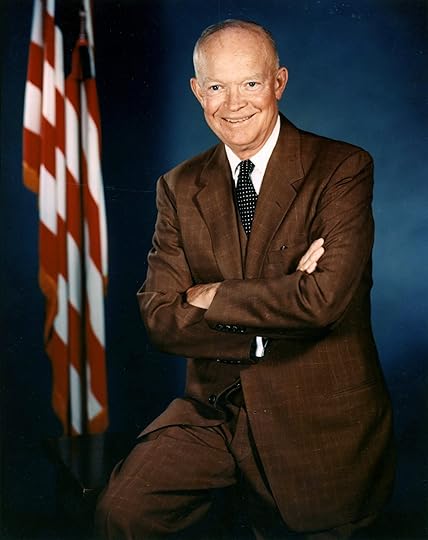
Here is an important statement by President Dwight D. Eisenhower.
“Every gun that is made, every warship launched, every rocket fired signifies, in the final sense, a theft from those who hunger and are not fed, those who are cold and are not clothed. This world in arms is not spending money alone. It is spending the sweat of its laborers, the genius of its scientists, the hopes of its children. The cost of one modern heavy bomber is this: a modern brick school in more than 30 cities. It is two electric power plants, each serving a town of 60,000 population. It is two fine, fully equipped hospitals. It is some fifty miles of concrete pavement. We pay for a single fighter plane with a half million bushels of wheat. We pay for a single destroyer with new homes that could have housed more than 8,000 people. This is, I repeat, the best way of life to be found on the road the world has been taking. This is not a way of life at all, in any true sense. Under the cloud of threatening war, it is humanity hanging from a cross of iron….Is there no other way the world may live?” – Dwight D. Eisenhower
When I was a child, I used to confuse Roosevelt and Eisenhower. I called them Rosenhower and Eisenvelt. My dad still teases me about this.
Great Presidential Quotes. One a day. Until Election Day.
September 28, 2016
Presidential Quote #2
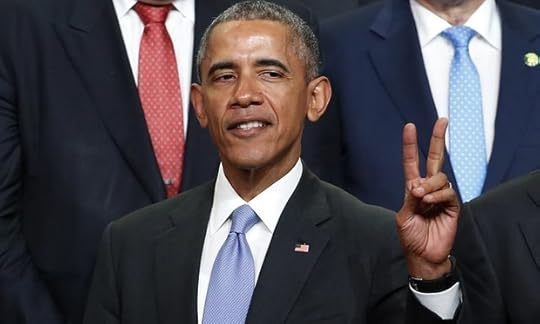
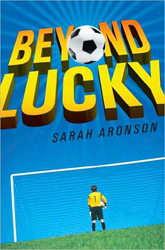
I could quote President Barack Obama every day until Election Day! (He was the President I quoted in the last chapter of Beyond Lucky, too!)
Like so many other Americans, I was moved when he spoke about CHANGE:
Change will not come if we wait for some other person or some other time. We are the ones we’ve been waiting for. We are the change that we seek.
Today, I’m also including part of his amazing speech at the Islamic Society of Baltimore. It speaks to inclusivity, every day Americans, and what it means to feel like you belong.
“I want to speak directly to the young people who may be listening. In our lives, we all have many identities. We are sons and daughters, and brothers and sisters. We’re classmates; Cub Scout troop members. We’re followers of our faith. We’re citizens of our country. And today, there are voices in this world, particularly over the Internet, who are constantly claiming that you have to choose between your identities — as a Muslim, for example, or an American. Do not believe them. If you’re ever wondering whether you fit in here, let me say it as clearly as I can, as President of the United States: You fit in here — right here. You’re right where you belong. You’re part of America, too. You’re not Muslim or American. You’re Muslim and American.”
Do you have a favorite Presidential quote? Send it to me! I’m posting one a day every day until Election Day!
September 27, 2016
Obsessed with politics?
Ever since my mom asked me to make posters for George McGovern, I have been interested in politics.
And why not? We elect leaders to make this world better.
I have never missed the opportunity to vote. When I was living in New Hampshire, I met many candidates. My son, Elliot, discovered presidential trivia when he was about ten. It was because of him that Beyond Lucky’s Ari Fish counts presidents for luck!
As I wrote the book, Elliot collected lots of great quotes from all the presidents. The one thing they have in common: our greatest leaders extol honor and empathy for the plight of every day Americans. That’s a theme in the book, too.
It’s all about regular people who are heroes. 
And heroes who are sometimes just regular people. 
I’m going to start sharing some of the quotes on a regular basis. Right here. Until election day.
Do you have a favorite presidential quote or speech? Send it to me! I’d love to share it!
August 22, 2016
From the newsletter: Killing the darlings!
 “In writing, you must kill all your darlings.”
-William Faulkner
Dear Writers,
Kill the Darlings. It’s one of the first and most important things we learn to do as writers. We all know it is essential. And sometimes, not as simple as it sounds.
Killing your darlings means:
Getting rid of individual lines that attract so much attention you have to explain them into the text. Or they take the reader out of the moment. Or they stop working, but we love them so much, we leave them in anyway.
Getting rid of subplots that have helped you write the story, but are now distracting the reader from the point of the story. If they show up too early, they can even mess with reader appetite.
Losing ideas that do not serve the story.
Killing characters that don’t add tension or conflict or don’t . . . serve the story!!!!
So why do we find killing our darlings so hard? Why do we get attached to lines and plots and characters that don’t…you know what I’m going to say… serve the story?
What can we do to recognize our darlings for what they are–obstacles to finishing? How can we honor them even as we delete them from the manuscript?
If you know me in real life, you know I ALWAYS delete my discovery draft. This is my Number One Best Darling Preventer–and I’ll always be grateful to Cynthia Leitich Smith for encouraging me to try it. My discovery draft is a draft is a mining expedition. I write until I know my characters. I do this as fast as possible. No rewriting. No structure. All play.
It’s a PLANNING EXERCISE.
NOTE: The more I write, the more important the planning phase has become to my writing! I now plan before drafting, and then again between drafts to make sure that the darlings are NOT getting in my way. Stepping away from the manuscript and playing has been the secret to keeping writing FUN and PRODUCTIVE.
So step one is easy: PLAN and PLAY.Anyway you like. Start with a storyboard of what your story is NOW and then write a storyboard for what you think your story can become. Or do this in outline form. Or make a whole bunch of lists. Try the connectivity chart of all your characters. Circle the ideas/characters that strengthen your story and add TENSION and CONFLICT. If they are not contributing, ask WHY. Sometimes, you can change a character to make her or him important. But sometimes, that character is a darling.
Step two isn’t hard either. Circle your favorite lines. Some will be worth saving. If you catch yourself overwriting to keep it, it probably needs to go. Last week, in my line edits, my editor asked me to change THE VERY BEGINNING and that meant losing my favorite line. I spent about three days moaning and groaning and trying to keep it. I had my speech ready for her! Then I tried giving it up. And no surprise, I found a better line!
Last, ALL THAT MATTERS is STORY. Your characters…your lines…your outcomes….they are all ARBITRARY. Story is FLEXIBLE. Darlings are often the product of putting “beautiful writing” ahead of story. They are what happens when we don’t yet know the point of our story. They are what happens when we want to get to PRODUCT too fast. They happen to ALL OF US, NO ONE IS LEFT OUT, SO GET USED TO IT!!! Kill them!
Ready to slay some darlings?????
Killing lines is one thing. But a whole character or subplot? Let’s talk about that.
My favorite exercise remains the connectivity chart. Write down all your characters on a piece of paper. Including the adults. Draw lines between the characters that share scenes. Then draw squiggly lines between the characters that create conflict with/for each other.
Here’s one of mine for an early draft of BELIEVE.
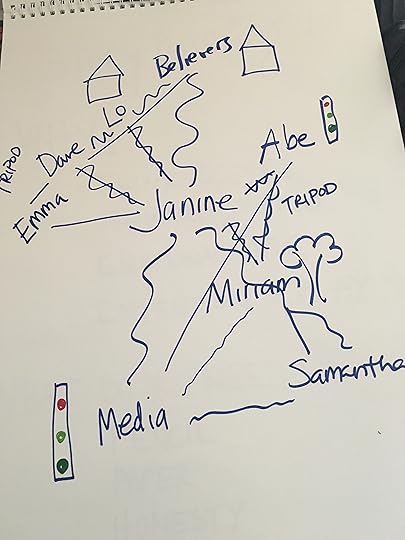
From this chart, I ask: Are there too many characters that create no conflict?
Are there characters that look like they should create conflict, but your readers have told you, do not?
Are your characters/subplots relying on coincidence? Do their storylines get muffled? Are they each serving the point of the story?
In this chart, I saw that Samantha wasn’t doing her job. Her dialogue was FULL OF DARLINGS, sassy lines that did nothing to push the story forward. Instead of cutting her (I liked all the threesomes in this book), I re-imagined her. I gave her more interesting desires. And misbeliefs. She began to create a real possibility of FAILURE for the main character. She even made me WORRY! (Always a good sign.) And she came to life! And that character ended up making a big difference in the big scenes.
Cutting a darling feels like a BIG DEAL. But it shouldn’t. Because the DELETE key makes space. It gives you an opportunity to add more, to tighten your story. And of course, PLAY!!! Remember: everything is arbitrary! Your story is all that matters!
Have a great writing week!
xo s
July 4, 2016
From the newsletter: Using memories

July 4, 2016
Memory is a passion no less powerful or pervasive than love. What does it mean to remember? It is to live more than one world, to prevent the past from fading and to call upon the future to illuminate it. It is to revive fragments of existence, to rescue lost beings, to cast harsh light on faces and events, to drive back the sands that cover the surface of things.” – Elie Wiesel
Dear Writers,
Elie Wiesel’s powerful memories and writings were a sort of scaffolding of my Jewish upbringing. I read Night long before my bat mitzvah. I understood the importance of keeping memories alive long before I ever dreamed of being a writer. I brought my children to hear him speak in 2006 at Dartmouth College. Here is a bit of what he said:
Memory tells us that the past is in the present, even when it is not unraveled.
Memory has its own archeology, its own mystery, its own language. If not complacent or intimidated, it will enrich your aspirations and commitments. What would culture, education or indeed civilization be without its lasting and challenging appeal?
My memory, though rooted in the darkness of the abyss, has taught me the imperative of solidarity and friendship. My good friends, when I came to those places and in those places people told us then don’t think about anyone but yourself. That is how you will survive. And they were wrong. Only those who thought of others, anyone who had a friend or a father or a brother or simply a comrade for whom he or she cares, he or she had a better chance to live, and therefore to survive.
My memory had taught me that my humanity is defined by yours. Even when my faith is different from yours, it is neither superior nor inferior in its authenticity. Is its name tolerance? No: tolerance could suggest condescendence, and I prefer the word ‘respect’. It also means: respect for your freedom and mine and for the freedom of those who have no freedom. I am free not because someone is not but because he or she is. And if their freedom is curtailed, mine is blemished.
Elie Wiesel spoke for all of us.
Since hearing of his death, I’ve been thinking about his life and the importance of memories. And how little ones escape our subconscious at the oddest of times. I’ve also thought about how our memories change over time. Pain and insult can dull, and how with time and perspective, we see more. With age, we gain a point of view to add texture to the original.
As writers for young readers, childhood memories are certainly important. Those first early memories–unchanged by logic and knowledge–are a big source of inspiration. In fact, I have recently found another benefit of playing and thinking and planning more–I have been able to access more memories. When I sit down at the notebook before the manuscript, when I draw and relax and let my mind meander, I remember new details. I can pull the old pictures into focus. I can use those memories to fortify my writing.
This is the power of our memories–and they are all unique and important. We remember incidents that brought joy and pain. We remember hard lessons learned. We remember when we resisted. When we lied. When we felt shame. When we felt courage. When we remember, we invite all the senses to join us. We start with memory and then enter a sort of dream state, so that we can feel those first emotions, so we can impart those emotions onto the reader.
Through memory, we can access emotion, setting, origin stories, problems, the interior strife. Memory is a launching point. (But remember: you can’t cling to it. Sometimes, you have to forget about what really happened and imagine a new outcome.)
In 1987, Wiesel wrote this in the NY Times. It’s a beautiful piece. This section, in particular, made me pause:
What about my faith in you, Master of the Universe?
I now realize I never lost it, not even over there, during the darkest hours of my life. I don’t know why I kept on whispering my daily prayers, and those one reserves for the Sabbath, and for the holidays, but I did recite them, often with my father and, on Rosh ha-Shanah eve, with hundreds of inmates at Auschwitz. Was it because the prayers remained a link to the vanished world of my childhood?
Today, in honor of Elie Wiesel’s life, let’s return to our childhood memories.
Open up your journal and write about one of your darkest hours–the first one you think of. Describe the room. Describe the backstory. Describe the people you loved at that moment. Relive the conflict. The heartache. The pain. Try not to impose your adult sensibilities.
Then remember how you emerged from this moment. How did you change? How did you grow? Did you remain friends with the people in your story? Why does this moment remain in your memory? Or is it something you tucked away until you were asked to relive it? Then leave this memory and find a triumphant one. Journal about that, too.
Back to Wiesel in 2006:
And that is also true of hope, the most vital element of all human equations. War is an act of despair. Peace of a song of and for hope. And my fervent desire has always been to create a hope that is not someone else’s nightmare.
None of us are made of all triumph or all sorrow. Our stories do not always directly reflect our memories, but they are fueled by them. As writers, we speak for ourselves, and we speak for others and we are writing for children. This is not a small thing to do. We write of triumph and pain. We do this with empathy and a desire to make the world better.
Have a wonderful writing week.
xo s
May 25, 2016
So my cousin just won The Voice! This is what I learned watching!
 If you hear a voice within you say ‘you cannot paint,’ then by all means paint, and that voice will be silenced.
-Vincent Van Gogh
Dear Writers,
I have already written at least once about watching my cousin, Alisan Porter, compete on The Voice. I have to admit: I LOVE hearing her sing. Well tonight, she WON IT ALL!!!!!!
I also have to admit: it brought out the neurotic in me! I am a reader who often (not always) reads the ending first. I love books for the journey, not necessarily for the surprises. Waiting each week to see who is in and who is out–especially with a vested interest–has been really rough.
So with my nerves pretty much shot, I figured it was time to write about how the process she has been part of has reinforced some things I know about the craft of writing and creativity. (If you know me, you know I can’t resist this kind of thinking!!!) These past few weeks have been a journey for her. In a lot of ways, it’s been just like writing a book.
1. Success requires RISK TAKING. Ali did not get into the finals playing it safe. She has sung a variety of songs and she has sung them IN THE PUBLIC EYE. (Aren’t we all happy we get to keep our rough drafts to ourselves???) But let’s talk about that risk taking. In taking risks, she challenged herself. She grew. She became a stronger singer. She felt able to share her deepest fears. Not all voters liked every song. But she did not back off her decision to sing any of them. She TRUSTED the process. (She also showed that it is good to be able to do more than one thing well.) When we take risks, we find new characters and stories, we discover why our characters do the things they do. Sometimes, we figure out that they want to do something that we hadn’t even thought of! In other words: go for the high notes!!!
2. We all need SUPPORT. Ali couldn’t do ANY of this without her husband, Brian, and her parents, Laura and Don, to help with the kids AND cheer her on. All of us have family that stand by us and rub our backs and cheer us on, especially when we are in the muddy middle! (On cue: Everyone: KISS YOUR FAMILIES!!! Tell them THANK YOU!!! Remember that nothing hard gets done alone!)
3. There is PERFORMANCE and there is PRACTICE. Each week, the coaches and contestants spend A LOT of time together practicing. Obviously, this is not news to us. We must practice our writing a lot! But it’s a good reminder: even when you have LOADS of talent, talent is not enough.
4. Song choice is important. AKA Story is the boss! So, this might be stretching it, but stay with me! When Ali sings someone else’s song, she is essentially borrowing a story. She changes some things: the POV. The little details. But she doesn’t change the integrity of the song. In other words, she puts the song first. And she is humble. She LOVES the song. When we work on story, we must often do the same thing! We love our characters. We dig deep to understand them–to know the WHY behind the actions.
Which leads to EMOTION. The key to so much of why she is in the finals!
5. EMOTION CONNECTS YOU TO YOUR AUDIENCE. It’s not your plot. It’s the emotion behind the actions that connect your character to your reader. When you give of yourself, you will find your audience.
Last, but not least,
6. All art is subjective. Not every song or book is for every listener or reader. Luck always matters. It’s the intention and heart we put into it that make our creative lives rewarding. In other words, if she doesn’t win, she will still have all the tools she needs to have a great career! That’s important for us to remember, too.
She is a singer because she sings.
We are writers because we write.
We are artists because we make art.
Prizes and contracts DO NOT define us.
Want to PRACTICE?????
Take a chapter that isn’t working.
Now, without peeking, write it in a different POV.
Now, without peeking, write it with ONLY dialogue.
Now without peeking, write it in FREE VERSE.
Now re-imagine that chapter
Happy Writing! Congratulations Ali and Christina and FAMILY!!!!
If you like this post, you can subscribe to my newsletter! Every Monday, I post my thoughts on creativity, the power of play, and books!
February 22, 2016
Think BIG!
I got such nice responses from today’s newsletter, I’m posting it here! Thank you!!!!
Neither a lofty degree of intelligence nor imagination nor both together go to the making of genius. Love, love, love, that is the soul of genius.
-Wolfgang Amadeus Mozart
Dear Writers,
This weekend, Sara Pennypacker talked about her new novel, Pax, and the lofty goals she has for this book. It is a story with big ideas about the consequences of war. It is also a book she took many years to write, that she didn’t always feel ready to write.
But she persevered.
She believed in the story.
She had something to say. And she was determined to get it right.
This is my favorite kind of “story behind the story,” because it rings true for so many writers I know. Yes, when we receive an idea, either through news or an image or a song or an experience, we feel the need to write. We often don’t feel ready. We often AREN’T ready. But if we have big dreams and diligence and luck….then we can do it.
I also believe that too often we shy away from those big ideas. We equate THEME with lessons. With didactic writing. With no.
So today, let’s say YES to theme. Let’s think about how a strong theme makes a book better.
I bet that the books you remember best, the books you loved the most, the books that might have even touched your soul or changed how you saw the world all had one thing in common: a strong universal theme. In our quest to write unputdownable, unforgettable novels, at some point, we need to think about the ideas that are important to us–the themes that mean a lot to us–the emotions that we feel deeply. We have to take the risk and write what is personally important to us.
Remember: I am not talking about message. Or moral. I’m not suggesting that you should shape your story to offer a lesson. Lessons and morals and warnings are not what STORY is about.
As Sara reminded us: STORY IS THE BOSS.
And theme is something else. Something BIGGERand BOLDER.
For me, theme can encompass every aspect of the craft of writing for children and young adults. Character, plot, details, setting . . . no matter where we start, we inevitably come back to theme and the intimate connection a book and its heart. Theme grows out of tension that comes from asking hard questions and exploring universal ideas.
You know the questions. What does my character want?? Need? Fear? Do when she is scared? What is missing in this world? What wound needs to be healed? What has happened to these people that makes them act the way they do?
What is important for ME to think about? What do I think about all the time anyway?
For me, THEME is the guts of story. It is the passion or conflict, the connectivity and the contradictions that drive the story forward. Janet Burroway, in Writing Fiction, writes that theme involves emotion, logic, and judgment. Donald Maass, in The Fire in Fiction, says, “It is the underlying conviction that makes the words matter.” When a writer crafts with a strong theme, every decision makes sense.
Theme comes from the questions that gnaw at the subconscious. It comes from obsessions. Theme comes from the ideas the writer encounters that simply don’t make sense. And then it comes from taking this inspiration and doing hard work and self-discovery. And if you’re wondering, that is exactly what makes writing satisfying. Face it: it takes so long to write a novel. It just isn’t worth it if the concepts or questions don’t mean something important.
John Gardner describes my process and goal to a tee: “The writer . . . broods on every image that occurs to him, turning it over and over, puzzling it, hunting for connections, trying to figure out–before he writes, while he writes, and in the process of repeated revisions–what it is he really thinks. . . . Only when he thinks about a story in this way does he achieve not just an alternative reality or, loosely, an imitation of nature, but true, firm art–fiction as serious thought.”
Are you ready to stretch??? To think big??????
What is your book about? What is it that you want to say? What are the themes that constantly come up in conversation…that gnaw at YOUR subconscious?
Think BIG! Be lofty! Write it down and stick it on your wall. As you continue to write and revise, remember that your readers need books that address big ideas. These ideas, whether sad, funny, full of action, or all about thought, are JUST what our readers want. They are consequential. They are unputdownable!
Now…..have a great writing week!
xoxox sarah
December 28, 2015
From the Newsletter: Writing Resolutions

Dear Writers,
It’s that time of year! This week, many of us will make New Year’s Resolutions! (I LOVE LOVE LOVE setting goals. I evaluate them at least every 3-6 months.)
Cheers to a new year and another chance for us to get it right. -Oprah Winfrey
Let our New Year’s resolution be this: we will be there for one another as fellow members of humanity, in the finest sense of the word.
-Goran Perrson
Always bear in mind that your own resolution to succeed is more important than any other.
-Abraham Lincoln
Here are my guidelines.
1. Make time for writing…even five minutes a day.
Do you have a full time job? Small kids at home? Other responsibilities? Then don’t make a resolution to write 5,000 words a day. That will only get you down. Instead: be realistic. Make a promise to write 2 pages a day. Or nine lines! Or for FIVE MINUTES. Commit to a time of day when you can realistically sit down and get some words on paper. You will be surprised how fast consistency pays off.
Don’t know what’s realistic?
Ask: WHO ARE YOU?
Look at your calendar! Take all your obligations into account.
2. Keep a journal. If you didn’t do it last year, try this year! I don’t mean a diary. Instead, keep a writing journal. This will help you know what works for you….and what doesn’t. Perhaps you write more after a walk. Or yoga. Or in a coffee shop. Or you hate noise. Or you can’t write until the dishes are done. The writing journal can help you know yourself. That is a priceless gift.
Still on the fence? Try COLLAGING. Or painting. Do something NEW to start your writing week.
Or
3. Try a new genre.
Tired of your manuscripts? Stuck shuffling words? Try a new genre. With lower expectations, a new genre can help you break free of writer’s block. I want to shout it so everyone can hear: DO NOT BE AFRAID!!!! THIS WORKED FOR ME!!!!!!!
4. TAKE A CLASS. With me!!!! I’d love it!!!! Or someone else! (I won’t be insulted!!!) There’s nothing better than talking about the craft. Plus: a new set of eyes will help you get a handle on a new revision.
5. The business of writing can be overwhelming, so take joy in your work. Be easier on yourself. Celebrate all your milestones. Thank yourself for accomplishing something that most people only talk about. Know that there are readers out there who need your stories. And if you need a pat on the back, know you are not alone. I have loved hearing from so many of you this year! It really helps my process to know that these posts are motivating.
If you haven’t read it yet, read BIG MAGIC!!!!
If you aren’t PLAYING yet….if you aren’t celebrating your own genius….GET BUSY.
REMEMBER: The goal
is
not
PERFECTION!
It is practice. And creativity. IT IS PROCESS; NOT PRODUCT.
This year, as you set your goals, STRETCH and make those resolutions! Make a commitment to your writing. If you did something spectacular this year, let me know! I’d love to share it! Or at some point this year, tell your family. Thank them for the support. Let them know what you plan to do this year.
2015 was the best year ever!
I can’t help but believe this will be another magical year.
Now…..Throw confetti!!!!!
xoxox sarah
Join the conversation! Sign up for my free newsletter! A new tip every Monday! www.saraharonson.com
December 22, 2015
From the newsletter: Bringing the force to your writing
 “Fear is the path to the dark side.” -Yoda
“Don’t call me a mindless philosopher, you overweight glob of grease.” -C3PO
Dear Writers,
I saw the new Star Wars movie this week. And I LOVED it. And you will, too, because it is a GREAT STORY. With GREAT CHARACTERS. They want things that are important. And because of all these things, it offers us some great lessons!
NOTE: There will be NO SPOILERS here, but if you get nervous about these things, save this post for after you see the movie!
Star Wars Lesson #1: Beginnings must bring the intrigue.
From the moment the movie began, I knew I was in good hands. In the most economical way possible, the movie set the stage and excited the audience. The world was introduced. We felt grounded. But more important, intrigued!
The first line, page, and chapter are SO important. The beginning is our first glimpse. It’s an invitation. Whether part of a series or stand alone, it sets the table. Think about how your favorite movies start. A close up? A panoramic view? No matter what, a great beginning makes the reader ask questions. And turn the page.
WHAT IT DOES NOT DO: A great beginning does not cram in a lot of information. It does not explain. It forces us to stay where we are. In our seats. In books, we turn the page. We need to know more.
Star Wars Lesson #2: The best protagonists have flaws. The best antagonists are not all evil. It is literally that balance between the force and the dark side that makes a character INTERESTING. We see it in every character that matters.
Convinced your antagonist is all evil? DIG DEEPER.
Star Wars Lesson #3: Revealing backstory at JUST THE RIGHT MOMENT pays off. On this, I will say no more. Just trust me. If you’ve seen the movie, you know: we see the ramifications of the backstory in many, many ways. When it is fully revealed, it all comes together. Through the characters. Because of what they want.
Star Wars Lesson #4: Nothing wrong with a little well-timed humor.
Star Wars Lesson #5: The power of THREE has the power of the force. Throughout the movie, characters were connected in threes. They battled in threes. They teamed up in threes (or in one case, three people and a Wookie.)
Star Wars Lesson #6: That french horn. In all the original Star Wars movie, I loved Luke’s theme song, the lone horn. It’s automatic: when we hear the horn, we think of Luke. That horn amplifies our emotions–it makes us yearn. And anticipate what is yet to come.
So are you ready to stretch? (Or are you going back to the movies first?)
Can you apply the Star Wars Lessons to your own WIP?
Most of them probably seem obvious. Except maybe Number 6. How can we create the master effect of music in our writing?
First, we can look at syntax, the music of our prose. We can craft the language we use to enter and exit a chapter or a scene. Is your narrative musical? What happens if you add a word that surprises? Can you look at your scene (like a director) and find the details that make your scenes sing? Are you using the BEST WORDS POSSIBLE????
Then think about that horn.
Like the lone horn, images or objects can stand for certain characters, themes, or emotions. So can colors. Is there an object or color that reappears in your book–that stands for more than what it is and speaks to theme? Can you attach an emotion to it? A desire? Can you step away from the manuscript and see how that object/color appears and changes throughout the story? Can you insert it at key moments to add relevance and anticipation?
Next week, we’re writing goals!
Until then, happy holidays! Enjoy your families. If you can, get a little bit of writing done. Even five minutes a day counts!
xo sarah
Like this post? Sign up for my weekly newsletter. On my website. Under TIPS.