Elise Edmonds's Blog, page 9
March 18, 2017
Reading Challenge Book Four: Wool
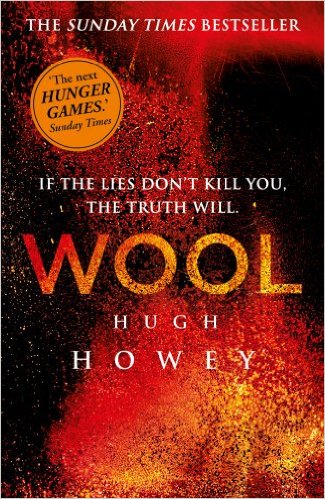
Book Four was an engrossing modern dystopian read:
Blurb
In a ruined and toxic future, a community exists in a giant silo underground, hundreds of stories deep. There, men and women live in a society full of regulations they believe are meant to protect them. Sheriff Holston, who has unwaveringly upheld the silo’s rules for years, unexpectedly breaks the greatest taboo of all: He asks to go outside.
His fateful decision unleashes a drastic series of events. An unlikely candidate is appointed to replace him: Juliette, a mechanic with no training in law, whose special knack is fixing machines. Now Juliette is about to be entrusted with fixing her silo, and she will soon learn just how badly her world is broken. The silo is about to confront what its history has only hinted about and its inhabitants have never dared to whisper. Uprising.
Why I chose this book
I’ve always been a big fan of dystopians, and I also wanted to read some books by indie authors who made it big. Wool fits the bill on both accounts.
Rating/content
I give this book 5 out of 5 stars.
This book follows the story of Juliet, a young woman who lives in a society based in an underground silo. The silo inhabitants are not allowed contact with the toxic outside world, and the greatest taboo is talking about the outside.
It’s an adult book, with occasional profanity, and some violence and peril as necessary for scenes of uprising. The book is a fairly easy read, with a little technical language in respect of mechanical and electrical equipment.
Good points
I really loved this book. It had everything I look for in a good dystopian. The set up of the society, living in underground silos, was original and well thought out. Every aspect of what it would be like to live in a large cylinder with only a metal staircase to ascend and descend was considered and developed. It was very immersive.
The strong female lead, dragged up from the depths of the mechanical department to work in government, appealed to me. Juliet was active and resourceful and questioning. She wouldn’t settle for a no.
The reveals throughout the book were done really well. I mean, I’ve read enough dystopian to have predicted it in advance, but I didn’t because I got so immersed in the society. I felt I discovered the shocking details along with the main characters.
Most of the secondary characters felt like individuals too, and it was also possible to understand the reasoning behind the bad guys actions. It raised ethical questions as to whether the bad guys were really doing what was best for the society or not, and you could see why they thought they were.
I also liked the underlying romance thread that ran throughout. Subtle, but there under the surface without overshadowing the plot. The way I like it.
Bad points
To be honest, anything I say here is just being super picky, because I didn’t really find fault with anything.
I guess the pace was a little slow at times, and the setting felt quite confining and oppressed – but that just reflects the nature of the story.
I didn’t fully get to grips with some of the mechanical stuff described, but that’s something I don’t really know anything about anyway.
Overall
If you’re a dystopian fan, this book is a must-read, and I will definitely be checking out the sequel.


March 16, 2017
Where Carpets Fly – Interview with Allie May

Today, I’m being interviewed by Allie May at Hypergraphia.
Allie fell in love with fantasy and the impossible at a young age thanks to Disney, superheroes, and fairies. She began reading at the age of four, and started writing as soon as she could hold a pencil. In high school, she won two Creative Communication contests and had her poems published.
After visiting the magical city of Paris, Allie fell in love with France, which inspired the setting for her fairytale retelling of Sleeping Beauty, “Rose and Thorn.” She recently published this short story in the Fairytale Anthology From the Stories of Old.
When she’s not at Disneyland, she’s working on her two fantasy novels. On the weekends, you might catch a glimpse of her in the shadows as a lightsaber-wielding superhero.
March 14, 2017
Strong Female Characters in Fantasy Books
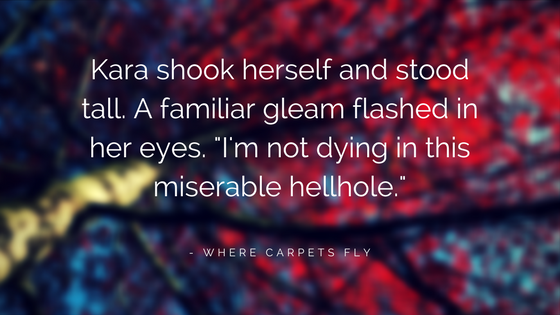
Discussing gender and its attributes always seems to be a touchy subject. And yet, I still think it’s something we need to talk about. I’ve read a lot of books, and it’s clear that certain genders both write and are portrayed in particular ways in particular genres.
A lot of fantasy books, particularly the older ones, are written by white Western men and often have a male hero, struggling with a quest or challenge in their world. Often this world is a medieval-style setup. But in more recent years, there has been increased focus on changing the environment and the lead characters to introduce diversity into the genre.
I have no issue with white medieval fantasy, but I think it’s great that fantasy has become more diverse and relatable to today’s multi-cultural societies. The world has become smaller with resources like the internet at our fingertips. We can use that to our advantage, researching and learning about people and places different from ourselves.
I’ve always enjoyed reading about strong female characters, and so when I came to write my own novel, it was a natural choice. But it can be difficult to get the balance right. Just because a female character is strong, doesn’t mean she can’t have weaknesses, and it doesn’t mean she can’t have any romance. A character who is too strong can become a caricature if your main intention is simply to write a strong character. I feel the key is to look at your character as an independent individual who reacts to the circumstances around her in accordance with her own nature.
Here are a few pointers to consider when writing a unique strong female character:
Physical strength
Consider what physical skills your character has. Where did she acquire them? What is her past history? If she had manual labour jobs of any kind, physical strength will be more believable.
Does her strength exceed the men around her? If so, consider if this is realistic. She may need to have genetic advantages or have had special training for this to be the case. As a general rule, women are naturally less inclined to muscle than men, but there is a range of strength over both genders which will overlap.
Magical strength
Magical powers are a key concept in most fantasy novels, and you have a lot of scope for creating powerful female characters here because generally these skills do not correlate to the real world.
However, power or ability shouldn’t come from nowhere. It’s important to consider how your character’s backstory leads her to acquire magical skills.
Mental strength
You may have a character who is physically weak but has inner strength. A woman trapped in an unpleasant relationship or a misogynistic society, for example, can still exhibit strength of mind. She can be optimistic, hopeful, faithful, and loving. She can be intelligent, cunning and resourceful. A powerless woman can still be strong if the forces outside cannot reach her inner mind and control her thoughts.
Obviously, all these characteristics are not exclusively female, but it’s more common for women to get the rough end of the stick in terms of society, because that has historically been the case in the real world.
Resourcefulness and independence
When times get tough for your female character, let her show self-reliance and take control. Active characters draw the reader in, but so often a female character will turn to the male characters to be ‘saved’ when something bad happens. Let your characters work together to solve their problems, irrespective of gender, and using their own particular strengths.
This doesn’t mean your female characters shouldn’t ask male characters for help, nor does it mean there shouldn’t be romantic aspects between them. It means that they should all be treated as the individuals they are, rather than the man automatically taking control simply because he’s the man.
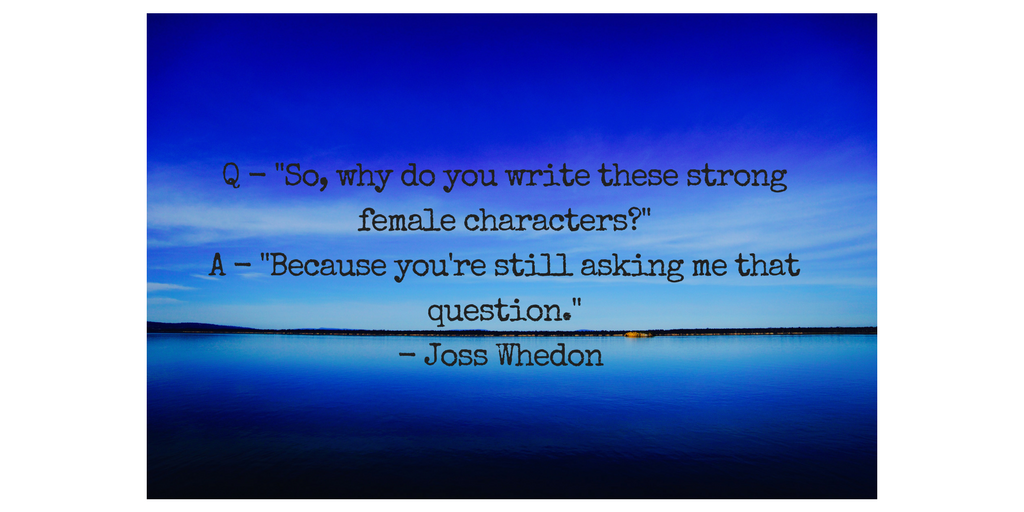
A well-drawn strong female character can inspire and empower her readers.
March 13, 2017
The World of Where Carpets Fly
Today, I’m being interviewed by Annie Douglass Lima whose blog, Realm Explorers, delves into the fantasy worlds of writers. It’s a fascinating series, so I hope you’ll stop by and explore my world and many others!
Annie was born in the United States of America but raised mostly in Kenya, which was her home for 14 years. Upon returning to the US, she attended Biola University in Southern California, where she majored in elementary education with an emphasis on Intercultural Studies. Shortly after graduating, she accepted a position as a teacher in a one-room schoolhouse in Papua, Indonesia. The job lasted for a year, and not long after her return, she married her wonderful husband Floyd, who she’d met at college. The two of them lived and worked in California for nearly five years, but when they felt the time was right, it was a joy to move overseas and start a new life in Taiwan.
You can read about Annie’s novel, Prince of Alasia, here.
March 8, 2017
Where Carpets Fly – Interview with Heather Hayden
Today, I’m chatting to Heather Hayden on her blog.
Heather Hayden is a writer, gamer, reader, editor, and computer geek, though not in any specific order.
She can’t remember when she first started tapping away at a keyboard but she’s grateful that those early attempts at writing are lost in the ancient format of floppy disc. She does miss that racing MS-DOS game she used to play but has found other games to spend free time on, such as Warcraft III and Magic the Gathering. A lot of her free time is spent reading her latest haul from the local library.
Heather wrote her first novel when she was fourteen, and published her first book when she was twenty-one. She is now hard at work on her next publication, a YA fantasy novel. Her first book was Augment, a YA science fiction novella.
At times Heather ventures outside to hike with friends, go biking, or go swimming. She prefers ocean water over lake water, has a fear of heights, and is currently in search of a new bike. She also loves anime, listening to music, and chocolate.
March 6, 2017
The Magic Behind Where Carpets Fly
I love looking at different magic systems and learning about how they work. I’ve even written a blog post or two about developing magic systems. When it came to writing my own fantasy novel, the worldbuilding was one of my favourite parts. So, today, I’m going to share a few hints and insights into the magical background of Where Carpets Fly.
There are four main types of magic used in the country of Tamarin:
Tangible Magic
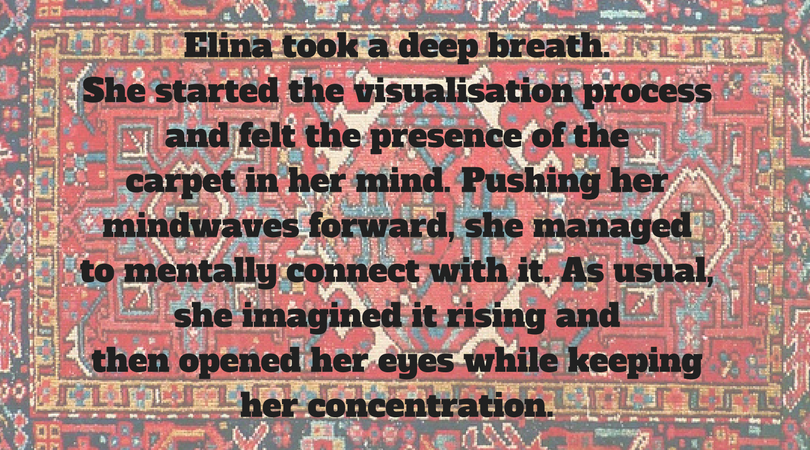 Tangible Magic is the ability to move physical, non-living items. For example, you could use it to shift heavy items around in your home—boxes, furniture, etc, or to carry objects long distances, or move them quickly into a particular position.
Biological Magic
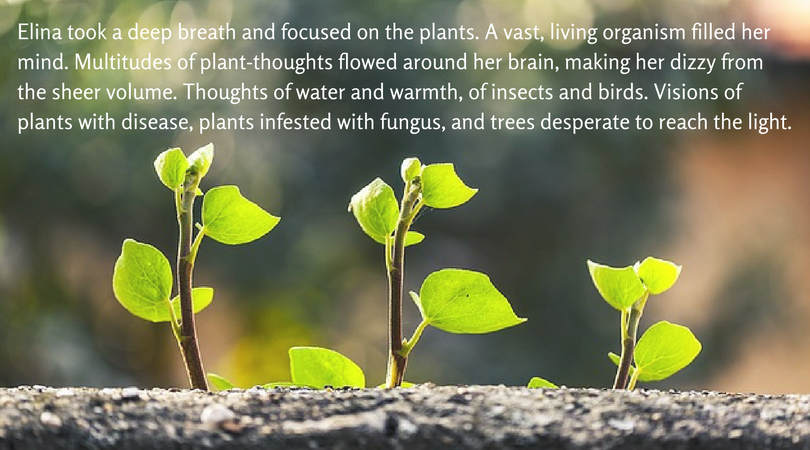
Biological Magic is the skill of talking to plants and animals. Plants are mastered first, and those with this skill are excellent gardeners! From there, people move on to talking to small creatures such as birds, before progressing to larger animals. Once you become proficient at talking to plants, you can persuade them to grow in certain ways and produce better fruit.
Elemental Magic
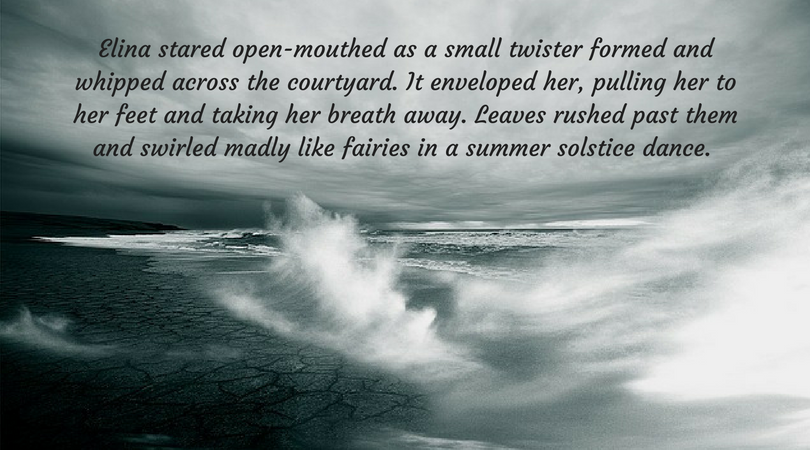
Elemental Magic is the manipulation of the four elements: fire, water, earth and air. At it’s most basic level, it’s good for chores like digging the garden! At the other end of the scale, sailors sometimes use Elemental magicians to steer ships by manipulating the wind and the sea.
Cognitive Magic
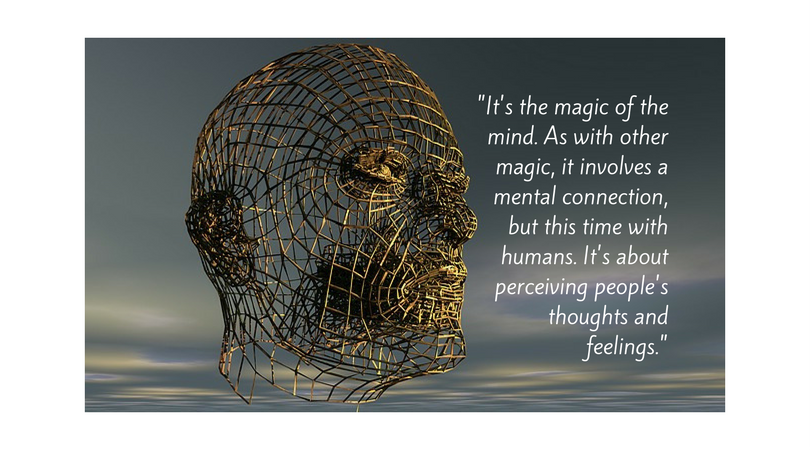
Cognitive Magic is the ability to read people’s minds and to telepathically communicate with other Cognitive users. It’s a secretive kind of magic, and many people are not even aware it exists because it tends to be used for government surveillance and kept very quiet.
In addition, the various types of magic can be ‘fixed’ into physical items, using a process called Charm Conditioning. This then means that everyone can activate the magic using certain commands, even if they can’t do that kind of magic themselves. Generally, people can do one or two types of magic well, and they are likely to inherit similar skills to their parents or grandparents. Of course, hard work is required to become skillful.
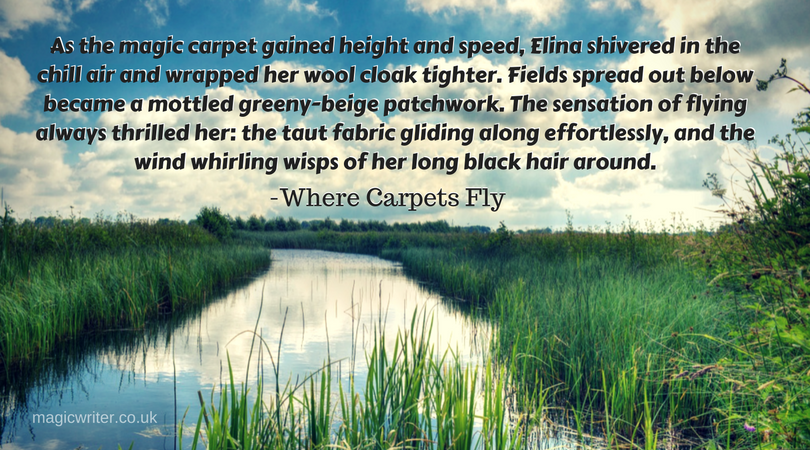
Flying carpets are the best example of Charm Conditioning:
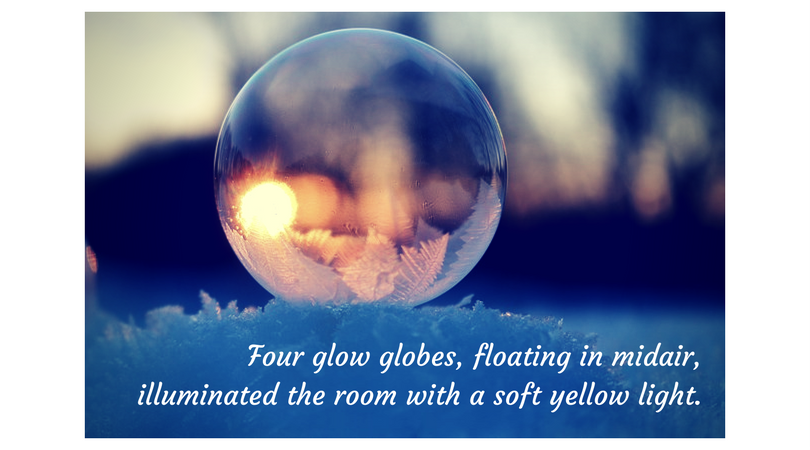
And another item that uses this magic are glow globes–the equivalent of lamps or torches. They are spherical globes, that produce a glowing light when tapped—a result of an Elemental Magic Charm. You will find them in every homeis.
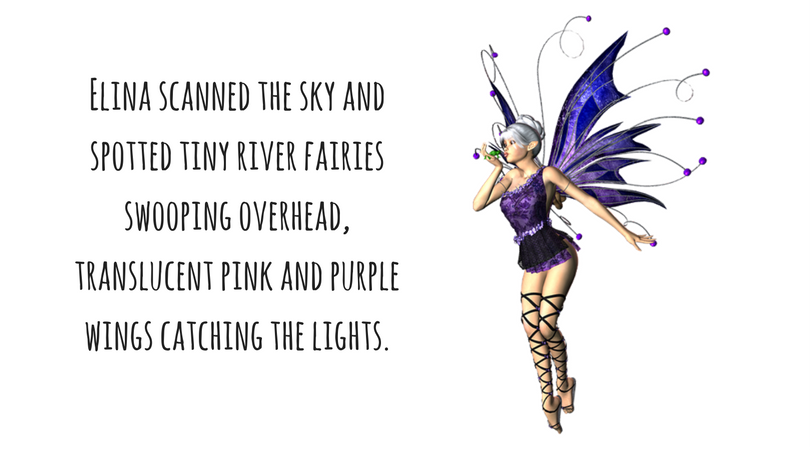
And finally, no fantasy world would be complete without some other-worldly creatures. I mainly have human races in my books, but I do have a race of tiny fairies, called river fairies. The fairies are sentient, although not everyone realises this. However, rumours abound that they might have a sixth sense. A few people can communicate with them, but it tends to be trivial conversation. The fairies love to play with people swimming in the river, particularly children.
I hope you enjoyed that brief look into the magical world of Where Carpets Fly. If you’re intrigued, you can find the book on Amazon!
March 3, 2017
Fellowship of Fantasy – Magical March Giveaway!
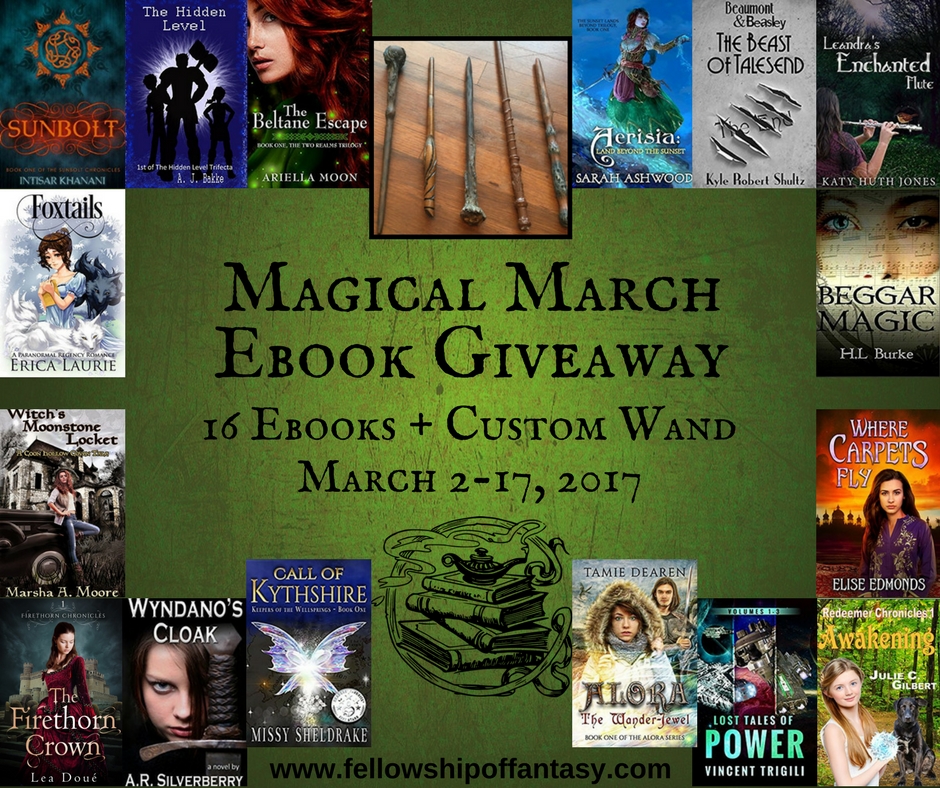
Here Be Magic …
Enchanted lands, magical creatures, fairies and witches and … space wizards? You bet! We’ve got all that and more for our Fellowship of Fantasy March eBook giveaway. Sixteen authors are offering sixteen adventures, along with a little something extra to make your month magical. Keep reading to learn more and get a closer look at a few books in the bundle.
Call of Kythshire
by Missy Sheldrake
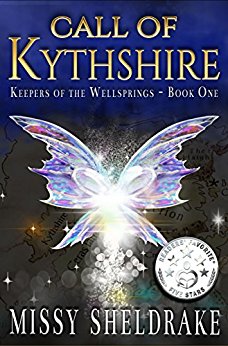
Inspired by books like the Harry Potter Series, the Chronicles of Narnia, and the works of Brian Froud and Jim Henson, Sheldrake hopes to capture the imaginations of readers of all ages with her Keepers of the Wellsprings series.
Azaeli Hammerfel has grown up in the guild hall of His Majesty’s Elite in the peaceful kingdom of Cerion, training hard and dreaming of the day she will finally become a squire and ride out with her parents, both knights, on the King’s Quest. Her dream comes true when she earns the right in her sixteenth year, but her name is left off the quest declaration and her parents and their guild ride off without her.
When tragedy befalls the Elite on their quest, Azi must band with her best friend Rian, a Mage Apprentice, to discover the source of a mysterious curse. They’re joined by an unlikely companion: a colorful fairy named Flit. The fairy claims she is from Kythshire, a mysterious and legendary land of Fae, closed off from the outside and cloaked in secrets.
Together, the group seeks to unravel a Sorcerous plot which threatens both the existence of Kythshire, and the peace the kingdom of Cerion holds dear.
Call of Kythshire is a tale of love and friendship, the value of family, and the fight between light and dark. It is a journey of failure and redemption. It is a clean read, free of sex and gratuitous violence, with a strong female lead.
Where Carpets Fly
by Elise Edmonds
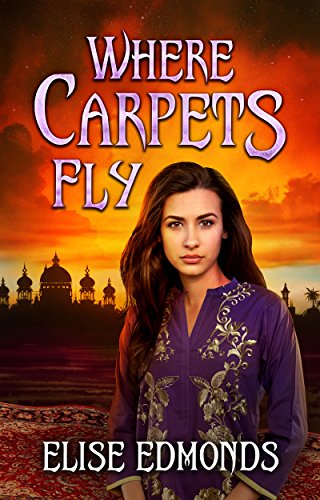
Elina Faramar finally leaves her family’s flying carpet shop when her father reluctantly agrees she can take magic lessons in nearby Kamikan. Urban life promises adventure, and new friend Kara shows her the sights.
However, Elina soon sees a darker side of life: a foreigner arrested at the circus, forbidden schoolhouse rooms with odd comings and goings, and unsociable pupil Simeon’s shady deals at the docks. Everything seems connected to the volatile neighbouring country of Pallexon, but no one will tell her why.
When Elina and Simeon develop a magical mind link, he seems close to confiding in her. But an unexpected voyage takes Elina and Kara away from answers and towards unknown danger in Pallexon.
Alone in a strange country, with no identity papers, the situation rapidly turns into a nightmare when Kara is mistaken for a spy. With her own freedom at stake, Elina must rely on her wits and magic to save her friend and unravel the secrets of Pallexon.
Sunbolt
by Intisar Khanani
The winding streets and narrow alleys of Karolene hide many secrets, and Hitomi is one of them. Orphaned at a young age, Hitomi has learned to hide her magical aptitude and who her parents really were. Most of all, she must conceal her role in the Shadow League, an underground movement working to undermine the powerful and corrupt Arch Mage Wilhelm Blackflame.
When the League gets word that Blackflame intends to detain—and execute—a leading political family, Hitomi volunteers to help the family escape. But there are more secrets at play than Hitomi’s, and much worse fates than execution. When Hitomi finds herself captured along with her charges, it will take everything she can summon to escape with her life.
Have a look at the entire collection of eBooks, and enter below to win them all–as well as a custom wand similar to the ones pictured here–for your very own.
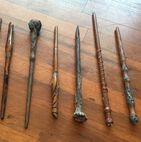
Giveaway runs from March 2-17. The winner will be notified by email on March 18. [FoF reserves the right to substitute the custom wand with something of equal value for anyone outside the US or Canada.]
Enter below and good luck!
February 28, 2017
Where Carpets Fly – Interview with Corinne Morier
Today I’m chatting with Corinne Morier over on her blog, The Pink Notebook.
Corinne Morier is a fantasy author with a penchant for writing stories that make readers feel. When she’s not writing her own stories or pestering her writer friends to hurry up and finish their books, you can usually find her playing video games, watching anime, or swimming.
Her paranormal flash story “The Photo” was published by Roane Publishing and her short story “Mother’s Gift” is available in the JL Anthology: From the Stories of Old. She chose to adapt this fairy tale because it has been one of her favorite fairy tales ever since she was a child.
February 27, 2017
My Top Ten Young Adult School Series
I’ve been reading school stories for a long time: before the young adult genre was really a thing. Back then, books were either for children or for adults with not a lot in between. I also read a lot of books published in the earlier part of the 20th century: children’s classics and so forth. But to me, a good school story is just that, and age and time is no barrier. So here’s a run down of some of the school tales I’ve enjoyed over the years, from classic to contemporary.
What Katy Did
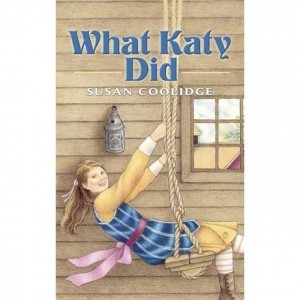
What Katy Did is the story of a young American girl back in the late 1800s. The first two books follow first her family life, and then her life at boarding school. Katy attends a fairly select school for young ladies with her sister, and they have to adjust to the unfamiliar environment, making lifelong friends – and some enemies – along the way. There are further books in the series following Katy’s future life, aimed at a slightly older audience.
Chalet School
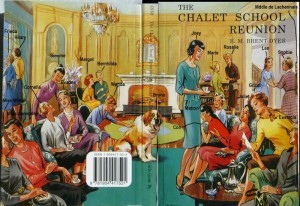
The Chalet School series has about sixty books. It’s the story of how one determined woman sets up a school in the Austrian Tyrol, where she has been advised to take her younger sister for health reasons. The series follows the rise and fall of the school over about forty years, from the Tyrol, back to Wales during the war, and then later in Switzerland.
The earlier books in the series are better than the latter, and some books are hard to get hold of these days – although there are groups out there trying to get them reprinted. Later editions are abridged.
Billy Bunter
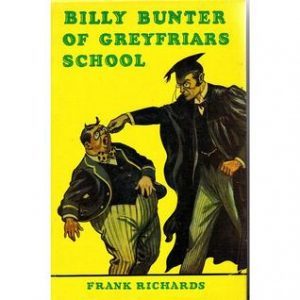
Billy Bunter originally started in The Magnet, a comic produced from 1908 to 1940. Later, books appeared based on the comics. These are the woes of a fat lazy schoolboy at a very English public school. Terribly un-PC these days of course, but very much books of their time. Despite that, the characters of the individual boys are amusing and the stories entertaining.
Copies of most of the books and the original comic can be found online, and the books also seem to proliferate charity shops.
Malory Towers
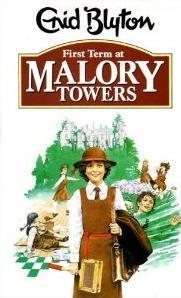
This series is great for younger children, although perhaps may seem a bit dated these days. It’s a classic boarding school series full of tricks, midnight feasts, making new friends, and learning lessons. A fun read.
The books follow the main character, Darrell Rivers, from joining the school at age eleven, all the way through to the sixth year at age eighteen.
The Naughtiest Girl
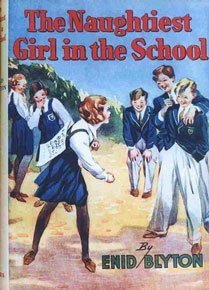
Another Enid Blyton series, this is a school with a difference. Whyteleafe School is a progressive school, run by a council of pupils. The pupils make the rules and decide on punishment and deal with each other via a jury system. It’s a fascinating idea, and very appealing as a child. And of course the main character, Elizabeth, is always getting into trouble. She arrived with the intention of being so naughty that she would be expelled. This series is also great for younger children.
The Worst Witch
These fantasy books focus on Mildred Hubble, a young witch who attends Miss Cackle’s Academy for Witches. Mildred’s has good intentions, but her clumsy personality leads her into disaster. Mildred and her friends have a strong rivalry with Ethel, a high-born, snobbish and vindictive classmate. Many antics ensue!
The Worst Witch is currently being produced as a TV series by the BBC. If you haven’t seen it – here’s a snippet on YouTube.
Witch Week
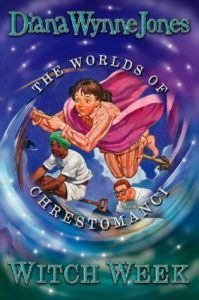
Witch Week is a book in the Chrestomanci series. It has a more serious tone and distinctive plot than many of the books above. It’s less a slice of life, and more of a one-off book. Various oddball pupils find strange things happening to them in a world where magic is forbidden and witches are still burnt to death. An inquisitor attends the school to find out if there is a witch among them.
Harry Potter
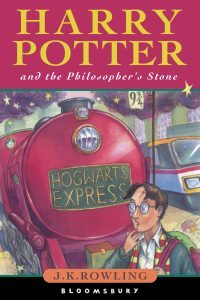
Harry Potter needs no introduction. Somewhat unbelievably, book one was published twenty years ago now. The story of a bespectacled orphan who survives the Dark Lord’s death curse and attends Hogwarts School of Witchcraft and Wizardry will be familiar to probably all my readers.
Septimus Heap
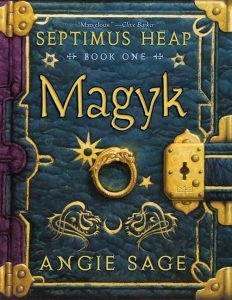
Septimus Heap is a series of seven books. It’s not strictly a school series, but it does involve a lot of apprenticeships and learning, so it fits the same kind of genre. The school aspects don’t really kick in until the second book. This is a great series about a city where wizards are highly respected and in control of the safety and defence of a city. We follow Septimus’s journey as a wizard’s apprentice.
Vampire Academy
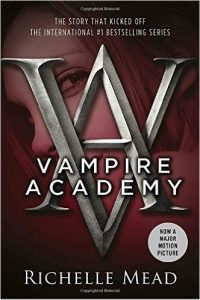
Vampire Academy is the last and most modern book on my list. It’s aimed at older teens and tell of a school where vampires learn skills and academic studies. The book focuses on Lissa, a vampire who is coming to terms with her odd powers, and her guardian, Rose who is learning to defeat their common enemy.
In the comments, let me know what your favourite school series is!
February 23, 2017
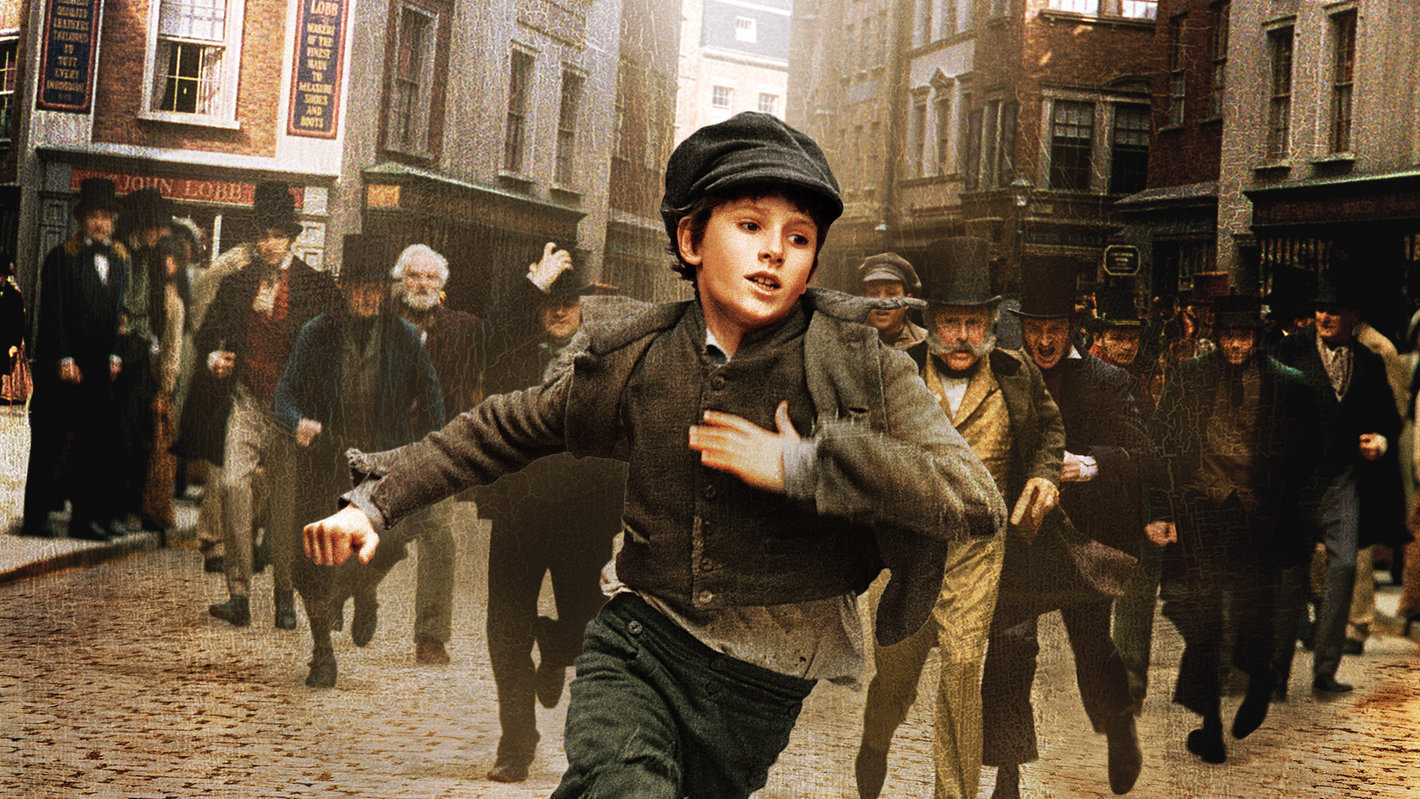
Reading Challenge Book Three: Oliver Twist
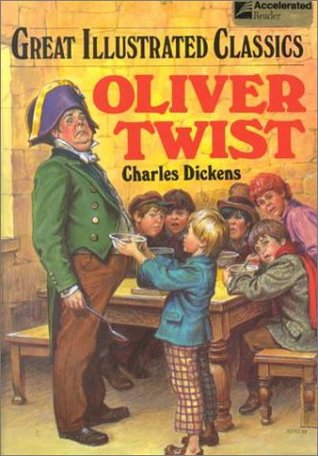 Book Three was a longer more in-depth read: a return to the classics with Oliver Twist.
Blurb
‘A parish child – the orphan of a workhouse – the humble, half-starved drudge – to be cuffed and buffeted through the world, despised by all, and pitied by none’
Dark, mysterious and mordantly funny, Oliver Twist features some of the most memorably drawn villains in all of fiction – the treacherous gangmaster Fagin, the menacing thug Bill Sikes, the Artful Dodger and their den of thieves in the grimy London backstreets. Dicken’s novel is both an angry indictment of poverty, and an adventure filled with an air of threat and pervasive evil.
Why I Chose This Book
A while back, my mum offered me some of her old classics. I accepted a few and shelved them, intending to read them later. I could have sworn one of them was Oliver Twist so I made a mental note to read it and put it on my challenge.
When it came to finding the book, all I could find was David Copperfield! So who knows what happened there. Anyway, I was all geared up to read it, so I picked up a cheap Kindle copy and went ahead.
Rating/content
I give Oliver Twist 4 out of 5 stars.
I consider that an average rating, because as a whole I felt bits of the book varied from 3 stars to 5 stars.
The main plot revolves around the mixed fortunes of a young orphan and the disreputable company of thieves he falls into.
It’s a complex plot, and the language used is difficult at times, so I wouldn’t recommend it for younger readers. Nor would young readers appreciate Dickens’ brand of satirical humour. However, if you want a Dickens to start with, I’d say this was a good choice. It’s way less complicated than some I’ve read.
No sexual content, very mild bad language, and some violence, although not gratuitous.
Good points
The beginning of the book is heavy with satire to the extent it had me laughing out loud from time to time. At first, we meet Oliver, a workhouse pauper. He is treated with incredible cruelty by the workhouse owners and upstanding citizens of the parish. Dicken’s makes his opinion only too clear about these do-gooder respectable citizens who treat the poor people like scum on the bottom of your shoe.
But it’s not as funny when you realise that he was parodying situations that existed in Victorian times. I’m assuming he’s exaggerating the circumstances to make a point, but nonetheless it’s quite scary that such attitudes prevailed. I do wonder what the current audience thought of this when he originally serialised the novel. Was it a wake-up call? Or did they accept it as part of life?
The plot is enjoyable and despite the fact it switches around from one group of people to another constantly – from Oliver, to the workhouse folk, to the thieving bad guys. One thread is a constant driving force and pulls everything together: Oliver’s mysterious origins. It’s well-crafted and keeps you turning the pages, and has a satisfactory ending.
As far as characters go, the only one who really drew me in was Nancy. Her storyline is heartbreaking, and Dickens portrays her internal struggles really well. The fact she sees herself as beyond redemption despite the fact she was the only one trying to do the right thing was terribly sad and made me long to give her a different ending.
Bad points
Many of the characters Dickens portrays come over as one-dimensional caricatures. The majority of his villains are bad through and through. Mr Bumble, the self-righteous beadle, never has a kind word to spare. Fagin and Sikes are ruffians of the lowest kind with never a hint of remorse. They are all entertaining, but aside from Nancy, lacked anything much deeper to me. Their comeuppance was satisfying, mind you.
The converse is also true. Oliver himself is a very dull little boy. Yes, I feel sorry for him, and he’s treated appallingly, but he remains so unnervingly sweet and trusting throughout the whole experience that it didn’t ring true. Rose is a another angelic character, who has zero flaws, and always does the right thing. She’s basically an angel in human form.
A lot of the characters lacked that internal struggle that made Nancy more relatable.
I didn’t have a particular problem with the writing style, but from time to time, Dickens veered off into his own happy little narrative for a few pages. It’s a bit tedious to read in these days of snappy modern writing. Once in a while I was shouting at him to stop explaining stuff and just crack on with the plot.
Overall
The good far outweighed the bad in this book. Obviously, the quality of the writing is second to none (although the particular edition I chose had a lot of errors – don’t think I can blame that on Dickens though!) and it’s interesting to see how writing techniques have changed over the years and fallen in and out of fashion.
I’d definitely recommend it as an enjoyable classic to read, and next time the film comes on TV, I shall make sure I watch it.