
Douglas J. Douma's Blog, page 27
May 31, 2017
Clark and His Correspondents
In approximately one month copies of the collection of Gordon H. Clark’s correspondence I compiled, edited by Tom Juodaitis, will be available from The Trinity Foundation. The cover design has just been finalized. Check it out:
[image error]
Filed under: Notes on the thought of Gordon H. Clark


May 26, 2017
One of Dillingham’s Missionary Ladies – Miss Bertha Abernathy
Not only were pastors at work in the early years of Dillingham Presbyterian Church, but women missionaries also played a key role. Of a number of women who came to serve as Sunday school teachers at Dillingham, it is Miss Bertha Abernethy who is most well known. This can be attributed to her having been at Dillingham for many years reaching even into the youth of some current church and community members.
The Reverend R. P. Smith recounted the value of missionary ladies sent by the Home Missions Committee in his book Experiences in Mountain Mission Work (1931).
“As we investigated and studied conditions, it became more and more evident that we should emphasize secular and Christian education in starting work on mission fields. First, a day school for the children; second, a Sunday School for the children and their parents; third, preaching services for all in the community.”- p. 34 “On a visit to one of our mission points I preached to a large congregation on Sunday. At the closing of the services I explained to the people that we did not have minister enough to send and give them preaching services regularly. A good honest man in the audience rose to help and comfort me. He said: ‘We like to hear you fellows preach, and I am not saying anything agin ye, but if we can’t git both, send us the women teachers. These women teach our children books and good manners during the week and on Sunday they teach us the teachers, we can git along mighty well for a good while yet just with them doing the work.’ To which I heartily agreed and sent the teachers.” p. 47
Born in Mecklenberg County to Madison and Elizabeth Brown Abernethy, Miss Bertha (Dec. 31, 1883 – 1955) first appears in the records in 1898 as the secretary of the Children’s Band of Earnest Workers at Steele Creek Church. She later graduated from Presbyterian College, now Queens University in Charlotte, NC and taught at the Old Dixie School back in her hometown of Steele Creek, NC. She came to Dillingham in 1906, the same year the Old Dixie School was closed, and largely remained in Dillingham until some time in the early 1940s.
Miss Bertha, who never married, did work also as the Principal of the Ebenezer Mission (for at least the years 1911 – 1913). It is this famed mission which was the setting of “Cutter Gap” in the popular novel “Christy.” The lead character, “Christy,” in real life Leonora Wood Whitaker, went from her home in Dillingham to the Ebenezer Mission herself in 1909. It might have been Leonora who encouraged Miss Bertha to also work there.
Sometime after Miss Bertha returned to Dillingham, her Aunt Rena Brown came to live with her and also work for the church.
Miss Bertha worked at the church, for a time living in the Manse. She also taught school at the no-longer-existing Chesnut Grove / Dillingham School House.
Today a quilt made for Miss Bertha when she retired and left Dillingham is still in good condition, now belonging to one of the members of the church.
Miss Bertha’s own memories of mountain work were recorded in an article in 1945:
Vol. XXXV. June, 1945. No. 6.
Former Worker Writes Of Personal Experiences
Miss Abernathy Contracted “Mountain Fever”
(We asked Miss Bertha Abernathy to write us. She pioneered with Dr. R. P. Smith in the first decade of
Asheville Presbytery. Editor.)
I fully realize that there is work to do for the Lord at any spot in this world, but as for me, I would always wish my work could be done in God’s wonderful mountains. It is there that I feel nearer to Him who made them. I got my first knowledge of this in 1906, when after having chills, I sought work for the summer in the mountains of Western North Carolina, hoping to get rid of the chills. I did that very thing, but I contracted “mountain fever” which I have had ever since — now in 1945.
Dr. R. P. Smith sent me to Barnardsville, N. C, for a three months’ summer school, which was held in the Presbyterian Church there. It was situated on a hill overlooking the village. By the time I climbed the hill, and pulled the rope which rang the bell, I was completely out of breath. But O, what a wonderful view I had from the door of the church as I caught my breath!
I boarded in the home of Mr. and Mrs. Theodore Steppe, where I was treated with the greatest kindness by the Steppes and all the people in the community. I did not complete the three months — June, July and August — for it was arranged that I should assist in the public school at Dillingham, where the Presbyterian minister was the principal, since the public schools were given longer terms — these three months’ summer schools were being discontinued. So public school work — with the spiritual interest of my pupils, the Sun-day schools of the churches of the community on my heart — was my line of business for a number of years.
Thus, until about 1928, Buncombe County was my paymaster, except the few years I taught in a mission school in Tennessee. I am sure that I did not show the interest in the spiritual life of the community as my Master would have had me do it. If I could do it all over again, I would do everything very differently. A greater part of the time I boarded in the homes of the community, which I enjoyed very much. Of course, they cooked things differently to what I was accustomed — but the way we cooked was strange to them also. But how I did enjoy their “eats”!
About 1922 I built a little home at Dillingham. My mother had died in 1920. My aunt Rena Brown came to live with me. After five years in this home, it burned down one night while we were at prayer meeting. About two and a half years later my aunt fell and broke her hip, and I went to my uncle’s to nurse her. Shortly Dr. Dendy arranged for us to come and live in the manse as hostesses. Again the Home Mission Committee was my paymaster. We lived in the manse about five years, when the Dillingham Church called a pastor. Since then I have lived with my aunt in Steele Creek, near Charlotte.
So many seem to think that the people who live in the mountains are quite different from other people. But as I see it, there are the same traits in people wherever I go. I find some faithful to God, and some unfaithful. I feel that the way we have all failed is not being more and more in love with Jesus, and not being trained to think of giving as a privilege — an honor — a part of worship.
There are two things which I enjoyed most of all. The first was visiting in the homes. To be able some blight, clear morning to start up one of the creeks and drop in at every home for a few minutes — to happen at one just at meal time — to me was a great delight. I realize now that I did not talk enough about the Bible while on these visits. Another thing I especially liked to do was to sit down at the church organ and play for our folks to sing — and how they liked to sing!
One year when I was teaching the primary department at Dillingham Public School, I had 47 children on my roll by the name of Dillingham. That changed greatly, for I had only a small percentage by that name the last year I taught.
So many things have changed. When I first went there, we rode about a half day from Asheville to reach Dillingham in a bugey or hack. Now they have regular buses, and can make the trip easily in an hour. But with all the material changes, God does not change, and longs so for our love — wants to be first in our lives. Ruskin says that one thing God will not put up with in our hearts is — second place.
An entry in the Missionary Survey, June 1913 (p. 612) written by Miss Bertha introduces the Ebenezer Mission:
[image error]
[image error]
Filed under: Historical Pastors of Dillingham Presbyterian Church


May 19, 2017
Gordon Clark’s views on Creation.
A number of people have asked, “What were Gordon Clark’s views on creation?” That is, was he an old-earth creationist or a young-earth creationist? (It is clear that he wasn’t a theistic evolutionist.) His views on the matter, if published, have escaped my noticed. But now I’ve found a relevant note from his papers, showing his position for at least that particular moment at which he wrote. This comes from Clark’s notes on the Westminster Confession of Faith, written in about 1943.
Clark writes,
Men were created not more than 10,000 years ago; but [there is] no indication when the material universe was created.
Well, that is the main quote of interest. Below is the whole relevant section for those who are interested:
[image error]
Filed under: Notes on the thought of Gordon H. Clark


May 16, 2017
Scripturalism and the Gettier Problem.
Scripturalism and the Gettier Problem
By Doug Douma and Luke Miner
So the story goes, epistemologists had long held knowledge to be justified true belief (JTB). (A story to be doubted according to Alvin Plantinga.) (That Clark held to JTB rather than just “true belief” (TB) Doug has argued in Gordon Clark’s Theory of Knowledge and Luke has argued in Gordon Clark and Knowledge: On Justification)
But the times were “a-changin” in the 1960s. Edmund Gettier’s 1963 paper “Is Justified True Belief Knowledge?” challenged the (supposed) long-held view of JTB and would prove to have significant impact on the field of epistemology. (Bob Dylan must have been an epistemologist. But it wasn’t until 1978 that he sang “One of Us Must Know.” By that point astute readers of Gordon H. Clark might have realized that Gettier’s problem was none of the kind.)
Edmund Gettier challenged the definition of knowledge as justified true belief by presenting cases where beliefs are true and justified but don’t count as knowledge. Basically his counter-examples to JTB occur when a person has a true belief that is based on good grounds but the belief is true by coincidence.
One of Gettier’s cases is essentially as follows: Smith has been told by the hiring manager that Jones will get the job, so he has good grounds for thinking Jones will get the job. Smith also knows that Jones has 10 coins in his pocket because he counted them himself. So Smith has the justified belief: “The man who will get the job has 10 coins in his pocket.” But, as it happens, Jones doesn’t get the job, but Smith gets it. Smith reaches into his own pocket and realizes that he, too, has had 10 coins in his pocket. This means that Smith’s justified belief: “the man who will get the job has 10 coins in his pocket” is actually true. It is a true, justified belief yet it is only true by coincidence so it doesn’t amount to knowledge.
Alvin Plantinga gives a less-confusing example which Bertrand Russell gave years before Gettier’s birth. You glance at a clock and form the belief that it is 3:43pm and, as luck would have it, the clock stopped precisely 24 hours ago. Since clocks can usually be relied on and since the belief that it is 3:43pm is true, you presumably have a justified true belief but, since it’s only true by luck, you don’t have knowledge.
One shouldn’t think that Edmund Gettier completely did away with the idea that knowledge can be defined as JTB. In actuality, Gettier’s paper contributed to starting the revolution in epistemology that continues today. Epistemologists have presented a host of new models for how true beliefs are justified which have solved the Gettier problem (among the most notable new models are Reliabilism, Proper Functionalism and Alston’s Epistemic Desiderata approach). Without getting into the details, the point is that Gettier exposed flaws in certain common conceptions of justification, but his counterexamples don’t apply to other conceptions of justification. This is why Gettier began his paper by listing two different conceptions justification to which his counterexamples apply and then providing two additional restrictions on the term. People who think that Gettier buried JTB six feet deep are usually surprised to find out that the best known contemporary epistemologists are still writing about justification (see Epistemic Justification).
How is all this relevant to Scripturalism and Gordon Clark’s theory of knowledge? As you’ve probably guessed, it isn’t all that relevant. Clark used the term knowledge to refer to true belief that possessed infallible justification.” Consequently, Gettier problems cannot arise in Clark’s theory. For Clark, a proposition is only justified if it is either acquired from the infallible Word of God by illumination of the Spirit, or by proper logical deduction from known (Biblical) propositions.
One might rightly point out that nothing in Scripturalism precludes us from using the term, “knowledge” to mean true belief with some degree of justification. Clark just didn’t use the term that way in technical discourse, though he did, in fact, sometimes use the word “knowledge” (and its cognates – know, knowing) in a colloquial or non-technical manner. If one wants to talk about fallible kinds of justification, he has multiple models of epistemic justification from which to choose in today’s literature.
Clark’s court-witness refutation of empiricism illustrates Clark’s commitment to infallible justification. He writes, “If a witness in a criminal case is shown to have perjured himself, how much credence do you give to the other statements he made. If you’re eyes deceive you once you can’t believe any of it.” (“What is Apologetics,” The Gordon-Conwell Lectures on Apologetics, 1981. Minute 36) So if a certain method (say sense-perception) produces some false beliefs, it can’t count as a source for knowledge.
Filed under: Uncategorized


May 13, 2017
George Marsden comments on The Presbyterian Philosopher.
[I received the following email from historian of American Christianity, George Marsden. An author of 10 books, Dr. Marsden is Emeritus Professor of History at the University of Notre Dame.
His father, noted in the email, was Robert Marsden who, according to A Ministerial Register of the Orthodox Presbyterian Church, 1936-1991, was born in Philadelphia in 1905, received an A.B. at Penn in 1927, studied at Princeton Theological Seminary 1927-1929, and graduated from Westminster Theological Seminary in 1930. A pastor in the OPC, he died in 1960.]
Dear Doug,
Thank you for sending your book. I have not yet finished it, but I have been very fascinated by the parts that I have read, particularly the controversy in the OPC. I am particularly interested in that because “the Clark controversy” was a common phrase that I heard during my childhood years. And I knew quite a few of the people involved. Ed Kellogg was our pastor in Middletown. I remember when Strong and Gray et al left the denomination, particularly because one of their allies was Frank Dyrness who ran the Quarryville Bible Conference and my father was on the board of that. I attended the Conference a couple of times, including I think in 1948 when I was 9 and the breakup was in full swing.
My father was, of course, deeply involved in a lot of this. I gave the papers I had of his to the Westminster Library a year or so ago, but I did not notice much directly on the controversy. He inherited the executive job for the Christian University after Rian left and it was being phased out. But those papers don’t indicate much except who was contributing to the cause. He was also the moderator of the 1946 General Assembly, I believe. I think, like Kellogg, he was initially on the side of Clark, but then lined up with the WTS folks versus those who left. So he was viewed highly enough by the WTS faculty to get job as Executive Secretary of WTS in 1947 (prior to that he was the denomination’s secretary for home and foreign missions—probably his letters re the controversy are in those files). He must have known Clark from way back. He was 3 years younger than Clark and from the same part of Philadelphia (though I think they went to another Presbyterian church) and they were at Penn at the same time as Senior and Freshman—and then Clark was a grad student and headed the League of Evangelical Students to which I’m pretty sure my father belonged—since he then went on to Princeton Theological Seminary.
Because of his deep involvement in all this, I’ve long wondered what was going on. I later got to know the Westminster faculty people fairly well and regarded them as persons of the highest integrity. Somehow Van Til convinced them that there was a matter of high principle involved and Murray was willing to argue for that. But it seems clear, as it did even to many pro-WTS types at the time, that they were setting a standard of doctrinal precision for Clark that would not have applied to anyone else. (This was complicated by the fact that Clark as well as Van Til was very argumentative and would not concede much about his positions—so there was not much of an atmosphere to encourage agreeing to disagree—the earlier Wheaton controversy suggests that he was prone to get into such disputes.) But to me the most illuminating point is the Program for Action that involved gaining control of WTS and turning the denomination in a direction that would be more attractive to fundamentalists. This became a political battle for control of the denomination. Ostensively it was about Clark. But the majority who sided with WTS in a general way, even if not necessarily on the specifics of the doctrinal-philosophical debate, managed to make it uncomfortable enough for those who designed the Program of Action that they left. I guess the crucial moment was the firing of Rian from the Christian University. And, as you show, others associated with that party were going to be given a hard time. But in the meantime, the tide had actually turned in favor of Clark so that the question of his ordination was no longer really the issue. I do think that there is something to Hakkenberg’s point (if I recall it) that this was the second instance in the wake of Machen’s death when his followers battle over whether the denomination would be more “American” or follow the lead of the Dutch allied with one Scotsman.
I’m not writing this as a criticism of the way you present things. I think you present them very well. I’m just trying to think through for myself how “the Clark case” could turn out to be such a fiasco that went so far beyond the bounds of the theological questions involved. Partly because of his own strong personality, partly over the precisionism of Van Til and others, and party because of the dissatisfaction of those who saw (with some justification I think) the OPC as getting to withdrawn into its doctrinal shell, it became the precipitant for a major political struggle for control of the denomination.
So thank you for your fine contribution. I understand the matter better now—even if questions remain.
Filed under: Notes on the thought of Gordon H. Clark


May 9, 2017
Fighting the Good Propaganda
I was asked by D. Clair Davis (former professor of church history at Westminster Theological Seminary, 1966-2003) to evaluate a particular essay written by D. G. Hart and John Muether. This essay, “The OPC and the New Evangelicalism,” is contained in their co-authored book, Fighting the Good Fight, A Brief History of the Orthodox Presbyterian Church. (Published by The Committee on Christian Education and The Committee for the Historian of the Orthodox Presbyterian Church, 1995).
I wouldn’t typically want to review a book (or essay) so many years after it was published, but I figured a review of it might be of some interest and value since the 15-page essay centers on the “Clark – Van Til Controversy” of which I have recently published three chapters on in my book The Presbyterian Philosopher, The Authorized Biography of Gordon H. Clark.
The essay “The OPC and the New Evangelicalism” is to be praised for revealing that there were political matters in behind of and intertwined with the theological matters of the Clark – Van Til Controversy. But it is to be faulted for what its contends those political matters were, for its lack of objectivity as a historical essay, and for its factual errors.
FACTUAL ERRORS
Starting with the last, let us note some factual errors contained in the essay.
FACTUAL ERROR 1: LICENSURE AND ORDINATION AT THE SAME MEETING
The authors contend “He [Clark] was licensed to preach and ordained at the same meeting.” (p. 107). And they repeat “The presbytery should not have decided upon Clark’s licensure and ordination at the same meeting.” (p. 110). I’ve already noted this mistake in The Presbyterian Philosopher, p. 155, where I wrote, “in truth, there was a month between Clark’s licensing (July 7, 1944) and ordination (Aug 9, 1944). Furthermore, Clark’s application for ordination (May 9, 1942) was more than two years prior to these events. His ordination was anything but rushed.”
FACTUAL ERROR 2: THAT CLARK HELD HUMAN KNOWLEDGE TO BE “IDENTICAL” TO GODS KNOWLEDGE.
The authors contend that Clark held that human knowledge is “identical” to God’s knowledge. They write, “they [the thirteen signers of The Complaint] maintained against Clark that such human knowledge is never identical to God’s knowledge.” (p. 108). This has been a persistent error of those who have written on this topic. It is true that The Complaint does once use the word “identical” referring to Clark’s view. The Complaint reads:
The far-reaching significance of Dr. Clark’s starting point, as observed under 1. above, is evident when we note that Dr. Clark holds that man’s knowledge of any proposition, if it is really knowledge, is identical with God’s knowledge of the same proposition.
But, it cannot be properly said that this which The Complaint maintained was “against” Clark, for Clark never held that man’s knowledge was “identical” to God’s knowledge.
In a previously unpublished paper of Gordon Clark’s from “Winter 1946/1947” Clark comments:
Before ending this part of the discussion, I wish to draw attention to the following assertions of the paper in question. On page 7, paragraph 1, are these words: “Dr. Clark’s fundamental insistence upon identity (italics theirs) of divine and human knowledge. . .” On page 8 near the bottom we find, “Dr. Clark insists upon identity of divine and human knowledge of a particular truth. . .” It is amazing that these men continue to circulate these false statements after I have so many times denied them, I denied them in the examination (cf. Transcript, 31:9–10). I denied them in The Answer (pages 20–21). I denied them in speeches in two Assemblies and in countless conversations. The Report of the committee to the thirteenth General Assembly denied them for me (page 3, next to the bottom paragraph). And in spite of all this, the committee for the complainants has neither seen nor heard these denial, and continue to make the same false statements. Truly, this is incomprehensible. (“Studies in the Doctrine of the Complaint,” published in Appendix C, The Presbyterian Philosopher, p. 265)
Rather, Clark held that man’s knowledge and God’s knowledge must be of the same (or identical) propositions. Yet, while the object of knowledge (the proposition) for Clark is identical between God and man, the mode in which man knows a proposition differs from the mode in which God knows a proposition, and thus knowledge itself is not identical. The false statement which Clark found (pun apparently intended) “incomprehensible” then in 1946/1947 continued to be made in Muether and Hart’s essay in 1995.
Whereas Clark explicitly and repeated emphasized the difference in the mode (or way) in which man knows (discursively) and the mode (or way) in which God knows (intuitively), Hart and Muether erroneously describe Clark’s position:
If we do not know the things God has revealed IN THE SAME WAY as God knows them, he [Clark] reasoned, then there is no connection between God’s and our knowledge and we are left with “unmitigated skepticism.” (p. 110)
POLITICAL MATTERS
REFORMED VS. AMERICAN OR DUTCH VS. PRESBYTERIAN?
The first two pages of the essay contend that the OPC, as a Reformed church, rejected Fundamentalism in the 1937 split with the Bible Presbyterians, and had a “coolness” to the new evangelicalism emerging in the 1940s. The next eight pages are on “The Clark Controversy” under the background of “relations between the OPC and other conservative Protestant denominations and organizations.” And the final four pages of the essay are on “The Character of the OPC.” This organization of the essay sets up what seems to be its major contention: Gordon H. Clark and his supporters were less Reformed than the group which opposed him. Hart and Muether write, “Clark’s most vociferous supporters wanted the OPC to be a church for all who opposed modernism” (p. 115) and “Ministers in the OPC who sided with Clark also hoped the church would become more evangelical than Reformed.” (p. 117) In other places Clark and his supporters are referred to as “American Presbyterians” or “the Americanist party (p. 108).”
This contention flows out of the framework of the essay that the “sometimes obscure theological debates … were always bound up with the larger question about the OPC’s relationship to the broader evangelical community and the church’s Presbyterian identity.” (p. 107)
Placing Clark and his supporters in a faction supporting greater ecumenicity, the authors appear to be linking them with the New Evangelicals. Though some of his supporters may have considered themselves more broadly evangelical, Clark saw himself as distinctly Reformed. As I argue in The Presbyterian Philosopher, the central focus of Clark’s work and life was dedication to the Westminster Confession of Faith, Presbyterianism’s defining confession.
Where Hart and Muether argue that “Clark’s most vociferous supporters wanted the OPC to be a church for all who opposed modernism,” I’ve noted of Clark himself,
In an article titled “An Appeal to Fundamentalists,” he encouraged like-minded Christians to come out of their faltering denominations and join the OPC. He was clear, however, to invite unity with fundamentalists only on the basis of following the doctrines of the original Reformers, namely the whole Reformed faith, not simply the basic tenets of fundamentalism which Clark likened to a house with a foundation but no roof. Clark’s vision was that the OPC would lead the fundamentalists under the banner of the teachings of the Westminster Confession of Faith in their entirety. Thus, whereas Paul Woolley, in his article “Discontent!,” stated his belief that the goals of church growth and commitment to Reformed principles were mutually exclusive, Clark held that the two goals were compatible. (The Presbyterian Philosopher, p. 90)
Clark saw himself as Presbyterian, not some lesser neo-evangelical.
Though some of Clark’s supporters had sympathies for non-Reformed Fundamentalists (and thus deviated in some measure from historical Presbyterianism), the opponents of Clark deviated from historical Presbyterianism towards the views of the Christian Reformed Church (CRC). For them, the CRC’s views became THE Reformed view. (see The Presbyterian Philosopher, p. 122-123.)
Hart and Muether note that the OPC did not join the National Association of Evangelicals (NAE), but rather affiliated with the Reformed Ecumenical Synod (RES) consisting of itself, the Christian Reformed Church (CRC), and the tiny Free Magyar Reformed Church in America. So the OPC got its wish of associating with its particular brand of Reformed theology as represented by the Dutch CRC from where Cornelius Van Til, Ned Stonehouse, and R. B. Kuiper had transferred.
Interestingly Hart and Muether note that John Murray’s minority report “reflected the theological convictions at the heart of Reformed theology.” And they contrast this with the majority who believed that a candidate, like Clark, should be licensed and ordained if he was in agreement with the “teaching of Scripture as expressed in the Westminster Confession.” But is not the Westminster Confession the “heart of Reformed theology?” Does this not betray where lies Murray’s theological convictions? Extra-confessional.
MISSING: OTHER POLITICAL MATTERS
Though Hart and Muether rightly note the question of the OPC relationship with other churches as figuring in to the controversy of the 1940s, they leave out a number of matters less pleasant to the history of the OPC. These include questions of alcohol acceptance, the Reformed University project, and control of Westminster Theological Seminary. (See chapter 6 of The Presbyterian Philosopher)
HISTORICAL OBJECTIVITY
The essay contains many subtle elements which reveal that it was written not as objectively-minded history, but as a theologically-minded polemic; a propaganda piece of the OPC. The first of these subtleties occurs in the title of the essay itself, “The OPC and the New Evangelicalism” seeming to imply (along with other statements in the essay) that Clark was a neo-evangelical when Clark (whose case forms the majority of the essay) could hardly be placed in that camp. As also noted above, the essay uncritically takes the position of Van Til and The Complaint, misunderstanding Clark’s view of “identical.”
It is hardly historically objective to refer to one theologian, John Murray, as “notable, IF NOT UNIQUE, for his ability to derive clear doctrinal formulations from careful exegesis.” Protestantism does not have a pope.
ONE FINAL QUESTION
In a number of places in the essay reference is made to “THE qualitative distinction” between God’s knowledge and man’s knowledge supposedly held by Van Til but not by Clark.
Clark’s opponents believed that Clark came perilously close to denying the qualitative distinction between the knowledge of the Creator and the knowledge of the creature. (p. 108-109)
While truth is one there is also a qualitative distinction between God’s knowledge and ours. (p. 114)
This “qualitative distinction” cannot be the mode (or way) since, as noted above, Clark held such a distinction. (Not to mention the The Complaint noted Clark’s distinction in mode saying it was good as such, but that another qualitative distinction was also needed). It cannot be the “object of knowledge” as Van Til affirmed such a distinction in 1948 and 1949. (see The Presbyterian Philosopher, 157-162). Rather the controversy became centered around the supposed distinction of “content” between God’s knowledge and man’s knowledge. But it was this very term which Van Til refused to define. And likewise Hart and Muether seem unable to define it.
The whole controversy itself can be summed in a quote from a letter Gordon Clark wrote to D. Clair Davis, his student at Butler University, in 1952:
There was a question I asked the complainants which they refused to answer. If mode answers how we know, and object answers what we know, what question is answered by the idea of content? They have (to this day, as far as I know) refused to define content so as to distinguish it from mode and object.—GHC to D. Clair Davis, 14 October 1952.
Filed under: Uncategorized


May 6, 2017


May 3, 2017
Scripturalism and the Cessation of Continued Revelation
Does Scripturalism allow for the possibility of continued revelation?
Outline
I. Definitions
A. The cessation of continued revelation
B. Scripturalism
II. Continued Revelation contradicted by:
A. The Westminster Confession of Faith
B. Clark’s own comments.
C. Clark’s disciples.
1. John Robbins
2. W. Gary Crampton
III. A Scripturalist Continuationist?
IV. The Incompatibility of Continuationism and Scripturalism
A. Response 1 and rebuttal – Something Other than Knowledge?
B. Response 2 and rebuttal – Knowledge in Heaven
C. Response 3 and rebuttal – Private Knowledge and Assurance
Conclusion
Does Scripturalism allow for the possibility of continued revelation?
Outline
I. Definitions
A. The cessation of continued revelation
The doctrine of cessation of continued revelation — that God has ceased revealing additional knowledge to man following the completion of the canon of Scripture — is an element of “cessationism.” Cessationism can also refer to (1) the cessation of all miracles and/or (2) the cessation of all spiritual gifts. But it is the cessation of continued revelation which is pertinent to the question at hand.
B. Scripturalism
Scripturalism is the epistemology formulated by Gordon H. Clark which limits the knowledge possible to modern man to the propositions of Scripture along with all propositions that can be logically deduced from the propositions of Scripture.
II. Continued Revelation contradicted by:
A. The Westminster Confession of Faith
The Westminster Confession of Faith (to which Clark held) reads:
Although the light of nature, and the works of creation and providence do so far manifest the goodness, wisdom, and power of God, as to leave men unexcusable; yet are they not sufficient to give that knowledge of God, and of His will, which is necessary unto salvation.Therefore it pleased the Lord, at sundry times, and in divers manners, to reveal Himself, and to declare that His will unto His Church; and afterwards for the better preserving and propagating of the truth, and for the more sure establishment and comfort of the Church against the corruption of the flesh, and the malice of Satan and of the world, to commit the same wholly unto writing; which makes the Holy Scripture to be most necessary;those former ways of God’s revealing His will unto His people being now ceased. – WCF 1.1.
And.
“The whole counsel of God, concerning all things necessary for His own glory, man’s salvation, faith, and life, is either expressly set down in Scripture, or by good and necessary consequence may be deduced from Scripture: unto which nothing at any time is to be added, whether by new revelations of the Spirit or traditions of men.” – WCF 1.6.
WCF 1.6. is a clear statement of Sola Scriptura. WCF 1.1. explicitly notes that the former ways of God’s revealing His will unto His people have ceased. Thus it is clear that the Westminster Confession of Faith teaches cessationism with regards to continued revelation.
B. Clark’s own comments.
Since Clark held to the Westminster Confession of Faith which is clearly cessationist with respect to continued revelation, Clark must have held to the doctrine of cessation of continued revelation. If this argument is insufficient however, there are a number of other places in his writings where Clark clearly affirms the cessation of continued revelation:
In What Do Presbyterians Believe (1956) Clark clearly shows his opposition to continued revelation when he contrasts the Reformers’ position of “Scripture alone” (which he holds favorably) with the position of “mystics and visionaries who claimed that God spoke to them directly.” He writes,
“In the Roman church, tradition as well as the Scriptures was accepted as such a rule, and in actuality superseded and contradicted them. At the same time there were mystics and visionaries who claimed that God spoke to them directly. The rule of faith which the Reformers acknowledge was the Scriptures alone.” p. 5.
Clark opposes the need for “additional revelations” and again emphasizes the sufficiency of “the Bible alone” in his essay “The Christian and the Law” (1957) reprinted in Essays on Ethics and Politics (1992). He writes,
“God has given us all the guidance we need. We do not need Roman Catholic tradition; we do not need mystic visions, we do not need additional revelations. But we do need, and need sorely, a great deal of Bible study. In the Bible, and in the Bible alone, we find the rule of life.” p. 20.
Additionally, in a letter of November 9, 1984 Clark writes to one Mr. Thompson L. Casey,
Your numerology, if that is the proper term, seems to me to have no Biblical basis. If you prefer frankness, rather than the silence of the Nelson publishers, your claims to having received revelations directly from God I regard as completely anti-christian. See the Westminster Confession I, vi; and the many Biblical commands neither to add to nor subtract from God’s written revelation. You have added a great deal.
These quotes make it abundantly clear that Clark held to the cessation of continued revelation. But does Scripturalism itself necessitate the cessation of continued revelation? Perhaps a continuationist might argue that cessationism is not a necessary corollary of Scripturalism. But having read the quotes in the previous section the continuationist should admit that Clark himself was a cessationist in regards to continued revelation.
C. Clark’s disciples.
Disciples of Gordon Clark have invariably been cessationists with respect to additional revelation.
1. John Robbins
In Pat Robertson: A Warning to America John Robbins writes,
What Paul is referring to here [1 Corinthians 13:8] is not full knowledge, which will never vanish away, either at the Second Coming or at the completion of the writing of the Bible, but the “word of knowledge,” the partial revelation that the apostles received prior to the completion of Scripture. When the full revelation, the Bible, is completed, then there will be no more need of “words of knowledge.” p. 56.
2. W. Gary Crampton
In “Scripturalism, A Worldview” (The Trinity Review, March, 2011) W. Gary Crampton writes,
“Scripturalism, then, teaches that all of our knowledge is to be derived from the Bible, which has a systematic monopoly on truth.”
III. A Scripturalist Continuationist?
The question at hand (Does Scripturalism allow for the possibility of continued revelation?) then probably wouldn’t be a question at all — given the cessationism of Clark and his disciples — except for the writings of internet theologian Vincent Cheung.
It could be argued that Cheung finds his two largest influences in Gordon Clark and the charismatic tradition, though he distances himself each of these. He downplays Clark’s influence on him saying, “Although I agree with Clark on many points, agreement does not necessarily signal influence. But as they do in many other cases, my critics tend to confuse correlation with causation.” (“Captive to Reason (2009),” p. 18.) Cheung correctly notes the post hoc ergo propter hoc logical fallacy but does not thereby rule out Clark’s influence on him.
Cheung doesn’t want to be associated with the charismatics either. He writes, “The charismatics do not represent the Bible, and they do not represent me.” (“Fulcrum,” p. 40.) And, “Although I affirm the continuation of the supernatural endowments of the Spirit, I do not call myself a Charismatic.” ( “Sermonettes, Volume 1,” p. 112.)
In his voluminous online writings Cheung calls cessationism (1) blasphemy, (2) heresy, (3) false doctrine, (4) unbiblical, (5) Satan’s ultimate protection, (6) the master heresy, (7) evil and dangerous, (8) incompatible with Christianity, (9) more dangerous and destructive than the heresies of the charismatics, (10) demonic, (11) a counter-Christian religion, (12) the reverse Gospel, (13) an anti-Apostolic cult, (14) the cessation of faith in God, (15) as serious and sinister as any heresy, (16) the great apostasy, (17) transgression, (18) not a doctrine to be argued about but a sin to be repented of, (19) amounting to preaching another Gospel, (20) one big middle finger in the face of Jesus, (21) among other heresies embraced by the Reformed tradition, (22) polytheism, (23) heathenism, (24) a revival of ancient polytheism and heathenism, and (25) the easiest and laziest of fake religions.
Cheung’s view of continued revelation he refers to as “expansionism,” a term he seems to have invented. He defines expansionism as “the biblical doctrine that supernatural powers and miracles are to increase in God’s people beyond what Jesus Christ himself exercised.” (“Expansionism, A Gospel Manifesto”) He writes, “I do not call myself a continuationist or my doctrine continuationism.” (“Sermonettes, Volume 8,” p. 37. ) In fact regarding continuationism he writes, “it is in reality so much weaker than what I believe that I take it as slander.” (“Fulcrum,” p. 9.) He contends that his being called a continuationist when he actually holds to a sub-type of a continuationism is a slander like a Christian (a sub-type of theism) being called a theist. But since the latter is hardly slanderous, neither is the former.
Cheung rejects the term Scripturalism. He writes, “I discourage an identification with Clark also because I cannot be certain that he would have agreed with some of the main points in my system. Thus it would be unfair to him to regard my philosophy as nothing more than a restatement or an application of his.” (p. 18) and “The term [Scripturalism] refers to the Philosophy of Gordon H. Clark. Although it is often applied to my philosophy, I do not embrace the term.” (p. 34) – (“Captive to Reason” (2009).)
Yet his writings frequently reference Clark. This has, in my experience, influenced many impressionable students online to believe that Cheung is a Scripturalist. They then in turn contend that Scripturalism is not incompatible with continuationism/expansionism because Cheung holds both.
IV. The Incompatibility of Continuationism and Scripturalism
Though Clark held to the cessation of continued revelation and though his disciples held to it also, is cessationism necessarily part of Scripturalism?
It is important to note that Clark’s axiom is not revelation generally, but the revelation of the Scriptures. In Clark’s Wheaton Lectures (1966) published in The Philosophy of Gordon H. Clark (1968) and again in An Introduction to Christian Philosophy (1993) he says,
“Hence the postulate here proposed is not revelation as natural theology, not revelation as ineffable mysticism, not an inexpressible confrontation, but a verbal and rational communication of truths, the revelation of Scripture.” p. 62
Clark also notes in Three Types of Religious Philosophy (1973),
“Dogmatism [another term for Scripturalism] does not conflict with truth from other sources because there are no other sources of truth.” p. 9.
In each of these quotes, and in many other places, continued revelation is ruled out against the principle of Scripturalism that the Bible and the Bible Alone is our source in the present-day for all knowledge.
A continuationist arguing for the compatibility of their position with that of Scripturalism might say that it is true (per Scripturalism) that knowledge is limited to the propositions of Scripture (and logical deductions from Scripture), but that Scripture itself allows for continued revelation. But, following Scripturalism, one would have to deduce not only the doctrine (A) that a person may receive additional revelation, but would have to deduce (B) the specific revelations from Scripture, for (A) is not sufficient for (B).
Now, one may say that the Scriptures are the criteria for verifying the truth of claims of additional revelation. But, the Scriptures can only be a negative test of truth. If the claim of additional revelation is contradicted by Scripture, the claim is false; it isn’t revelation. If the claim of additional revelation is a proposition of Scripture then it isn’t additional revelational. If the claim of additional revelation is neither a proposition of Scripture nor a proposition contradicted by Scripture, it cannot be determined to be either true or false.
A. Response 1 and rebuttal – Something Other than Knowledge?
Continuationist objection: Continuationists don’t consider additional revelations to be on par with the Scripture.
Answer: The revelation of Scripture is knowledge. If items of continued revelation have some status other than that of “knowledge”, then the “revelations” are not revelations. For what can be revealed other than knowledge? God does not reveal opinions or falsehoods.
B. Response 2 and rebuttal – Knowledge in Heaven
Continuationist objection: Does not knowledge increase in heaven?
Answer: Cessationists also believe in additional knowledge in heaven. The Scripturalist limitation on knowledge as from Scripture and deductions from Scripture applies to the present world.
Clark, in fact, in his chapter “Eschatology” in First Lesson in Theology, notes of 1 Corinthians 13:12, “verse 12 asserts the continuance and multiplication of knowledge in heaven.”
C. Response 3 and rebuttal – Private Knowledge and Assurance
Continuationist objection: Assurance of salvation requires revealed private knowledge.
Answer: Clark surmounts this problem in a number of ways. Clark holds that beliefs regarding self are opinions, not self-knowledge, as they cannot be deduced from Scripture (and so be justified). Assurance itself, Clark holds, is the psychological state of certainty, not an epistemological state of knowledge. And, as the opinion that one is saved can be deduced from understanding that one is a believer, it need not be revealed to man.
a) Beliefs about oneself are only opinion, not knowledge.
Self-knowledge is not possible in Scripturalism, for the self is not listed in the Scriptures. Rather one can only have opinions about self. Knowledge is limited to the Scriptures alone.
Clark notes this point in the Clark-Hoover debate:
Questioner: Dr. Clark, since we can’t deduce from Scripture that we are human beings responsible to God, how can we be morally responsible? How are you … how do you know that you are a human being responsible to God since you can’t deduce from Scripture that you are a human being? And if you don’t know that, how are you morally responsible? How can you be morally responsible?
Gordon Clark: In addition to what can be known by deduction, people have various opinions. They are not deduced. They may by chance be true, but we can’t really know that they’re true, because we haven’t proved them. I have a vague opinion that maybe I am almost human, though people don’t always think so. But if I am, then I am responsible for obeying the law of God. And I often try to, try to meet that responsibility but I fail considerably.
b) Assurance is not knowledge, but is equivalent to certainty. Assurance of salvation is a type of certainty. It is psychological not epistemological.
In Today’s Evangelism (1990), we see that Clark holds “certainty” to be equivalent to “assurance.” He writes,
“The Westminster Confession puts the matter very strongly. “This certainty is not a bare conjectural and probable persuasion, grounded upon a fallible hope; but an infallible assurance of faith, founded upon the divine truth of the promises of salvation, the inward evidences of those graces unto which these promises are made, the testimony of the Spirit of adoption witnessing with our spirits that we are the children of God: which Spirit is the earnest of our inheritance, whereby we are sealed to the day of redemption.” p. 94.
We see that Clark holds “certainty” to be a “psychological act” in the audio lecture “A Contemporary Defense of the Bible” (1977):
Questioner: Dr. Clark, somewhat along the same lines, do you believe that we can know certainly, I’m not saying that we can prove it, but that we can know with certainty that we’re not right now dreaming?
Dr. Clark: You use the word certainty. People are certain of very peculiar things. Some people, I judge, a few not many, are certain that drinking vinegar will cure warts. Hence it is not particularly important in my point of view to ask or explain why a person is certain of anything. Certainty is a psychological act that is more misused than anything else. To be certain of something doesn’t mean that it is true. People are certain of many things that are false. And so that part of your question I would dismiss.
c) For one to hold the opinion that they are saved, private revelation is not necessary as the belief is deducible from the faith.
Clark writes, “Assurance of eternal life can be deduced from a knowledge that one is a believer. … if one knows, if one has a clear intellectual understanding that he believes, he should have legitimate assurance” (First John, p. 161) Here Clark uses “knowledge” in the colloquial, non-technical sense. This is clearly the case since one cannot “know” that one is a believer. That is, “I am a believer” is not something deducible from nor found in Scripture. Additionally Clark speaks of “a clear intellectual understanding that he believes” and does not raise it to the level of knowledge by providing justification of the belief.
Since assurance of salvation “can be deduced from a knowledge that one is a believer,” it is not necessary for assurance to be revealed.
In Today’s Evangelism (1990) Clark distinguishes the illumination of the Holy Spirit from the revelation of God, and so rejects the necessity of additional revelation for assurance.
“Though the wording is very clear, it may be necessary in this age to point out two places where a misunderstanding may arise. First, the infallibility mentioned is not ours, as if we are infallible. The infallibility belongs to the promises of God. There is no hint here that we rise to the level of the inspired authors of the Bible. This would be a reversal to the Romish position that a supernatural revelation is necessary. All that is necessary is the Scripture. The second point at which a misunderstanding may occur is the reference to the Spirit witnessing with our spirits. Here too, the same idea is involved. The Spirit witnesses with our spirits as we study the Bible. He does not witness to our spirits, as if giving an additional revelation. Aside from these two matters, the Westminster Confession is clear.” p. 94-95.
Conclusion
Since continuationism is incompatible with Scripturalism, Charismatics must determine their own epistemology rather than borrowing Clark’s from the Reformed tradition.
Filed under: Uncategorized


April 19, 2017
E. Mac Davis, First Pastor of Dillingham Presbyterian Church
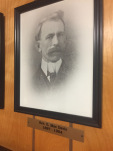
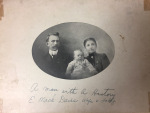
E. Mac Davis a.k.a. Edmund McMillan Davis (June 21, 1869 – August 6, 1905) was the founding pastor of Dillingham Presbyterian Church. The son of Alexander and Emily Jane (McMillan) Davis, he first made a public confession of his faith in the First Presbyterian Church of Knoxville at the age of fifteen. He earned a B. A. and was class valedictorian in 1890 at the University of Tennessee. In 1892 he earned an M.A. from the same school and was an instructor of Latin and English there from 1890-1893. He then studied at Union Theological Seminary* in Richmond, VA and graduated from Princeton Theological Seminary in 1896. Thereafter he returned to the University of Tennessee as an instructor of Hebrew History and Literature (1896-1897). In 1897 Davis began his pastorate at Dillingham Presbyterian Church and remained there until 1904. From there he took a pastorate in McDonough, Georgia (in the Atlanta Presbytery) but died young the next year from “mental and physical exhaustion after a week’s meeting in the hot weather.”
Following the founding of Dillingham Presbyterian Church in 1897, and his marriage to Miss Janie Watkins Carrington of Sunnyside, Virginia in March 1899 (with whom he would have one son and two daughters), Davis next appears in the record making a request for needed items for the people of the community; specifically for used text-books and barrels of children’s clothing, as shipping by barrel was cheaper than box. (Presbyterian Standard, Charlotte, May 18, 1899. Vol XLI, No. 20.) The same source notes that Davis conducted religious services at “Barnardsville, Democrat, Dillingham, Terry’s Fork, Paint Fork, Sugar Creek, Rock View and Carson’s School house.”
Synod minutes note that Davis was the first to reside in the manse of Dillingham Presbyterian Church. They read, “The manse at Barnardsville has been completed, and Brother Davis is occupying it.” (Minutes of the Eighty-Eight Annual Session of the Synod of North Carolina, Held and Charlotte N.C., October, 1901. pg. 422-423)
Like his predecessor R. P Smith, E. Mac Davis noted the conditions in the North Carolina mountains. He wrote, “The majority of the preachers are as unread as the people themselves, unread in history and frequently unread in the Scriptures. The average preacher could not pass an examination for entrance into the sixth grade of a city school. Not one in three owns a Bible dictionary or concordance. They receive the Bible as the ipsissima verba of revelation. An appeal to it is the end of controversy—the end in one sense and the beginning in another.”
Regarding his time while pastor at Dillingham Presbyterian Church, it has been written of him, “Rev. Davis is said to have been directly responsible for the enactment of a law prohibiting the manufacture and sale of whiskey within two miles of any church in Buncombe County. He personally went to Raleigh with the petition and remained until the bill was passed by the legislature. This law, however, only affected government licensed distilleries. There still remained a number of illegal moonshine operations in the coves of more remote sections of Big Ivy.” (Dillingham’s of Big Ivy, Buncombe, and Related Families. Margaret Haile, Gateway Press, 1985)
Likewise, synod minutes note, “Brother Davis has won a great victory in his field by his valiant labors resulting in the passage of a prohibition bills covering all territory in Buncombe, Madison, and Yancey counties, except incorporated towns. We cannot over estimate what this means in the advancement of the cause of Christ in that section.” (Minutes of the Eighty-Eight Annual Session of the Synod of North Carolina, Held and Charlotte N.C., October, 1901. pg. 422-423)
The Asheville-Citizen Times recorded, “REV. E. MAC. DAVIS TO CARRY PETITIONS AND LETTERS TO RALEIGH. Editor The Citizen: The people of Ivy township are thoroughly aroused against the distillery operated and the distillery proposed to be operated between Democrat and Barnardsvllle on Big Ivy creek.” (Asheville Citizen-Times, Monday, February 11, 1901, pg. 3.)
The Charlotte news later recorded, “Until the late Rev. E. Mack Davis began preaching there about 12 years ago, the gospel was seldom heard in that section. Mr. Davis was an honored member of this Synod and did a most effective work. Moonshiners warned him that if he did not cease preaching he would be killed. He did not heed the warning, hut continued to preach. He went at once to Asheville and his life insured for ten thousand dollars, with the provision that if he should be killed the money should be used in erecting ten new church buildings in the part of the state where he was preaching. He was not killed, but his horse was cruelly treated and his hair was clipped so close as to cause the animal to resemble a mule as much as possible. Mr. Davis turned this misfortune of the horse to good account, however, he had photographs of him taken and sold enough of them to build a new church.” (The Charlotte News, Thursday, October 7, 1910, p. 7.)
Finally his deeds were recalled and recorded in the Presbyterian Standard upon his death in 1905: “In a county that had been celebrated for its number of murders, he did not hesitate to threaten the illicit distillers with detection and arrest, and on more than one occasion he led the revenue officers to the stills and helped in breaking up those sources of demoralization. It is probable that his very boldness saved his life, — that and his unfailing humor. When some of his enemies shaved his horse’s tail and mane Mr. Davis rode Jumbo to Asheville, had a photograph taken of the disfigured steed, and sold enough of them to contribute very largely to the building of a new church, upon the completion of which he publicly thanked the perpetrators of the joke.” (The Presbyterian Standard, January 4, 1905 Vol. XLVII -No. 1)
*While at Union Seminary, Davis wrote the following article: “The Distinctive Element in Christian Morality” Union Seminary Magazine, Richmond, VA, Vol. VI, No. 1, September-October, 1894.
[image error]
Filed under: Historical Pastors of Dillingham Presbyterian Church


April 17, 2017
Robert Perry Smith, “The Shepherd of the Hills”
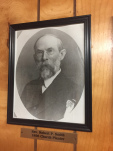
In the library of Dillingham Presbyterian Church there hangs on the wall pictures of each pastor to have called the church home. The first of these has a plaque noting “Rev. Robert P. Smith, 1896 Church Planter.” Though the honor of “Founding Pastor” of Dillingham Presbyterian Church is reserved for the second plaque on the wall – E. Mac Davis – it was Smith, working for the Asheville Presbytery, who likely preached the first sermon at the spot and whose efforts laid the groundwork for the church plant.
Robert Perry Smith (Mar. 24, 1851 – Feb. 4, 1936) was quite an accomplished man. Though orphaned at age 12, he later graduated from Columbia Theological Seminary (in Columbia, SC). He was the principle of Reidville Boys Academy (1874-1875), Reidville Girls Academy (1877-1885), and the 2nd President of Presbyterian College (Clinton, SC) (1885-1888). In 1888 he went to work in the mountains of North Carolina. After first serving as a pastor in Gastonia, NC, he worked for the Presbytery of Asheville as the Superintendent of Home Mission Work for thirty-three years. In that role he planted a number of churches in the region and, in 1904, organized the Mountain Orphanage in Crabtree near Canton, NC. The orphanage, which operated from 1907 to 1922 in Balfour, NC, moved next to its present site in Black Mountain, NC where it continues operating today as the Black Mountain Home for Children, Youth, & Families. Smith’s dedication to the mountain churches and people earned him the nickname “The Shepherd of the Hills.”
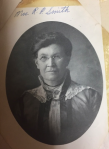
Smith was married to Ella Louise Reid (July 4, 1853 – Jan. 3, 1934), the daughter of Presbyterian minister Rev. Robert H. Reid, of whom Reidville, SC is named. In 1931 he wrote Experiences in Mountain Mission Work published by The Presbyterian Committee of Publication in Richmond, VA. He died in Asheville in 1936 and his body is buried there at Riverside Cemetery. His wife preceded him in death by two years.
Smith’s book Experiences in Mountain Mission Work tells of the interesting and unusual happenings in his travels and work in the isolated mountain regions.
Just getting to the mission field was challenging itself. Smith writes, “Of necessity the roads followed the courses of the streams. Much of the way they occupied the same space. Often the stranger asked: ‘Is the creek in the road, or is the road in the creek?’”
Recalling the all-too-common illiteracy there he wrote, “There was not a book of any kind in the home and not a member of the family could read.” (p. 24) Though “deprived of school privileges and possessing a meager vocabulary,” Smith writes of the people, “they do not hesitate to pass beyond Webster and coin a word when it is needed.” (p.30)
Poverty forced the people of the region to be industrious and insightful. For example, one man told Smith, “Twenty-two years ago I went South on a trading trip and with other things I bought this box of matches and paid fifteen cents for it. We have used only four or five out of it.” (p. 28)
That Smith and the preachers who came to the Western NC mountains were well-needed and wanted is seen in a story of Smith’s of one lady he met who had a church certificate in her trunk lying there for thirty-two years. When asked whey she didn’t just join another church she said: “I kept hoping that a Presbyterian preacher would come some day and I wanted to have a Presbyterian home for him and give him a Presbyterian welcome. I have lived to see my hopes realized, I am glad to see you.” (p. 116)
References:
http://www.presbyteriansofthepast.com/2014/07/03/robert-h-reid/
https://www.presby.edu/about/2013/04/05/pcs-second-president-robert-perry-smith
http://hendersonheritage.com/1419-2/
http://www.main.nc.us/phfc/history.htm
Dillinghams of Big Ivy, Buncombe County, N.C. and related families. Margaret Wallis Haile, Gateway press 1985.
Experiences in Mountain Mission Work, Robert Perry Smith, The Presbyterian Committee of Publication, Richmond, VA, 1931.
[image error]
Filed under: Historical Pastors of Dillingham Presbyterian Church


Douglas J. Douma's Blog

- Douglas J. Douma's profile
- 7 followers

