Shep Hyken's Blog, page 229
April 21, 2014
5 Top Customer Service Articles For the Week of April 21, 2014
Each week I read a number of customer service articles from various online resources. Here are my top five picks from last week. I have added my comment about each article and would like to hear what you think too.
Everything I Need to Know About Customer Service, I Learned at Nordstrom by Marie Rosecrans
(Desk.com) That first job at Nordies helped me understand what it meant to deliver great customer service, and a few key things have really stayed with me throughout my 20+ year career (yes, it’s been that long!).
My Comment: Three words that belong together: customer + service + Nordstrom. This very short article is another great story and demonstrates that not only does Nordstrom have a great system in place, they also have a great culture.
5 Things Customers Hate about Customer Support (And How to Address Them) by Adel Zsurzsan
(Merlin) We listed 5 things customers hate about customer support, so that we know what we can do to lessen these pain points in our daily operations.
My Comment: It doesn’t matter if you are a small company without a true customer support department or a large company with a large call center, at some point a customer is going to call for help or support. When they do, is it an opportunity to show how good you are? Or, a disappointment and confidence-buster for the customer? I know what I want: No or short wait times, knowledgeable reps that help me on the first call, someone that treats me like me and not a number and someone that focuses on reasonable solutions and not policies.
The Five Agreements of Customer Experience by Annette Franz
(CX Journey) Have you thought about how the Five Agreements relate to customer experience management?
My Comment: Love this article! These “agreements” work for customers, employees – and in life. They are about a positive way to think and the right way to treat people. They create personal confidence and customer confidence. If you ever thought about creating a set of core values for a company, this would be a great place to start.
Capitalizing on Customer Lifetime Value By Anna Papachristos
(1to1 Media) While brands recognize the importance of customer lifetime value, many fail to calculate its true impact, for most are still unable to offer the type of holistic customer experience that builds loyalty and retention from the first interaction onward.
My Comment: Every employee should understand the customer lifetime value. It makes it easier to make customer focused decisions. Years ago Stu Leonard used to say the average grocery story customer was worth about $5,000 a year. So, when the customer complains that the carton of milk was spoiled, don’t hesitate to give him/her another three dollar carton of milk.
Why We Do All Hands Support at Olark by Ben Congleton
(Olark) Our hope for All Hands Support Month is to provide templates that other companies can use to create their own take on All Hands Support.
My Comment: The idea of letting non-front-liners experience what it is like to be on the front line is a great idea. Olark is a case study on the benefits of such a program. Everyone should experience what it is like to be in customer support.
Shep Hyken is a customer service expert, professional speaker and New York Times bestselling business author. For information contact (314)692-2200 or www.hyken.com. For information on The Customer Focus™ customer service training programs go to http://www.thecustomerfocus.com. Follow on Twitter: @Hyken
(Copyright ©MMXIV, Shep Hyken)
The post 5 Top Customer Service Articles For the Week of April 21, 2014 appeared first on Shep Hyken.


April 18, 2014
Guest Blog: 4 Simple Tips to Making Your Real-Time Customer Support a Success
This week on our Friends on Friday guest blog post, my colleague Nic Bryson discusses why his company started using real-time customer support and its benefits. I believe the speed with which we respond to our customers is critical. – Shep Hyken
In today’s “always-on” and connected world, where customers can interact from anywhere around the globe 24/7, the decision to introduce real-time customer support in our company came quite naturally. It helped us increase customers’ satisfaction, earn trust and reputation, and of course, extend our customer network (nothing motivates a user to share his positive experience more than an immediate and thorough resolution of his problem  ) However, its successful implementation was not an easy task to perform, and here’s a few lessons we’ve learned along the road:
1. Define your communication channels
Depending on your product and customer base, you may choose live chat or phone for real-time support In my experience, the first is more suitable for the cases where you need to provide a customer with screenshots and step-by-step instructions. And the latter works better for less technical customers as they seem to be more interested in talking the problem through over the phone. No matter what you choose, make sure you have enough resources to stay true to your real-time promise.
2. Prepare a FAQ
Most of the questions that come to our support team repeat themselves. So having a FAQ page helps a great deal. In the case of real-time support, there’s no time to go through the whole list of questions every time, so make sure your team is well acquainted with the constantly updated guide (assuming you keep it updated – which you better do!)
3. Don’t leave them hanging
Unlike regular support, real-time requires instant reaction to the customer’s request. Remember that you are there to establish trust, and if it takes you longer than a few seconds to respond, the customer is probably wondering if you forgot about them. If we are talking about social media channels then it’s important to remember the results of a recent study from The Social Habit. According to the study, among the customers who contacted a company through social media 42% expect a response within 60 minutes or less. Show respect for your customers’ time and respond fast.
4. Leverage the power of Social Media
A recent survey by customer experience advisory thinkJar showed that 60% of businesses in the US and the UK use social media for customer service. Oddly enough, another survey found that almost 60% of these companies don’t respond to customers on social media when asked a direct question. I find this statistic alarming.
We have many customers who ask support questions via Twitter. If it’s a small question or issue we try to resolve it right there. If the answer doesn’t fit in 140 characters, we revert to e-mail or even phone, depending on the customer’s preferences.
Using social media tools for support reasons has several advantages. First of all, it’s transparent: if there’s an issue, we can openly admit it and instantly let all of our customers know once it is fixed. Second, it’s a great addition to our FAQ: users can simply browse through our recent messages and maybe even find the answer to their question. And, finally, and most importantly, it brings us closer to our customers. You know how they say, be where your customer is.
When you have great real-time support, customers will talk to you more often because they have confidence that they’re going to get great service. When customers are contacting you proactively, customer success is a natural byproduct.
Do you think real-time support is already a business necessity or an unnecessary luxury? I’ll be happy to see your thoughts in the comments.
Nic Bryson is the Vice President of Customer Success at Wrike, provider of the popular task management software. Passionately leading a global customer care team, Nic drives forward Wrike’s open innovation strategy through a constant dialogue and productive co-innovation with its customers from 50+ countries.
For more articles from Shep Hyken and his guest contributors go to customerserviceblog.com
The post Guest Blog: 4 Simple Tips to Making Your Real-Time Customer Support a Success appeared first on Shep Hyken.
April 16, 2014
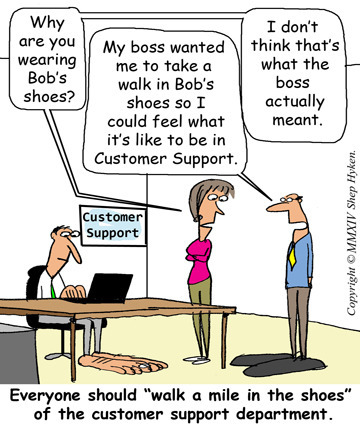
An Opportunity to Walk in the Customer Support Center’s Shoes
 The Customer Experience
No doubt that customer service is a great differentiator. This is especially true in a world where a customer, depending on what they need, has many choices of businesses to choose from, all selling similar, if not exactly the same, products and services.
Okay, that’s most likely nothing new to you. And if you’ve been following my work, you know that I’m a fan of every employee being a part of customer service, not just the customer service department or others on the front line. Some companies take this to a higher level than others.
Here’s an interesting story to make the point. Olark is, today, a live chat software company. Olark was founded in 2009. The very first project started by the founders, in 1998, was a web hosting company. This evolved into what Olark is today. The founders immediately recognized that delivering great service would differentiate them from their competition. The four guys that started the company realized that one person couldn’t handle all of the customer service calls, so they decided to share the responsibility evenly between them. As the company became more successful and added employees, they continued to split the customer service function between all employees. They actually named this practice All Hands Support. Customer service was part of their culture.
This idea is brilliant, as everyone employed at Olark learns just how important customer service is at many levels. They learn about customers, they hear about all of the different issues and problems, and they have an opportunity to see how their responsibilities can impact the customer experience.
Years ago I wrote about Anheuser-Busch executives would take one day out of each quarter to spend with a sales rep in the field. This gave them a better understanding of their customers. Undercover Boss, the popular TV show, demonstrates just how important it is for higher level executives to experience what happens in the field and on the front line. In many cases, the boss finds it to be an eye opening experience.
But, that’s just for the leadership of the company. What about the rest of the organization? Why can’t everyone, like the employees do at Olark, experience what it’s like on the front line, dealing directly with customers? What kind of reaction do you think your employees would have when they discover, first-hand, the reactions of your customers to your products and customer service?
Imagine the guy who boxes up the product on the phone with a customer who received a product that was missing parts. Or someone from the accounts receivable department on the phone with a customer who has been overcharged. If even for just a few hours every few months, consider giving all employees an opportunity to walk in the customer support centers shoes. It could only help everyone understand just how important their roles and responsibilities are to the customer experience.
Shep Hyken is a customer service expert, professional speaker and New York Times bestselling business author. For information contact (314)692-2200 or www.hyken.com. For information on The Customer Focus™ customer service training programs go to http://www.thecustomerfocus.com. Follow on Twitter: @Hyken
(Copyright ©MMXIV, Shep Hyken)
The post An Opportunity to Walk in the Customer Support Center’s Shoes appeared first on Shep Hyken.
April 14, 2014
5 Top Customer Service Articles For the Week of April 14, 2014
Each week I read a number of customer service articles from various online resources. Here are my top five picks from last week. I have added my comment about each article and would like to hear what you think too.
Three Steps to Achieve Consistency of Customer Satisfaction by Hansen Lieu
(SAP) As the authors admitted, delivering a consistently good customer experience – over time – is very difficult. It requires discipline and a laser focus on customers. But, if your organization can do this, it gives you a strong competitive advantage that is difficult to replicate.
My Comment: This, unfortunately, is a story that is told too often. The quality of the customer service diminishes with small negative interactions. The key is consistency. Consistency, assuming the experience is consistently good, creates confidence. Confidence leads to potential customer loyalty. Without confidence there can be no loyalty.
Maggie Lang, Kimpton Hotels: Creating Great Experiences Online and Off by Brent Leary
(Small Business Trends) Maggie Lang, Senior Director of Guest Marketing for Kimpton Hotels & Restaurants, shared with me how the boutique hotel chain is taking a strategic, unified approach to customer experience development to take on the big hotel chains in the battle for the modern day traveler.
My Comment: Great interview that reinforces how important social media is to the customer service and experience strategy of a business. And, it just so happens that Kimpton, one of my favorite hotel chains, is the case study. Social media is much more than another channel for us to monitor for customer complaints. For Kimpton, because of social media, the experience can begin before check-in, or continue long after check-out. There is no reason that other companies in virtually any industry can’t do the same.
Why Great Customer Service Isn’t Enough to Be Customer-Centric by Xand Griffin
(PeopleMetrics) What I discovered was that while lots of people talk a whole lot about customer-centricity, most don’t understand what it means.
My Comment: Customer service is just a part of a customer-centric organization. As mentioned in this article, if a business were truly customer-centric, putting the customer in the middle of every decision, there might not be a need for a customer service department to field any issues, complaints or problems. Sounds like perfection, which is not reality. However, what if the customer-centric company were to deliver the perfect experience? What would that look like? What would or could a company do differently? This article is a great conversation starter.
Richard Branson on Why Making Employees Happy Pays Off by Richard Branson
(Entrepreneur) Happy employees are central to the success of a business. We all instinctively know this, but it can be hard to pinpoint why. Nobody would argue that employees should be sad and downtrodden, yet it seems as though some businesses and their managers set out with the intention of presiding over a group of miserable people, and then succeed in doing just that.
My Comment: The “always amazing” Sir Richard Branson should be listened to when he speaks – or writes! The numbers from the studies regarding happy and engaged employees confirm the higher productivity. So does the success and stock prices of many of these companies. Sir Richard gets it. This reminds me of what Herb Kelleher, another maverick in the commercial aviation industry, said when asked the question, who is more important – employees, passengers or shareholders? His response was that happy employees meant they were more likely to work harder to make the passengers happy, which meant the passengers would fly again on his airline. That in turn would make the airline more successful, which made the shareholders happy.
6 Tips for the Best Online Customer Support by Anneke Steenkamp
(Zopim) By adjusting the way in which your online customer support system is run, you can impact the overall success of your business.
My Comment: Online support is gaining in acceptance. Customers are realizing that it is sometimes easier and more efficient than even a phone call. The key, as the article points out is consistency in all of the channels that the customer uses to communicate with the company. The online experience must be as good as an in-person experience. As the author points out, these tips are a good start and should make anyone who provides online support something to think about.
Shep Hyken is a customer service expert, professional speaker and New York Times bestselling business author. For information contact (314)692-2200 or www.hyken.com. For information on The Customer Focus™ customer service training programs go to http://www.thecustomerfocus.com. Follow on Twitter: @Hyken
(Copyright ©MMXIV, Shep Hyken)
The post 5 Top Customer Service Articles For the Week of April 14, 2014 appeared first on Shep Hyken.
April 11, 2014
Guest Blog: Why Employee Happiness Is The Key To Brand Success
This week on our Friends on Friday guest blog post, my colleague Adele Halsall writes about how important it is to support your employees in order to achieve brand success. I have always believed that you must treat your internal customers the way you want them to treat your external customers. – Shep Hyken
In almost every case of failed business performance or poor customer service practices, there is usually a large element of employee dissatisfaction or disengagement. Without employment engagement there can never be any real team solidarity, and without team solidarity your brand can never begin to establish itself or start to flourish.
This is why employee happiness is so important in achieving brand success. Your employees are your greatest assets, so aside from making sure you hire the right minds to start off with, you need to make your team is happy, healthy and well.
Happy employees provide a strong support structure from inside the company and they make much better brand ambassadors.
So how do you go about doing that?
1. Empowerment Is A Great Tool
Empowerment is one of the greatest gifts you can give to your employees. It is often empowered employees who are able to take matters into their own hands and create those ‘wow’ moments that keep customers coming back. By empowering your employees to make responsible decisions on their own and take control of a situation, they’ll be in a better position to help customers without being limited to the ‘red tape’ that comes with traditional policies and procedures.
It’s never too late to empower your workforce. Introducing weekly training sessions in your workplace can slowly encourage your staff to start thinking more proactively and confidently, without being told what to do. Exercises that boost self image and self belief will also play a huge part, as the more positive your employees feel about themselves and their own capabilities, the better they will be able to reflect and communicate this to customers.
Try to favour training programs that approach sessions as social forums rather than formal ‘classes’ or seminars. This will offer a more dynamic and interactive learning process and provide longer term results.
2. Team Bonding Is Essential
Your team members don’t all have to be best friends (and that’s highly unlikely anyway). But promoting a kind, friendly work environment where your workers can feel supported, comfortable and accepted is the best foundation for stimulating creativity and productivity.
One of the first things you ought to do is eliminate gossip from the workplace, and make it known that any similar behaviour will not be tolerated. Gossip does nothing for workplace wellbeing; instead it simply isolates, fragments and detracts from growth and progression; whether that is individually or on a project scale.
Provide plenty of opportunities for your employees to get to know one another outside of work – this could be monthly or weekly lunches, after-work drinks, or even a weekend event. Whilst team-building seminars with plenty of activities can bring positive results, employees are more likely to respond to day trips that have teamwork embedded within them, such as paintballing or rock climbing.
3. Individual Success = Brand Success
Employees that feel a personal alignment with the company brand and demonstrate shared values are already likely to perform their job much more effectively.
But what about your employees’ own individual goals; aspirations; dreams; hopes, or plans for the future? If you’ve noticed a decline in your employees’ motivation or passion for the role, it may be because they’re feeling undervalued.
Brand flourishing isn’t always all about the collective. UK based company Npower’s customer services department is often said to have one of the best customer service departments within the energy industry, this is probably in no small part because they make a genuine effort to empower their employees and help them to progress in their career. By nurturing individual ambitions and personal projects, you’ll be fostering a positive environment of growth and flourishing, which will only serve to strengthen your brand’s mission overall. Try having a heart-to-heart with your employees individually to see what you can do to support their own talents and projects. Where do they hope to be in one to two years time? How about three to five years? Five to ten?
By making the traditional work dynamic more collaborative and two-way (rather than static and one-dimensional), your employees will feel more appreciated, valued and stimulated. They’ll be more likely to feel excited about coming to work and more likely to immerse themselves in working towards the goals and projects of the brand. And when a whole team is excited and passionate about what it is doing, magic things can happen.
[image error]Adele Halsall is a writer and researcher for Customer Service Guru. She is passionate about retail and consumer trends, and how this is shaped and governed by advertising and social marketing. She is particularly experienced in marketing and customer engagement, and enjoys contributing to ongoing debates related to best business practices, start-up culture, and the culture of customer relations. Email her at adele@customerserviceguru.co.uk or @gurucustomers
For more articles from Shep Hyken and his guest contributors go to customerserviceblog.com
The post Guest Blog: Why Employee Happiness Is The Key To Brand Success appeared first on Shep Hyken.
April 9, 2014
The Chief Customer Officer Customer Service and Experience Is Now Part of the C-Suite
 It is a C level title that is becoming more and more popular. The Chief Customer Officer now has an important seat at the boardroom table. The CCO’s job? To ensure that everything the company does on the front line that impacts the customer, and the processes behind the scenes that support the front line customer experience, is focused on the customer. This includes the obvious areas of customer service and customer experience, as well as a few not-so-obvious areas.
So who reports to the CCO? Or, who does the CCO report to? That is an interesting question because depending on the company that has decided to appoint the CCO, there are varied responsibilities. Here’s my take. And, it really isn’t that tough of an answer.
In my mind, there three important areas for the CCO to focus on: culture, systems and customer advocacy.
When it comes to the culture, either the company is completely customer focused or it’s not. That begins with culture. It’s how employees are hired and trained, and how the vision or mission is created or changed to reflect a customer-focused philosophy. Customer service and experience must be woven through the fabric of the entire company.
And then there are the systems that the company has in place. The CCO’s job is to help ensure that the systems are customer focused and that everyone – and every department – is working together. Silos must be eliminated, with the goal of creating a unified company that is focused on the customer. The CCO must constantly be asking questions that challenge the company’s systems and processes to be customer-focused. In its simplest form the question is:
Is this a customer-focused decision?
There are many variations of this basic question. The idea is to challenge every aspect of the company to keep the customer in mind. Policies, new products, new accounting programs, new software programs; these are just a few of the areas that should come before the CCO to consider if they meet the requirement of being customer-focused.
The third responsibility is customer advocacy. CCO is the manager of the “Voice of the Customer,” which includes direct customer feedback and data analysis. The CCO must understand both the business and the customer well enough to know what data is important and how to interpret the data.
The Chief Customer Officer has his or her hand in all aspects of the company, if nothing else than to ask the right questions and keep the company focused. And, at the same time he or she is the advocate for the customer. There must be a balance between how a company operates and what a customer expects. An effective CCO creates a sense of harmony between the company and the customer.
Shep Hyken is a customer service expert, professional speaker and New York Times bestselling business author. For information contact (314)692-2200 or www.hyken.com. For information on The Customer Focus™ customer service training programs go to http://www.thecustomerfocus.com. Follow on Twitter: @Hyken
(Copyright ©MMXIV, Shep Hyken)
The post The Chief Customer Officer Customer Service and Experience Is Now Part of the C-Suite appeared first on Shep Hyken.
April 7, 2014
5 Top Customer Service Articles For the Week of April 7, 2014
Each week I read a number of customer service articles from various online resources. Here are my top five picks from last week. I have added my comment about each article and would like to hear what you think too.
Nordstrom Marketing Strategy … What is Their Difference Maker? By Mike Schoultz
(Digital Spark Marketing) Today we will examine 10 different ways the Nordstrom brand has chosen to use their customer experience to stand out above the noise and become a significant contributor to their marketing strategy.
My Comment: Everyone knows that Nordstrom is a legend in the world of customer service. This is a peek behind the curtain as to how they do it. Most, if not all of these ten points, are common sense. Sometimes common sense makes the most sense.
Nine Tips For Offering Exceptional Customer Service On Social Media by Tracy Foster
(Forbes) Here are nine tips for offering exceptional customer service via social media.
My Comment: Social media customer service is growing in popularity. However, as pointed out in the article, it is more than just reacting to problems that people Tweet or post on Facebook. Social media allows a company’s customer service to be reactive and proactive. Tips number 5, 6 and 8 make that point. And, 9 is the icing on the cake. Using social media to become a resource for things other than what you sell shows the customer that you want to deliver value.
13 Tough Questions to Skyrocket Customer Experience Improvement by Anne Reuss
(360Connext) The truth can be hard to face but enlightened leaders recognize their customers as emotional beings. They put more value on the experience and relationship than the product itself, and they will leave faster than you can finish your coffee if they’re not happy.
My Comment: I would hope that most companies want to know the answers to these questions. And, some may be a little scared about the answers they get. Feedback is a gift. Positive answers to these questions may make you feel great. But the real “gift” is that a negative answer may be an opportunity to improve. By the way, the same type of questions can be used to get great employee feedback.
Who’s Sorry Now by Dan Lewis
(Now I Know) When it comes to apologies and explanations, Southwest has a guy for that. His name is Fred Taylor, and he’s sorry your flight didn’t work out as planned. Even if you weren’t going to make a stink about it.
My Comment: Southwest Airlines is recognized as a leader in their industry on two fronts, profitability and customer service. I’m always impressed with the number of stories and lessons we can learn from them. One of the most important tactics for any business is to be proactive with a customer’s problem. This article is a case study in how an amazing company does just that.
10 Tactics for Increasing Your Customer Value and Loyalty by Mike Bal
(Entrepreneur) Brand loyalty is one of the most difficult assets for a business to attain. Or, at least it was. We used to have to rely on customers having a great experience with our product/service, or with our employees. Now, we can give them a great experience, but most businesses still haven’t figured out how to do it.
My Comment: These are ten powerful tips to building a strong relationship and creating customer loyalty. It’s not just what you do for the customer. It’s how you create a connection with the customer. Great information that any organization should consider implementing immediately (if they aren’t already doing so).
Shep Hyken is a customer service expert, professional speaker and New York Times bestselling business author. For information contact (314)692-2200 or www.hyken.com. For information on The Customer Focus™ customer service training programs go to http://www.thecustomerfocus.com. Follow on Twitter: @Hyken
(Copyright ©MMXIV, Shep Hyken)
The post 5 Top Customer Service Articles For the Week of April 7, 2014 appeared first on Shep Hyken.
April 4, 2014
Guest Blog: The Power of Surprise
This week on our Friends on Friday guest blog post, my colleague Paul Reilly writes about how important it is to say yes to our customers for an Amazing service experience. –Shep Hyken
“First time I’ve ever lost a game that way. First time I’ve ever seen a game lost that way.” -NICK SABAN
Saban is referring to his surprise loss to Auburn in the 2013 Iron Bowl. With one second left, Alabama attempted a 50+ yard field goal. The ball soared through the air, on target, but it didn’t have the distance. The ball fell eight yards short into the arms of Chris Davis, an Auburn receiver. Davis ran it back for a touchdown to win the game. The Auburn nation was in a euphoric state while Alabama was devastated. Although the game was just another win and loss, there was one element that made this game larger-than-life, surprise. Surprise can have the same effect in customer service.
Surprise has the ability to make every service experience that much better, or make everything worse. In fact, a recent Harvard Business Review article mentions that surprise can amplify whatever emotion you are experiencing. The article also argues that surprise is one of our most powerful marketing tools. Surprise can make or break your customer experience.
However, surprise is becoming more and more difficult. Companies benchmark themselves against their competitors. Companies are too quick to say “me too” instead of “Surprise! We’re different.” Companies are changing to become the same, rather than changing to surprise their customers.
Given, the ubiquitous nature of products and services, it shouldn’t surprise you that only 7% of customers are delighted. In a recent customer service survey sponsored by American Express, customer experiences are average or below average 93% of the time.
To surprise customers, we must look for opportunities. Customers will give us hints, but we need to recognize these hints as opportunities. If the customer shows the slightest hint of dissatisfaction, it is an opportunity. The slightest hint of satisfaction is also an opportunity to heighten the experience.
To surprise customers, we must also find a way to say yes. When a customer needs our help, we say yes. When a customer needs more information, we say yes. When a customer asks “can you do this,” we say yes. There are several ways we can say yes. For example, if you don’t know the answer, find out who does. If the customer problem is unique, research a solution. If they need to vent, then listen. I recently met a business owner who understands the importance of saying “yes” to customers. Surprisingly, the name of his company is Yes Cleaners.
The next time you are presented with an opportunity to surprise a customer, say yes. They will remember the experience. Think of the last time you received surprise service.
Paul Reilly began his sales career at the age of 16 in St. Louis, MO. He has sold car washes, painting services, jewelry, propane, construction tools and fasteners, and medical equipment. He sold while attending the University of Missouri-Columbia, where he earned his undergraduate degree in Business Marketing. Paul also sold while earning his MBA from Webster University. He has been a top-performer in his extensive sales career because he embraces the 101 philosophy “Sell customers what they need, and give them the service they want.”
For more articles from Shep Hyken and his guest contributors go to customerserviceblog.com
The post Guest Blog: The Power of Surprise appeared first on Shep Hyken.
April 2, 2014
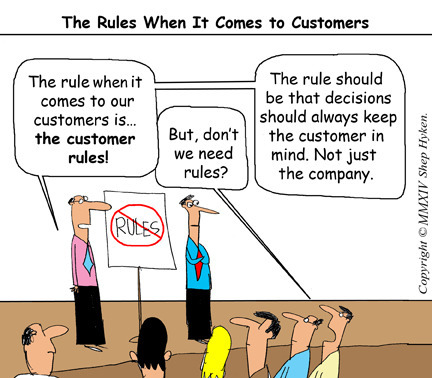
Customer Service May Rule, But Rules in Customer Service Don’t
Empower Employees
It was just two weeks ago that I was on a family vacation and I’m still thinking about what a resort employee said as she denied what I thought was an extremely simple request:
I’m sorry, it’s our rule.
It was early in the morning and six of us wanted to sit on the patio outside of the restaurant for breakfast. All of the tables were set up for four people. Just the day before we were inside the restaurant, employees were happy to push two tables together allowing us all to dine together. Apparently, there are different “rules” for the outside patio. And by the way, the restaurant wasn’t crowded and there were plenty of open tables.
I asked the hostess if we could push the two tables together, and her response was, “I’m sorry we aren’t allowed to do that.”
“Why not,” I asked.
She embarrassingly put her head down and said, “I’m sorry, it’s our rule.”
You can only imagine what I was thinking at that point. I asked if she would go ask the manger if they could make an exception for us. A few minutes later she came back and said, “The manager will make an exception for you.”
The next day we were back. We asked to put the two tables together again. This time the hostess didn’t turn us down. She simply told us she would be right back. And, just a couple of minutes later she returned and said, “The manager said it would be okay.”
There are several lessons that couldn’t be clearer:
First, rules should be made about taking care of customers, not about the convenience of the business – as if pushing two tables together would be all that inconvenient.
Second, an employee shouldn’t have to go to the manager to ask permission for such a simple request.
Third, since the employee did ask the manager for permission and the manager approved, why did she have to go ask for the same thing the next day?
When it comes to customer service decisions, I can’t stand the word rules. You can throw the word policy in there too. A better word might be guidelines. Or, if you insist on using the words rules and policies, then at least get employees to, rather than hide behind them, understand the spirit of the meaning behind them.
Once that is in place, empower employees to make decisions to support the customer. They shouldn’t have to ask permission to do something that seems like common sense. And, after they have been given permission the first time, they shouldn’t have to ask a second time.
Shep Hyken is a customer service expert, professional speaker and New York Times bestselling business author. For information contact (314)692-2200 or www.hyken.com. For information on The Customer Focus™ customer service training programs go to http://www.thecustomerfocus.com. Follow on Twitter: @Hyken
(Copyright ©MMXIV, Shep Hyken)
The post Customer Service May Rule, But Rules in Customer Service Don’t appeared first on Shep Hyken.
March 31, 2014
5 Top Customer Service Articles For the Week of March 31, 2014
Each week I read a number of customer service articles from various online resources. Here are my top five picks from last week. I have added my comment about each article and would like to hear what you think too.
Sharing Compelling Stories on Social Media is Boosting Bookings, Driving Loyalty by DJ Vallauri
(Hotel News Resource) Knowing your audience based on the social media platform they frequent is key to online marketing success and hotel guest loyalty.
My Comment: While this article focuses on the hotel industry, the ideas are good for any type of business. Customer service is the “new marketing.” Social media channels are able to provide any company (not just hotels) great opportunities to connect with the customer. Too many companies simply monitor the social channels to hear about complaints. While that’s not a bad start, there is so much more, as this article points out.
What Not to Say: Words that Cost You Customers by Noreen Seebacher
(CMSWire) But nothing is more maddening — or more contrary to the whole philosophy of CXM — than scripted responses that lack even trace amounts of empathy, understanding or compassion. As customer experience researcher, innovator and entrepreneur John A. Goodman so clearly articulates, some things are better left unsaid.
My Comment: No doubt that companies train their employees to say the wrong things to the customer. In the right situation these phrases are perfect. But in the wrong situation they are loyalty killers and worse, may fuel anger and resentment toward the employee. The ideas in this article can help us show employees how important it is to be flexible and think before we speak.
5 Easy Ways to Improve Customer Experience by Brian Morris
(Digital Marketing Ramblings) In order for you to improve customer experience, you have to think in terms apart from product and pricing; rather, you have to consider how you can make buying from you fun and enjoyable for your customers. At the same time you want to make sure you’re not going to lose revenue by making customers happier.
My Comment: Agree that these are five easy ways to improve a customer experience. Simple and common sense. And, they are also five easy ways to help improve customer loyalty. Love the idea of posting a picture on social media – if appropriate. It helps create an emotional connection between the company and the customer.
Is Your Customer Experience a Loop or a Line? by Bizness Apps
(Bizness Apps) By examining each step of the customer experience, you can put yourself into the customer’s shoes and better understand not just one moment in your relationship, but all moments.
My Comment: The big take away for me in this article is the clarity of the concept of a
loop versus a line. The loop is about the customer coming back. The
concept of the line is that the customer’s experience is one way – just a
simple transaction. Customers go through various phases as they
interact with the company that determine if they will come back again, which makes me ask: What do we do to make sure we have a loop versus a line?
CEM Toolbox: Employee Experience by Annette Franz
(CXJourney) Employee experience is a tool, you ask? Yes! Employees are actually your most important tool! Remember that the employee experience drives the customer experience; if your employees aren’t engaged, it will be very difficult for them to delight your customers; in very simple terms, this describes “the spillover effect.” Here’s some evidence – as if you needed more!
My Comment: Much of what is listed in this excellent article is also great for general customer service. The point is, if we work to attract and retain great employees, with many of the same tactics and “tools” we use to attract and retain customers, we will create an environment of loyal employees that are focused on taking care of our customers. And, I love the idea of plotting the employee life cycle – like a customer journey map.
Shep Hyken is a customer service expert, professional speaker and New York Times bestselling business author. For information contact (314)692-2200 or www.hyken.com. For information on The Customer Focus™ customer service training programs go to http://www.thecustomerfocus.com. Follow on Twitter: @Hyken
(Copyright ©MMXIV, Shep Hyken)
The post 5 Top Customer Service Articles For the Week of March 31, 2014 appeared first on Shep Hyken.