Andrew L. Wilson's Blog, page 2
October 11, 2016
Proud Author holds First Book in Hands!
For you fans out there, advanced copies of the book have arrived!
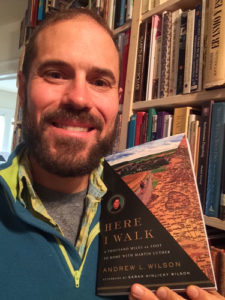 The first copy of Here I Walk, freshly arrived from the publisher


October 10, 2016
Advanced copies have arrived!
To all you fans, I have a bit of good news. My publisher has just written to say that the printed book has just arrived at their offices! After many years of effort, I will be a pleasure to finally hold the object in my hands.
I should have a copy by tomorrow; you all must wait a month until the official release. Look for Here I Walk at future conferences, and at a store near you. My publisher says that Barnes and Noble should be stocking it! Stay tuned for updates very soon.
October 5, 2016
Stay Tuned
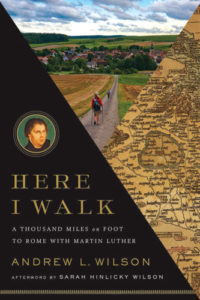
The long awaited book is coming out soon. You can see the publicity at my publisher’s website. Stay tuned for more things soon to come:
Here I Walk
[image error]
March 25, 2014
Follow the Money
We’ve been quiet for a very long time, but things are afoot. I’ve been busy writing various things, but chief of all I’ve now engaged with Brazos to write a book about our pilgrimage. We’ll keep you posted! As an appetiser, here’s some of my recent work. This review of Peter Brown, The Eye of the Needle (Princeton University Press, 2012) first appeared in the January/February 2014 issue of Books and Culture.
When you are dead, asked Salvian from his pulpit above Marseilles’s teeming harbour, to whom will you leave your earthly possessions? It was not an idle question. Those were dire days for the Empire—around ad 430—and ripe for such otherworldly solutions. Barbarian hordes haunted the uneasy sleep of Salvian’s flock. Someplace sure and incorruptible was needed for their treasures: place them in heaven, urged their monk-bishop. Write Christ directly into your will. There was only one hitch: Roman law did not recognize Christ as a legal beneficiary.
Money mysteries such as this one dominate the era, which is precisely why Peter Brown, whose long and laureled career has homed in on such dissonance with nothing short of prodigious insight, focuses on the subject in his latest (and perhaps greatest) work, Through the Eye of the Needle. The allusion, of course, is to the disappointing story of the rich young ruler, who sulked away after Jesus asked him to give away his wealth to gain heaven. He became the foil par excellence for an era of heroic renunciation, where a very few of “the richest private landowners of all time” gave it all up for Jesus. But alongside such giants as Paulinus of Nola stand countless small-scale donors whose plunking solidi and plinking sesterci raised churches, monuments, shrines, and monasteries throughout the Roman world.
Many others such as the retired general Sevso, whose unearthed silver platter—19 pounds worth!—sports a token Christogram, seemed otherwise to live in “an imaginative universe in which Christianity was almost totally absent.” The fact that most Christians never fully unburdened their camels has tended to fertilize a jejune morality tale, where a kind of institutionalised hypocrisy and otherworldly doublespeak gutted the virile civic life of Rome to fill church treasuries. That’s the tale spread by Edward Gibbon’s 18th-century masterpiece, The Decline and Fall of the Roman Empire, which looms over the era over the like some great triumphal arch, through which all must past to visit this undiscovered country. Long discredited by scholarship, the rhetorical power of Gibbon’s lament continues a covert life among Christianity’s historical apologists, and now more than ever in our own ceaseless chatter about the so-called perils of the Constantinian church. In Brown’s treatment, refreshingly, that tiny needle’s eye opens instead upon a vast and poorly understood land- scape, where even our best evidence is but “a frail bridge to the past.” But it is a landscape put into relief by riches. Brown uses “the theme of wealth itself as a doctor uses a stethoscope,” for it “enables us to enter into the very heart of Roman society.”
While popular opinion about the era, Christians’ included, still fixates on a cerebral clash of civilizations, researchers have quietly made giant steps in uncovering—quite literally—the vast middle ground where most Christians actually lived. Inscriptions, buried mosaics, and sarcophagi give us a glimpse into the otherwise silent world of the unlettered. It’s not a detour from the real story but a necessary plunge into the dirt: for “we do not meet the average Christian in the pages of books or in the texts of the sermons of Christian bishops. We meet such persons, rather, on their tombstones.” Brown gives us a distantly familiar story with an entirely new cast: the Harvester of Mactar; Donatist bishop Optatus; Clamosus the schoolteacher. These souls, silenced but for a chunk of chiseled rock or the salvaged corner of a floor mosaic, speak out for vast swaths of the unremembered from Timgad to Trier—their quest for honors, their mundane tragedies, but mostly their place in the church, which along with the synagogues of the epoch “provided a space where the moderately rich could shine” through small and durable gifts. “It is late Roman society with a gentler face.”
If the siroccos of Tunisia have taken the flinty edge off a certain Geistesgeschichte, Brown’s subtle touch does not glory in the rubble but uses it to build up lost dimensions to certain set pieces, long buried in deep ideological ruts. The spat between Ambrose and Symmachus over the Altar of Victory—that dernier cri of a moribund paganism—gets interesting when we learn that the bishop of Milan came from new money. Wealth leavens the historical lump. Among Rome’s élite, who in 384 remained resolutely pagan, the vestal virgins guaranteed the harvest upon which the Empire rose and fell. What the Prefect of Rome called “a mean-minded budget cut,” Ambrose skillfully recast as a monumental waste of resources—which should have gone to the “poor.” He “secularized” the discourse by “subtly… turn- ing what many thinking persons considered a religious crisis into a crisis of social relations.”
The well-trod Pelagian controversy, turbid from centuries of philosophical churnings, is recast by Brown in terms that practically all of us can under- stand. We forget that the precipitating event was the sack of Rome, which sent the rich flying to African shores, theo- logical tutors in tow. The star financial moralists of the 4th century, Jerome and Pelagius, played guru to these extremely wealthy ladies, peddling an ascetic extremism mined from their dabblings amongst the monks of mysterious “East” but tem- pered for the comforts of villa life. Their conscience-panged pupils gazed benevo- lently toward distant horizons full of do-gooding potential. These super-rich, with their old and timeless money, were used to spreading it as they pleased. And if their high-minded life-coaches assured them that God demanded every last solidus for their salvation, well, why shouldn’t they slough off wealth with aristocratic ease?
So when some mediocre African bishop started pushing back at the likes of Melania the Younger (one of those richest landowners of all time), insisting that getting rid of sin was not so easy, and that wealth had its good uses—alms for the poor, for example—it was every bit as much a class conflict as it was about the human capacity to will the good. Our own self-help literature, inane as much of it is, is geared to the same sort of audience as Pelagius addressed, who had gazed upon the world from a distance and could envi- sion the higher ground of moral simplicity. The notion of insurmountable sin is anathema to this imagined option of personal social mobility.
Augustine, who had made his way within sight of the very top of Roman soci- ety on the shoulders of just such a crowd, knew precisely whence they came. But his years as a pastor and patron to a thick slice of Roman Africa had pushed him to adopt a starker “doctrine for the long haul.” Practically alone among the West- ern fathers, the bishop of Hippo earned his living from church offerings. He was well aware that wealth and its compro- mises made for dirty business, even more so in an empire whose financial motors ran quite explicitly on state-sponsored extortion, delegated at spear point to tens of thousands of local curiales, little Zacchaeuses all. Spectacular renunciation was for spectacular people. Regular sin (for who could avoid it?), on the other hand, required regular amends. Alms clinking into the church coffers to be dis- tributed among “the poor” was as good a way as any to forgive the substantial debts accrued during this new age of gold.
The explicit amalgam of financial and theological language common to late antiquity has “caused exquisite embar- rassment to modern scholars,” living as we do in the shadow of Luther and his indulgences, not to mention Marx and his opiates. But, Brown insists, we must beware our anachronistic scruples: “if we wish to understand the economic upsurge of the Christian churches at this time, it is important that we overcome a prudery no late Roman Christian would have shared.” The very fluidity of monetary wealth made it an apposite image for the accessibility of salvation. And besides, we overestimate our own innocence. We may meticulously guard God from filthy lucre; but just ask a pastor what percentage of the congrega- tion’s resources is destined for the physical plant. Or ask the same of America’s one thousand Christian colleges, each raising money for sports centers from rich alums by appealing to a higher cause. In Roman Africa, the Middle Ages, or today, “Earth and heaven [are] brought together by the Christian gift.”
Brown’s is a timely work. It’s been almost thirty years since The Body and Society wove from similar sources a riot- ous tapestry of evolving Christian attitudes toward sex and its renunciation. Those were the heady days of Foucault and Derrida—and the birth of the moral majority. But these are our obsessions, and sex-talk is usually about others, whereas money tends to implicate us all. Now, as our own Christian communities tear themselves apart managing sexual desire in lieu of waning of social limits, I have a sneaking suspicion, as did Christians of late antiquity, that the real game is elsewhere, playing itself out in the balance sheets and building projects of Christians around the planet. While we’ve gotten all hot and bothered over Augustine the killjoy, we turn a blind eye to the truly great social scandal of his age: voluntary poverty. Greed was the truly mortal sin for the ambitious ascetic, not lust. John Cassian’s Institutes, the veritable font of Western monasticism, treats sexual temptations and wet dreams without embarrassment. But the desire to possess, to hoard food and small coins, these were “so humiliat- ing that…[he] thought that it was better that laypersons not read his chapters on avarice”
In the parched Sahara of today’s academic prose, The Eye of the Needle is a life-saving oasis. In the course of its pages we cower in anxiety with “recently ennobled families whose offspring trem- bled on the edge of downward mobility”; we suffer the “rancors of freelance poly- maths”; and we plunge into the muck of church discipline with realism all too familiar: “it was an autocracy frankly tempered by character assassination.” American Evangelicals, who habitually slip toward repristinationism, will empa- thize with Salvian, for whom “the vibrant image of the Primitive Church hovered above his age as a permanent rebuke—a historical superego.” Brown stands in the tradition of Gibbon as one of the great stylists of the historian’s art.
Perhaps the greatest success of the book is not the ease with which it transports us to a bygone world, but how often it brings us back to our own. Throughout the reading I was reminded of my own hometown of Yakima, Washington. Middling in nearly every way, it was ruled by an élite of mysteriously wealthy small businessmen, doctors, and lawyers, ambitious for themselves and for their carefully reared offspring, eager to display their wealth from lofty Scenic Drive. Below them lay the engineers, teachers, man- agers, administrators, and even smaller businessmen who filled the respectable pews of First Presbyterian Church and mingled during coffee hour. Our pastors, with their Princeton and Cambridge pedigrees, offered us a glimpse into a distant and superior world where Einstein wandered absent-minded and divines undid cosmic mysteries over lunch. As it had been for the Christianized Romans, surrounded by a still vital pagan culture, the rest of our world remained resolutely secular: clergy were waived the fee at the country club and honeymooned in Hawaii. We are far from any theoretical ecclesiology. I imagine myself as a future archaeologist, puzzling over my Yakima church’s neo-Florentine ruins, then leafing through the directory (perfectly preserved by the desert climate) and concluding: “It was late American society with a gentler face.”
Sober thoughts for a sober time. For ome reason, perhaps a vestigial royalism, we are tempted to link the tectonic shift in the classical world to the conversion of Constantine. The real change, cautions Brown, came several decades later, when treasures started pouring into heaven from all quarters. The unforeseen culture that arose as the “poor” in Christ became immensely rich from these gifts—well, let’s call it Christendom. And if we’re now on its tail end, we’d better have a wise and knowledgeable guide to tell us what exactly it was, and how it came about.
This book is it.
July 26, 2012
Cut Off at the Pass
To forge my editing and narrative skills, I put together the following video of our crossing the Alps. Our friend Hans is busy making a more professional short film of our trip to be unveiled at this summer’s International Luther Congress. But to fill the gap, and get a taste of what you have in store, I offer this as a foretaste. Enjoy and share with your friends.
Cut off at the Pass from Andrew Wilson on Vimeo.
May 4, 2011
Our Story in Backpacking Light
Andrew tells the history of our pilgrimage from the lightweight-backpacking point of view on the website of one of our sponsors, Backpacking Light. You need an account to read the whole thing, but you can at least be tantalized by the first few paragraphs by clicking here!
April 21, 2011
The Wilsons on Travel with Rick Steves!
We just got word that our radio interview with Rick Steves about our pilgrimage will air this Saturday, April 23. You can find out what station to listen to it on at this page. And if by some chance you miss it, you can listen to it archived on the web starting April 24th.
We wish you a rich and blessed Good Friday and Easter!
March 29, 2011
Remembering the Road
As the winter draws to a close and the spring flowers efface the gray, gray landscape, our imaginations are turning back to our 70 days on the road. It’s hard to stay inside and the walls seem to be squeezing us too tight.
We’ve had happy occasion to jump back into the pilgrimage experience in the past couple of days. Last night, Andrew delivered his “Pomegranates, Passes, and Pilgrims” talk complete with photos once again at the Eglise du Bouclier here in Strasbourg as a guest of the International Church of Strasbourg and the Anglican Chaplaincy.
And just this week we are appearing as the cover story on Christian Century. Andrew took the photo on the cover and you can see me blurry in the background! You can read the beginning of the article here.
February 14, 2011
Luther on His Way Home
In the dreary coldness of February I have to admit to not being entirely sad that we aren’t walking back from Rome, especially thinking of the rotten weather that Luther certainly would have encountered in the famously harsh winter of 1510-11. But five hundred years ago this month he was on his way back home, carrying news of the failure of the mission back to this brothers. On the bright side, he got to see some different sights on his return journey.
The trip home started out the same as the inbound journey, from Rome back to Siena and then on to Florence and Bologna. But at that last city, Luther and his companion took a turn to the east, finishing their Italian sojourn through the cities of Modena (home to the original balsamic vinegar), Mantua (the setting of “The Taming of the Shrew”), Verona (the setting of “Romeo and Juliet”), Rovereto, Trent (home to the eventual Council of Trent, convened by the papal party in response to the Reformers), Salorno, Bolzano, Klausen (today Chiusa), Brixen (today Bressanone), and Sterzing (today Vipiteno). They crossed back to the north side of the Alps through Brenner Pass, bypassing Switzerland entirely by taking the path through the Austrian Alps. After Innsbruck and Seefeld, they re-entered Germany near Mittenwald and carried on to Peitung, Landsberg, and Augsburg. They made their final Danube crossing at the bridge at Donauwerth and picked up their previous route, finishing the journey through Nuremberg, Bamberg, and Coburg before arriving back home again in Erfurt.
Surely this intrigues those still as-yet-unidentified Catholics out there who intend to retrace Luther’s return journey…?
In other news, look for another article reflecting on our pilgrimage last fall in the April 5, 2011 issue of Christian Century! I’ll post a link to the issue when it’s published—I think you’ll be able to read the beginning of the piece online.
January 18, 2011
Luther in January and other things to ponder
Well, 500 years ago this January, our friend Martin Luther was wrapping up his stay in Rome and gearing up for the long walk back home with the news of an appeal denied. We read recently that 1510-11 was a particularly harsh winter; maybe that’s why he and his companion veered farther to the east on the way back, possibly even passing through Venice, before hitting the Alps in March.
While we’ve had to accustom ourselves to the stationary life once more in the past two months, we have at least had the chance to write more about our experience. A version of Sarah’s lecture at Augsburg College and Lenoir-Rhyne University, “What Has Erfurt to Do with Rome?” will appear in the spring 2011 issue of Lutheran Forum; you can subscribe here if you’re interested (Sarah also is the editor of Lutheran Forum and can assure you it’s a great read at a great price!). Sarah and Andrew both have forthcoming articles about aspects of the pilgrimage… check back here in the next few weeks and we should have more details about when exactly they’ll appear.
Blessed Epiphany season to everyone!