Byron Sogie-Thomas's Blog, page 2
March 27, 2017
Who’s Your Family?

If you’ve read Razor Bumps and Stretch Marks, you may recall the poems “Call for Mama” and “Daddy’s Blanket,” two of the poems in the collection that are either explicitly or implicitly about family, whether biological or otherwise.
We are often faced with the opportunity to celebrate family. There are also those moments when family ties are broken by death, by people moving away, or by growing apart. Our journey through life is filled with interactions that lead to friendships that sometimes become more meaningful than blood relations.
So who’s your family? And what does family mean for you? You would think the answers to this question are straightforward, but for many people, it is anything but. For you, is it simply a matter of DNA and genetics? Is it about shared values? Or is it about your cherished experiences and mutual aid in the trenches, when the chips were down and so-called “family” were either unwilling or unable to come to your rescue?
At the end of the day, it probably matters little who you call family. The question is: do they support you, tell you the truth even if it’s hard to say, and stick by you through thick and thin? Do they love you unconditionally? If so, be thankful and embrace them, whoever they are.
On one hand, we don’t choose the families we were born into, but then again, it’s up to you to determine the reach of your welcome. Extended family, anyone?
Hugs!
The post Who’s Your Family? appeared first on Byron Sogie-Thomas.


March 20, 2017
History: We’ve Come This Far by Faith
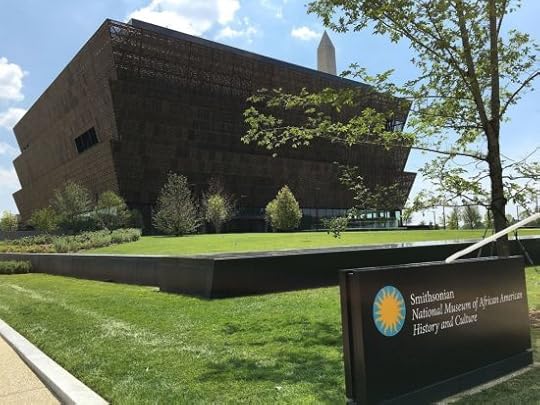 By Fuzheado – Own work, CC BY-SA 4.0, https://commons.wikimedia.org/w/index...
On page 39 of Razor Bumps and Stretch Marks, there is a poem entitled “Little Bag of History.” I wrote it after listening to a friend tell me about her past and about how her life course had informed her worldview and her sense of what she wanted in her life.
This seems as true for the history of nations and civilizations as it is for individual people. The perennial battle over what appears in history textbooks seems like a perfect way to illustrate this point. If your agenda is to prettify history, then you want more of a “glamor shot” in the textbook. If your goal is to present a darker view, for whatever your reasons, then you want a “mug shot.” A glamor shot is not the way to go if you want to portray the horror of slavery in America, for example. Similarly, a mug shot is not suited for describing America’s role in modern science, up to and including taxpayer-funded research that gave us satellites, jet engines, and the internet.
Not only does learning and understanding history help improve society, it is also as important as science and engineering. It fosters innovation and develops critical thinking skills in people. In addition, history is always writing the next chapter.
The most accurate rendition of history has to be a sophisticated blend of mug shot, glamor shot, context, perspective, and an unwavering desire to make sure all that nuance survives from generation to generation. Personal history should probably be considered within a similar framework. The understanding of your own history changes as you mature and grow, and you are likely to tell the story differently depending on the audience or the context. The greatest challenge, in my experience, is that sometimes you need to give yourself room to own your mistakes in order to avoid a situation where regret becomes a taskmaster, rather than a humble servant. Similarly, there is an appropriate space for celebrating victories so you can build on them. Legacy beckons…
The famous Italian philosopher George Santayana once said, “Those who cannot remember the past are condemned to repeat it.” Well, sometimes we should repeat history, shouldn’t we?
The post History: We’ve Come This Far by Faith appeared first on Byron Sogie-Thomas.