
Pauline Wharton's Blog, page 3
July 31, 2017
Ready for printing!
[image error]
At last! My book has gone off to the printers. Preparing it for printing is much worse than writing it – it’s a nightmare, in fact. I’m hoping there will be no glitches, and it will be available on Amazon soon.



Honouring Nelson
[image error] Last week my sister and I visited the Queen’s House, Greenwich, to see this recently refurbished clock made by our g-g-g grandfather, Henry Philipson, in honour of Admiral Nelson.


July 21, 2017
Ashover Show
[image error]
The Ashover Show is where the inspiration for Jed in ‘Death at Brambles’ really did win the Victoria Sponge competition. I believe he’s entering again this year – see you there, Wednesday August 9th.


July 17, 2017
Struggling with book
I’ve been neglecting the blog lately as I’ve been trying to get my book about Windermere ready for publication. It’s really hard work, pushing my amateur computer skills to their limit. In the end, there was no way I could get a big A4 landscape file to fit on to the pages of my book, so I had to put all the data in by hand, and the same with tables. Whew! Still, I may be able to give a preview of the cover soon.


June 21, 2017
Cumbria Family History Society
I’ve recently rejoined the Cumbria Family History Society, and posted some of the data on my genealogy page there. I’m amazed at the knowledge and enthusiasm of some of the members. Post a query, and several people will answer you immediately, They’ll search sometimes quite obscure records for you, and discuss your problem amongst themselves until they come up with the best answer. What I love about family history is the alternative picture of the past you get, instead of the politics and kings and queens of the school subject. You discover your own relatives being sent to work in factories when they are ten or eleven years old, moving around the country in search of jobs, being forced to emigrate because of poverty. You find girls working as servants seduced by their employers, and glimpse the great gulf between the gentry and the rest of society. All the major movements in social and economic history are reflected in the life of your own family in a fascinating way, and it may even affect how you see the problems of today.


June 12, 2017
Memories of Rudyard Lake
[image error]
Yesterday my two small grandchildren completed a sponsored walk round Rudyard Lake –well done! And yes, Rudyard Kipling’s parents gave him the name after staying there. But it reminded me of when we used to go every Sunday morning to take our friend Sam – who was approaching ninety and we thought was too old to drive – for his Sunday morning row in his 100-year-old boat. The other crew were Sam II, who was almost the same age, and Ray. Sam completed a sponsored row during one of the Rudyard festivals not long before he died in 1999.
Sam’s parents were Jewish refugees who arrived in Hull at the same time as Montague Burton. The immigration officials couldn’t spell the names of the arrivals so they made up names they thought sounded similar to the real ones. Sam’s father intended to go to America, but somehow or other he got stuck in Stoke-on-Trent, where he became a scrap dealer.
Sam was brought up in Cobridge, an inner city area of Stoke, in an overcrowded house where he shared a bedroom with several other relations. Nevertheless, he went to Oxford and later became a teacher in Newcastle-under-Lyme. During the war, he served with the RAF, but after setting off from an airfield in Norfolk and ending up somewhere near Southampton, it’s perhaps not surprising he was posted to the Outer Hebrides.
Sam had his own car, a Triumph Herald, which he had kept since it was new. I remember he gave me a lift in it once, and it still had the polythene protecting the door panel!
Sam was a great friend, and in these troubled times it’s worth remembering all the people who came to here, never became rich or famous, but contributed to our country and made us feel better for knowing them.


June 10, 2017
Free download Sunday and Monday
A chance to read my English village murder ‘Death at Brambles’ free on Sunday and Monday. Click the links in the sidebar.[image error]


June 9, 2017
Visit my local history pages
I was amazed at the response I got after putting what I thought was a rather dull post on facebook. Next time I must be better prepared – I had lots of visitors to my local history pages, and there wasn’t really much there! I’ve put that right now, with the story of my daredevil ancestor Robin the Devil (well, that’s what we claim in the family, anyway), our family history, and interesting records to download. So if you know the Windermere area, have an interest in grandfather clocks, or you have a relation called Phillipson, take a look.


June 3, 2017
Family History – Philipson clockmakers
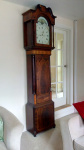
I’m a local historian as well as an author of novels, and it all came about because my mother wanted to know more about her grandfather, Aquilla, who had died before she was born. Family history is just like detective work – painstakingly searching the records, finding new clues, having hunches – and it turned out to be fascinating. I discovered my mother’s family, the Philipsons – we spell it Phillipson – were well known clockmakers, who had already been written about by clock experts. They had started out working for a famous maker of grandfather clocks, Jonas Barber of Winster, and eventually inherited his business. But there was a mystery – the last Philipson clockmaker had disappeared. My research came up with the answer – at the age of about forty, Henry Philipson junior had left his wife and was living with a young woman half his age in Kendal. They had several children, of whom Aquilla was one, and, it must be admitted, they were a rough lot. The eldest son appeared in court after attacking a neighbour with a meat cleaver, and like father like son, because after being widowed, he too ran off with a young woman, this time a girl of sixteen. But through my research, I found interesting new relations, and between us we have now brought four Philipson grandfather clocks back into the family. What’s more, we’ve all turned out rather well, in spite of the disreputable episodes in our past, producing university graduates back in the fifties, when it wasn’t so easy to get into university, especially if you were working class. What that illustrates to me is what I already believed – the problem for the poor is that they’re poor. With the right opportunities, poor children can achieve as much as anybody. Above is a picture of our Philipson clock.


May 13, 2017
Now that’s what I call a book launch!
When I was looking for the photograph of me dressed up as a brewer’s wife, I came across this one – me with a brain damaged knight!
I was asked if I would help to launch a book about walks around Staffordshire Castles, which was to take place at Tutbury Castle. I was to present the book to the Warden, and then a group of Wars of the Roses re-enactors were going to stage a battle. When I arrived, I was introduced to the Warden, and then taken off to dress up in a costume borrowed from a librarian.
I went out on to the castle green, where there was a large crowd made up of warriors swinging terrifying looking weapons, and their camp followers and children, all in beautiful medieval costumes, as well as local VIPs. I gave a short speech which went down well, and then turned to present the book to the Warden. He’d vanished!
I looked round bewildered, while everyone else laughed. Then I realised that while I was getting changed, he had transformed himself into John of Gaunt, complete with swarthy complexion, wig, chainmail and tights!
The knight in the picture was one of the warriors, and he’d travelled all the way down from the North East that evening to take part in the battle. It was the days of Maggie Thatcher, and he was unemployed. The DHS refused to believe he received no pay or expenses for the re-enactments, and they had docked his unemployment benefit. He told me he spent his winter evenings clipping together his chain mail! His character was based on a real person, a brain damaged knight – I wasn’t surprised, looking at some of the weapons, especially the ball and chain.
The picture begs a caption – at the time, councils were very short of money, and my suggestion was ‘Staffordshire Libraries – years behind the times’ ‘ – but that would have been cruel and unfair!
[image error]



