Ellis Shuman's Blog, page 20
February 4, 2021
Review of Shadow Falls by Wendy Dranfield
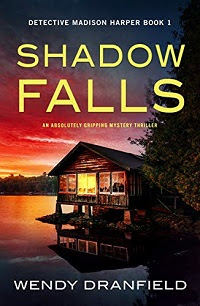
In Shadow Falls by Wendy Dranfield (Bookouture, January 2021), Nate Monroe and Madison Harper both have troubled pasts, and a lot more in common than they realize. Both of them spent time in prison, convicted of crimes they didn’t commit. Nate served time on Death Row after being framed for his girlfriend’s murder. And Madison, a former police detective, lost custody of her son after she, too, was framed on a manslaughter charge. Both of them are driven by a desperate need to right past wrongs.
Nate works as a private investigator while Madison is barely making ends meet as a waitress. She contacts Nate in hopes he will help clear her name and find her son. When Nate is hired to investigate the disappearance of a twelve-year-old girl at a summer camp called Shadow Falls, he reluctantly allows Madison to join him in the case.
The two of them travel to northern California to the camp, which is on the verge of closing down after all the bad publicity it received following the girl’s disappearance. Nate and Madison question the camp director and her staff, all of whom seem to be hiding secrets. The police are not sharing information, and the girl’s parents seem to know more than what they’re saying.
Nate and Madison are portrayed very realistically in this novel. They have lives outside of the narrative, and events in the past that affect what they do in the present day. They have faults and issues they need to handle in the future. Both are strong-willed individuals who won’t necessarily have happy endings in their quests for revenge. They are portrayed with a soft side as well, allowing a stray dog named Brody to join them on their journey.
Shadow Falls is well written, and certainly lives up to its name as an absolutely gripping mystery thriller. The plot moves swiftly as Nate and Madison pursue their investigation, keeping one glued to the page until the unexpected denouement at the very end. Except, it’s not the end for Nate and Madison. The two of them will continue their efforts to clear their names in the next novel of the series.
Wendy Dranfield is a former coroner's assistant turned crime writer who lives in the UK. Several of her short stories have been published in UK and US anthologies. She has also been shortlisted and longlisted for various competitions, including the Mslexia Novel Competition. She has previously written a Young Adult mystery and the Dean Matheson crime series. Shadow Falls is the first novel of her Detective Madison Harper series.


February 3, 2021
The Incredible Shira Haas

Israeli actress Shira Haas has been nominated for a Golden Globes award in the category of Best Actress in a Limited Series for her role in Netflix’s series “Unorthodox.” In the series, Haas, 25, plays a young ultra-Orthodox woman from Brooklyn, who flees the community for an uncertain future in Berlin.
“I’m super excited and happy,” she said, quoted in Deadline. “It’s more than I expected. It’s the greatest.”
The series was inspired by the 2012 memoir Unorthodox: The Scandalous Rejection of My Hasidic Roots by Deborah Feldman. I previously reviewed that book here.
“Unorthodox” was also nominated for a Golden Globes award for Best Limited Series or TV Movie.
Haas’s breakout role was in “Shtisel,” an Israeli television drama series about a fictional Haredi Jewish living in the Geula neighborhood of Jerusalem. I am currently watching the third season of “Shtisel,” and Haas stands out for her stunning portrayal as a young ultra-Orthodox wife desperate to get pregnant despite a life-threating medical condition. The third season of the show has some very powerful episodes.
Haas’s nomination for a Golden Globes award is just the latest recognition for her incredible talents. She was previously nominated last year for an Emmy Award as Outstanding Lead Actress in a Limited Series or Movie for her role in “Unorthodox”. She won the Ophir Award for Best Supporting Actress in the Israeli drama film "Asia", a film I have yet to see.
In the future, Haas told Deadline the she wants to keep portraying “different characters, that even though we are different from them, they can connect us all together. And to keep on telling meaningful stories.”
Good luck in the Golden Globes, Shira!
Related article:
Review of Unorthodox: The Scandalous Rejection of My Hasidic Roots by Deborah Feldman.
January 25, 2021
"The Muse" - short story
 “Have you told your wife about us?”
“My wife? Why do I have to tell her anything?”
“She probably suspects that you’re cheating on her.”
“I’m not cheating!”
“A married man and a much younger woman meeting for coffee every evening? Some people would consider that cheating.”
“We’re not doing anything we’re not supposed to be doing. We’re just having fun.”
“You’re not being honest with her. She assumes you’re coming to this coffee shop after work with the intention of writing, when you’re actually spending time with me. If you haven’t told your wife about us, you’re cheating.”
“My wife trusts me. Totally. After you leave, I’ll start writing.”
Read the rest of the story on CommuterLit.com.
Photo by Kinga Cichewicz on Unsplash.
January 20, 2021
What’s better than having your short story published online?

A package was delivered to my home yesterday. I quickly opened the DHL envelope and pulled out the thick blue magazine. The December edition of Adelaide Literary Magazine. My story “Mother and Daughter” is on page 105.
“Mother and Daughter” was published online last month and you can read it here. Three other short stories I wrote were also posted online during the month of December, for a total of six during 2020. It is always exciting to have your writing recognized, to see your name appear online, and to be able to share your writing with others. But there is definitely something to be said for having your story published in print, and to actually hold the magazine in your hands.
Adelaide Literary Magazine is an independent monthly literary magazine based in New York and Lisbon. The December edition of the magazine, including my story, can be purchased on Amazon.
Another story of mine will also appear in print. “Rakiya,” published online by Vagabond, Bulgaria's first and only high-end English monthly magazine, will be included in its print edition as well.
And finally, I just received notification that another story of mine will be published online. This is my first acceptance of 2021, with hopes that there will be many more to follow. Details of that story will be provided very soon.
Short stories:
January 12, 2021
"Mother and Daughter" - short story

There was no need for words. Lyuba urged her daughter forward, indicating with a nod which way the young girl should go. Which person to approach. Not the elderly man smoking a thin cigarette or the gawky teenager, his head weighed down by enormous headphones. Not the fashionably dressed woman talking on her phone or the smiling couple strolling with a baby carriage. No, none of those would do. When her daughter hesitated, Lyuba prodded her in the ribs, pushing her toward the heavyset matron laden down with shopping bags.
They had been following the woman for several minutes as she made her way through a market buzzing with early morning activity. Crowds at the vegetable stalls, shoppers searching for the biggest potatoes, the ripest tomatoes, the plumpest squash. Merchants standing proudly behind pungent piles of onions and green mountains of cucumbers. Voices raised as they chanted the praises of their merchandise. Customers demanding the finest produce at the cheapest price. The stocky woman filled her bags and prepared to head for home.
“Get out of my way!” she snapped after the girl bumped into her. She bent down, cursing as she gathered the apples that had spilled onto the pavement. “Damn gypsies!”
As Lyuba hurried to the far side of the market with her daughter in tow, she laughed to herself. Just as she planned, that woman was more concerned with organizing her bags than with checking her purse.
Read the rest of the story on Adelaide Literary Magazine.
January 4, 2021
"Rakiya" - short story
 Every spring, a competition is staged in the village to determine the best homemade rakiya in the region.
Comparisons of rakiya and other spirits are nothing new in Bulgaria – one such competition takes place annually in Sofia – but those contests consider alcoholic drinks mass-produced by established wineries and corporations. The event in the village, on the other hand, is open to residents of the area who make rakiya in their bathrooms, garages, and cellars. This competition attracts little fanfare and winning is solely a matter of local pride.
"Nazdrave!"
"To your health!" Vasil replies, lifting his shot glass to toast his cousin. He stares into Georgi's dark eyes for several seconds and says to him, "Thank you for driving down from Plovdiv."
"You thought I wouldn't come?" Georgi takes down his drink in a single gulp. "I wouldn't miss this for the world. After all, you will be the winner tomorrow. And this is what is going to win," he says, pointing to the clear glass bottle on the table.
"Another toast?"
"Another! We're just getting started!" Georgi shakes ash off his cigarette and hands his glass to Vasil for a refill.
Read the rest of this story on Vagabond.
December 30, 2020
Vaccination!
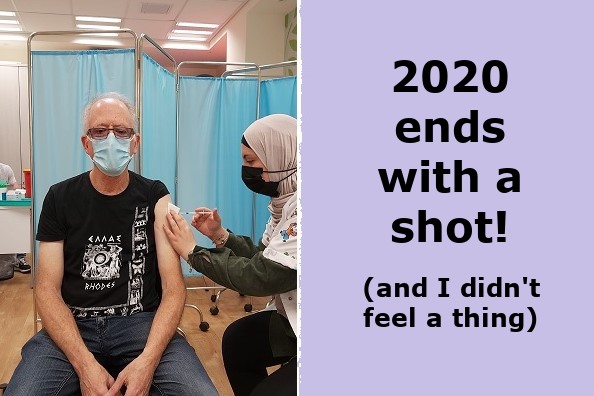
If there is anything Israel did right in this past year’s battle against coronavirus, it was in securing enough vaccines to start a massive inoculation campaign. At this stage, citizens over 60 and at-risk groups are eligible and an incredible 1/3 of that population (nearly 700,000 as of yesterday) has already been vaccinated.
Israel currently leads the world in vaccinations per capita, with 7.44 doses administered per 100 people. Bahrain is second, followed by the United Kingdom and the United States. Although there is a fear that Israel may run out of vaccines in mid-January, enough are being reserved for the second required dose for those who have already been vaccinated.
With such a huge rush to get vaccinated, my wife and I were worried it would be difficult to set an appointment. We had heard stories about people waiting on the phone for over half an hour before getting disconnected. But for us, the process was extremely simple and efficient.
Jodie registered us on our health care provider’s website and our vaccinations were set for January 6th. However, a few days later, the nurse on our moshav called to say that there were openings on December 30th. We would get our shots at a clinic in Mevesseret at exactly 14:09 and 14:14 on Wednesday afternoon.
We showed up at the clinic and walked right in, directly to the nurse’s desk. No crowd at the entrance, no waiting in line. The nurse took our details and within 2 minutes, I sat down for my shot. And then Jodie got her shot. We were told to wait outside for 15 minutes, to make sure there were no immediate reactions to the vaccine, and then we were able to go home.
Today we will set our appointments for the second dosage in three weeks’ time. Both Jodie and I feel a slight pain in our shoulders—nothing more serious than a muscle cramp—but overall, we are just relieved that we got our shots.
As we start 2021, our sincere hope is that everyone will get vaccinated so that we can put COVID-19 behind us!
December 29, 2020
Review of ‘The Devil’s Gorge’ by Dora Ilieva
 Sam Angelov, a University of Toronto student, receives notification that he has inherited an apartment in Bulgaria from his grandmother. Accompanied by his friend, Ben, Sam flies to Sofia to meet with a local lawyer. While the inheritance paperwork is being processed, Sam sets out to meet a distant cousin, Kossara, and her father Kiril, a well-known history professor.
Sam and Ben travel with Kossara to the Thracian city of Perperikon in the Rhodope Mountains, where Kiril and a group of archaeologists are working at a dig. Perperikon sits high on a rocky hill and its history revolves around a temple of Dionysus, the Greek god of wine and fertility; and Orpheus, the legendary musician and poet. Kiril is convinced that two invaluable treasures from the ancient world are buried somewhere on the site.
The Devil’s Gorge by Dora Ilieva (2014) is an engaging archaeological thriller set in one of the most beautiful regions of Bulgaria. The settings described in the book are real, and as colorful and fascinating as described. The Nestinarstvo fire dancing tradition is still practiced in rural areas of Bulgaria.
The Devil’s Gorge of the title refers to the stunning Devil’s Throat Cave, through which Orpheus is said to have descended into the subterranean kingdom of Hades to seek his lost love Eurydice. The cave plays no significant role in this story, but perhaps Sam and Kossara will return to it in the novel’s sequel.
Dora Ilieva is a Bulgarian-Canadian author who grew up in Sofia, Bulgaria, and moved to Canada when she was twenty-eight. She is married and has three children. She works as a teacher and writes in her spare time. The Devil's Gorge, the author's debut novel, was followed by The Master and White Clay in the Across the Ocean series.
December 21, 2020
"The Bear" - short story
 A 65-year-old man was killed by a bear in the Rhodope Mountains on Friday. The victim was in the woods collecting firewood when he was attacked, villagers said. More than 200 wild bears roam the forests in the Smolyan District, but this was the first reported case of a bear attacking a human.
“The bears are starving,” explained the mayor of the village.
“They may be starving, but that doesn’t mean we should be served as their dinner!” complained one of the terrified villagers.
“He killed a cow last year,” cried another.
“He’s a killer bear!”
“There’s no need to get alarmed,” cautioned the mayor. “The appropriate authorities have been contacted and they assured me they will deal with the problem.”
The appropriate authority was Anton Monev, head of the Regional Police Directorate. Anton called me shortly after being notified of the incident. He urged me to come, saying I could join him the next morning when he went to hunt down the bear.
Read the rest of the story on Potato Soup Journal.
December 9, 2020
"The Baker" - short story

“I’ve heard you have the best pitas in all of Sofia.”
“Who am I to argue with what people are saying?” Jamal said, looking up from the cash register to find a well-dressed middle-aged man drumming his fingers on the counter. “What can I get you?”
“Would it be possible to make an order for one hundred and fifty?”
Jamal stepped back, not surprised at the large order but rather that the man was speaking to him in colloquial Arabic. “I’m sure that can be arranged,” he said, turning to his brother for confirmation. Standing near one of the ovens, Amar nodded his consent.
“Good,” the customer said. “I will pay you now, in advance. Could you have the order ready if I come by tomorrow at three?”
Jamal rang up the purchase and handed over the change and a receipt. “Dovizhdane,” he said, instinctively saying goodbye in Bulgarian.
“Shukran,” the man replied in Arabic as he left the bakery.
Read the rest of the story on Isele Magazine.