
Jeff Grubb's Blog, page 4
February 10, 2025
Theatre: Anniversary Plays
Covenant by York Walker, Directed by Nicholas Japaul Bernard, Arts West Through 2 March.
Blues For an Alabama Sky by Peral Cleage, directed by Valerie Curtis-Newton, Seattle Rep through 23 February
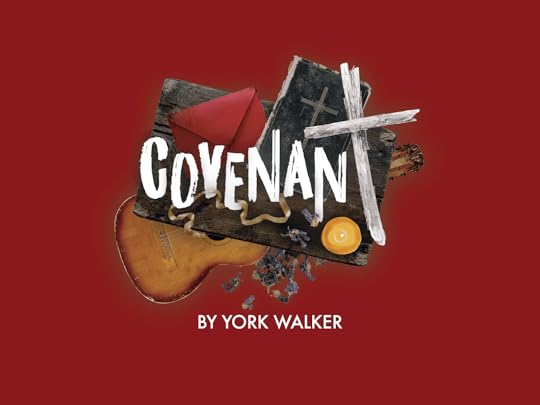 The Lovely Bride and I have crested 42 years of marriage this past week (thank you, thank you), and to celebrate, we decided to hold a "staycation" where both of us took off work. As a result, we played games (I lost several games of Wingspan), ate a lot of good food (Chestnut Cafe, which is the LB's favorite's lunch spot, Lobster Shop in Tacoma, Mashiko Sushi in West Seattle, and Toulouse Petite near the Seattle Center). And, as fate would have it, we had two plays scheduled over three days - Covenant at the Arts West, and Blues for an Alabama Sky at the Seattle Rep.
Let me get to the heart of the matter - Covenant was the best play and the best performance I have seen in Seattle for years, Arts West has been putting together bang-up seasons for the past couple years, and this one fired on all cylinders. The writing was top-notch, the performances were amazing, the direction was fantastic, and set design was grand. The small nature of the theatre brought an intimacy that allowed the actors to reach out across the void of the forestage and grab the audience by the collective shoulders and give them a good shake. The play is mythic and suspenseful and fully engaged.
Covenant is about secrets. It is also about faith and superstition, but it is most of all about secrets. The setting is a small town in Georgia, 1936. Johnny (Donavan Mahannah) comes back to his home town. He left town a stammering boy in the wake of his older brother's death. He returns now without the stammer, a master musician with his guitar, and possessing a smooth self-assurance. Naturally there's suspicion he made a deal with the devil. He came back for Avery (Simone Alene), who was just a friend but now something much more. Avery's Mama (Felicia V. Loud) is a god-fearing woman who does not approve of Johnny and his juke joint antics. Little sister Violet (Deja Culver) and family friend Ruthie (Kaila Towers) round out the ensemble. They're all brilliant.
And I don't want to say more because I don't want to do spoilers here - it's that good. Each character gets their turn to tell stories and reveal secrets, as well as sparking off each other in meaningful relationships. And the writing is SO GOOD, of the level that I was left thinking "Man, I wish I had written that" and "Man, I wish I could write like that". There is a not an ounce of fat in this play - even the most cast-off line has meaning and subtext, and is delivered in such a natural and engaged fashion, that over the course of the play as you realize (often to your horror) what is really going on here. All questions are resolved, even the ones you didn't know you had.
And part of that is the direction (Nicholas Japaul Bernard) and the dramaturg (Marquisa 'QuiQui" Dominguez. The players maneuver perfectly a two-tiered stage, the back stage being Mama's dining room, dominated by a cross, which the forestage was open for a variety of purposes, including a general "theatre space" as the actors share secrets with the audience. The sound design was excellent, accenting the action on the stage. Even the stagehands, the black-dressed theatre ninjas moving props onto and off the stage, were used perfectly.
I rarely say that something is a near-perfect play, but this is it. Get yourself out to West Seattle for this one.
 Sunday we decamped for the Seattle Center and Blues for an Alabama Sky. And I will be honest - it was good. And if I saw it on its own I would probably give it greater praise. But it suffers in comparison with Covenant.
We're still in the 1930s, but this time in Harlem. Angel (Ayanna Bria Bakeri) is a hot mess of cabaret singer who just lost her job, her living space, and her boyfriend. Guy (Jamar Jones) is her gay best friend from Savannah, who is a costumer and is sure that Josephine Baker will sweep him up and invite him to come work for her in Paris. As he is trying to navigate a drunken Angel home, they're aided by Leland (Ajaz Dontavius), newly arrived from Alabama in the big sinful city. Delia (Ester Okech Lewis) is the prim neighbor from across the hall who is working to bring a family planning center (read: birth control) to Harlem, aided by a boisterous local doctor (Yusef Seevers). The five of them struggle with life and survival in the wake of the fading Harlme Renaissance.
And it works, mostly. The first act feels like it drags a bit, Checkov's gun makes a requisite appearance, and you can see some of the twists and turns coming a ways off. Some personal revelations and traumas show up rather late in the day. And there is a huge amount of name dropping going on - Marcus Garvey, Josephine Baker, Adam Clayton Powell (Jr and Sr), Margaret Sanger, Langston Hughes, none of whom show up on stage.
The music, however, is haunting and delightful, with Nathan Breedlove on the trumpet acting as the ghostly spirit of the city itself to show time passing. Which is a good thing, since the stagecraft involves a turntable set that shifts back and forth to show what apartment we are in. I would wonder if the play would work better in a smaller confines, or, on the other hand, if Covenant would fade if thrust onto a larger stage.
Yet, it all comes together. The actors are fine. It is the best of three revivals at the Rep this season (it was originally produced 30 years ago). Given a choice between this and the Super Bowl, I'd definitely choose Alabama Sky. But seriously, go hunt down Covenant and prepare to be impressed.
More later,


February 2, 2025
Game: Murder, She Roleplayed
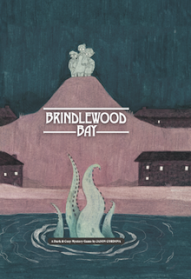 Brindlewood Bay by Jason Cordova, The Gauntlet, 2022
Here's the High Concept - Murder She Wrote Meets a Cthulhu Cult. The players take the roles of elderly women living in a small New England town. They're members of a book club known as the Murder Mavens, and they solve mysteries. And in the process they discover a deeper conspiracy underlying it all.
It's a really good game concept, and I was pushing our regular group of veteran gamers to try it out, and despite some challenges, it worked out pretty well.
Let me hit the biggest challenge first - the rule set is a complete mess. It is well-produced, a digest sized hardback, but the contents could stand a complete revision. RPG rules are challenged by two conflicting purposes. One is to teach the game, and the other is be a reference when playing the game. This book does neither well.
Part of it is that the game is Powered by the Apocalypse (PbtA), which is a new style of play. Its got some really cool ideas, but Brindlewood assumes that you're already familiar with them. The vibe I got on the first reading was akin to reading the original Chainmail or original D&D rules. There a basic assumptions to the game that are assumed to be common knowledge, so a newcomer will just bounce off them.
Further, you absolutely need to have the characters sheets available to understand the game. There is a description of characters sheets in the book, but vital information that only exists on the sheets (which are not in the book). I was part of the Kickstarter, so I could dig up the files, but for everyone else, you have to go online (no, they don't tell you where to go, or even that you really need the characters sheets to understand the game). The further downside of this is that, once the site holding the sheets go down (because the Internet is both eternal and ephemeral), you're high and dry.
The organization of the book does not help. Definitions, when provided, are in a couple different locations. The explanation of what happens in the first play session shows up 140 pages after we're told about what is a typical play session consists of. There is no index. We had three hard copies of the book and an e-book at the table, and we were still flipping through pages, muttering "I'm sure it's here elsewhere".
Powered by the Apocalypse runs differently than your traditional RPG game (like D&D or CoC). Players are much more empowered to determine what happens, defining both the results (and penalties) of their actions. The basic mechanic is two six-sided dice. You role for success. On a 6 or less you fail (and you or the Keeper can describe what happens) on a 7-9 You succeed but at a cost (the Keeper decides with your input). On a 10 or better you succeed, but we advance the meta-plot a bit (the Meta-Plot involves a creepy cult of a supernatural being - we just started digging into that after the second scenarios, but have not gotten too far)..
The players have a lot of input, and as a result always have to be on their toes and ready to engage (as opposed to the more traditional, initiative driven systems where you wait your turn to do something). The Keeper also has be on their toes, in that one has to continually figure out what goes wrong on those all-too-common rolls. Sometimes this results in dead spots where players (and/or the Keeper) are trying to figure out what happens next.
Further, while this is a mystery game, you the Keeper don't know whodunnit. The players gather clues which tend to be rather open ended, and let the players fill in the blankes (real conversation from the game - ME: You find a steamy letter. PLAYER: Who is it from? ME: Who do you want it to be from? PLAYER: I HATE this game!). After they have gathered sufficient clues, they piece them together and roll to see if they are right. As one player put it "OK. Who are we pinning this on?"
I know. This all sounds like this is a heavy lift. How did it work out in play?
Well, we had a marvelous time over about five game sessions. The character creation system required a lot of engagement - they effectively had to write the introduction to the TV show, where each character got their moment and a description of their "cozy place" home. As a result we created characters with much more depth than the your standard 1st-level dwarf warrior. Again a favorite interchange: ME: Tell me about your late husband. PLAYER: No one ever suspected a thing
The format is very much 80's television, right down to the jump-scare (getting locked in a freezer, or sliding off the deck of a ship) and going to commercial. There are a multitude of ways to damage or kill the characters, and a multitude of ways for the characters to unwind that and take another path. The setting is a small coastal town in New England, but many of us had worked in Lake Geneva, Wisconsin, so the small-tourist town flavor came naturally to us. We ran through two adventures - one involving a wealthy family patriarch getting pushed off his yacht, the other being a Halloween party where the victim was drowned in a tub used for bobbing for albums. It was goofy in places and a lot of fun.
The flavor is great, and the players rose to the occasion. This is definitely a case of a good game, but a challenging explanation of it, and we had to mentally unwind a lot of traditional role-playing assumptions and mannerisms in order to get to the heart. And yeah, I'd like to see a few other examples to see where this game did and did not adhere to the original PbtA rules. But a good time was had by all.
More later,
January 29, 2025
Game: Auf Weidersehen Berlin
 Berlin: The Wicked City, Unveiling the Mythos in Weimar Berlin By David Larkins with Mike Mason and Lynne Hardy, Chaosium 2019
I've mentioned this before, but the concept of doing full-fledged reviews carries with it the responsibility of actually playing the game. I talk about my recent arrivals with the light hand of first impressions and initial read-throughs, but full reviews demand a higher level of engagement. The downside of this is that it may take weeks or months to get to a post-worthy review. This is hardly a good recipe for telling you about the new hotness.
But anyway, Berlin: The Wicked City.
Berlin was the capital of Germany in the twenties and thirties (the government was based out the town of Weimar briefly after WWI and that's where the name "Weimar Republic" came from). It was a vibrant, cultured, and often decadent city, with cabarets, art, a thriving literary scene, and a nascent movie industry. And sex. Lots of sex.
The book is recommended for mature readers, and leans hard into the city's cabarets and sex workers. A lot about sex workers. Even when talking about the various districts in Berlin, it drills down on what kind of sex workers are common there. Sort of like if you were writing about Las Vegas, but concentrating on strip clubs and escort services. It's a bit much, and while it adds depth to the setting, I never want to hear people complaining about the Random Harlot Table in the DMG ever again.
The sourcebook section is incredibly detailed - we're a hundred years in the past in another country. And most people's knowledge of that era is primarily watching Cabaret on their iPad (which is not horrible, since the movie is based on the musical which is based on the book by an author who LIVED in Berlin during that era). So the first hurdle is getting people to understand what it is about Berlin they should consider when adventuring there.
And the authors have done their homework, and want you to know about it. Bios about everyone who hung out in Berlin in the 20s and 30s. Floorplans of famous buildings of the era. The adventures themselves are filled with name-checks and famous characters, such that I took the rare measure of asking the players not to look up everyone they encounter on the Wikipedia.
The game rules? OK, we talked about the new system a while back. In general, they hold up well in play, and I like the fact that the staged nature of success makes it easier to narrate combat. In addition, the setting for the adventures makes for new players to slide into. Germany in the immediate post-war period had stricter gun control laws, so the idea of player characters packing heat is initially off the table (Gun laws were loosened later, but then only for "approved" people).
What about the adventure? Ah, there's the rub.
Well, I wasn't impressed. I ran the first of the three adventures, and after reading the second, thought about just going on to something else with my team. But after a vote, we pressed on, and had a good time of it. Of course, this requires a bit more detail and explanation, and with it a big SPOILER WARNING for those who are planning to get involved with this. So consider the SPOILER LIGHT lit and know that HERE BE SPOILERS.
My regular group on this was four players. A big-game hunter looking to book rich tourists to safaris in East Africa. A grizzled American reporter who came for the war and stayed for the beer. An albino heiress who lost her father and brothers in the war. An alienist who had an unpleasant encounter with Deep Ones when he was in the Kriegsmarine in the Baltic. You know, your typical grab-bag of Call of Cthulhu characters. They were all members of the Independent Order of the Owls, a club of paranormal researchers. This was one of the groups suggested by the book for creating a common theme among diverse heroes, and it gets good marks for giving the Keeper a place to start and unify the team.
The further good news is that the adventures swing away from the standard CoC plot ("You are summoned to a distant, unfamiliar place by someone who will be dead by the time you get there"). The bad news is that the players are often bystanders in their own adventure. They are roofied, magically teleported (a couple times) and in the case of the first adventure, have their fates determined by a single die roll at the beginning of the game. At the same time, there is a lot for the Keeper to do as well, in that you have to come up with encounters as the Brownshirts and their allies in authority close in on you (the Owls were raided at one point, and I had to make that up on the fly). Plus there are places where the text leaves you high and dry on basic reasoning about NPC behavior (Why DOES the Russian count choose to hire you?) and places where you have to make sure certain clues are delivered (make sure the amnesiac Grand Duchess mentions the Berlin Zoo to lead their players there later).
The adventures cover the rise and fall of postwar Berlin. The first adventure takes place among the physical and economic decimation following the end of the War and features the malevolent spirit of a mass murderer. The second occurs during the roaring 20's recovery and deals with a group seeking to incarnate an ancient goddess (and unfortunately succeeding). And the final adventure occurs during the authoritarian takeover of Germany, with the SA (Brownshirts) rising, and takes a tour through German cinema. And through it all we have murdered prostitutes, dissolute, naked celebrities, and SS-supported brothels.
How did our group fare? They lived, sorta. The American reporter sacrificed himself to defeat an elder god and was replaced with an exact duplicate. After the third adventure he joined the big game hunter and emigrated to Wisconsin. The alienist fled to Switzerland, and the heiress attempted to use the knowledge they gained to resurrect her dead husband. This last bit did not go well, and she went quietly mad and remained in Berlin until the Allied bombers arrived.
Berlin: The Wicked City, is an impressive sourcebook. The research is excellent, and by using period maps of the city, the maps are well-done. The handouts were well put together, and we discovered that even the newspaper typefaces of the time were politicized. Ultimately, though, this is a challenging product, not so much for the adult nature of it but because the adventure often denies players their agency, and requires the Keeper to thread some very narrow needles to keep the plot moving forward.
More later,
January 25, 2025
Theatre: Jack and Tollers
 Lewis & Tolkien by Dean Batali, Directed by Karen Lund, Taproot Theatre, January 22- March 8
 CS Lewis and JRR Tolkien. In the real world, they were compatriots, fellow professors, members of the Inklings writing group, occasional pranksters, and good friends. In the world of fantasy literature, their followers and fans rival the Tupac/Biggie rivalry. I will admit I'm on Team Tolkien, but let me back up a moment for some background before weighing in on the play itself.
The Lovely Bride and I had a busy Saturday, with Tai Chi class in the morning, a light lunch at the Greenwood restaurant Razzi's, then joining up with friends John and Janice for this play. Then we had additional errands (grocery shopping, getting more bird seed and cat litter), before returning home. At our age, that's a big day.
And we got to break in the Isaac Studio Theatre, which is a nice, smaller venue than the main Taproot Stage. I've described Taproot's main theater as a jewel box with a thrust stage and 225 seats. The Isaac is even smaller with 150-some seats laid out in a more traditional manner with a high-rise of comfortable seats looming over a small stage. Perfect venue for a play about two men in a bar. Lewis and Tolkien reunite after many years apart at the Eagle & Child, their favorite pub, to reminisce, reconnect and settle a few old scores.
Now, my mental image of Tolkien, supported by interviews over the years, is that of a scholarly Hobbit. Brilliant in his chosen field (Middle and Old English), who in his spare time side wrote what would become defining books of British Literature. He sits there in a highbacked chair, smoking a pipe and discussing Beowulf. Not something for dynamic playgoing, I will admit. So I had make some strong mental adjustments for both the Tolkien and Lewis as presented on the stage.
Jeff Allen Pierce's Tolkien is much more animated. Gruff, grumpy, and defensive. More conservative and Catholic than usually presented. Tolkien and Lewis were both religious, but from his writing, I always put Lewis down as being more hard-core to his faith. Narnia, Perelandra, and the Screwtape Letters all drip with Christianity. Tolkien's works were also extremely moral, but he lacked all the bells and whistles, or rather, the allegory, found in Lewis's works. The play's Tolkien is much more emotional, loud, pedantic, and often loud.
Lewis (Peter Cook), on the other hand, is more aloof, controlled, and professorial. He comes off as the more cerebral of the two, more in command of his emotions. He is more in line with what I think of as a Oxford Don. He comes off as man hurt by the end of their friendship, but has let the years scab over it, while Pierce's Tolkien still grapples with the situation. Of the two, he is the better man.
Both actors are good in their roles, as is Chloe Michele as Veronica, a waitress of the bar, whose character is often referee and audience for their set-too. She pops in regularly both to take the edge off both men, and break up the back-and-forth as they argue.
The play succeeds when talking about the relationships between two men who have grown apart. The Lovely Bride got it and was moved the by tragedy of their breakup and the hope of restoration. For my part, I had to turn off the part of my brain where I kept comparing the two against my imaginary versions and instead broke them down into component parts - effectively, a priest and a rabbi walk into a bar. And in those terms, it worked.
Also, forgive this pedantic digression, but when you say someone is an apologist, it does not mean in these circumstances that they are sorry for what they may have done. Rather they are offering a reasoned argument for someone. That's unclear in many cases, but the Apology of St. Paul (Acts 22), for example, is not that he's sorry for being a Christian, but a thoughtful explanation of Christianity. We toss the word around here a bit assuming that the audience would pick it up correctly, but I don't know if that's the case.
Anyway. Was it a worthwhile afternoon? Yep. Did it work as a play? Also yes. Should you go see it? Yes - the Saturday matinee had a full house and has already been extended two weeks. But as history, even as historical fiction, it fails to live up to expectations. And mind you, expectations were high.
More later,
December 24, 2024
And To All A Good Night
Grubb Street wishes you and yours a safe and happy Holiday Season.
 Rest on the Flight into Egypt by Luc Olivier Merson (1879), MFA, Boston.
December 21, 2024
Theatre: A Very Wooster Holiday
 Happy Christmas, Jeeves by Heidi McElrath and Nathan Kessler-Jeffrey, directed by Karen Lund, based on the stories of PG Wodehouse Taproot Theatre Company, Through December 31
Let's round out this festive season's holiday plays with a Wodehousian romp. The Lovely Bride and I, along with our friends Janice and John, set out for the northern reaches of Seattle for lunch at Saffron Grill in Northgate (Indian/Mediterranean fusion, which was quite good), then doubled back to Greenwood and the Taproot Theatre for Happy Christmas, Jeeves, And it was all quite enjoyable.
Happy Christmas is not based on any one particular Bertie and Jeeves story so much as it is based on all of them. Indeed, one of the criticisms of Wodehouse's stories is their similarity - High-class toff Bertie Wooster gets himself in trouble, and only his sage and unflappable valet Jeeves can extricate him. And while this is true, but it is a little unfair, sort of like saying that The Simpsons have one story, and they just keep telling it different ways for 35 years. So this particular creation, from the pens of McElrath and Kessler-Jeffrey, features all the characters, hallmarks, and tropes of the traditional Bertie/Jeeves stories, mixed together and served as a Christmas Pudding.
Here's a deal - Bertie would like to do nothing more than spend the holidays alone, curled up with a new book by his favorite author. Such is not to be, of course, because his dreaded Aunt Agatha descends upon him with the demand that he put his hapless cousin Claude on a train to South Africa (spoiler- Claude doesn't go), and then the situation is made worse by Bertie's old chum Bingo Little having fallen in love with a waitress named Mabel, but doesn't know how to get HIS aunt's approval of the cross-social-class match. Add a few cases of mistaken illnesses and an escaped ferret and you culminate in an inspired collection of door-slamming and hallway-chasing.
And it's a lot of fun. And I should add that for this particular matinee performance, the understudies took over. There was a flurry of addenda slips in the program book, and folk stepping up into the leads. Jon Lutyens emerges as a pitch-perfect Jeeves, all manner and decorum even when armed with a net and a broom. Joe Moore was a delight as Bertie, all loose-limbed, slack-jawed, and goggle-eyed. Moore had been listed as Cousin Claude in the program, but after being promoted, that role was nicely assayed by Giao Nguyen. Kim Morris is a juggernaut-class Aunt Agatha, all sound and fury. William Eames was the endearing and infuriating Bingo Little. Nikki Visel was the very precise and proper (and cougarish) Lady Bittlesham, Bingo's Aunt and author of books on proper etiquette. Mabel was Rachel Guyer-Mafune, and this would be the fourth production I've seen her in at a fourth different theater. She's a hard-working actor.
They're all good. Delightfully so. And the direction was top-notch, dealing with the challenges of a small theater with a thrust stage and flanked on three sides by the patrons. This performance had pacing, and would set up and delivered jokes and humorous situations, with enough breathing room to let the audience catch up. The acting was broad, the action was slapstick, and there resulting confusion completely enjoyable. The audience was enchanted and engaged.
I liked it a lot, so much so that afterwards, I sat down to pen this, since it runs for only one more week (they did extend it over the weekend). This was the best Christmas show (Though Snowed In was nice as well). So if you need something to do in your post-Christmas break, here's a breath of fresh air with a very familiar setting. Happy Christmas to all!
More later,
December 9, 2024
Theatre: Metaphysical Humor
 Blithe Spirit by Noel Coward, directed by Allison Narver, Seattle Rep Through December 22
Despite the playwright's name, this is not a Christmas play, though it is the kind of play that fits well within the holiday season - light, frothy, traditional, safe. Something to take in as a break from cookie baking, or to take the out-of-town visitors to. And indeed, it felt like a full house was in attendance this past Sunday afternoon.
But as a play I found it frustrating, in the same way I found By the Skin of Our Teeth frustrating. It is classic theatre in the expected style, and parts of it are excellent, but it ultimately misfires for me.
Here's the skinny - Charles and Ruth Condomine (Arlando Smith and Gina Hammond), both on their second marriages after the deaths of their first spouses, throw a dinner party with the Bradmans (Sara Waisanen and Nate Tenenbaum). Charles is working on a new novel involving a fraudulent occultist, and to that end has invited a local medium, Madame Arcati (Anne Allgood), to hold seance. All the others are skeptical, even mocking, but Arcati proves to be the real deal, and summons the spirit of Charles' first wife, the ebullient Elvira (Kirsten Potter). Whackiness ensues.
But, like Skin of Our Teeth, it should work, but it doesn't. This is a venerable old warhorse of a play, long-running in London's West End, subject of numerous revivals and innumerable summer stock and school versions. It should burble with wit and verve, but instead most of the banter shouts along at a uniform volume level and speed, such that I'm worn out trying to keep up. The pacing feels off. The three main characters in this love triangle are not expected to be particularly likeable, but by the same token, none of them seem to deserve their ultimate fates. They're all shallow. A little callous, but not delightfully so. They all seem to be talking, but there is little actual conversation going on here.
Where the play succeeds in where the talking stops and the physical comedy takes over. Allgood as Madame Arcati is a wondrously comic medium, a loose-limbed crane as she works her spells and flings herself bodily into trances. And Sophie Kelly-Hedrick as the maid, Edith steals every scene she is in as a Monty-Python-Gumby-turned-servant. The stagecraft is top-notch in the Rep tradition, and fits particularly well for the physical comedy. And the Lovely Bride has informed me that the gowns were excellent.
But ultimately, it misfires. Maybe the old plays I enjoyed have grown long in the tooth. Maybe it's just the modern approach to them. But the end result is just OK - not great, not horrible, just fine but not worth a strong recommendation for the holiday season. But just sort of indifferent. Truly blithe.
More later.
December 5, 2024
The Big Pile of Books: Plane Books
Too Many Clients by Rex Stout, Bantam Books, originally published in 1960
And Four To Go By Rex Stout, Bantam Books, originally published in 1958
Fade to Black by Robert Goldsborough, Bantam Books, originally published in 1990
The High Window by Raymond Chandler, Vintage Crime originally published in 1942
Pickup on Noon Street by Raymond Chandler, Ballantine Books, originally published in 1952
Playback by Raymond Chandler, Ballantine Books, originally published in 1958
The Mysterious Affair at Styles by Agatha Christie, Arcturus Books, originally published in 1920
So I've been doing a lot of air travel this year, and when I travel, I bring along paperback mysteries. They are small, portable, you don't have to turn them off when landing or worry if the batteries are low. I usually get them at used bookstores, so if you lose them, you're out a few bucks.
And there's something I've noticed that I haven't seen anyone else comment about - the demise of the mass market paperback. I've been in a couple big chains, and the stubby pocket-sized mass-market paperback has been almost completely replaced with the larger-size trade paperback. The only mass-markets I'm finding (even in grocery stores, is the aisle next to the greeting cards) are by established authors and part of larger series that have been running in that format for years. Even a couple of the entries here are trade-sized reprints, purchased while on the road. Is this change-over really a thing? Are we losing the traditional mass market paperback of our youths?
Anyway.
These mass-market mysteries are also relatively short, unlike the doorstop fantasy books of the last several decades. That works out as well, since I can finish a book in one hop from Seattle to Milwaukee, or a round-trip to LA.
I still tend to favor Nero Wolfe mysteries, if you haven't noticed, but I am getting towards the end of the Rex Stout canon, and have actually bought the same book twice under different covers because I was unsure if I have read it or not. I've even engaged with Stout's estate-approved successor. So I'm doing a bit more experimentation, this time with some Raymond Chandler I had never encountered before, and dabbling with Agatha Christie.
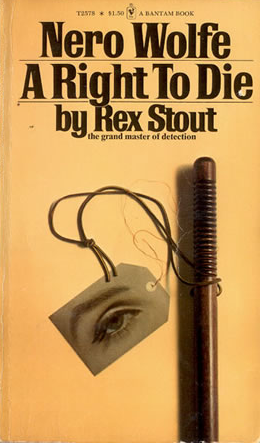 Anyway, here are some recent additions
A Right To Die - Usually, Wolfe's world exists in a 7-year bubble. When we first meet Archie and Nero in the 30's, they've been together about 7 years. In the fifties, they've been together about 7 years. But now we are in the 60's and suddenly we get a direct call-back to an episode in the 30's. Back in 1938, Wolfe cracks the case in Too Many Cooks by appealing to the better nature of a group of African-American waiters. Now, one of those former waiters shows up at his door, quoting the speech that Wolfe had made that night. His problem is that his son is engaged to a white girl, and he wants to find out what's wrong with her. And then, of course, the white girl turns up dead. I mentioned that Wolfe's world is predominately white, but this is one of the times that Stout touches on racism.
Too Many Clients - This is Stout's sex mystery (amusing since the back cover of the paperback edition has a promotion for Everything You Wanted to Know About Sex* (But were afraid to ask). Much as A Right To Die delved into race relations, Too Many Clients deals with a high-level exec maintaining a sex-den in Spanish Harlem, where he um, entertains young women. When the exec turns up dead, Wolfe starts gaining client after client who wants to know who did it (and confirm that it wasn't them). The sex is polite, gentile, and mainly confined to the erotic art on the sex-den's walls. And since Archie Goodwin, our narrator, is a gentlemen, it doesn't get much further than a passing glance. Very much of its age.
And Four To Go - This is collection of Stout's shorter works, which originally saw print in glossy magazines like Look and The Saturday Evening Post (both long-gone as regular periodicals). This collection deals with a murders set around the holidays - A Christmas Party poisoning, an Easter parade shooting, a Fourth of July picnic stabbing. Each with a host of suspects and motives and a solid reason for the relatively inert Nero to get involved. Also was a fourth story that was an alternate version of a story that appeared elsewhere, with only the age of a female character changed. Interesting and a pity that such few avenues for this type of fiction now exist.
Fade to Black - Robert Goldsborough is the appointed heir (by Stout's estate) to carry on the stories of Nero and Archie. And it's all right - I can't really fault it. All the pieces are there - the brownstone, the orchids, the gourmet meals, the dicey relationship with the cops. But is does feel a little off, oddly because Stout's stories were always in the moment when they were written. Wolfe is always reading some recently-published volume, and the New York of the era is drivable. Fade to Black hews to that rule as well, but it feels weird once we get into later decades. The first line is "The whole business started at Lilly Rowan's Superbowl party", which just feels odd to me. The mystery involves dueling add agencies and stolen ideas, and there is a body, of course. It's not bad, but we are looking at a different place and time.
(As an addition, this volume was publishing in 1990, and the evolution of the mass-market paperback is clear from the earlier books of the 60's. It is a mass-market, but the margins are wider, and the leading (the white space between the lines) is larger. The book itself has more pages and is thicker, though I doubt there are more words. Paper in this later era was apparently cheaper, allowing the book to swell and take up more space on the bookshelf).
 The High Window - This was purchased in Missoula Montana at Shakespeare's, a bookstore across the river from the hotel where MisCon was being help. I had finished Murder at the ABA and wanted to get a book for the return trip. I had read most of the "big" Raymond Chandler (The Little Sister, The Big Sleep, The Long Goodbye), and wanted to dig into the ones I had not heard of before (or had not been turned into movies). In The High Window, Phillip Marlowe is hired by an upper-class client to recover a rare coin. . Almost immediately hoods start leaning on him and dead bodies start piling up. Two things stay with me as I read through these - one is how Chandler managed to turn LA into a character, an impressive thing for a town that legendarily has "no there there". Chandler here is dealing with the upper crust and the roots they've set down in the more sordid parts of LA
(And by the way, this the trade version of the book, reprinted in the 1992, and can be compared against the earlier mass markets. Thinner, taller, but also wider margins and leading. And a higher price tag, even taking into account inflation).
Playback - One other theme that haunts Chandler's pages is broken women - those who have been traumatized as a foundation for their actions. You notice it after reading a few of them. In The High Window it was timid secretary Merle Davis. In The Long Goodbye it was Linda Loring. In this case it is Betty Manning (with a host of other names) who is on the run to California. Detective Phil Marlowe is hired to shadow her, then switches sides and becomes her defender in a cluster of lies and betrayals. The part of LA that Chandler defines here is Enclave Culture - those wealthy colonies along the coast where the old money retires, the young money wants to be included, and the help staff can't afford to live within the town boundaries. That part is the most interesting feature, along with Marlowe's internal monologues.
Pickup on Noon Street - This is a collection of shorts originally written for pulps like Black Mask. There's no Marlowe here, but rather characters named Dalmas and Carmady, both of which have their own internal code that Chandler relies on. LA is here as well, but seedier, seamier sides, which means a lot of hoods and guns, troubled women, and bodies on the floor. I picked up the book at Half-Price, and it came with its own little mystery - a polaroid used as a bookmark of what could be a shoreline or a distant mountain range in the distance, with a non-descript skyscraper along one side.
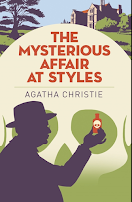 The Mysterious Affair at Styles - The first Agatha Christie novel, and the first Poirot, this feels like a bloodless affair in the wake of Chandlers continual callousness and Stout's colorful domesticity. It is the classic Manor Mystery where the suspects are all in the house the night of the murder and everyone has a motive somewhere along the line. Christie wanted to write a mystery where she plays fair, and gives all the clues needed to solve the puzzle, but the passage of a hundred years made this reader sail past the pertinent clue in identifying the murderer. Yet it has a clockwork logic to it and a very British reserve that contrasts with the other books described in this post. The character with the most personality is narrator Hastings - Poirot's expository sidekick in the style of Doctor Watson and Archie Goodwin - who falls for one of the suspects. This particular edition was another trade paperback, nicely presented and large-formatted.
 And that's it for the Plane Books of 1924. The thing that strikes me in this mystery reading is the frame holding the mystery is sometimes more engaging that the mystery itself. Dorothy Sayers has a very political in her writing. Stout (and his successor) takes New York City and turns it into a cozy place for the occasional killing. Chandler reveals the LA outside his window, and Christie gives a tour of the upstairs/downstairs life in the interwar years. The books are centered on the mystery, but what makes them successful is what they're really about.
And I'm looking at stocking up for next year's trips. There will be fewer of them, but they will still be there.
More later.
November 24, 2024
Theatre: Holiday Mood
Snowed In (Again) by Corinne Park Buffelen, Music composed by David Taylor Gomes, Directed by Kelly Kitchens. Arts West through December 22.
 Ah, with the first windstorm shaking the last leaves off the broadleaf maples and causing widespread power outages, the first holiday play of the season is now upon us, and just before Thanksgiving as well. Last year Arts West put together a revue centered around four actors (and a pianist) going to a cabin in the mountains to work on a Christmas Show and getting ... snowed in.
It was fun. And so we do it again this year. New cast, similar cabin, tasked with putting together a SEQUEL to the previous show. So we get a mixture of songs from the previous year ("Bonita the Sexiest Christmas Elf") with a few newcomers (Grampus" - a wonderful paen to family holiday gatherings with that Grinchic patriarch), along with interstitial material dealing with family traditions and paralyzing deadline pressure. And Olive (the Other Reindeer) makes a return as well.
And the cast is in fine voice and high spirits - Lauren Drake, Ays Garcia, Alexander Kilian, and Brandon Reil as the "new kids" ensemble, Aaron Jin on the keyboard. And they are excellent, though competing with Sarah Russell's rendition of "I'm Happy Being Hosted" is a tough lift. That's one of the challenges of doing a sequel - comparison with the original flavor. And the choreography was sharp and in places hilarious. .This year's version had less nods to Seattle and more to the season, which is cool as well.
A nit? Sure, but just one. The blocking and set design had a seat for the actors directly in front us in the front row, so I had a case of looking at the back of the actor's heads. And butts. Not that there's anything wrong with that. And it was amusing to see Alexander Killan curled up in a fetal position from the sudden stress of creating an all-new show with the old material. So there's that.
The humor is broad, the actors are spirited, the feelings are grounded. No heavy stakes, no character arcs, no (major) lessons learned. It is very much a Holiday Revue, put together with heart and soul. Yeah, it was fun and a great way to enter the holiday season.
More later,
November 22, 2024
Bomb Cyclone
So, I'm writing this from a friend's house, about 15 minutes south of Grubb Street. Because Grubb Street is currently without Internet.
You may have heard that the Puget Sound was hit recently by a "Bomb Cyclone", which is a scary term and in real life is no picnic either. A Bomb Cyclone is a tropical depression that develops quickly (The Bomb part) over the ocean, creating high winds (The Cyclone) along its periphery. It is not a hurricane, though it can have hurricane-force winds.
And what it does is pull in air from the surrounding area to power those winds. And in the Seattle area, this means that said winds get pulled through the mountain passes to the east of us. The passes are currently closing due to snowfall already, but the winds get HOV access. These winds get concentrated by the passes before blasting into the more settled foothills.
And that's why its a bad thing for those foothills. Whenever we get a bad windstorm, it's because the winds are coming out of the east, being pulled through the mountains. That's the case here.
Power went out at the height of the storm and stayed out for about 9 hours. The Lovely Bride had years ago (after the last outage) purchased a large cinder-block-sized battery and so got to hook up her CPAP machine there. I did not, and didn't want to take the chance of draining her battery too much. But we had some level of preparation. And we still had land-lines phones, functional cell phones, a gas stove in the bedroom and a gas stovetop in the kitchen. So we were not knocked down to "Little House on the Prairie" status. But a lot of folk (like, hundreds of thousands) lost power and a lot of them still don't have it restored, particularly in the valleys leading down from those windswept passes.
Anyway, nine hours. Good work on the recovery from Puget Sound Energy. Our neighbors are on another line, and they are still out, but have an extension cord long enough to plug into our socket near the back yard, so their freezer is still running.
But also, as the storm passed through, a large branch from one of the firs out front came down and neatly severed our Internet cable. So even when power got restored, we still were without Internet. So we called Comcast, and they sent out a guy. Guy shows up and explains that the area still does not have Internet service at large (something about a nearby Node being out), and until they repair the Node, they can't re-hook up the house. Something tells me that the "Node" may be on the same line as our unfortunate neighbors, so we'll have to wait until power comes back up for them, and then they can fix the node. And THEN they can come back an hook up the house again.
No, Comcast has no idea when all this is going to happen. The guy's suggestion was to keep calling in to complain. Yay.
Anyway, we are Internet-less for the immediate future. A road crew from Kent came by the morning after the storm and cut up the fallen branch and hauled it away (just as was coming out of the garage with a handsaw in hand and my face set with grim determination). So, good work Kent Road Crew. And Wednesday morning consisted of cleaning up the mid-sized branches. Thursday is when we got the bad news that Comcast was neither as cool as Puget Sound Energy or the Kent Road Crew. And by Thursday afternoon I was already looking for a way to get back online.
Yahsee, my current gig (Senior Writer for Elder Scrolls Online - I don't know if I mentioned that), requires I get online to communicate with coworkers and put things into the engine. So no connectivity, no work. It was a forced vacation, and while I still had some PTO left for the year, I was planning on spending it elsewhere. And after two days of quietly reading in a warming waterbed, I was pretty much chomping at the bit to get back to it.
So, I made some phone calls. Some friends were still without power at that point, but one had both power and connectivity, and I hauled my desktop down to his place and set up on his usually-unused dining room table. And then had to get a "wifi usb dongle" to hook everything up to the friend's Internet (at home I use a long ethernet cable plugged directly into the router). But now I am back in business, such as it goes, for the foreseeable future. Just in time to lay down my tools for Thanksgiving.
I will update this when/if we get to the stage where I return to my former haunts. In the meantime, I am in a bit of exile here. But at least I can contact the outside world again.
More later,
Jeff Grubb's Blog

- Jeff Grubb's profile
- 192 followers

