Barry Clark's Blog, page 3
July 2, 2018
America’s Great Cultural and Political Divide
America is more divided culturally and politically than at any time since the 1850’s. Real and authentic dialogue does not occur and violence and the threat of violence increase daily. We are on a precarious path with potentially dangerous outcomes.
In 1850 one of the greatest debates in American, perhaps world history occurred. On one side Daniel Webster, master wordsmith and by 1850 a severe alcoholic. On the other, John C. Calhoun, a man debating literally from his deathbed.
Calhoun has of course been much maligned of late, being a white southern man that supported states’ rights. Danial Webster sits somewhere in the paragon of American greats. This despite the fact the Compromise of 1850 did not prevent war, it merely made is inevitable and much bloodier that had the issue been resolved politically, diplomatically or militarily in 1850. Webster’s reputation is also untarnished by the provable and obvious fact that his arguments were intellectually dishonest. He often argued in the style later familiar as “we have to define what ‘is’ is”. “Accede” was one such word that Webster attacked vigorously in an attempt to make a claim that the founders never used such a word to describe the acceptance by the states of the Constitution in 1787. [1]
Of course, accede was a word used, and often, to describe the ratification of the new constitution. Here are but three examples.
“If these, with the States eastward and northward of us, should accede to the Federal government . .” George Washington [2]
“The Constitution has been ratified by all the States; . . . Rhode Island did not accede to it, until more than a year after it had been in operation;” Justice Story [3]
Father of the Constitution, James Madison, “used the expression ‘to accede’ in the Convention of 1787, in order to denote the act of adopting ‘the new form of government by the States.'” [4]
Webster knew well that accede was both used and that it represented the actual mindset of sovereign states ratifying a constitution that delegated specific powers to a new central government. Accede was a problem and had to be purged, because the antonym of accede is secede – you must actually look in the Oxford dictionary for that obvious truth, Meriam-Webster does not reflect this, how odd false narratives and alternative truth is. (Daniel had no relation to the Webster dictionary but the political take of the revisionist language is still obvious)
Webster argues in 1850 that words had meaning, it appears that if standard meanings do not fit the narrative then the thing to do is to simply try and change the definition.
Despite those facts, the debates surrounding the Compromise of 1850 came close to real dialogue, much closer than what followed and near than what we witness now.
Move forward to 1856 and all façade of honest intellectual debate had disappeared. Both sides hurled vitriolic and personal attacks against each other. Lies, misrepresentations and falsehoods filled fiery speeches and diatribes. In the heat of all of this Charles Sumner had the particular bad judgment to go a bit too far one day in May of that year. Two days later, Preston Brooks responded, repeatedly with a cane to Sumner’s head – on the Senate floor no less. [5] That action is something one might expect in the Roman Senate during the waning decades of the Empire. There is a lesson here.
America has not been so divided since the decade of the 1850’s. The shooting incident at a 2017 Republican congressional baseball practice is not an event that exists in isolation. I suggest it represents the Sumner-Brooks episode of our time.
Consider the results of a Pew Research Center study. [6]
“The divisions between Republicans and Democrats on fundamental political values – on government, race, immigration, national security, environmental protection and other areas – reached record levels during Barack Obama’s presidency. In Donald Trump’s first year as president, these gaps have grown even larger.” [7]
Take just one criterion used in the study for instance.
“Racial discrimination. In recent years, Democrats’ views on racial discrimination also have changed, driving an overall shift in public opinion. Currently, 41% of Americans say racial discrimination is the main reason many blacks cannot get ahead – the largest share expressing this view in surveys dating back 23 years. Still, somewhat more Americans (49%) say blacks who cannot get ahead are mostly responsible for their own condition.” [8]
That difference of opinion defines much about a person’s worldview and there is really not much room for compromise of agreement between those two polls. On one end is an ideology that the government must essentially regulate opportunity, on the other the idea that America is the land of opportunity. Those are very different positions but those differences are found in almost all social and economic policies left and right. This represents a fundamental difference in philosophy, one where there is no easy middle ground. People either believe in individual responsibility, hard-work and the American dream or they believe that government must fix and control most things.
This difference is profound, and it is expressed more and more dishonesty and with growing hate. Recently a PhD I am acquainted with was describing an organization and bemoaning their ineptitude. He said, and I paraphrase. “well it is run by a bunch of white men”.
I assume this man is intelligent enough to have sat in classrooms for a large portion of his life and to convince others that have spent their life in academia to bestow upon him the title of doctor. I would assume he could see the absurdity and hypocrisy of his utterance – yet he did not and cannot.
Here is a thought exercise for you. Go into an office, boardroom or on television and say “well, you know, that organization is run by a bunch of black women/Latinos/homosexuals/etc.”. Ordinary people just don’t do that. The backlash would be immediate. It would be viewed as racist, insensitive and ignorant.
It is not, however, and apparently, racist in our current order of things to say what my acquaintance said about old white, presumably Christian, heterosexual men, and to say it and intended it with disdain, loathing and subtle hate. We have entered our version of the 1850’s.
There is more of course. Political debate and dialogue across the spectrum have degraded into attacks, falsehoods and smears. Political debate, a real debate about ideas, simply do not happen either in government or academia. Certain elements have defined the idea of free speech as their “right” to get together with a few of their clown friends and shout down anyone that says anything they do not like. This happens all the time on college campuses.
I sense that there is real fear on the right about groups like Antifa. I suspect there is real fear on the left within folks that sympathize with Antifa about the right. Violence has already occurred.
In June of 2016, NPR ran a piece examining if left-wing violence was increasing. NPR is a fairly left-leaning organization so one might expect a complete pass on the matter. The article not only acknowledged the marked increase in a propensity toward violence, it concluded with:
“Domestic terrorism experts say that concern is only heightened by the fact that the line between what’s considered mainstream and what’s considered fringe is becoming increasingly blurred.” [9]
The NPR piece was partially in response to an editorial published in The Washington Times by Judson Phillips that began with:
“The first skirmishes of a second American civil war have begun.
No, this is not a metaphorical analogy to that bloody conflict that killed approximately 620,000 Americans. It is an objective statement of the reality in America.” [10]
I contend that we have entered the age of bloody Kansas and there are numerous John Brown proto-terrorist types stirred up, mad as hell and not ready to take it anymore. I would only disagree with the phraseology, we are on a path toward our first actual civil war, the war of 1861-1865 was a war independence.
The Atlantic published a piece in September of 2017 that began with one example of how disconnected some elements have become form common-sense.
“Since 1907, Portland, Oregon, has hosted an annual Rose Festival. Since 2007, the festival had included a parade down 82nd Avenue. Since 2013, the Republican Party of Multnomah County, which includes Portland, had taken part. This April, all of that changed.
In the days leading up to the planned parade, a group called the Direct Action Alliance declared, ‘Fascists plan to march through the streets,’ and warned, ‘Nazis will not march through Portland unopposed.’ The alliance said it didn’t object to the Multnomah GOP itself, but to ‘fascists’ who planned to infiltrate its ranks. Yet it also denounced marchers with ‘Trump flags’ and ‘red maga hats’ who could ‘normalize support for an orange man who bragged about sexually harassing women and who is waging a war of hate, racism and prejudice.’ A second group, Oregon Students Empowered, created a Facebook page called ‘Shut down fascism! No nazis in Portland!’”
Next, the parade’s organizers received an anonymous email warning that if “Trump supporters” and others who promote ‘hateful rhetoric’ marched, ‘we will have two hundred or more people rush into the parade … and drag and push those people out.’ When Portland police said they lacked the resources to provide adequate security, the organizers canceled the parade. It was a sign of things to come.” [11]
The Oxford dictionary defines terrorism as: “The unlawful use of violence and intimidation, especially against civilians, in the pursuit of political aims.” The threat of violence depicted above certainly meets the definition of a terroristic threat, it was intended to silence political speech through the threat of and if necessary the use of violence.
I am honest enough to admit this is not merely a leftist thing. It is entirely possible that disaffected sections of the right could turn to the sort of violence exhibited by the left at some point in the future, either in reaction to violence or because of some perceived wrong. I also would challenge anyone the point out specific examples of organized, sustained violence by right-leaning groups in the US since the 1960’s, excluding some isolated examples by neo-Nazis in the Pacific Northwest in the 1980’s. But Neo-Nazis have never represented anything like the numbers the extreme left does. The extreme left has become something of the mainstream, calling out big-name support and attendance at their events.
This not the case for right-leaning extremist. There is no there there, it does not happen. It could, we sit on just that sort of powder keg, but it does not occur. I would contend that in the current state where dialogue cannot occur and violence, bully by agitated protest, and uncivil behavior continue there absolutely will be more violence, from all sides in the future.
Donald Trump will not go away, he will continue to execute policies that make people like Robert DeNiro foam at the mouth and utter profanities. And it will only get worse. Trump will likely appoint a very conservative Supreme Court justice this year that will shape the law for many years. There is always the possibility that one of the other aged justices might die or be forced to retire in the next two years. None of this will sit well with progressives and liberals. Trump will continue to be Trump and his core supporters will remain “deplorable”. There is much more anger yet to come from liberals.
In 2000 Michael Peirce wrote a piece originally published on LewRockwell.com and eventually included in The Annotated Secessionist Papers that was filled with the anger, frustration and palatable rage many conservatives felt after eight years under a Clinton administration. Mr. Peirce was ready to leave the entire union by that juncture. [12] The interesting thing is Mr. Peirce and folks like him on the conservative side never found their answers in the first decade of the 2000’s. George W. Bush was mired in wars and Obama was as much anathema to traditional Americanism as Clinton to them. Clinton and Obama set the stage for a Trump to exist – their leftist policies swung the right further to the right. Trump will do and has done the same for the left, I would not be surprised to see an avowed socialist actually win the next election. This will serve only to divide us more.
We, in America, are in a real mess and I have no idea how to fix this. Neither vocal minority. left or right, wants to be lorded over by policies of the other, nor at this point will either long tolerate it. The potential for violence has already been expressed in direct and overt action and there is no sign that this will cease. We must either figure out a way to exist as Calhoun’s concurrent majorities, or a way to allow our individual states to better represent the culture of their populations or we must peacefully break it all apart into smaller pieces. To simply ignore the storm on the horizon is folly, hail has already damaged the roof and there is much worse to come.
[1] Bledsoe, Albert Taylor, “Is Davis a Traitor: Or Was Secession a Constitutional Right Previous to the War of 1861?”, Hermitage Press, 1907, pp. 13-17,
[2] ibid.
[3] ibid.
[4] ibid.
[5] Wikipedia contributors. “Caning of Charles Sumner.” Wikipedia, The Free Encyclopedia. Wikipedia, 22 May. 2018. Web. 2 Jul. 2018.
[6] “The Partisan Divide on Political Values Grows Even Wider”, The Pew Research Center, October 5, 2017
[7] ibid.
[8] ibid.
[9] “FACT CHECK: Is Left-Wing Violence Rising?”, NPR, June 16, 2017
[10] “Resist movement, violence are tearing America apart Antifa, others terrorizing America”, The Washington Times, June 14, 2017
[11] “The Rise of the Violent Left Antifa’s activists say they’re battling burgeoning authoritarianism on the American right. Are they fueling it instead?”, The Atlantic, September 2017
[12] Peirce, Michael, et. al. “The Annotated Secessionist Papers” Second Edition, The Calhoun Institute, pp. 70-79
References
Bledsoe, Albert Taylor, “Is Davis a Traitor: Or Was Secession a Constitutional Right Previous to the War of 1861?”, Hermitage Press, 1907.
Wikipedia contributors. “Caning of Charles Sumner.” Wikipedia, The Free Encyclopedia. Wikipedia, 22 May. 2018. Web. 2 Jul. 2018.
“FACT CHECK: Is Left-Wing Violence Rising?”, NPR, June 16, 2017.
“The Rise of the Violent Left Antifa’s activists say they’re battling burgeoning authoritarianism on the American right. Are they fueling it instead?”, The Atlantic, September 2017.
Clark, Barry, et. al. “The Annotated Secessionist Papers” Second Edition, The Calhoun Institute.
The post America’s Great Cultural and Political Divide appeared first on The Calhoun Institute.


June 23, 2018
The Annotated Secessionist Papers, Second Edition
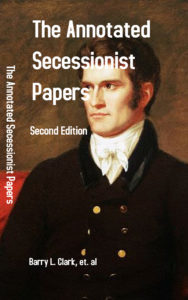
The Annotated Secessionist Papers, Second Edition is now available on Amazon in paperback and for Kindle.
Description: A collection of essays, articles and papers, in the tradition of the Federalist and Anti-Federalist Papers, that discuss secession from a legal, constitutional and historical perspective.
The post The Annotated Secessionist Papers, Second Edition appeared first on The Calhoun Institute.
March 10, 2016
Dismantling the Unitary Electoral System? Uncooperative Federalism in State and Local Elections
Dismantling the Unitary Electoral System? Uncooperative Federalism in State and Local Elections
Michael T. Morley, Barry University School of Law, March 5, 2016, 110 Northwestern University Law Review Online ___ (2016 Forthcoming)
Abstract: Most Americans assume that we have a “unitary” system of elections, particularly for general elections. Although many federal laws govern only federal elections, states have generally chosen to apply them to state and local elections, as well. As a result, a person typically is either a “voter” eligible to vote in general elections for offices at all levels of government, or a “non-voter” who is ineligible to participate at all. The unitary status of American elections has likely evolved into a convention: a principle that lacks the force of formal law that people nevertheless expect to limit government officials’ discretion.
A few states have begun to challenge the convention of unitary elections. These states, such as Arizona and Kansas, have engaged in uncooperative federalism by exercising their power to implement different rules for state and local elections than federal law imposes on federal races. While their actions represent a sharp break from states’ consistent practice over the past decades, it is a valid exercise of those states’ constitutional prerogatives. Moreover, the federal government must share at least some of the blame for undermining the norm against unitary elections. The U.S. Election Assistance Commission has refused exercised its discretion to modify the federal voter registration form to allow states to request documentation confirming that people registering to vote are, in fact, U.S. citizens, as state law requires.
The federal government has adopted a policy heavily favoring the “affirmative” right to vote, by making it easy for people to register to vote and hard for states to remove people from the voter registration rolls. This policy makes it more likely that states will engage in uncooperative federalism and seek to dismantle their unitary election systems by adopting more balanced policies that place equal emphasis on the “defensive” right to vote, protecting the value of eligible voters’ ballots by ensuring they are not diluted or effectively nullified by non-citizens’ votes.
Number of Pages in PDF File: 17 Available at SSRN
[CI] As Morley points out this is an entirely valid application of state Constitutional prerogative – if only states would exercise their prerogatives more extensively. It is arguable that one should “defend” their “right” to vote by taking positive actions, as opposed to automatic registration as is practiced in at least two states.
March 6, 2016
The Classical Limits to Police Power: Adam Smith and the Economic Foundations of the Slaughterhouse Dissents
The Classical Limits to Police Power: Adam Smith and the Economic Foundations of the Slaughterhouse Dissents
Nicola Giocoli, University of Pisa. March 5, 2016, http://ssrn.com/abstract=2742517
Abstract: The paper examines the influence of classical economics on an important episode in the American 19th-century jurisprudence on business regulation, the Slaughterhouse Cases of 1873. Law historians know well that the dissents penned in that occasion by Supreme Court Justices Field and Bradley lay down the fundamental doctrines of the later Lochner era of laissez faire constitutionalism. The paper argues that these dissents were inspired by Adam Smith’s system of natural liberty and, in particular, by his views about the regulation of negative externalities and the undesirability of government-granted monopolies. The Smithian influence emerges even more clearly when the outstanding briefs presented by counsel for the plaintiffs John A. Campbell are also taken into account.
Number of Pages in PDF File: 30
March 3, 2016
The Revival of States’ Rights: A Progress Report and a Proposal
The Revival of States’ Rights: A Progress Report and a Proposal
Lynn A. Baker, University of Texas School of Law, 22 Harvard Journal of Law and Public Policy 95 (1998)
Abstract: This is an edited version of remarks presented at the 17th Annual National Federalist Society Symposium on “Reviving the Structural Constitution” in March 1998. Focusing on the U.S. Supreme Court’s decisions in United States v. Lopez (1995) and Printz v. United States (1997), it offers both a brief progress report on the Court’s seeming revival of states’ rights and some suggestions for how the Court might proceed in the future.
Writing for the Court in Gregory v. Ashcroft, Justice O’Connor observed that “[iln the tension between federal and state power lies the promise of liberty.” For those of us who share Justice O’Connor’s view that judicial affirmations of states’ rights are guarantors of liberty rather than harbingers of slavery, the 1990s have been a time of cautious optimism. With its decisions in New York v. United States,2 United States v. Lopez A Seminole Tribe v. Florida, Printz v. United States, and City of Boerne v. Flores the Court has signaled a willingness to resume its too long-ignored duty to enforce the Constitution’s protections for state autonomy
Number of Pages in PDF File: 12
[CI] Eight years on and the candle of hope this paper may have portended has expired.
Publius’s Political Science
Publius’s Political Science
John A. Ferejohn, Roderick M. Hills, Jr., New York University School of Law, February 1, 2016, NYU School of Law, Public Law Research Paper No. 16-03
Abstract: “Publius,” the collective author of The Federalist, was not just a polemicist and normative theorist but also a political scientist. We argue that the political psychology, and institutional predictions that comprise The Federalist are best understood as political science, because the predictions could be – and were – revised in light of “that best oracle of wisdom, experience” (Federalist 15). After outlining some “maintained hypotheses” about human nature that undergird The Federalist, we describe three respects in which James Madison revised, in light of post-1790 experience, Publius’ institutional predictions. The Federalist pressed the view that the national legislature would be the most powerful branch, requiring the Constitution to bolster the implied powers of the executive, limit states’ power, and dampen direct popular participation by the People themselves. After the successes of Hamilton’s initiatives demonstrated the potency of the Presidency during the 1790s, Madison radically revised all three of these institutional predictions, calling for limits on implied presidential powers, a broad construction of states’ reserved authority, and, most dramatically, popular participation through disciplined political parties. Rather than view these revisions as abandoning the political theory of The Federalist, we argue that Madison and Hamilton both retained Publius’s foundational normative assumptions, while revising their predictions about institutional behavior in light of the empirical evidence – precisely the proper response of an empirically oriented political scientist. In this sense, Hamilton’s and Madison’s post-ratification breach was less a retreat by either from Publius’ political theory and more a confirmation of the status of The Federalist as, in part, political science revised in light of political experience.
Number of Pages in PDF File: 47
[CI] Alternatively, the post ratification change of perspective may actually illuminate some truths in the pre-ratification antifederalist arguments.
Repairing the Irreparable: Revisiting the Federalism Decisions of the Burger Court
Repairing the Irreparable: Revisiting the Federalism Decisions of the Burger Court
David Scott Louk, University of California, Berkeley, School of Law, Students , April 20, 2015, Yale Law Journal, Vol. 125, p. 682, 2016
Abstract: The text of a Supreme Court opinion rarely tells the full story of the debates, discussions, and disagreements that resulted in a particular decision. Drawing on previously unexamined archival papers of the Justices of the Burger Court, this Note tells the story of the Burger Court’s federalism jurisprudence between 1975 and 1985, famously bookended by a pair of rare and abrupt reversals of Supreme Court precedent. The Note documents the Justices’ deliberations for the first time, sheds new light on the institutional workings of the Court, and enriches our understanding of the foundations of modern federalism. In its federalism cases, the Burger Court grappled with the challenge of balancing the states’ autonomy against the rise of new national problems and an expanding federal government’s solutions to them. The Justices’ papers show that they were more attuned to policy outcomes and the real-world consequences of their decisions than may typically be assumed. Above all, the papers reveal the Burger Court’s deep struggle to articulate a sustainable federalism jurisprudence given the constraints of judicial craft. As the Note concludes, however, the Burger Court’s uneven federalism experiments nonetheless laid the groundwork for the Court’s subsequent attempts to fashion more workable doctrines. The Rehnquist and Roberts Courts have adjudicated federalism disputes more effectively by avoiding impracticable doctrines and remaining mindful of the institutional limitations of courts as federalism referees.
Number of Pages in PDF File: 47
Globalization and the Growth of Executive Power: An Old Story
Globalization and the Growth of Executive Power: An Old Story
Alasdair S. Roberts, University of Missouri at Columbia – Truman School of Public Affairs, February 19, 2016, Indiana Journal of Global Legal Studies, 2016, Forthcoming
Abstract: Prepared for the annual symposium of the Indiana Journal of Global Legal Studies, Maurer School of Law, March 3-4, 2016. Americans have always worried about an undue concentration of power in the executive branch — and recently, there is concern that globalization might be aggravating the problem. But the concern is overstated, or at least misstated. Globalization is not a new phenomenon, and most of its effect on executive power was realized decades ago. Today, globalization might actually be corroding executive power, either because it undermines the power of the nation-state, or shifts authority to technocrats. If there is a general tendency toward increased executive power in the twenty-first century, this is more directly attributable to other factors, such as improvements in information technology, intensified electoral competition, and the weakening of legal checks on the accumulation of authority in the executive branch.
Number of Pages in PDF File: 18
[CI] This is an interesting take on an old fear. Perhaps globalism and the rise of extra-national technocracies has affected the relative gravitas of executive power as seen traditionally. It is also possible that this shift is but a new phase of government building. What is now rather loose associations and confederations of nation-states, held together by emerging international law, treaties and agreements may someday turn into the central government that observers worry is investing too much power in its executive.
This would fit with the trend in the West since 1648, consolidation from loose association to consolidation within unions of large states of power centrally. What this paper my be hitting at on the margins is that perhaps we live in the proto-federal phase of a global central government.
How the Constitution Became Christian
How the Constitution Became Christian
Jared A. Goldstein, Roger Williams University School of Law, February 27, 2016, Roger Williams Univ. Legal Studies Paper No. 167
Abstract: Although the Constitution is conventionally portrayed as the embodiment of what it means to be American, it is more accurate to describe the Constitution as the battleground over which disputes over national identity are fought. This article illustrates the dynamics that transform conflicts over national identity into constitutional issues by examining three episodes in the recurring debate over whether the United States should be considered a “Christian nation” — the nineteenth-century movement to add an expression of Christian faith to the Constitution, mid-twentieth-century Judeo-Christian nationalism, and the New Christian Right that began in the 1970s. These episodes reveal that over the past century a shift has occurred among Christian nationalists, who have moved from denouncing the Constitution as a godless document unworthy of a Christian people to lauding the Constitution as an expression of the nation’s Christian identity.
This article asks how the Constitution became (for many Americans at least) Christian.
The answer lies in America’s constitutional culture, which channels conflicts over national identity into constitutional disputes. The episodes examined here follow a similar pattern. In each case, members of a dominant religious group mobilized in response to perceived threats to their status — from Catholics, immigrants, Communists, and secular humanists. In each episode, members of the movement believed Christian devotion to be part of America’s essence and therefore considered threats to Christian dominance as attacks on America itself. And in each case, the movement attempted to preserve the nation’s supposedly Christian identity by making constitutional demands, either to amend the Constitution to proclaim the nation’s Christian devotion or to interpret the Constitution to be Christian.
Through this recurring pattern — in which a threat to group status is seen on nationalist terms and mobilizes a movement to make constitutional demands — fights about what it means to be American become fights over the meaning of the Constitution. Rather than embodying what it means to be American, the Constitution provides a seemingly neutral and patriotic language for making claims of national inclusion and exclusion, for asserting that some people and some values are authentically American, while others are dangerously foreign and must be rejected.
Number of Pages in PDF File: 67
Goldstein, Jared A., How the Constitution Became Christian (February 27, 2016). Roger Williams Univ. Legal Studies Paper No. 167. Available at SSRN: http://ssrn.com/abstract=2739069
March 2, 2016
Law’s Culture: Conservatism and the American Constitutional Order
Law’s Culture: Conservatism and the American Constitutional Order
Bruce P. Frohnen, Ohio Northern University College of Law, 2004, Harvard Journal of Law and Public Policy, Vol. 27, p. 459, 2003-2004
Abstract:
This article argues that most contemporary analysts, whether claiming allegiance to the ideological left or right, misunderstand the nature and especially the fundamentally cultural character of American constitutionalism. Beginning with an explication of American “cultural” conservatism as presented by thinkers such as Russell Kirk, the author proceeds to an analysis of the bases of the American constitutional order emphasizing the role of history in the formation of its structures and normative traditions in their maintenance and enforcement.
Number of Pages in PDF File: 30
[CR] An excellent analysis of Kirk’s view of the Constitution that the document was intended to protect from democratic excesses, i.e. the majority voting for themselves the proceeds of other’s labor through taxes and social programs.
John C. Calhoun notes that taxation divides the community into two great antagonistic classes, those who pay the taxes and those who benefit from them (1850) (OLL)