Gary Lloyd's Blog, page 6
May 31, 2022
Leadership Trussville inaugural class deadline June 3
TRUSSVILLE – The newly-formed Leadership Trussville seeks community leaders to join its inaugural class. The deadline to apply for consideration is this Friday, June 3, 2022, by 5 p.m.
The Board seeks class members who, among other things: demonstrate leadership through their current professional positions; exhibit a diversity of educational backgrounds; hold positions of leadership in the community; represent a broad cross-section of business and professional disciplines; and demonstrate a commitment to full participation and successful completion of the program.
Those interested may apply via Leadership Trussville’s online application process.
Following an overnight kickoff/retreat in September, class members will participate in one class day per month starting in October. Each class day will have a full-day focus on various city aspects (e.g., business, education, government, healthcare). The class culminates in May 2023 with group presentations and a graduation ceremony.
Leadership Trussville is a non-political, non-governmental, independent 501(c)3 nonprofit governed by a Board of Directors. The purpose of Leadership Trussville is to encourage and educate an annual class of highly motivated individuals who want to strengthen their leadership skills, deepen their sense of civic involvement, and be more involved with ideas and initiatives to better the Trussville community while learning first-hand about the issues and needs in Trussville.
For more information, please email admin@leadershiptrussville.org or reach out to a member of Leadership Trussville’s Board of Directors.


May 24, 2022
Trussville: 75 years as a town
By Gary Lloyd
TRUSSVILLE – If you’ve found your way to this blog post, thank you. I hope you scroll until the end. I hope you hit the share button or tell a relative to read this. I hope you learn something.
On June 10, Trussville will mark its 75th anniversary of incorporating as a town. Not a city, but a town. Know the difference? Population. A town includes 2,000 or fewer people, while a city surpasses 2,000 residents.
In 1947, when Trussville incorporated as a town, it included 1,443 residents. Ten years later, when it became a city, its population had increased to 2,161 people. Trussville, as of the 2020 Census, is home to 26,123 residents.
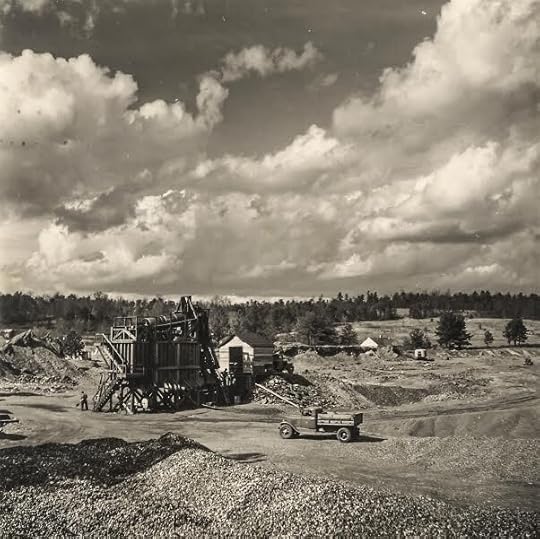 Construction of the Cahaba Project during the 1930s (photo courtesy of Alabama Department of Archives & History)
I’m not an elected official, nor a historian, nor someone who lived through any of the most historic times in these city limits, but I think the history here in Trussville is unique in Alabama, in the United States.
June 10 marks the 75th anniversary of Trussville incorporating as a town. It officially became a city on May 31, 1957. At the Aug. 22, 1946 Cahaba Community Association meeting, pros and cons of incorporation of Cahaba alone — the Cahaba Project, a government housing development — and also of including Trussville, was discussed. It was suggested that the people of Trussville advise the government that they desired to be included in the corporate limits. A motion was passed unanimously to form a plan of incorporation and operation of a city government to serve both Cahaba and Trussville.
It was unanimously agreed on Sept. 24, 1946, that the incorporated municipality should include both Cahaba and Trussville. A March 11, 1947, letter from the Federal Public Housing Authority briefly outlined the proposed incorporation of the town of Trussville. The letter stated that the Cahaba Project was a fine example of planning for semi-subsistence homes that would be protected from the uncontrolled growth of its neighbor, Trussville. All minor streets had been planned that their connections with Trussville were made by way of Chalkville Road or Parkway Drive.
“The time has come now to join these separate communities as an Incorporated Town,” the letter stated. “In order to do so there must be more direct connections between the two communities and a pooling of their interests so that a well organized community will be attained.”
The letter recommended that both sides of the Cahaba River be dedicated as park lands, as well as The Mall and triangular area near present-day Brentwood Avenue. The grassy area between Magnolia Court and Hewitt Street was also recommended to be kept as park land.
On June 2, 1947, an election was held to determine whether to incorporate the town of Trussville into a city form of government. The election carried and all property owned by the Federal Public Housing Authority with four legal voters per 40 acres of land was included in the area to be incorporated. The Cahaba Project was absorbed into the town of Trussville when it was incorporated on June 10, 1947.
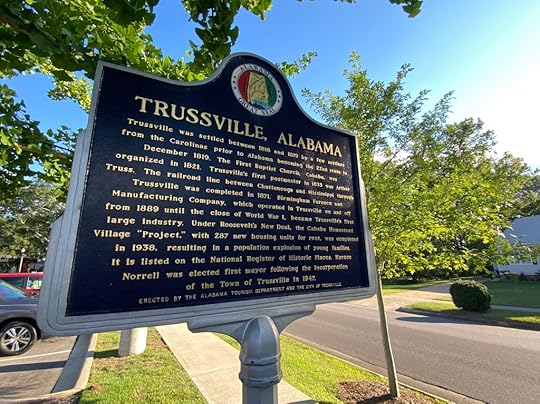
Trussville historical marker sign outside the Trussville Public Library (photo by Gary Lloyd)On July 21, 1947, an election of a mayor and five aldermen was held. Horace Norell was elected mayor, and elected as aldermen were Mary Lou Farley, George A. Glenn, Alton Williams, John Yarbrough and Richard Beard. The homes and duplexes in the Cahaba Project were sold to individuals in 1947, at prices ranging from $4,400 to $9,000 each.
That is a long way – well, a long way if you’re accustomed to 140-character news in 2022 – to tell you that I wrote about the 75th anniversary of Trussville, of its rich history, for the Cahaba Sun’s June 2022 issue. Here are my history-focused stories for that issue:
Dedicated to history: Impact of Trussville man’s research, preservation still felt today – This cover story is about Earl and Carol Massey’s historic preservation efforts in Trussville. Believe me, you want to read this story.
Movie on the Mall to coincide with 75th anniversary – Come to The Mall in Trussville on June 10 for a movie from 1947, historical artifacts, food trucks and more. I’ll see you there.
Trussville museum offers deep look into city’s past – I have spent a lot of time at this museum, a small room that not many residents, to my knowledge, have visited. Please come and spend some time here. Make sure to check the Trussville Historical Board’s Facebook page to stay up to date on when the museum is open.
75 years of growth – Enjoy statistics? This is the historical statistics of Trussville story for you.
May 18, 2022
Basketball in the summer
By Gary Lloyd
I was leaving the house one night recently, headed to Publix for at least the third time that week, when I saw it.
Resting on a sewer top in my neighborhood was a red, white and blue basketball, the type that Julius Erving dominated with in the American Basketball Association before that league merged with the NBA in 1976.

Just a glimpse of a basketball in the dark reminds me of summers past. It’s what we did most summers growing up. I remember playing 21 with neighborhood buddies in my driveway. My next-door neighbor and I practiced almost daily in our driveways, me shooting three-pointers and him throwing down slam dunks. We only broke a garage door window once.
We jogged across Queenstown Road to the Hidden Trace neighborhood, dribbling basketballs. We had slam dunk contests on old hoops we lowered with the help of a broom handle. I remember the burn of June pavement on my wrist and forearm from a failed one-handed jam. Every Christmas, I unwrapped a new Wilson or Spalding basketball to replace the year-old one that I had dribbled into shreds of leather. Those basketballs experienced more weather than Columbia boots. They became waterlogged during April showers, almost melted into the asphalt in June and July, were stained yellow by August pollen, and lost their leathery grip in the fall months.
Those were the days.
I don’t see basketballs outside much anymore. I see an electric mini-motorcycle blazing down the street and something that the youths tell me is a Segway self-balancing scooter. Those kids aren’t dribbling or running or even walking, but at least they’re outside, I guess.
It seems so many kids spend their days inside nowadays, even on a cloudless summer day. They crush candy on iPads, record silly videos on something called TikTok, and, if they are playing basketball, are doing so in a climate-controlled gymnasium.
You’ll read those last couple paragraphs and call me a curmudgeon, and that’s fine. I do live a lot in the past, because, well, I like history and I miss the way many things used to be. I miss the relentless search for a specific Levi’s size in Century Plaza. I miss printing directions to Driver Stadium in Gardendale off MapQuest. I miss a CD case the size of carry-on luggage holding burnt CDs under the driver’s seat. I miss pickup basketball games on the blacktop at what is now Cahaba Elementary School.
But I’ll try to leave you with a glimmer of hopefulness for my outdoor outlook, lest you liken me to Mr. Wilson from “Dennis the Menace” or Walt from “Gran Torino.”
About 24 hours after seeing that ABA basketball on the sewer top, I was driving by again, my destination I don’t recall. I was probably headed to Publix again for Mucinex, soft-baked oatmeal raisin cookies and DiGiorno pizza. You know, the essentials. Anyway, I saw that basketball again, and it was not in the same spot as the night before.
Some kid, or hopefully some kids, had played with it again.
Gary Lloyd is the author of six books and is a contributing writer to the Cahaba Sun.
May 6, 2022
The powerful force of nostalgia
By Gary Lloyd
I never knew that an elderly woman frantically filling a notebook with stories and tips in black ink could take me back in time.
She knew an iconic author when she heard one speak, and the cramping in her fingers was worth it. After all, it was Rick Bragg up on that stage at the Trussville Public Library.
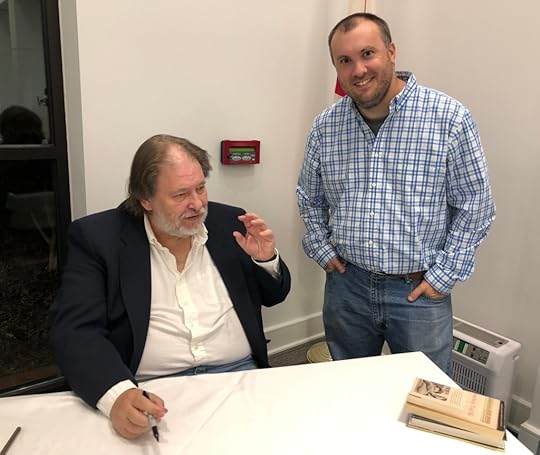 Rick Bragg talks with me May 3, 2022, at the Trussville Public Library.
I hadn’t seen Bragg in person since my last year of college, but we had stayed in touch via email and an occasional phone call. He taught a sportswriting class when I was at the University of Alabama, and I learned more in that short class than any other in my life. I still have my purple JN-491 notebook, which contains graded papers, tips and printed Sports Illustrated articles.
It was in college that I learned of Bragg and his first book, All Over but the Shoutin’. I bought it at a Books-A-Million in Tuscaloosa and read it twice in a matter of weeks. Another professor teased me about reading it so much. It’s the greatest storytelling I’ve ever read. When I finished the epilogue, I felt as if I had lived Bragg’s story.
The elderly woman sitting on the second row in the library’s auditorium must have felt the same. Bragg spoke for an hour about his mom, older brother, dog, books he had written and, famously, a story he wrote about a chicken named Mopsy that narrowly escaped the jaws of a bobcat.
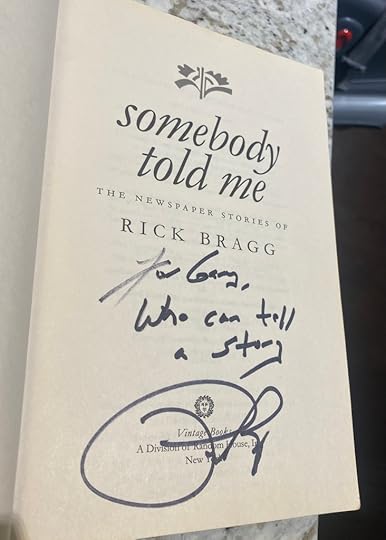 A signed copy of Bragg’s Somebody Told Me: The Newspaper Stories of Rick Bragg
He talked about biographies he wished he could have written (Hank Williams, Nick Saban) and about a modern-day fictional book he may write.
He fielded a half dozen questions about all sorts of topics, one of which came from a former full-time journalist who now writes a monthly column. One man told Bragg that he subscribes to Southern Living magazine, and when it arrives at his home, he tears out Bragg’s column to read and keep, and tosses the rest of the publication in the trash.
“Nostalgia is the single-most powerful force in the publishing world,” Bragg said to that man, and I don’t remember how a profound response like that came after such a bizarre story. “Nostalgia is powerful. People like to remember. And even if they think they don’t like to remember, they do.”
Bragg stayed after to sign books. I waited in a line that stretched out the library’s back doors to the Cahaba River. I was anxious. Would Bragg remember me? Would I have a chance to talk for any substantial amount of time?
When it was my turn at his table, I heard, “I thought that was you.” He remembered me. He signed two books, and we talked about writing and book projects. He asked me how my current project is going, and I told him that it was overwhelming, that there’s so much material to research, so many people to interview.
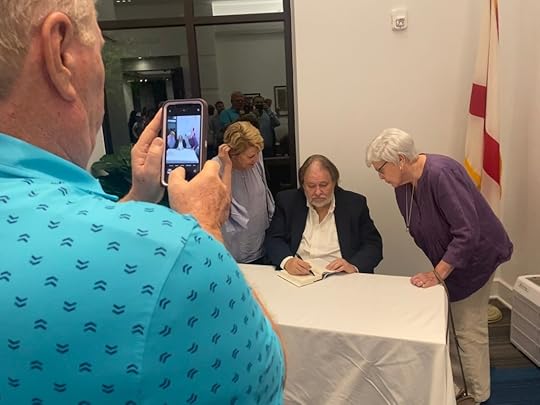 Bragg signs books at the Trussville Public Library on May 3, 2022.
Bragg told me that when a project is kicking me or throwing me off, I must react like a frog in a well.
Huh?
“You have two directions to go,” he said. “Up or sideways.”
As a reader of all his words, it’s admittedly not Bragg’s best metaphor, but it made sense. Essentially, he was telling me to keep moving in any way I can, to work as hard as I can to make this book the best one I can.
“Keep dancin’,” he said.
Gary Lloyd is the author of six books and is a contributing writer to the Cahaba Sun.
April 27, 2022
Cahaba Sun stories roundup
Here are some of my Cahaba Sun stories from the last few months:
Longtime Hewitt coach heads to Hall of Fame humble, grateful
Tuggle, Free Lawn Care win Gatekeeper Awards
Split Decision: Trussville marks 30 years since its first attempt at a school system
Hewitt-Trussville senior racks up 5 military nominations
Chase Bays plans for motorsports track in Trussville
Trussville tax renewal overwhelmingly passes
Moving Again: Trussville legislator aims to stop unnecessary train blockages
Bible Reading Marathon coming to Trussville
Celebrating Warren Truss at 250
April 21, 2022
The roads less traveled
By Gary Lloyd
Google Maps bothers me, trying to get me to my destination in the quickest, most boring way possible. The audacity.
The app seemingly goes berserk when I miss an I-59 on-ramp to three lanes of 80 mph insanity and demands that I pull a U-turn on the spot, right there in Highway 11 traffic.
I never try that U-turn, for two reasons. First, because pulling a U-turn on Highway 11 only ends at the auto repair shop, swiping an American Express card for three months’ salary. Second, because I’ve skipped that particular on-ramp on purpose, knowing I can catch the next one in Roebuck, after I’ve driven past Huffman United Methodist Church on Gene Reed Road, where I grew up and played basketball.
Google Maps needs a “Roads Less Traveled” feature, one that focuses not on arrival times and fuel efficiency, but on good times and memory efficiency.
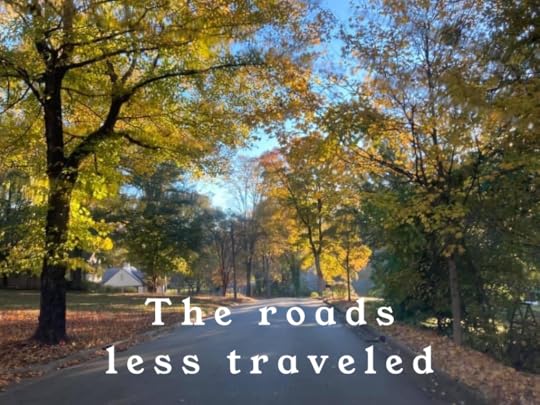
I often take what many call the “long way” to a destination. I call it the “purposeful way.”
When I cover a football game at Waldrop Stadium in Homewood, I try to park at the Greater Birmingham Humane Society for at least a few minutes and eat whatever fast food I’ve picked up as a pregame meal, to see a family walk out with its new rescue dog. When I travel to Willie Adams Stadium in Pinson, I leave early enough to pass through the gates at Turkey Creek Nature Preserve, a hidden gem in our area. A trip to downtown Birmingham to file homestead exemption paperwork at the courthouse is not complete until I find Second Avenue West, where the oldest baseball park in America, Rickwood Field, still stands.
The same goes for Trussville. How could I not turn right onto Parkway Drive and pass through the historic Cahaba Project, to drive underneath that grand tree canopy, to see a New Deal-era project still so intact, so pure.
What good is it to simply coast down Highway 11 back toward Trussville without swinging by 85th Street South, where my paternal grandmother once lived, to ensure the home looks just as I remembered it as a boy? Why wouldn’t I cut through Valley Road to Highland Avenue to catch a glimpse of the former home of my maternal grandparents, to make certain the front yard is still immaculate? How could I not make a left onto Reid Drive from Queenstown Road and climb the steep hills that I once pedaled with ease as a high-metabolism teenager, just to see if the Normans’ brown van is still in the driveway, to verify that the street light beside my old driveway still flickers in the evening?
I’ve done this for as long as I can remember, and I’m not quite sure why. I suppose I have a gravitation to the past, for times long tucked away in dusty photo albums and fading memories. It’s likely why I write about them now, to keep them alive somehow, in newsprint and book pages.
Driving by these places, taking these roads less traveled, doesn’t get me where I need to go any faster. But it sure feels more important.
Gary Lloyd is the author of six books and is a contributing writer to the Cahaba Sun.
February 19, 2022
‘Sonny Days’ excerpt
By Gary Lloyd His name is Sean Dietrich. You may know him as Sean of the South. I know him, simply, as Sean. And he was kind enough, when talking to me about a speaking engagement in Trussville, to talk about dogs. It’s not hard for either of us to talk about the animals that … Continue reading ‘Sonny Days’ excerpt
Cahaba Sun stories roundup
By Gary Lloyd I’ve fallen behind on linking all my Cahaba Sun freelance stories in one place. Let’s change that. No Paine, no gain 1st bronze bust added at Trussville Veterans Memorial Gray Car Murals hoping to go plural in Trussville Balancing past and present: Future of historic neighborhood Cahaba Project under discussion Bark-a-bout: Local … Continue reading Cahaba Sun stories roundup
February 16, 2022
Reading long books
By Gary Lloyd I’ve got a heap of long, unread books that, if I stacked them up and stood on the top one, I could clean the leaves from my gutters. “Don’t you need a ladder, Gary?” “Who needs a ladder when you have Tolstoy and Thoreau?” In college, I was sternly instructed that “To … Continue reading Reading long books
January 9, 2022
Why didn’t I write that?
By Gary Lloyd If journalism could afford a time machine, I’d go back to Aug. 2, 2010, on Laurel Drive Southeast in Magee, Miss. It was late in the afternoon on a hot Monday, deadline approaching, but I should have talked to bystanders and family until the batteries in my tape recorder went dead, should … Continue reading Why didn’t I write that?