Elizabeth Sumner Wafler's Blog, page 6
August 1, 2016
Welcome to my website!




July 31, 2016
Sunday Sampler
Miss Mary Cassidy was one, hot profligacy. That’s what Miss Foxie had once whispered conspiratorially to my mother as they stood on her porch, Lacey and I playing troll dolls in the hidey-hole made by a ring of overgrown boxwoods. Flame haired Miss Mary—who had been Magpie since childhood—dressed like a nineteen fifties’ pin-up girl.
Miss Foxie had scoffed. “Who wears red suede heels to traipse around these uneven old bricks?” And Miss Magpie was a huge flirt, batting her fake eyelashes at the faculty men, even the boys, as though sending Morse code anyone could crack.


July 25, 2016
Monday Morsel
Another excerpt from chapter three of A Faculty Daughter:
“Clover was a quicksilver flower child like her mother, Heather, her limbs as supple as a lizard’s. She was nine and the youngest of the faculty daughters. She and her brother, Blue, were playing cat’s cradle with string. They sang softly. ‘Hey, Feelin’ good was good enough for me, me and Bobby McGee . . .’ floated from the tree.”


July 19, 2016
Excerpt Chapter One
“We emerged from a shady stretch of lane, fragrant with white barked loblolly pine and cypress, and into the late Sunday afternoon sun. The football stadium, track, and former parade ground spread before us. Browning had been a military school until two years earlier. My earliest memories were set to the cadence of morning drill.
The fields teemed with students referred to as “the Browning boys” or more generally “the boys,” who whooped and called to each other over the rush of wind through the windows. My father smiled fondly, a wrist draped lazily over the wheel. “Hell is empty and all the devils are here.” My father was always quoting Shakespeare, whom he considered the wellspring of all wisdom.”


July 8, 2016
A Daughter’s Heart
Today’s I’m posting a 1500-word short story I just wrote for a competition, the prompt: scar. I took the liberty of using a teeny bit of a scene from In Robin’s Nest. Who recognizes it?
A Daughter’s Heart
“Have you seen my reading glasses, Sukie?” Lillian Randall asked.
Ellen stared at her mother for a long swaying moment. Lillian had called her by her sister’s name, but not in the way she had when the children were growing up, when Lillian’s mind had been crowded with the commerce of her brood of three. Back then she’d shaken her head and corrected herself with a hooting laugh.
“Mom. I’m Ellen.”
Lillian’s eyes flew to her daughter’s, and reflected the fear they found there. She reached across the old pine table to clutch a pad of Post-It notes as though it were a lifeline, jostling a mug of tea that had grown cold. Lillian fumbled for a pencil from a blue pottery cup and spoke as though tasting her daughter’s name for the first time,“El-len?”
Ellen blotted at the widening ring of tea around the mug with a paper napkin and willed her heart to slow. “Want me to write it down for you?” she asked gently. She wrote her name on a note, and then below it she scribbled a silly smiley face capped with spiraling curls. She handed the Post-It to her mother with a tremulous smile.
“Here you go.”
No emotion crossed Lillian’s face. She pushed herself from the table and stood regarding her sunny yellow kitchen.
“Want to put it on the fridge, Mom?” Ellen asked.
Lillian’s brow was so furrowed you could have sown it with seed. Her voice quavered. “The fridge?”
Ellen’s stomach lurched. She rose and piloted her mother to the refrigerator door.
“You’ve got it,” she said as Lillian pressed the note against the surface. Ellen’s mind flashed to the game of pin the tail on the donkey the family had played on her eighth birthday. I need to cash a reality check, she thought.
Since the night Ellen’s brother Philip had called her at her home in Richmond to say that he and Sukie suspected Alzheimer’s, Ellen had dismissed the notion.
“Mother’s just getting forgetful, Phil. It happens. We’re not locking her up in some home.”
When Ellen was a child, people had called her “Little Lil.” Ellen was glad she looked like her mother. Proud that she shared Lillian’s intelligence and strength, her dark curling hair. When an inconceivable accident had taken Lillian’s husband’s life, she had hauled up her bootstraps and whisked the plastic cover from her college typewriter. She’d published a successful series of cozy mysteries and kept the wolf from the Randall door. Ellen had followed in her mother’s footsteps and made her living as editor-in-chief of Edible Richmond Magazine. And she was adamant about Lillian’s condition: women like Mom and me don’t get Alzheimer’s. And then Ellen had come home to Lynchburg for a visit. To this. She led Lillian back to the table.
“Here, Mom, let’s make you a fresh cup of tea. I’ll fetch my phone and show you some new pictures of the boys. Louis has a girlfriend.”
Lillian adored Ellen’s college-aged sons, Louis and Grant. “Oh, goodie,” she said, as happy as a songbird with a new beak.
As a stream drummed from the faucet into the bottom of the kettle, Ellen gazed out at the backyard to the crumbling playhouse where she and Sukie had spent a million hours pretending or giggling or squabbling about piddling things. A scarlet flash caught her eye. “Look, there’s a cardinal on the feeder.”
She lit a stove burner, settled the kettle on the flames. She turned to Lillian, who peered through the bay window into the twisty limbs of a sycamore, dark and barren against a colorless February sky.
“Oh, lovely!” she said.
Ellen leaned against the counter and considered her mother— the messy halo of hair, the defeat in her rounded shoulders, the sharp wings of shoulder blades beneath her sweater— and her heart squeezed with pity. “I’ll be right back, Mom.”
Ellen padded upstairs towards the bedroom she’d shared with Sukie. She passed Lillian’s room and did a double take. Casting a furtive glance at the stairs, she crept inside for a closer look. Post-It notes papered the walls. What the hell? she thought. On the closet door a pink note with “Son- Philip” had been penned in Lillian’s careful hand. Other notes of blue and yellow and green read, “Favorite bird- cardinal,” “Grant & Louis- Boston University.” Ellen’s heart tipped and sank. Notes crossed the expanse of Lillian’s dresser like a fairy tale trail of breadcrumbs. Ellen ran a fingertip over the last one, “Husband Thomas Randall- passed away 1973,” and a clot of grief formed in her throat. This was not forgetfulness. No, not at all. At once the acrid odor of smoke assailed Ellen’s nostrils. “Mom!”
In the kitchen, Lillian batted at the leap of blue flame from the back burner with a towel. “Fire!” she cried.
Two days later, Ellen fastened the top button on Lillian’s white wool coat. She smiled and tipped her forehead to touch her mother’s, as Lillian had done when Ellen was a child. Lillian closed her eyes and sighed softly. Philip waited for them in the driveway. It was he who had made the appointment with a neurologist after receiving Ellen’s sobbing phone call.
The diagnosis was grim: advanced Alzheimer’s disease. Sukie quickly found a full-time caregiver, winsome and sturdy Carlotta, who moved into the girls’ old bedroom. Ellen returned to Richmond, carrying an ache inside her like a malignancy. She moved through the spring as though suspended in a bubble of quiescence. By May, Lillian was unable to climb the stairs to her room. She became combative with Carlotta and Philip. “We have to put Mom in a nursing home,” Ellen said to her siblings.
Ellen conducted an online search and discovered a new facility, Sheltering Oaks, close to Philip’s home. Ellen returned to Lynchburg, and helped move Lillian to the nursing home. Ellen and Sukie decorated their mother’s room with Lillian’s special things—an Asian lamp, a pretty mirrored tray on which she’d kept her toiletries, a prized French vanity chair, a trio of botanical prints– while the chirpy administrator took Lillian for a tour. When her children slipped out, Lillian was sitting before a BINGO board, though her hands lay like a pair of oven mitts on her lap.
Lillian adjusted to life at Sheltering Oaks. Philip and Sukie took turns visiting every day. In Richmond, Ellen worked prodigiously, grateful that her mother was safe and content. But by August, Lillian was incontinent. She loathed the papery diapers against her skin. In September, she lost her appetite. Her weight plummeted. Then Ellen’s genteel mother began to curse—with words that would make a mafia boss blush. The doctor prescribed medication for Lillian that calmed her derision but left her withdrawn, silent. Ellen dreaded going to Lynchburg. She spaced her visits farther apart. She told herself she was protecting her heart.
One brilliant-edged October Saturday, Ellen stepped into Lillian’s room with a bouquet of imported white peonies, Lillian’s favorites and as expensive as truffles. A stench hit her with the force of a Tsunami. Lillian had been nattering at a diaper and trying to hide the unspeakable evidence. Unholy brown shit striped her bed sheet, the little French chair. She had streaked it down one wall like a mad decorator trying out paint samples. Transfixed, Ellen saw the stuff lodged beneath her mother’s too long fingernails. Sour acid rose in her throat. She dropped the peonies and fled, hurtling through double doors to take in great breaths of air. The front desk nurse had witnessed Ellen’s exodus, her mouth an astonished o. Ellen knew she would check on Lillian.
Ellen stayed away for two weeks, three. She huddled in cardigan sweaters as though a cold, cold band of scar tissue had crept around her heart. Finally, early one December morning when ice silvered the trees and hung from the gutters like stalactites, Ellen received a call from Philip. Lillian Randall had passed away in her sleep. The three siblings prepared for the funeral. An outpouring of affection from Lillian’s friends smoothed and cosseted them like a Down comforter. The good parish women of Lillian’s church kept them fed. For “Little Lil” her mother’s death was a terrible relief. She took a leave of absence from the magazine, and moved into Lillian’s home to prepare it for sale.
On New Year’s Day Ellen gathered her courage like handfuls of skirts and ventured into Lillian’s room. The Post-It notes lay dusty, flat and accusatory. Ellen took them into her hands one-by-one as if they were scraps of antique embroidery. She discovered in them the sum of what had mattered to her mother. It was that simple. Ellen pressed them into a tooled leather scrapbook. She labeled it “What Mom Could Not Forget.”
With the soft spring thaw, the scar that had seemed to cover Ellen’s heart began to ebb, not to disappear, but to reshape itself into a cradle for her mother’s memories.


June 28, 2016
4th of July Sparkler of a Giveaway!
Goodreads Book Giveaway
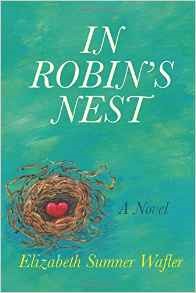
In Robin’s Nest
by Elizabeth Sumner Wafler
Giveaway ends July 12, 2016.
See the giveaway details
at Goodreads.
https://www.goodreads.com/giveaway/widget/193479


June 27, 2016
“Brexit” and Other Clevernesses

Brexit has had me thinking. Not only about the global economy, the plummeting of US stock, and how Britain’s debate to leave the EU has mirrored much of the political debate happening in the good old USA, but about catchwords like Brexit.
I’ve been having a love affair with words for the last two years. My husband knows. Drawn to the language arts since my dalliance with Dick, Jane and Sally in kindergarten, it was not until I embarked on a full-time writing career that I began to experiment and wrestle with words, to really appreciate the interesting turns of phrases and pattern play in the writing of others.
People tell me I have a gift for using vibrant, descriptive language and rich imagery. But how are people clever enough to come up with those catchy words and phrases, the ones that get flung around like rice at a wedding? Idioms like book hangover, dejabrew, rom-com, road rage, Elvis has left the building, or kitten heel? And what makes idioms endure? Why do we still use the oldies-but-goodies like going Dutch, Benjamin, burn the midnight oil, it costs an arm and a leg, or until the fat lady sings?
What do you think? What are your fave catchwords, old or new?


June 22, 2016
Slaying My Darlings

A southern writer, the most eloquent William Faulkner, once said,
“In writing, you must kill all your darlings.”
Until you begin writing day in and day out, you have no idea how hard it is to pull the plug on passages you thought were so fresh, so brilliant, the likes of which no one has ever read. The inspired ones. The ones that made your lips spread across your face in wonder, or made you shout, “Ding dang-it, I’m good!” The ones that spilled from a torrent of your innermost thoughts and feelings.
So along you sail, accepting your editor’s corrections with a simple tick on a check box. “Okay,” you say to yourself. “I see that. Acknowledged and accepted.” And then you spy a larger box, a bright pink one, ahead in the next paragraph. Your heart skips a beat: not another correction, but a comment. She loves it? She’s confirming my fabulous turns of phrase, my talent?
“Superfluous. Consider eschewing.” Superfluous? In one swaying moment the truth crashes in like a hostile intruder. Your darling is in peril.
But the editor’s right. And so was Faulkner. Passages that are unnecessary to the plot, the ones that don’t help move the story along, must go. So your finger hovers above the delete button. And in the space between heartbeats, your darling joins the ranks of the dearly departed.
OR, you can do what I sometimes do. If I just can’t let go, like a parent peeking through a classroom window, I file my darling. I have a folder on my desktop. And guess how it’s labeled? “Slayed Darlings.” I haven’t done anything with these passages yet. But I have an idea. I may post one of them here occasionally, like a blooper from a TV show. And if you’ve read one of my books, maybe you’ll try to guess where the little darling would have belonged.


June 19, 2016
The Father Who Loved Me
Father’s Day. It’s weird to have a father who doesn’t remember you. One who will smile at the splashy greeting card the nursing home attendant with the broad brown face and sparkling eyes opens for him. A father whose lips may form the name “Elizabeth” but whose mind won’t conjure my face.
My father no longer remembers a single fact about my life. He doesn’t remember teaching me to swim when I was four-years-old, or the chest-swelling pride he felt attending my graduations, or sniffling as he walked me down a flower-strewn aisle. He doesn’t remember that I followed his footsteps and became a teacher, or that I made him a grandfather for the first time.
But I remember my father and his love, his really silly sense of humor. He would call me every year on my Birthday at 9:03 am, the time that I was born, and tell me how much I had always meant to him. The phone has kept silent the last four years. But at 9:03 on my special day in September, I know I’ll remember and send up a little prayer. Of gratitude for the father who loved me well.


June 14, 2016
The Ghost of Other Feet
The beautiful photo, taken by my friend David Steele in Santa Fe, inspired this post.

The Ghosts of Other Feet (in 100 words or fewer!)
I feel the ghosts of other feet. Who, following the yellow sun riding the crest of the ridge, skipped the path, scuffing the dust in a fit of deliciousness at being alive? Who trudged the deadfall-strewn path, winded, burdened by failure? What lovers strolled, hands entwined, too drawn to each other’s faces to capture the slipping light? The roots of the sky-poking trees must absorb the footfalls, releasing them like vapor, like ghosts of human experience, into the evening-cool air.