Molly Fisk's Blog, page 10
December 9, 2012
Installing a Library on Your Front Lawn
For my birthday this year, only about five months late, I'm opening a library. This is not the brick Carnegie-type library with lots of shelves that you have in your neighborhood. My library is the size of a bread box and will stand on a pole in my front yard. It has a roof, three solid sides, and a glass front door so you can see the contents. It might hold 25 books. It's a free library, so if you see a book you'd like to read, you can just take it, and either right then, or some other day, or never, you can bring a book back in exchange.
I'm not one to join organized groups, Lord knows, but my library is a proud member of littlefreelibrary.org, which has helped to bring bread-box-sized libraries to many states in the Union as well as Canada, India, Italy, Germany, Ghana, and Australia. Today I received my official number in the mail: #2416.
You are perhaps wondering how I got this wacky idea. I blame it entirely on chickens. As a kid raised in San Francisco, I'm afraid I developed an unhealthy fixation on Laura Ingalls Wilder's “Little House” books, describing a life so different from my own. Since the age of eight I've wanted to raise chickens. This might be my most closely-held secret. Even though I live in the 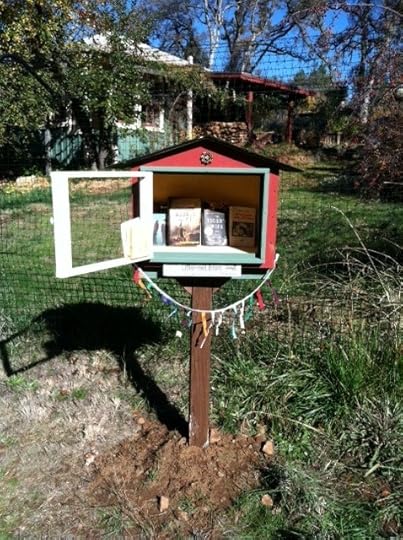 country now, and could easily acquire poultry, I haven't yet. I'm afraid chickens will attract predators, who will be foiled by the necessary chicken-protection equipment and eat my cats instead.
However, sometimes late at night I indulge in a mild form of what might be called homesteading porn: I go on-line and look at chicken coops. That's how I discovered a local coop builder was constructing these units for peoples' front yards. I'm not ready for chickens, but I can definitely raise books. I'm a writer, for Pete's sake! Giving books away is second nature.
I'm painting the library to match my house and I have seven volumes picked out to start the taking-and-leaving process. My main dilemma is where to locate this new member of the family. I live on a busy country road. I'd like to position the box in such a way that it slows people down but doesn't cause injury-accidents. There's room to pull off the pavement next to my mailbox, although as one friend pointed out, it's easier if, like the mail truck, you have right-handed drive. One of the stated aims of the Little Free Library organization is to build a sense of community. I don't think causing car accidents with your library is quite what they had in mind,.
Beginning in December, you can go over to littlefreelibrary.org and look me up on their US map. Swing by if you're in the neighborhood and don't have anything to read. Better yet, join the fun! Get someone to build you a one-room structure about the size of a bread box, nail it up on a pole, and put books in it yourself!


November 14, 2012
Pining for Petrichor
-->
Last Tuesday, fall arrived in my town: “season of mists and mellow fruitfulness,” according to John Keats. The temperature plummeted from 91 to 68 and most of us were relieved. It's almost Hallowe'en, after all, and pitch dark by dinnertime.
To prove my fortitude and general machismo, I went swimming one more time up at the lake, which is gorgeous now all the boats are gone and flotillas of coots have arrived. I might have just taken a photo, but my friend Betsy had her wetsuit on, and gloves, and a bathing cap, and I 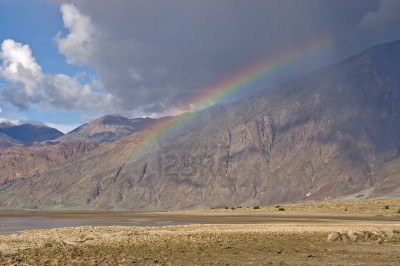 couldn't let her go in all by herself, could I? They don't make wetsuits in my size, so I had to rely on my personal insulation system, which worked beautifully in the end. In the beginning, the water seemed icy and I complained a lot, which always helps warm a person up. Some swearing was also heard. But really, the water's not that bad, and by the time I'd gotten in, muttering under my breath, to follow Betsy and Rocky, her dog, it was comfortable and we swam and swam.
I don't know if you remember from your childhood what it's like the day after the County Fair, when the carnies dismantle the rides and Job's Daughters cart all that used frying oil out of their booth in five-gallon buckets. Or even after a dinner party, when you're reaching under the sofa to grab a stray napkin ring and the sink is full of soapy water that's lost all its heat and most of its bubbles? Fall seems like that to me: a season of cleaning up and putting everything away. Tidy piles of firewood appear next to my neighbors' houses, and all the summer toys disappear. In a perfect world, I'd be up on a ladder cleaning out my gutters, but luckily perfection has never managed to find me, so instead I'm sitting on the dead dry grass of my so-called lawn, eating a windfall pear.
When Keats wrote “season of mists,” he was in England, where it had been raining all summer long. Here in the globally-warmed Sierra foothills of Northern California, we don't see rain between early May and late October. If something looks like mist, don't hesitate to call 911: it's likely to be the initial few minutes of a terrible forest fire. The surface of Scott's Flat Lake, which is really a reservoir, has dropped 20 feet since the day we first dove in. Some evaporated, but most if it was released downstream to farmers and our town's water treatment plant.
Even though the nights have cooled and the sun's less fierce, everything is still parched: Jeffreys, lodgepoles, manzanita, the golden California grasses, all the small animals and birds. And us big mammals, too: mountain lions, brown bears, and middle-aged former redheads, by this time of year we're longing and pining and waiting impatiently for “petrichor,” that incredible smell when hot dry dirt is drenched by the first rain.
Pining for Perichor
-->
Last Tuesday, fall arrived in my town: “season of mists and mellow fruitfulness,” according to John Keats. The temperature plummeted from 91 to 68 and most of us were relieved. It's almost Hallowe'en, after all, and pitch dark by dinnertime.
To prove my fortitude and general machismo, I went swimming one more time up at the lake, which is gorgeous now all the boats are gone and flotillas of coots have arrived. I might have just taken a photo, but my friend Betsy had her wetsuit on, and gloves, and a bathing cap, and I couldn't let her go in all by herself, could I? They don't make wetsuits in my size, so I had to rely on my personal insulation system, which worked beautifully in the end. In the beginning, the water seemed icy and I complained a lot, which always helps warm a person up. Some swearing was also heard. But really, the water's not that bad, and by the time I'd gotten in, muttering under my breath, to follow Betsy and Rocky, her dog, it was comfortable and we swam and swam.
I don't know if you remember from your childhood what it's like the day after the County Fair, when the carnies dismantle the rides and Job's Daughters cart all that used frying oil out of their booth in five-gallon buckets. Or even after a dinner party, when you're reaching under the sofa to grab a stray napkin ring and the sink is full of soapy water that's lost all its heat and most of its bubbles? Fall seems like that to me: a season of cleaning up and putting everything away. Tidy piles of firewood appear next to my neighbors' houses, and all the summer toys disappear. In a perfect world, I'd be up on a ladder cleaning out my gutters, but luckily perfection has never managed to find me, so instead I'm sitting on the dead dry grass of my so-called lawn, eating a windfall pear.
When Keats wrote “season of mists,” he was in England, where it had been raining all summer long. Here in the globally-warmed Sierra foothills of Northern California, we don't see rain between early May and late October. If something looks like mist, don't hesitate to call 911: it's likely to be the initial few minutes of a terrible forest fire. The surface of Scott's Flat Lake, which is really a reservoir, has dropped 20 feet since the day we first dove in. Some evaporated, but most if it was released downstream to farmers and our town's water treatment plant.
Even though the nights have cooled and the sun's less fierce, everything is still parched: Jeffreys, lodgepoles, manzanita, the golden California grasses, all the small animals and birds. And us big mammals, too: mountain lions, brown bears, and middle-aged former redheads, by this time of year we're longing and pining and waiting impatiently for “perichor,” that incredible smell when hot dry dirt is drenched by the first rain.
October 18, 2012
A Vacation at Home
This summer I was not, as they say, very flush. So when it came time to plan my vacation, trips to Prague, or even Vermont, were out. After some consideration, it seemed smart for me to stay home. There's a dreadful new word for this: “stay-cation,” but we will not mention it again.
The problem with staying home is that it's way too easy to fall back on the list of chores you've been avoiding all year, and that's no vacation, in my opinion. I was also trying to get some momentum going on a book I'm writing about my cancer class, so I wanted to carve out time to write. But since writing is part of my day job, the time couldn't all be spent writing.
I stewed over this for a while, and then went swimming, where it occurred to me that I could do art projects for 10 days, and that would feel very different from my regular life and be a lot of fun. But, I thought, I need to get out of town at least a little bit, or I'll feel gypped. Luckily, I have incredibly generous friends. For the first three days, I borrowed a house near Lake Tahoe, and was able to write a lot and swim in that beautiful blue water. For the last four days, I was loaned a trailer about 25 feet from the Pacific, and wrote there as well. The water was 52 degrees and there were sharks, so I didn't swim, although I waded.
In between these out-of-town writing jaunts I had a great time at home. I made a necklace out of some turquoise and chalcedony beads I already owned. I harvested my lavender and made seven gorgeous sachets out of ribbon with things like kale and poppies on them. I made three kinds of jam, and a new honey-and- lemon concoction for sore throats I'd read about on-line. I worked on an oil painting and prepped a few canvases. I went swimming every day and took I few hikes I'd never been on before. And I went on one random road trip, following streets I'd never seen and ending up in Bodega Bay, where Hitchcock filmed “The Birds.”
The two biggest projects aren't done yet. One is my little library, which is going to live on a post down by the mailbox very soon, but it needs to be painted. And the other is the ballgowns I'm making out of chicken wire. I molded the bodices on a friend of mine's torso, but haven't finished the skirts yet. I want these to be up on my lawn by Hallowe'en, so I've got some time.
I really can't recommend this kind of vacation more highly. I ended up feeling refreshed, relaxed, accomplished, and even a little bit smug, since I'd spent so little money. If Buenos Aires and Bangkok are outside your budget this year, why not try your own backyard?
Just don't call it that godawful, ridiculous, made-up, travel-agency word.
October 8, 2012
You Say Tom-AY-to...
I saw a photo today that made me crack up. It shows a sidewalk chalkboard, the kind restaurants sometimes use, which read: “How to cope with the end of tomato season: 1. denial, 2. anger, 3. bargaining, 4. grief, 5.,” in big red letters, “CANNING!!” Using Elisabeth Kubler-Ross's stages of grief is part of what makes it funny, but the reality of the sentiment is also hilarious. I don't know about you, but everyone in my town right now is harvesting things and canning them, or freezing or drying or pressing, etcetera. It seems every single person in the county has a garden this year, PLUS there are small farms springing up on every street corner, to supply farmer's markets on Saturday, Tuesday morning AND Thursday night. Goat milk is everywhere. When I asked on Facebook what methods people liked for drying pears, of which I have a plenitude, no fewer than four loans of dehydrators were offered to me.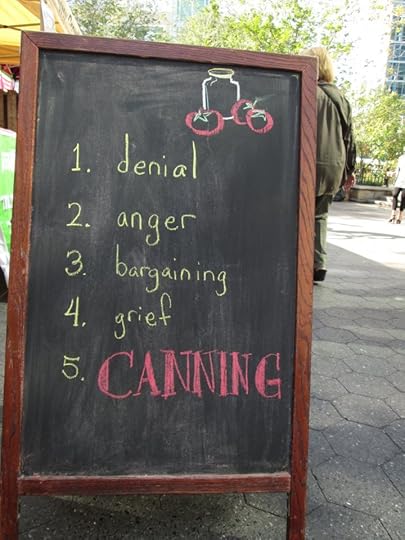
During World War II, Americans were encouraged to grow their own food in “Victory Gardens,” the idea being that factories and laborers who usually made food could turn their efforts to munitions instead, and the war might more easily be won. Back then, a lot of people grew their food already, or were only half a generation away from having grown it, so it wasn't much of a leap. Nowadays, though, many have forgotten how to do things our grandparents knew cold. I can cook and bake from scratch, having been raised in the hippie era. I regularly make jam and fruit preserves, but I have no idea what to do with vegetables other than freeze them. How to can food using the water-bath method is a mystery to me, and I'm a little nervous about it because I've read so many pioneer novels where people are killed by botulism from poorly-canned food. I love giving home-made edibles for Christmas, but not if they're poisonous.
The other thing I noticed zipping around the net was a wry motto: “Knitting! Not just a hobby, but a post-apocalyptic survival skill...” This made my stomach hurt, touching, as it does, my new deep-seated fear that whatever the cause may be — global warming, the revolution against corporate power, or World War III — we're going to be living very differently ten years from now, or maybe two years from now.
Part of my coping strategy is to put this fear aside, so let's go back to tomatoes. Since I didn't grow any, I'm going to buy them at the farmer's market. I'll slow-roast some, which don't get saved but are eaten immediately, and make sauce out of the rest. A friend's coming over to teach me how to can. In the winter, when I open the mason jars to use the sauce, if I boil it for 10 minutes, apparently the botulism toxin is vanquished. I hope it works.
I promise, I'll test this out on myself before I invite you for dinner!
August 27, 2012
Tithe & Teeth
Yesterday, I went to the farmer's market wearing a lavender tie-dyed dress, and one of the farmers handed me a lavender gladiolus flower that exactly matched it. I was delighted, and she was delighted — there was a bubble of sheer happiness around both of us for a minute — and I thought to myself, Oh, this is what the phrase “wreathed in smiles” looks like...
Did you know one of the most common activities in World War II concentration camps was gift-giving? And nobody had anything to give, really. People gave each other their last bite of stale, moldy bread,  a corner of moth-eaten blanket, their own body heat. They gave their voices in song. Often the generous people made it through, where miserly or more desperate ones did not. Giving is a powerful marker of humanity. It shows a commitment to connection that may be required for survival in extreme circumstances, whether you're on the receiving end or the giving one. It's a sign of autonomy and strength, even for people who can't stand up any more or lift a hand to feed themselves.
One of my friends just began “tithing.” Not the practice of giving money to a church, or the medieval dues paid in agricultural products by serfs to owners of the land they were farming, but a newfangled version. “Tithe” literally means a one-tenth part of something: your income, your grape harvest, your salmon catch. My friend heard it might help more money come her way. And it might: a Buddhist I know raises employee salaries when business is slow and says it always turns things around.
I'm happy to improve my cash flow, but what I'm working on now is cultivating deeper consciousness of and gratitude for my privileges: being born middle class, white, able-bodied, and smart into the First World during a prosperous century. I've done a lot of whining these last years while trying to save my house, and it's time for that to stop — at a certain point it's really bad manners. I don't want to forget I'm luckier than most people on this planet.
I do give away books, and time. I read poems at almost every benefit I'm asked to. But I've never thought I had enough money to spare. In case I'm wrong about this, for the rest of the year I'm going to give away some of my income. Not a tenth, because I'm still paying off debt. More like 4%. Every two weeks I'm going to write checks to organizations or people I believe in. My friend says it's an interesting process, because of course, some weeks you really don't think you have enough and want to keep it all. What happens when a big dental surgery bill comes up against sending $53 to Doctors Without Borders? I'm looking forward to finding out. Having 32 teeth in your head is also a middle-class American privilege, after all.
It's very possible to be wreathed in smiles with fewer of them.
July 26, 2012
Training to Watch the Olympics
Don't look now, but the Summer Olympics start tomorrow. I've been trying to get in better shape before they begin. This is partly in solidarity — all those athletes have worked for years to get as good as they are; it seems only right to walk an extra mile in their honor. And it's partly in anticipation of the Sports-Watching Couch-Potato Injury problem. You know, the way audience members strain and twitch on the sofa so the diver on the screen will make her flips in time to hit the water cleanly? I don't want to inadvertently pull a muscle egging on some fourth-place Latvian discus thrower.
The Olympics are the only reason I wish I still owned a television. Everything else I handle with Oscar parties, HBO rentals, or Downton Abbey Sunday dinn ers. I watch the British Open and Red Sox games at local bars. But for the Olympics I want to be near a TV all day long. I'm addicted to the intensity, the beautiful bodies doing such hard work, the joy, the youth, and how long these people have worked to get here. I also have a secret Princess Kate fixation, and since this year London's the host, I'm going to be even more glued to the screen, hoping for a glimpse of white teeth, brown hair, and surrealistic head gear.
I'm a good California progressive who can't bear either mainstream advertising or American jingoism, but during the Games I'm able to block all that nonsense out (or judiciously use the mute button). The Olympics were always meant to be outside time, and that's how I treat them. A special couple of weeks, where my politics and common sense get suspended in honor of athleticism, stamina, drive, collegiality, and Speedos.
If you're under 40, you're wondering why the heck I don't watch the festivities on my computer. After all, NBC is live-streaming every single event. I'm not sure what to tell you, except I don't know precisely what live-streaming is or how to access it, and I don't want to sit at my desk for fun when I have to sit there for work. Yes, I have a laptop. But its screen is too small to show why the judges marked down that Korean gymnast. And don't even start about smart phones. What the younger generations fail to realize is that Baby Boomers are all half-blind: we can't see a thing on those tiny machines, even though we carry them around with knowing looks and much savoir faire.
Where are YOU watching the Olympics? Maybe I should come over to your house. I make a mean cup of Darjeeling, if you're imitating the Brits, and a meaner Margarita, if you're rooting for Mexico. I could bring Guatemalan coffee, Greek olives, a French baguette and baba ganoush.
Because you know we're going to have to do some carbo-loading to keep up our strength.
July 1, 2012
Weed-Whacking, the Anti-Depressant
Version:1.0 StartHTML:0000000167 EndHTML:0000003609 StartFragment:0000000457 EndFragment:0000003593
-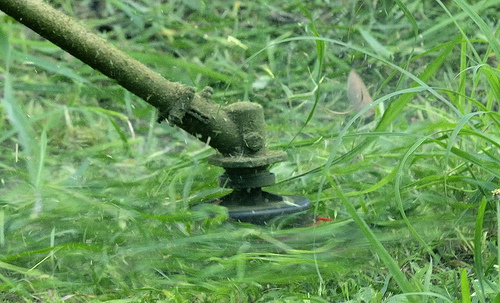 Two teenaged boys are making a huge racket weed-whacking my back yard. I wouldn't go so far as to say this din is an aphrodisiac, but it's definitely an anti-depressant. In three hours, the two of them, one six-foot-five and one five-foot-six, both sixteen, have done everything on my to-do list except plant zinnias, and I want to do that myself. I'm feeling grateful, delighted, relieved, and did I say grateful? Incredibly grateful. I'm quite sure that actual lines on my forehead are disappearing as the grass succumbs to their machines. Their parents would probably disagree, but for me, these kids are human botox.
One thing about living alone is it's hard to do everything that needs to be done all by yourself. It's possible. I've done it. But it's not that much fun. It's a burden on your mind before you do it, and then doing it is usually dusty, hot, grubby, prickly, annoying, and takes a long time. When you're finished, all you can think about is what's next on the list. How tall is the grass? Has fire season started yet? Do I have defensible space? Did my weedwhacker die over the winter? Do I have any of those little bottles of oil you're supposed to add to the gas? I don't mean to sound like either a city slicker or a helpless female, I'm just letting you read the ticker tape machine in my head. In the winter-time, my mental burden is firewood, although there's some overlap, because if you're smart, you'll get your wood in during June, when it's cheaper. I am occasionally smart, but more often I am buying it in October for top dollar and stacking it in the rain.
There is only one of me, and I have a lot of resistance to getting chores done. Luckily, God invented teen-aged boys and once in a while, they're willing to work for money. They have strong backs for lifting heavy flower pots, long arms for reaching to clip wisteria that's trying to winkle its way under the roof shingles, and require only water to keep going for hours. Well, water and praise, and a drive home afterward, and a very reasonable hourly rate, in cash please. Today we stopped at the corner store to get the right change so each of them could be paid the same amount, and they immediately bought ice cream bars with their earnings. The other great thing about teenaged boys is watching them eat. It's like having your own small herd of ravenous wildebeests.
I came home to a very quiet house. Four out of five cats were sacked out on the bed, exhausted from all the disturbance. One sprawled on my desk, waiting for me to sit down again and keep him company while he slept. It was eerily quiet, but then a whistling bug piped up, a few birds began to argue, and the wind swept through and rang all my neighbor's chimes.
June 21, 2012
Being Fat
-->
This week I gave my students an exercise they hate: to write about something they really don’t want to write about. Since I wanted to support them, and because it’s so good for a writer to challenge herself, I decided I’d better do the exercise, too.
What I really don’t want to write about is being fat. Specifically, that I weigh more than Arnold Schwarzenegger. Being a heroin addict or an alcoholic in this culture has a certain racy cachet, while being fat is just, well, gross. Keith Richards and Bonnie Raitt, both now in recovery, were still respected when they were using and drinking, but people whose addictions included food — say, late Elvis, Marlon Brando, and Orson Welles, were pretty much written off. Most Americans have stopped making jokes in public about blacks, Jews, or paraplegics, but fat is still a culturally-permitted target for ridicule and disdain. If you don't believe me, watch the movie “Love, Actually” again.
In addition to condoned national disgust, and putting my name in the same sentence with Arnold Schwarzenegger’s, here’s what else I dislike about being fat: the unexpectedly snug fit of airline seats; having to relearn my balance on cross country skis, ice skates, and bicycles; and how much more time it takes to find clothes that I like.
But being fat has taught me a lot I’m glad to know. Paradoxically and conveniently, becoming larger has made me invisible, particularly to construction workers, whose whistles and suggestive remarks plagued me a lot in my 20’s and 30’s. As I've coped with how people treat me, I’ve learned to be more compassionate toward everyone else on the margins of our narrow-minded society, like people of color, gays and lesbians, the homeless, the chronically ill and mentally ill, the poor, Vietnam Vets, and anyone who doesn’t speak English very well.
 It’s also boosted my political thinking. Once you’re outside the culture’s target market, you can see more clearly how that massive advertising machine really works. If women were not manipulated into worrying about our looks, the diet, food, beauty, and fashion industries would all crash, and we'd lose half our Gross National Product. Not to mention how much time we'd have to focus on true political change.
I’m not suggesting that a few Oreos for breakfast constitute political action — you are, after all, still supporting a brand — but to reject the carefully choreographed steps expected of American women in the way of beauty and standard sexiness is a great relief as well as a liberation. And it’s good to discover that standard sexiness is not the only kind there is.
But the best part is that when you’re fat, and the cultural norms of beauty leave you out, you are free to embrace a different sort of beauty, one that’s lasting and nourishing and that we get to define for ourselves, based on infinite variety. One we bring forth whole and shimmering out of our open, curious minds and our generous hearts.
June 6, 2012
The House Finch Dilemma
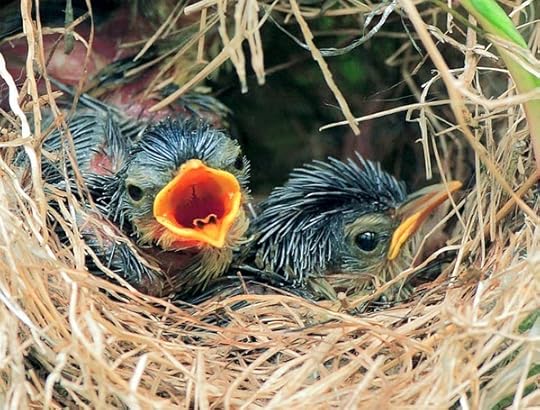
A pair of house finches just built a nest in the only spot on my property a cat won't be able to reach. Unfortunately, it's on the beam holding the roof up over my front porch. The cats have terrified every bird who's tried to nest in the bird houses I put up, thinking they were out of range. Titmice, nuthatches, mountain bluebirds, I'm sorry to say, have all been frightened off. The beam is perfect, though, snugged in so close under the eave that while a cat could climb one of the posts, there's no place to stand when he or she gets up there. Now what happens is I open the front door first thing in the morning, greet Mrs. Finch, and then the cats walk back and forth under the beam yowling and chattering their teeth at her.
 I was raised by my parents in California but spent a lot of time back East with my grandmother, a well-known bird-bander. I whiled away many school vacations helping her disentangle the feet of birds she'd netted so she could weigh, measure, and band them. By the age of 12 I knew how to mend any mist-nets that hawks or bats had ripped through, and was regularly put to this task.
My grandmother hated cats. When the neighbor's tom lurked under her bird feeders, she went after him, witch-like, with a broom. She's been dead for 22 years, about two years longer than I've been saving cats from the pound, but I still hear her voice in my head telling me, “Don't be ridiculous: You can't love cats and birds at the same time.”
She was so often right, in my memory — smart, tall, aristocratic, full of energy. But she carried my family's conviction that there wasn't going to be enough love, so you had to use it sparingly, and this turns out to be wrong. There's plenty of love, and using it creates more of it. Enough for cats and birds together, and dogs too — foxes, chickens, coyotes, brook trout, otters, caribou, brown bears. You don't ever have to choose! You can love chocolate AND vanilla, Republicans and Democrats, Toyotas, Volkswagens, and Subarus.
The only big drawback to loving a lot is being played out on my doorsill. Pretty soon, the house-finch chicks are going to hatch, and after a week of loud shrieking and manic feeding, they'll be ready to fledge. Unless I figure out a good two-day solution, there will be five agile, open-mouthed felines waiting to catch each baby on its first attempt to leave the nest. I've thought of rigging a sheet up, so the birds don't reach the ground. I've thought of locking the cats in my office with a litter box. I'm strongly considering just leaving town so I don't have to watch what happens.
It can be painful to love everything, I grant you. But think of how much you lose by holding back.