
Mariah Burton Nelson's Blog: Stronger Women, page 2
July 6, 2011
Civil Rights and Association Leadership
This is a mini-speech I gave in June at the Detroit reunion of Diversity Executive Leadership Program (DELP*) participants.
New York State just legalized gay marriage.
Regardless of one’s religious beliefs, surely everyone here appreciates this as a civil rights victory, right?
One by one, the states (six, plus the District of Columbia so far) are freeing Americans to marry whomever they choose.
“Same-sex” marriage is not really about gay people having the right to marry. It’s about everyone having the right to marry the person of their choice, regardless of gender, skin color, nationality, etc.
The 44 states where gay marriage is still illegal cling to a pattern of discrimination no less unfair than the miscegenation laws, which made it illegal to marry someone from a different race (and persisted in some states until 1967).
So civil rights are on my mind because of New York’s recent victory, and also because the topic came up in some of the educational sessions this morning.
And of course civil rights came up when we toured the Charles H. Wright Museum of African American History in Detroit.
What an educational — and emotional — experience.
I started asking myself, Is DELP an extension of the civil rights movement?
It’s not promoted as such. It’s a professional preparation program. The focus is on leadership and learning, not politics.
But at its core, DELP is about education and equal opportunity. It’s about helping people achieve their potential, and thus strengthen the whole. Aren’t those core concepts of the civil rights movement?
Of course, civil rights goes by many other names, such as the women’s movement (does anyone remember feminism?), the gay rights movement, and the disabled rights movement. All are about education (including but not limited to consciousness raising) and opportunity.
I once heard this definition of the difference between politics and spirituality: Politics is about what divides people, and spirituality is about what unites us.
Politics is about what keeps us separate, and spirituality is about what brings us together.
Seems to me that perhaps DELP is not just professional, but also political and spiritual.
Because it’s enfranchising disenfranchised groups, it’s political.
Because it’s bringing diverse people together as a professional family, it’s spiritual.
As I look around this room, I see a lot of smiling faces: not only in my “newbie” class of scholars, but also on the faces of the alums who return to Detroit each year for a reunion.
I feel so welcomed by this group. It occurs to me that this is what everyone wants, in any group: to feel welcomed; to feel accepted and even celebrated for our unique talents and contributions; to feel a part of something larger than ourselves.
We want to associate with each other without prejudice or discrimination.
Here’s what ASAE is doing, with support from Detroit: Supporting diverse association leaders who are raising consciousness, opening doors to new opportunities, bringing people together, demonstrating inclusion, and facilitating productive associations of all kinds.
Whether we think of this as a professional program or also a political or spiritual one, I’m sure of this: It’s quite an honor to be on this team!
* Each year, the American Society for Association Executives selects twelve members from underrepresented groups (gay people, racial minorities, and people with disabilities) for a two-year fellowship that provides education and training in association leadership. The ten-year-old program is sponsored by the Detroit Convention and Visitors Bureau. The goal is to develop a more diverse leadership pool. I was delighted and honored to be selected in the 2011-2013 class of DELP scholars.


June 6, 2011
The Art of Excellence (Interview)
The following interview appeared in the May 2011 edition of Sport Management Academy Newsletter.
An award-winning athlete, author, journalist, speech writer and speaker, Mariah Burton Nelson has played a leading role in redefining what it means to be a success in the sports industry. She currently serves as Executive Director of the American Association for Physical Activity and Recreation.
Q. What do you feel is your greatest achievement?
A. Populating the world with more female athletes. When I ride my bike (in the Washington DC area), and see trails full of female cyclists, runners, walkers, and in-line skaters of all ages, I feel gratified that I have played a small role in creating those opportunities. I reflect on how far we’ve come from my childhood.
My mother was a swimmer (and still is, at 87,) but she and her friends never ran or rode bikes or played team sports. When I was growing up, people expected “tomboys” to “grow up and be ladies.” Now girls and women take for granted their right to move, and they understand the relationship between exercise, health, and happiness.
Many women have told me, “You inspired me to be an athlete.” That was not my initial intent — I just wanted to write books and give speeches about women’s sports experiences — but what a satisfying result!
Q. What qualities do you think are key to professional success?
A. Discipline. We do so many things because we’re in the habit of doing them. And those habits — the good ones — are what lead to success. I swim or lift weights or ride my bike or do yoga every day because I made a decision many years ago to be an athlete, and that’s what athletes do. I don’t need to re-decide every day. That’s the good news: Discipline itself becomes a habit. You become the kind of person who does the right things, over and over again.
The same is true for discipline at work. After a while, you dispense with the inner dialogue about whether or not to work, or work harder. You write the proposal, then polish it until it shines, because you made a deal with yourself a long time ago. You might not even remember why or when you made that deal, any more than you recall your original tooth-brushing agreement.
Another word for discipline is practice. This is more good news: When you do something repeatedly, you get better at it. You feel increasingly competent, and confident, which leads you to try even harder.
I just submitted a proposal, and the recipient told me that in the 25 years he’s been writing and reviewing proposals, he’s never seen a better one. I was happy, but I wasn’t really surprised. I’m sure that much of my own professional success is largely due to the fact that I work harder, and have higher standards, than most people.
I think this is rooted in self-discipline. I learned it in sports, and continue to benefit from the daily discipline of sports, but discipline begins with commitment. Anyone, even someone without athletic training, can start there.
Q. What role do you feel mentors play in achieving career goals?
A. I’m reading a new biography of Babe Didrikson called Wonder Girl (coming out in June 2011). She died the year I was born, but I read her autobiography as a young girl, and she inspired me by being so incredibly disciplined, hard-working, passionate, competitive, and successful. I also looked up to my mother, an exuberant swimmer and physician who was openly, playfully competitive. They were my two role models: Babe and Mom.
But I did not have any mentors per se because so few women were playing sports when I was growing up (I was born in 1956), and so few people were writing about women and sports when I started doing that, in 1980. Basically, I invented my career (as a sportswriter focused on women and gender issues.) I admired Frank Deford and George Leonard and other male sportswriters, but I didn’t know them personally, and often wished that I had a mentor I could turn to for advice. Perhaps I would have made fewer mistakes. Given a chance, someone certainly would have taught me something about respectful silence and tact. Sometimes I’ve been too outspoken for my own good.
So I can’t really comment on mentors from personal experience, but I’ve heard good things about them, and try to be what I think of as “the kind of person who’s worth looking up to, in case anyone’s looking.”
Q. If you could give one piece of advice to today’s sport managers what would it be?
A. Actively seek diversity. Birds of a feather flock together, so we must consciously transcend our natural tendency to hire and promote people who look and sound and think as we do. My current staff of nine includes people of Indian, Korean, African, European, and Iranian descent, someone who is legally blind, and someone who is gay. (That’s me.) Do we talk about those differences? Rarely. We’re too busy talking about how to promote physical activity, and how to best serve our members. But does our diversity make us stronger as a team? Surely. To achieve this sort of diversity, one must recruit widely, and make a commitment to putting aside personal prejudices in order to get to know people as people. The rewards – personal and professional – can be great.


Open Letter to Stanford Women’s Basketball Alums
The following article appeared in the Stanford Women’s Basketball Alumnae newsletter, May 2011.
Today I gave a speech about nonprofit management. As soon as I finished, a man eagerly raised his hand. “Did you play for Tara?” he asked.
This happens all the time. Everywhere I go, people want to talk Stanford hoops. Kate Starbird. Candice Wiggins. The Ogwumikes. Beating UConn’s streak. Even that scary tree.
It’s my own darn fault. I proudly include my Stanford basketball story in my bio. I’ve written about sports at length. My body itself – at six-two – makes its own bold statement, prompting the question, “Did you play basketball?” – or, when I was younger, “Do you play basketball?”
But this is also your fault, my Stanford sisters. You’re the ones who made Cardinal basketball famous. My teammates and I pried the “Men Only” signs off the Maples Pavilion doors, then marched defiantly inside. You blew those doors off their hinges. Thousands of fans (and one dancing tree) streamed into that merry arena, eager to celebrate your many achievements.
That’s who I meet: your fans.
Funny, we never thought about fans in the seventies. We never anticipated your popularity. We just wanted access. Equal coaching, training, recruiting, scholarships, uniforms, and travel. Equal rights. Equal respect.
In an era of daily insults and exclusions, sports were becoming a symbol of women’s nascent power. When I arrived at Stanford in 1974, Billie Jean King had just beaten Bobby Riggs in a nationally televised tennis match (1973). Title IX had just passed (1972). A poster in my dorm (Larkin) showed a photo of women running, swimming, and cycling. “Women in Sports,” it read. “WE CAN.”
Yes, we can, and yes, you did. Because of you, I meet people all over the country whose lives have become more exciting, hopeful, and inspired. They tell me about watching you, admiring you, wanting their daughters – and sons – to be like you.
I, too, am a fan of yours – and not only because you make my resume look good. You have taken the Stanford program farther than we pioneers dreamed possible. You probably played (as we did) for the love of the sport, but because of your strength, spirit, and success, you helped transform the way society perceives women, and how we all perceive ourselves.
Thank you!
Mariah Burton Nelson
More from Mariah about Stanford women’s basketball history.


May 30, 2011
Running Club Gets Kids on the Move
Children at an elementary school in Maryland are voluntarily participating in a running club, with unexpected consequences: Not only are fitness scores soaring, discipline problems are declining and test scores are on the rise. So says The Washington Post in today’s paper.
I’m not surprised. This is what we at the American Alliance for Health, Physical Education, Recreation, and Dance have been advocating. The article quotes Charlene Burgeson, executive director of one of our five associations. This year, we launched Let’s Move in School, which encourages educators to provide physical activities throughout the school day, not just in PE class. Almost 5,000 schools with more than 3 million children have signed up to participate.
The results also support the work of John Ratey, author of Spark, the book that demonstrates the relationship between physical activity and improved cognitive function.
One striking element of the program: Tangible rewards. Virtually every child in the school is running at recess now, counting laps, and receiving, in exchange, a plastic pendant. These charms, worn on necklaces, have become the “in” thing, akin to friendship bracelets. Students also see their names posted on the gymnasium walls, with additional recognition for children who accumulate marathon and 100-mile totals.
My only objection: Assistant Principal Marilyn Mathews is quoted as saying that the school has long promoted physical activity because the school happens to have 11 percent more boys than girls. The author, Robert Samuels, goes on to say, “Of course, girls and boys alike benefit from the exercise,” but readers could be left with the impression that boys need more exercise, or that it’s logical for school administrators to provide more activity opportunities to boys than to girls. What’s up with that? A very old-fashioned and sexist notion.
Nevertheless, the main point here is one all schools should note: Offer kids opportunities to be physically active, build in rewards, then sit back – or join them, as some teachers do – and watch them improve their behavior, their fitness, and their academic achievement.
See New York Road Runners for how to bring free running programs, resources, and activities for educators who want to bring fitness into their schools. A series of A Running Start videos offers games, activities, and training techniques.


April 17, 2011
Women Who Exercise (and Sing)
One of many pleasures of public speaking is engaging an audience in something new and slightly risky. A tension builds: Who will participate? What will happen next?
Most adults do not consider themselves singers, and are reluctant even to sing Happy Birthday among family and friends.
Therefore – to create dramatic tension and challenge audience members to “practice taking a small public risk,” I write songs that reinforce the messages of my speeches, invite some singers to join me on the podium, then encourage everyone else to sing along.
(“How many of you cannot sing well?” I ask. “Fine. Please tell the person next to you, so that they won’t be surprised when they hear you singing off-key.”)
Here (by request) is a song I shared with the Executive Women’s Golf Association last week, the Bethesda AAUW in January, and the Tucker Center for Research on Girls and Women in Sport last spring. I’ll probably share it (or some variation on it) at the upcoming Iowa Women’s Leadership Conference too. You’re welcome to use it too; please just give me credit.
Women Who Exercise
Sung to the tune of “My Favorite Things” from The Sound of Music
Women who exercise
build bones and muscles
Less risk of stroke and
Less strain on blood vessels.
Less diabetes
Arthritis and fat
Physical happiness!
How about that!
OSTEOPOROSIS!
Deep vein THROMBOsis!
These would FEEL so bad.
But when we get moving
We rarely get sick
More good news:
We’re RARELY sad!
We are all athletes
I hope you believe it
Fitness is yours
I know you can achieve it.
Make it a habit
and learn how to train
Your BODY will love you
and so will your BRAIN!
FEWER BACK aches!
FEWER HEART aches!
Better sleep…
and sex
Go golfing or swimming
Invite all your friends
Good HEALTH is all YOURS…
Go flex.
by Mariah Burton Nelson, who did not consider herself a singer until she started singing these songs on stage at her own speeches — then noticed, over time, that her singing improved through practice, which confirmed one of her messages: Practice works!


April 12, 2011
Tara VanDerveer: “You ARE On the Team”
A week before the WNBA draft I am at the Final Four. Tara VanDerveer has just been named Coach of the Year by the Women’s Basketball Coaches Association.
I tell her that I really appreciate the two receptions Stanford held for former players this year: One chairs-in-a-circle discussion between current players and about ten former players, and one casual conversation in an Indianapolis bar.
“It’s been 33 years since I played at Stanford,” I marvel. “But you make me feel like I’m still on the team.”
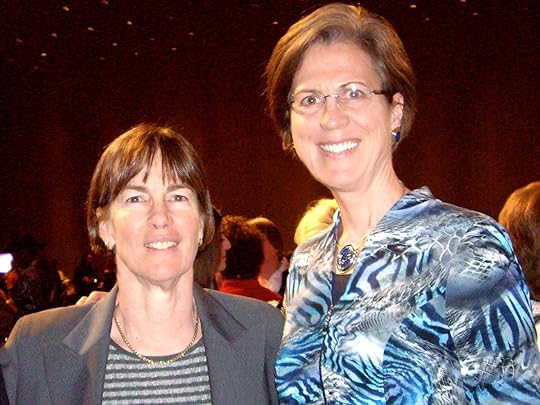
“You ARE on the team,” replies Tara. She introduces me to her mother, and to her sister Heidi.
I have accomplished many things since Stanford. I’m socially and professionally connected. Still. It feels weirdly satisfying to have Tara tell me I’m still on the team. Even though I live in the DC area, never get back to Maples Pavilion for games, and — though this is heresy to admit — don’t even FOLLOW the team closely until it’s Final Four time. I’m too busy living my life.
For instance: Tomorrow I’m travelling to Amelia Island, Florida, to speak to the Executive Women’s Golf Association. I’ll be keynoting their annual Golfpalooza. My topic: Competition, Leadership, and Teamwork. Those executive women golfers are also “on the team.” Which is why they attend conferences — why we all do. Sure, we want to learn, but we also want to connect. We want to belong. We want to feel part of something larger than ourselves, and work to achieve goals in collaboration with others who share our values.
“You ARE on the team,” Tara said. Same thing the Minnesota Lynx told Connecticut superstar Maya Moore in the WNBA draft.
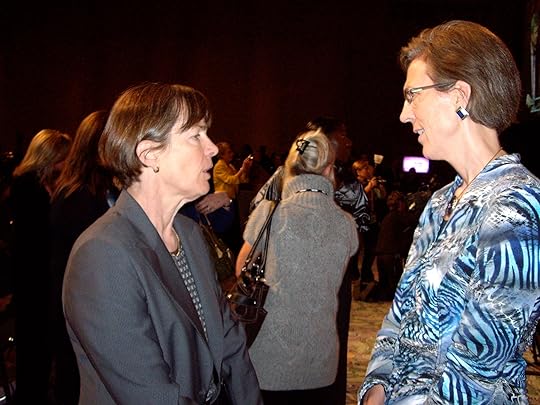
Isn’t that what we all want to hear?
–Mariah Burton Nelson, who only wishes she had stood up straighter when this photo was taken! Tall sisters, however — power players who were on magnificent display in Indy during the Final Four — will understand: It’s hard to talk to shorter people without bending over!


March 14, 2011
Black Power, Female Athletes, and a Controversial Poem Called “The Change”
Tennis is not usually a topic of conversation at the Association of Writers and Writing Programs annual convention, which was held in Washington DC in February. But this year the buzz was about a tennis-player poem, of all things.
Called The Change by Tony Hoagland, the poem drew criticism from the poet Claudine Rankine, many audience members, and numerous bloggers, all of whom think it’s racist. (Rankine’s comments seem to have been removed from at least some blogs. She asks good questions, though, for writers about race.)
True, Hoagland describes a Venus/Serena Williams-like figure as “that big black girl from Alabama,/ cornrowed hair and Zulu bangles on her arms,/some outrageous name like Vondella Aphrodite” and he claims he ”couldn’t help wanting/the white girl to come out on top,/ because she was one of my kind, my tribe,/ with her pale eyes and thin lips.”
But I think the poem is ironic.
I think the narrator actually admires the black player, with her “complicated hair/and her to-hell-with-everybody stare”… so big/and so black, so unintimidated… hitting the ball…like she wasn’t asking anyone’s permission.”
Is this not a heroic portrait? Surely compared to that pale-eyed, thin-lipped white girl, who warrants no more description. She’s neither engaging nor powerful. The poet’s eye cannot rest on her; he’s clearly drawn instead to the black woman’s audacity and strength.
I think “the change” of the title is the end of white domination, and I cannot see that as an unwelcome change by the narrator. Note also his depiction of like the “little pink judge” who “had to climb up on a box” to adorn the black goddess with her medal.
Isn’t that just plain funny?
The world is changing. This is a good thing. Athletes are leading the way – and female and African-American athletes have long changed white attitudes, simply by showing up and showing off their athletic skills.
While I’m sorry the poem seems racist and offensive to some people, I like it, and admire Hoagland for tackling this subject.
I also see the poem as a man dealing with female size and strength; he’s intimidated, but in effect admits that.
When he depicts the black player holding her racket “over her head like a guitar” in triumph, how can readers not celebrate with this rock-solid rock star, and with all strong, minority people who have fought hard for their rights, and won?
– Mariah Burton Nelson, who loves it when her twin passions of sports and creative writing merge


March 10, 2011
When is a Basketball Player Not Just a Basketball Player?
In today’s Washington Post, Lenny Bernstein writes about his outing to a Fairfax, Virginia gym. There he found a basketball league where the athletes play hard, play full court, have fun — and do not keep score.
Two things make this league unusual: The not-keeping score part, and the fact that the players are in their 40s, 50s, and 60s.
However, he chose to interpret this scene through a gender lens: Because the players are female, he made enormous assumptions about the relationship between gender and noncompetitive games.

Mariah (wearing 1974 Stanford pinney - a whole other story) with Bonnie of NOVA United
(Things started looking suspicious when the author, alone in a gym with at least ten female athletes, referred to men as “the elephant in the gym.” Funny – lots of people can walk into a gym filled with female athletes and not even think about men, not beg the question: How do these athletes compare to male athletes? Those people, when they see people playing basketball, just see people playing basketball.)
Bernstein interviewed one (one!) male player who proclaimed that in his league, noncompetitive games would be “inconceivable.” That man also conjectured, based on his experience with his one (one!) son, that “competitive juices” are “hard-wired.”
I can’t tell from the Fairfax gym photos, but it could be that all of the players in this league happen to be white. Why not make gross generalizations about how black players would never dream of noncompetitive games — based on a quote by one random black player?
Brings to mind Susan Faludi‘s famous line: Feminism is the radical notion that women are people. This league’s decision to play score-free MIGHT be related to gender, or gender socialization, or age, or even race or religion – but these players are people first.
More than 3 million girls play high school sports on a competitive basis, with basketball being the most popular sport. So it’s misleading to say, as Bernstein does, that “research shows that girls tend to favor more cooperative games.”
I hope no one fills Brittney Griner in on this hard-wired, cooperative-game secret on her way to the Final Four. Could ruin things for fans if she and her Baylor teammates discovered their true nature and refused to keep score against Stanford or Connecticut.
Even if there is a gender difference, the gender SIMILARITIES are enormous. (The author admits that this league is full of former college players, and players who keep score in other leagues.)
There are many ways to play sports, stay fit, socialize, have fun — and define winning. Women of all sizes, abilities, ages, and colors experiment with all of those ways — as do men.
The real story here is that these people are still playing hoops in middle-age — and making up their own rules, to suit themselves. Good for them!
– by Mariah Burton Nelson, who recently watched two NOVA United women’s 50+ teams play at halftime of a George Washington University basketball game, who knows their founder, Helen White, who is a member of the National Senior Women’s Basketball Association, and who would still be playing basketball – and keeping score – if she had any cartilege left in her knees.


Stronger Women

- Mariah Burton Nelson's profile
- 23 followers

