Sarah Baughman's Blog, page 15
September 24, 2015
GraftedHeart
Scripture is very clear that God does not change. The author of the letter to the Hebrews writes, when warning the Christians not to follow strange and new teaching, that “Jesus Christ is the same yesterday and today and forever” (Hebrews 13:8). His love and His grace are not dependent upon His mood or even upon our action. He loves us with an everlasting love. God does not change.
In another sense of the word, though, He does indeed change. Not Himself, but hearts.
“For I the LORD do not change; therefore you, O children of Jacob, are not consumed” (Malachi 3:6). Just prior to this verse, God is telling of the time that He will come as a refiner and purifier, and how He will purify His people, and make them again acceptable to Him.
How He would change them.
God is in the business of changing hearts. Sometimes this means a change in life. Sometimes it is a more subtle change, visible only to those who also know the saving love of God.
My own heart has been – is continually being – changed. By the grace poured out for me, by His Spirit, which God has placed in my heart, by His Word, the Bible, that was given as the place to find Him. He is the Vine,
we are the branches.
In Romans 11:11-24, Paul writes in some detail of the manner in which God has brought those who did not previously know Him to Himself. Paul uses the imagery of an olive tree and its branches: Christ is the tree, and people brought into faith in Him are like branches grafted onto the tree. (Note: for those unfamiliar with the term, grafting is a technique used by horticulturists to combine two different plants. While there are different techniques, the one Paul mentions is that of cutting a stem or branch from one tree and inserting it into a cut in the original plant.) As a believer in Christ, I was grafted into Him!
This is the reason for my choice of name for my publishing imprint. My prayer is that my writing would share the hope and grace offered by God in the person of His Son, Jesus. There is heart-changing power in His Word, and even more, full, over-flowing life.
I will leave you with the words of Thomas Hansen Kingo, in 1689:
On my heart imprint Thine image,Blessed Jesus, King of Grace,That life’s riches, cares, and pleasuresHave no power Thee to efface.This the superscription be:Jesus, crucified for me,Is my life, my hope’s Foundation,And my Glory and Salvation.
In another sense of the word, though, He does indeed change. Not Himself, but hearts.
“For I the LORD do not change; therefore you, O children of Jacob, are not consumed” (Malachi 3:6). Just prior to this verse, God is telling of the time that He will come as a refiner and purifier, and how He will purify His people, and make them again acceptable to Him.
How He would change them.
God is in the business of changing hearts. Sometimes this means a change in life. Sometimes it is a more subtle change, visible only to those who also know the saving love of God.
My own heart has been – is continually being – changed. By the grace poured out for me, by His Spirit, which God has placed in my heart, by His Word, the Bible, that was given as the place to find Him.
 He is the Vine,
we are the branches.
In Romans 11:11-24, Paul writes in some detail of the manner in which God has brought those who did not previously know Him to Himself. Paul uses the imagery of an olive tree and its branches: Christ is the tree, and people brought into faith in Him are like branches grafted onto the tree. (Note: for those unfamiliar with the term, grafting is a technique used by horticulturists to combine two different plants. While there are different techniques, the one Paul mentions is that of cutting a stem or branch from one tree and inserting it into a cut in the original plant.) As a believer in Christ, I was grafted into Him!
This is the reason for my choice of name for my publishing imprint. My prayer is that my writing would share the hope and grace offered by God in the person of His Son, Jesus. There is heart-changing power in His Word, and even more, full, over-flowing life.
I will leave you with the words of Thomas Hansen Kingo, in 1689:
On my heart imprint Thine image,Blessed Jesus, King of Grace,That life’s riches, cares, and pleasuresHave no power Thee to efface.This the superscription be:Jesus, crucified for me,Is my life, my hope’s Foundation,And my Glory and Salvation.


September 12, 2015
Losing the Little Things
 I've always loved this ribbon.
Glad to find a great use for it!I have a real problem. For a long time, while working on my writing, I would misplace my thumb drive. It's so tiny, and so easy to leave . . . well, anywhere. But it holds all of my writing. If I lose it, I'm really stuck. (Note: Now I use Dropbox also to back up my work; I'm slowly learning to utilize some of the modern conveniences available.)
While it should have been obvious to me, I never thought to attach the thumb drive to something larger and more visible until just a couple of weeks ago.
Do you ever feel that the small things sometimes just seem to slip away? Even if they're something that you once or even still hold dear?
 Fed by His WordSpending time with God in His Word is one of those things for me. I know how important it is, how vital to my life as a Christ-follower, as a wife, as a mom, as a Sunday School Teacher, as anything. But isn't it easy to let it slip away? To be misplaced?
A huge help for me lately has been learning to attach that to something that I do every day: breakfast. Maybe that wouldn't work for everyone, but I have found a great deal of help in reading the Word while I eat breakfast with my family. If I find a helpful gleaning for the kids, I can share it then. And I almost always eat breakfast. Making Bible-ingesting as big a part of my routine as food-ingesting has helped me be sure not to let it slip away.
There are other things I want to learn to keep: letter-writing, walking with my family, keeping the dishes washed. In time, I hope to reclaim all of those, and to attach them to ribbons of their own.
What are some of the little things that you would like to keep hold of?
August 10, 2015
A Lesson from Beads
“To this end we always pray for you, that our God may make you worthy of his calling and may fulfill every resolve for good and every work of faith by his power, so that the name of our Lord Jesus may be glorified in you, and you in him, according to the grace of our God and the Lord Jesus Christ.”2 Thessalonians 1:11-12 ESVhttp://bible.com/59/2th.1.11-12.esv
Our church was having new carpet installed in the classrooms and Sunday School office; we had to remove everything on the floors. I took the opportunity to do some organizing. One of the minor projects was the beads for crafts.
I wanted to sort out the pony beads from the others, since they're easier for preschool-aged kids to string.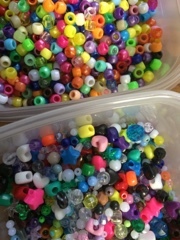 Some of the pony beads, though, had tiny seed beads stuck in the middle.
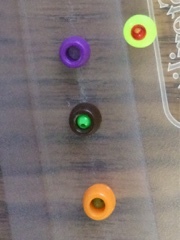 I left them in the bin of mixed beads, and kept sorting. When I got to the bottom of the bin, I started shaking it back and forth, trying to knock out the little beads.
It worked for some, but not all. I moved them into a smaller box with a lid and really let 'em have it.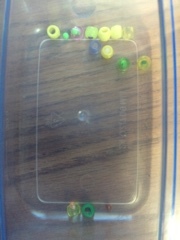
It's a good thing beads aren't living!
More beads came out, but some still stubbornly stayed put. I tossed those into the mixed-bead box again. They may come dislodged later, but for now, I'll let them stay put.
The problem is, those beads with the seed beads stuck in them--they can't fulfill their purpose, their vocation.
Beads are for stringing. String will not fit through those beads.
What are the seed beads in your life?
Do you ever feel like life is just shaking you around, and you can't find your bearings? Maybe you know something needs to change, but you can't seem to fix it.
Our gracious Lord is constantly working on us. Sometimes it may feel like everything is out of control and we can't find our bearings, no matter what we do. The problem is, though, it doesn't matter so much what we do. It's about what He is doing in us.
Are the kids not letting you get your project done? Is one bill piling on top of another and you feel that it'll never stop? Is work stressing you out more than usual and you can't seem to find contentment in it anymore?
There's no magic fix to this, but take heart in the fact that it is in the midst of these trials that you are being molded, shaped for His calling, and equipped for work in His kingdom. He is with you in the storm, and will be with you still when the waters calm.
Grant me grace, Lord, to persevere through the trials in life. Strengthen my trust in You that I do not lose heart, but cling all the more tenaciously to Your Word and its message of the Cross. In the name and for the sake of Christ I ask this. Amen.
Our church was having new carpet installed in the classrooms and Sunday School office; we had to remove everything on the floors. I took the opportunity to do some organizing. One of the minor projects was the beads for crafts.
I wanted to sort out the pony beads from the others, since they're easier for preschool-aged kids to string.
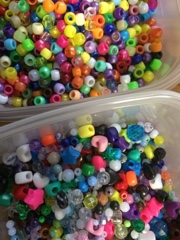 Some of the pony beads, though, had tiny seed beads stuck in the middle.
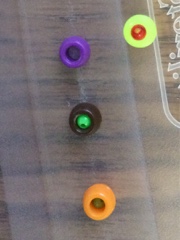 I left them in the bin of mixed beads, and kept sorting. When I got to the bottom of the bin, I started shaking it back and forth, trying to knock out the little beads.
It worked for some, but not all. I moved them into a smaller box with a lid and really let 'em have it.
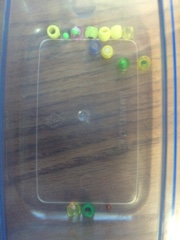
It's a good thing beads aren't living!
More beads came out, but some still stubbornly stayed put. I tossed those into the mixed-bead box again. They may come dislodged later, but for now, I'll let them stay put.
The problem is, those beads with the seed beads stuck in them--they can't fulfill their purpose, their vocation.
Beads are for stringing. String will not fit through those beads.
What are the seed beads in your life?
Do you ever feel like life is just shaking you around, and you can't find your bearings? Maybe you know something needs to change, but you can't seem to fix it.
Our gracious Lord is constantly working on us. Sometimes it may feel like everything is out of control and we can't find our bearings, no matter what we do. The problem is, though, it doesn't matter so much what we do. It's about what He is doing in us.
Are the kids not letting you get your project done? Is one bill piling on top of another and you feel that it'll never stop? Is work stressing you out more than usual and you can't seem to find contentment in it anymore?
There's no magic fix to this, but take heart in the fact that it is in the midst of these trials that you are being molded, shaped for His calling, and equipped for work in His kingdom. He is with you in the storm, and will be with you still when the waters calm.
Grant me grace, Lord, to persevere through the trials in life. Strengthen my trust in You that I do not lose heart, but cling all the more tenaciously to Your Word and its message of the Cross. In the name and for the sake of Christ I ask this. Amen.
August 8, 2015
Sew New
 Pardon my mess behind.Earlier in the summer, I was doing a lot of sewing. There have been several projects, but one of my favorites was this dress. It had several steps: foundation layers, including a chemise and a set of stays which I later decided to make built-in-to the dress.
 The construction is called fall-front, or bib-front, which means the dress is stepped into, the back and shoulders put on and fastened in the front of the bust, then the front "bib" brought up to be pinned in place and the waist tied in back.Clear as mud? Good.
 The fun part was the fabric. It may not be 100% historically accurate (the pattern is a bit too close), but I wanted something that looks like it was remade from an older gown from the 1700s.
Which my main character in my upcoming novel, Penelope's Hope, had to do. Though she is no seamstress. Her talents lie in other artistic areas. More on that later.
My thoughts about sewing, though, have led me here.
Have you ever wanted to be able to re-do something? Maybe a conversation or a project or a meal? I have.
 This sewing project was like that in many ways. I got to re-do a regency dress, because my first had some problems with fit. It was lovely, but not very useful because of the poor fit. The front bib-part gaped because I did not measure correctly, and just made the panel a straight rectangle. It needed darts at the base and a drawstring or fitting at the top.The new dress was actually made from old bedsheets I picked up at a thrift store. Isn't that the best?
I love thinking of how God picks us up, maybe feeling unwanted or old and useless. He re-makes us, puts His Spurit in us and even uses us to help other people. He can make the oldest, least desirable into a thing of beauty.
Therefore, if anyone is in Christ, he is a new creation. The old has passed away; behold, the new has come. (2 Cor 5:17)
 This is one of the photos of the dress, btw. More on that later.
Photo credit on this last one goes to Alex Shaw of Shaw Photography.
Thanks for reading!
January 20, 2015
Graceful Hands
This morning, I was working on my novel (Penelope's Surrender), and my three-year-old G woke up. I paused my work to get his breakfast, then resumed working while he ate. We were chatting a bit, and in the course of this, he turned to me and said, "Mama, your hands are ugly."
Now, anyone who knows G well knows that occasionally, he will say unkind things to elicit a reaction. This time, he didn't use that tone. He simply said it in a calm, matter-of-fact voice.
"Mama, your hands are ugly."
How would you react?
Well, at first I wanted to say, "G, that's not kind. Please don't say things like that to Mommy."
And I did, eventually, for the sake of instructing him in how to speak words to build up, and not tear down. But that's an entirely different devotional direction.
I just asked what he meant (turns out, he only meant my left hand), and what he thought made it ugly (only when I spread my fingers wide).
And this isn't about discussing with a person who says something hurtful before deciding they just don't like you. But it could be.
It's about our hands. And how we use them. And whether that makes them ugly or beautiful.
Are your hands dry this winter season? Mine are. I haven't been taking care of them as I should if I want them to be soft and smooth. Does that make my hands ugly? Or your hands? Is it bad to have well-cared-for hands? No. On all counts.
What is your motivation?
Are your hands soft and smooth because you care for them but neglect other things for which you are called to care? Or are they rough because you are caring for everyone and everything else, but neglecting yourself?
I find sometimes that my hands can be a good indicator of the state of my well-being. When my cuticles and hangnails are chewed, ragged and un-cared-for, I'm usually worrying about something. They aren't too bad right now, but could be better.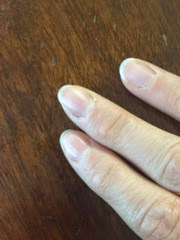 When my skin is dry, it's because I'm neglecting my own care.
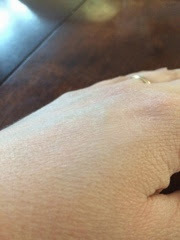
Not gonna lie, my skin is pretty dry right now. It isn't cracking and bleeding, but if I go on without any moisturizing, it will be soon.
But more than anything, my hands are working for my family.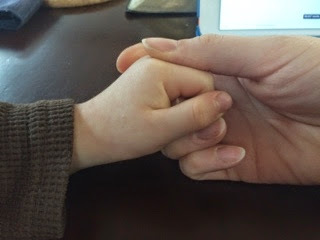
Working, caring, instructing, and loving. They are getting it done, maybe a bit worse for the wear, but beautiful in this service.
How are your hands?
Probably better than you think. Your hands, my hands, have been cleansed with Christ's blood, the same as the rest of us. We are free to move forward in lives of love and service to one another and to the world. We are working for God's kingdom and for those who are lost to be brought to His side.
His hands were pierced for us, and ours rise to give thanks, lower to extend mercy to the downtrodden, and reach out to meet others where they are. He uses our hands as His own to do these things, and to serve His people.
So next time you wash your hands, or use some lotion, or hold someone else's hand, remember that they are not merely your hands, but God's instruments to care for the world around you.
Now, anyone who knows G well knows that occasionally, he will say unkind things to elicit a reaction. This time, he didn't use that tone. He simply said it in a calm, matter-of-fact voice.
"Mama, your hands are ugly."
How would you react?
Well, at first I wanted to say, "G, that's not kind. Please don't say things like that to Mommy."
And I did, eventually, for the sake of instructing him in how to speak words to build up, and not tear down. But that's an entirely different devotional direction.
I just asked what he meant (turns out, he only meant my left hand), and what he thought made it ugly (only when I spread my fingers wide).
And this isn't about discussing with a person who says something hurtful before deciding they just don't like you. But it could be.
It's about our hands. And how we use them. And whether that makes them ugly or beautiful.
Are your hands dry this winter season? Mine are. I haven't been taking care of them as I should if I want them to be soft and smooth. Does that make my hands ugly? Or your hands? Is it bad to have well-cared-for hands? No. On all counts.
What is your motivation?
Are your hands soft and smooth because you care for them but neglect other things for which you are called to care? Or are they rough because you are caring for everyone and everything else, but neglecting yourself?
I find sometimes that my hands can be a good indicator of the state of my well-being. When my cuticles and hangnails are chewed, ragged and un-cared-for, I'm usually worrying about something. They aren't too bad right now, but could be better.
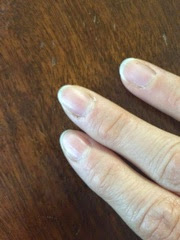 When my skin is dry, it's because I'm neglecting my own care.
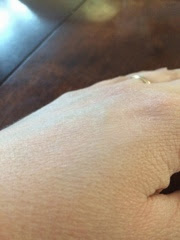
Not gonna lie, my skin is pretty dry right now. It isn't cracking and bleeding, but if I go on without any moisturizing, it will be soon.
But more than anything, my hands are working for my family.
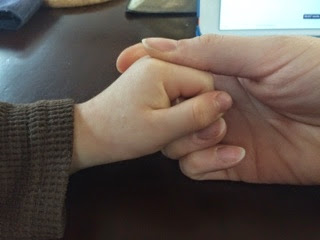
Working, caring, instructing, and loving. They are getting it done, maybe a bit worse for the wear, but beautiful in this service.
How are your hands?
Probably better than you think. Your hands, my hands, have been cleansed with Christ's blood, the same as the rest of us. We are free to move forward in lives of love and service to one another and to the world. We are working for God's kingdom and for those who are lost to be brought to His side.
His hands were pierced for us, and ours rise to give thanks, lower to extend mercy to the downtrodden, and reach out to meet others where they are. He uses our hands as His own to do these things, and to serve His people.
So next time you wash your hands, or use some lotion, or hold someone else's hand, remember that they are not merely your hands, but God's instruments to care for the world around you.
July 25, 2014
Regency Stays
As promised, a post about making Regency Stays. This means the corset style worn during Jane Austen's time period. I made what is known as short stays, which seemed easier than a full corset, so...here we go!
I found an awesome tutorial (http://biancavonbavensen.blogspot.com...) that I followed. It uses measurements to make an original pattern to fit the wearer. I was making the stays for my friend who was modeling for my book cover shoot with another friend, to wear unde the Regency dress I also made (that'll be another post, later).
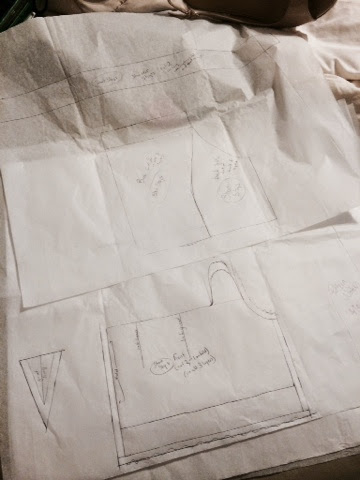
(Here is the pattern I made; I measured and drew it onto tissue paper. I've since learned that I prefer gift wrapping paper for drafting patterns, but this worked for such a small pattern.)
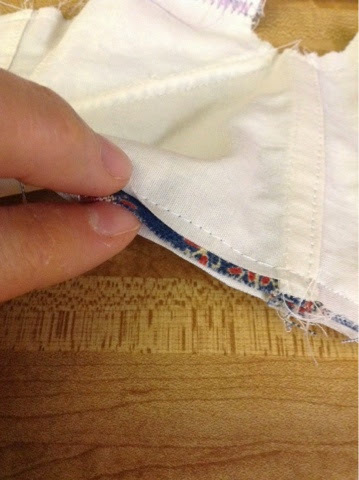
I cut three of each piece (liner, interliner to stiffen, and outer layer) and assembled the three layers seperately. I used French seams, which would be period-accurate, and left them a bit wider than perhaps was necessary, but it added good structure, since I did not want to use boning.
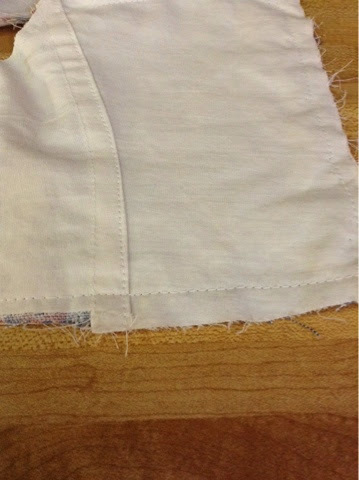
I used an old bed sheet for the two layers that will show, and some heavier home decor fabric I already had for stiffening. It is streachier than it should be, but these stays won't be worn extensively, so I think it will be alright.
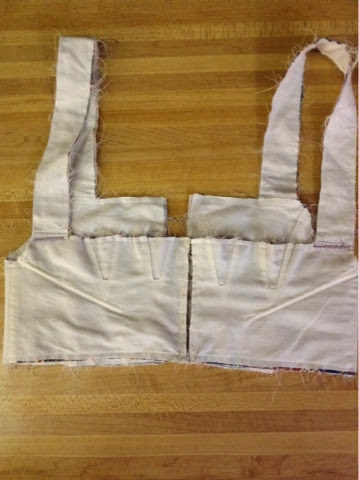
Here are the gussets, to give enough room for supporting the bust. During the regency, the bosom was pushed up to create a shelf-like silhouette. The gussets are formed by inserting triangles into a slit in the fabric. I think I googled "how to sew a gusset" for instructions on that, but cannot remember the site I followed right now.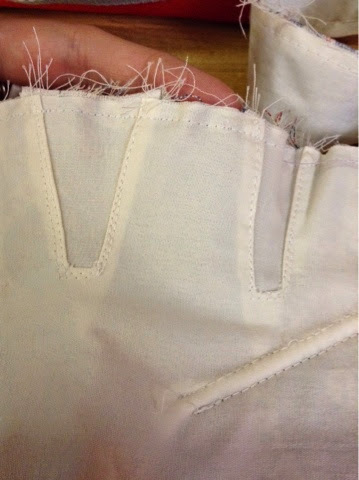
Finally, the pieces were ready to assemble. I pinned all around the edges, temporarily holding all three layers together. Before I sewed them, I added some cording to help support the bust.
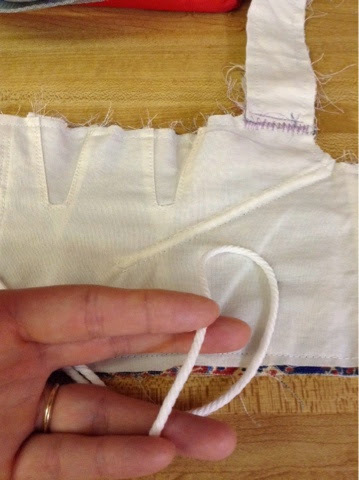
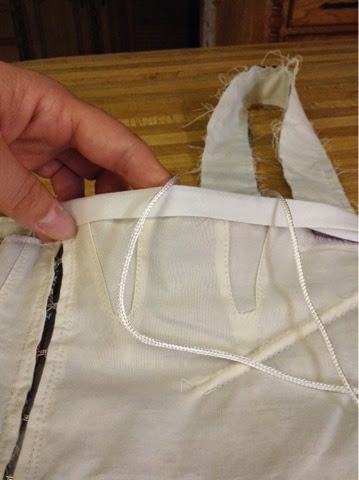
You can see the diagonally-sewn cording under the garment, as well as some leftover cording I had. This gives just a bit more structure and support than nothing, but not as much as boning would have.
I found that this pattern was just a bit too big around; I'm not sure if it was measurign error or what, exactly, but I plan to take an inch off the back on either side, so that the stays may be laced more tightly if needed. I think for the photo-shoot, they were just a bit too loose, sitting where a modern bra would be, and therefore failed to create the proper silhoutte. My plan is to hand-sew the eyelets, as there were no grommets or metal eyelets at thee time (yes, I know, they won't show, but I'd like the practice on something that won't show...I'll post about that later, if anyone is interested).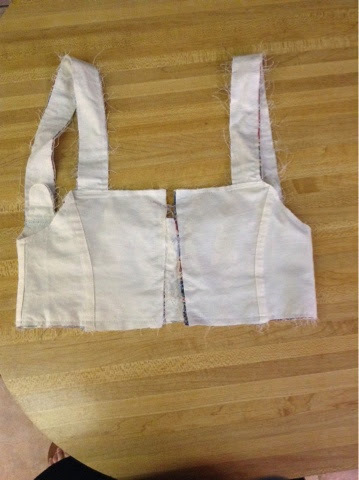
I also added hooks and eyes to the front; a proper treatment would have been a front-lacing closure, as I am pretty sure metal hooks and eyes did not exsist a the time, and I don't think a split busk was used yet, either. But this is a modern convenience for my friend, who may wear the dress for a costume or something in the future, and I didn't want it to be difficult for her to use.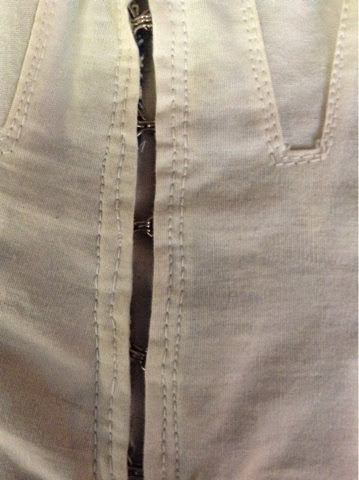
I also plan on binding the entire thing with bias tape, and using the pictured cord for lacing in the back.
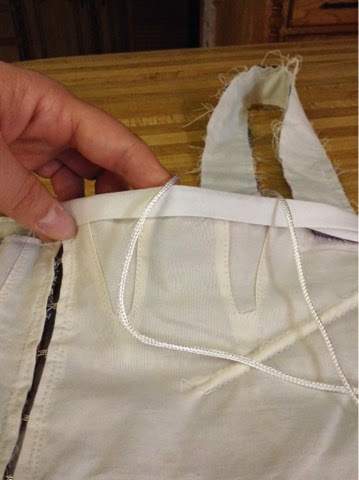
When I post about the dress, I will show the finished stays. For now, though, this is what I have.
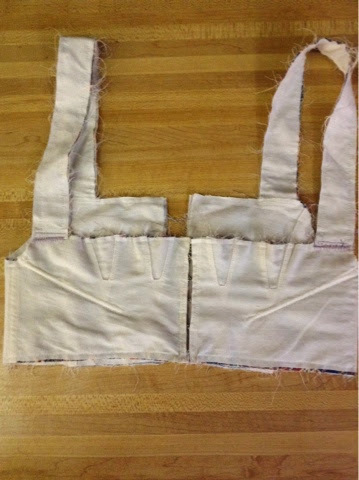
Thank you for reading!!!
I found an awesome tutorial (http://biancavonbavensen.blogspot.com...) that I followed. It uses measurements to make an original pattern to fit the wearer. I was making the stays for my friend who was modeling for my book cover shoot with another friend, to wear unde the Regency dress I also made (that'll be another post, later).
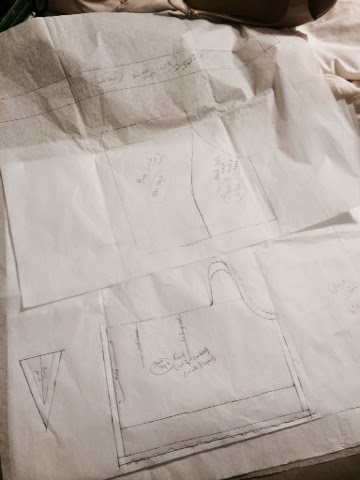
(Here is the pattern I made; I measured and drew it onto tissue paper. I've since learned that I prefer gift wrapping paper for drafting patterns, but this worked for such a small pattern.)
I cut three of each piece (liner, interliner to stiffen, and outer layer) and assembled the three layers seperately. I used French seams, which would be period-accurate, and left them a bit wider than perhaps was necessary, but it added good structure, since I did not want to use boning.
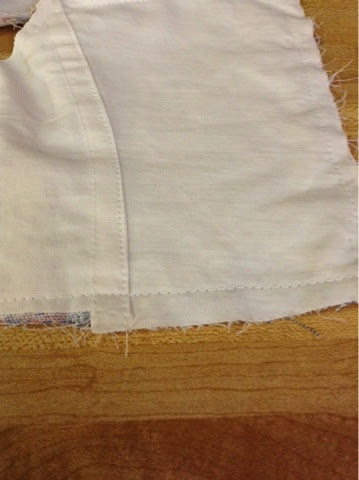
I used an old bed sheet for the two layers that will show, and some heavier home decor fabric I already had for stiffening. It is streachier than it should be, but these stays won't be worn extensively, so I think it will be alright.
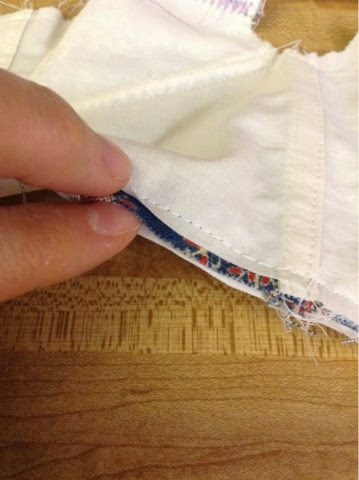
Here are the gussets, to give enough room for supporting the bust. During the regency, the bosom was pushed up to create a shelf-like silhouette. The gussets are formed by inserting triangles into a slit in the fabric. I think I googled "how to sew a gusset" for instructions on that, but cannot remember the site I followed right now.
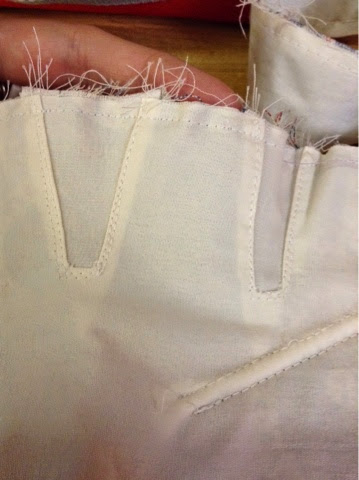
Finally, the pieces were ready to assemble. I pinned all around the edges, temporarily holding all three layers together. Before I sewed them, I added some cording to help support the bust.
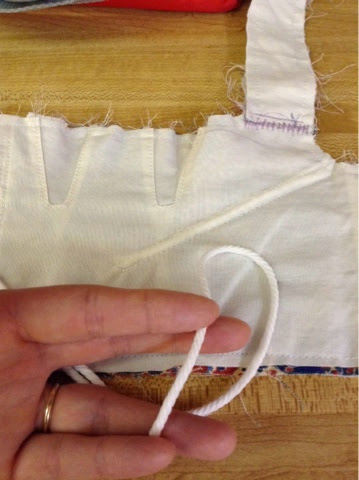
You can see the diagonally-sewn cording under the garment, as well as some leftover cording I had. This gives just a bit more structure and support than nothing, but not as much as boning would have.
I found that this pattern was just a bit too big around; I'm not sure if it was measurign error or what, exactly, but I plan to take an inch off the back on either side, so that the stays may be laced more tightly if needed. I think for the photo-shoot, they were just a bit too loose, sitting where a modern bra would be, and therefore failed to create the proper silhoutte. My plan is to hand-sew the eyelets, as there were no grommets or metal eyelets at thee time (yes, I know, they won't show, but I'd like the practice on something that won't show...I'll post about that later, if anyone is interested).
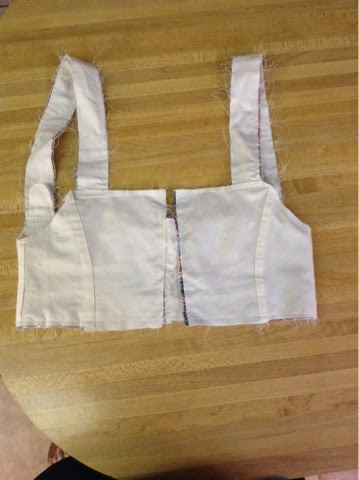
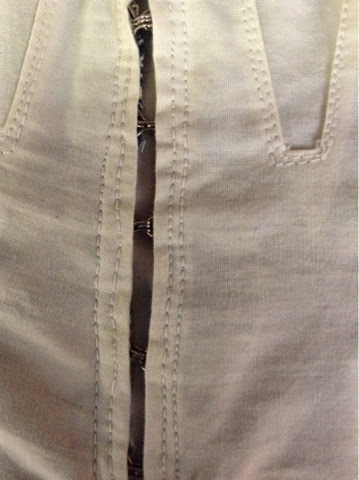
I also added hooks and eyes to the front; a proper treatment would have been a front-lacing closure, as I am pretty sure metal hooks and eyes did not exsist a the time, and I don't think a split busk was used yet, either. But this is a modern convenience for my friend, who may wear the dress for a costume or something in the future, and I didn't want it to be difficult for her to use.
I also plan on binding the entire thing with bias tape, and using the pictured cord for lacing in the back.
When I post about the dress, I will show the finished stays. For now, though, this is what I have.
Thank you for reading!!!
July 11, 2014
Regency Hair
Sorry for the long hiatus. It's been an interesting year, and unfortunately, with a limited amount of time, this blog has suffered. But I've been working hard on finishing my book and it's getting really close!!
Part of the process of getting ready to publish my book is working on the cover. Colleen Oakes, a friend and author, has graciously been offering tips and advice and help in getting my book off the ground. She mentioned that a cover with a person on it gives a potential reader someone to identify with. So, being mindful of my budget, I've decided to DIY it. Sort of.
I'm making a dress for my model, a friend from church, to wear. I've been researching patterns, underpinnings, accessories, and hair from the Regency period. Today, I'm going to share a possibility for how to style my friend's hair.
I started by watching a LOT of tutorials. Find them here, here, here, and here. I've taken pieces from each and come up with this.
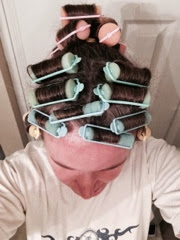
I started by sectioning off the front and back, and putting the rest into a snug ponytail.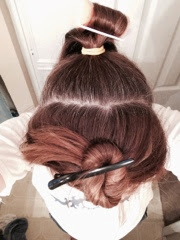
I forgot to take a pic before I started rolling. Here's a side-view: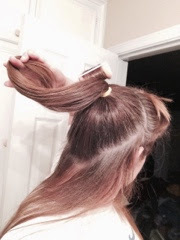
Don't mind my greys. I'm working on a coffee-coloring method...future post???
You could use rag-curls for a more accurate method, or a curling iron for a quicker method. I'll probably use an iron with my model, but I had the time today, since my youngest is home sick with a fever. I curled the ponytail with a looser curl, mostly to help and stick-out ends look a bit more polished. The rest I used slightly smaller curlers, for a more traditional ringlet.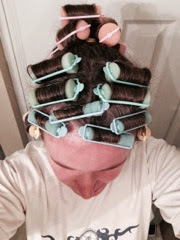
...and the side: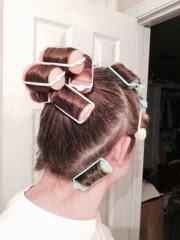
Did laundry like this, and some sewing, too. Finally, I got impatient and started removing the rollers.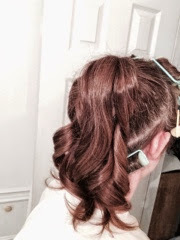
I divided sections of hair, teased them, and rolled them into loops.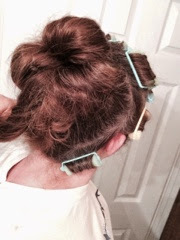 I left the slightly curly ends out.
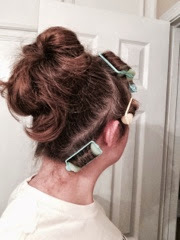 Next time, I think I won't, but I'll also have less hair inside the ponytail, and tease that hair to make a larger bun.
Now to the front. Here's where I'd really love some feedback from you.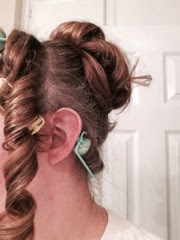 I got some really great curls, and pinned them back to add interest and finish (I hope!) to the bun.
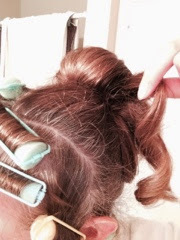 The hair in the back curled really well:
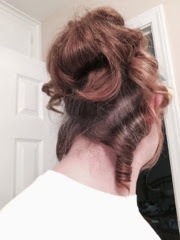 ...and I divided it into smaller curls...
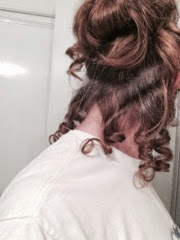 ...and ended pinning those up, too.
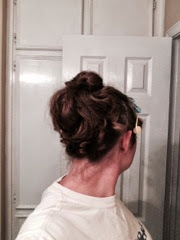 Can't see it too well in this pic, but there are little curls on the under-side of the bun. Now to the front again.
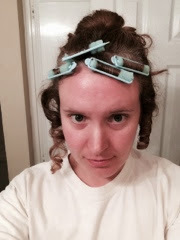 Side-curls looking ok... Not really even. A curling iron could fix it, but I was being lazy.
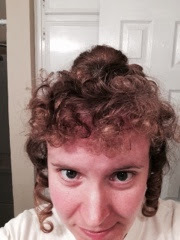 Yikes! They came out as the back curls, all tight together, and when I started separating them, they were ok, but uneven. So I wondered what would happen... I'm not a fan; what do you think? I used some smoothing hair stuff and re-grouped my curls.
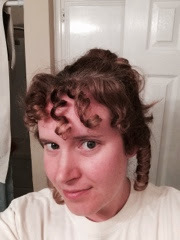 And still didn't like it too much. So I left a tiny curl down on each side and pinned it all back.
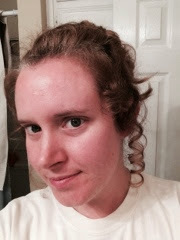
I'm thinking next time, I'll keep sections of longer hair down in front, to frame the face, and also the pieces by the ears.
Here's my question: what do we do with modern bangs? Can they be styled accurately? Or should we just incorporate them into the longer hair and pretend they aren't there?
I'm hoping to post on my adventures in making Regency underpinnings next. :-)
Part of the process of getting ready to publish my book is working on the cover. Colleen Oakes, a friend and author, has graciously been offering tips and advice and help in getting my book off the ground. She mentioned that a cover with a person on it gives a potential reader someone to identify with. So, being mindful of my budget, I've decided to DIY it. Sort of.
I'm making a dress for my model, a friend from church, to wear. I've been researching patterns, underpinnings, accessories, and hair from the Regency period. Today, I'm going to share a possibility for how to style my friend's hair.
I started by watching a LOT of tutorials. Find them here, here, here, and here. I've taken pieces from each and come up with this.
I started by sectioning off the front and back, and putting the rest into a snug ponytail.
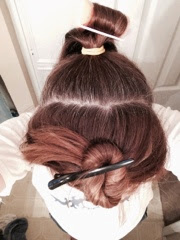
I forgot to take a pic before I started rolling. Here's a side-view:
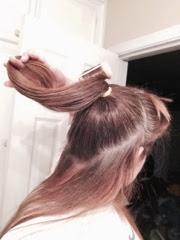
Don't mind my greys. I'm working on a coffee-coloring method...future post???
You could use rag-curls for a more accurate method, or a curling iron for a quicker method. I'll probably use an iron with my model, but I had the time today, since my youngest is home sick with a fever. I curled the ponytail with a looser curl, mostly to help and stick-out ends look a bit more polished. The rest I used slightly smaller curlers, for a more traditional ringlet.
...and the side:
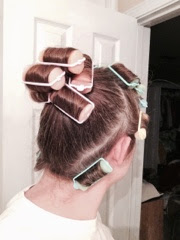
Did laundry like this, and some sewing, too. Finally, I got impatient and started removing the rollers.

I divided sections of hair, teased them, and rolled them into loops.
 I left the slightly curly ends out.
 Next time, I think I won't, but I'll also have less hair inside the ponytail, and tease that hair to make a larger bun.
 Now to the front. Here's where I'd really love some feedback from you.
 I got some really great curls, and pinned them back to add interest and finish (I hope!) to the bun.
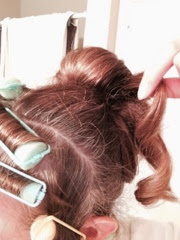 The hair in the back curled really well:
 ...and I divided it into smaller curls...
 ...and ended pinning those up, too.
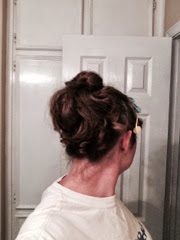 Can't see it too well in this pic, but there are little curls on the under-side of the bun. Now to the front again.
 Side-curls looking ok... Not really even. A curling iron could fix it, but I was being lazy.
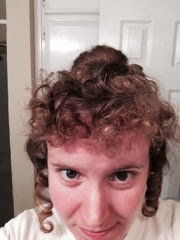 Yikes! They came out as the back curls, all tight together, and when I started separating them, they were ok, but uneven. So I wondered what would happen... I'm not a fan; what do you think? I used some smoothing hair stuff and re-grouped my curls.
 And still didn't like it too much. So I left a tiny curl down on each side and pinned it all back.

I'm thinking next time, I'll keep sections of longer hair down in front, to frame the face, and also the pieces by the ears.
Here's my question: what do we do with modern bangs? Can they be styled accurately? Or should we just incorporate them into the longer hair and pretend they aren't there?
I'm hoping to post on my adventures in making Regency underpinnings next. :-)
August 29, 2013
A Short Devotion on Colossians 2:6-7
Therefore, as you received Christ Jesus the Lord, so walk in him, rooted and built up in him and establishedin the faith, just as you were taught, abounding in thanksgiving. Colossians 2:6-7
We received Christ as we were taught about Him, and our hearts overflow with His love and mercy and grace!
We walk in His footsteps, following His example of reaching out to others and carrying to them the same message which we received.
We are rooted and built up in Him, the Word of God. We find all that we need in that Word. And in that Word, we are securely planted and also made to grow. In Him, we are no small seedling, scorched by the heat of the day or drowned by the rainwater. We are strong in Him!
We are established in the faith which was given to us, which we all share. The word carries with it a sense of longevity, a sense of stick-with-it-ness Because we are established, we will not be blown about by false whisperings or lost in the face of difficulty.
We have been taught by His Word, by God Himself. This teaching is true and trustworthy, bringing life and salvation to all who receive it.
We respond with thanksgiving, glorifying God in all that we say and do, for He is our God and we are His people.
We received Christ as we were taught about Him, and our hearts overflow with His love and mercy and grace!
We walk in His footsteps, following His example of reaching out to others and carrying to them the same message which we received.
We are rooted and built up in Him, the Word of God. We find all that we need in that Word. And in that Word, we are securely planted and also made to grow. In Him, we are no small seedling, scorched by the heat of the day or drowned by the rainwater. We are strong in Him!
We are established in the faith which was given to us, which we all share. The word carries with it a sense of longevity, a sense of stick-with-it-ness Because we are established, we will not be blown about by false whisperings or lost in the face of difficulty.
We have been taught by His Word, by God Himself. This teaching is true and trustworthy, bringing life and salvation to all who receive it.
We respond with thanksgiving, glorifying God in all that we say and do, for He is our God and we are His people.