Brett Ann Stanciu's Blog, page 159
August 20, 2016
Moon Rise
Camping these past few days on a island in Lake Champlain, the kids and I were biking back from the south end in the dusk when a crimson full moon appeared over the horizon, startlingly beautiful.
A 100 years ago, this mile-long island was farmed by tenant labor, sending out vegetables, dairy, wool. Now, those once-upon-a-time farm fields run rampart with goldenrod and stinging nettles. Sumac trees branch over paths for enchanting tunnels. The mighty lake, like so much of our world now, is polluted, but even so, the beauty of water and sky, singing cricket and chorusing frog, blue heron and turtle, is mesmerizing.
The next night, the children and I canoed into the dusk, and then walked out on a rocky jetty as dark filtered in. We perched there, watching the moon rise over the horizon. I’ve been reading Howard Axelrod’s The Point of Vanishing, a book about his two years in Vermont solitude, and I kept thinking of his line near the end: you are human. Not solitary, not a discrete entity, but part of the moving, changing landscape, in all its infinite beauty.
I wanted to see through all surfaces and to see through myself, but I wasn’t a transparent thing. I was bone, sinew, skin. If I lost depth perception when it came to life, if I removed every line so there was no difference between near and far, I’d never survive – maybe as a ghost or as a cipher but not as a human being.
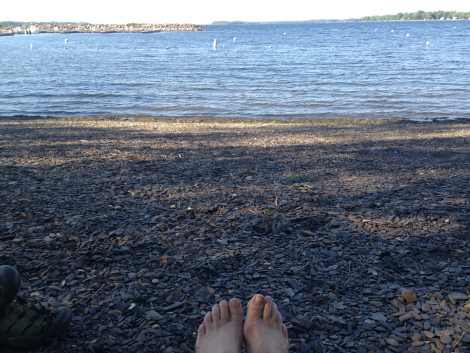
Burton Island, Vermont


August 17, 2016
We Hold These Truths To Be Self-Evident
A little over four years ago, my 7-yr-old and 13-yr-old daughters and I spent all day in Newport, VT’s county courthouse; their father was on trial with five others for criminal trespassing. The six defendants – self-named the Lowell Six – had been arrested in a dispute over constructing 21 enormous wind towers. Green Mountain Power claimed they had rights to the property. The Lowell Six claimed the property belonged to the Nelson family. The case’s details I wrote about in VTDigger.
The top floor of that beautifully built old courthouse had enormous windows with a view of Lake Memphramagog. Birds came and went about their avian business, all day. While the jury was out, the sun edged down.
In the end, the Lowell Six were found guilty. Five of them served some variation of community service for a crime none of them believed they had committed; the sixth was arrested for contempt of court and spent a weekend in jail, three years later. Green Mountain Power’s 21 wind towers were built, constructed out of sheer material greed and cloaked in a smokescreen of green energy.
Like everyone else, I inherently believe in MLK’s arc of justice bending around. Yet, after all this, I see, instead, the complexity (and perhaps the length) of what justice might mean. Where is the bend of justice in this case? I don’t see it yet, but that doesn’t mean I’m not looking.
Some days, all day, days, it rains.
-– Janisse Ray


August 16, 2016
August, 2016, Vermont
11-years-old. Hair sun-bleached. Eyes on the bike route. Hungry for mocha mud ice cream.
Evening breeze —
water is slapping against
the legs of a blue heron.
– Yosa Buson
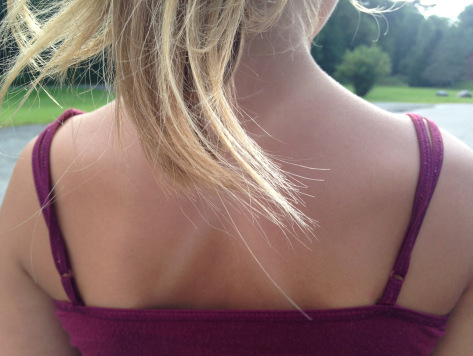
Stowe, Vermont


August 14, 2016
Girl with Confidence
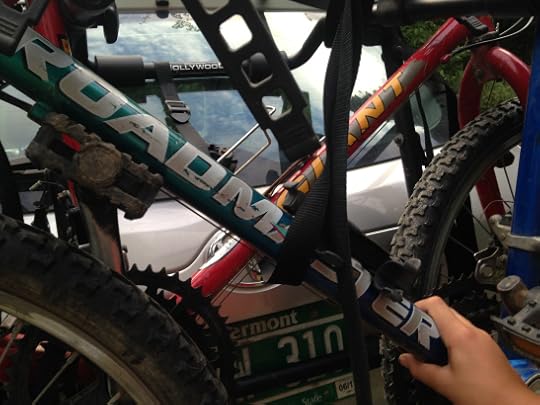
My 11-year-old daughter woke up this morning, searched for a particular pair of shorts, and ran down our dirt road. She ran for the first time beyond the road’s well-travelled end and down the narrower section, where woods and wild blackberries flank either side.
In the afternoon, she took her sister and me on a tour of Morrisville’s rail trail where she’s sprinted this summer with a friend. With delight, she showed us a bridge over a narrow road, the brewery where we later ate dinner, a tiny house with a glass front, a cluster of ramshackle trailers.
The ride, fragrant with August’s lush goldenrod, scottish thistle, honeysuckle, was a three-dimensional map of her childhood world: a unique, dear gift.
Summer was our best season: it was sleeping on the back screened porch in cots, or trying to sleep in the treehouse; summer was everything good to eat; it was a thousand colors in a parched landscape; but most of all, summer was Dill.
Scout, in Harper Lee’s To Kill A Mockingbird
Morrisville, Vermont


August 13, 2016
Living Literature
My kids and I saw a live theater production today of one of my favorite books, To Kill a Mockingbird, a novel I tutored to high school students years ago. At one point, I had taken that novel apart in all kinds of ways, knew it backwards and forwards, in and out: mad dog, camellias, serving lemonade in times of stress.
Listening today, for the first time I realized compassion (that thread I’ve returned to, over and over this year) is at the heart of this novel. Tom Robinson, poor Southern black man, is the only person who has compassion for Mayella Ewell, a young woman about as white trash as could be, with a nasty father, too many little siblings and no mother, and scant means all the way around.
Tom Robinson did what Atticus advised; he imagined walking around in another’s skin, not because he desired anything from this woman, but purely from the decency of his own heart. If for no other reason, that’s why we need literature more than ever now: we desperately need that imagination.
Boo was our neighbor. He gave us two soap dolls, a broken watch and chain, a pair of good-luck pennies, and our lives.
– Harper Lee, To Kill A Mockingbird


August 12, 2016
Novelist as Voyeur
Among many, I’m reading Gay Talese’s intensely bizarre The Voyeur’s Motel, and I squelched an impetus to conceal the unmistakable cover at the lake with my kids this afternoon. There’s an underlying subtext of, well, porn, which is something I never read.
Perhaps the other subtextual issue is that I realize, like all novelists, I’m a tenor of voyeur, too, always looking at other people and parsing their lives, wondering at the mechanics not only of their material lives, but their souls, too. Talese’s book reminds me of the far classier Blink by Malcolm Gladwell, and the four horsemen in relationships. Over and over, I’ve thought of that Contempt horseman rearing its head. (How much I wish I’d heeded Gladwell’s words, many years ago.)
A third of the way through the motel book, I’m already longing for Talese to toss me some kind of bone of human decency, and perhaps one reason I keep reading is I want that decency to rear up at some point.
You can never really determine during their appearance (of couples) in public that their private life is full of hell and unhappiness. I have pondered why it is absolutely mandatory for people to guard with all secrecy and never let it be known that their personal lives are unhappy and miserable.
– Gay Talese, The Voyeur’s Motel
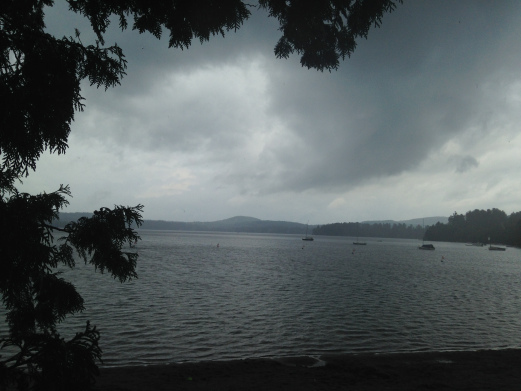
Such a grim view. Then there’s this: swimming, we could see a bank of clouds rushing across the lake today. In this humid day, with no sign of lightening, only the rain rushing in and rushing out, the girls kept swimming in the downpour, just the two of them in all that cool water. Voyeur that I may be – beneath a cedar tree in a shower storm – I hope to catch a more joyous slice of human life.
Greensboro, Vermont


August 11, 2016
Mother’s Work
Maybe I’m just incredibly narrowly read, but it seems far too infrequent that I read a male writer exclaiming, “Thank god. The kids played Monopoly all afternoon and left me alone at my desk. For two whole hours.” Perhaps what I need isn’t so much a room of mine own (which I now have, after many years) but a nanny of my own.
Rain is rumored, but long in arriving. We’re now settled into a summer routine of kids swimming at the lake while I spread out my laptop and a bag of work on a stained towel. By the dinner, it’s been a full day of work sandwiched with swimming and snacks. This is the high point of the summer – the crickets at full throttle, the lakes endless, the garden escaping its fence and long past the dire point of must-weeding. What will grow, will indeed grow. Blackberry tart rears its maplely head this evening.
Here’s a brief bit of beach reading from Mary Norris’s Between You and Me, one more womanly skill among many mothering others:
Used well, the semicolon makes a powerful impression; misused, it betrays your ignorance.


August 10, 2016
Blackberries in All Their Heavenly Glory
I naturally think of the world in terms of metaphors, and blackberry season is a thread that’s wound all through my adult life. Twenty years ago, we moved into our house – essentially a hunting camp then – on a clay-soil Vermont hillside with little else of human life around. On a woods road behind the house, I discovered a blackberry thicket. I see my younger self, picking alone in those brambles, wearing an old red t-shirt and darted at by hummingbirds, afraid of the bears who had clearly enjoyed their share of the wild harvest.
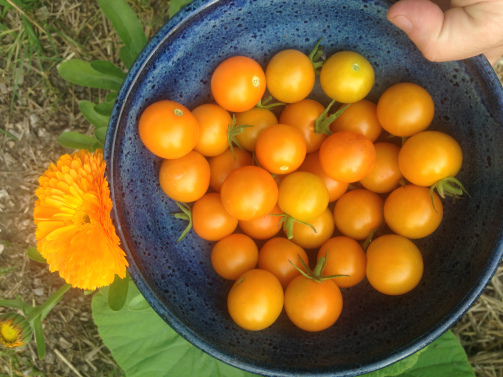
My daughters and I easily picked a quart last evening of exceptionally sweet and juicy berries. Some years, the berries are seedy and hard; some years, the vines are nearly absent of fruit; others, like this one, go on and on for weeks, delicious, wild, there for the gathering.
One year, I pulled a long thorn from my young daughter’s sandal. Her tiny heel released a single drop of crimson blood. Through all these seasons, here’s been the berries, various as our own family dynamics – generous or bitter, depending on the season – but invariably returning. Isn’t that metaphor enough?
Here’s a Galway Kinnell one-liner:
I love to go out in late September among the fat, overripe, icy, black blackberries to eat blackberries for breakfast, the stalks very prickly, a penalty they earn for knowing the black art of blackberry-making; and as I stand among them lifting the stalks to my mouth, the ripest berries fall almost unbidden to my tongue, as words sometimes do, certain peculiar words like strengths or squinched, many-lettered, one-syllabled lumps, which I squeeze, squinch open, and splurge well in the silent, startled, icy, black language of blackberry – eating in late September.
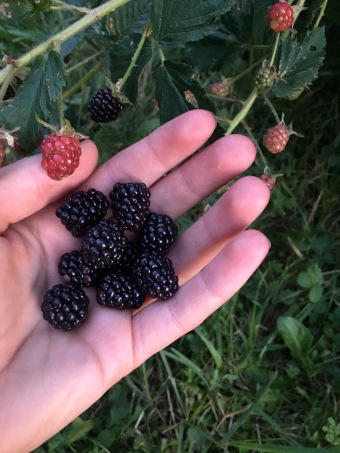
Photo by Molly S.


August 8, 2016
A Mouse Passing
This will likely reveal the sad state of housekeeping around here, but the other morning I found a dead mouse in the living room. The little creature must have folded itself against the chimney in the night and passed along into the next realm for small rodents, leaving behind a gray and a very long-tailed body. I swept it into the dustpan and laid it outside beneath a maple tree. Still early in the morning, the grass was cool beneath my bare feet, and the children were sleeping, wreathed in their world of dreams.
Ill, injured, or simply old? I don’t know. The leaves flipped up their undersides, preparing for rain. I knew the little body wouldn’t remain there long. These shells of creatures never do, scavenged up by some other animal, turned into someone else.
Oddly, as I walked back into the house and picked up my laptop on the couch again, I thought of an Issa haiku I first read when I was a teenager, more resonant, stronger, than ever. Ah, little mouse…
Don’t kill that fly!
Look–it’s wringing its hands,
wringing its feet.
– Kobayashi Issa


August 7, 2016
One Life Instruction, via Mary Oliver
Last summer, we were eating dinner with friends who have young children, and two couples compared notes about their toddlers drinking dirty bath water. I laughed and assured them, yes, someday their kids would brush their own teeth. The real challenge, I claimed, was when the teenagers take off in the Toyota.
As I often am, I was wrong. What about when a child decides to disappear into a remote mountain wilderness? Or head down her own path of parenthood?
In my forties, now, I’ve reached the point where life is no longer that amorphous, endlessly murky terrain, but indeed life stretches out, far more winding than I ever would have imagined when I was twenty. Perhaps it’s the decade of my life, but now separations, cancers, loss and loss again, is no longer uncommon – which perhaps is why good news is so much sweeter. Every one of these babies born well, a new house, a book published, a journey completed in good humor.
Or this: my girls with their long legs sprawled on the couch, laughing about silly things, nothing more, just silliness. Long life is made of little tiny moments: soak up the sweeter ones.
Instructions for living a life.
Pay attention.
Be astonished.
Tell about it.
– Mary Oliver