Dave Donelson's Blog: OutTakes, page 6
August 28, 2012
Visual Aids For Sales Presentations
Larger group presentations often call for visual aids, which can both embellish and complicate your presentation. Whether you’re using foam-board flip cards or a laptop with presentation software projected onto a big screen, be sure that you know how to use the presentation medium and have rehearsed with it.
Find out, if you can, just how large the room will be and how many participants you’ll be facing. This will help you determine what kind of visual aids, if any, that you want to use. You may not want 24 X 30-inch flip cards for a group of four—unless they’re going to be seated at the opposite end of a 20-ft. table.
Never count on the prospect to provide any equipment. There’s nothing worse than arriving to connect your laptop to the prospect’s projector only to discover that you need an adapter neither one of you has. Whether you’re going high-tech or low-tech, bring every single item you could possibly need with you. This includes everything from extension cords and grounded-outlet adapters to monitors and projectors. If you need an easel for your flip cards, bring one yourself. I can almost guarantee that if you don’t, the prospect’s won’t work or someone in another department will have borrowed it just before you arrived.
It’s mandatory that you set up your visual aids before the group gathers in the room. I would rather skip the visual aids completely than stumble through a pitch while I’m fumbling with a “General Protection Page Fault” on my laptop. In fact, if it’s not possible to get access to the meeting room and set up before the group gathers, play it safe and don’t bother with the visual aids. It’s better to make a neutral low-tech impression than a bad high-tech one.
If you’re using a laptop, set up your software so that you don’t have to click through several screens to get to your presentation. Create a shortcut to the presentation right on your opening screen. That way, all you have to do is click on it to start the show. Finally, check the view from the back of the room to be sure everyone can read your material.
No matter which format you use for your visual aids, design them as much like your written presentation as you can. Make each slide (or card) simple, clear, and to the point. Any bodies of text will need to be converted to bullet points, of course. This isn’t the place to go into great detail on constructing slide presentations, but get yourself a good tutorial if you plan on preparing your own.
Group presentations are actually great fun to give. You get to practice your craft in a slightly different way from the normal routine. And you have the opportunity to use all of your persuasive skills and stagecraft to their fullest effect. Most group presentations involve prospects with large potential, so there’s usually a lot riding on the effectiveness of your pitch. You’ll make good use of your stage fright management skills.
Dave Donelson distills the experiences of hundreds of entrepreneurs into practical advice for small business owners and managers in the Dynamic Manager's Guides, a series of how-to books about marketing and advertising, sales techniques, motivating personnel, financial management, and business strategy.

Find out, if you can, just how large the room will be and how many participants you’ll be facing. This will help you determine what kind of visual aids, if any, that you want to use. You may not want 24 X 30-inch flip cards for a group of four—unless they’re going to be seated at the opposite end of a 20-ft. table.
Never count on the prospect to provide any equipment. There’s nothing worse than arriving to connect your laptop to the prospect’s projector only to discover that you need an adapter neither one of you has. Whether you’re going high-tech or low-tech, bring every single item you could possibly need with you. This includes everything from extension cords and grounded-outlet adapters to monitors and projectors. If you need an easel for your flip cards, bring one yourself. I can almost guarantee that if you don’t, the prospect’s won’t work or someone in another department will have borrowed it just before you arrived.
It’s mandatory that you set up your visual aids before the group gathers in the room. I would rather skip the visual aids completely than stumble through a pitch while I’m fumbling with a “General Protection Page Fault” on my laptop. In fact, if it’s not possible to get access to the meeting room and set up before the group gathers, play it safe and don’t bother with the visual aids. It’s better to make a neutral low-tech impression than a bad high-tech one.
If you’re using a laptop, set up your software so that you don’t have to click through several screens to get to your presentation. Create a shortcut to the presentation right on your opening screen. That way, all you have to do is click on it to start the show. Finally, check the view from the back of the room to be sure everyone can read your material.
No matter which format you use for your visual aids, design them as much like your written presentation as you can. Make each slide (or card) simple, clear, and to the point. Any bodies of text will need to be converted to bullet points, of course. This isn’t the place to go into great detail on constructing slide presentations, but get yourself a good tutorial if you plan on preparing your own.
Group presentations are actually great fun to give. You get to practice your craft in a slightly different way from the normal routine. And you have the opportunity to use all of your persuasive skills and stagecraft to their fullest effect. Most group presentations involve prospects with large potential, so there’s usually a lot riding on the effectiveness of your pitch. You’ll make good use of your stage fright management skills.
Dave Donelson distills the experiences of hundreds of entrepreneurs into practical advice for small business owners and managers in the Dynamic Manager's Guides, a series of how-to books about marketing and advertising, sales techniques, motivating personnel, financial management, and business strategy.


August 27, 2012
Half Moon Bay Sized Right For Golf Weekends
The Ritz Carlton Half Moon Bay epitomizes the perfect golf weekend destination. Just 30 minutes from San Francisco International Airport, the resort offers accommodations at a fabulous Ritz hotel, two very entertaining golf courses, and guest pampering that won't stop.
Golf is the heart of the resort and two excellent and completely different golf experiences are available to both resort guests and daily fee players. The Old Course, a traditional parkland-style track that opened in 1973, was designed by Arnold Palmer and Francis Duane. Its18th hole along the ocean has been ranked among the 100 best in America. The Ocean Course was designed by Arthur Hills to pay homage to Scottish links-style courses. It debuted in 1997 and was remodeled in 2009 to make it play even more true to the style.

18th Hole on the Old Course. Photo courtesy of the resort.
The Old Course stretches 7,001 yards from the tips. The generous fairways and gentle greens are perfect for the resort player who chooses the right tees (the whites are fine at 6,323 yards). The better player will be rewarded by well-placed tee shots and aggressive pin-seeking approaches while the less-than-perfect golfer won't be decimated by a miss or two. The Old Course ends with two thrilling holes on the Pacific, a 167-yard one-shotter that plays dead into the prevailing wind followed by a risk-and-reward 405-yard par four with the ocean on the right and a ravine crossing the fairway smack in the middle of the range of just about everybody's tee shot. A driver should probably be your last choice off the tee on the final hole. The shot into the tiny 18th green is a simple short iron or wedge made a bit more demanding by the audience typically watching from the hotel patio and fire pit adjacent to it.
The Pacific is in view from every hole on the Ocean Course, but is in play (kind of) only on the 184-yard par-three seventeenth hole, where an errant tee shot can easily find the beach at the bottom of the cliffs next to the green. The ocean breezes (or gales), though, shape every shot you make on the 6,854-yard track--especially on the back nine. The course plays much like pure links, with rolling, contoured fairways where odd bounces prevail and approach shots into generous greens demand careful consideration of the humps and bumps of the greenside terrain. Shot values matter more than sheer length and power. The fairways are generous but the rough is mowed short around bunkers to bring the hazards into play on tee shots. Greenside surrounds are cut to “just above green” mowing height to foster ball movement on the ground and native fescue between holes provides you with visual cues about how to direct your shots.
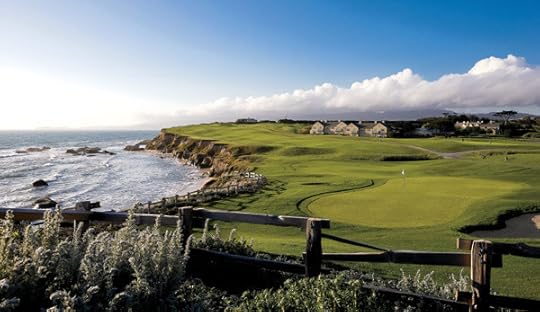
18th Hole on the Ocean Course. Photo courtesy of the resort.
With a little planning, it's easy to play both courses in a day. Just be sure to leave time for a generous lunch break in Mullins Bar & Grill in the clubhouse or in the Conservatory Lounge in the hotel. The sliders of pulled pork cooked for 48 sweet hours deserve your full attention, so allow enough time between rounds to enjoy them.
Other dining options include the nautically-inspired Navio, which serves fine coastal cuisine from a 1,000 sq. ft. display kitchen and ENO, a wine bar that contains over 5,000 bottles of international wines and includes sommelier-selected wine flights. Other resort amenities include a 16,000 sq. ft. Spa and Fitness Center with a unique co-ed Roman mineral bath, an immense patio perched on the cliffs above the beach, and soul-searing views of the Pacific from nearly every room. There also a scenic trail that winds along the cliffs and activities nearby include horseback riding, deep-sea fishing, whale watching, sea kayaking, hiking, biking and antiquing.
Among many other books, Dave Donelson is the author of Weird Golf: 18 tales of fantastic, horrific, scientifically impossible, and morally reprehensible golf


Golf is the heart of the resort and two excellent and completely different golf experiences are available to both resort guests and daily fee players. The Old Course, a traditional parkland-style track that opened in 1973, was designed by Arnold Palmer and Francis Duane. Its18th hole along the ocean has been ranked among the 100 best in America. The Ocean Course was designed by Arthur Hills to pay homage to Scottish links-style courses. It debuted in 1997 and was remodeled in 2009 to make it play even more true to the style.

18th Hole on the Old Course. Photo courtesy of the resort.
The Old Course stretches 7,001 yards from the tips. The generous fairways and gentle greens are perfect for the resort player who chooses the right tees (the whites are fine at 6,323 yards). The better player will be rewarded by well-placed tee shots and aggressive pin-seeking approaches while the less-than-perfect golfer won't be decimated by a miss or two. The Old Course ends with two thrilling holes on the Pacific, a 167-yard one-shotter that plays dead into the prevailing wind followed by a risk-and-reward 405-yard par four with the ocean on the right and a ravine crossing the fairway smack in the middle of the range of just about everybody's tee shot. A driver should probably be your last choice off the tee on the final hole. The shot into the tiny 18th green is a simple short iron or wedge made a bit more demanding by the audience typically watching from the hotel patio and fire pit adjacent to it.
The Pacific is in view from every hole on the Ocean Course, but is in play (kind of) only on the 184-yard par-three seventeenth hole, where an errant tee shot can easily find the beach at the bottom of the cliffs next to the green. The ocean breezes (or gales), though, shape every shot you make on the 6,854-yard track--especially on the back nine. The course plays much like pure links, with rolling, contoured fairways where odd bounces prevail and approach shots into generous greens demand careful consideration of the humps and bumps of the greenside terrain. Shot values matter more than sheer length and power. The fairways are generous but the rough is mowed short around bunkers to bring the hazards into play on tee shots. Greenside surrounds are cut to “just above green” mowing height to foster ball movement on the ground and native fescue between holes provides you with visual cues about how to direct your shots.

18th Hole on the Ocean Course. Photo courtesy of the resort.
With a little planning, it's easy to play both courses in a day. Just be sure to leave time for a generous lunch break in Mullins Bar & Grill in the clubhouse or in the Conservatory Lounge in the hotel. The sliders of pulled pork cooked for 48 sweet hours deserve your full attention, so allow enough time between rounds to enjoy them.
Other dining options include the nautically-inspired Navio, which serves fine coastal cuisine from a 1,000 sq. ft. display kitchen and ENO, a wine bar that contains over 5,000 bottles of international wines and includes sommelier-selected wine flights. Other resort amenities include a 16,000 sq. ft. Spa and Fitness Center with a unique co-ed Roman mineral bath, an immense patio perched on the cliffs above the beach, and soul-searing views of the Pacific from nearly every room. There also a scenic trail that winds along the cliffs and activities nearby include horseback riding, deep-sea fishing, whale watching, sea kayaking, hiking, biking and antiquing.
Among many other books, Dave Donelson is the author of Weird Golf: 18 tales of fantastic, horrific, scientifically impossible, and morally reprehensible golf
August 24, 2012
Golf Course Lightning? Gimme Shelter!

Photo courtesy of Adam Donlin, Ballyowen Director of Golf
If you have any doubt about what happens when lightning strikes a golf course, look closely at the green in this picture from Ballyowen in Hamburg, NJ. The flag has been replaced since the one that drew the lighting was obliterated, but check out the cracks in the green radiating from the cup. Now imagine the force that created them coursing through your body. Not pleasant, but that's exactly what could happen if you ignore the simplest rule in golf: if there is the remotest possibility that lightning is in the area while you are on a golf course--take immediate shelter!
A few things to keep in mind:
Lightning can strike several miles from the center of a storm and far from the clouds you see. Ever heard of a "bolt from the blue?" They're real! Lightning can strike fifteen miles from a thunderstorm.
You will not always have warning from thunder. Atmospheric conditions can send the thunder sound wave away from you. On the other hand, if you hear thunder, don't try to second-guess it. There's lighting somewhere in your vicinity so take cover.
Don't trust the "30-second rule." It's widely believed that you can count the seconds between a lightning flash and the sound of the thunder and, if it's greater than thirty seconds, the danger is too far away to be cause for concern. That's dangerous wishful thinking--the next lightning flash you see can easily be the one that strikes your head.
Most lightning casualties occur in the beginning of a storm because golfers tend to try to ignore the warning signs and try to squeeze in just one more hole. Many injuries also come after the storm--lightning can strike up to thirty minutes after the thunderstorm has supposedly passed.
Many golf courses have lightning warning systems, but don't wait for the horn to sound if you see the storm coming. The systems are great, but not always maintained in perfect working order.
The safest place to be is in the clubhouse, so head for it at the first indication of trouble. If you can't make it, avoid the places you want to be like in a course rain shelter, under a tree, or even in your golf cart. All of these actually increase the probability of being struck. Instead, find the lowest point away from things like standing water, fences, or machinery, crouch down, and put your hands over your ears to minimize hearing damage. Don't lay flat on the ground and stay at least fifteen feet from other people--lightning can jump from them to you.
What should you do if someone in your group is struck? Here's what the National Severe Storms Laboratory says:
Call 911 and provide directions to the victim
Don't endanger yourself or others if the victim is in a high-risk area and the storm is continuing. Lightning DOES strike the same place twice!
Victims don't carry a charge after being struck, so it's safe to touch them to render treatment. They also seldom suffer from major fractures or bleeding complications, so it's safe to move them away from a high risk area if you can do so safely.
If the victim is not breathing, start mouth-to-mouth resuscitation. If you can't find a pulse, start cardiac compression as well. If the ground is cold and wet, put a protective layer beneath the victim to decrease hypothermia.
Literally hundreds of people are killed and injured every year by lightning. While about 10% of strike victims die, the other 90% usually suffer lifelong effects. Don't be one of them.
Among many other books, Dave Donelson is the author of Weird Golf: 18 tales of fantastic, horrific, scientifically impossible, and morally reprehensible golf


August 21, 2012
Sales Skills For Group Presentations
Selling is just like playing chess—the rules are the same every time but no two games are just exactly alike. And it’s a good thing, too, since we’d all get bored pretty quickly if the games ever started repeating themselves. One of the variations many salespeople encounter is the need to make a presentation to a group rather than to a single prospect.
It may be Mr. Big and his assistant, a committee of decision-makers and decision-influencers, or even the board of directors. When you make a group presentation, you’re generally working in a different physical setting that can range from chairs pulled around the prospect’s desk to a conference room with a table the size of an aircraft carrier. You might even have to make your pitch in an auditorium complete with podium and sound system.
Regardless of the setting, the basic differences between a group presentation and a one-on-one call deal with the distribution and control of your written materials and handling the very different dynamics of large group meetings. It’s important to remember, though, that all the other good sales techniques remain the same. Your goal is still to gather information about the prospect, for example, and you should still follow the five-page presentation format I introduced in The Dynamic Manager’s Guide To Sales Techniques, including asking questions at the end of each page. Your stage presence and enthusiasm level are even more important when pitching a group, though, as is your ability to gain their attention and hold their interest.
Handling your written materials is actually easier in many ways when you are working with a group. The best tactic to control the pace of the presentation is to hand out one page of the presentation at a time. You never want to distribute the entire proposal at the beginning for the same reason you shouldn’t just hand it to a single prospect: they’ll turn immediately to the price and fixate on it. Instead, hand out each page in its turn. In a small room with a limited number of participants, you can handle this easily yourself—provided you can walk and talk at the same time. With a larger group you may need some assistance, which can be provided by the group members themselves. If you don’t have a helper with you, just ask the people nearest to you to “take one and pass them on” to the people behind them. Your goal is to see that everyone in the group gets a copy—but that none have any page in their hand until you’re ready to talk about it.
Dave Donelson distills the experiences of hundreds of entrepreneurs into practical advice for small business owners and managers in the Dynamic Manager's Guides, a series of how-to books about marketing and advertising, sales techniques, motivating personnel, financial management, and business strategy.

It may be Mr. Big and his assistant, a committee of decision-makers and decision-influencers, or even the board of directors. When you make a group presentation, you’re generally working in a different physical setting that can range from chairs pulled around the prospect’s desk to a conference room with a table the size of an aircraft carrier. You might even have to make your pitch in an auditorium complete with podium and sound system.
Regardless of the setting, the basic differences between a group presentation and a one-on-one call deal with the distribution and control of your written materials and handling the very different dynamics of large group meetings. It’s important to remember, though, that all the other good sales techniques remain the same. Your goal is still to gather information about the prospect, for example, and you should still follow the five-page presentation format I introduced in The Dynamic Manager’s Guide To Sales Techniques, including asking questions at the end of each page. Your stage presence and enthusiasm level are even more important when pitching a group, though, as is your ability to gain their attention and hold their interest.
Handling your written materials is actually easier in many ways when you are working with a group. The best tactic to control the pace of the presentation is to hand out one page of the presentation at a time. You never want to distribute the entire proposal at the beginning for the same reason you shouldn’t just hand it to a single prospect: they’ll turn immediately to the price and fixate on it. Instead, hand out each page in its turn. In a small room with a limited number of participants, you can handle this easily yourself—provided you can walk and talk at the same time. With a larger group you may need some assistance, which can be provided by the group members themselves. If you don’t have a helper with you, just ask the people nearest to you to “take one and pass them on” to the people behind them. Your goal is to see that everyone in the group gets a copy—but that none have any page in their hand until you’re ready to talk about it.
Dave Donelson distills the experiences of hundreds of entrepreneurs into practical advice for small business owners and managers in the Dynamic Manager's Guides, a series of how-to books about marketing and advertising, sales techniques, motivating personnel, financial management, and business strategy.
August 18, 2012
Kiawah Island - The Complete Golf Destination
Shrimp ‘n Grits. Even if you don’t want to play one of the most exciting golf courses in the country, bask on a top-ten beach, or luxuriate in a five-star spa, it’s worth the trip to Kiawah Island just to chow down on Shrimp ‘n Grits, a dish you’ll fortunately find on many menus at the resort. I liked it so much I had it for breakfast one day.
The dish is a lot like the entire experience at Kiawah, the oceanfront resort just 21 miles from Charleston, South Carolina. Each mouthful seems to combine the briny breeze off the Atlantic with the nutty grist of the dunes, all smothered with the creamy gravy of Southern hospitality. The resort melds into a 10,000-acre barrier island, home to egrets, loggerhead turtles, and alligators, not to mention ten miles of perfect Atlantic Ocean beach. You can stay at the ultra-luxury 255-room Sanctuary Hotel or rent one of the 600 charming villas and private homes on the island. There are world-class tennis facilities, a nature center with on-staff naturalists, bike rentals, three swimming pool complexes, a 21-acre park, and year-round family activities.
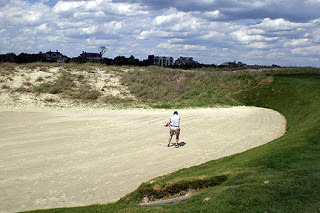
But the prime attraction at Kiawah Island—or at least the reason we went—are the five championship golf courses headlined by Pete Dye’s Ocean Course, once named America’s Toughest Course by Golf Digest, home of the 1991 Ryder Cup, and home of the 2012 PGA Championship. Not to be overlooked are the other four courses at the resort, all creations of the world’s top golf course architects. They are Osprey Point by Tom Fazio, Turtle Point by Jack Nicklaus, Cougar Point by Gary Player, and Oak Point by Clyde Johnston.
Golfers with a sense of history remember very well the “War By The Shore,” the 1991 Ryder Cup that poured gasoline on the spark of rivalry ignited by the European win in 1987 and the jaw-clenching tie of 1989. When the matches came to Kiawah, they took on a death-before-dishonor tone that they’d never really seen before. Corey Pavin and Steve Pate wore combat-style camo hats in their second day match, the fans were beered-up and raucous, the course was windswept and fast, giving the golfers on both sides fits as they tried to navigate the tough layout and hit the tiny target greens. As the final day dawned, the teams were tied. The singles matches went back and forth, with one memorable moment after another including Mark Calcavecchia’s choking finish that culminated in a missed two-foot putt. The Americans won the event on a missed putt, too, this one the last putt of the last hole when Bernhard Langer’s four-footer slid past the cup.
There may not be chants of “USA! USA!” when you play the Ocean Course, but that won’t make it any less thrilling. The 7,296-yard, par 72 layout runs back and forth along the dune line, giving you views of the ocean on practically every hole while forcing you to play the wind differently on each one as well. The course doesn’t play flat like some other tracks in the region, but has many not-so-subtle elevation changes Dye carved into the fairways to add to the fun. Among the stand-out holes is the 543-yard par-five second, a double dog leg that features a cross hazard in the landing area for the second shot, forcing either a heroic effort to carry it or a precise layup to avoid it. It’s followed by the shortest par four on the course, the 390-yard third hole where the green is perched on a natural sand dune that requires a perfect, high, soft approach to hold the green.
The Ocean Course plays progressively harder as you proceed through the round. At the fourteenth hole, the wind is either your best friend or your worst enemy. Your only choice on this 194-yard par three is to hit the green, which is surrounded by a waste area on the left and a steep collection area on the right from which it’s almost impossible to get up and down. The seventeenth hole strikes fear into the heart of every golfer who stands on the tee and tries to muster the strength and courage to carry the water to the green as much as 221 yards away. The average player at the resort loses two balls on this hole—and most play from the forward tee boxes!
Turtle Point, the Jack Nicklaus design that opened in 1981, is almost the opposite style of golf course, although not much less challenging. It’s a low-profile track where fairways and greens blend into the existing landscape without the artificial mounding and radical features that have become so popular elsewhere. At 6,914 yards from the tips and five par fours measuring 420 yards or longer, the course offers a fine test. The 412-yard fifteenth hole, with its tiny green tucked into the dunes, is part of a three-hole oceanfront duo and possibly the hardest hole on the course.
Tom Fazio’s Osprey Point features four large natural lakes, fingers of saltwater marsh, and dense forests of ancient live oaks, palmetto palms, and magnolias. The 6,871-yard, par 72 course has a great mix of golf holes including the 453-yard par-four ninth and two 200-yard-plus par threes, as well as some short par fours that tempt the big hitter to take a trip on the wild side.
Cougar Point, designed by Gary Player, is known for its three-hole stretch through the front nine bordering the tidal marsh and offering panoramic views of the Kiawah River. The countless wading birds, wave-skipping pelicans, and soaring osprey can easily break your concentration on par—in a good way. The 6,861-yard, par 72 course has an excellent finishing stretch that begins with the 542-yard par five fifteenth hole and ends with the dramatic 415-yard eighteenth.
Oak Point lies just outside the Kiawah gate. It’s a more typical parkland course and makes a good break from the on-island courses. It’s not to be taken lightly, either. At 6,701 yards, it’s long enough to keep your attention and tricky enough to put a big number (or two) on your scorecard.
Kiawah Island is one of the country’s prime non-golf vacation destinations, too. Tennis Magazine ranks it among the top tennis resorts in the nation, based on the quality of instruction as well as on the two separate tennis facilities, one with 14 Har-Tru clay courts, two lighted hard courts and a backboard, the other with nine Har-Tru clay courts (one lighted) and three hard courts (one lighted) as well as a zoned practice court with a ball machine and automatic retrieval system. Family activities include swimming, canoeing, kayaking, bicycling, cookouts, oyster roasts, sing-alongs, and nature walks. Staff naturalists conduct marsh creek canoe trips, sea kayaking, birding walks, night beach walks, and bike tours. Guests at Kiawah enjoy a uniquely pristine beach that stretches ten miles along the Atlantic—and 100 yards wide at low tide! Island homes are set back behind the dunes and the Sanctuary Hotel is the only one on the beach, so it’s much like enjoying your own private beach.
After all the fun and games, you’ll need a place to lay your head, of course. You have two options. First is the Sanctuary, an ultra-luxurious oceanfront resort and spa that opened just seven years ago. Ninety percent of the guest rooms—which are among the largest you’ll find anywhere—have ocean views and all of them have five-fixture bathrooms with walk-in showers and deep soaking tubs. The hotel’s spa has a Five-Star Mobil rating and features 12 treatment rooms, sauna, steam room, and whirlpool as well as a beauty salon and fitness center. Indulge yourself—or a treat a special someone—to a Mint Julep facial, Lowcountry Verbena Body Polish, or a Body Wrapture—a treatment with warm grain- and herb-filled wraps used to induce deep relaxation. For an additional housing option, you can rent a private home or condo through the Villas at Kiawah Island.
Now, back to the Shrimp ‘n Grits. Kiawah offers an array of dining options—all of which offer more than just my favorite dish. The Ocean Room at the Sanctuary is the resort’s premier restaurant. It specializes in serving local, grass-fed beef, helping to earn it both the Forbes Five-Star and the AAA Five-Diamond awards. Jasmine Porch, the more casual restaurant at the hotel, serves up Lowcountry cuisine in a setting of authentic Charleston brick, oak-planked floors, and a breath-taking view of the Atlantic ocean. Yes, this is the prime destination for Shrimp ‘n Grits, but you can also enjoy She Crab Bisque, house-made charcuterie, and other local specialties. There are also several casual eating spots on and around the property and each of the golf courses offers dining options as well, although some don’t offer dinner. The Atlantic Room at the Ocean Course concentrates on fine local seafood while Tomasso at Turtle Point is an Italian eatery
Among many other books, Dave Donelson is the author of Weird Golf: 18 tales of fantastic, horrific, scientifically impossible, and morally reprehensible golf

The dish is a lot like the entire experience at Kiawah, the oceanfront resort just 21 miles from Charleston, South Carolina. Each mouthful seems to combine the briny breeze off the Atlantic with the nutty grist of the dunes, all smothered with the creamy gravy of Southern hospitality. The resort melds into a 10,000-acre barrier island, home to egrets, loggerhead turtles, and alligators, not to mention ten miles of perfect Atlantic Ocean beach. You can stay at the ultra-luxury 255-room Sanctuary Hotel or rent one of the 600 charming villas and private homes on the island. There are world-class tennis facilities, a nature center with on-staff naturalists, bike rentals, three swimming pool complexes, a 21-acre park, and year-round family activities.

But the prime attraction at Kiawah Island—or at least the reason we went—are the five championship golf courses headlined by Pete Dye’s Ocean Course, once named America’s Toughest Course by Golf Digest, home of the 1991 Ryder Cup, and home of the 2012 PGA Championship. Not to be overlooked are the other four courses at the resort, all creations of the world’s top golf course architects. They are Osprey Point by Tom Fazio, Turtle Point by Jack Nicklaus, Cougar Point by Gary Player, and Oak Point by Clyde Johnston.
Golfers with a sense of history remember very well the “War By The Shore,” the 1991 Ryder Cup that poured gasoline on the spark of rivalry ignited by the European win in 1987 and the jaw-clenching tie of 1989. When the matches came to Kiawah, they took on a death-before-dishonor tone that they’d never really seen before. Corey Pavin and Steve Pate wore combat-style camo hats in their second day match, the fans were beered-up and raucous, the course was windswept and fast, giving the golfers on both sides fits as they tried to navigate the tough layout and hit the tiny target greens. As the final day dawned, the teams were tied. The singles matches went back and forth, with one memorable moment after another including Mark Calcavecchia’s choking finish that culminated in a missed two-foot putt. The Americans won the event on a missed putt, too, this one the last putt of the last hole when Bernhard Langer’s four-footer slid past the cup.
There may not be chants of “USA! USA!” when you play the Ocean Course, but that won’t make it any less thrilling. The 7,296-yard, par 72 layout runs back and forth along the dune line, giving you views of the ocean on practically every hole while forcing you to play the wind differently on each one as well. The course doesn’t play flat like some other tracks in the region, but has many not-so-subtle elevation changes Dye carved into the fairways to add to the fun. Among the stand-out holes is the 543-yard par-five second, a double dog leg that features a cross hazard in the landing area for the second shot, forcing either a heroic effort to carry it or a precise layup to avoid it. It’s followed by the shortest par four on the course, the 390-yard third hole where the green is perched on a natural sand dune that requires a perfect, high, soft approach to hold the green.
The Ocean Course plays progressively harder as you proceed through the round. At the fourteenth hole, the wind is either your best friend or your worst enemy. Your only choice on this 194-yard par three is to hit the green, which is surrounded by a waste area on the left and a steep collection area on the right from which it’s almost impossible to get up and down. The seventeenth hole strikes fear into the heart of every golfer who stands on the tee and tries to muster the strength and courage to carry the water to the green as much as 221 yards away. The average player at the resort loses two balls on this hole—and most play from the forward tee boxes!
Turtle Point, the Jack Nicklaus design that opened in 1981, is almost the opposite style of golf course, although not much less challenging. It’s a low-profile track where fairways and greens blend into the existing landscape without the artificial mounding and radical features that have become so popular elsewhere. At 6,914 yards from the tips and five par fours measuring 420 yards or longer, the course offers a fine test. The 412-yard fifteenth hole, with its tiny green tucked into the dunes, is part of a three-hole oceanfront duo and possibly the hardest hole on the course.
Tom Fazio’s Osprey Point features four large natural lakes, fingers of saltwater marsh, and dense forests of ancient live oaks, palmetto palms, and magnolias. The 6,871-yard, par 72 course has a great mix of golf holes including the 453-yard par-four ninth and two 200-yard-plus par threes, as well as some short par fours that tempt the big hitter to take a trip on the wild side.
Cougar Point, designed by Gary Player, is known for its three-hole stretch through the front nine bordering the tidal marsh and offering panoramic views of the Kiawah River. The countless wading birds, wave-skipping pelicans, and soaring osprey can easily break your concentration on par—in a good way. The 6,861-yard, par 72 course has an excellent finishing stretch that begins with the 542-yard par five fifteenth hole and ends with the dramatic 415-yard eighteenth.
Oak Point lies just outside the Kiawah gate. It’s a more typical parkland course and makes a good break from the on-island courses. It’s not to be taken lightly, either. At 6,701 yards, it’s long enough to keep your attention and tricky enough to put a big number (or two) on your scorecard.
Kiawah Island is one of the country’s prime non-golf vacation destinations, too. Tennis Magazine ranks it among the top tennis resorts in the nation, based on the quality of instruction as well as on the two separate tennis facilities, one with 14 Har-Tru clay courts, two lighted hard courts and a backboard, the other with nine Har-Tru clay courts (one lighted) and three hard courts (one lighted) as well as a zoned practice court with a ball machine and automatic retrieval system. Family activities include swimming, canoeing, kayaking, bicycling, cookouts, oyster roasts, sing-alongs, and nature walks. Staff naturalists conduct marsh creek canoe trips, sea kayaking, birding walks, night beach walks, and bike tours. Guests at Kiawah enjoy a uniquely pristine beach that stretches ten miles along the Atlantic—and 100 yards wide at low tide! Island homes are set back behind the dunes and the Sanctuary Hotel is the only one on the beach, so it’s much like enjoying your own private beach.
After all the fun and games, you’ll need a place to lay your head, of course. You have two options. First is the Sanctuary, an ultra-luxurious oceanfront resort and spa that opened just seven years ago. Ninety percent of the guest rooms—which are among the largest you’ll find anywhere—have ocean views and all of them have five-fixture bathrooms with walk-in showers and deep soaking tubs. The hotel’s spa has a Five-Star Mobil rating and features 12 treatment rooms, sauna, steam room, and whirlpool as well as a beauty salon and fitness center. Indulge yourself—or a treat a special someone—to a Mint Julep facial, Lowcountry Verbena Body Polish, or a Body Wrapture—a treatment with warm grain- and herb-filled wraps used to induce deep relaxation. For an additional housing option, you can rent a private home or condo through the Villas at Kiawah Island.
Now, back to the Shrimp ‘n Grits. Kiawah offers an array of dining options—all of which offer more than just my favorite dish. The Ocean Room at the Sanctuary is the resort’s premier restaurant. It specializes in serving local, grass-fed beef, helping to earn it both the Forbes Five-Star and the AAA Five-Diamond awards. Jasmine Porch, the more casual restaurant at the hotel, serves up Lowcountry cuisine in a setting of authentic Charleston brick, oak-planked floors, and a breath-taking view of the Atlantic ocean. Yes, this is the prime destination for Shrimp ‘n Grits, but you can also enjoy She Crab Bisque, house-made charcuterie, and other local specialties. There are also several casual eating spots on and around the property and each of the golf courses offers dining options as well, although some don’t offer dinner. The Atlantic Room at the Ocean Course concentrates on fine local seafood while Tomasso at Turtle Point is an Italian eatery
Among many other books, Dave Donelson is the author of Weird Golf: 18 tales of fantastic, horrific, scientifically impossible, and morally reprehensible golf
June 29, 2012
Identifying The Sales Decision Maker
When someone walks into your store or calls to place an order, you’re sometimes dealing with the decision maker. Often, though, that person is simply carrying out the instructions of the real buyer. The sales manager’s secretary who orders “Top Producer” awards from a trophy store, for example, may decide what kind of plaque to buy, but the decision to make the purchase in the first place was made by the manager. If you want to sell more, you have to persuade that person—the original decision maker—to buy them.
To sell completely new accounts, of course, you absolutely have to find the person who can say “yes.” When you approach a new potential customer on your own initiative, it’s very easy to get stuck dealing with an underling who may or may not be able to give you an order. You need to at least try to see the prime decision maker when you make your first contact. So how do you know who they are?
One way to find out, of course, is to ask. Before you knock on the door with a presentation, call the company and ask for the name of the president, the marketing director, the human resources manager, or whomever you think is most likely to be the person who controls the budget you want to tap. You can also find names on company websites or from services like Dun & Bradstreet. Their reports not only provide data like address and phone numbers, but also whether you are dealing with a headquarters location. Facts you can use include the number of employees nationwide and locally as well as annual sales, both of which can help you estimate how much potential the account has. You’ll also find the names of various executives, a.k.a. decision makers. One nifty feature allows you to store this company’s name online in a tracking folder and be notified of changes.
To carry your sleuthing a step further, type the executive’s name into Google. Do the same with the company name itself. If they’ve been in the news, you might learn that they’re just announced a new product that your product or service could help their sales force introduce. Or you might find that they’re active with a church, youth activities, or a local non-profit, which gives you a way to open the door by offering to support their favorite cause. Other places to check include your local newspaper’s website, which often contains a search feature that will pull up past stories about your prospect from their archives.
Dave Donelson distills the experiences of hundreds of entrepreneurs into practical advice for small business owners and managers in the Dynamic Manager's Guides, a series of how-to books about marketing and advertising, sales techniques, motivating personnel, financial management, and business strategy.


June 23, 2012
Make More B2B Sales
If you’re in business-to-business sales, you know where you and your product generally rank on the list of priorities of most prospects. It’s usually way down there near the bottom of the list simply because a business operator or manager has so many situations clamoring for their attention every day.
Start with personnel (the biggest headache of all) and all the issues that go with it: hiring, firing, motivating, compensating, absenteeism, benefits, training, and on and on. Then there is the cost of goods if the business is a retail establishment or the cost of materials if it’s a manufacturer. These contribute directly to the profit margins, which are thin and getting thinner in most businesses today. There’s the “infrastructure” of the business—overhead items like rent, utilities, computer systems, debt service, and insurance. There are partners and shareholders to deal with, not to mention the most important of all, the customers. And then there’s that old bugaboo: taxes in all their myriad forms.
With all these matters weighing on the prospect’s mind, is it any wonder that it’s tough to get an appointment—especially one to ask a bunch of questions?
It’s even tougher when you factor in the competition—other salespeople. And I’m not just talking about your direct competitors. I’m referring to the army of salespeople peddling items and services that deal with all the above issues. Vendors, manufacturer’s reps, insurance agents; the list is endless. They all want a few minutes of the prospect’s time every day. If the prospect saw them all, they’d never get anything else done. If you want an appointment, you have to break through the clutter. You should pay the prospect for his time, not expect him to pay you.
These days most prospects expect the seller to have done their homework before they come in the door. They barely have time to do their own jobs, much less educate every salesperson who wants to sell them something. So, do the research first, then come up with a product or service that will meet the needs you think the prospect might have. Now, instead of calling the prospect and asking for some of their valuable time to educate you, you can offer to give them something of value—an idea to help their business in some way. Approached that way, the prospect is much more likely to give you a few minutes to make your pitch.
Dave Donelson distills the experiences of hundreds of entrepreneurs into practical advice for small business owners and managers in the Dynamic Manager's Guides, a series of how-to books about marketing and advertising, sales techniques, motivating personnel, financial management, and business strategy.


June 22, 2012
Weird Golfer Profile
Veteran Journal News sports reporter Mike Doughtery tells you more than you probably want to know about me at http://golf.lohudblogs.com/2012/06/14/a-quick-round-with-dave-donelson/.
Among many other books, Dave Donelson is the author of Weird Golf: 18 tales of fantastic, horrific, scientifically impossible, and morally reprehensible golf

Among many other books, Dave Donelson is the author of Weird Golf: 18 tales of fantastic, horrific, scientifically impossible, and morally reprehensible golf
June 15, 2012
The Unfortunate Truth About Consultive Selling
Consultive selling, about which shelves full of books have been written and decades’ worth of seminars presented, is based on the principle that you need to understand the prospect’s needs before you can make a sale. Nothing wrong with that. But some practitioners of the approach believe the first step is to set up a meeting to ask the prospective customer a series of questions, the ever-popular “needs analysis” call. By answering those questions, the theory goes, the customer will tell you what they need or want to buy. Then you can come back with a proposal on the next call. There’s certainly nothing wrong with the intentions of that approach, but in my experience it seldom works out quite so neatly.
For one thing, few prospects will give you the time to answer your questions unless they’re already interested in your product, which sounds good until you realize that making presentations only to those people means you’ve eliminated a large group of prospects who won’t give you the first appointment. I’ll grant that pre-qualifying prospects this way may be a good time management method, but I can’t help but believe that the “not interested” prospects could be a very valuable source of new business.
And that number grows every day because the “needs analysis” approach is hugely over-worked as more and more prospects refuse to invest their time in it. Business operators are bombarded with offers to study their financial needs, manufacturing systems, advertising plans, and insurance programs. “It’s a valuable study without any obligation to buy” is an offer they’ve heard so many times that they’ve become immune to the pitch.
What can be even more discouraging is that, in many industries, the same prospect has undergone the consultive needs analysis multiple times with the same company because the vendor has such high turnover in its sales force. And they’ve gotten nothing in return except another proposal to buy which looks suspiciously like the last proposal they got from that company’s previous salesperson. In other words, fewer and fewer prospects are falling for the “needs analysis” gambit.
But what about those who do let you in the door to answer your questions? While generalizations can be dangerous, I don’t believe that they’re going to give you the best, most accurate information on which to base your proposal. They wouldn’t be seeing you unless they already had some pre-conceived notion of what they would like to buy from you. This, in turn, will tend to color the answers they give to your needs analysis questions. Not that the prospect would lie to you, it’s just that when someone already knows the answer, they tend to interpret the question to fit it. And their interpretation of your question may not be the same as yours, with some possible confusion over the answer as a result.
And that’s assuming they’re fully cooperative to start with. What are the things you want to learn when you conduct the needs analysis? Most of the questionnaires I’ve seen can be boiled down to two questions: 1) How can the prospect best use my product and 2) How much money can they spend on it? The variations on the first question will get some fairly accurate answers, but the second will often generate purposefully wrong answers because most people are pretty sensitive about giving out financial information to perfect strangers.
And that’s what you are, after all—a stranger. Since this is the first call on the prospect, by definition you don’t know them and, even more importantly, they don’t know you. All the prospect knows is that you’re there to get something from him (information and time) and he’ll get something in return (a proposal) sometime in the future. You should look on every sales call as a transaction in which items of value change hands. Even if a sale doesn’t occur, information changes hands—and that’s an item of value. In a solid transaction, items of equal perceived value are exchanged in a two-way process. On the consultive sell first call, though, the prospect gets nothing of value in return for his or her time and cooperation.
Dave Donelson distills the experiences of hundreds of entrepreneurs into practical advice for small business owners and managers in the Dynamic Manager's Guides, a series of how-to books about marketing and advertising, sales techniques, motivating personnel, financial management, and business strategy.


June 12, 2012
Celebrate US Open With Free Kindle Book, "Grand Slam"
Bobby Jones did it, Tiger Woods almost did it, but if the moon were full during the Masters, U.S. Open, British Open, and PGA Championship, could a werewolf win the elusive Grand Slam of golf? Find out in
Grand Slam
, a special excerpt from Weird Golf available for the Kindle.
This week, in honor of the US Open at the Olympic Club, Grand Slam is absolutely free! Check it out and tell your friends. It's a howling good deal.
Among many other books, Dave Donelson is the author of Weird Golf: 18 tales of fantastic, horrific, scientifically impossible, and morally reprehensible golf

This week, in honor of the US Open at the Olympic Club, Grand Slam is absolutely free! Check it out and tell your friends. It's a howling good deal.
Among many other books, Dave Donelson is the author of Weird Golf: 18 tales of fantastic, horrific, scientifically impossible, and morally reprehensible golf