
Sumayya Usmani's Blog, page 3
November 4, 2016
Empowering independence through flavour
I haven’t posted much for a while, as this year has been so busy, but I had the wonderful opportunity to teach a week of Root Camp in beautiful Bute on Scotland’s west coast this autumn, and I has to share my experience. This post was first written for A Scots Larder
Sharing a week, with a group of strangers is challenging, but when it’s a group of sixteen teenagers, the challenge is amplified. When I accepted a week-long position to teach cookery at ‘Root Camp’ on Bute, I was daunted and completely oblivious as to how difficult yet fulfilling the experience would be. Cassia Kidron’s brainchild Root Camp is a residential field to fork cookery course offered to 14-21 year olds, giving them the basic tools to help cook from scratch, learning to how to pick their own vegetables, fishing, plucking game birds and the skills to butcher meat – but most of all create real food.
My stomach was in knots as I approached Bute, a beautiful Scottish island that exudes a fading Victorian legacy and as I drove up to Mount Stuart from the ferry, I was riddled with nervous excitement . This neo-Gothic mansion and its surrounding lands, kitchen garden and attached ‘flats’ were to be my home for the next week along with sixteen young personalities who I knew nothing about.
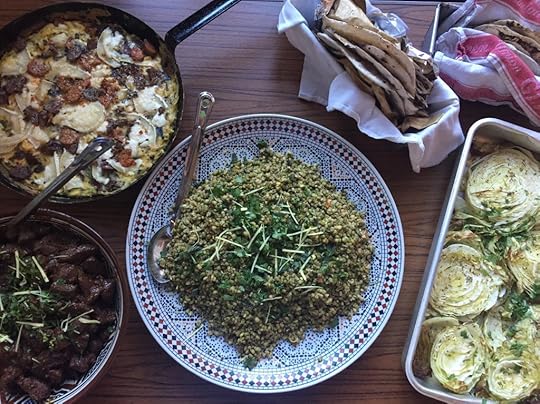
Photo credit Sumayya Usmani
I was greeted with cool disinterest – A few fresh faces filled with a commitment to learn, others less so. A week filled with cooking some foods they had never tried, getting hands dirty in the garden, all this and the idea of plucking game birds during the week had quite a few very apprehensive. These children were in my hands, ones to share my passion for cooking, while not knowing their feelings about food and creating some unfamiliar dishes made my job even harder. But I had faith that the act of creating the simplest dish from scratch, feeding others and eating together would prove to be a powerfully liberating experience for them, instilling a sense of accomplishment and generosity.

Mount Stuart – photo credit Joe Woodhouse
Beginning with a simple idea to set the scene, I introduced my heritage flavours, let them play with the ingredients, and allowed them to make recipes their own. All this was fueled by my basic cooking philosophy of cooking using your senses estimation to create hearty home cooking and my desire to feed others. We had such incredible bounty from the island to work with: seasonal vegetables pulled out fresh from the estate’s kitchen garden included turnips, beetroots, squashes and pumpkins oozing autumnal earthiness. Strong fragrant meat from local game birds and venison was enhanced with fresh herbs and autumn sweet apples and brambles were inevitably found in an indulgent crumble. Personally, the highlight of my trip was the fresh double cream I had in my coffee, guilt-free each morning from the local dairy farm, with a arduous day ahead of teaching the groups, for long 4 – 5 hour cookery sessions for lunch and dinner. Encouraging the use of this abundant Scottish larder slowly developed an independent confidence of cooking soups, breads, risottos, curries with ease enjoying the magic of creating wholesome food, by instinct – on their own.

Photo credit Joe Woodhouse
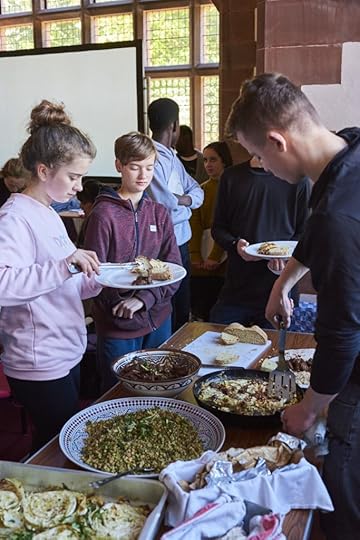
The week started with a diverse group of personalities, experience and uncertainty – slowly we established a method, efficiency progressed, ideas got explorative, independence in the kitchen grew, an understanding of flavour flourished. A mid week slump of frustration translated into lasting endearment; challenges lead to respect. In the end it all came together – the experience left 16 new friends, cooking and creating food together with a common bonding experience. What will come of this week away, maybe some will cook again, other may make a career out of it but one collective understanding we all took back was a sense of empowerment created by the very act of sharing food and the generosity of cooking from scratch but most of all, building confidence and independence through sharing flavour.
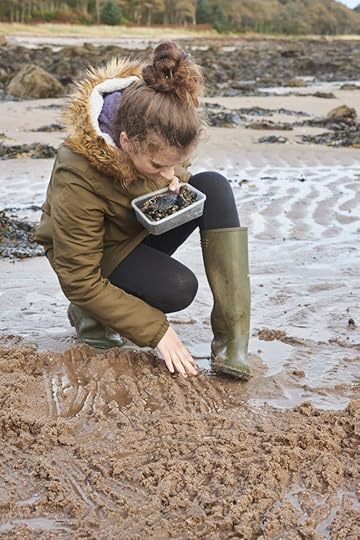
Photo credit Joe Woodhouse
The post Empowering independence through flavour appeared first on Sumayya Usmani Author | Writer | Cook.


April 18, 2016
Interview on BBC Radio 4 Women’s Hour
Click here to listen to my interview on BBC Radio 4’s Women’s Hour, which was broadcast on 6th April.
The post Interview on BBC Radio 4 Women’s Hour appeared first on Sumayya Usmani.
April 12, 2016
Summers Under The Tamarind Tree: A dream is launched
A Spring night in London, 7th April 2016 – the air is filled with a sense of surreal excitement as friends, family and colleagues gather at London’s only cookbook shop, Books For Cooks, off quaint Portobello Road. ‘Summers Under The Tamarind Tree’ is the star of the evening as I walk up to a window display that was only a dream a few years ago, one that I could only imagine would ever be as well received as it has been. I am thankful, as I walk into an evening of it’s celebration.
Amongst the flurry of congratulations, signings and a few minutes of an emotional talk about the inception, seed and birth of this book; I get little time to really take in what is going on. Everyone was there to rejoice the first book of it’s kind – one that celebrates the flavour of MY homeland, the dream is shared with all those in the room.
Beef kofta curry with poppy seeds, lentil battered cauliflower pakoras, my Dadi’s semolina brittle, potato bhujia and walnut and cardamom halva balls – are served. A flavour of Pakistan is shared around. I speak about how my mother helped cooked some of these, and how I can never come close to her flavour!
An evening with those I love, admire and who share a similar passion for authenticity coupled with a team from Quarto Group / Frances Lincoln, my supportive publishers and my literary agency Greene & Heaton – I couldn’t have asked for a more perfect celebration of my debut cookbook.
A book that is a tribute to the women of my family; some still here, others no longer and the people of my homeland – I hope that Summers Under The Tamarind Tree, a memoir filled with the flavours I grew up with, whets your appetite just as much as it fuels my love for Pakistan and it’s authentic cuisine.
I will end by sharing some exciting news: I have have been commissioned to write my next book: out April 2017, a follow up filled with nostalgia and sweetness. More soon…
The post Summers Under The Tamarind Tree: A dream is launched appeared first on Sumayya Usmani.
October 11, 2015
Cardamom and Kewra Scented Memories of Firni and my Nani
Autumn kindles a need for evenings in, lighting the season’s first fire, the desire for warm sustenance and comforting sweetness. This is amplified for me now living in Scotland, and as the weather turns, I yearn for a blanket of hearty meals and warming drinks.
But growing up in Karachi, a city that knew no autumn, where the constant was a blazing sun that lit the sky relentlessly, few treats I longed for were warm; with the exception of my Nani’s (maternal grandmother) ‘firni’ rice pudding. It was more the warming aromatics that enhanced the experience for me, I remember well her compact airy kitchen always vividly scented with the astringency of cardamom, the headiness of rose and the silky comfort of milky rice and caramelized sugar.
Firni is a recipe that has found its way into our cuisine from Persia and the Middle East, and into the ancient kitchens of the Muslim emperors of India. A perfect dessert for the royal dining table, though made with seemingly simple ingredients, this was a dessert served cold, adorned with expensive spice such as saffron, rose water and topped with nuts and silver leaf, it has been a traditional dessert of festivity and celebration in our part of the world ever since.
Although to this day in Pakistan firni is eaten cooled in unglazed terracotta pots (which always added an earthy clay flavour enchancing the dish) , I was probably the only person who ever ate it hot, fresh off my Nani’s vintage white enamel hob. Usually scented with kewra (screwpine water), a heady extract of the bulb of the Pandamus flower, my Nani would fragrance it with freshly ground cardamom, stir through a little kewra or rose water and top it with crushed pistachios.
It is perhaps not just the comfort of this dish that plays such an important part in my food memory but also the fact that this is the first recipe I learnt to cook, not so much from set written instruction but from a sensory recollection. In my mind, this ground rice pudding is a celebration of simple ingredients, married together with a grandmother’s love and indulgence, it was impossible for my youthful palate not to be beguiled.
My recollection of my Nani cooking firni is a sight that is imprinted in my mind but the her recipe for it is vague, all I remember is her artfully grinding a handful of basmati rice finely in her stone mortar and pestle, adding flavour to cardamom infused buffalo milk and some khoya (milk solids) and the result would be a comfort I would crave any time of day. Always sweetened with gur (sugar cane molasses) or brown cane sugar, but sometimes, with the seasonal treat of fresh chopped guava or mango if her trees had been generous that summer. Much of this recipe is cooked by instinct, as is most Pakistani food.
Though it has been many years since my grandmother’s passing, I think often of her beside that hob, lovingly preparing firni for me; this dessert that ignited my love for cooking. Each time I cook it, the aromas of earthy rice and vibrant cardamom that envelope my kitchen transport me back to happy childhood, bringing to life her flavours through such a simple combination of warm comfort and spice.
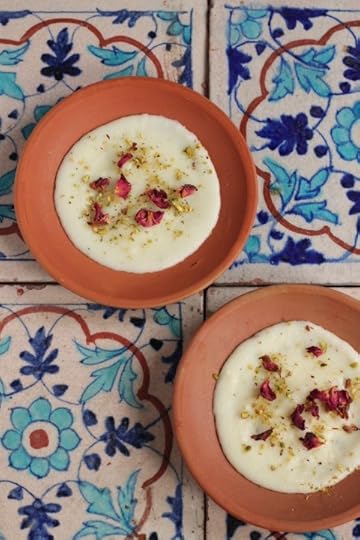
Firni, ground rice pudding with cardamom and rose water
Preparation time: 60 minutes
Cooking time: 30 minutes
Makes: about 10 bowls of firni
1 litre of full fat milk
400 gram tin of sweetened condensed milk
7 tbsp basmati rice
½ cup of water
½ tsp freshly ground green cardamom
1 tbsp each of crushed pistachios and edible rose petals for garnish
1 tsp kewra or rose water
Method
Start by soaking the basmati rice in the water for an hour. Discarding all but 1 tbsp of the water, grind the rice with this water in a electric wet grinder, into a fine paste
In a saucepan, heat the milk and add the condensed milk to the paste, warm but do not allow to boil (about 5-6 minutes). Add the rice paste and beat it with a whisk so as to ensure no lumps remain
Cook on a very low heat, stirring it all the time until the milk forms a custard-like consistency. Now add the ground cardamom powder. Stir in the kewra or rose water
Cool the firni completely but stirring continually. Do not let it set – it should set in the bowl. You could eat this warm like me!
Set the firni in glass or terracotta bowls – refrigerate covered
Garnish with crushed pistachios and edible rose petals
The post Cardamom and Kewra Scented Memories of Firni and my Nani appeared first on Sumayya Usmani.
September 7, 2015
Bramble, Aniseed and Pistachio Gulgulay (Doughnuts)
Growing up I would be told romantic stories of winter approaching in my father’s childhood home in Jaunpur, North India. Slow cooking would be placed upon their log fire as smoke would bellow above the open night sky in their courtyard, and one sweet treat that would be most anticipated, which would have all eight siblings, expectantly awaiting the first cold breeze of a North Indian winter.
My father spent his early childhood in one of those haveli Luknowi homes, where life revolved around a central courtyard – every meal, gathering, meeting or event took place within those four quarters. My father remembers only certain food memories, and this is one of them, when my Dadi would make banana cardamom gulgulay: warm, spiced doughnuts that celebrated the change of season. Sadly I have never visited this home even though it still houses some of my distant family. Since my father’s immediate family migrated to Pakistan in 1947 leaving so much of what they loved to start a new life, my Dadi (paternal grandmother) always shied away from entertaining conversations about their old home, maybe partly because it is an emotional journey, and partly because she wished to focus on the here and now.
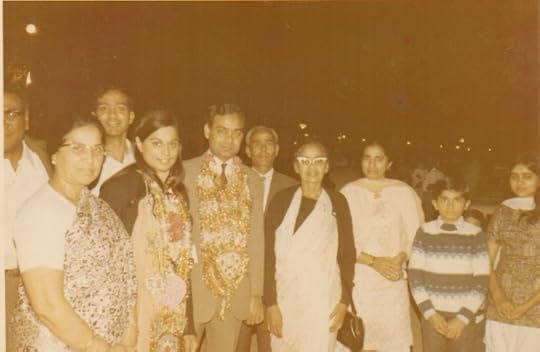
Dadi 4th from right, the one with the funky glasses!
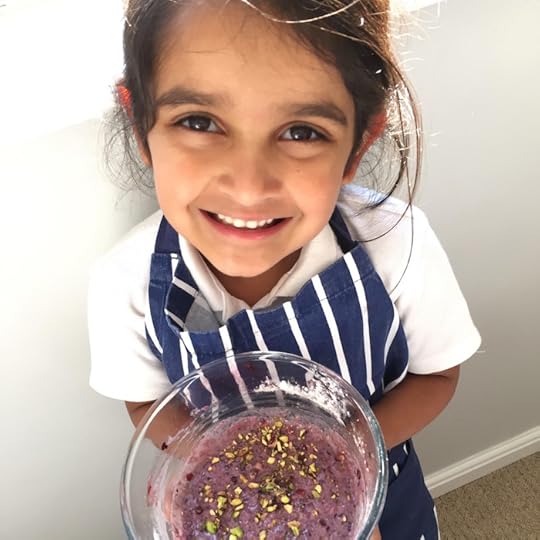
My Dadi was a rather compelling lady – Slim, tall, graceful, and even after eight children, she remained very much a woman who liked her little indulgences. You’d always see her armed with her trusted silver ‘panddan‘ (a silver box with the South Asian mouth freshener of leaves, aniseed and cardamom etc) – always indulging in an evening cigarette as well, always eloquently narrating stories of family dinners and meals, and which is why, what I loved about her was he ability to talk about food. Her passion for it never left her, and it was heartbreaking in her last days, when she could cook no more, feed her loved ones no more and most of all not eat herself. But my best memories of her are those when she told stories of how she fed my father – as the eldest, he was the most treasured. Gulgulay are simple round doughnuts, still found on the corners of streets in Pakistan, their deep fried attraction the most comforting during winter. Traditionally flavoured with banana (as my Dadi’s), cardamom, aniseed, and sweetened with gur (sugar cane molasses – also called jaggery). I know for certain that my aunts would help her make these on winter mornings, so these days I get my little girl involved (nothing like passing on your heritage though food), and her passion for it comes just as naturally.
My greatest regret is that I never took so many recipes from my Dadi directly, and I don’t believe that anyone got her gulgulay recipe, but I make this from a sensory recollection, from the stories told, the memories relived. I flavour them with a very Scottish autumnal berry, the bramble (blackberry for those who don’t know) – these that I have grown to adore (as has my daughter), as I think it reminds me most of my Dadi. Its stunning elegance, its tough picking, its long, patient endurance during the summer months. It speaks to me of her passion, commitment to family and most of all, her love for flavour and home.
Bramble, Aniseed and Pistachio Gulgulay
Makes about 15 small round gulgulay – Preparation Time: 20 mins / Cooking Time: 10 mins
50 g plain flour
1/4 tsp each of freshly ground green aniseed and cardamom seeds
1 tsp baking soda
10-20 g demerara sugar
7-8 big fat brambles (blackberries), crushed with a fork into a rough pulp
2 tbsp crushed pistachios
1-2 tbsp whole milk
Vegetable oil for frying
Icing sugar to decorate
Finely crushed pistachio to decorate
Method
Begin by sifting the flour, add the baking soda, spices and mix
Add the sugar into the crushed brambles and then pour over the flour mixture on top. Stir until it comes together into a thick batter
Add the pistachios and if you feel it is too thick (doesn’t look like a regular doughnut batter) add a tiny bit of milk. Leave to rest for about 10 minutes
Heat the oil in a deep frying pan, when hot, turn the heat to very low
When the batter starts to bubble when stirred (about 10 min) using 2 teaspoons drop about 3-4 small spoonfuls into the hot oil and fry one either side for about a minute each
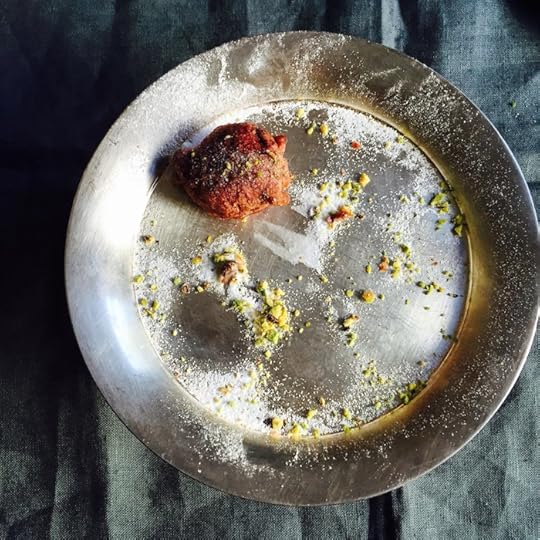
Dust with icing sugar and finely crushed pistachios and serve hot, they don’t last long!
The post Bramble, Aniseed and Pistachio Gulgulay (Doughnuts) appeared first on Sumayya Usmani.
August 20, 2015
Raspberry, Pistachio and Falsa Sour Cream Cake
Journey to a Raspberry. Pistachio and Falsa Sour Cream Cake:
Very round and tart, but so very perfect. A stain that never shifts, a flavour that haunts you long after. These sensory memories of falsas in the monsoon months are embedded in my heart and laced on my tongue. A childhood anticipation of a humid Pakistani summer, finding these precious crimson berries on street corners, sprinkled with black salt, it was always a respite from unbearably hot days.
In my mind not much could replace their comforting piquancy, that sharp acidic punch, that annoyingly satisfying crunch of its seed. But I then found my falsa soul in the Scottish raspberry, picked fresh in the summer – I never thought I would find a flavour that took me home. Their violet floral intensity and piercing tang took me to a place I knew well, but treaded with unfamiliar caution. Their short life, seasonal dependancy spoke so much of the falsa.
This recipe is one of new beginnings, of my finding comfort through flavour, familiarity and a sense of home.
Ingredients
113 g / 1/2 cup softened butter
160 g / 1 1/4 cups golden caster sugar
2 medium eggs
225 g / 2 cups plain flour
1 teaspoon baking powder
1 teaspoon baking soda
1/4 teaspoon salt
250 ml / 1 cup / 1/2 pint sour cream
1 1/2 teaspoons rose water
1/2 teaspoon freshly ground cardamom
110 g / 1/2 cup chopped pistachio
200 g Falsa pulp or blackcurrant pulp if Falsas not available!
1 punnet Raspberries
Method
Begin by preheating your oven to 175 degrees C
In a big stainless steel or copper bowl, cream the softened butter with the caster sugar, with an electric mixer. Add the eggs and beat until smooth
In another bowl, sift the the flour, baking powder, baking soda, and salt. Add this slowly to the butter mixture until it all combines well. Now using a spatula, fold in the sour cream, cardamom and rose water
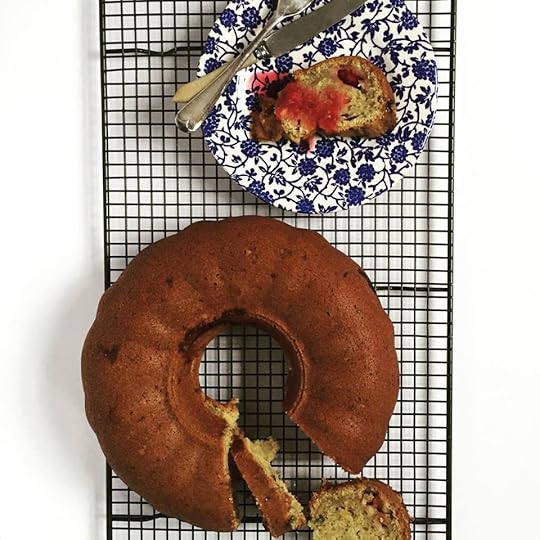
Pour half of the batter into a 9-inch Bundt or ring pan that has been coated with oil. Swirl in half of the falsa or blackcurrant pulp, and half of the raspberries and then cover with the remaining batter. Swirl another tablespoon of the falsa or blackcurrant pulp on top
Place in the middle shelf of the preheated oven and bake for 45-50 minutes until a toothpick comes out clean. Cool for 15 – 20 minutes, then turn out onto a serving plate. Serve at room temperature with the remaining falsa or blackcurrant pulp and cream if desired
The post Raspberry, Pistachio and Falsa Sour Cream Cake appeared first on Sumayya Usmani.
July 16, 2015
Eid Lunch – for the Love of Family and Food
Eid will always remind me of my childhood and growing up in Pakistan. I have a clear sensory memory of awakening to aromas of cloves and cardamom wafting from the kitchen into my bedroom. This is a day that revolves around family togetherness and a celebration of food, after a month of abstinence and contemplation.
Though a global Muslim festival, Eid is celebrated differently in each country, highlighting the fact that this is not just a religious day but a time to rejoice our culture and identity. But, the one unifying similarity is that Eid is a celebration of food, authentic flavour and family togetherness.
As a child I would eagerly await Eid – we would receive money called ‘Eiddee’ in tiny colourful envelopes from older family and friends and I would always look forward to collecting my ‘kings ransom’ from my father, who would promise me this only if I woke up early, changed into my pretty new clothes and glass bangles!
Food took centre stage – from breakfast of seviyan, hot cardamom chai and jalebis (fried sweet sugar syrup doughnuts) and dahi baras (lentil fritters with yoghurt) made by my mother, followed by ‘elvensies’ of sheer khurma (hot sweet vermicelli saffron milk drink) at my Nani’s (maternal grandmother’s). Before lunch we would distribute food from our homes to the needy; this is a big part of the Eid culture in Pakistan, feeding those who may not be able to afford it themselves. Our lunch would always be at my Dadi’s (paternal grandmother’s), which always promised to be a lavish spread of biryani, shami kebabs, koftas, always ending with mithai (sweet meats) and her version of seviyan. A day of family visits, sitting together, being force fed an obscene amount of food, laughing and cherishing what is on our tables is how I would describe Eid in Pakistan.
To me, Eid is a moment of thankfulness – for the food we receive, for those who need it more than us and the loved ones in our lives. These recipes to me are the flavour of Eid lunch in Pakistan and ones I have adapted but still cook in the UK today.
Bavette Shami Kebabs with black cardamom, black cumin and cinnamon
Shami kebabs (pictured at the top of this blog post) are usually melt in the mouth pureed spiced meat and channa daal based kebabs, found in nearly all homes in Pakistan, with a history as far back as the Mughal Empire. Often a labourious task, I have adapted a traditional recipe and used bavette steak which is cheap and just beautiful, and instead of pureed mince beef – as traditional – I have left the meat to cook slowly until it pulls apart together with spices and channa daal. When bone dry, add cool fresh herbs and ginger and mould together into burger patties shapes, dip lightly in egg and shallow fry. Perfect Eid guest treats with some spiced tamarind chutney.
Makes 6-8 kebabs
Cooking time: 2-3 hours
Ingredients
400 g bavette steak
50 g channa daal (soaked for about 30 minutes to overnight before cooking)
1 cinnamon stick
2 black cardamom
1 tsp black cumin (or regular cumin if not available)
1 tsp coriander seeds
2 star anise
2-3 dried red chillis
1 tsp black peppercorn
8-10 cloves
½ inch piece ginger, chopped into tiny pieces
½ bunch coriander, chopped finely
20 mint leaves, chopped finely
2 green chillis, chopped finely
1 egg, beaten
Vegetable oil to shallow fry
Method
Add the first 10 ingredients in a heavy based saucepan and add 1 ½ pints water. Bring to the boil and then return to a simmer, cover and leave to cook for about 3 hours on a low heat. Keep checking to make sure the meat doesn’t stick at the bottom, and ensure that you stir it occasionally. Do not add any more water
After about 2 hours or so check to see if all the moisture is gone, the meat is tender and falling apart, and the lentil is mush
Break and pull apart the meat, add the finely chopped ginger, chopped mint, coriander and green chillis. Mix until combined with the meat
Take about 2 tbsp of the meat mixture and using your hand, form flat burger patties shapes to make the shami kebabs. Dip each into egg and set aside on a plate
Heat vegetable oil in a shallow frying pan; once hot add about 3-4 shami kebabs into the pan, fry for about 1 minute each side until medium brown on either side
Serve hot with any a hot sauce or ketchup
Pakistani festive beef biryani
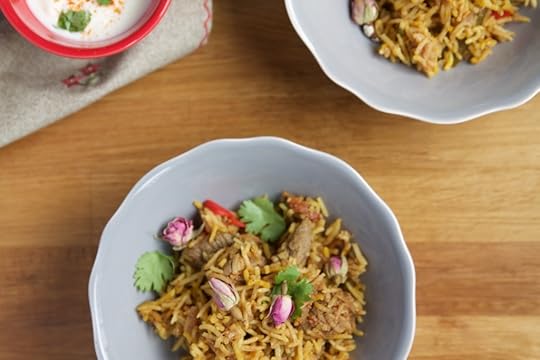
This recipe is a labour of love, as is the Eid lunch- Cooking for those you love deserve such dedication.
Cooking time: 1 hour
Serves: 8-10 people
Ingredients
350 g basmati rice, washed, soaked for 30 minutes, parboiled and drained
5 tbsp vegetable oil
½ tbsp ghee
1 stick cinnamon
2 star anise
1 tsp black cumin
10 cloves
1 tsp coriander seeds
2 black cardamom
5 green cardamom
8 cloves
1 bay leaf
1 small piece mace
2 red onions, chopped finely
1 tsp each of grated ginger and crushed garlic
4 tomatoes, chopped roughly
1 tsp turmeric
½ tsp red chilli powder
400 g braising steak or beef chuck pieces
200 g Greek yoghurt
½ tsp saffron, steeped in 2 tbsp hot boiling water for 15 minutes
10 mint leaves
½ lemon, sliced
2 tsp rose water or kewra essence
½ tbsp melted ghee
2 green chillis
1 tbsp pistachios
10 edible dried rose buds or 1 tbsp edible dried rose petals
Method
Begin by par boiling the soaked rice, drain and set aside. It should be firm but not entirely raw
Heat a heavy based saucepan medium low, add the oil and ghee. When hot add all the whole spices and cook for 30 seconds, or until you can smell the oil aromatised by the spices
Turn heat up to medium, add the red onions and fry until light golden, then add the ginger and garlic. Cook for 30 seconds, until the garlic no longer smells raw. Add tomatoes, and cook until the moisture of the tomatoes is gone (add about 1-2 tbsp for water if the tomatoes burn). The result should be a thick, rich sauce with no hard tomato bits and oil rising to the surface of the sauce. Add the turmeric and red chilli powder
Next add the beef and stir fry until sealed (about 2-3 minutes). Add the Greek yoghurt and continue to stir fry until the moisture of the yoghurt evaporates and you are left with a sauce. Cover the pan and turn the heat to low
Allow to cook until the sauce is thick reddish brown, with oil rising to the top. This will take a patient 15-20 minutes of cooking; you may need to add a little water if the meat isn’t cooked through. In this case cook covered for a few more minutes until the sauce is thick again
Once the meat is cooked through, it’s time to layer the rice on top and infuse the aromatics of saffron, lemon, mint, green chilli and rose water or kewra. Layer the rice evenly on top of the meat
Poke the aromatics into the rice, pour over the saffron and rose water or kewra, and then using a piece of foil cover the entire surface of the saucepan and place the lid firmly over to create a seal, so that the steam does not escape the pan. Turn the heat to its lowest setting and steam cook for 10 minutes. Once done, remove the foil and let the steam escape
Mix the rice and meat with sauce gently using a dessert spoon so as to not break the rice
Serve hot in a serving dish and scatter in pistachios and rose petals or buds
My Nani’s Muzaffar Seviyan served with clotted cream – sweet vermicelli with saffron and cardamom
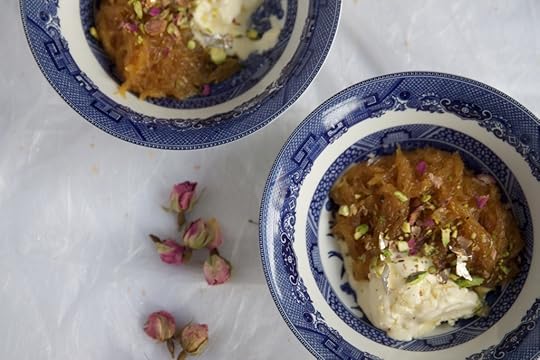
There are many ways to make the quintessential Eid dessert called Seviyan. This is a sweet roasted vermicelli which can be made in either milk or water and sugar. The flavour is one that always reminds me of Eid and the excitement it brings. This is my maternal grandmother’s recipe, traditionally served with khoya (milk solids), but I also think clotted cream works equally well, giving it a British touch!
Serves: 6-8 people
Preparation time: 10 minutes
Cooking time: 10-15 minutes
Ingredients
2 tbsp ghee (clarified butter)
½ cup chopped pistachios
4-5 green cardamom seeds (discard husks)
1 ½ cups fine wheat vermicelli, crushed into small pieces
½ pint boiling hot water
½ tsp saffron, steeped in 1 tbsp boiling water for about 5 minutes
60 g caster sugar
Silver leaf to decorate (optional)
2 tbsp desiccated coconut to garnish
1 tbsp each of sultanas, slivered almonds and pistachios to garnish
100 g clotted cream
Method
Heat the ghee in a wok style pan over medium heat and melt until hot. Add the chopped pistachios and cardamom seeds and stir-fry for 30 seconds. The cardamom should be fragrant and the pistachios very lightly brown. Turn the heat to medium low
Add the crushed vermicelli and stir-fry until evenly light brown; this takes about 3-4 minutes of constant stir frying. The vermicelli will now smell toasted and the colour should be a medium brown
Add the boiling water to the vermicelli together with the steeped saffron, mix until combined and cook until the vermicelli is tender and all the water is absorbed (about 3-4 minutes)
Next sprinkle over the caster sugar, stir until dissolved (about 1-2 minutes)
Turn heat off, and place in a serving dish. Decorate with silver leaf (optional), then serve warm topped with nuts, sultanas, coconut and clotted cream
(Keeps on its own for about 3-4 days covered, in a cool dry place)
The post Eid Lunch – for the Love of Family and Food appeared first on Sumayya Usmani.
Sumayya Usmani's Blog

- Sumayya Usmani's profile
- 24 followers


