
Zena Wynn's Blog, page 2
March 20, 2024
Wix Audiobooks: Misadventures and Lessons Learned
In last week's blog, I confessed that I'm not the most business-savvy person. What saves me is that I'm an information hound, eager to learn, and don't mind admitting my ignorance or asking questions. One of my business goals is to make my website more profitable by selling ebooks and audibooks direct. At the very least, I'd like the website to earn enough to pay for itself.
With the debacle that was Spotify's big announcement and the changes it prompted (see last week's blog), business decisions I'd put on hold got pushed to the front of the line. I need to start pushing audiobooks in my website store.

Selling Audiobooks Direct: Author Side
When choosing my Wix site, I deliberately chose a design that would allow me to sell music albums and singles. Because audiobooks are mp3 files, selling one meant I was able to sell the other. I uploaded my audiobook files before uploading my ebooks to my store. I've had this website for over two years now and have yet to sell one audiobook. I prayed about it, and God gave me a few ideas.
Idea #1: Lower the prices of my audiobooks. I changed the prices to $5, $10, and $15 based on narration length.
Idea #2: Bundle the ebook with the audiobook in a BOGO for free deal. This was simple to do. I'd noticed when setting up the audiobook files that I had the option to add bonus content. Uploading the epub file to the mp3 files only took seconds.
Setting up the store was easy. The biggest problem was not knowing what happened when a reader purchased an audiobook. This information was critical because it determined whether my Wix store was sufficient for my needs or whether I'd have to pay additional money to use a site like BookFunnel. In addition, I needed to know in case my customers experienced issues. I had to have an answer to give them.
I'm already paying over $300 a year for my website and store. I didn't want to add an additional $120 a year for Bookfunnel. I also didn't want to load my audibooks to yet another site where I had no control. If possible, the best outcome was to make Wix work.
End User Experience - The Customer Side
First Issue: I tried to purchase an audiobook. Couldn't. I use PayPal with my website. PayPal wouldn't allow me to buy from myself. (Bummer!) I called my daughter, explained the problem, and asked her to buy one of my audiobooks. She did and sent screenshots of what the customer saw at each step.

The process was easy. She selected the audiobook, made payment, and within minutes received a payment notification with a download link. The download was a zip file which took a few minutes to download. My daughter has an Apple phone. She sent me the link so that I could do the same with my android phone.
Second Issue: The good news is that all of the files downloaded in the correct order. (A major concern of mine.) The bad news is that she couldn't figure out how to play the audiobook. Once she did, it only played once chapter at a time and wouldn't auto-advance. I speculated that it might be the media player she used.
Once my file downloaded to my phone, I had to find and extract it, and then figure out how to play it. Once extracted, playing it turned out to be easy. Samsung asked me which app I wanted to use to play it: Media Player, Amazon Music, or Spotify?
My first mistake was telling it to always use Amazon Music. Amazon couldn't find the file. To be honest, it could totally have been user error. I deleted the files from my phone and started again. This time I selected the music player app I'd installed. Other than repeating chapter one twice (no clue what that's about), it played just fine. It auto-advanced from one chapter to the next, just like my audiobooks do with Audible.
Final Analysis
Selling audibooks is possible with my website. Tech-challenged customers like me might have a few issues, but nothing that can't be overcome with a bit of patience. It remains to be seen if the new price structure will garner sales.


March 12, 2024
Adapt or Break: The Constantly Changing World of Publishing
I'll confess. I don't like change. It's fine when I initiate it, but when it's forced on me...? Man, can my attitude stink. The month of February brought change after change. Changes I'm none too happy about.

Spotify
First, Spotify made their big announcement about the changes to their Terms and Conditions. Mind you, I'm not the most business-savvy person, but I'm smart enough to align myself with other authors and authorprenuers who are. When social media blew up with the news, I read all of the posts to get a good understanding of what the new terms meant. I didn't like them. Spotify quickly modified the new terms in what some are labeling a planned shock-and-switch type of ploy. (i.e. "Let's horrify them with an extreme rights grab and then roll out the terms we really want them to agree to.)
As stated, I didn't like the new terms and the modified terms didn't matter. Show me who you are as a company, and I'll pay attention. I decided to move my audiobooks from Findaway Voices/Spotify as an aggregator. Because I used ACX to create them, I still have audiobooks with Audible, who also distributes to Amazon and Apple. Findaway Voices/Spotify allowed me to distribute my audiobooks wide, which included libraries. However, they aren't the only option out there. They're simply the platform I learned about first.
Now I have to examine my options, decide on a new distributor to replace Spotify, and make that move. After reviewing my available options and praying about it, Author's Republic won my choice. Because they used to be a partner with Findaway Voices, they already have my audiobooks. What I don't know and have yet to receive an answer on is if I need to reupload my audiobooks to them. I have notified Spotify that I do not agree to the new terms--the deadline was 3/15/24--and as soon as my last royalties pay out, they've been instructed to close my account.

Kindle Vella
Spotify wasn't the only company who made changes to how they do business. Amazon also changed the bonus structure and how the in-app purchases works for readers in a one-two knock out punched that killed any desire I have to be a part Kindle Vella. I knew the bonuses wouldn't last forever. It's why I pulled the one completed book I had on Vella and had them unpublish the book I had in progress in 2023. However, because hope springs eternal and I have a bucket-list cruise I needed to pay for, in January I decided to give it another try. Fortunately, I only had 4 episodes of the new story uploaded when the new terms were announced.
To be honest, in terms of royalties, Kindle Vella was never worth the amount of work it took as an author to draw readers to the platform. Most of my readers prefer the full book vs. the one episode at time model. They also complained that it was less expensive to purchase the entire book once published than reading it via Vella. A sentiment I share. I've never purchased Vella credits, despite having a credit balance of over 900 tokens that Amazon gave me for free. I also don't like the episodic model of reading. When I sit to read, I want the entire book. Actually, I want the whole series so I can binge if it's a series I'm reading.
With little expectation of the bonuses that prompted me to give Vella a try and the new reading structure, it was a no brainer to contact Amazon and have them unpublish my book. What surprised me is that they did it immediately. Before, they made me wait 90 days. I was later told by another author that whenever a company changes their terms, they have to allow authors so much time to immediately opt out.
I can only guess at the amount of authors who did the same. Some will hang in there and change their books to try and make the new model profitable. Others won't pay attention to what's going on in the publishing world around them and only take note when Amazon bleeds them dry. It's a business decision each author has to decide for themselves.
Final Thoughts
Needless to say, with all of this going on, writing hasn't actually been a priority. Maybe it's a blessing in disguise that I don't have the added stress of trying to push out new episodes every week on my new writing project. What sucks is that not having Vella killed some of the impetus had to write consistently. Hopefully once I adjust to the time change and get over the spring fever that has me wanting to DIY remodel my entire house, I'll get back to writing on a daily basis.
February 12, 2024
Contract Brides: Selene Chapter 3
I placed my thumb on the panel and stood still while the scanner read my face. The locks disengaged, and I opened the door. The single-floor apartment was a two-bedroom, two-bathroom condo. The front door opened into the combination living room, dining room, and kitchen. The whole thing sounded much larger than it was. When the four of us were home, the space felt crowded. Fortunately, we all worked different schedules and were rarely home at the same time.
February 6, 2024
Contract Brides: Selene Chapter 2
For dessert, we devoured a sumptuous chocolate mousse with a dark chocolate cookie crust topped with homemade whipped cream from real cows. The food was more delicious than the synthesized food I generally consumed. Giddy with a potent cocktail of happiness, excitement and nerves, I somehow managed to finish the bottle of wine. Bain’s smile was indulgent as he poured glass after glass--three in total.
February 5, 2024
World-building for my new series, Contract Brides: Selene
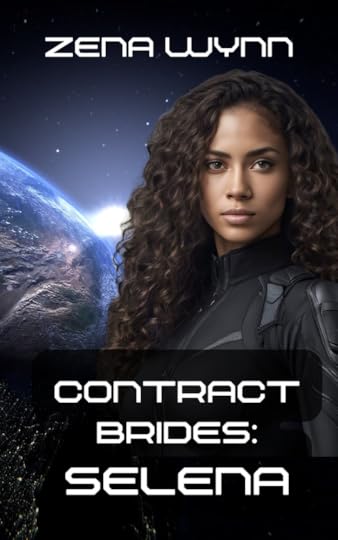
Last month, I began a new writing project. New might me a misnomer. I'm totally rewriting a book I originally published in 2009, The Contract. I've always had a desire to return to this world I created. For years, I toyed with the idea and finally gave into the compulsion this year.
Setting:
Contract Brides: Selene is book one in a futuristic, environmental dystopia story. In this world. centuries of climate change has forced humans to build underground cities. The idea of living underground isn't new. The notion first crossed my mind when I read an article about SubTropolis, an underground business complex in Kansas City, Missouri. This sent me down a research rabbit hole of other subterranean cities, and U-Town took shape in my mind. (https://www.youtube.com/watch?v=Ih6-MWrNcXE)

When building my underground city, my next question was how big could I make it? Meaning, how deep and wide into the earth could U-Town be? With this book being a science fiction romance, it was imperative I get my facts right. For this, I researched mines. The deepest underground coal mine in the United States is almost two miles deep (9,587ft). For a comparison, the World Trade Center in New York City was 1,776 Feet with 104 Floors. The thought of being that deep underground triggers a mild sense of claustrophobia in me, but it spark tons of creative ideas for my city. My city, U-Town, currently has three levels and over 50,000 residents. I'm wondering if that's sufficient. Studying New York City is giving me a good idea of what's feasible and what's not.

In addition, because my hero works in the mining industry as a heavy equipment operator, I spent hours watching the construction of NYC subway tunnels - past and present. The process is fascinating. Even more fun is taking current technology and using my imagination to predict how that same technology might advance three hundred years into the future.
(Current underground city in Montreal Quebec)
Society:
Dystopian means some type of disaster had to occur to change life as we know it. My first step was underground cities. My next problem was to determine how living underground has changed society. What type of government exists now? How has the environmental disaster of the past changed how people live in the future? What about people who don't want to live underground? Is living on the surface even possible? If so, what difference would their be between surface dweller and subterranean dwellers.
What about class distinctions? As long as there is life there will always be rich and poor segments of society. How do people earn a living? What type of housing is available? The answers to these questions shape my characters' lives.
These questions are just the tip of what I'm exploring to create the futuristic world of Contract Brides. I hope you'll go on this journey with me. To this end, I'm making this story available in Kindle Vella. https://www.amazon.com/CONTRACT-BRIDES-Selene/dp/B0CTGJ827S
For those readers who don't have access to Kindle Vella or simply don't like it, I thought about you, too. I've created a subscription account here on my website. Pay for the book upfront and you'll receive notifcations when chapters are posted to read. You can leave feedback via comments and when the story is complete, edited, and ready to publish, you'll receive the ebook. https://www.zenawynn.com/post/contract-brides-selena-chapter-1
If anyone is curious about The Contract, it's still available in my store: https://www.zenawynn.com/product-page/the-contract
January 31, 2024
January 16, 2024
My Journey into Audiobook Publishing
My first experience with audiobooks was not a good one. To encourage myself to walk more, I’d purchased (or borrowed) a Johanna Lindsey historical romance on cassette tape. (Yep, that long ago.) I loaded the cassette into my Walkman, put on my headphones, and started my laps around the park. The narrator was a man, and I hated it. Worse, it bored me to tears. I came away with the conclusion that audiobooks were not for me.
My next experience was 100% better. A coworker got me hooked on the In Death series by J.D. Robb. I was slowly reading my way through my coworker's private book collection. When hers ran out, I shopped the local used book store. I was able to find all but one—Survivor in Death. I looked everywhere for that stupid book, and no one had it. Finally, I found it on Audible. An audiobook. I groaned, but I was desperate so I bought it (with a 30 day free trial membership).
The narrator blew me away. It was like listening to a play. I couldn’t put it down, and when the story finished, I mourned its end. That’s when I discovered the power of the narrator. The right one can make a mediocre story great, and the wrong one can make a great story sound mediocre.
I continued with my Audible membership, quickly growing to a library of over 200 audiobooks. I learned what I liked in a narrator, and what I didn’t. For instance, I prefer female narrator's voicing male characters rather than male narrator's voicing female characters. I stay away from erotic romance audiobooks because not all narrators can read sex scenes without sounding corny or cheesy. Others sound like I’m listening to porn, which does not make for a pleasant listening experience. This knowledge of my likes and dislikes helped when I branched out to publish my books in audiobook format.
The Process
I discovered the Audiobook Creation Exchange (ACX), which is an Amazon owned company. Through ACX, you can hire narrators to produce your book, or if you have the skill and the talent, can narrate your own book and upload it through them for distribution. I do not recommend the last option for romance books. It might work fine for non-fiction, but honestly, fiction readers want a listening experience, not just someone reading to them. They can use Alexa for that.
Since my original posting of this article in 2018, several other audiobook publishing options have become available. Findaway Voices operated similar to ACX with more distribution outlets. I believe they no longer offer narrators for production since being purchased by Spotify, but consider using them if you want to take your published audiobooks and distribute them wide.
In addition to several audiobook publishing companies, in recent months, AI (artificial intelligence) narration has become an option. Google, Apple, and now Amazon offer it, along with several other publishing companies. Since I prefer human narration--that's a whole other conversation--you'll have to research if you want more information on this.
Payment options on ACX.
Royalty share — This payment option is popular with authors without a large budget, but not so popular with narrators. The narrator produces the audiobook. You (the author) publish it, and you and the narrator split the profits. Royalty share contract terms are usually seven years. Audible will not release you, the author, from this contract unless A) the narrator agrees and/or B) you've paid the narrator to release you from it. Be careful if you choose this option. Seven years is a long time.
Phaze, one of my former publishers, contracted two of my books as a royalty share option before going out of business. They tried to cancel the contracts with ACX, to no avail. I was able to get The Contract canceled with the narrator's permission. It took months of back and forth. He wanted payment to cancel the contract, but I had no money to offer. Phaze was listed as the legal rights holder, and despite my documentation from Phaze proving otherwise, I was left on the outside looking in.
With True Mates: Mary and the Bear, I had to wait until the contract ended last year in 2023. I never received payment for that book. The narrator wouldn't respond when I reached out, and the publisher's portion of the royalties went fell into the void. One day, when I feel up to the fight, I'll reach out to ACX's legal team about my money--again.
Pay For Production Fee (PFH) — With this option, you pay the negotiated amount upon completion of the project. This is the option I use, though it can be pricy.
Royalty Share Plus — This option combines Pay for Production with Royalty share. You pay so much in cash, and the balance is paid via royalty share. I don't know what the contract term is for this option as I've never used it.
Finding a Narrator
This is, perhaps, the longest part of the process. I’ve learned through trial and error that success depends on two things: timing and payment option.
Last December (2017), I posted several books for auditions. At first, I didn’t get any nibbles. So, I went to the Producer for Hire section, listened to samples, and invited several to audition. Things picked up dramatically. Because of the amount I offered--up to $200 per hour--there was plenty of interest. (Please note: In 2018, the highest PFH rate was $200-$400. Now in 2024, it's $400-$1000, though I expect with AI now being an option, this may come down.) This allowed me to be very choosy. In addition to the audition clips, usually 5 minutes long (about 2 pages of script), I listened to the narrator’s samples. If they had produced audiobooks for other authors, I listened to those clips and read reader reviews about the narrator.
Don’t be afraid to dialogue with the narrator, or request an additional audition with a different section of script if you’re having a hard time deciding between two or more narrators. I did it with my True Mates series. The initial audition script was for Carol’s Mate. When I narrowed down my choice to a final three, I explained that the narrator I chose would be for the entire series, and that they were one of the finalists. Then, I asked if they would mind reading another audition from a different book in the series. They all agreed.
A note about audition scripts: Be sure to choose a section of your script that has both male and female dialogue. If your characters have accents, supply a section of that script as well. If the book is spicy, consider giving them a sex scene to read. Give your narrator as much information as possible as to what you’re looking for and tips/characteristics of your characters that will help them with their narration. This benefits them and you.
Negotiations:
Be upfront with the narrator about your expectations before sending the contract. I’m pretty easy going. I don’t mind slight changes in the script as long as it doesn’t change the intent of the wording, or change how I view my character. I expect requested changes to be made without argument. Also, I appreciate narrators that keep in touch with me and keep me appraised of their progress. I try to do the same with them.
Edits:
It is not the narrators job to edit your manuscript. They will read it exactly as written. It’s a good learning curve for writers, because you hear every typo, repetition, or omitted word when the story is being read.
Edits are in two, or rather, three rounds. The narrator will send the first 15 minutes for your approval. This is so as the Rights Holder, you, can be sure you and the Narrator/Producer are on the same page regarding pronunciation, characterization, etc. If you don’t like it, offer suggestions for improvements. If you still don’t like it, don’t approve it. Once you do, you’re locked into the contract. I’ve only had one case where this happened. I didn’t like the narration style of the female half of the couple I contracted. Her voice was flat and monotone. I explained my dissatisfaction to the narrators, and ACX canceled the contract.
Once the first 15 minutes are approved, the narrator will complete the rest of the book. They’ll send it to you. It’s your responsibility to listen to it. I do two listens. One without the manuscript in front of me, listening to the flow. Then I listen to it again, reading along with the narrator so I can note any errors or discrepancies. When marking errors, you need to inform the narrator of the chapter, time stamp, what they said, and what you wrote. Occasionally, I’ll add a note of explanation if it's possible the narrator may think I'm being nitpicky.
You send this information to the narrator. They make the corrections. You listen a second time to make sure all the corrections were made. If not, you can send it back one last time. I’ve rarely had to do this. When satisfied, you approve the book and return it to the narrator. They finish the formatting and mastering for ACX.
Payment (PFH)
Once you’ve approved the book, ACX will prompt you to provide payment. You submit payment via the agreed upon method. I use PayPal. The narrator confirms they received payment and submits the file to ACX for quality assurance and approval. Once ACX approves it, they will schedule it for release and notify you (the author) when it's available for purchase by readers.
To date, I have twenty-seven produced audiobooks and one in production. Longer audiobooks sell better, as most readers prefer a longer listen (12 or more hours). They also cost more to produce. I began with my short stories first and worked my way to the longer books, going series by series. I still have several books not in audiobook format.
If you're looking for an instant return on your investment, audiobooks may not be for you. My experience with audiobooks show this to be a long-term investment. Audiobooks are more popular than they used to be, and their popularity continues to grow. However, a large portion of my readers still prefer ebooks or print to audiobooks.
To check out my catalogue of available audiobooks, click here: https://www.zenawynn.com/audiobooks
December 19, 2023
2023 Publishing Wrap Up
One of the things I dislike the most about this time of year is the realization that the year is almost over. The other is how busy the Christmas season gets, but I digress. The end of the year is a time of reflection. It feels like half of the world is looking forward to the coming year while the other half reflects on the events of the year ending. It's almost like dying and being reborn.
By dying I mean that we start the new year full of hopes, dreams, and plans for what we want to accomplish. Things like how many books we plan to publish. How much money do we want to earn in royalties and other business goals that will help us succeed. In December, we look back and do a reckoning. Did I accomplish all that I set out to do? If I didn't, why not? What hindered me, and how can I improve in the coming year?
The rebirth is easy to understand. It's the hope that the coming year brings. I may not have accomplished all I set out to do in 2023, but there's always next year, 2024. The calendar flips the page, and the slate is wiped clean.
I began 2023 with one major goal: finish Mate Run Cara and publish it. A few additional books completed and released would have also been nice. I completed Cara's story and released it this fall, months later than I'd originally planned. Instead of pushing to write and publish another book, I changed focus. Self-publishing is hard work, and there always seems to be some task that needs doing. Something that fell through the cracks because all of my attention was on writing. I chose to spend the rest of 2023 tackling those.
I worked on revamping my website. I watched videos, read articles, and listened to podcasts and audiobooks on creating a website where readers wanted to linger. Then, I researched (and am still researching) tricks to drive traffic to my website, all with the goal of increasing direct sales from my website store. I'm happy to report that in the last six months, I've sold $23 worth of books from my website. It's almost double the $13 of books I sold in 2022.
It might not sound like a big deal to you, but to me, it's proof that it can be done. It won't happen quickly, but if I keep putting into practice the things I'm learning, eventually I'll reach my goal of having a self-supporting website.
One of the biggest problems I have as an author and a business owner is negative self-talk. Someone says, "You should do this ___" and my immediate thought is, "That won't work." Usually, because I've tried it before, or I listened to other authors for whom it didn't work and assumed it won't work for me. The sales I earned on my website are proof that it can. Just because it didn't work immediately or in the way I hoped it would doesn't mean it's bad business advice.
Another thing I worked on this year is figuring out what works for me in terms of social media. If you do any type of promotion, I don't have to tell you how frustrating the constantly shifting sand of getting views and exposure can be. I finally decided to put the majority of my time and effort into Facebook, Instagram, and Threads. I may occasionally throw something out to my TikTok account, but it can no longer be my primary focus. I get the most reader engagement on Facebook. If I work on Instagram and Threads, I believe I can increase my engagement there as well. While I had a Twitter account, I don't think I used it more than once. It simply wasn't my scene, and while I found watching X's implosion amusing, it didn't impact me.
Next year, I want to improve my blog and work on providing content that people find interesting and informative. I also want to increase my website and newsletter subscribers. To that end, on December 15th I started The Great Christmas Giveaway. I'm giving away one book a day via my newsletter. (www.zenawynn.com) The daily gift notification is only going out to newsletter subscribers. While the giveaway is ongoing, I'll continue to add new subscribers so no one misses out.

The cynical part of my personality says that once readers get the freebies, they'll unsubscribe. Some may, but remember, I'm working on my negativity. Hopefully, the majority will stick around. In addition, I hope readers will see how easy it is to purchase directly from my store and begin buying directly from me.
December 11, 2023
The Great Debate: AI in Publishing
What is Artificial Intelligence (AI)? AI makes it possible for machines and/or software to learn from experience, adjust to new inputs, and perform human-like tasks. You don't have to look far to find it. It's in the facial recognition software used to unlock your phone. Those auto-reply suggestions in your email? AI. Entertainment and social apps like Facebook and TikTok use it in their algorithms. Car manufacturers use a version of AI for self-driving cars.
The question then is if AI is so prevalent in our everyday lives, why is it so divisive when it comes to the publishing world?

Before you scroll away, please note that this isn't another argument for or against the use of AI. Trust me. I'm as sick of those as you are. I can't scroll my Facebook feed without stumbling across yet another post advocating the benefits or the evils of AI. There seems to be no middle ground. People are either avidly for it or rabidly against it.
Let's take a look at the various types of AI programs. According to Google, the 5 Best AI Writing Tools for Fiction are ChatGPT, Sudowrite, Claude, OpenAI Playground, and Verb. I am most familiar with ChatGPT because there is a free version. AI Art generators include Dall-E, Bing Image Creator, Midjourney, Canva, OpenArt, Deep Dream, etc. I'm not a graphic artist, and while I believe AI produces some truly beautiful cover art, it's not something I've played with. The newest group troubling the publishing waters is AI Voice Generators for producing Audiobooks. Several companies offer this service, including Google Voice and new to the market, Amazon.
Writers are using AI programs to do everything from outlining their books, brainstorming plot ideas, asking for help with sticky points in the storyline, and writing the entire story. The latter can be divided into two groups: those who have AI write them a story that they then rewrite and heavily edit, and those who feed AI their detailed outline, have AI write a story based upon it, and then edit the results.
People who use the AI Art generator tend to fall into two groups as well: those who feed AI text prompts until the software creates a usable image, and those who provide AI software with a base image and then use the text prompts to manipulate the image into something they can use. However, I'm not here to discuss the ethical, moral, or legalities of using AI as an author.
So, what's this about? Freedom of choice. Whether I agree with it or not, I'd argue in a heartbeat an individual's right to make decisions that best fit their business plan and profit margin. You want to use AI to write your sex scenes, action scenes, or even the entire book? Do you, boo. You've chosen to use AI narration to produce audiobooks to sell? If you like it, I love it.
For those foaming at the mouth right now saying it's unethical, that artists are being put out of work because of AI, and that you'll never support an author who uses such business practices? That's your choice, too.
What I don't like as a business owner (self-published authors are business owners) and an individual is someone telling me how to run my business. I don't like narrators getting on TikTok telling authors not to use AI narration and telling readers not to purchase the audiobooks of those who do. I don't like readers posting on social media that authors shouldn't use AI art generators to make cover art for their books, and if they do, telling everyone they know not to support said author's work. It's no one's business but the person what business decisions they make.
When I first began contracting narrators via ACX to make audiobooks, the highest payment tier was $200-$400 per recorded hour. The highest tier is now $400-$1000 per recorded hour. I know authors who pay $200 to a couple thousand dollars for book covers. Most authors do not see enough of a return on their investment (ROI) to justify this expense.
I've said it before and I'll say it again. You wouldn't call Coca-Cola, tell them their business practices suck, and that you'll no longer going to buy from them or allow your friends to do so. Or, maybe you would. What do I know? I'm Gen-X. I'm too busy trying to survive and thrive in this current economy to worry about a company's business practices. Unless that company is Amazon, and their business practices affect my bottom line.
Maybe I'm in the minority but I don't feel an author should have to justify or explain their decisions to anyone they aren't married to or in partnership with. Do I use AI, either to write, for narration, or for my cover art? As my momma would say, Noneya.
November 27, 2023
Rapid Release: The Pros and Cons

How often should a romance author release a new book? The answer depends on who you ask. If it's a traditionally published author, the answer can range from every six months to once a year, depending on the publishing company's schedule. If you ask an indie author, their answer will range from once a quarter to three-to-four times a year. But if you ask a romance reader, they'll respond once a month, if possible.
Romance readers are a voracious bunch. It's no secret that the book it took an author months or years to write and publish, a reader can consume in a few hours and immediately look for the author's next release. It's gratifying but also frustrating and can cause authors to feel pressured to keep up with the demand.
When I first began writing, I had a goal of two or three releases a year. Actually, that's not accurate. When I first began my publishing journey, I was traditionally published. My only responsibility was to write, submit, and write the next book. Now that I'm independently published, my goal is two to three books a year, depending on their length. However, I'm also responsible for everything my publisher previously did. It gives me more control, but I also have more responsibilities. Responsibilities that have taken away from my writing time.
But, to be honest, I'm tired. I could devote more time to writing and push myself to publish my next book to meet my goals. Releasing a book a quarter is nice for the bottom line. Those first few royalty checks on a new release look really nice. However, it's also stressful, and no matter how often you release, someone will still be asked, when does the next book release? This, as stated before, is a blessing and a curse.
Even if I could manage it, I doubt I'd be a super producer. First, I'm not a fast writer. Second, I tend to be a moody writer. I have to be in the mood to sit down and write. Otherwise, it's a waste of time. And some days, I just don't see the point.
Back during the days when I was an editor for a publisher, there was an author who released a book a month. I'd begun reading her books, but after a while, it got to be too much. I hadn't finished the last one when the next was released. Before I knew it, I was behind by several books. Some readers would take that as a challenge to catch up. It overwhelmed me. That's been over ten years ago, and I don't think I've read a book by her since.
From a business standpoint, rapid release might sound good on the surface. However, rapid release doesn't allow a reader time to explore your back catalog. It also doesn't give an author time to advertise previously published books. Worse, it assumes that readers have already read everything you've written, which is a little arrogant, in my opinion. (This applies to me, too, as I frequently find myself not advertising my backlist on the assumption that readers have already read it.)
These last two years, my goal of publishing two to three books a year has slowly dwindled to being grateful to have published one. Some of it is because my focus has shifted. I don't want to spend every free moment writing, publishing, and advertising. I've reclaimed my personal life, and it feels good. Do I miss the larger royalty checks? You bet, but if I do my job right and keep pushing my backlist, those royalties will keep rolling in as new readers get introduced to my work.
So, if you're an author, how many books do you plan to release next year? If you're a reader, how often would you like your favorite authors to release?


