Mark Stay's Blog, page 44
May 4, 2021
The Druid at Thieves Holm – Free to download now
The Druid at Thieves Holm is part three of The Miss Charlotte Quartet and is FREE to all subscribers of the Woodville Village Library Newsletter. CLICK HERE TO SIGN UP.

Parts one and two — I’ll See You In My Dreams and The Last Night of the Witchfinder — are also available completely free to all subscribers to the Woodville Village Newsletter, and all the stories are also available as MP3 audiobook downloads…
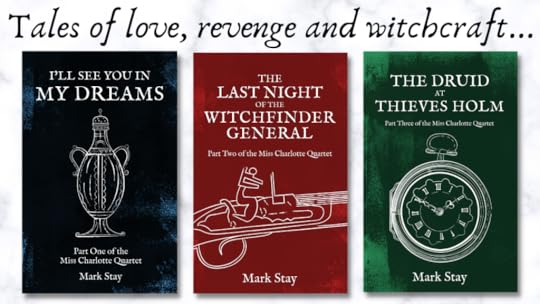
London, Autumn, 1744 Charlotte Southill slinks into Newgate Gaol to interrogate a thief before he is hanged. Only Wilmot Moor knows who has the scrap of paper with the ritual that will allow Charlotte to summon Time and discover the truth behind the mysterious girl in her dreams. Charlotte will travel from London to a tiny islet off the coast of John O’Groats where she will encounter the Druid at Thieves Holm. I waffle about it here, and there’s a brief clip of the audio edition, too…
Big thanks to Julian Barr for his editing skills, Claire Burgess for helping Araminta, Dominic Currie for the music, and Andy Bowden for the cover art.


May 1, 2021
Here’s One Way To Write A Novel (Part 2): Three-Act Structure
I’ve just hit 22,000 words on my new novel, and this is where things can get a bit sticky. To make our way through the muddy middle of a novel, it helps to understand the basics of three-act structure, so here are a few pointers…
Here’s a link to part 1… https://youtu.be/A9u0SFjv3N8
And here’s the thematic video I mention… https://youtu.be/vD64WDtWsV8
TRANSCRIPT
Hello, folks. It’s been a couple of weeks since the last update. Since then, I’ve had a haircut and my first vaccine and I’m just getting over the side effects…
I’m still using the same method to write the first draft of this book, so scribbling in a notebook one day, then switching to the laptop and bringing it to life the next. And it’s been working pretty well so far. I’ve just hit 22,000 words, which is about a quarter of the way through this book. I want it ultimately to be somewhere between 80- and 90,000 words tops. So I’m about to hit what is possibly the most difficult part of the novel.
The second act, the muddy middle. As I said in the first video, and I’ll pop a link below if you haven’t seen it: https://youtu.be/A9u0SFjv3N8 — openings are relatively easy. Everything’s exciting. The world is your oyster. But when you get to the end of the first act, your characters will have started making choices that have consequences. Story consequences. So how do you navigate this? Well, let’s take a moment to talk about the basics of structure. All stories have this in common: a beginning, a middle, and an end. This is the three act structure at its simplest, used by the ancient Greeks in their storytelling, still used by Hollywood today.
Now, you may have read all sorts of fancy stuff about four-act, five-act, seven-act structures, pyramids, diagrams, all sorts of stuff. But in the end, it all comes down to these three essential beats: a beginning, a middle, and end. And why are we even talking about acts? We’re writing a novel. Well, this is largely because the language of theatre and screenwriting has seeped into the bigger conversation about narrative. But it really does help to think of your story in these terms, not least because an understanding of story structure will help you identify the strengths and weaknesses of your writing and enhance your self-critical skills. Here’s a simple breakdown of how the acts work. So, Act One is all about the set up, and that’s what I basically just completed. I’ve introduced my main characters. The setting, the themes, the tone and the rules of the story are established. There will be some kind of incident that will trigger the story and set the protagonist on the path of the story. The First Act usually ends with a turning point that will launch Act Two. Act Two is all about confrontation. Your protagonist will be tested as they strive to achieve their goal, the action rises and rises, leading to a midpoint that then becomes a crisis. The final events of Act Two, which often herald disaster or certain failure for our hero, will trigger the events of Act Three. Act Three is all about resolution. The stakes are raised to the point where we think it’s going to end in disaster. But the protagonist will take the lessons learned by the tests of Act two and find a resolution. They will almost certainly have changed from the person they were in Act one. And that’s it. The building blocks of story.
You can apply this not only to your overall story, but to each chapter which will have its own beginning, middle and an end. So this is what I have ahead of me next. Act Two. This is where I test my characters like an Old Testament God making their lives increasingly difficult. The good news is I have a pretty good idea of how I want Act three and the ending to pan out. So I just need to bridge that gap with some fun shenanigans.
And if I get stuck, then I need to take a moment just to think thematically. I covered that in a previous video… https://youtu.be/vD64WDtWsV8
Again, I’ll pop a link below. Sounds easy, doesn’t it? Hmm. I’ve just written a scene where they come to a door and I have only the vaguest idea of who is on the other side. So, yeah, we’ll see. It’s never easy. But here goes. There’ll be another update a couple of weeks and until then, happy writing.
April 25, 2021
Tips for Writing Dialogue
Here are some tips for making the dialogue in your novel or screenplay feel real without the waffle…
TRANSCRIPT:
Hello folks, one day to the haircut. Right, before that, let’s talk about dialogue. There’s a knack to writing dialogue, and some people have it, and others have to learn it. It’s a bit like playing an instrument. Some people can pick up a guitar and strum chords straight away. Other people, like me, need a little more practise, but that’s fine because soon we’ll all be playing Kumbayah in perfect rhythm.
Now, first thing with dialogue: maybe record yourself having a conversation with someone.
Make sure the other person knows for legal reasons, of course. Make it long enough to forget that you’re recording the conversation to avoid being too self-conscious, then transcribe the conversation. I did this with a friend of mine years ago, back when I first started writing plays, and it was amazing to know just how much waffle and repetition people speak before they actually get to the point. And we’ll discuss waffle in more detail in a moment.
Readers in reviews, they’ll say that they like their dialogue to feel naturalistic and real. But the trouble is, naturalistic and real is waffly, boring and distracting. The knack is to make it sound natural, while cutting out all the excess waffles.
Here are a few pointers; listen to others.
My cousin used to live tweet conversations he overheard on the bus to work and they were always hilarious with phrases that were absolute gems of dialogue. So whenever you hear a colourful exchange or phrase, jot it down in a notebook or your smartphone, you know, send it to yourself, keep a file of them somewhere. You may never use it, but doing this regularly will attune your ear to great dialogue. The more attuned you get, the better and more sparky your dialogue will be.
Cut the small talk.
Every now and then I hear someone complain that, “Oh, people in films never say hello when they pick up the phone. How rude.” There is a reason for that. We cut the unimportant stuff and get to the essence of the stuff that drives the story forward. This comes back to my point about naturalistic dialogue. I’ve literally had conversations that go like this: Mark, it’s your mum. How are you? Good. How are you and Dad? Oh, fine, fine, fine. Oh, good, good, good, good. That’s nice. Everything alright? Yeah, yeah, yeah. It’s all fine. Lovely, lovely. Good, good. That’s great. That’s lovely. That’s great… Oh your Great uncle died… What!?
You could never get away with that in a novel, unless it was a comedy bit. But the thing is, small talk… If small talk is essential for a character, then maybe fold that into the descriptive prose, you know: Mum called. She made the usual small talk, then hit me with the news. “Mark, I’m sorry, but your great uncle died.”
Next tip: Say it out loud.
I highly recommend talking to yourself. Write the first pass of your dialogue as freely and waffly as you like, go full naturalistic if you want, and then cut out all the fat. How to identify waffle and fat? Well, yeah, you’ve heard of the phrase chewing the fat? Apparently, this comes from small talk that sailors would make when chewing on salt hardened fat while they worked. This kind of chit chat that passed the time, you know. But as authors, we’re not passing the time with idle gossip.
We need to grip the reader. So our dialogue needs to do three things:
One: Move the story forward. Any exchange of dialogue needs to bring us closer to the end. Asking about the weather won’t necessarily do this.
Two: it needs to reveal character. Does your dialogue give us any insight into the character’s feelings and motivations?
Three: Build relationships. Does the dialogue create a dynamic that helps the reader understand relationships? For example, a father might yell at his kids, but be meek around his boss. That tells us something about him. If your dialogue doesn’t meet these criteria, then prepare the cutting snippers, because that dialogue might need to go. And you can get messy.
OK, so while we’re avoiding all the small talk, we can still sound naturalistic with interruptions, overlapping, half-finished thoughts, stammering… All these and more can help make your characters sound distinct.
Now, a quick word on slang, jargon and patois.
Use it very, very sparingly, especially when writing outside of your own experience. There’s nothing more likely to make the reader cringe than, say, a white person writing Jamaican patois, for example.
Some of you might have read the novel I co-wrote, Back to Reality. There’s an Italian character in that, Federica, who has a very distinct way of speaking. But we kept any overt Italian-isms to an absolute minimum to stop her sounding like Super Mario. We also gave it to an Italian friend to read to make sure we weren’t going to be banned from the country for life. You just need a tiny sprinkle of slang, patois to let the reader know the speech patterns, and they’ll hear the voice in their head and create their own accent and rhythm. You know, if you start emphasising it in every sentence of dialogue, it’s just too much. When it comes to jargon — military, police, scientific tech talk, doctors, things like that — use just enough to be authentic and avoid characters telling each other stuff they already know. You know, you get, “As you know, Dr. Smith, we make an incision here…” Use your prose to let the reader know just enough to add two plus two.
Again, I know it’s easier said than done, but it comes with practise. You have to keep the voices distinct as well. How can you stop characters from all sounding the same, or sounding like you? It’s important to make characters distinct. And a fun exercise is to remove all of the dialogue tags in an exchange and see if you can tell who’s saying what. Maybe give it to someone else to read and see if they can tell the difference.
This is where you need to get in character. If you find a character’s dialogue is bland, then, as an exercise, write the scene from their first person point of view, think about any moments of hesitation, frustration, what they really want to say, as opposed to what they actually say, how they hear the voice of others in that exchange. Do they find some people annoying, grating? Are they in a position of power in this scene, or are they having to watch what they say in order to get what they want?
Also, think about word choice. Do they use short, abrupt phrases? Or are they verbose and erudite? Do they use any slang, do they swear ten to the dozen? Think about their background and their world. You know, a working class docker will have very different dialogue to a nun… She’ll swear more for a start. Once you’ve done that, I think you’ll find it easier to write in their voice when it comes to dialogue. And have a think about subtext. You know, having characters blurt out exactly what they mean can be effective.
But mostly we should work with subtext:
Dialogue that defelcts, defends and skirts can be really engaging. Saying exactly what’s on your mind can have terrible consequences. You know, only the cold hearted tell their boyfriend or girlfriend that they want to break up. You know, characters that feel real will do everything they can to avoid delivering bad news. No one likes that. Or they will tailor what they say to the social situation.
Body language is also your friend.
We pick up so many clues from body language that it’s important to pair dialogue with descriptions of your character’s posture and mannerisms. Something like, “That’s so helpful. Thank you.” Delivered with a shake of the hand and a smile, is very different to, “That’s so helpful. Thank you.” Delivered with pursed lips and a withering glare. And tension. Thinking about subtext and body language brings me to how dialogue can build tension. Tension in a story comes from unanswered questions. Will he propose? Will she say yes? And dialogue can really help drive that tension and resolve it. Make every word count, keep the story moving forward, and keep the reader on the hook, which is easier said than done, of course. Well, I hope that was helpful.
And until next time, happy writing.
April 20, 2021
Author Talk with Kent Libraries
I had great fun chatting to Simon at Kent libraries about the books and authors that changed my life…
April 18, 2021
Theme is Story Fuel (and why you’ll never get stuck again)
What is your story’s theme? How can you figure out what it is? And how will knowing your theme ensure that you’ll never get stuck again…
Here’s the transcript of the Craig Maizin episode of Scriptnotes: https://johnaugust.com/2019/scriptnotes-ep-403-how-to-write-a-movie-transcript
TRANSCRIPT:
Hello, folks, apologies again for the lockdown hair. Two weeks to go. Let’s talk about theme. Sometimes, if you ask writers about the theme of their story, they’ll probably give you a one word reply like: family, war… Chickens.
Okay, probably not chickens, but it’s usually something monolithic. Some writers might not know the theme of their work-in-progress at all. And that’s fine because there are times when, you know, I don’t figure out what it is until I finish a draft. But, the sooner you can figure out what your theme is, the better. Because the theme, my friends, is story fuel. We’ll come back to that. First of all, what is theme exactly? Well, first of all, theme is not “an idea”.
Anyone can have an idea. Drunk uncles stagger up to me at barbecues and say, “I got a great idea for a book and you can write it for me”. No? It’s just me? Okay. Anyway, the point is: ideas are two-a-penny and they are not the theme. An idea is: a man dresses up as a bat to fight crime. The theme can change with every man bat story. Your theme is the central dramatic argument of your story.
It’s the question that the story and its characters will interrogate from the beginning, through the middle, and right to the end. And that’s the key to figuring out what your theme is: make it a question. Imagine that your book has been published and it’s being read by a book group. What’s the main topic of conversation for that book? What’s the big question that they will be asking? And here’s the thing. It doesn’t have to be earth shattering or original.
It just needs to be a little bit tricky to answer. So going back to our Man Bat example… the theme for that might be: can a man fight crime and not become a criminal himself? It’s the age old question of vigilantism, and it’s a good one. One that has fuelled all kinds of very different stories for time immemorial. So, how is theme story fuel? Well, we all get stuck when writing. And I find that if I know what my theme is, I’m much more likely to find a solution when I’m wondering what happens next.
So, for example, in my current book, the big overarching theme is: are we stronger together or on our own?
Now, as an old liberal lefty, I’m all for unity and working with others. But there are times when we need to strike out on our own. And when I’m working on the story, and wondering what happens next, I ask, how can I present this dilemma and dramatise it in the story? How can I divide my united characters? Or how can I take someone who works alone and make them realise that they might need help? All good stuff. You really should give it a try.
It really does. The screenwriter Craig Mazin, who wrote Chernobyl and many other things goes into this in greater detail in Episode 403 of the Scriptnotes podcast, and how it ties into protagonist’s story of change. And it’s really good stuff. I think the episode is behind a paywall now, but you can check out the transcript online. I’ll pop a link below. Well, I hope that was useful, and happy writing.
April 11, 2021
Here’s One Way To Write A First Draft
I’ve been working on a new way of writing the first draft of my novel. And it’s been working really well… so far…
TRANSCRIPT:
Hello, folks. Apologies for the hair. Still in lockdown and two weeks till I get a haircut, so this is going to get worse before it gets better. Anyway, I’m working on the first draft of Skyclad, the third Witches of Woodville book.
Regulars will know that I used to be a big outliner when it came to writing, but I’m becoming more and more of a pantser or discovery writer, whatever you want to call it.
That is, I’m making it up as I go along. Well, sort of. I do have a rough idea of where I’m going and I know how I want the story to end. And I have a few key notes on a few key moments, but I thought you might be interested to know how I’m working with this one. Again, regulars might know that I have a different notebook dedicated to each project. Here’s the one for Book Three of the witches of Woodville, Skyclad.
This was bought at the National Trust Gift Shop at the White Cliffs of Dover, which is a little clue as to where some of the book will take place. What I’ve taken to doing with this story is switching from day to day between paper — the notebook — and the screen — the laptop — and it’s really working for me. So to give you some idea… On, say, Monday, I will start noodling ideas for what happens next in the story in The Notebook.
So here I’ve written in big letters, “How can the Poltergeist exorcism go wrong?” Slight spoiler, but it’s the opening scene. I’ve made notes on what can happen in that scene and they are imperfect notes. I’ve given myself permission to wander off, and noodle and try different scenarios, and scribble stuff out, and put other things in boxes and underline them, and highlight them. And what I find is that by the end of the writing session, I have a really good idea of how that chapter pans out.
The level of detail varies from session to session. But the next day, Tuesday, when I open up the laptop, I’m not victim to the tyranny of the blinking cursor. You know that feeling when you look at a blank page of Word or Scrivener that bastard cursor is flashing at you, “Go on, write something. What are you waiting for? Call yourself a writer?” Well, now I just go to my notes and start typing, and before I know it I’m up and running. I used the less formalised version of this with The Crow Folk and the second book, Babes in the Wood, available to pre-order now.
And it worked really well. So this is an evolution of that. A few caveats. I’m only 10,000 words into this novel and, in my experience, openings are pretty easy when compared to the rest of the book… not least the middle section, which can lead to much wailing and gnashing of teeth. So I’ll check in with this in about a month’s time and see if I’m feeling quite so smug still. Also, I’m writing the third book in a series.
I know the characters and situations really well. I have a very good idea of how people will react when presented with challenges. And that makes a writer’s life much, much easier and makes me wonder why it’s taken me so long to write a series. This is so much fun. Anyway, I hope you found that helpful. How is your writing going? Does this sort of method work for you? Pop a comment below or drop me a line. In the meantime, happy writing.
April 3, 2021
Another FREE short story for you…
Part two of The Miss Charlotte Quartet — The Last Night of the Witchfinder General — is now available completely free to anyone who subscribes to the Woodville Village Newsletter. Sign up and grab your copy here… https://witchesofwoodville.com/#library
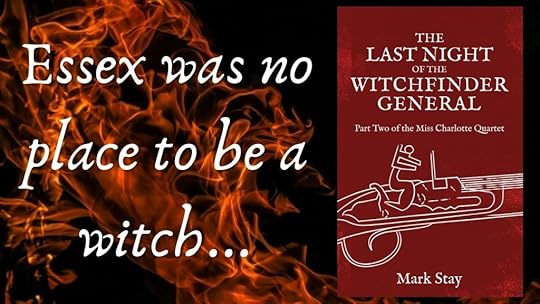
Manningtree, Summer, 1647
Matthew Hopkins, Witchfinder General, has come out of retirement for one last trial. And now Charlotte Southill is here to show him what a real witch can do…
Charlotte Southill vows revenge when one of her friends falls victim to the notorious Witchfinder General, Matthew Hopkins. But someone doesn’t want him dead and Charlotte must confront some raw and painful memories.
TRANSCRIPT:
Hello folks. I’m delighted to announce that the second story in the Miss Charlotte Quartet — The Last Night of the Witchfinder General — is available to download… completely and utterly FREE for all the lucky people who have signed up to the Woodville Village library newsletter.
If you’ve read The Crow Folk you will know that Miss Charlotte has something of a secret history and these stories will go some way to letting you into her dark past.
Yes, these stories are a little darker than the Witches of Woodville novels and this one in particular contains hanging, torture, vomiting, farting, drowning, poisoning, shooting, stabbing and al fresco urination.
What more could you ask for in a 5000 word short story? It’s available as an eBook and audiobook. Let’s have a quick listen…
ESSEX WAS no place to be a witch.
Charlotte stood in the shadow of the gallows, watching her friend Dorothy Marsh sway in the summer breeze. Flies buzzed around Dorothy’s gaping mouth. Her bloodshot eyes bulged as if in fright, her last terrified words left unsaid. Dorothy’s pepper hair was matted with blood and the mob had taken all but her stained smock and a single shoe.
A dark rage grew inside Charlotte, rising like bile. She had seen too many women like Dorothy hanging from a noose these past three years. Dorothy wasn’t even a witch, but a midwife. A woman of compassion and kindness who offered Charlotte shelter and food when she was last here.
Matthew Hopkins, Witchfinder General, had come out of retirement for one last trial.
And now Charlotte Southill was here to show him what a real witch could do.
I had great fun writing this one, but even a short story is not written is isolation. My thanks to Julian Barr for editorial wisdom, Andrew Bowden for another cracking cover design and the lovely new logo for Woodville Village (points)…
Thanks also to Dominic Currie for the music. Head Librarian Araminta Cranberry for her introduction and afterword, and Claire Burgess for the usual.
Part Three of The Miss Charlotte Quartet will be available on 4th May and will again be FREE to all newsletter subscribers, so if you haven’t already please click on the link below and sign up. You can also get a free recipe for Jam Roly Poly as featured in The Crow Folk and much more besides. It will also be the first place where you will soon be able to read an extract from book two of The Witches of Woodville BABES IN THE WOOD (which is available to pre-order). Thanks again to everyone who’s read The Crow Folk, and especially those delightful people who have left reviews online and such.
Until next time, happy reading!
March 27, 2021
A New Logo for the Village of Woodville
The parish council of Woodville Village is delighted to unveil the new village logo:

Village Head Librarian, Miss Araminta Cranberry, stated, “This is a vast improvement on the previous village sign, which many said looked like a squirrel nailed to a cross. This new design is much less likely to deter visitors and frighten children and animal lovers. It also better represents the magical heritage of the village, as well as hinting at the incident in 1973 that no one here talks about. No further questions, please.”
The logo was designed by Mr Andrew Bowden of www.ididthat.uk – Mr Bowden won the contract after completing the three trials of endurance and finally agreeing to accept payment in doubloons and bitcoin. Mr Bowden is from the county of Essex, but parish councillors agreed not to hold that against him and he was released from custody after only a few hours.
March 26, 2021
The First Round of Edits Are Away!
Why do I love editors? Because they help me create a better book. I’ve spent the last week or so in the first round of edits for my next book Babes in the Wood, and here’s what I learned…
Apologies in advance for… the wind…TRANSCRIPT:
Hello, folks, Mark Stay here. Last time we talked, I’d just started the edits on book two of the
Witches of Woodville: Babes in the Wood. Well, after a week and a bit
of intense editorialising they’re done.
They’re off to my… Well, I say “done”. This is probably the first round, but they’re off to my editor, Simon & Schuster, Bethan, for her to have a look at. Lessons learned? Well, um, this took longer than the first book. Now, the first book was Alpha-read and Beta-read up the wazzoo. Lots of eyes on that before it went off to any publisher. So it was in very, very good shape.
This one was in good shape, too. But, uh, there is a murder mystery element to it.
Which… Writing any kind of mystery like that is, is storytelling with the hood off, you know, everyone can see the working parts because you put them there on display for people to… To notice things. And if everything doesn’t quite make sense, then it really stands out in a way that other stories, you know, you can probably get away with the odd teeny weeny plot hole. So this one, most of Bethan’s notes were just little clarifications. Can you make this a bit clearer? Can you hang a lantern on this? You know, can you emphasise this a bit more? Uh, of course, during, uh, during my edit, I realised one massive plot hole was that I have a murder and never once explain how the murder was done. Only I could do that. Um, this is why you have editors, folks. So, uh, that was handy. I was able to… The thing is I’d written it down. I put it in my notebook. This is one good reason why you should have a notebook, folks, for each project that you’re doing, because I had actually written it down. I just hadn’t put it in the actual novel. Small point. But, you know, we always catch it in the end, which is good.
So, yeah, really happy with it.
And it gave me the opportunity to add a few extra layers, a few extra flourishes that… Particularly towards the end I wanted to ramp up the tension a little bit more. So I’m really happy with it. Really happy with it. So that’s gone off to Bethan. She’s in the middle of editing another book. So it might be a few weeks before I see it again.
But until then, I’ve got a short story to edit. I’ve got a short story to finish. These are the Miss Charlotte Quartet stories. So, I’m gonna spend this weekend… Beautiful… I’m gonna spend this weekend rereading that and giving that a final polish, and getting that ready. So if you subscribe to my newsletter, you can get these stories for free. Free! Number one’s out already.
I know.
Good, innit?
Number two is coming on the fourth of April in ebook and audio… Got to record that too. And then
three and four are on their way. So that’ll keep me busy. That’ll keep me out of trouble. So yeah. If I hear any more on the edit…
I’ll let you know. I’ll get back to you. In the meantime, I’m just going to pop into my local library.
Happy reading.
Happy writing. See you again soon.
March 19, 2021
Babes in the Wood COVER REVEAL
Today we reveal the outstanding cover art from Harry Goldhawk for the second of the Witches of Woodville books, Babes in the Wood. Behold…
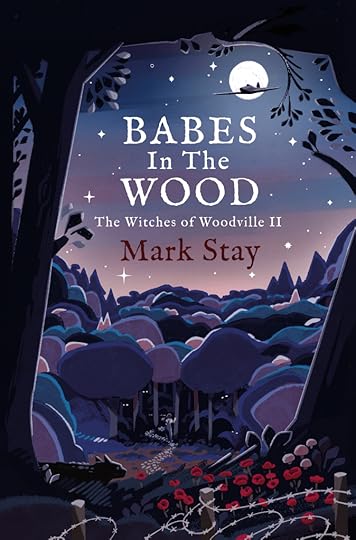
I mean… look at it. Just gorgeous and full of mystery. Look at the eyes in the woods!!
The book will be published on 28th October and you can pre-order Babes in the Wood from the usual places. All the buy links you need are here, but in the meantime do join me in congratulating Harry on another incredible cover.