
Taiia Smart Young's Blog, page 3
July 3, 2017
11 Quotes For Newbie Writers And a J. Cole Lyric
#SassBossLinkUp panelists with Sapphira Martin (center), SassBoxx founder
Recently, I participated in the #SassBossLinkUp (founded by Sapphira Martin) a panel about creative leaps and entrepreneurship, which inspired this post about 11 quotes for newbie writers (obvi).
All of my fellow panelists and the moderator are pretty badass—one of them, Briana Owens, has a gig in advertising but also owns Spiked Spin, a hip-hop cycling biz.
Another, Robin J., founded the TheTakeOvah.com to give musicians exposure without competing with the mainstream.
As the panel discussed who and what inspired us, Robin mentioned that she tatted a J. Cole lyric on her arm. I think it was her arm, I sipped a few cocktails before the panel, so that part is a big hazy. Forgive me.
But!!! I love the “False Prophets” rapper, so if there was anybody’s lyrics worth getting permanent ink for, Cole is on my top 10 list.
Autograph is just one of the gems on J. Cole’s Friday Night Lights. (courtesy of @RealColeWorld’s Instagram)
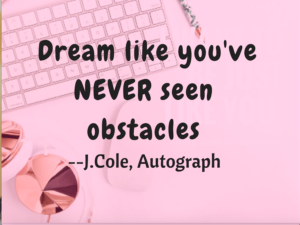
Her tat is a line from “Autograph” and I knew immediately:
They say anything’s possible
You gotta dream like you never seen obstacles
That sums up how we have to think as creatives, entrepreneurs, writers, dreams and doers. There’s always going to be a gatekeeper, a closed door and someone too eager to reject our idea.
I don’t think we have to be fearless but we do have to be courageous and move past self-doubt—even when it’s screaming that we shouldn’t write that story because:
[FILL IN ANY EXCUSE THAT WILL HOLD YOU BACK HERE].
In honor of inspiration and dope lyrics that not only keep us motivated but keep us moving forward (shout out to Cole), here are 11 quotes for newbie writers by writers (who’ve make creative leaps just like you) about writing and why we make it do what it do.
“I’m writing a first draft and reminding myself that I’m simply shoveling sand into a box so that I can later build sandcastles.” —Shannon Hale
“A woman who writes has power and a woman with power is feared.”
—Gloria E. Anzaldúa
“To survive you must tell stories.” —Umberto Eco
“Writing is really a way of thinking—not just feeling, but thinking about things that are disparate, unresolved, mysterious, problematic or just sweet.” —Toni Morrison
“Easy reading is damn hard writing.” —Nathaniel Hawthorne
“A word after a word after a word is power.” —Margaret Atwood
“Writing has laws of perspective, of light and shade just as painting does, or music. If you are born knowing them, fine. If not, learn them. Then rearrange the rules to suit yourself.” —Truman Capote
“I think writing really helps you heal yourself. I think if you write long enough, you will be a healthy person. That is, if you write what you need to write, as opposed to what will make money, or what will make fame.” —Alice Walker.
“The single story creates stereotypes, and the problem with stereotypes is not that they are untrue, but that they are incomplete. They make one story become the only story.” —Chimamanda Ngozi Adichi
“I don’t believe in the phrase ‘aspiring writer.’ To me it’s just, you’re a writer.”—Shonda Rhimes
The post 11 Quotes For Newbie Writers And a J. Cole Lyric appeared first on Taiia Smart Young.


June 24, 2017
Here’s What I Know About Writing Workshops

That time I taught a writing workshop for Beverly Bond’s Black Girls Rock!
I’ve dropped some serious coin on writing workshops with schools like the Frederick Douglass Creative Arts Center in Harlem (RIP), Gotham, Mediabistro and The Best Sellers Publishing Course. The last one was more about publishing than writing, but that’s for a later post. It’s safe to say I’ve seen my share of writing communities from investing in my craft.
For those of you about to break your writing workshop cherry, let me offer some insight, as someone’s who has been a student and a teacher. See the photo here with some happy young writers at the Black Girls Rock! conference.
THERE’S LEVELS TO THIS
For the sake of this post, let’s agree that you’re in a short story writing workshop. The word count for shorts vary from 1,000 to 7000 words; flash fiction is around 500 words; micro-fiction is 300 words or less. (See there’s something for everybody.)
Choose a workshop where everyone is on the same level, meaning let the newbies join Red Riding Hood and find their way together to grandma’s house, while the advanced folks wax poetic about why their shorts must be told in verse.
There’s nothing wrong with staying in your lane on this one, i.e. beginner, intermediate or advanced. Why?
Because: intimidation.
This isn’t school. Back then the teacher read your “The Night My Goldfish Died,” story and assaulted your grammar in red pen and your classmates were none the wiser. In workshops, everyone reads everyone’s crappy first attempt. It’s easier to swallow critiques for “The Affair My Best Friend’s Husband” without someone on the level of Junot Díaz or Amy Tan sitting next to you.
CRITICISM SUCKS OR NAH?
A word about criticism…
The purpose of a critique is to evaluate the work to increase the reader’s understanding. Note: Most instructors offer a guide or explain in great detail how to deliver thoughtful commentary, because we all know that opinions are like booty holes, everybody got one.
Now isn’t the time to get in your feels. Thoughtful analysis is designed to improve your story about discovering a ghost in you TiTi’s coat closet. You want the best story. You know what it feels like to close a book or finish a short story and feel dissatisfied with the final product.
Young writers working on their college essays during my writing workshop for the Seed of Fortune organization.
WRITERS ARE SUPERHEROES
If you don’t have thick ass alligator skin before the course, then you’ll become a reluctant member of the reptile family after surviving multiple weeks of critiques from your instructor and classmates. If you don’t, shame on you.
Being a writer isn’t for normal folks. We’re superheroes.
Once you earn your red thigh high boots and golden lasso, you’ll accept meaningful critiques that can help you see blind spots in your work. And you may develop an appreciation for genres beyond your comfort zone. If you’ve never read dystopian fiction (à la Scott Westerfield’s Uglies) and a classmate is workshopping that model, you’ll be forced to pay attention and understand the moving parts of this ethos.
It’s only fair, right? I mean, she did suffer through the ghost thing.
LASER FOCUS FOR THE WIN
There’s nothing like a financial investment of $300 or more on a course to inspire laser focus. And unlike college, there isn’t a frat party or sheepskin diploma waiting for you once the eight weeks are completed. If the goal is to have a piece ready for Word Riot (for flash fiction fans), Glimmer Train (for literary types) or Lightspeed (for sci-fi folks), then commit to killing it outside of the workshop.
That means sit down and write, build those dystopian worlds and explain the behavior of those ghosts, because if you can’t write about it clearly and don’t understand it, the folks in the workshop won’t get it either, which WILL make you frustrated, angry, hurt and in your feels.
It’s like that New Year’s lie resolution everyone made in December to be fit for 2017. Those abs don’t crunch on themselves. If they did, I’d STILL have a six pack. You gotta hit the gym and go hard. The same concept applies here.
If the first seven weeks are devoted to cranking out a messy draft, and the last three are for revising, cancel Christmas, skip happy hour and postpone a Tinder hookup to make that keyboard dance. Revising is a writer’s best friend, but it’ll make you question why you wrote 500 words about a dog kennel in a story about friendly ghosts; and all of your favorite sentences will end up on the cutting room floor.
Writers call it “killing your darlings” (or “killing your babies,” depending on which writer you’re talking to) because we can’t afford to fall in love with any part of the story that doesn’t make it better.
All of that extra crap has to go to make your story better and that’s non-negotiable for superheroes.
What was the biggest surprise you experienced from taking a writing workshop?
The post Here’s What I Know About Writing Workshops appeared first on Taiia Smart Young.
June 10, 2017
Want to Write Better? Listen and Observe

In January, my dad sent a text saying that Bae and I “were made for each other.”
It’s the kinda thing the best man says during his wedding toast. I could practically hear John Legend in the background singing Made to Love. (It’s the kinda thing a writer learns from listening and observing.) I was curious about my dad’s take on my relationship.
Me: How can you tell?
Dad: By the way you guys were huddled under the blanket watching a movie in my living room.
Snuggling with Bae is something I’d done hundreds of times at home and never thought about it. Well, except for that time we watched a movie with another couple and they sat on opposite sides of the room and didn’t even share the same popcorn bowl.
I tried to see what my dad saw. With a wide-angle lens, we probably looked like a scene from a romantic comedy. We were all cozy under a huge, comfy blanket on dad’s leather couch with the fireplace cracklin’ in chilly Atlanta.
You need a macro lens to know that I’m all about invading the personal space of my loved ones. It’s my thing. It’s part of my character, if you will.
I pinch my mother’s big ole butt in public.
I TRY to hold the No. 1 Son’s hand when he’s checking out girls at the park.
I kiss my niece’s forehead then hold her hostage in a bear hug.
So it’s really about the lens, the angles. What we see. What we don’t see. What we hear. We we don’t hear. Context.
Listen. Observe. Listen. Observe. Listen. Observe.
I thought about how I process conversations I’ve overheard, describe moments and learn from observing people’s actions.
I listen like I have a FBI-sanctioned wiretap.
Nosey, much? Nope. I’m curious. There’s a difference.
People say incredible ish in line while buying a box of munchins at Dunkin Donuts. Even 30 seconds of a convo in DD provides quick insight into someone’s personality.
Best. Convo. Ever. Found on @overheardnewyork.
If you don’t believe me, follow Overheard in NY on Instagram. I started listening to strangers’ conversations when I began riding public transportation solo at 11 years old. I think that’s how I learned to write dialogue.
When I’m in a crowded elevator, I listen to what people say and how they say it.
Does she have an accent? Does he have a lisp? Does he drop F-bombs between every other word? Does she mispronounce the name of a French designer, who’d be pissed to know she owns eight fake handbags?
I listen for what’s said, but more important, what isn’t said.
I stick around for the climax.
It’s not enough to see how a man gently brushes hair out of a woman’s face. I gotta stay until the end. Does she blush? Does she smack fire out of him for ruining a perfectly good hair whip courtesy of God’s wind machine?
The funniest clip circulating on social media a few weeks ago was The Trumps: A Love Story. Or as I like to call it: Get Your Damn Hands Off Me, Donald. During a series of appearances Trump reaches for Melania’s hand and she swats him away like the whole world isn’t watching this artic chill.
My favorite moment is during inauguration. Melania is outfitted in a powder blue Ralph Lauren dress and standing next to The Donald like a soldier ready for battle, while Barack and Michelle lovingly hold hands like high school sweethearts.
See what I mean about angles?
And this is why I stay until the end…
Oh, and a word about sticking around until the end: Remember the Oscar’s Best Picture debacle? Yeah, the one where Faye Dunaway announced that La La Land had won when Moonlight really earned the trophy?
Just sayin’, Scribes. It ain’t over until the fat lady sings.
I scan the crowd for my Uncle Lovell.
True story: I’m at a funeral and my Uncle Lovell is pissed because everyone is commenting about the “wonderful job” the mortician did with The Deceased.
Random Bereaved Person: Doesn’t The Deceased look sharp! Oh, and his hair is slicked back just right!
After a few minutes of nonstop compliments unc had enough.
Uncle Lovell: FORGET ABOUT HIM, WHAT ABOUT ME? HOW DO I LOOK?
Me: (cackling in the corner)
Yes, he’s pissed that they’re ignoring his live body to fawn over the guy in the casket.
My point is this: It’s easy to get caught up in the moment of the occasion—a graduation, funeral or wedding—and believe everyone is experiencing the same emotion. Exuberance. Grief. Bliss. Or that everyone is on the same page. (See my Uncle Lovell.)
Think about it, at a wedding you expect guests to smile as the bride makes her way down the aisle. But if you scan the crowd with a periscope, maybe there’s a woman giving the bride the ultimate side eye.
Then you can’t help but wonder: What’s her deal?
Remember Whitley and Bryon’s wedding on A Different World? The happy couple stood at the altar ready to recite the ’till death do us apart script and nobody saw Dwayne (Whitley’s ex-bae) standing in the aisle. Why?
’Cause the guests expected the usual wedding protocol: vows, kiss, reception, dance, cake. In that order.
Nobody expected Dwayne to walk toward Whitley and yell: Please, baby! Baby, please!
Dwayne disrupted the whole situation and stole Byron’s wife-to-be.
I ask myself, is there a story here?
In my mind, EVERY snippet of a conversation overheard on the No. 4 train, a quote I read on Twitter or a line from a movie can be the start of something.
I collect juicy tidbits and save them for later. Sometimes they make it past my pretty notebook or notes app on my iphone.
In HBO’s docudrama The Wizard of Lies, Andrew Madoff (son of the infamous Bernie Madoff) met with a writing class at Princeton and one of the students asked why didn’t he work harder to:
1) clear his name
2) convince the world that he and his brother didn’t know anything about his father’s $65 billion Ponzi scheme.
His answer was all kinds of honest: “I don’t know if I’m that sympathetic of a character. I’ve lived a life of great wealth and privilege… It’s hard to tell our story, there were just three of us, and there were thousands of victims.”
Exactly. Save your tissues. Don’t cry for him Argentina.
The Madoff sons had lavish homes, unlimited funds and prep school educations, while I ate Ramen noodles in college and repaid federal student loans with entry-level wages. So no the Madoffs don’t get any boohoos from me, even though I do believe Bernie kept them all in the dark about his shady investments.
Andrew (may he rest in peace) knew there wasn’t a story to tell—or at least one that the public or Bernie’s victims (like holocaust survivor Elie Wiesel) could digest without violently throwing up.
Now, it’s your turn. Tell me what you observe about people or couples when you’re out and about.
Listen intently, stay for the climax and scan the crowd.
What did you see from your vantage point? Is there a story waiting to take shape?
The post Want to Write Better? Listen and Observe appeared first on Taiia Smart Young.
June 4, 2017
Three Ways to Elevate Your Pitch Game
Pitching and serving all kinds of book magic at the Jack and Jill Mother’s Metro Cluster in Tarrytown, NY.
I’m not ashamed to admit that I carry copies of my book Famous! How to be the Star of Your Show around in my bag, like a mixtape rapper selling CDs at the gas station. Why? Because I’m always ready for the big pitch.
Shout out to rappers who’ve nailed this concept. I’ve supported many Brooklyn rappers this way. Let’s keep this art going. Being indie is serious business and no one sells your product better than you.
Anyway, Famous! is my baby and while I prefer to sell books in bulk at schools and youth groups, sometimes there are impromptu opportunities for sales. Although Famous! is available on amazon.com and barnesandnoble.com, those sites haven’t mastered the art of the 30-second pitch. (Plus, online outlets take a cut of the profit and when I sell books from my inventory, that coin goes directly into my bank account.)
What do you do? is bound to come up at a cocktail party, panel discussion or BBQ. I tell the person or group that I’m an author and when they inquire about the book, it’s time to werk. (Not to be confused with work. Click over to your friendly urban dictionary for the definition.)
Sidebar: Months before I had my 30-second pitch on lock, I amped myself up with Eminem’s “Lose Yourself.”
You better lose yourself in the music, the moment you own it
You better never let it go, you only get one shot,
Do not miss your chance to blow, this opportunity comes once in a lifetime you better
Yes, I’m a disciple of theme music.
Anyway, talking about myself seems obnoxious and by extension, talking about my book is super-obnoxious. But if I don’t pitch (i.e. sell), I don’t eat. And I’m a huge fan of food, indoor plumbing, heat in the winter and mobile service. So I pitch like Pedro Martinez when he rocked a Boston Red Sox uniform.
Here are some keys to master the art of the 30-second pitch for your book.
(Note: The following tips also work in various scenarios, including if you’re trapped in the elevator with your CEO and want to tell her about your advertising idea for a new organic lemonade.)
WRITE, REVISE, RINSE, REPEAT
I’m a fan of writing everything down. There’s some not-so complicated science detailing how and why the brain retains what we write. Don’t fight it. Just do it.
And don’t attempt to get it right the first time.
Let the words flow and crank out a few lines, even if they’re incomplete sentences or don’t make sense. Borrow from your synopsis. Use symbols, doodles and sketches, anything that brings the blurry image into focus.
Do this a few times, then go back and highlight the most interesting parts. The summary needs to be descriptive and convey the heart of the book.
The trick is to make the reader/potential customer see the pitch.
Think of it as an audio trailer with visual inspiration.
Example: Someone described my (unpublished) YA novel as “the hip-hop Empire.”
That was a super close depiction, and anyone who heard that phrase would know that focused on rap music and a family power struggle.
Tight. Bright. Visual.
Boom.
REHEARSE WITH THE WOMAN/MAN IN THE MIRROR
Remember the vintage Jack Benny joke “How do I get to Carnegie Hall?” And the punch line is: “Practice, practice practice.”
It’s time to practice when the pitch is tight and bright. It’s clear the book is about zombies, bio-chemical weapons and a female detective destined to expose government secrets.
I have two preparation methods. First, record the audio and play it back to critique pitch, pace and tone.
Don’t sound like:
a used car salesperson
a cheerleader high on Adderall
an I, Robot android
Go for warm, friendly and convincing. Second, deliver the pitch to a full-length mirror, with a genuine smile and eye contact. Be sure to blink. Make your face and voice sync up. Don’t scare grandmas and young children.
Don’t look like:
a reality TV housewife suffering from bad Botox
Jared Leto’s Joker in Suicide Squad
a comb platter of number 1 and 2, with a side order of Bride of Chucky
There’s no shortcut to this one, Scribes. Get in the mirror and rehearse until it’s smooth and conversational.
CONQUER YOUR SHYNESS, BELIEVE IN YOUR FLYNESS
This line is courtesy of Mr. Kanye West. Roughly translated it means move past self-doubt and believe what you’re saying—and the other person will too.
Think about it the next time a 3 a.m. infomercial pops up. Tony Horton has convinced me (and many insomniacs) that abs like his are within my reach if I purchase P90X. His empire is upward of $400 million, which means his pitch game is insane. And to think, this guy used to be a comedian. Clearly, TH found his niche.
At fairs and festivals, I’ve seen authors tell potential customers to read the back of their book for the scoop.
What? Nope. Not. Doing. That.
Reading synopses is for bookstore browsing.
Live events are for turning on the charm, channeling your inner Tony and firing up the Square for the sale.
When a book lover meets me in living color, the person who’s staring into my eyes is about to experience all this black girl magic—whether she’s ready for it or not. I’m friendly, genuine and interested in what he or she has to say.
Rarely do they walk away empty handed.
Oh, and the best pitch I’ve ever heard from a rapper selling mixtapes was that his music was inspired by golden era hip-hop, and because he didn’t curse, I could play the CD with my grandmother and kids in the car.
I laughed and happily gave him $5. I didn’t walk about empty handed.
If you were trapped in an elevator with an agent or a potential customer, would be ready with your 30-second pitch?
The post Three Ways to Elevate Your Pitch Game appeared first on Taiia Smart Young.
September 11, 2016
6 Ways Self-Publishing Will Drive You Bat Sh*t Crazy

Self-publishing a book can (and will) drive you nuts. But what my headline doesn’t say is that it’s rewarding in many ways, especially for your bank account if your marketing game is tight. I’ll save that convo for another post. Before you take the leap, there are a few things that you should know. Let my pro tips be your guide.
1. You’re in total control, à la Janet Jackson.
(Courtesy of MaDMAn/Creative Commons)
For the control freaks in the room, this sounds hella sexy. And it is…but let me explain. When you’re in the thick of it, it’s far from being a vision of Michael B. Jordan (remember the scene in Creed where he’s shadow boxing?) with his shirt off. Writing aside, your duties include accounting, marketing, hiring an editor, creating a production schedule and formatting the book. Pro tip: If your skills (and time) can be used to elsewhere, don’t kill yourself trying to format your book in Scrivener. It can be done, but it ain’t for everybody. Hire someone to do it (with experience, please!) or lock down a professional typesetter who can set up your bestseller in print and ebook formats for one set price. Ask to view samples of his/her work. (Remember, Janet had Jimmy Jam and Terry Lewis on her squad.)
2.You’ve been diagnosed with a severe case of analysis paralysis.
The good news is this: You don’t need penicillin to cure this one. Set a time limit for certain tasks, i.e. devote three hours on Monday and Tuesday to researching book cover designers. Otherwise, you’ll go down the rabbit hole and never come up for air. Who’s affordable? Who’s expensive? Who offers multiple cover revisions? Debate the pros and cons and then pick your top three. Pro tip: Ask your network for recommendations and Google top designers for indie or self-published authors. There are plenty of options online but selecting a designer is a custom fit. I found my designer (hey, Ana Grigoriu!) after reading this post from the crazy resourceful Joanna Penn at The Creative Penn.
3.You’re blowin’ money fast.
(Courtesy of 401kcalculator.org/Creative Commons)
So you’ve cut back on happy hour and Saturday brunch with the girls because you’ve decided that yes, you will appear on the cover of your memoir (good for you, that’s good branding). But aside from hiring the bomb photographer with the designer price tag, you’ve only set aside major coins for hair, nails, brows and a professional beat from a celebrity makeup artist, which means there’s about $500 left in the kitty. Guess what? You haven’t hired an editor or talked to a printer about cranking out 500 copies of your book! Pro tip: Before you spend a dollar, open up an Excel Worksheet (didn’t I mention accounting earlier?) and create a realistic budget to pay a photographer, book cover designer, typesetter and editor. Are you using postcards, bookmarks and T-shirts? Include that in your lineup too, along with hair, makeup and wardrobe expenses. Give the editor and the printer (not the makeup artist) the biggest piece of the self-publishing pie. If you go the ebook route, there’s no need to worry about printing.
4. You don’t plan for unexpected delays (or disasters).
(Courtesy of Lisa Jacobs/Creative Commons)
What do they say about Murphy’s Law? Oh, yeah, anything that can go wrong, will go wrong. I’m not talking about a zombie apocalypse or an outbreak of scurvy. You have to account for real life ish. What if your copy editor has a death in the family and won’t be able to work on your manuscript for a week? What if a snowstorm brings your city a halt and your photo shoot is set for the local park? What if your computer dies? Pro tip: Pad your self-publishing production schedule with an extra week or two or three so that you handle delays without having a complete meltdown.
5. You swear you can hit your daily word count and watch Netflix at the same damn time.
Here’s the truth: You shouldn’t text and drive for a reason. Driving requires eyeballs on the road, right? Well, writing requires your full attention too. Don’t turn on Unbreakable Kimmy Schmidt and attempt to write a gut-wrenching breakup scene. That’s hard to do if you’re laughing as Titus sings about “peeno-noir.” Multitasking kills brain cells. But don’t take my word for it. See what Forbes, Inc. and the HuffPost have to say about the matter. Pro tip: Reward yourself with a Kimmy ep after you’ve crushed your daily word count. Think of it this way, the writers on that show are living their dream—you’re just getting started on yours.
6. You refuse to take a course or consult a mentor.
We’re all about the DIY life on this here Internet, right? And that’s cool for distressing jeans and learning how to contour your nose. Reading a bunch of blog posts and listening to podcasts about self-publishing is a start, but you need to know the ins and outs of marketing and making a profit too. I went the blog and podcast route before I bit the bullet and enrolled in The Best Sellers Project (shout out to Tiphani Montgomery and Tressa “Azarel” Smallwood). Get advice from people with skin in the game, so you can knowledgeably discuss paper weight and binding options with the printer. Pro tip: Invest in a class or join a Facebook group. You need these resources to know where to purchase ISBNs and barcodes and understand how adding pictures to your page-turning memoir will drive up the printing price.
The post 6 Ways Self-Publishing Will Drive You Bat Sh*t Crazy appeared first on Taiia Smart Young.
May 3, 2016
 Taiia Smart Young
April 9, 2016
 Taiia Smart Young
March 18, 2016
3 Things I Learned From Taraji P. Henson, Tyra Banks & Jordin Sparks
When I interview someone, especially a celebrity like Taraji P. Henson, Tyra Banks and Jordin Sparks, I want it to feel like a conversation. I come to the game with one thought in mind: A.S.K., as in, always seek knowledge. Even if it’s 11:30 p.m. on the East Coast and London (nor the celeb on the other end) as folks say, isn’t “up yet.” It’s understandable when a celebrity
#TBT That time I interviewed Taraji P. Henson for Juicy magazine.
(or civilian) doesn’t want to talk but totally has to promote The Big New Project before God is up.
I can almost see Miss Star with one eye open reciting canned answers and pretending to be all sunshine and Sugar Smacks for a 500-word story. For Miss Star, this is about as much fun as flossing. She’d much rather get beauty rest or save the early morning chitchat for Good Morning America’s millions of viewers.
She’s human.
And I’m sympathetic to interrupting her sleep but this girl came to get the goods. That means good quotes that won’t be seen in e’ry
corner of this here Internet.
When the interview feels more like a conversation vs. a straight question and answer moment, I know that I’m in Tom Cruise mode: mission accomplished.
That’s when the interviewee shares gems, truths and lessons. Sometimes the quotes are cut from the story but the knowledge sticks with me.
Here’s what I learned about loving your craft, discovering the true meaning of longevity and writing beautiful music from Taraji P. Henson, Tyra Banks and Jordin Sparks.
And in case you’re wondering, I conversed with these ladies at decent hours. I swear.
Golden Globe winner Taraji P. Henson on the biggest lesson she’s learned after 20 years in Hollywood…
“Never stray from the love of the craft and don’t get caught up in money and awards and I didn’t get this and that. That can make you lose your fire, your passion and it becomes about something else… Whenever the business part gets to be too much, I’ll go away and do a play, just to remind myself that this is what I love and why I love it.”
Emmy Award winner Tyra Banks on the meaning of longevity…
“Having a mission that’s bigger than you as a human being—that, to me, is true longevity. What I’m working on now isn’t publicizing myself, but publicizing the message. There’s a big difference. When I was younger, it was about publicizing myself. I’m going to be on the cover of this magazine. I’m going to walk these red carpets. [Now I’m focused on] expanding the definition of beauty and entertaining girls in a way that is so fun and so exciting… and having a message that’s stronger than celebrity.”
Grammy Award Winner Jordin Sparks on writing as therapy…
“I’ve been writing since I was little. Not necessarily music, but I’ve been writing poetry since I was about 10. It wasn’t until I older that I realized songs are just poetry with music to them… I’ve always loved writing down my feelings and journaling. It’s an amazing way to get feelings off your chest. [It’s] therapeutic to write about something that inspired you.”
What do you learn from your interview subjects when you A.S.K.?
The post 3 Things I Learned From Taraji P. Henson, Tyra Banks & Jordin Sparks appeared first on Taiia Smart Young.
March 10, 2016
Write For Yourself, Not Your Cousin Peaches

Two of my young friends from Mott Hall Bridges Academy.
A few weeks ago, I hosted my #BeTheStarOfYourShow Workshop at Mott Hall Bridges Academy in Brooklyn and this question popped up: How do you silence the critics and write for yourself? Side note: This isn’t your Grandma Joyce’s workshop. It’s based on my book Famous! How to Be the Star of Your Show and it’s fun, interactive and we discuss e’rything from politics to pop culture. It inspires outspoken girls to talk non-stop while quiet girls…okay, more on that later.
The theme was confidence and all the things that make us feel great, like buying a new outfit, spotting an appreciative nod from a cutie, acing an exam, writing a dope poem and crushing it at the step show. This energetic group of middle school girls had diverse career interests from choreography to politics to law to medicine to writing.
Hello, writing!
Naturally, I asked this aspiring writer about her work, “Where can I read your stuff?”
Tumblr?
Scribophile?
She—let’s call her Vee—was one of the quiet girls I mentioned earlier, and whenever I spot girls like her in my workshops, I turn the spotlight on them because they’d never grab it for themselves.
Vee didn’t appreciate the attention. She stared at me, long and hard with all the warmth of a glacier. She reminded me of my elementary school self—timid, hiding behind books and glasses. My smile beamed enough heat to melt her ice and she warmed up to a semi-eye roll.
Vee said: “I don’t share my stories with anyone. I’m worried that people won’t like it.”
I understood. Writers can be heady and self-conscious. We pretend to have thick skin, but we get in our feels about our creations. The best way to describe it is like this:
“Keep in mind that I’m an artist and I’m sensitive about my sh*t.”
Shout out to my fellow Pisces Erykah Badu for telling folks exactly how we feel. Our work is personal and if someone doesn’t like it, then we think they don’t like us. Right?
WRITE FOR YOURSELF
I told Vee and the other girls the truth. You never really get over that feeling, but you learn to manage it by obeying this cardinal rule: Write for yourself. (Click here for writing tips.)
Don’t give anybody access to your head. Not your teacher, agent, editor, reviewer or cousin Peaches. (What does she know about writing? Nothing.) The minute you start thinking about Peaches your story is doomed, or worse, it may never make it to the page. Characters will stop sharing bits of dialogue in the shower. Scenes won’t play themselves out like a movie during your hour-long commute. Those strong feelings about your father’s fifth wife start to boil, simmer and cool because you clogged your mental piping with other people’s beliefs and opinions.
Writers aren’t the only ones to deal with this problem, it’s a challenge for all creatives, fashion designers, painters, musicians and anyone who puts something out into the world for public consumption. Oh, and successful people aren’t immune to the self-conscious flu. I’ve interviewed enough actors, singers and entertainers to know that they worry if fans and critics will get their work.
But I digress.
There are always going to be readers who:
1) Hate your writing voice
2) Criticize the plot twist
3) Disagree with the protagonist’s decision to stay with her cheating spouse
4) Completely miss that two important characters are Black. (Yes, I’m talking about the Hunger Games’ Rue and Cinna. People skipped over that in the book and had the audacity to be irate when the movie came out. Please. Stop.)
And the list goes on and on.
All of these authors found their tribe. (Courtesy of Brittany Stevens: Creative Commons)
Or, you can pretend, like essayist and author Margaret Atwood suggested that no one will read it.
She said:
“The only way you can write the truth is to assume that what you set down will never be read. Not by any other person, and not even by yourself at some later date. Otherwise you begin excusing yourself. You must see the writing as emerging like a long scroll of ink from the index finger of your right hand; you must see your left hand erasing it.”
Thanks for the tip, Ms. Atwood.
Whatever path you (or my new friend Vee!) take is up to you. It doesn’t matter if some people (and that goes for Peaches too) don’t like it.
You’ll find a group who does like it, possibly love it, and those people, as Seth Godin says, are your “tribe.”
Are you ready to write for yourself?
The post Write For Yourself, Not Your Cousin Peaches appeared first on Taiia Smart Young.
Taiia Smart Young's Blog

- Taiia Smart Young's profile
- 1 follower


