Guilherme Solari's Blog, page 6
November 8, 2015
The day I visited Mr. Lucchetti’s Library
I arrived at the beginning of the afternoon and walked up and down the street trying to find the doorbell at the plain-looking gate in Jardinópolis, in the countryside of Sao Paulo, Brazil. It didn’t look like the dwelling of a living legend at all, and two different house numbers were engraved on the facade. I opted to try and clap my hands in front of the gate, and soon heard a “just a minute” coming from the back.
I was greeted by Marco Aurélio Lucchetti – AKA “Marquinhos”, Mr. Lucchetti’s son – and by the suspicious looks of four unsociable cats. In the kitchen, there he was, extending his hand in an elegant gesture and opening a warm smile as he asked how my travel had been. I shook his hand and couldn’t help but hug him too. To any writer it is an honor to met Mr. Lucchetti.
Because Lucchetti writes about as much as you and I breathe. The NY Times defined him in 2014 as a “human pulp fiction factory”, and it is hard to disagree. He wrote more than 1,5 thousand books, 300 comics, 25 movie scripts and uncountable articles. I confess that, besides meeting my idol, I wanted to visit him also to, ravenous reader that I am, see the personal library of a human pulp fiction factory.
Marquinhos was the one who took me after coffee to see the library, that began at the end of the hall. I was soon happy enough snooping the bookcases taller than myself, full of titles protected by transparent plastic curtains. That was when Marquinhos turned the lights up and my mind was blown. That “library” I was in was just the entrance to the real one, that took over another house entirely!
Then I finally understood the numbering confusion at the entrance to the house. A neighboring video shop was annexed to the structure to store Lucchetti’s books and personal files. Because Lucchetti is the kind of person that rents two houses, one for him to live in, another for his books to live in.
I asked how many books they had in there and they said they weren’t sure, but that the most recent estimation pointed to 30 thousand books and 70 thousand comics and pulp magazines. I don’t doubt it. I counted no less than 50 2-meter tall metal shelves – several of them with two sides crammed with dictionaries, books about art, music and cinema; literature classics, westerns, sci fi titles, fantasy, detective stories, horror and comics. I felt like I had wandered into the world’s coolest used book store.
We had a break for ham sandwiches and to chat for a few hours about vampires, ghosts, Sherlock Holes, Poe, Hypnosis, zombies, mausoleums, lycanthropy, hard-boiled detectives and femme fatales. At first I thought Lucchetti was born in the wrong country – and century – for a writer who loves the horror and detective genres. After all, how can you dream of mist-taken streets in Brazil, the land of sun and summer? How can you write about detectives wearing long overcoats in a blazing heat that demands shorts and flip-flop sandals? How can you admire the crow in urubu country?
But as I heard the man talking there in front of me I changed my mind, Lucchetti was indeed born in the right place and time. If he came up in England at the end of the 19th century he would be another – excellent – writer from England at the end of the 19th century. But it is precisely because he is a fish out of water that Lucchetti’s perspective is unique. He is a kind of Victorian astronaut hat visits our world wearing an invisible steampunk diving suit. His eyes may glaze upon sunny beaches, but his mind sees a Gothic castle lit by moonlight amid perpetual night as wolves howl in the background. His life would have been easier in other conditions, he faced and still faces great adversities publishing in Brazil, but the selfish side of me was glad that that was not the case. Lucchetti is the outsider, the other, the mutant, the stranger. He is the crow that came to live amid the urubus.
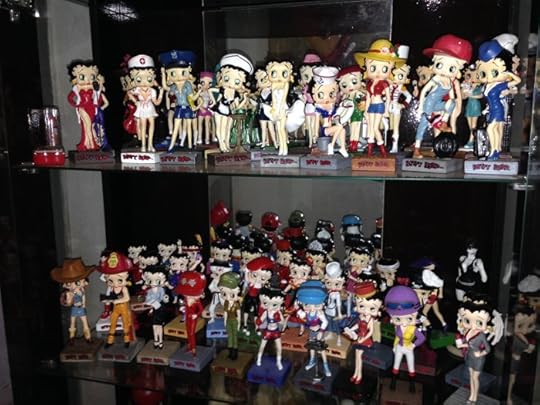
I slept in a room filled with clocks that tick-tacked incessantly – like several others on the hallways and walls all over the house. Nothing that couldn’t be sidestepped by wearing ear plugs – a sleeping trick I picked up from my time as a night shift journalist. The following day, after breakfast, Marquinhos comes from the street with another magazine that came with a Betty Boop doll – they completed 60! – and Lucchetti’s face lit up as an 85 year-old boy as he studied the figure in his hands.
Then it was time to take a look at Lucchetti’s personal files. He showed me even more bookcases, filled with carefully bounded manuscripts of radio plays, scripts, comics, beautiful drawings, collages, piles and piles of unpublished original text. I was stunned by the meticulousness. Every single text had a dated note about when and in what context it was written. An enormous tome in particular had the title, the date and the publisher’s name – including the address at the time of publication – of each and every one of his 1547 published books.
And, on the table, the faithful typewriter Lucchetti uses since the 1950’s. I got a bit emotional when I looked at that pile of metal and plastic. It was a testimony to the human mind’s ability to dream, to travel without leaving your chair, and few minds wondered as much as Lucchetti’s. Amid those piles of fictional work, it became clear to me that the one I had met personally was not Lucchetti, that flesh and bone were only a part of him. The real Lucchetti lives in a Castle of the Mind, and the only way of really meeting him is reading his books.
As I was in the bus back home to Sao Paulo I looked back and saw the late afternoon sky darkening from a yellowed red in the horizon to the black zenith, where the first stars appeared over Jardinópolis. And I thought that, somewhere down there, was Mr. Lucchetti, Marquinhos, the noisy clocks, the Betty Boops, the suspicious cats – some who did eventually venture into my lap during my visit – thousands of books and more than half a century of a life dedicated to writing. I am sure that there will be other visits, but I new then that first one had been special. I understood then that I will never forget the day I visited Mr. Lucchetti’s library.
O post The day I visited Mr. Lucchetti’s Library apareceu primeiro em Guilherme Solari.


November 6, 2015
The Borribles, by Michel de Larrabeiti (Book Review #2)
What if Peter Pan’s Lost Boys were street urchins?
The Borribles could be described as an urban version of Peter Pan’s Lost Boys. Borribles look like children, and can only be differentiated by their pointy years. All Borribles were children one day, but they turned into these curious creatures after running away to live on the streets of the big cities. If they are not captured, Borribles never age and live forever. They are barred by social taboos from having money, so they steal everything they need or desire.
This book from 1976 in an underground classic of English young adult literature. It never really achieved wide success, most likely because of the surprising amount of violence in a book directed to children and teens. There are passages with brutal beatings and several bloody deaths.
But the book is fun, there is no denying that. The Borribles have a tribal structure in their society, with different neighborhood leaded by informal representatives. In this first book, the Borribles get together after scouts capture a Rumble, anthropomorphic rats that the Borribles hate, and they decided to assemble an elite group to assassinate the rat leaders in the town of Rumbledom.
Writer Michael de Larrabeiti, who died in 2008, build his narrative in a fast and evolving way. The characters are interesting individually, but the group in the end form bonds of friendship that seemed to me similar to the fellowship of the ring of Lord of The Rings. The idea of the journey was equally epic, as the group faced several dangers until they get to Rumbledom for a final showdown. The book is centered on the actions rather than the descriptions, and that gives a welcome speed to the story.
There are two more books on the Borrible series: The Borribles Go For Broke and The Borribles: Across the Dark Metropolis.
O post The Borribles, by Michel de Larrabeiti (Book Review #2) apareceu primeiro em Guilherme Solari.
November 5, 2015
Fahrenheit 451, by Ray Bradbury – Book Review #1
“It was a pleasure to burn.”
In a future society, books are forbidden and “firemen” responsible for burning the remaining titles. That’s the job of one Guy Montag, but he begins to question his role as he gets in contact with a teenager who reads secretly. And he becomes himself a criminal reader of smuggled books.
The most surprising thing about Fahrenheit 451 is that it’s premise could, in the hands of a lesser writer, easily turn a condescending little lesson about the importance of reading books. But like any work of art that would be missed if it was burned, Fahrenheit 451 doesn’t want to give you answers. The book wants you to ask questions.
The main point for me is not that books are burned. That is only the most dramatic side of something bigger: that society allows them to be burned, and that no one is interested in reading in the first place. The only sources of distraction for the denizens of Fahrenheit 451 are sports or soap operas in televisions the size of entire walls. The speed of television does not allow you to stop and think, just swallow that entertainment loaf. From this insipid entertainment are born people who literally talk to the walls and a society unable to question.
Montag’s wife, Mildred is one example. She can’t talk about anything other than the soaps or what threatens her financial security. She is a cattle-person, described as having an invisible cataract behind her pupils, afraid of anything different, incapable of thinking or feeling without directions from the TV or authorities. Montag discovers how they can’t connect to one another because in the end they don’t know their own history. And without that knowledge you can’t even know who you are, or what you want.
Today is 2015, and the society described in Fahrenheit 451 seems even more palpable than when the book was written in 1953. The internet shortens our attention span towards shorter and simpler texts and videos. More than ever we more intelligent – we have access to an ocean of information literally at our finger tips – but we are not wise. We don’t know what to do with our information.
And we have no memory. The social media timelines dictate the discussion of the day, what funny video is trending, what news we should be disgusted with, what meme will be the big joke for a day or two before it is once again forgotten. Fahrenheit 451 even reminds us of the “mass society judgments” that lead to self-censorship.
I believe reading is fundamentally important for wisdom, more than any other art form. Reading is solitary work. It demands silence, and to let your ideas absorb the author’s, contest them, accept or adapt. Fahrenheit 451 says that you can’t make others think, but I believe it comes with a good recipe for wisdom: “Number one, like I said, is quality of information. Number two: time to digest. And number three: the right to conduct your actions based on what we learn from the two previous items.”
O post Fahrenheit 451, by Ray Bradbury – Book Review #1 apareceu primeiro em Guilherme Solari.
Ego trip time: The self-interview
The Smashwords site gives the option of posting a self-interview as a way of completing your author profile. I am sharing it here for fans, friends, family members and stalkers to enjoy.
Where did you grow up, and how did this influence your writing?
I grew up and live in Sao Paulo, Brazil, and I can describe it as a place I love to hate. It is an ugly, bloated, violent, expensive city of 17 Million people that has grown mad and unplanned. At the same time, it is one of the most multicultural cities in the world, we receive immigrants and influences from all over Brazil and the globe. It is also a place of found memories for me, where most of my friends and family are. I think this love/hate duality of modern life in a metropolis has become a part of me, and it leaks into my writing.
Your sci fi novella Immaculate Conception has American and European refugees running from war. How did that come up?
We live in times of great fear and uncertainty, and that fear most often than not is directed towards refugees. The best way to make someone feel empathy towards another is to put them in the other’s shoes, making the rich of today the refugees of tomorrow. I tried to do that in the Immaculate Conception, and, at the same time, write a fun, pulp, noir, cyberpunk story.
What attracts you in the cyberpunk genre?
I love how is at the same time a glimpse at the future and a look at problems we have for millennia, and probably will have forever. The moment a new promising technology appears, people begin thinking of ways to pervert it for personal gain. The technology in a cyberpunk book may become dated, like when we read now some classics of the genre from the 80’s, but the underlying human will of corrupting technology for personal gain is timeless.
You also wrote a book about a vigilante who watched every 80’s action movie ever made. How did that come up?
I grew up on movies like Escape From New York, The Terminator, RoboCop, Predator, First Blood, Aliens, etc, and wanted to do a homage to them. I imagined the owner of a run-down video shop who was repeatedly robbed and decided to fight crime. A “hero” whose only superpower was to watch every 80’s action movie ever made. The result was The Cascavel Chronicles, the perfect excuse to write a book full of references and cheesy one-liners from these films I love.
How do you get inspired to write?
I don’t believe in inspiration, really, but rather in work. This “waiting for the muse” thing is not for me. Don’t get me wrong, I love it when inspiration comes, but I try not to depend on it. I just sit down and crack my head on the keyboard until the text comes out.
How do you deal with writer’s block?
I don’t believe in writer’s block either, at least not in the way it is usually portrayed. Writer’s block for me happens when we are afraid to write something stupid, when our expectation of what we want to write doesn’t live up to the reality of it. The limitations of our style and intelligence are laid bare. We are not as good as we thought or wish we were. The antidote? Hammer into your head that you can only do your best and nothing more.
What advice would you give to aspiring writers?
Well, I do consider myself an aspiring writer myself, all I can do is replicate the advice of more experienced writers. The one I like the most is from Neil Gaiman. Basically it is: 1. Write. 2. Finish what you write. 3. Write again.
What is your writing process?
I am not a fast or prolific writer. Sometimes I have spent hours to squeeze only a few paragraphs from my mind. What I do is try and solve the problem by throwing time at it. I try, like J. K. Rowling said, to protect my writing time “like a lioness protects it’s cubs”. I usually walk a lot in my room as I “write”, then run to my computer when I have an idea. I do have the occasional inspiring moments when the story just flows through me, but that is the exception. Writing for me is usually a long, painful war of attrition.
What are you working on now?
I am working on the next book on the Cybersampa series, called The Murder of the Pro Gamer, my cyberpunk take on the world of eSports. Coming June 2016.
What are your five favorite books?
Out of the top of my head they are Don Quixote (Miguel de Cervantes), Watership Down (Richard Adams), The Forever War (Joe Haldeman), A Canticle for Leibowitz (Walter M. Miller, Jr.), Fahrenheit 451 (Ray Bradbury) and I am cheating here and including a sixth: High-Rise (J. G. Ballard).
O post Ego trip time: The self-interview apareceu primeiro em Guilherme Solari.
November 4, 2015
News: Immaculate Conception on Barnes & Noble
The Immaculate Conception cyberpunk novella keeps on expanding it’s tentacles on the internet. Now it is available ate the Barnes & Noble store, for the Nook reader. Be sure to check it out.
I have updated the book’s page with the link. As always, you can read online for free the first chapter, “Someone had Fun”.
O post News: Immaculate Conception on Barnes & Noble apareceu primeiro em Guilherme Solari.
November 3, 2015
News: Immaculate Conception Press Release
The Immaculate Conception press release has been – wait for it… – released! Check it below.
Also, the book will be free for this first week at Smashwords, using coupon code BQ88R. Be sure to grab it!
AMERICAN REFUGEES FLOOD INTO BRAZIL IN NEW CYBERPUNK NOVELLA
Brazilian writer imagines a sci fi and noir setting where the rich nations of today become the war-thorn refugees of tomorrow in the Immaculate Conception ebook.
Sao Paulo, November 3, 2015 – Brazilian writer and journalist Guilherme Solari is releasing his first title in English, Immaculate Conception, an ebook set in a future after a nuclear war ravaged the Northern Hemisphere. Millions of American and European refugees flood into Megasampa, the urban sprawl formed by the combined metropolitan areas of Sao Paulo and Rio de Janeiro. The refugees gather in the Novo Bronx ghetto, a place of vice, death and hardship, but also of regular people trying to rebuild their lives.
“We live in times of great fear and uncertainty, and that fear most often than not is directed towards refugees, a lot of them come from Haiti, Africa and the Middle East to my city of Sao Paulo,” said Solari. “The best way to make someone feel empathy towards another is to put them in the other’s shoes. I tried to do that in the Immaculate Conception, and, at the same time, write a fun, pulp, noir, cyberpunk story.”
In Immaculate Conception, the first book in the author’s Cybersampa series, unrest grows in Novo Bronx as a series of macabre murders strike fear into the heart of the populace. Killings that are attributed to a creature the locals are calling Bebê Diabo, the Devil Baby. The Proctech private police quells the rebellion for the time being, but the gruesome deaths are unlike anything they have ever encountered. Reluctantly, they call out of retirement a man called Cascavel, the only detective insane enough to solve an insane case.
The Cybersampa series is set in a possible future of disastrous climate change, constant cancer and radiation, overpopulation, mysticism, corporations running rampart, omnipresent social media, indigenous traditions rebirth, privatized government and religious zealotry. “What I like most about cyberpunk subgenre is that it is at the same time a glimpse at the future and a look at problems we have for millennia, and probably will have forever,” said Solari.
The Immaculate Conception ebook has a comic book inspired cover designed by Brazilian artist Bruno Dinelli. For a limited time (Tuesday, November 3 through Sunday, November 8) the Immaculate Conception ebook, normally priced at $1.99, will be available to the public as a free download at Smashwords at https://www.smashwords.com/books/view/589039 using coupon code BQ88R.
About the author – Guilherme Solari is a journalist and writer from Sao Paulo, Brazil. He has written about movies, literature and videogames for some of Brazil’s biggest news sites, like UOL and Folha de S.Paulo. Solari is the author of The Cascavel Chronicles, a prequel to Cybersampa and a love letter to old action movies. The book, released in Brazil in 2015, follows the owner of a run-down video shop that decides to fight crime. His only “superpower”? He watched every single 80’s action movie ever made. He is also the co-writer of the play Fogo, which was presented in Sao Paulo in 2010. His short story Egofobia was published in the Portuguese edition of The Thackery T. Lambshead Pocket Guide to Eccentric & Discredited Diseases, alongside the works of authors like Neil Gaiman, China Miéville and Alan Moore.
Contacts:
Email: guilherme.solari at gmail dot com
Site: guilhermesolari.com
Facebook: Facebook.com/guilhermesolaricom
Twitter: twitter.com/solari
O post News: Immaculate Conception Press Release apareceu primeiro em Guilherme Solari.
October 30, 2015
News: Immaculate Conception now on Smashwords!
My book Immaculate Conception (Cybersampa #1) is now available too on the Smashwords website.
As always, you can check out more about the book in it’s page, or read the first chapter online.
Buy the book on Smashwords.
O post News: Immaculate Conception now on Smashwords! apareceu primeiro em Guilherme Solari.
October 29, 2015
News: Immaculate Conception Available!
Hello World!
I am thrilled to announce that my first book in English is now available, Immaculate Conception. be sure to grab it for your Kindle. You can also read the first chapter here. To know more about me, well, check the about page. A brief synopsis:
The Immaculate Conception novella is the initial story in the Cybersampa series, set in 22nd-century Sao Paulo. Millions of American and European refugees run from the destruction of the war-torn Northern hemisphere and flood into Megasampa, the urban sprawl formed when the metropolitan areas of Sao Paulo and Rio de Janeiro joined in the mid-21st century.
They gather in the Novo Bronx ghetto, a place of vice, death and hardship, but also of refugees just trying to rebuild their lives. Novo Bronx was never a quiet place by a long shot, but now unrest grows as a series of macabre murders strike fear into the heart of the populace. Murders attributed to a creature the locals are calling Bebê Diabo, the Devil Baby.
The Proctech private police quells the rebellion for the time being, but the gruesome deaths are unlike anything they have ever encountered. Reluctantly, they call out of retirement the only detective insane enough to solve an insane case.
A detective called Cascavel.
The cover is by Brazilian illustrator and designer Bruno Dinelli.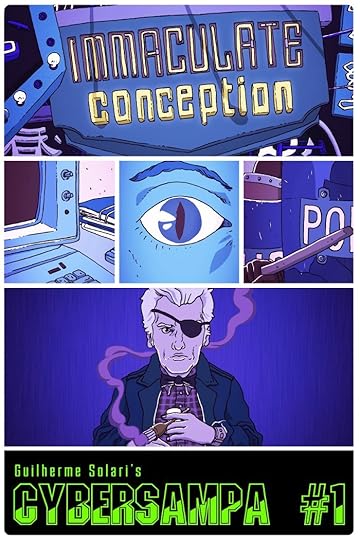
O post News: Immaculate Conception Available! apareceu primeiro em Guilherme Solari.