C. Litka's Blog, page 72
June 7, 2015
Writing A Summer in Amber
I think my initial idea for a story like A Summer in Amber came from watching the first two seasons of Downton Abbey on Netflix. I seem to remember thinking that I'd like to do a story like that – but with more adventure rather soap opera elements. I quickly decided not to write it as a period piece. First, because I always wanted to write science fiction and by placing the story in the future would make it, more or less, a science fiction story. And looking ahead, genre fiction is generally more popular than literature, so being able to list it as science fiction seemed the way to go. And secondly if I wrote it as a period piece I'd need to research the period to make it authentic and for that I'd have to rely on the work of others, at the risk of being less than original. And no doubt, the story has been told many times as well in the period and after it. So by setting the story in a future I could include the elements of the past I cared to include to give it the old-fashioned atmosphere I wanted, without the need for historical accuracy. Basically it allowed me to cheat.
I'd read an article about the potential threat solar storms pose to societies dependent on an electrical grid around that time and decided to use that idea to knock technological civilization back the several hundred years I need to give the future the Edwardian feel I was looking for. I did want a steampunk air to the story. The imposing of late Victorian technology on the 21st resulted in a different feel than imposing the 21st on the 19th century. A sort of mirror image. And I had no intention of including zombies which seem to somehow become a standard steampunk feature, nor airship pirates or mechanical men. Still, I hoped that the eclectic mix of old and new technologies would give the future a rather pastoral air to it that I rather doubt it will ever have again. Though, I should add that I know enough about the past to know that you'd not want to live it the way it was.
I placed the story largely in Scotland because of my fondness for the Scottish stories of John Buchan, like the Thirty-nine Steps, John Macnab and Huntingtower series, and Compton Mackenzie's Scottish stories like, Monarch of the Glen, Keeping the Home Guard Turning, Whiskey Galore, and Hunting the Fairies. Plus the 1958 version of the 39 Steps with Kenneth More which is, for some reason, is one of my favorite movies – perhaps its on location filming that gives it the nostalgic look and feeling I wished to capture in my story. I spend several weeks traveling about Scotland back in the early 70's via a British Rail pass so I had a little sense of the country from almost half a century ago. This story is based, however, on my travels about Scotland via Google street view. The only way I care to travel these days. And as long as I'm mentioning inspirations, I should also add that E C Segar's Popeye comic strip story from 1930 called the Mystery of Brownstone Hill, served as an inspiration for one feature of this story.
I started writing this story some three years ago under various titles, including, The Tick Tock Gate, and the Rhymer's Gate. The main thrust of the plot, and the semi-diary approach remained the constant throughout the process, though the nature of the central mystery, and the type of story changed. I don't think I ever seriously considered writing it as a fantasy, but I certainly tried to write it as a mystery or an adventure-thriller. The story is set up by Lord Learmonte insistence that the manuscript transcribed by an outsider in Scotland because of his fear of industrial spies within his organization. In the original version, I had those spies and their activities in Scotland be a driving force in the story. I had envisioned attempts to steal the secret, with perhaps kidnappings and chases across the Scottish countryside – in short, much more like a 39 Steps type of story. I could never quite get to work, however. My writing style was just too slow paced, and I really like to have actions make sense, and those plots seemed to include too unlikely or unbelievable actions for my tastes. Guess I'm just not that type of writer. So last summer, unwilling to give up on the half-finished story, I decided just to write it as "a novel". A nice, generic novel. Sandy Say would just relate what happened during his summer in the highlands, both the everyday and the extraordinary events, as he slowly fell into the "magic" of those days and youth. Using this "what I did over summer vacation" approach, I was able to finish the story, and, with several revisions since then, losing something like 9,000 words in the process, get it to the point were I felt it was good enough to publish and bering the long project to it's end, in a sigh of steam, the grinding of the brakes, and clank of carriages.


May 14, 2015
Version 1.5 is now available
A new version, "ver. 1.5" of A Summer in Amber should be available soon at your favorite ebook seller. It features various bug fixes and reading enhancements, or, since I'm not a multi-million dollar software company, some typos (hopefully all, though I rather doubt it) have been fixed and I while I was tracking them down, I reworked some passages to make for smoother reading as well. If you haven't started reading the story yet, or just started, make sure you download this newest version for the reading experience.
The nice thing about self-publishing is that I can improve my product on an ongoing basis. I regret, however, the necessity of that, but that's the way things are for this piece. This is my first self-published piece and it's been a learning experience. One of the things I've learned – I hope – is to do all my revisions before it's proof-read. The proof-read version of this piece had almost 9,000 more words in it, so you can imagine how a revision of that scope created opportunities for errors to creep back in. And creep in they do, as I seem to be a rather careless typist. And even though I try to proof-read my work, I'm afraid I'm a terrible proof-reader. I believe I read what I expect to read, skimming over words rather than reading what's actually written, word by word. And with my own work, with the words still echoing in my head, proof-reading seems to amount to little more than wishful thinking.
I am, however, committed to making A Summer in Amber error free, so feel free to point out any errors you run across. I'll issue a new version as it's warranted. Truth is, I can't bear to look at it again, so it's up to you.
April 20, 2015
A Summer in Amber
Thanks for looking in. I'll use this blog to supply a bit of background to the story and a place to keep in touch with any reader who might find their way here. You are more than welcome to leave comments below. I will answer any questions you might have about the story or anything else.
You can download A Summer in Amber for FREE here:
Smashwords
https://www.smashwords.com/books/view/537938
Barnes and Noble:
http://www.barnesandnoble.com/w/a-summer-in-amber-c-litka/1121817659?ean=2940151888936
iBooks: Is now available in the iBook app
Kobo: https://store.kobobooks.com/en-US/ebook/a-summer-in-amber
Kindle Edition (currently free – US Store only): http://www.amazon.com/dp/B00WV8NXKS
(A Mobi version which can be side loaded on to your kindle is available from Smashwords.com for free if the American Amazon store is not available to you.)
A Word on the Price (FREE) I wrote this story for fun. It was never meant to be a commercial product. I enjoyed day dreaming up the story (and all the versions of it along the way) and I enjoyed all work, over the course of several years, needed to put those day dreams into words. Publishing and sharing the book is simply a matter of seeing a project finished. I hope you enjoy it.
The Map
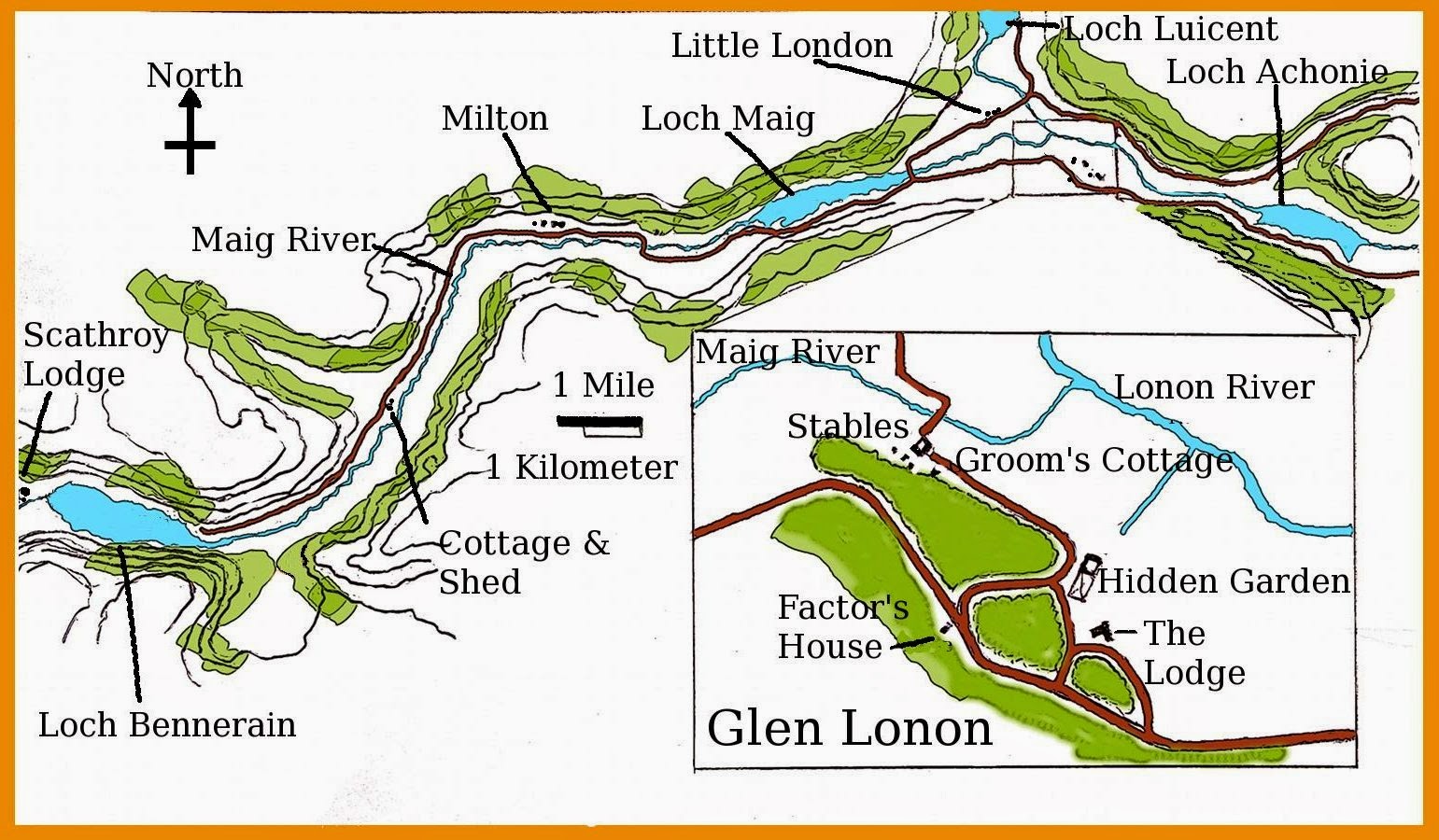
Below is the map of the fictional Glen Lonon and Maig Glen to help envision what's going on where. You should be able to click on it and download and print it out it if you want. With some detective work you should be able to track down the actual "Glen Lonon and Maig Glen" on google maps and with "pageview" view the glens from the main road. It might look a little different, after the neglect of the Storm years – more over grown and wilder with most of the cottages along the way abandoned. You can download and print out the map if you care to.
The Storms Years
The Storm Years are the defining historical incident of the story. They created the world the story is set in. The first of the solar storms arrived 36 years prior to the story. I didn't go into too much about just what are solar storms, so below are two articles that go into the phenomena in greater depth
http://earthsky.org/space/are-solar-storms-dangerous-to-us
http://books.nap.edu/openbook.php?record_id=12507&page=1
The short version is that the sun can send out something called a "coronal mass", made up of huge quantities of matter and radiation, which if it should strike the earth causes a geomagnetic storm which affects the earth's magnetic field which in turn can cause power surges in long electrical power lines, buried pipe lines and such. If strong enough, these power surges can knock whole power grids off line. In 1989 a geomagnetic storm left Quebec Province without power for 9 hours. The most powerful geomagnetic storm is known as the "Carrington event" which happened in 1859. Aurorae were seen around the world, bright enough in some locations to read the newspaper by. In addition, telegraph systems failed as the wires collected the geomagnetic energy, causing sparks to fly from pylons, some reported fires, and some operators could send signals with the batteries disconnected. If it happened today, it's estimated that it could cost from .6 to 2.6 Trillion dollars of damage in the United States alone. One such storm missed the earth in 2012 by not all that much.
For the purpose of the story, the sun grows very active, with massive coronal mass events and the resulting geomagnetic storms which result in a series of these storms that have continued since the first ones which initially caused the hi-tech countries of the world to slide into chaos.
These first storms destroyed the power grids of the world. They were also strong enough that circuit boards in many computers, cell phones and other electronics collected enough energy to fry delicate components, rendering them useless. I also envision these storms disrupting radio, TV and cell phone transmissions, making them unreliable services. Satellites, for GPS, TV and communications, weather, etc have also been put out of action by these storms.
The social order broke down as the mechanism of modern society became unusable, for there was simply no place left unaffected which could offer relief to the affected areas.
For the purpose of the story, I imagined that the resulting chaos gradually stabilized in England over the course of five years during which the population may have fallen by 25% due to starvation, illness and exposure to the elements, as well as a bit of violence. Other parts of the world may have faired better – if they weren't as "developed" while still others fared worse, especially areas that did not have a 19th century or earlier infrastructure and social institutions in place to fall back on.
I pictured Europe and the British Isles (and much of Asia) re-converting their housing to an 19th century standard – re-opening chimneys, opening coal mines and growing crops close to the much less populated cities could be fed. I also pictured society becoming much more local, falling back on 19th or 18th century ways, with the landed gentry taking the lead in preserving order, food and shelter. By the time of the story, England had emerged from this fall back position and now was at a point of equilibrium – using both modern technology, like solar panels to power house, and 19th century technology like steam engines and horse carts, and locally farmed food. Radios, TVs and cell phones are still unable to operate reliably, so all this data is carried on glass fiber land lines over great distances and into houses and offices were it can be accessed by wi-fi. Wi-fi hot spots are like the old phone booths, allowing you to jump on the fiber optic lines to make calls, view TV or the internet when you're within wi-fi distance.
In a way this is a mirror image of a steampunk story, in that instead of imagining modern inventions in the Victorian era, I have Victorian life superimposed on the 21st century. And in a way it's just a nostalgic trip back to my dimly remembered youth, which while not in England, has some rural memories where that old fashioned life still lingered. To get a feel for life in England after the Storm, you can go hark back to the first half of the last century, and I've included some links to short movies that document that era below:
First is the link to the the complete collection of these old time English film series:
http://film.britishcouncil.org/british-council-film-collection
The second describes small time life, which in post-Storm England is once more is a very common way of life.
http://film.britishcouncil.org/country-town
The third link is to a film on a market town, which give one the idea of the markets described in this book http://film.britishcouncil.org/market-town
Watsons
I use the term "watson" to describe what could be considered a super-cell phone. A single multi-purpose device that is a phone, a computer, a camera, and micro-projector, and what ever else may be added to it by adding "pages" like adding pages to a ring binder. It is every digital devise you may have, carried in your pocket. It is rugged, water proof and shielded from the effects of the solar storms. (From a song by Angus and Julia Stone called "Mango Tree" in which Angus seems to sing "Call up your watson" which I seemed to translate as "Call (you) up on your watson," the watson being slang for a cell phone. I don't believe that's the actual lyrics.)
Tra – traditional style of dress.
I think I covered that pretty clearly in the text. The storms have disrupted the atmosphere and it now allows more UV radiation to reach the surface. People have to cover their skin in order to avoid sun burn and other, longer range effects. Many people have adopted pre-technology fashions as a way of rejecting the modern world that made them so vulnerable to the solar storms. Below is a link to some very early movies that show people at the turn of the century wearing this type of clothing. They also show the horse drawn wagons and carriages that are common in the post-Storm England & Scotland of the story.
https://www.youtube.com/watch?v=lQV1_B63LTM